Saved Bookmarks
This section includes 7 InterviewSolutions, each offering curated multiple-choice questions to sharpen your Current Affairs knowledge and support exam preparation. Choose a topic below to get started.
| 1. |
Is the definition given below for ionisation enthalphy correct ? Ionisation enthalphy is defined as the energy required to remove the most loosely bound electron from the valence shell of an atom |
| Answer» Solution :No. It is not CORRECT. The accurate and absolute definition is as follows: Ionization ENERGY is defined as the minimum AMOUNT of energy required to remove the most loosely bound electron from the valence SHELL of the isolated NEUTRAL gaseous atom in its ground state. | |
| 2. |
Is the decomposition of magnesite a redox reaction ? |
|
Answer» Solution :Magnesite decomposes on heating to give MAGNESIA and CARBON DIOXIDE. `MgCO_(3) to MgO+CO_(2)` Here there is no change in oxidation numbers. This deomposition is not a redox reaction. |
|
| 3. |
Is the bond energy of all thefour C-H bonds in CH_(4) molecule equal? If not then why? How is the C-H bond energythen reported ? |
| Answer» SOLUTION :No because after breaking of C-H BONDS one by one, the electronic environments CHANGE. The reported value is the average of the bond DISSOCIATION energies of the four C-H bonds. | |
| 4. |
Is sodium lime test satisfactory for the detection of nitrogen ? |
| Answer» SOLUTION :No, it is not. | |
| 5. |
Is smog formed only in winter or only in summer or in both ? Explain |
| Answer» Solution :Classical smog is formed in winter when fog of SULPHURIC acid droplets condenses on the SURFACE of particulars. PHOTOCHEMICAL smog is formed in summer during afternoon when there is bright sunlight so that photochemical reaction can take place between `NO_2` and HYDROCARBONS present in the air. | |
| 6. |
Which of the following ions are more responsible for transmission of nerve signal? |
|
Answer» Lithium |
|
| 7. |
Is Pb^(4+) a reducing agent or an oxidising agent? Why? |
| Answer» Solution :`Pb^(4+)` is a strong oxidising agent. `Pb^(2+)` is more STABLE than `Pb^(2+)` due to inert pair effect. HENCE Pb+ TRIES to be converted to `Pb^(4+)` by gaining ELECTRONS. In other words `Pb^(2+)` is reduced easily. So, it is a strong oxidising agent. | |
| 8. |
…………..is obtained when yellow phosphorus is heated with an aqueous solution of NaOH in an inert atmosphere. |
|
Answer» |
|
| 9. |
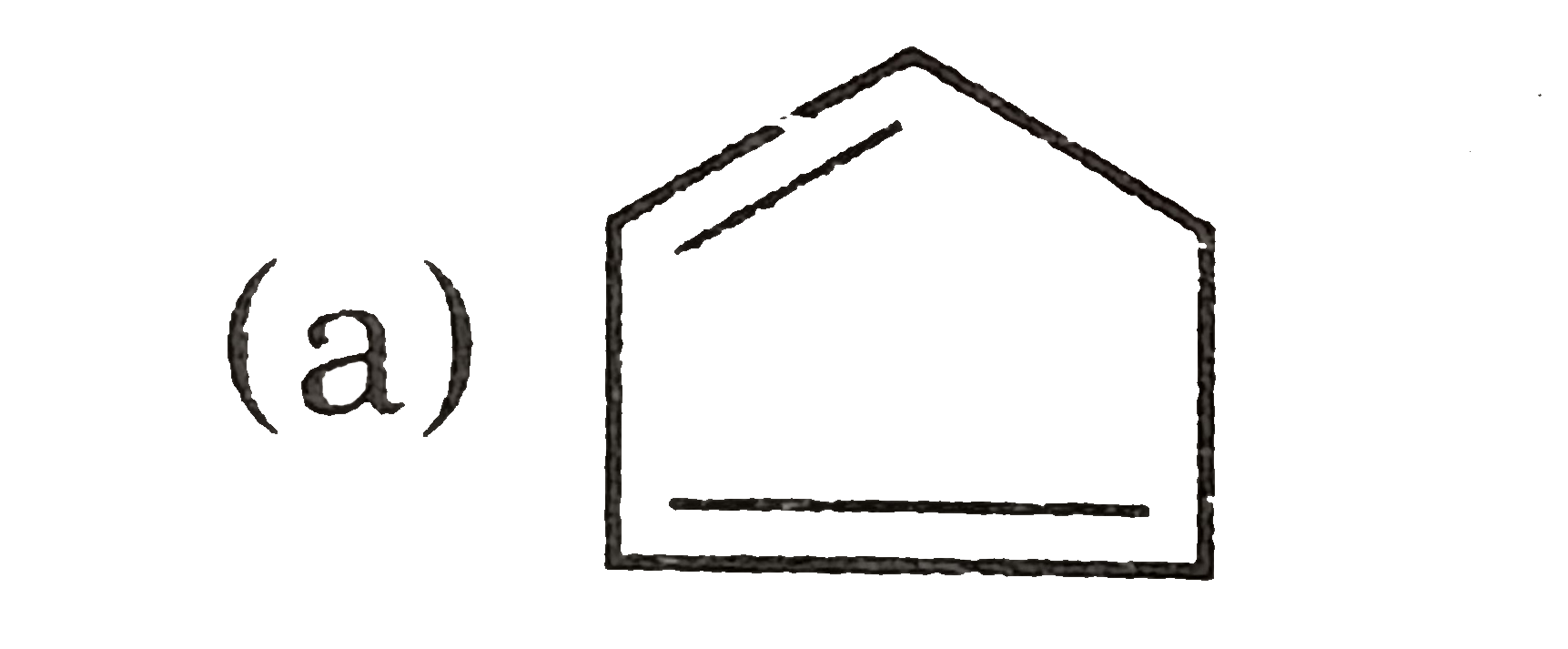
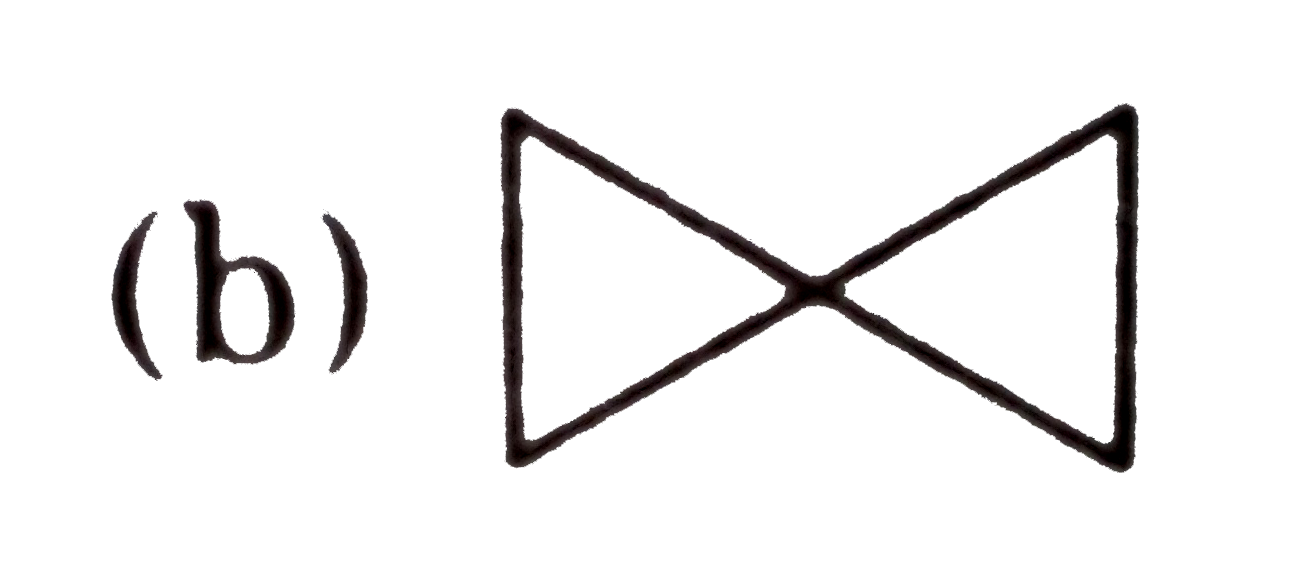
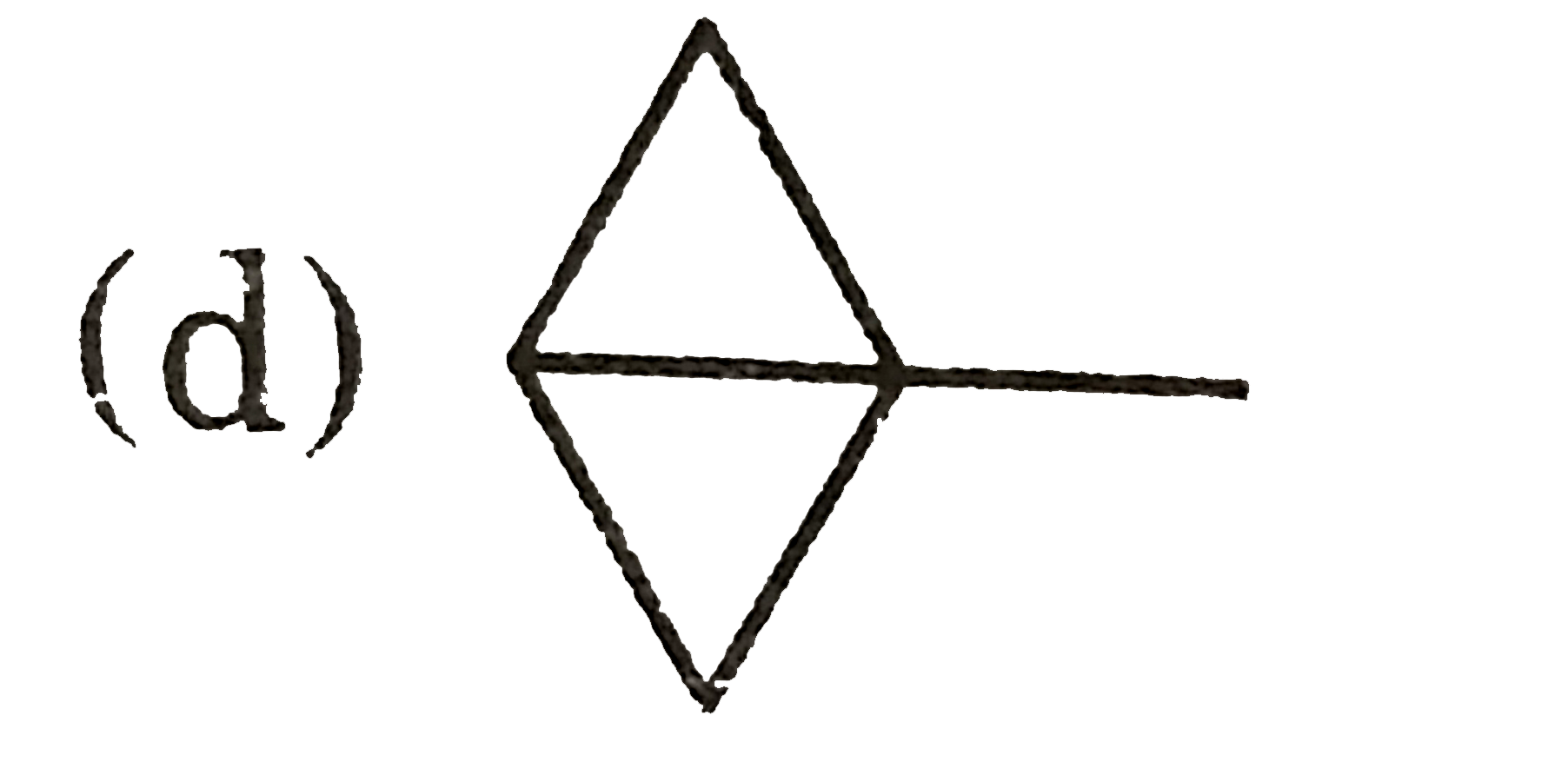
is not isomer of : |
|
Answer»
|
|
| 10. |
Is Neyon molecule Ne_(2) possible ? Why ? |
| Answer» SOLUTION :`Ne_(2)` MOLECULE is not POSSIBLE because the bond order is zero so it is UNSTABLE. | |
| 11. |
Is moist air heavier or lighter than dry air and why ? |
|
Answer» SOLUTION :Dry air MAINLY contains `O_(2)` and `N_(2)` in the ratio of nearly `1:4`by VOLUME. Mol. Mass of dry air `=x_(o_(2))M_(o_(2))+x_(N_(2))M_(o_(2)).M_(o_(2))=32,M_(N_(2))=32,M_(N_(2))=28.As M_(H_(2)O)=18` which is less than `M_(o_(2))` or `M_(N_(2))`, molar mass of moist air will be less and hence will have less DENSITY and will be lighter. |
|
| 13. |
……is IUPAC and …..common name of C_(6)H_(5)Ome respectively |
| Answer» SOLUTION :Methoxibenzen, ANISOLE | |
| 14. |
Is it sate to stir 1 M AgNO_3 solution with a copper spoon ? Given : E_(Ag^(+)|Ag)^@=0.80V,E_(Cu^(2+)|Cu)^@=0.34V |
| Answer» Solution :No , copper spoon will dissolve as `Cu^(2+)` IONS because copper has more TENDENCY to GET oxidised than silver. | |
| 15. |
Is it safe to stir 1 M AgNO_(3) solution with a copper spoon ? Given E_(Ag^(+),Ag)^(@)=0.80 "volt and" E_(Cu,Cu^(2+))^(@)=-0.34 volt explain |
|
Answer» `Cu+2 Ag^(+)rarrCu^(2+)+2Ag` Hence 1 M `AgNo_(3)` soluton cannot be STIRRED with a copper spoon |
|
| 16. |
Is it possible to store : (i) copper suplhate solution in a zonc vessel ? (ii) Copper suphate solution in silver vessel ? (iii) Copper suphate solutionin a gold vessel ? Given : E_(Cu^(2+),Cu)^(@)=+0.34V,E_(Ag^(+),Ag)^(@)=+0.80V "and" E_(Au^(3+),Au)^(@)=+1.50V |
|
Answer» Solution :(i) We cannot `SuSO_(4)` soluton in a zinc vessel if the following REDOX reaction occurs `Zn+CuSO_(4)rarrZnSO_(4)+Cu` or `Zn+Cu^(2+)rarrZn^(2+)+Cu` By convention the cell may be represented as `Zn|Zn^(2+)||Cu^(2+)|Cu` By convention the cell of the above redox reaction may be represented as `Ag|Ag^(+)||Cu^(2+)|Cu` and `E_(cell)^(@)=E_(Cu^(2+),Cu)^(@)-E_(Ag^(+),Ag)^(@)=0.34-0.80 =-0.56 V` since the EMF of the cell is -ve therefore `CuSO_(4)` does not react with SILVER in other wods `CuSO_(4)` solution can be stroed in asilver vessel (iii) we cannot stroe `CuSO_(4)` solution in a GOLD vessel if the following redox reaction occurs `2 Au+3Cu^(2+) rarr2 Au^(3+)+3Cu` The cell corresponding to the above redox reaction may be represented as `Au|Au^(3+)||Cu^(2)|Cu` and `E_(Cu^(2+),Cu)^(@)-E_(Au^(3+),Au)^(@)=0.34 -1.50 =-1.26 V` since the EMF of the above cell reaction is -ve therefore `CuSO_(4)` solution does notreact with gold in other words `CuSO_(4)` SOLUTOIN can be stored ina gold vessel |
|
| 17. |
Is it possible to store (i) Copper sulphate in a zinc vessel ? (ii) Copper sulphae in a silver vessel ? (iii) Copper sulphate in a nickel vessel ? (iv) Copper sulphate in a gold vessel |
|
Answer» Solution :(i) From Table 18.1 , it clear that electrode potential of COPPER `(Cu^(2+)|Cu=0.34)` is more than zinc `(Zn^(2+)|Zn=-0.76V)` , THEREFORE , it will be readily reduced to copper and zinc will be oxidized . As a result , zinc VESSEL will DISSOLVE . (ii) It is possible to store copper SULPHATE in a silver vessel because silver vessel will not dissolve `(Ag^(+)|Ag=0.80V)` . (iii) It is not possible to store copper sulphate in nickel vessel because Ni will dissolve (`Ni^(2+)|Ni=-0.13V)` (iv) It is possible to store copper sulphate in gold vessel `(Au^(3+)|Au=1.61V)`. |
|
| 18. |
Is it possible to remove completely by boiling the temporary hardness due to Mg(HCO_(3))_(2) ? |
|
Answer» SOLUTION :Temporary hardness of `H_(2)O` due to `Mg(HCO_(3))_(2)` can be completely REMOVED by boiling because soluble `Mg(HCO_(3))_(2)` is converted into INSOLUBLE `MgCO_(3)` which can be removed by filtration `underset("(Soluble)")(Mg(HCO_(3))_(2)) OVERSET("BOIL")to underset("(Insoluble)")(MgCO_(3) darr) + CO_(2) uarr + H_(2)O` |
|
| 19. |
Is it possibleto prepare methane by kolbe electrolytic method |
| Answer» SOLUTION :Kolbeelectrolyticmethodis suitablefor THEPREPARATIONOF symmetricalalkanesthat isalkanescontainingevennumberof carbonatomsMethanehas onlyone carbonhenceitcannotdownthe combustionreactionof propanewhose`Delta H^(@)= 2220 KJ` | |
| 20. |
Is it possible to isolate pure staggered ethane or pure eclipsed ethane at room temperature? Explain . |
| Answer» Solution :The energy differences between staggered and eclipsed froms of ETHANE is just `12.55 "kJ mol"^(-1)` which is easily met by collisions of the molecules at ROOM TEMPERATURE. Therefore, it is not POSSIBLE to isolate either PURE staggered or pure eclipsed ethane at room temperature. | |
| 22. |
Is it possible to calculate the electronegativity of an element if its atomic radius is known? |
|
Answer» |
|
| 23. |
Is ionic bond directional ? |
|
Answer» |
|
| 24. |
Is hydrogen electropositive? |
|
Answer» Solution :Hydrogen has electropositivity. It is EVIDENCED by the FORMATION of proton. `H RARR e^- + H^+` Howere hydrogen is not a METAL . It is a common non-metal. |
|
| 25. |
…….is formed by heterolytic fission |
| Answer» Answer :D | |
| 26. |
Is equilibrium establish in open vessel between vapour and water ? Why ? |
| Answer» Solution :No, as in OPEN VESSEL REACTION continue in ONE DIRECTION only. | |
| 27. |
Is demineralised or distilled water useful for drinking purposes ? If not, how can it be made useful ? |
|
Answer» Solution :Permanent hardness is due to the presence of soluble salts of magnesium and calcium in the form of chlorides and sulphates in water. Permanent hardness is not removed by boiling. It can be removed by the FOLLOWING methods. (i) Treatment with washing soda (sodium carbonate) : Washing soda reacts with soluble calcium and magnesium chlorides and sulphates in hard water to form insoluble carbonates. `MCl_2 + Na_2CO_3 to MCO_3 darr + 2NaCl (M=Mg,Ca)` `MSO_4 + Na_2CO_3 to MCO_3 darr + Na_2SO_4` (ii) Calgon.s method: Sodium hexametaphosphate `(Na_6P_6O_18)` , commercially called .calgon., when added to hard water, the following reactions take place. `Na_6P_6O_18 to 2Na^(+)+ Na_4 P_6O_18^(2-)` `M^(2+) + Na_4P_6O_18^(2-) to [Na_2MP_6O_18]^(2-) + 2Na^(+)` (M=Mg, Ca) The complex anion keeps the `Mg^(2+)` and `Ca^(2+)` ions in solution. (iii) Ion-exchange method : This method is also called zeolite/permutit process. Hydrated sodium aluminium silicate is zeolite/permutit. For the sake of simplicity, sodium aluminium silicate `(NaAlSiO_2)` can be written as NaZ. When this is added in hard water, exchange reactions take place. `2NaZ_((s)) + M_((aq))^(2+) to MZ_(2+(aq)) to NZ_(2(s)) + 2Na_((aq))^(+)` (M=Mg, Ca) Permutit/zeolite is said to be exhausted when all the sodium in it is used up. It is regenerated for further use by treating with an aqueous sodium chloride solution. `MZ_(2(s)) + 2NaCl_((aq)) to 2NaZ_((s)) + MCl_(2(aq))` (iv) Synthetic resins method : Nowadays hard water is softened by using synthetic cation exchangers. This method is more efficient than zeolite process. Cation exchange resins It contain large organic molecule with -`SO_3H` group and are water insoluble. Ion exchange resin `(RSO_3H)` is changed to RNa by treating it with NaCl. The resin exchanges `Na^+` ions with `Ca^(2+)` and `Mg^(2+)` ions present in hard water to make the water soft. Here R is resin anion. `2RNa_((s))+ M_((aq))^(2+) to R_2M_((s)) + 2Na_((aq))^(+)` The resin can be regenerated by adding aqueous NaCl solution. Pure de-mineralised (de-ionized) water free from all soluble mineral salts is obtained by passing water successively through a cation exchange in the `H^+` form) and an anion exchange in the `OH^-` form) resins. `2RH_((s)) + M_((aq))^(2+) hArr MR_(2(s)) + 2H_((aq))^(+)` In this cation exchange process, H+ exchanges for `Na^(+), Ca^(2+), Mg^(2+)` and other CATIONS present in water. This process results in proton release and thus makes the water acidic. Anion exchange process : `RNH_(2(s)) + H_2O_((l)) hArr RNH_(3)^(+) . OH_((s))^(-)` `RNH_3^(+). OH_((s))^(-) + X_((aq))^(+) hArr RNH_(3)^(+) . X_((s))^(-) + OH_((aq))^(+)` `OH^-` exchanges for anions LIKE `Cl^(-), HCO_3^(-), SO_4^(2-)`etc. present in water. `OH^-` ions, thus, liberated neutralise the `H^+` ions set free in the cation exchange. `H_((aq))^(+) + OH_((aq))^(-) to H_2O_((l))` The exhausted cation and anion exchange resin beds are regenerated by treatment with dilute acid and alkali solutions respectively. |
|
| 28. |
Is demineralised or distilled water useful for drinking purposes? If not, how can it be made useful? |
| Answer» Solution :No. Demineralised(or distilled) WATER dose not CONTAIN essential mminerals. It can be MADE USEFUL by adding required amounts of usefulminerails. | |
| 32. |
Is CaF_(2) linear or bent or neither of the two? Justify . |
| Answer» Solution :`CaF_(2)`is neither LINEAR nor-bent MOLECULAR because it is IONIC compound and ionic bond is non-directional. | |
| 34. |
Is boricacid a protic acid ? Explain . |
Answer» Solution :It is a not a protic acid since it does not ionize in `H_(2)O` to give a PROTON.  Insteadbecause of the small size ofboron andpresence of only six electrons inits valence shell, `B(OH)_(3)` accepts a lone pair of electrons from the oxygen atom of the `H_(2)O` MOLECULE to form a hydratedspecies.  The `+ve` charge on the O-atom in turn, pulls the `sigma`-electrons of the O-H bonds towards itself thereby facilitating the release of a proton. As a result , `B(OH)_(3)` acts as a weak MONOBASIC Lewis acid and thus reactswith `NAOH`SOLUTIONTO formsodiummetaborate. `B(OH)_(3) + NaOH rarr Na^(+)[B(OH)_(4)]^(-)` or `underset(" Sod. metaborate")(Na^(+)BO_(2)^(-))+2H_(2)O` |
|
| 35. |
Iron pyrites is generally roasted to obtain Fe_(3)O_(4) first. Fe-(3)O_(4) can be concentrated by |
|
Answer» GRAVITY SEPERATION |
|
| 36. |
Iron pieces are attracted towards a magnet but zinc pieces are no. Why ? |
Answer» Solution :Iron contains unpaired electrons  and hence is paramagnetic whereas ZINC has no unpaired electron `(._(30)ZN = [AR]^(18) 3d^(10) 4S^(2))` and hence is diamagnetic. It is rather repelled by the magnet. and hence is paramagnetic whereas ZINC has no unpaired electron `(._(30)ZN = [AR]^(18) 3d^(10) 4S^(2))` and hence is diamagnetic. It is rather repelled by the magnet.
|
|
| 37. |
Iron (III) thiocyanate [Fe(SCN)_3] dissolves readily in water to give a red solution. The red color of the solution deepens when________is added. (i) oxalic acid (H_2C_2O_4) (ii) sodium thiocyanate (NaSCN) (iii) iron (III) nitrate [Fe(NO_3)_3] (iv) mercuric chloride (HgCl_2) |
|
Answer» (i), (ii), (iii) `[Fe(SCN)_3]rarr FeSCN^(2+)+2SCN^(-)` The equilibrium between undissociated `FeSCN^(2+)` and the `Fe^(3+)` and `SCN^(-)` ions is given by `{:(FeSCN^(2+)(AQ.),hArr,Fe^(3+)(aq.),+,SCN^(-)(aq.)),(Red,,"Pale-yellow",,"Colorless"):}` When we add some SODIUM thiocyanate `(NaSCN)` to the solution, the STRESS applied to the equilibrium system is an increase in the concentration of `SCN^(-)` (form the dissociation of `NaSCN`).To offest this stress, some `Fe^(3+)` ions react with the added `SCN^(-)` ions, and the equilibrium shifts form right to left. `FeSCN^(2+)(aq.)]larr Fe^(3+)(aq.)+SCN^(-)(aq.)` CONSEQUENTLY, the red colour of the solution deepens. Simillarly, if we add iron (III) nitrate `[Fe(NO_(3))_(3)]` to the original solution, the red color would also deepen because the additional `Fe^(3+)` ions `["form Fe(NO_(3))_(3)]` will shift the equilibrium form right to left. Note that both `Na^(+)` and `NO_(3)^(-)` are colorless spectator ions.When we add some oxialic acid `(H_(2)C_(2)O_(4))` to the original solultion, it ionizes in water to form the cxalate ion, `C_(2)O_(4)^(2-)`, which binds strongly to the `Fe^(3+)` ions. The formation of the stable yellow complex ion `Fe(C_(2)O_(4))_(3)^(3-)` removes free dissociate (to relieve the concentration stress of removed `Fe^(3+)` ions) to replenish the `Fe^(3+)` ions and the equilibrium shifts form left to right. `FeSCN^(2+)(aq.)]rarr Fe^(3+)(aq.)+SCN^(-)(aq.)` The intensity of red color decreases (due to decrease of concentration of `FeCN^(2+)`) and the red solultion turns yellow due to the FOMATION of `Fe(C_(2)O_(4))_(3)^(3-)` ion.The addition of `HgCI_(2)` (aq.) also decreases red solor because the `Hg^(2+)` ions react with `SCN^(-)` ions to form stable complex ion `[Hg(SCN)_(4)]^(2-)`. The removal of free `SCN^(-)` (aq.) shifts the equilibrium form left to right to replenish `SCN^(-)` ions.This experiment demostrates that at equilibrium, all reactants and products are present in the reacting system. Second, increasing the equilibrium to the products `(Fe^(3+)` or `SCN^(-))` shift the equilibrium to the left, and decreasing the concentration of the products `(Fe^(3+) or SCN^(-))` shift the equilibrium to the right. These results are just as predicted by Le Chatelier's principle. Note that oxialic acid is sometimes used to remive bathtub ring that consists of rust or `Fe_(2)O_(3)`. |
|
| 38. |
Iron (II) oxide has a cubic structure and each unit cell has side 5 Å. If the density of the oxide is 4 g cm^(-3), calculate the number of Fe^(2+) and O^(2-) ions present in each unit cell (Molar mass of FeO=72 g mol^(-1), N_A=6.02xx10^23 "mol"^(-1)) |
|
Answer» |
|
| 39. |
Iron (II) oxide has a cubic structure and each unit cell has side 5 Å. If the density of the oxide is 4 g cm^(-3),the number of oxide ions present in each unit cell is (Molar mass of FeO =72 "g mol"^(-1) , N_A=6.02xx10^23 mol^(-1)) |
|
Answer» `=((4 G CM^(-3))(5xx10^(-8)cm)^3(6.02xx10^23 MOL^(-1)))/(72 g mol^(-1))approx 4` Thus, there are 4 formula units (FeO) per unit cell.Hence, `O^(2-)` ions =4 |
|
| 40. |
Iron (II)oxide has a cubic structure and each unit cell has side 5 Å . If the density of theoxide is 4 gcm^(-3)Calculate the number ofFe^(2+) and O^(2+)ions presnent in each unit cell ( Molar mass ofFeO= 72" g mol"^(-1) N_(A) = 6.02 xx 10^(23)"mol"^(-1) ) |
|
Answer» |
|
| 41. |
Iron (II) oxide has a cubic structure and each unit cell has side 5Å. If the density of the oxide is 4 g cm^(-3), the number of oxide ions present in each unit cell is ("Molar mass of " FeO = 72 g " mol "^(-1),N_(A) = 6.02times10^(23)"mol^(-1)) |
|
Answer» `=((4" g "CM^(-3))(5times10^(-8))(6.02times10^(23)"mol"^(-1)))/(72" g "mol^(-1))` =4 |
|
| 42. |
Iron (II) oxide has a cubic strcuture and each unit cell has side 5 Å. If the density of the oxide is 4 g cm^(-3), the number of oxide ions present in each unit cell is ( Molar mass of FeO =72 "g mol"^(-1), N_(A) = 6.02 xx 10^(23) "mol"^(-1) |
|
Answer» <P> `= ( ( 4 g cm^(-3))( 5 xx 10^(-8) cm)^(3)( 6.02xx 10^(23) "MOL"^(-1)))/( 72 "g mol" ^(-1)) = 4` Thus, there are 4 formula units (FEO)per unit cell. Hence, ` O^(2-) ` IONS = 4. |
|
| 43. |
Iron has the lowest oxidation state in |
| Answer» Answer :C | |
| 44. |
Iron has body centred cubic unit cell with a cell edge of 268.65 pm. The density of iron is7.87 " g cm"^(-3) . Use this information to calculate Avogadro's numer (At mass of Fe =56 "g mol"^(-1)) |
|
Answer» <P> ` N_(0)= ( Z xxM)/(a^(3) xx p) = ( 2xx 56 " MOL"^(-1))/(( 286.65 xx10^(-10) "cm")^(3) xx ( 7.87 " g cm" ^(-3)) ) = 6.04 xx 10^(23) " mol" ^(-1)` |
|
| 45. |
Iron has a body centred cubic unit cell with a cell edge of 286.65 pm.The density of iron is 7.87 "gcm"^(-3). Use this information to calculate Avogadro's number (At. Mass of Fe =56 "g mol"^(-1)) |
|
Answer» `N_0=(ZxxM)/(a^3xxrho)=(2xx56 G mol^(-1))/((286.65xx10^(-10)cm)^3xx(7.87 g cm^(-3)))=6.04xx10^23 mol^(-1)` |
|
| 46. |
Iron exhibits bcc structure at room temperature . Above 900^@C , it transforms to fcc structure. The ratio of the density of iron at room temperature to that at 900^@C(assuming molar mass and atomic radii of iron remain constant with temperature ) is |
|
Answer» `sqrt3/sqrt2` As M and a REMAIN contant and `N_0` is ALSO CONSTANT , `rho prop Z` `rho_"bcc"/rho_"FCC"=Z_"bcc"/Z_"fcc"=2/4=1/2` |
|
| 47. |
Iron exhibits +2 and +3 oxidation states. Which of the following statements about iron is incorrect- |
|
Answer» Ferrous compounds are relatively more ionic than ferric compounds |
|
| 48. |
Iron crystallises in a bcc system with a iattic parameter of 2.861Å. Calcualte the density of iron in the bcc system. |
|
Answer» `7.92gmL^(-1)` `d_(Fe)=((2)xx56.0g mol^(-1))/((6.02xx10^(23)mol^(-1))(2.861xx10^(-8))^(3)cm^(3))=7.92gcm^(-3)` |
|
| 49. |
Iron crystalizes in two bcc lattices, the alpha- from below 910^(@) and the gamma-form above 1400^(@)C, and in an fcc gamma-atom between these two temperatures. What is the maximum such a void to the host iron ion radius? |
|
Answer» 0.29 |
|
| 50. |
Iron crystalizes in two bcc lattices, the alpha- from below 910^(@) and the gamma-form above 1400^(@)C, and in an fcc gamma-atom between these two temperatures. gamma-form dissolve appreciable amounts of carbon and occupies ______ in fcc. |
|
Answer» T.V. |
|