Saved Bookmarks
This section includes 7 InterviewSolutions, each offering curated multiple-choice questions to sharpen your Current Affairs knowledge and support exam preparation. Choose a topic below to get started.
| 1. |
Iron crystalizes in two bcc lattices, the alpha- from below 910^(@) and the gamma-form above 1400^(@)C, and in an fcc gamma-atom between these two temperatures. What is the symmetry of a face-centered void of a bcc unit cell? |
|
Answer» distored octahedral 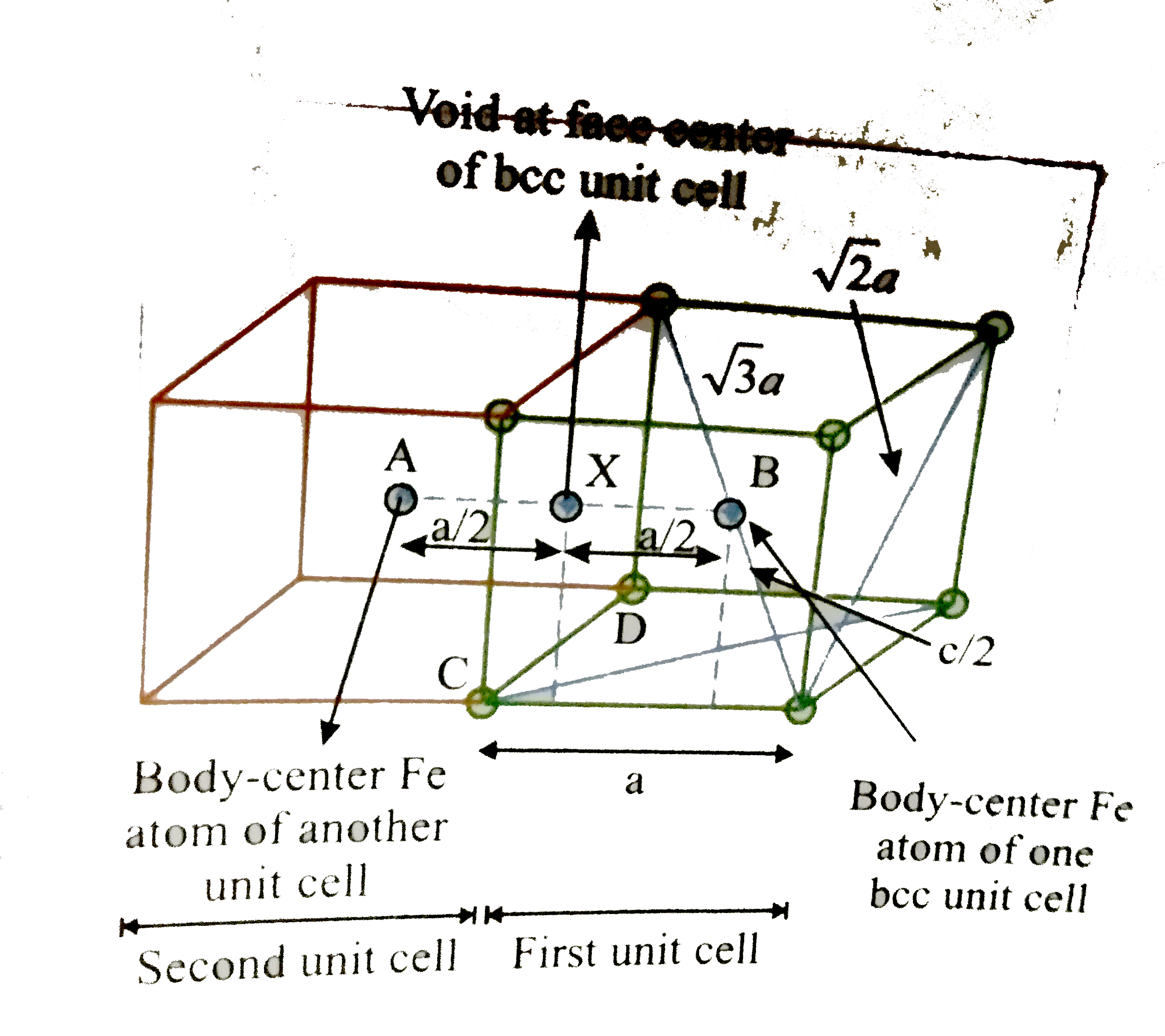 In bcc, the ATOM at the BODY center B is in contact with those at the corners, the corner atoms do not touch each other. The body diagonal `=sqrt(3)a=4r` thus, `a=((4)/sqrt(3))r` ....(i) From body center to body center (A-B)=a (figure above) ALSO, `a=2r_((Fe))+2r_(("void"))=(4r)/sqrt(3)` `thereforer_(Fe)+r_("void")=(2)/sqrt(3)r`. `THEREFORE (r_("void"))/(r_(Fe))=((2)/sqrt(3)-1)=0.155` The face diagonal are longer `(sqrt(2)a)` than the distance between body centers, so the geometry of the void is a shortened octagedron called distorted octahedron. |
|
| 2. |
Iron changes its crystal structure from body-centred to cubic close-packed structure when heated to 916^@C. Calculate the ratio of the density of the bcc crystal to that of ccp crystal, assuming that the metallic radius of the atom does not change. |
|
Answer» Solution :In the BCC PACKING, the space occupied is 68% of the total volume available while in ccp, the space occupied is 74%. This means that for the same volume , masses of bcc and ccp are in the ratio of 68:74 .As the volume is same, ratio of density is ALSO same , viz, 68:74, i.e., `"d(bcc)"/"d(ccp)"=68/74`=0.919 Alternatively, Density`(rho)=(ZxxM)/(a^3xxN_0)` For bcc, Z=2 , `r=(sqrt3a)/4` or `a_"bcc"="4R"/sqrt3` For bcc, Z=4 , r=`a/(2sqrt2)` or `a_"fcc"=2sqrt2r` `therefore rho_"bcc"=(2xxM)/((a_"bcc")^3xxN_0)` and `rho_"fcc"=(4xxM)/((a_"fcc")^3xxN_0)` `there rho_"bcc"/rho_"fcc"=2/(a_"bcc")^3xx(a_"fcc")^3/4=2/(4r//sqrt3)^3xx(2sqrt2r)^3/4=(2xx3sqrt3)/(64r^3)xx(16sqrt2r^3)/4=3/8sqrt6=0.919` |
|
| 3. |
Iron changes its crystal structure from body-centred to cubic close- packed structure when heated to916^(@)C. Calculate the ratio of the density of the bcc crystal to that of ccp crystal, assuming that themetallic radius of the atom does not change. |
|
Answer» Solution :In the bcc packing, the space occupied is 68% of the total volume available while in ccp, the space occupied is 74% . This means that for the same volume, masses of bcc and ccp are in the RATIO of 68 : 74 . As the volume is same , ratio of density is also same, VIZ , 68 : 74 . i.e,X ` (d(ccp))/(d(ccp)) = 68/74 = 0.919` Alternatively Density ` (p) = (Z xx M)/( a^(3) xx N_(0))` For bcc, ` Z = 2,r= ( sqrt3 a)/4 or a_("bcc") = (4R)/sqrt3` For fcc, ` Z = 4 ,r = a/(2sqrt2)or a_("fcc") = 2 sqrt2 r ` ` p_("bcc")= (2xxM)/((a_("bcc"))^(3) xx N_(0)) and p_("fcc") = ( 4 xx M)/((a_("fcc"))^(3)xx N_(0))` `p_("bcc")/(P_("fcc"))= 2/((a_("bcc"))^(3))xx ((a_("fcc"))^(3))/4 = 2/((4r//sqrt3)^(3))xx ((2sqrt2r)^(3))/4 = (2xx3sqrt3)/(64 r^(3)) xx (16sqrt2 r^(3))/4 = 3/8sqrt6 = 0.919` |
|
| 4. |
(I)(Reactant) In this reaction I and II are , |
|
Answer» Enantiomers |
|
| 5. |
Secondionizationenergyof anelement ishigherthanitsfirstionizationenergyWhy? |
|
Answer» SIZE of the CATION is HIGHER than neutural atom |
|
| 6. |
IP_1 and IP_2 of Mg are 178 and 348 "k cal mol"^(-1). The energy required for the reaction Mg to Mg^(2+) + 2e^(-) is |
|
Answer» `+1720K.cal ` |
|
| 7. |
Ions of an element of group 1 participate in the transmission of nerve signals and transport of sugars and amino acids into cells . This element imparts yellow colour to the flame in flame test and forms an oxide and a peroxide with oxygen . Identify the element and write chemical reaction to show the formation of its peroxide . why does the element impart colour to the flame . ? |
|
Answer» Solution :SINCE the alkali metal IMPARTS yellow colour in the FLAME test , it must be sodium . It reacts with `O_(2)` to form a MIXTURE of mainly sodium peroxide `(Na_(2)O_(2))` with a small AMOUNT of sodium oxide `(Na_(2)O)` ` 4 Na + O_(2) overset(Delta) (to) 2 Na_(2)O, 2 Na_(2)O + O_(2) overset(Delta)(to) 2 Na_(2)O_(2)` or `"" 2Na + O_(2) overset(Delta)(to) Na_(2)O_(2)` |
|
| 8. |
Ions of an element of group 1 participate in the transmission of nerve signals and transport of sugars and amino acids into cells. This element imparts yellow colour to the flame in flame test and forms an oxide and a peroxide with oxygen. Identify the element and write chemical reaction to show the formation of its peroxide. Why does the element impart colour to the flame ? |
|
Answer» Solution :`Na^(+)` ions participate in the TRANSMISSION of nerve signals and gives oxide and peroxide. `4Na +O_(2)overset(DELTA)to 2Na_(2)O` (LESS quantity) `2Na_(2)O +O_(2) overset(Delta)to 2Na_(2)O_(2)` (High quantity) `2Na+O_(2) overset(Delta) to Na_(2)O_(2)` Ionisation enthalpy of sodium is LOW. When sodium metal or its salt is heated in Bunsen flame, the flame energy causes an excitation of the OUTERMOST electron which on reverting back to its initial position gives out the absorbed energy as visible light and complementary colour of absorbed colour form the light radiation is seen. That.s why sodium imparts yellow colour to the flame. |
|
| 9. |
Ions which have the same electronic configuration are those of |
|
Answer» Lithium and sodium |
|
| 10. |
______________ions are found in large proportions in biological fluids. |
|
Answer» `Na^+` & `CL^-`<BR>`K^+` & `Cl^-` |
|
| 11. |
Ions necessary for blood clotting and for muscle contraction |
|
Answer» `Fe^(3+)` |
|
| 12. |
Ionization potential of phosphorus is greater than that of sulphur because - |
|
Answer» <P>of its smaller size |
|
| 13. |
Ionization enthalpy of alkali elements are low, because.... |
|
Answer» their ELECTRONEGATIVITY is too high. |
|
| 14. |
Ionization enthalpy of alkaline earth metals increases on moving top to bottom. |
| Answer» Solution :False STATEMENT (In a group, when moving TOP to bottom, atomic size increases and HENCE, ionization enthalpy DECREASES) | |
| 15. |
Ionization enthalpy (Delta_iH "kJ mol"(-1)) for the elements of group-13 follows the order. |
|
Answer» `B gt Al gt Ga gt In gt Tl` |
|
| 16. |
Ionization enthalpy [IE_1] of O is less than that of N - explain. |
|
Answer» <P> |
|
| 17. |
Ionization energy of nitrogen is greater than the ionization energy of oxygen. Give reason. |
|
Answer» Solution :`"_(7)N1s^2 2s^22p^3 (or) uarr darr, uarrdarruarr uarr uarr`,Nitrogen has exactly half FILLED VALENCE electrons, which REQUIRES high `I.E_1` `"_(8)N1s^2 2s^2 2p^4 (or) uarr darr, uarrdarruarr uarr uarr`, Oxygen has incomplete valence SHELL electrons, which requires COMPARATIVELY less `I.E_1`. |
|
| 18. |
Ionization energy of beryllium is greater than the ionization energy of boron. Why? |
|
Answer» Solution :`Be (Z =4) 1s^2 2s^2`. It has completely filled valence electrons, which requires HIGH `IE_1`. `B (Z =5) 1s^2 2s^2 2p^`. It has INCOMPLETELY filled valence electrons, which requires comparatively less `IE_1`. Hence `I.E_1. Begt I.E_1 B`. |
|
| 19. |
Ionization energy of Mg is greater than that of Al. Why? |
|
Answer» Solution :`Mg(Z-12)1s^(2)2s^(2)2p^(6)3S^(2)` `AL(Z=13)1s^(2)2s^(2)2p^(6)3s^(2)3p^(1)` Although the NUCLEAR charge of aluminium is greater than that of magnesium, I.E of Mg is greater than that of Al. It is because Mg ATOM has more STABLE configuration than Al atom. `therefore I.E_(1)` of MggtI.E_(1)` of Al. |
|
| 20. |
Ionizationconstants K_(a) for formic acid and acetic acid are 17.7xx10^(-5) and 1.77xx10^(-5). Which acid is stronger and how many times the other if equimolar concentrations of the two are taken ? |
|
Answer» Solution :`K_(a)` for`HCO OH gt K_(a)` for `CH_(3)CO OH`. Hence, formic ACID is STRONGER. Further, `("Strength of HCOOH")/("Strength of " CH_(3)CO OH)=sqrt((K_(HCO OH))/(K_(CH_(3)CO OH)))=sqrt(10)=3.16` TIMES . |
|
| 21. |
Ionisation potential values of Li, Be and B are respectively in kJ "mol"^(-1) |
|
Answer» 801, 899, 520 |
|
| 22. |
Ionisation potential of nitrogen is greater than that of oxygen . Explain by giving appropriate reason. |
|
Answer» Solution :`N(Z = 7) 1s^2 2s^2 2p_x^1 2p_y^1 2p_z^1`. It has exactly half filled electronic CONFIGURATION and it is more stable. Due ot stability , ionization energy of nitrogen is high. `O(Z=8) 1s^2 2s^2 2p_x^2 2p_y^1 2p_z^1` . It has incomplete electronic configuration and it requires LESS ioniztion enegy. `I. E_(1) N gt I. E_1 O` |
|
| 23. |
Ionisation potential of hydrogen is ? |
|
Answer» greater than inert GASES |
|
| 24. |
Ionisation potential is lowest for |
|
Answer» Halogens |
|
| 25. |
Ionisation of NH_(4) OH is supressed by the addition of NH_(4)CI because |
|
Answer» `NH_4 CL ` is a SALT of WB and SA |
|
| 26. |
Ionisation enthalpy of C (1086), N (1402) and F (1681) kJ "mol"^(-1)respectively then which one ionisation enthalpy of oxygen 1310 and 1510 kJ mol"^(-1)? |
| Answer» SOLUTION :Because order of ionisation enthalpy is `C lt O lt N lt F`, so are is 1310 KJ `"MOL"^(-1)`. | |
| 27. |
Ionisation enthalpyis an __________ process |
|
Answer» exothermic |
|
| 28. |
Ionisation enthalpy (Delta_(i) H_1 kj "mol"^(-1)) for the elements of Group 13 follows the order. |
|
Answer» `B gt AL gt Ga gt In gt TL` |
|
| 29. |
Ionisation enrgy of a h-like ion (A) is greater than that of another H-like ion (B) Let r, u, e and (L) represent the radius fo the orbit speeed of the electron , energy of the atom and orbital angualr momentum of the electron repectively . In groun state : |
|
Answer» ` r_A GT r_B` |
|
| 30. |
Ionisation energy of He^(+) is 19.6 xx 10^(-18)"J atom"^(-1) The energy of the first stationary state of Li^(2+) is |
|
Answer» `-4.41 xx 10^(-18) J ."atom"^(-1)` |
|
| 31. |
ionisationenergyof Heis19.6 xx 10^(-18)j atom^(-1 )Theenergyof the firststationarystate(n=1)of Li^(+) is |
|
Answer» `4.14 xx 10^(16)atom^(-1)` `E_(1)(He^(+))= -0 19.6 xx10^(18) J atom^(-1)` where `E_(n) =`ionizationenergyof `He^(+)` K = theenergyof the firststationary state `Z=2 ` `k=(-19.6 xx 10^(18))/(4 )= 4.9xx 10^(18)` `E_(1) (L_(1)%^(2))= (4.9 xx 10^(18)3^(2))/( 1^(2))` `4.41 xx 10^(17J atom^(1)` |
|
| 33. |
The ionization constants of HF, H COOH and HCN at 298 K are 6.8x10^(-4), 1.8xx10^(-4) and 4.7xx10^(-9) respectively. Calculate the ionization constants of the corresponding conjugate base. |
| Answer» SOLUTION :`1.47 XX 10^(-11) , 2.08 xx 10^(-6)` | |
| 34. |
Ionisation constant of a weak base MOH, is given by the expression K_(b) = ([M^(+)][OH^(-)])/([MOH]) Values of ionisation constantof some weak bases at a particular temperature are given below : {:("Base","Dimethylamine","Urea","Pyridine","Ammonia",,,),(K_(b),5.4xx10^(-4),1.3xx10^(-14),1.77xx10^(-9),1.77xx10^(-5),,,):} Arrange the bases in decreasing order of the extent of their ionisation at equilibrium. Which of the above base is the strongest ? |
|
Answer» Solution :Greater the ionizationconstant `(K_(b))` of a BASE, greater is the ionization of the base. HENCE, order of ionization will be `{:(,"DIMETHYLAMINE",gt,"Ammonia",gt,"Pyridine",gt,"Urea",),(K_(b),5.4xx10^(-4),,1.77xx10^(-5),,1.77xx10^(-9),,1.3xx10^(-14),):}` |
|
| 35. |
Ionisation constant of a weak base MOH, is given by the expression K_b=([M^+][OH^-])/([MOH]) Values of ionisation constant of some weak bases at a particular temperature are given below: {:("Base","Dimethylamine","Urea","Pyridine","Ammonia"),(K_b,5.4xx10^(-4),1.3xx10^(-14),1.77xx10^(-9),1.77xx10^(-5)):} Arrange the bases in decreasing order of the extent of their ionisation at equilibrium. Which of the above base is the strongest ? |
|
Answer» Solution :lonisation CONSTANT of a weak base MOH `K_b=[M^+][OH^-][MOH]` More the IONISATION constant `(K_b)` of a base, more is its ionisation and stronger the base. So, dimethyl amine is the STRONGEST base. `{:(K_b,"Dimethylamine",gt,"Ammonia",gt , "Pyridine",gt,"Urea"),(,5.4xx10^(-4),,1.77xx10^(-5),,1.77xx10^(-9),,1.3xx10^(-14)):}` |
|
| 36. |
Ionisation constant of CH_(3)CO O His 1.7xx10^(-5) and concentration of H^(+) ions is 3.4 xx 10^(-4). Then initial concentration of CH_(3) C O O H molecules is |
|
Answer» `3.4xx10^(-4)` `((3.4xx10^(-4))(3.4xx10^(-4)))/((a-3.4 xx 10^(-4))) = 1.7 xx 10^(-5) ` (Given) or, `(a-3.4xx10^(4))=((3.4xx10^(-4))^(2))/(1.7xx10^(-5))=6.8xx10^(-3)` or `a=6.8xx10^(-3)+3.4xx10^(-4)~~ 6.8 xx 10^(-3)` |
|
| 37. |
Ionistable H atom in H_(3)PO_(3) is x and in H_(3)PO_(2) is y. Then ratio of x,y is |
|
Answer» `=(x)/(y)=(2)/(1)=2` |
|
| 38. |
Ionic species are stabilised by the dispersal of charge. Which of the following carboxytate ion is the most stable? |
|
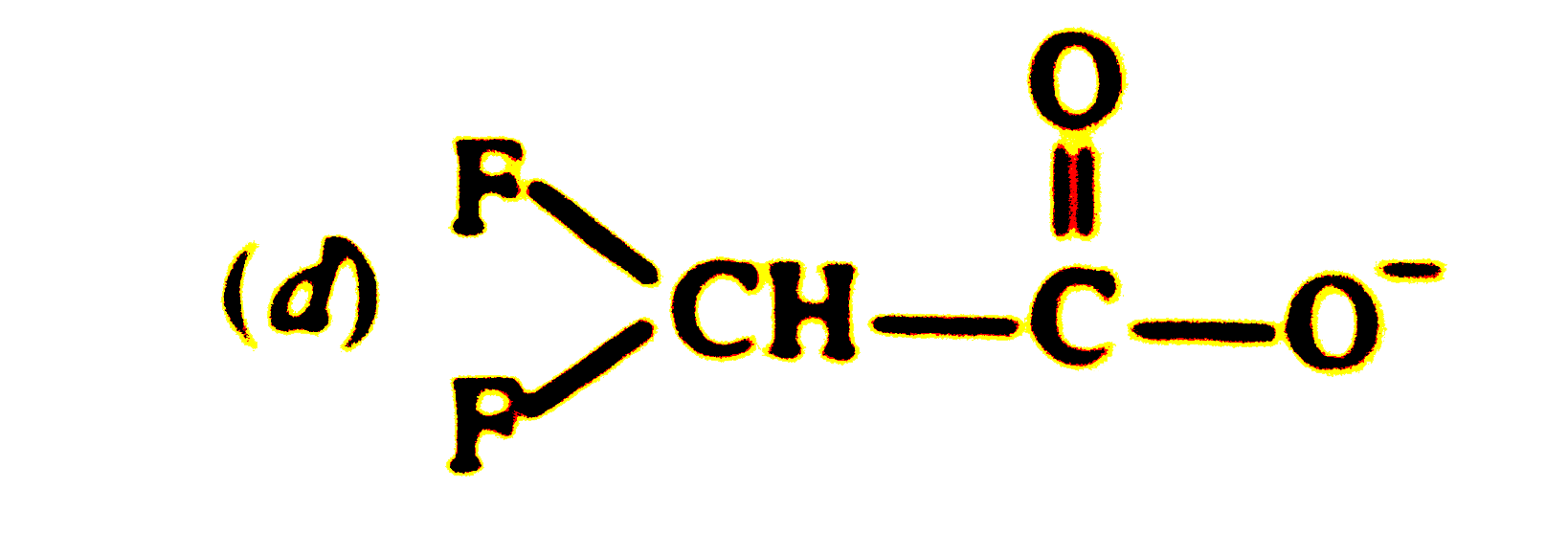
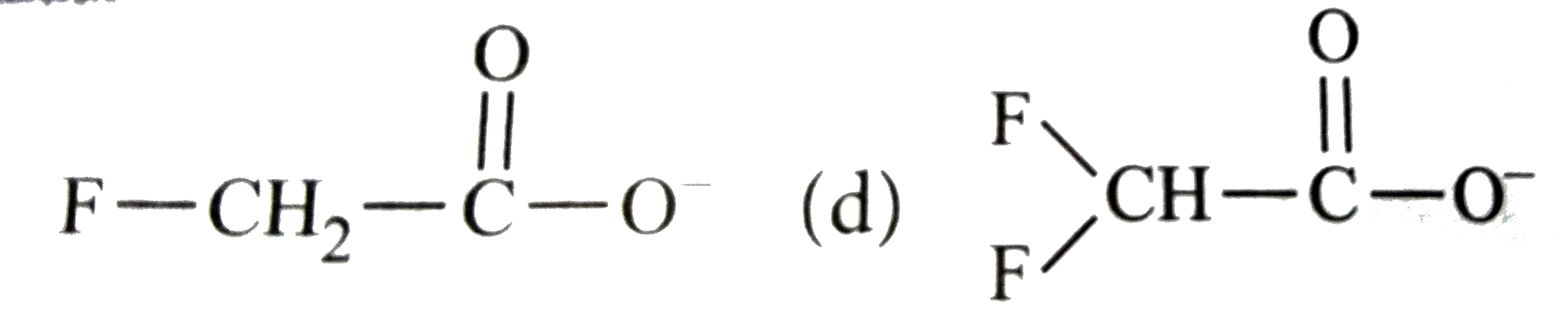
Answer» `CH_(3)-overset(overset(O)(||))(C )-O^(-)` (i) Here, the -ve charge is dispersed by +R effect of the carboxylate iona ND -I effect of the halogen. Since + R effect is COMMON in all the four structure, therefore, overall dispersal of -ve charge depends upon the on. Of halogen atoms and their ELECTRONEGATIVITY. Since, F has the HIGHEST electronegativity and option (d) has two such Fatoms, therefore, dispersal of -ve charge is maximum in option (d). The resonance structures are of under  Because of F in resonance, the maximumstabilisation occurs in (d). (ii) Inductive effect: Due to -I effect Cl and F attract the electrons of bond towards them  In (d) due to (-I) effect of two F, the maximum change is established |
|
| 39. |
Ionic species are stabilised by the dispersal of charge. Which of the following carboxylate ion is the most stable ? |
|
Answer» `CH_(3)-overset(O)overset(||)(C)-O^(-)` 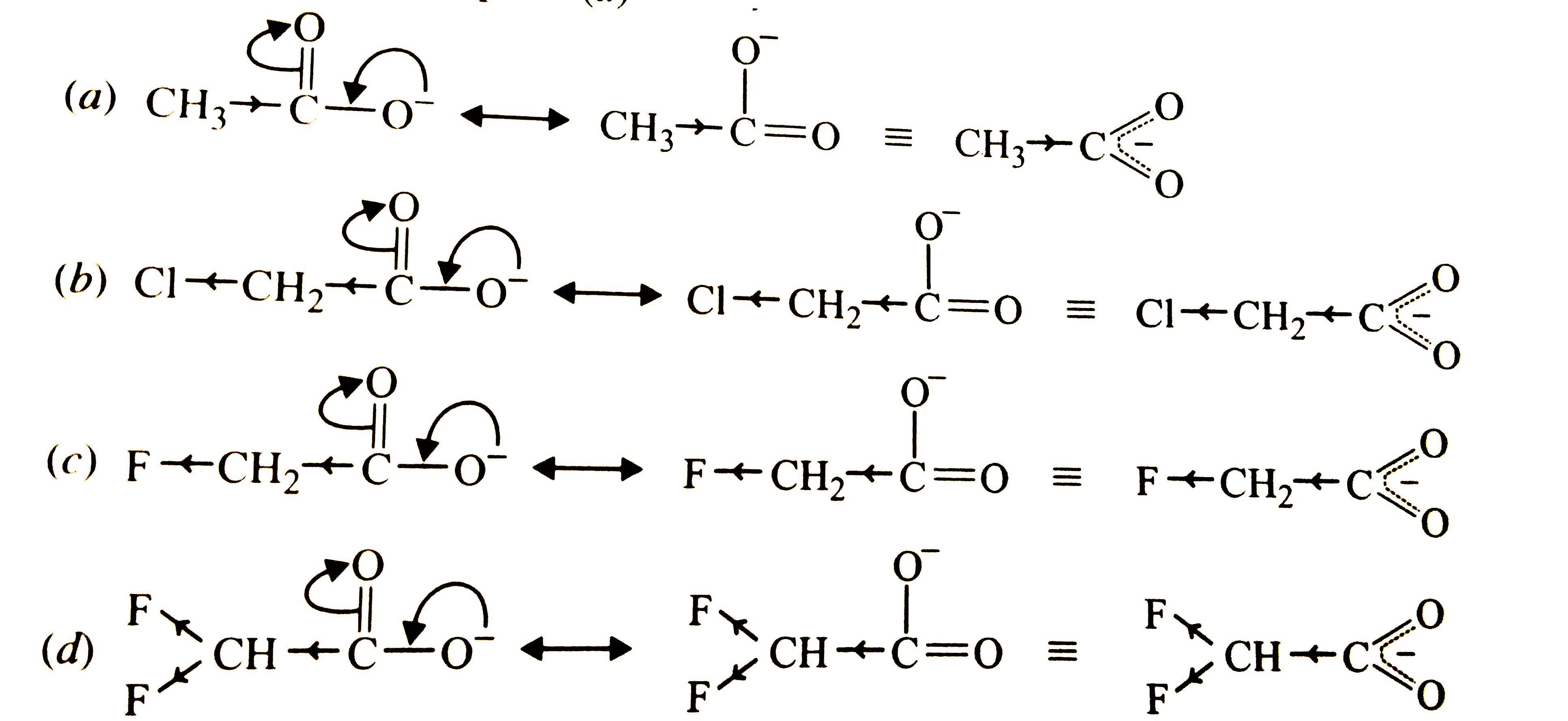 In option (a), -ve charge on the carboxylate ion is intensified by R-effect of the `CH_(3)` group but in options (b), (c) and (d), it is dispersed by -I effect of the HALOGEN. Therefore, carboxylate ion (a) is the least stable. The stability of the other carboxylate IONS, however, depends upon the number of halogens atoms and their electronegativity. SINCE F has the highest electronegativity and option (d) has two such F atoms, therefore, DISPERSAL of -ve charge is maximum in option (d). |
|
| 40. |
Ionic species are stabilised by the dispersal of charge. Which of the following carboxylate ion is the most stable? |
|
Answer» `CH_(3)-overset(O)overset(||)(C)-O^(-)` 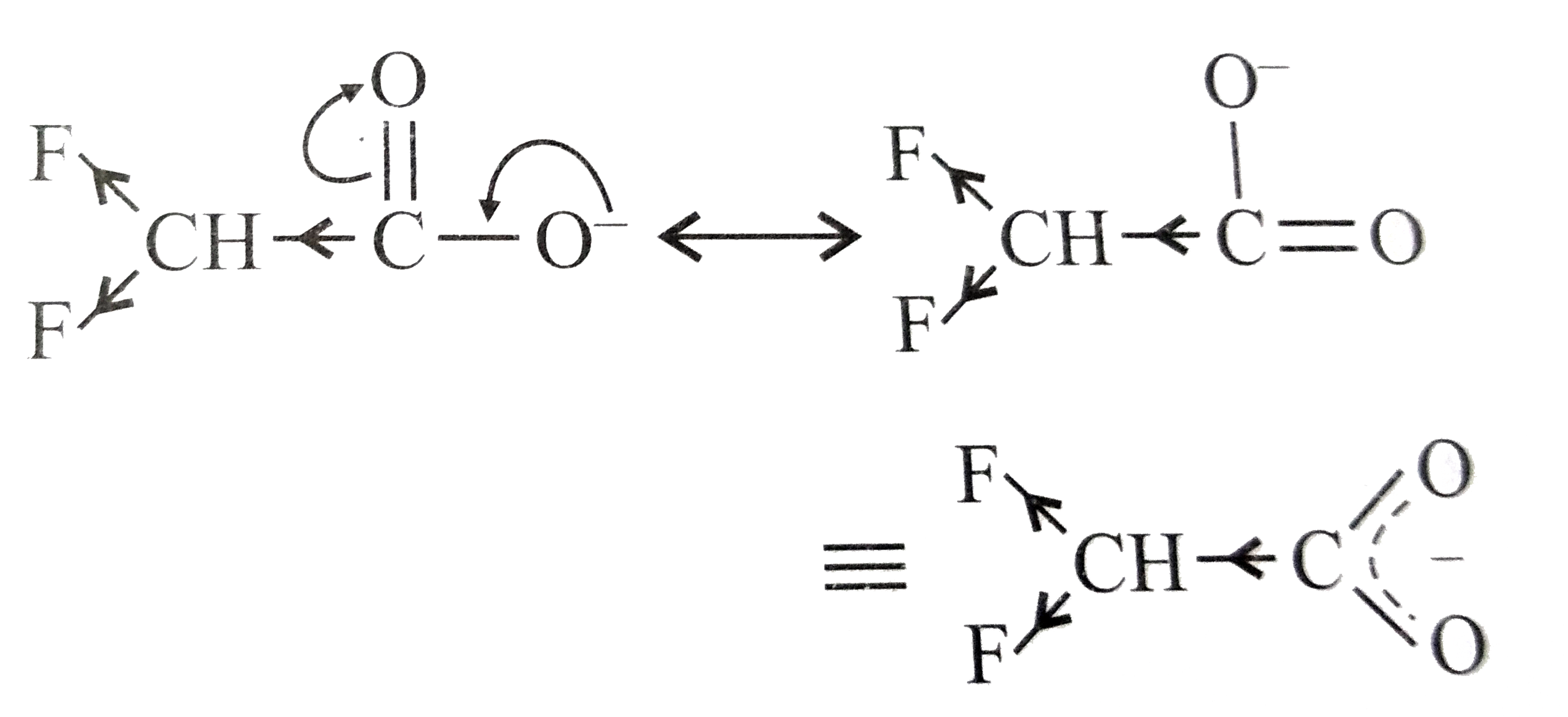 As F is most electronegative and in this structure there are TWO F atoms, therefore, DISPERSAL of negative CHARGE is maximum HENCE it is the most stable. |
|
| 41. |
Ionic solids, which have anionic vacancies due to metal excess defect, develop colour. Explain with the help of a suitable example. |
| Answer» Solution :TAKING the EXAMPLE of NaCl, when its crystals are heated in presence of sodium vapour, some chloride jons leave their lattice sites to combine with sodium to FORM NaCl. For this reaction to occur, Na atoms lose electrons to form `Na^+` ions. The electrons thus released diffuse into the crystal to occupy the anion VACANCIES created by `Cl^-` ions. The crystal now has excess of sodium. The sites occupied by UNPAIRED electrons are called F-centres. They impart yellow colour to the crystal because they absorb energy from the visible light and get excited | |
| 42. |
Ionic solids, which have anionic vacancies due to metal excess defect , develop colour. Explain with the help of a suitable example. |
| Answer» Solution :Taking the exampleof NaCl, when its crystals are heated in presence of sodium vapour , some chloride IONS leave their lattice sites to combine with sodium to from NaCl. For this reaction to occur, Na atoms lose electrons to form ` N^(+)`ions.The electrons thus released diffuse into the crystal to occupy the anion vanncies created by ` Cl^(-)`ions. The crystal now has EXCESS of soidium. The sites occupied by unpaired electrons are called F-centres.They impart yellowcolour to the crystal because they ABSORB energy from the visible LIGHT and get excited. | |
| 43. |
Ionic solids do not conduct. |
| Answer» Solution :In it the ions OCCUPY certain fixed LATTICE POSITIONS in the crystals and do not move. Hence they do not CONDUCT. | |
| 44. |
Ionic solids do not conduct electricity. |
| Answer» Solution :In IONIC solids IONS occupy certain fixed positions in the crystal and do not MIGRATE. | |
| 45. |
Ionic solids conduct electricity in the molten state but not in the solid state. Explain, |
| Answer» SOLUTION :In the molten STATE, IONIC solids dissociate to give free ions and hence can conduct electricity. However, in the solid state as the ions are not free but remain held TOGETHER by STRONG electrostatic forces of attraction, they cannot conduct electricity in the solid state | |
| 46. |
Ionic solid Na^(+) A^(-)crystallise inrocksalt type structure . 2.592 gmof ionicsolidsalt NaA dissolvedin waterto make2 litresolution . The |
|
Answer» |
|
| 47. |
Ionic reactions takes place in |
|
Answer» LIQUID state |
|