Saved Bookmarks
This section includes 7 InterviewSolutions, each offering curated multiple-choice questions to sharpen your Current Affairs knowledge and support exam preparation. Choose a topic below to get started.
| 1. |
PF_(3) reacts with XeF_(4) to give PF_(5) underset((g))(2PF_(3))+underset((s))(XeF_(4))rarrunderset((g))(2PF_(5))+underset((g))(Xe) If 100.0gm of PF_(3) and 50.0 gm XeF_(4) react, then which of the following statement is true? |
|
Answer» `XeF_(4)` is the limiting reagent No. of MOLES of `PF_(3)=(100)/(88)=1.13` No. of moles of `XeF_(4)=(50)/(207)=0.24` 1 mol `XeF_(4)` produce 2 mol `PF_(5)` `therefore 0.24` mol `XeF_(4)` produce `0.24xx2` = 0.48 mol PF |
|
| 2. |
Petroleum refining is |
|
Answer» distillation of petroleum to get DIFFERENT fractions. |
|
| 3. |
Petroleum refining invovles a) distillation b) cracking c) reforming |
| Answer» Answer :D | |
| 4. |
Petroleum ether obtained on fractionation of petroleum contains pentane, hexane and heptane. State whether the statement is true or not. |
|
Answer» |
|
| 5. |
Peroxodisulphate, on hydrolysis yields |
|
Answer» water `HO_(3)SOOSO_(3)H_((aq))overset("hydrolysis")rarr 2HSO_(4(aq))^(-)+2H_((aq))^(+)+H_(2)O_(2(aq))` |
|
| 6. |
Peroxides of alkali metals are |
|
Answer» Paramagnetic |
|
| 8. |
Peroxide ion …… (i) has five completely filled antibonding molecular orbitals (ii) is diamagnetic "" (iii) has bond order one (iv) is isoelectronic with neon Which of these are correct ? |
|
Answer» (III) and (iv) E.C. `sigma_(1s)^(2) sigma_(1s)^(**2)sigma_(2s)^(2)sigma_(2s)^(**2)sigma_(2p_(z))^(2)pi_(2p_(x))^(2)pi_(2p_(y))^(2)pi_(2p_(x))^(**2)pi_(2p_(y))^(**2)` It tha four completely filled antibonding molecular obitals . It is diamgnetic . Bond order `= (1)/(2) (10 - 8) = 1` Total electrons PRESENT = 18 Thus , it is not isoelectronic with neon `._ ""(10)Ne` Hence, only option (ii) and (iii) are correct |
|
| 10. |
Peroxide effect (Kharash effect) can be studied in case of ……………….. |
|
Answer» oct -4 -ENE |
|
| 11. |
Peroxide effects is observed only in HBr and not in HCl or Hl.Justify. |
|
Answer» Solution :`CH_(3)-CH=CH_(2)+HBroverset("Peroxide")underset((C_(6)H_(5)CO)_(2)O_(2))(to)CH_(3)-CH_(2)-CH_(2)-Br` The `H-Cl` bond is STRONGER `(430.5 kJ mol^(-1))` than `H-Br` bond `(363.7kJmol^(-1))`, thus `H-Cl` is not cleaved by the free radical. The `H-I` bond is weaker `(296.8kJ mol^(-1))` , than `H-Cl` bond. US `H-I` bond BREAKS easily but IODINE free radicals combine to form iodine molecules instead of adding to the double bond and hence peroxide effect is not observed in `HCl` & `HI`. |
|
| 12. |
Perovskite, a mineral of titanium is found to contain calcium atoms at the corners, oxygen atoms at the face centres and titanium atoms at the centre of the cubic. Oxidation number of titanium in the mineral is |
|
Answer» `+2` O atoms per unit cell =` 6 xx 1/2 =3` Ti atom per unit cell =1 Hence, the formula of the mineral is ` CaTiO_(3)` SUPPOSE ox. No. of Ti =x . Then+ 2 + x + 3(-2) = - or x = +4 |
|
| 15. |
Perovskite, a mineral of titanium is found to contain calcium atoms at the corners, oxygen atoms at the face centres and titanium atoms at the centre of the cube. Oxidation number of titanium in the mineral is |
|
Answer» `+2` O atoms per unit cell =`6xx1/2=3` Ti atoms per unit cell = 1 HENCE, the formula of the mineral is `CaTiO_3` Suppose OX. No . Of Ti =x Then +2+x+3(-2)=0 or x =+4 |
|
| 16. |
Perovaskite, a mineral containing calcium, oxygen &titanium crystallizes in the given unit cell If oxygen atoms are removed from alternate position then the formula of perovskite is |
|
Answer» CaTiO |
|
| 17. |
Permutit is : |
|
Answer» HYDRATED SODIUM ALUMINIUM SILICATE |
|
| 18. |
Permangante (VII) ion, in basic solution oxidizes iodide ion I- to produce molecular iodine (I_2) and manganes (IV) oxide (MnO_2). Write a balanced ionic equation to represent this redox reaction. |
|
Answer» Solution :Step -1 write the SKELETAL equation for the GIVEN reaction `MnO_4^(-)(aq)+1^(-)(aq)toMnO_2(s)+l_2(s)....(i)` Step-2: Write the O.N. of all the elements above their respective symbols.  `Mn_n^(+7)O_4^(2-)toM_n^(+4)O_2` (ON of Mn from +7t +4 i.e., 3 unit charge)....(ii) `I^(-)toI_2^(0)` (ON of iodine from -1 to 0)......(iii) Oxidation half equation `I^(-) (aq) to I_2 (s)`..........(IV) Reduction half equation `MnO_4^(-)(aq)toMnO_2(s)`......(v) Step 4: To balance oxidation half Eq. (a) Balance all atoms `2l^(-) (aq)toI_2(s)` (b) Balance O.N. by adding electrons `2l^(-) (aq)toI_2(s)+2e^(-)` .....(vi) Charge on either side of Eq (v) is balanced. THus eq (vI) represents the balanced oxidation half equation. Step 5: Balance the reduction half equation (v) Balance O.N. by adding electrons. `MnO_4^(-)(aq)+2H_2O(l)+2e^(-)toMnO_2(s)+4OH^(-) (aq)`...(vii) Step 6: To balance the electrons lost in Eq. (vi) and GAINED in Eq. (vii) Equation (vi) `times 3+` Equation (vii) `times 2` we have, `6I^(-) (aq)to3I_2(s)+6e^(-)` `2MnO_4^(-) (aq) +4H_2O(l)+6e^(-) to2MnO_2(s)+8OH^(-) (aq)` `overline(underline(2MnO_4^(-) (aq) +6I^(-) (aq)+4H_2O(I)to2MnO_2(s)+3I_2(s)+8OH^(-) (aq)))` |
|
| 19. |
Permanganate (VII) ion, MnO_(4)^(-) oxidises I^(-)ion to I_(2) and gives manganese (IV) oxide MnO_(2) in basic medium. The skeletalionic equation is given as pMnO_(4(aq))^(-)+qI_((aq))^(-)+x H_(2)O_((l)) rarr rMnO_(2(s))+sI_(2(s))+yOH_((aq))^(-) The values of p, q, r and s are |
|
Answer» `{:(,p,Q,r,s),(,1,2,8,4):}` |
|
| 20. |
Permanganate (VII) ion, MnO_(4)^(-) in basic solution oxidises iodide ion, I^(-) to produce molecular iodine (I_(2)) and manganese (IV) oxide (MnO_(2)). Write a balanced ionic equation to represent this redox reaction. |
|
Answer» Solution :Step-1 : First we WRITE the skeletal ionic EQUATION, which is `MnO_(4(aq))^(-)+I_((aq))^(-)toMnO_(2(s))+I_(2(s))` Step-2 : The two half-reactions are : Oxidation half : `overset(-1)(I_((aq))^(-))tooverset(0)(I_(2(s)))` Reduction half : `overset(+7)(MnO_(4(aq))^(-))tooverset(4)(MnO_(2(s)))` Step-3 : To balance the I atoms in the oxidation half reaction, we rewrite it as : `2I_((aq))^(-)toI_(2(s))` Step-4 : To balance the O atoms in the reduction half reaction, we add two water molecules on the right : `MnO_(4(aq))^(-)toMnO_(2(s))+2H_(2)O_((l))` To balance the H atoms, we add four `H^(+)` ions on the left : `MnO_(4(aq))^(-)+4H_((aq))^(+)toMnO_(2(s))+2H_(2)O_((l))` As the reaction takes place in a basic solution, therefore, for four `H^(+)` ions, we add four `OH^(-)` ions to both sides of the equation : `MnO_(4(aq))^(-)+4H_((aq))^(+)4OH_((aq))^(-)toMnO_(2(s))+2H_(2)O_((l))+4OH_((aq))^(-)` Replacing the `H^(+)andOH^(-)` ions with water, the resultant equation is : `MnO_(4(aq))^(-)+2H_(2)O_((l))toMnO_(2(s))+4OH_((aq))^(-)` Step-5 : In this step we balance the charges of the two half-reactions in the manner DEPICTED as : `2I_((aq))^(-)toI_(2(s))+2e^(-)` `MnO_(4(aq))^(-)+2H_(2)O_((l))+3e^(-)toMnO_(2(s))+4OH_((aq))^(-)` Now to equalise the number of electrons, we multiply the oxidation half-reaction by 3 and the reduction half-reaction by 2. `6I_((aq))^(-)to3I_(2(s))+6e^(-)` `MnO_(4(aq))^(-)+4H_(2)O_((l))+6e^(-)to2MnO_(2(s))+8OH_((aq))^(-)` Step-6 : Add two half-reactions to obatin the net reactions after CANCELLING electrons on both sides. `6I_((aq))^(-)+2MnO_(4(aq))^(-)+4H_(2)O_((l))to3I_(2(s))+2MnO_(2(s))+8OH_((aq))^(-)` Step-7 : A final verification shows that the equation is balanced in respect of the number of atoms and charges on both sides. |
|
| 21. |
Permanganate ion reacts with bromide ion in basic medium to give manganese dioxide and bromate ion. Write the balanced ionic equation for the reaction. |
|
Answer» Solution :Step-1 : The skeletal ionic equation is : `MnO_(4(AQ))^(-)+Br_((aq))^(-)toMnO_(2(s))+BrO_(3(aq))^(-)` Step-2 : Assign oxidation numbers for Mn and Br. `overset(+7)(MnO_(4(aq))^(-))+overset(-1)(Br_((aq))^(-))tooverset(+4)(MnO_(2(s)))+overset(+5)(BrO_(3(aq))^(-))` This indicates that permanganate ion is the oxidant and bromide ion is the reductant. Step-3 : Calculate the increase and decrease of oxidation number, and make the increase equal to the decrease. `overset(+7)(2MnO_(4(aq))^(-))+overset(-1)(Br_((aq))^(-))tooverset(+4)(2MnO_(2(s)))+overset(+5)(BrO_(3(aq))^(-))` Step-4 : As the reaction OCCURS in the basic medium, and the ionic charges are not equal on both sides, add `2OH^(-)` ions on the right to make ionic charges equal. `2MnO_(4(aq))^(-)+Br_((aq))^(-)to2MnO_(2(s))+BrO_(3(aq))^(-)+2OH_((aq))^(-)` Step-5 : Finally, count the hydrogen atoms and ass APPROPRIATE number of water molecules (i.e. one `H_(2)O` molecule) on the left side to achieve BALANCED redox change. `2MnO_(4(aq))^(-)+Br_((aq))^(-)+H_(2)O_((l))to2MnO_(2(s))+BrO_(3(aq))^(-)+2OH_((aq))^(-)` |
|
| 22. |
Permanganate oxidises sulphite to sulphate in acidic solutions. |
|
Answer» Solution :a) The ionic skeleton EQUATION is written as `MnO_(4)^(-)+SO_(3)^(2-)overset(H^(+))rarrMn^(2+)+SO_(4)^(2-)` b) Writing OXIDATION numbers `overset(+7)(MN)overset(-2)(O_(4)^(-))+overset(+4)(S)overset(-2)(O_(3)^(-2))rarroverset(+2)(Mn^(+2))+overset(+6)(S)overset(-2)(O_(4)^(-2))` d) Dividing hte reaction into two halves and BALANCING in acidic medium, separately Oxidation half - reaction : `SO_(3)^(2-)rarrSO_(4)^(2-)` Step - 1 : Balance oxygen atoms `SO_(3)^(2-)+H_(2)OrarrSO_(4)^(2-)` Step - 2 : Balance hydrogen atoms in acidic medium `SO_(3)^(2-)+H_(2)Orarr2H^(+)+SO_(4)^(2-)` Step - 3 : Balance the charge `SO_(3)^(2-)+H_(2)Orarr2e^(-)+2H^(+)+SO_(4)^(2-)".....(a)"` Reduction half - reaction : `MnO_(4)^(-)rarrMn^(2+)` Step 1 : Balance oxygen atoms `MnO_(4)^(-)rarrMn^(2+)+4H_(2)O` Step 2 : Balance hydrogen atoms `MnO_(4)^(-)+8H^(+)rarrMn^(2+)+4H_(2)O` Step 3 : Balance charge `MnO_(4)^(-)+8H^(+)+5e^(-)rarrMn^(2+)+4H_(2)O"....(b))"` e) Equalising the electron and adding the two halves. `"eq (a)"XX5+"eq (b)"xx"2, we get,"` `{:(5SO_(3)^(2-)+5H_(2)Orarr10e^(-)+5SO_(4)^(2-)+10H^(+)),(2MnO_(4)^(-)+16H^(+)+10e^(-)rarr2Mn^(2+)+8H_(2)O),(bar(2MnO_(4)^(-)+5SO_(3)^(2-)+6H^(+)rarr"")),(""2Mn^(2+)+5SO_(4)^(2-)+3H_(2)O):}` This is balanced equation. |
|
| 23. |
Permanganate ion reacts with bromide ion is a basic medium, to give manganese dioxide and bromate ion. Write the balance chemical equation for the reaction. |
|
Answer» Solution :Step- 1 Write the skeletal equation. The skeletal equation for the given reaction is: `MnO_4^(-)(aq)+Br^(-) (aq) toMnO_2(s)+BrO_3(aq)` Step -2 Find out the elements which undergo a change in oxidation number (O.N.)  O.N DECREASES by 3 PER Mn atom.......(i) Here, O.N. of Br increases from -1 Br to +5 in `BrO_3^(-)` and therefore, `Br^(-)` acts as the reactant. Further O.N. of Mn decreases from +7 in `MnO_4^(-)` to +4 in `MnO_2`, therefore `MnO_4^(-)` acts as the oxidant. Step -3: Balance O atoms by ADDING `H_2O` molecules. `2MnO_4^(-)(s)+Br^(-) (aq)to2MnO_2 (s)+BrO_3^(-)(aq)+H_2O(l)`.....(iv) Step -4: Balance H atoms by adding `H_2O` and OH IONS since the reaction occurs in basic medium, therefore, add `2H_2O` to L.H.S and 2OH to R.H.S of Eq. (iv), we have, `2MnO_4^(-)(aq)+Br^(-)(aq)+2H_2O(l)to2MnO_2+BrO_3^(-)(aq)+H_2O(l)+2OH^(-) (aq)` |
|
| 24. |
Permanent harndness from water can be removed by adding: |
|
Answer» `Na_(2)CO_(3)` |
|
| 26. |
Permanent hardness of water cannot be removed by |
|
Answer» WASHING SODA method |
|
| 27. |
Permanent hardness of water can be removed by adding |
|
Answer» `Na_(2)CO_(3)` |
|
| 28. |
Permanent hardness is due to presence of soluble salts of Mg and Ca in the form of chlorides and sulphates in H_(2)O. It can be removed by |
|
Answer» boiling |
|
| 29. |
Permanent hardness of water arises due to the presence of |
|
Answer» CHLORIDES and Sulphates of Ca & Mg |
|
| 30. |
Permanagante (VIII) ion in basic solution oxidses iodide ion I^(-) to produce moleculariodine I_(2) and managanes (IV) oxide (MnO_(23)) write balaced ionic equation to repersent this redox reaction |
|
Answer» Solution :Step 1 write the skeletal equatoin for the given reaction `MnO_(4)^(-)(aq)+I^(-)(aq)rarrMnO_(2)(s)+I_(2)(s)` step 2 write the O.N of all the elements above their respective symbol  step 3 find oiut the species which hve been oxidised and reduced and split the given skeletal equation in to two rection step 4 To balance oxidation half eq(ii) (a) balance all atoms other than O and H atoms since there are two I atoms on the R.H.S of Eq (ii) but only one on ethe L.H.S therefore multiply `I^(-)` ion by 2 we have (b) balance O.N by adding electrons the O.N of I in `I^(-)` ion is -1 while that in `I_(2)` is 0 thus each `I^(-)` ions loses one electron since there are two `I^(-)` ions on the L.H.S therefore add `2e^(-)` to the R.H.S of Eq (iv) we have `2I^(-)(aq)rarrI_(2)(s)+2e^(-)` (c ) balance charge not needed since charge on EITHER siede of equ(v) is balaned thus eq (v) represent the balanced oxidation half equation step 5 balance teh reduction half equation (iii) (a) balance all atoms other tha O and H not needed because Mn is already balanced ltvbrgt (b) balanced O.N by adding electrons the O.N of Mn in `Mn_(4)^(-)` on the L.H.S of equ (iii) is +7 while the O.N of Mn in `MnO_(2)` is +4 on the R.H.S therefore and `3e^(-)` to R.H.S of eq (iii) we have `MnO_(4)^(-)(aq)+3e^(-)rarrMnO_(2)(s)` (c ) balance charge by adding `OH^(-)` ions sicne the reaction occurs in the basic medium Therefore add add 4 `OH^(-)` to the R.H.S of Eq (vi) we have (d) balance O atoms The R.H.S of eq (vii) has six o atom s while the L.H.S has only four therefore add `2H_(2)O` to the L.H.S of E(vii) we `MnO_(4)^(-)(aq)+2H_(2)O(aq)+2H_(2)O(l)+3e^(-)rarrMnO_(2)(s)+4OH^(-)(aq)` by doing so H atoms are automatically balanced therefore eq (VIII) represents the balance reduction half equatoin step 6 to balance the electrons lost in Qe (v) and gained eq (viii) multiply eq (v) by 3 and eq (viii) by 2 and add we have `6I^(-)(aq)rarr3I_(2)(s)+6e^(-)` `2MnO_(4)^(-)(aq)+4H_(2)O(l)+6e^(-)rarr2MnO_(2)(s)+8OH^(-)(aq)` `2MnO_(4)^(-)(aq)+6I^(-)(aq)+4H_(2)Orarr2MnO_(2)(s)+3I_(2)(s)+8OH^(-)(aq)` this represent the final balanced redox equation step 7 VERIFICATION total charge on L.H.S of eq (ix) =2(-1) +6(-1)=-8 total charge of R.H.S of Eq (ix) =8 since the magnitude of charge on either side of Eq (ix) isequal therefore eq (ix) represent the correct balance redox equation |
|
| 31. |
Permanagante ion reacts with bromide ion in basic medium to give manganese dioxide and bromate ion write the balaced chemical equation for the reaction |
|
Answer» Solution :Step 1 write the skeletal equaton the skeletal equation for the given reaction is `MnO_(@)^(-)(aq)+Br^(-)rarrMnO_(2)(s)BrO_(3)^(-)+BrO_(3)^(-)`(aq) step 2 find out the elements which undergo a CHANGE in oxidatoin number (O.N)  here O.N of Br increases from -1 in `Br^(-)` to +5in `BrO_(3)^(-)therefore Br^(-)` ACTS as reductant further O.N of Mn decreases form +7 in `MnO_(4)^(-)` to +4 in `MnO_(2) THEREFOR MnO_(4)^(-)` acts as OXIDANT step 3 find out total increase / decrease in O.N since there is only one Br atom on either side therefore total in O.N of Br is 6 further since there is only one Mn atom on either side therefore total decrease O.N of Mn is 3 step 4 balance increase / decrease in O.N since the total increase in O.N is 6 and decrease in O.N is 3 therefore multiply `MnO_(4)^(-)` by 2 combing steps 2 and 3 we have `2MnO_(5)^(-)(aq)Br^(-)(aq)rarrMnO_(2)(s)+BrO_(3)^(-)(aq)` step 5 balance all atoms other than O and H to balance Mn on either side of Eq (ii) multiply `MnO_(2)` by 2 we have `2MnO_(4)^(-)(aq)+Br^(-)(aq)rarr2MnO_(2)(s)+BrO_(3)^(-)(aq)+H_(2)O(l)` step 7balance H atoms by adding `H_(2)O` and `OH^(-)` ions since the reactin occurs in basic medium since there are tow H atoms on R.H.S and none on L.H.S of equ(IV) therefore add `2H_(2)O` to L.H.S and `2OH^(-)` to R.H.S of eq(iv) we have `2MnO_(4)^(-)(aq)+Br^(-)(aq)+2H_(2)O(l)rarr2MnO_(2)(s)+BrO_(3)^(-)(aq)+H_(2)O(l)+2OH^(-)(aq)` |
|
| 32. |
Periodicproperties show aregular gradation onmovingfrom leftto rightin aperiodor fromtoptobottomin a group . Downa groupthe atomicionicradii, metalliccharacterand reducing characterincreasewhileionizationenthalpyand electronegativitydecrease. Alonga periodfrom leftto rightatomic ionicradiiand metalliccharacterdecrease whileionizationenthalpyelectronegativitynon- metalliccharacterand oxidisingpowerincreases. However ,electrongainenthalpybecomesless negativedown agroupbut morenegativealonga period. Incontrastinertgaseshavepositiveelectrongainenthalpies whichdo not showanyregular trend .The incorrectstatementamong thefollowingis : |
|
Answer» The firstionizationpotentialof A1 islessthanthefirstionizationpotential of Mg. |
|
| 33. |
Periodicproperties show aregular gradation onmovingfrom leftto rightin aperiodor fromtoptobottomin a group . Downa groupthe atomicionicradii, metalliccharacterand reducing characterincreasewhileionizationenthalpyand electronegativitydecrease. Alonga periodfrom leftto rightatomic ionicradiiand metalliccharacterdecrease whileionizationenthalpyelectronegativitynon- metalliccharacterand oxidisingpowerincreases. However ,electrongainenthalpybecomesless negativedown agroupbut morenegativealonga period. Incontrastinertgaseshavepositiveelectrongainenthalpies whichdo not showanyregular trend .Tikc thecorrectorderof secondionisationenthalpyin the following |
|
Answer» `F GT O gt N gt C` |
|
| 34. |
Periodicproperties show aregular gradation onmovingfrom leftto rightin aperiodor fromtoptobottomin a group . Downa groupthe atomicionicradii, metalliccharacterand reducing characterincreasewhileionizationenthalpyand electronegativitydecrease. Alonga periodfrom leftto rightatomic ionicradiiand metalliccharacterdecrease whileionizationenthalpyelectronegativitynon- metalliccharacterand oxidisingpowerincreases. However ,electrongainenthalpybecomesless negativedown agroupbut morenegativealonga period. Incontrastinertgaseshavepositiveelectrongainenthalpies whichdo not showanyregular trend .Whichof the followingisoelectronicions has thelowestfirst ionizationenthalpy ? |
|
Answer» `K^(+)` |
|
| 35. |
Periodicproperties show aregular gradation onmovingfrom leftto rightin aperiodor fromtoptobottomin a group . Downa groupthe atomicionicradii, metalliccharacterand reducing characterincreasewhileionizationenthalpyand electronegativitydecrease. Alonga periodfrom leftto rightatomic ionicradiiand metalliccharacterdecrease whileionizationenthalpyelectronegativitynon- metalliccharacterand oxidisingpowerincreases. However ,electrongainenthalpybecomesless negativedown agroupbut morenegativealonga period. Incontrastinertgaseshavepositiveelectrongainenthalpies whichdo not showanyregular trend .Amongst the followingelements(whoseelectronicconfigurationare givenbelow ) theone havingthe highestionizationenthalpy is : |
|
Answer» `[Ne] 3 s^(2)3p^(1)` |
|
| 36. |
Periodic properties of 2^(nd) period in Section-I and Section-II is related graph. Select proper option from the following: |
|
Answer» `P to 1, Q to 2, R to 3` |
|
| 37. |
Periodicproperties show aregular gradation onmovingfrom leftto rightin aperiodor fromtoptobottomin a group . Downa groupthe atomicionicradii, metalliccharacterand reducing characterincreasewhileionizationenthalpyand electronegativitydecrease. Alonga periodfrom leftto rightatomic ionicradiiand metalliccharacterdecrease whileionizationenthalpyelectronegativitynon- metalliccharacterand oxidisingpowerincreases. However ,electrongainenthalpybecomesless negativedown agroupbut morenegativealonga period. Incontrastinertgaseshavepositiveelectrongainenthalpies whichdo not showanyregular trend .Itthe ionicradiiof K^(+)and F^(-) are about1.34 Å eachthen theexpectedvaluesof atomicradii ofK and Fshouldbe respectively : |
|
Answer» 2.31 and 0.64 `Å` |
|
| 38. |
Periodic change in electronic configuration is responsible for the physical and chemical properties of element. Justify this statement. |
|
Answer» SOLUTION :(i) The electronic configuration of the elements changes periodically in a period and group as well. (ii) We could FIND a pattern in the physical and chemical properties as we go down in a group or move across a period. (iii) For example: The chemical reactivity is high at the beginning, lower at the middle and INCREASES to a maximum at group 17 in a period. (iv) The reactivity increases on moving down the group of ALKALI METALS. But the reactivity decreases on moving down the group of halogens. (v) Atomic radii increases down the group and decreases across the period. |
|
| 39. |
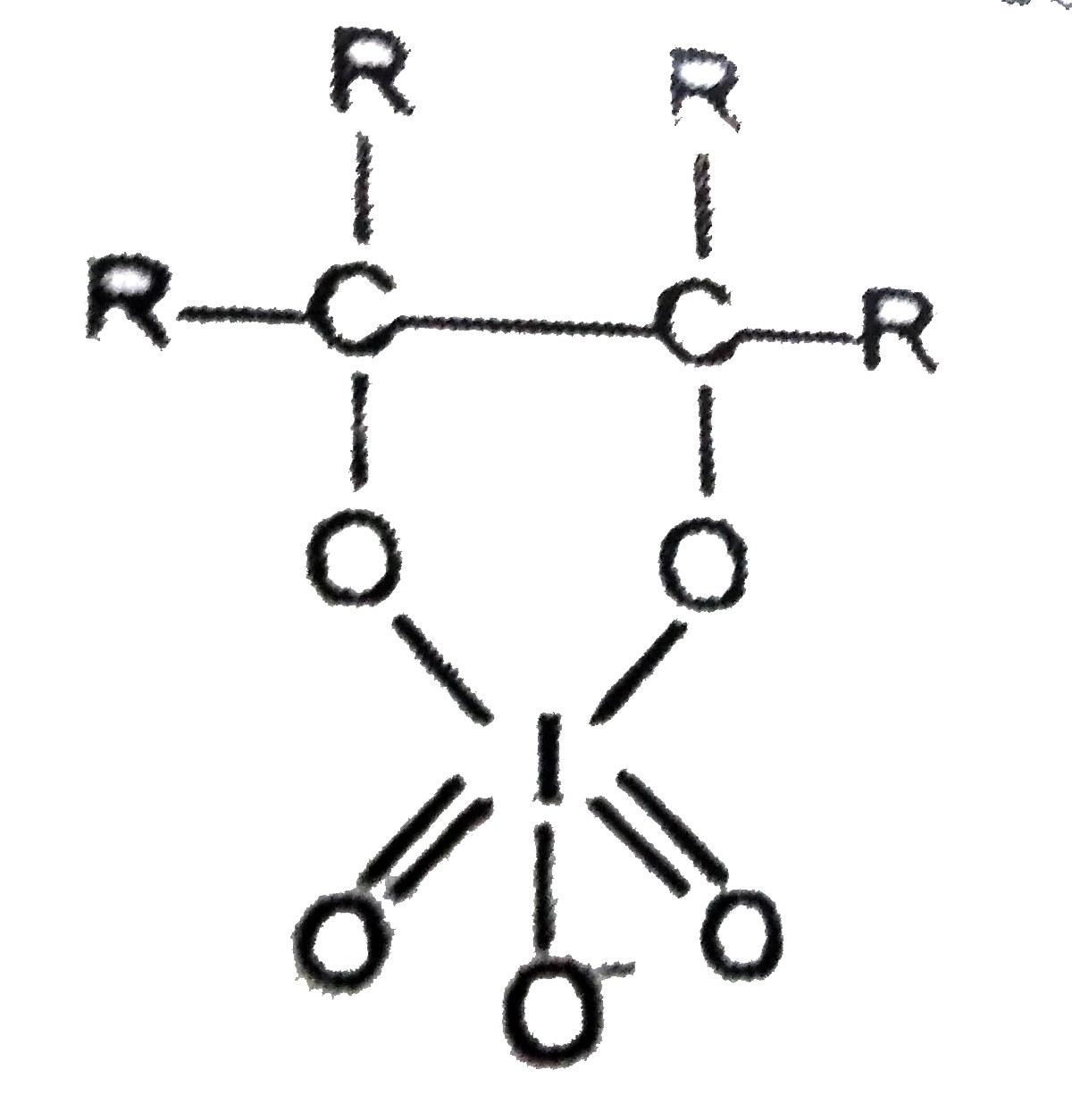
Periodic acid is generally used for the oxidation of vicinal diols or alpha-hydrocarboxyl compounds. Which of the following statements are correct for this reaction |
|
Answer» OXIDATIVE CLEAVAGE takes place in the above reactions Cyclic intermediate is formed with vicinal diols. |
|
| 40. |
Perdisulphuric acid (H_2S_2O_8) or Marshall's acid can be prepared by the electrolytic oxidation of H_2SO_4. AT anode O_2 and H_2 are obtained as side products. After passing a current of 0.5 A for a certain time, the volume of H_2 and O_2 collected was found to be 10.08 and 2.24 L, respectively, at STP. What is the weight of H_2S_2O_8 produced during the same time? Also find the duration of electrolysis (in seconds) assuming 75% efficiency of electronysis. Give all the electronde reaction. |
|
Answer» Solution :(a). Ectrode reactions: `{:(2H_2SO_4toH_2S_2O_8+2e^(-)),(2overset(ɵ)(O)Hto(1)/(2)O_2+H_2O+2e^(-)):}]` At anode SINCE two reactions are occuring at anode and one reaction at cathode, number of equivalent of `H_2S_2O_8` `+` number of equivalent of `O_2=` number of equivalent of `H_2`. LET the weight of `H_2S_2O_8` be x g " Eq of "`H_2S_2O_8=(x)/((194)/(2))` 1 " mol of "`H_2=2Eq` of `H_2=22.4L` at STP " Eq of "`H_2=(10.08)/((22.4)/(2))` 1 " mol of "`O_2=4 Eq` of `O_2=22.4L` " Eq of "`H_2S_2O_8+ Eq` of `O_2=Eq` of `H_2` `(x)/((194)/(2))+(2.24)/((22.4)/(4))=(10.08)/((22.4)/(2))` `(x)/(97)+0.4=0.9becausex=48.5g` Weight of `H_2S_2O_8=48.5g` (b). At cathode, only one reaction takes PLACE, so the number of faradays for electrolysis can be calculated from cathode reaction. `1Eq` of `H_2 gas =1F` `(10.08)/(11.2)Eq=0.9F` For `75%` efficiency, Number of faradays delivered`=0.9xx(100)/(75)` `=(90)/(75)xx96500` coloumb `Ixxt=(90xx96500)/(75)` `5xxt=(90xx06500)/(75)` `t=23160s=6.43hr` |
|
| 41. |
Percentages of free space in cubic close packed structure and in body centered packed structure are respectively |
|
Answer» 32% and 48% |
|
| 42. |
Percentages of free space in cubic close packed structure and in body centered packed structure are respectively. |
|
Answer» 30% and 26% |
|
| 43. |
Percentages of a free space in cubic close packed structure and in body centered packed structure are respectively. |
|
Answer» 32% and 48% |
|
| 44. |
Percentage yield of SO_(3) in the following reaction is plotted against pressure at definite temperatures. 2SO_(2(g)) +O_(2(g)) harr 2SO_(3(g)), Which of the following relation is correct? |
|
Answer» `T_(1) GT T_(2) gt T_(3)` `:.` as `T UARR`, % yield `darr` `:. T_(1) gt T_(2) gt T_(3)` and as `P uarr`, % yield `uarr` `:. P_(3) gt P_(2) gt P_(1)` |
|
| 45. |
Percentage of lead in lead pencil is : |
|
Answer» Zero |
|
| 46. |
Percentage of ionic character is maximum in- |
|
Answer» `H-F` |
|
| 47. |
Percentage of free space in which cubic close packed structure and in body centred packed structure are respectively |
|
Answer» 40% and 26% %free space =100 - 74 = 26% Packing efficiency in bcc structure = 68% %free space = 100 - 68 = 32% |
|
| 48. |
Percentage of copper and oxygen in samples of CuO obtained by different methods were found to be same. This proves the law of |
|
Answer» CONSTANT proportions |
|
| 49. |
Percentage of copper and oxygen in samples of CuO obtained by different methods were found to be the same. This proves the law of |
|
Answer» CONSTANT proportions |
|
| 50. |
Percent of water present in oceans |
|
Answer» 2.04 |
|