

Saved Bookmarks
This section includes 7 InterviewSolutions, each offering curated multiple-choice questions to sharpen your Current Affairs knowledge and support exam preparation. Choose a topic below to get started.
| 1. |
Consider the reaction given below. On the basis of these reactions find out which of the algebric relations given in options (i) to (iv) is correct? (i) C(g) + 4H(g) to CH_(4)(g), Delta_(r)H = x kJ"mol"^(-1) (ii) C("graphite") + 2H_(2)(g) to CH_(4)(g), Delta_(r)H = y kJ"mol"^(-1). |
| Answer» SOLUTION :The energy RELEASED in Eq.(a is more than the energy released in Eq.(b) because in Eq.(b), some energy is used up to break the bonds of hydrogen molecule. | |
| 2. |
Consider the reaction cquilibrium, 2SO_(2(g)) + O_(2(g)) hArr 2 SO_(3(g)) , Delta H^(@) = -198KJ . On the basis of Le Chatelier's principle, the condition favourable for the forward reaction is |
|
Answer» Lowering of TEMPERATURE as WELL as pressure |
|
| 3. |
Consider the reaction, CH_3CH_2CH_2Br + NaCN to CH_3CH_2CH_2CN + NaBr This reaction will be the fastest in …………………….. . |
| Answer» Solution :DMF(N. N.-dimethyl formamide) | |
| 4. |
Consider the reaction, CH_(3)CH_(2)CH_(2)Br+NaCN to CH_(3)CH_(2) CH_(2)CN+NaBr This reaction will be the fastest in |
| Answer» Solution :DMF (N, N'-dimethyl formamide) | |
| 5. |
Consider the reaction CaCO_(3) (s) hArr CaO (s) + CO_(2) (g) is a closed container at equilibrium . What would be the effectof addition of CaCO_3 on the equilibrium ? |
|
Answer» INCREASES |
|
| 6. |
Consider the reaction (A) H_(3)PO_(2)(aq)+4AgNO_(3)(aq)(l)rarrH_(3)PO_(4)+4Ag(s)+4HNO_(3)(aq) (b)H_(3)PO_(2)(aq)+2CuSO_(4)(aq)+2H_(2)O(l)rarrH_(3)PO_(4)(aq)+2Cu(s)H_(2)SO_(4)(aq) (c )C_(6)H_(5)CHO(l)+2[Ag(Nh_(3))_(2)]^(+)(aq)+3OH^(-)(aq)rarrC_(6)H_(5)COO^(-)(aq)+2Ag(s)+4NH_(3)(aq)+2H_(2)O(l) (d)C_(6)H_(5)CHO(l)+2Cu^(2+)(aq)rarr "No change observed" What inferenc edo your draw about the behaviour of Ag^(+) and Cu^(2+) form these reaction ? |
|
Answer» Solution :Reacting (a) and (B) incdicate that `H_(3)PO_(2)` is a REDUCING agent and thus reduces both `AgNO_(3)` and `CuSO_(4)` to Ag and Cu respectively conversely both `AgNO_(3)` and `CuSO_(4)` act as oxidising agent and thus oxidise `H_(3)PO_(2)` to `H_(3)PO` Reaction (C ) suggest that`Ag(NH_(3))_(2)` oxidses `C_(6)H_(5)CHO` to `C_(6)H_(5)COO^(-)` but reaction (d) indiciates that `Cu^(2+)` IONS cannot oxidise `C_(6)H_(5)CHO` to `C_(6)H_(5)COO^(-)` therefore from the above reaction we conclude that `Ag^(+)` ion is a stronger oxidising agent than `Cu^(2+)` ion |
|
| 7. |
Consider the reaction. A + B rarr C + D If the reaction is exothermic and spontaneous only in the direction opposite to the indicated one coment on the sign of Delta G and Delta S for the direction indicated in the equation. |
| Answer» SOLUTION :`DELTA G = Delta S = -ve`. | |
| 8. |
Consider the reaction : (a) 6CO_(2)(g)6H_(2)O(l)rarrC_(6)H_(12)O_(6)(s)+6O_(2)(g) (b)O_(3)(g)+H_(2)O(l)rarrH_(2)O(l)+2O_(2)(g) Why it is more appropriate to write these reactions ad : (a)6CO_(2)(g)+12H_(2)O(l)rarrC_(6)H_(12)O_(6)+6H_(2)O(l)+6O_(2)(g) (b)O_(3)(g)+H_(2)O(l)rarrH_(2)O(l)+O_(2)(g)+O_(2)(g) Also suggest technique to investigate path of the above (a) and (b) redox reaction |
|
Answer» Solution :(A) Allthought the meachanism of photoynthesis is very complex but broadly speaking it may be visualized to occur in two steps in the first step `H_(2)O` decomposes to give `H_(2)` and `O_(2)` in presence of chlorophyll as the `H_(2)` thus produced reduces `CO_(2)`to `C_(6)H_(12)O_(16)`in the SECOND step during the second step some `H_(2)O` molecules are also produced as show below `12H_(2)O(I)rarr12H_(2)(g)+6O_(2)(g)` `6CO_(2)(g)+12H_(2)(g)rarrC_(6)H_(12)O_(6)(s)+6H(2)O(l)` `6CO_(2)(g)+12H_(2)O(l)rarrC_(6)H_(12)O_(6)H_(12)O_(6)(s)+6H_(2)O(l)+6O_(2)(g)` therefore it is more appropriate to write the equation for photosythesis as (iii) because it imphasis that `12 H_(2)O` are used per molecule of cabohydrate FORMED and 6 |
|
| 9. |
Consider the reaction. A + B rarr C + D If the reaction is exothermic and spontaneous in the direction indicated, can you comment on the sign of Delta G and Delta S ? |
| Answer» Solution :`DELTA G = -ve, Delta S = -ve` (if `Delta H GT TDelta S`) | |
| 10. |
Consider the reaction. A + B rarr C + D If the reaction is endothermic and spontaneous in the direction indicated, comment on the sign of Delta G and Delta S. |
| Answer» SOLUTION :`DELTA G = -ve, Delta G = + ve` | |
| 11. |
Consider the reaction 4 NO_(2)(g) +O_(2)(g)rarr 2N_(2)O_(5)(g), Delta_(r)H = - 111 kJ . If N_(2)O_(5)(s) is formed instead ofN_(2)O_(5)(g) in the above reaction, the Delta_(r)H value will be ( given , DeltaHof sublimation for N_92)O_(5) is 54kJ mol^(-1)) |
|
Answer» `- 165kJ` 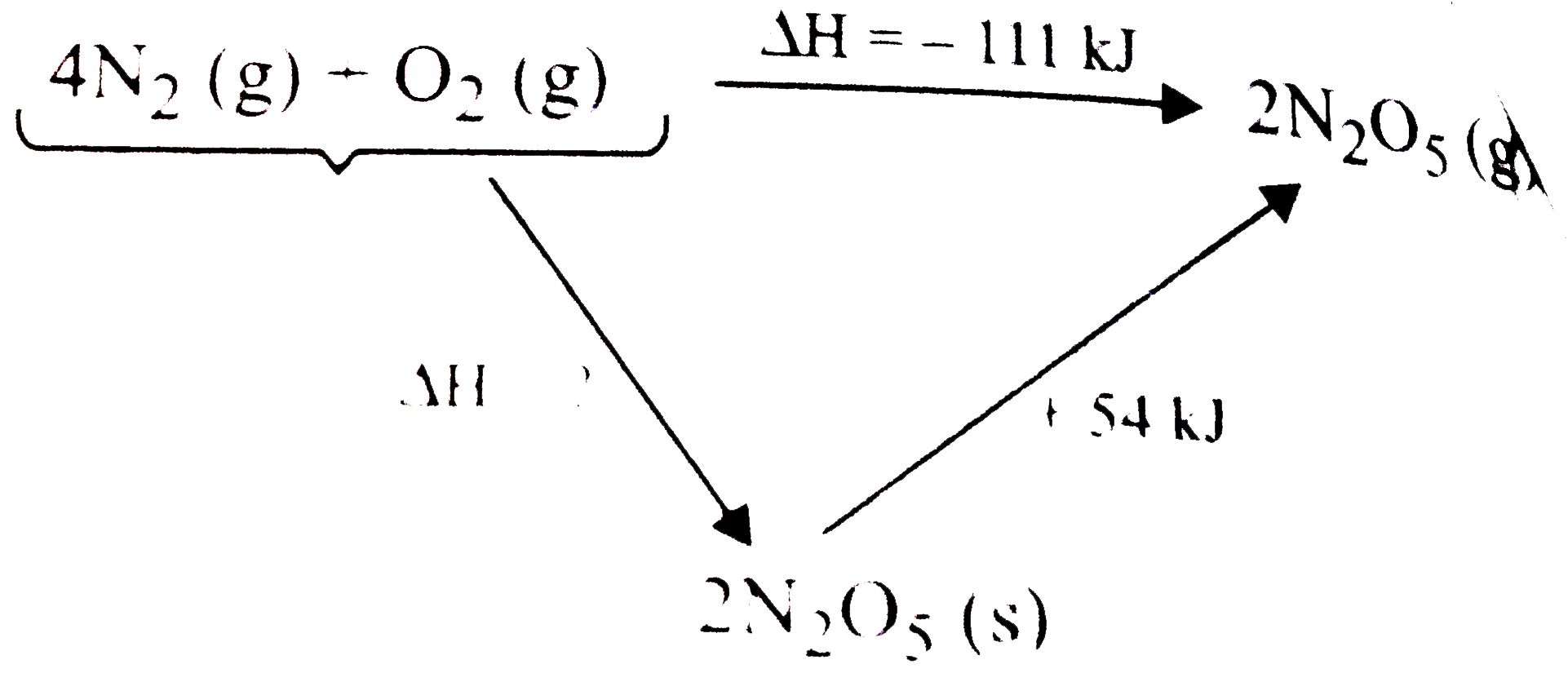 By HESS's LAW,`DELTAH+ 54 = - 111kJ` or `DeltaH= - 165kJ` |
|
| 12. |
Consider the reaction : 2s_(2)O_(3)^(2-)(aq)+I_(2)(s)rarrS_(4)O_(6)^(2-)(aq)+2I^(-)(aq)S_(2)O_(2)^(2-)(aq)+2Br_(2)(l)+5H_(2)O(l)rarr2SO_(4)^(2-)(aq)+4Br^(-)(aq)+10H^(+)(aq) Why does the same reducant thiosuphatereact differently with iodine and bromine? |
| Answer» Solution :The average O.N of S in `S_(2)O_(3)^(2-)`is +2 while in `S_(4)O_(6)^(2-)` it is +2.5 The O.N of S in `SO_(4)^(2-)` is +6 SINCE `Br_(2)` is a stronger oxidising agent that `I_(2)` it oxidises s of `S_(2)O_(3)^(2-)` to higher OXIDATION state of +6 and hence FORMS `SO_(4)^(2-)` ion `I_(2)` howevr being aweaker oxidising agentoxidises S of `S_(2)O_(3)^(2-)` ion to a loweroxidation of +2.5 in `S_(4)O_(6)^(2-)` ion it is because of this reason that thiosuplhate REACTS differently with `Br_(2)`and `I_(2)` | |
| 13. |
Considerthereaction 2SO_(2(g)) + O_2(g) harr 2SO_(3(g)) for which K_c = 278 M^(-1)0.001 mole of cash of the reagents SO_(2(g)), O_2(g) and SO_3(g) are mixed in a 1.0l flask. Determine the reaction quotient of the system and the spontaneous direction of the system. |
|
Answer» `Q_c = 1000`, the EQUILIBRIUM SHIFTS to the right |
|
| 14. |
Consider the reaction, 2CI_(2)(g)+2H_(2)O(g)hArr4HCI(g)+P_(2)(g) DeltaH^(@)=+113KJ The four gases, CI_(2),H_(2)O,HCI "and" O_(2), are mixed and the reaction is allowed to come to equilibrium. Each operation is to be considered separately. Temperature and volume are constant unless stted otherwise. Report the number of operations in the left column which lead to increase in the equilibrium value of the quantity in the right column. (a) Increasing the volume of the container Number of moles of H_(2)O (b) Adding O_(2) Number of moles of H_(2)O (c) Adding O_(2) Number of moles of HCI (d) Decreasing the volume of the container Number of moles of CI_(2) (e) Decreasing the vollume of the container Partial pressure of CI_(2) (f) Decreasing the volume of the container K_(C) (g) Raising the temperature Concentration of HCI (i) Adding He Number of moles of HCI (j) Adding catalyst Number of moles of HCI |
|
Answer» |
|
| 15. |
Consider the quantity (MkT)/(PV) of an ideal gas where M is the mass of the gas. It does notdepends on the |
|
Answer» TEMPERATURE of the gas It depends only on nature of gas. |
|
| 16. |
Consider the partial decomposition of A as 2A_((g))hArr 2B_((g)) + C_((g)) At equilibrium 700 m/ gaseous mixture contains 100 ml of gas C at 10 atm and 300K. What is the value of Kp for the reaction ? |
|
Answer» `(40)/(7)`  For ideal gases volume % = MOLE % `Kp=(((200)/(700)xx10)^(2). ((100)/(700)xx10))/(((400)/(700)xx10)^(2))=(10)/(28)` |
|
| 17. |
Consider the nitrationof benzene using mixed conc H_(2)SO_(4) HNO_(3)if a large quantity of KHSO_(4) is added to the mixture the rate of nitration will be ……….. |
|
Answer» UNCHANGED |
|
| 18. |
Consider the nitration of benzene using mixed conc. H_2SO_4 and HNO_3, if a large quantity of KHSO_4 is added to the mixture, the rate of nitration will be … |
| Answer» Solution :slower | |
| 19. |
Consider the nitration of benzene using mixed conc. H_(2)SO_(4) and HNO_(3). If a large amount of KHSO_(4) is added to the mixture, the rate of nitration will be : |
|
Answer» Slower Adding `KHSO_(4)` DECREASING concentration of `NO_(2)^(+)` |
|
| 20. |
Consider the nitration of benzene using mixed conc. H_2SO_4 and HNO_3. If a large amount of KHSO_4 is added to the mixture, the rate of nitration will be |
|
Answer» faster |
|
| 21. |
Consider the molecules NH_(2) ^(-) , NH_(3) , NH_(4)^(+) . Arrange them in the decreasing order of bond angles and give reason for your arrangement. |
|
Answer» Solution :(i) The decreasing ORDER of bond angles is : `NH_(4)^(+) gt NH_(3) gt NH_(2)^(-)` (ii) The N-atoms in all the THREE molecules are `sp^(3)` hybridised (iii) The number of lonw - pair of ELECTRONS present on nitrogen of `NH_(4)^(+), NH_(3)" and " 0, 1 ` and 2. (iv) Greater the number of lone pairs , greater is the REPULSION and lesser is the bond angle. |
|
| 22. |
Consider the molecules CH_(4), NH_(3) and H_(2)O. Which of the given statements is false ? |
|
Answer» The H-0-H bond ANGLE in `H_(2)O ` is larger than the H-C-H bond angle in` CH_(4)`. `CH_(4) rarr 109.5^(@) , NH_(3) rarr 107.5^(@) , H_(2) O rarr 104.45^(@)`. |
|
| 23. |
Consider the molecules CH_(4), NH_(3) and H_(2) O Which of the given statements is false ? |
|
Answer» The H-O-H BOND anglein `H_(2) O ` is smallar 
|
|
| 24. |
Consider the isoelectronic species, Na^(+), Mg^(2+), F^(-) and O^(2). The correct order of increasing length of their radii is ........ |
|
Answer» `F^(-) LT O_(2)^(-) lt Mg^(2+) ltNa^(+)` As the +ve charge decreases, the IONICRADII increases. As the -ve charge increases, the ionic radii also increase. |
|
| 25. |
Consider the isoelectronic species, Na^(+),Mg^(2+),F^(-) and O^(2-). The correct order of increasing length of their radii is: |
|
Answer» `F^(-)O^(2-)ltMg^(2+)ltNa^(+)` |
|
| 26. |
Consider the isoelectronic species Na^(+), Mg^(2+),F^(-) and O^(2-).The correct order of increasing length of their radii is: |
|
Answer» `F^(-)ltO^(2-)ltMg^(2+)ltNa^(+)` |
|
| 27. |
Consider theisoelectronicspeciesNa^(+) , Mg^(2+) F^(-) and O^(2-). Thecorrectorderofincreasinglengthof theirradii is ………. |
|
Answer» `F^(-) lt O^(2-) lt MG^(2+) lt Na^(+)` |
|
| 28. |
Consider the ground state of Cr atom (Z = 24). The numbers of electrons with the azimuthal quantum numbers, l = 1 and 2 are, respectively |
|
Answer» 12 and 4 |
|
| 29. |
Consider the given process. And identify the incorrect statement |
|
Answer» Configuration at `C-2` is LOST on enolisation |
|
| 30. |
Consider the follwing statements : I. Atomic hydrogen is obtained by passing hydrogen throgh an electric arc. II. Hydrogen gas will not reduce heated aluminium oxide. III. Finely divided palladium absorbs large volumn of hydrogen gas. IV. Pure nascent hydrogen is obtained by reacting /na with C_(2)H_(5)OH. Which of the above statements is/are correct ? |
|
Answer» I Alone |
|
| 31. |
Consider the followng list of reagents : Acidified K_(2)Cr_(2)O_(7) alkaline KMnO_(4) ,CuSO_(4),H_(2)O_(2),cI_(2),O_(3),FeCI_(3),HNO_(3) and Na_(2)S_(2)O_(3) The total number of reagent that can oxidise aqueous iodine is |
|
Answer» `2KMnO_(4)+H_(2)O+KIrarr2MnO_(2)+2KOH+KIO_(3)` `NaS_(2)O_(3)` being a reducing agent cannot oxidise `I^(-) to I^(2)` All the remaining SEVEN REAGENT can oxidise aqueous ion to iodine i.e `O_(3)+2KI+H_(2)rarr2KOH_I_(2)+O_(2)` `2FeCI_(3)+2KIrarr2FeCI_(2)+2KCI+I_(2)` `4HNO_(3)+22KIrarr2FeCI_(2)+2KCI+I_(2)` `4HNO_(32)+2KIrarr2KNO_(3)+2NO_(2)+I_(2)+2H_(2)O` |
|
| 32. |
Consider the following two reactions : (i) "Propene "+H_(2) rarr "Propane, "DeltaH_(1) (ii) "Cyclopropane"+H_(2)rarr"Propane, "DeltaH_(2) Then, DeltaH_(2)-DeltaH_(1) will be |
|
Answer» 0 `DeltaH_(1)=(BE_(C=C)+BE_(H-H))-(2BE_(C-H)+BE_(C-C))` 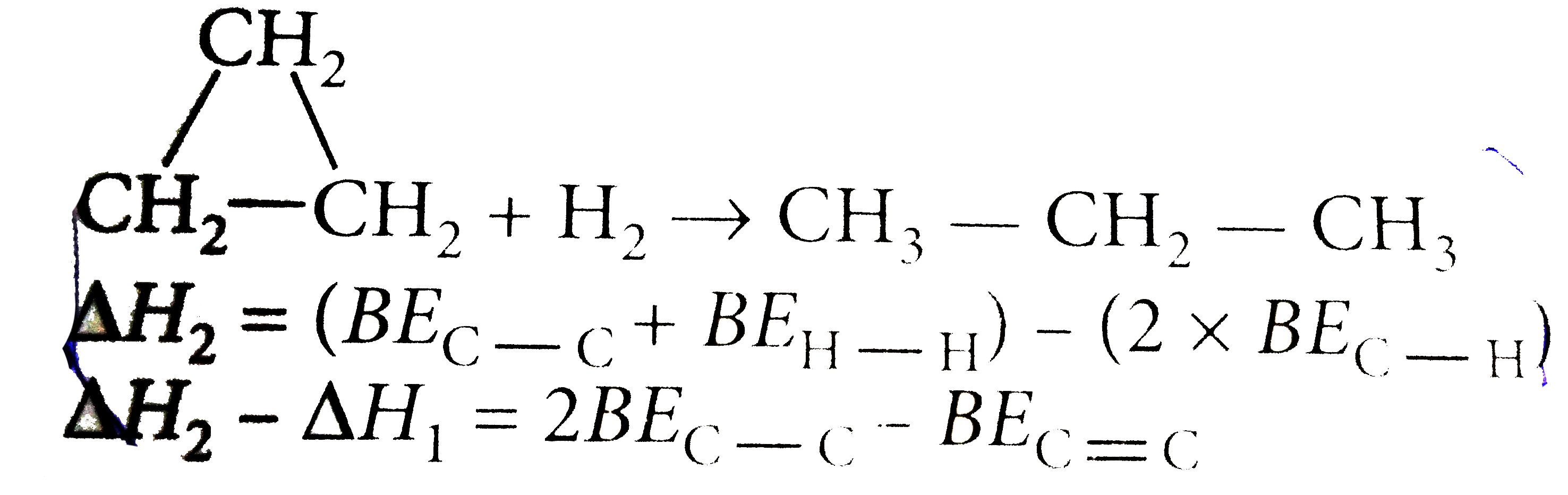
|
|
| 33. |
Consider the following two equilibrium established together in a closed container A(s)hArr2B(g)+3C(g) , K_(P_(1) A(s)hArr3D(g) , K_(P_(2) Starting with only A(s), molar ratio of B(g) & D(g) at equilibrium is found to be in a ratio 1:6 determine (K_(P_(2)))/(8K_(P_(1))) |
|
Answer» `K_(p_(1))=(P_(0))^(2)((3P_(0))/(2))^(3)` `K_(p_(2))=(6P_(0))^(3)` `(K_(p_(2)))/(K_(p_(1)))=(6^(3))/(((3)/(2))^(3))=64` `(K_(p_(2)))/(8K_(p_(1)))=(64)/(8)=8` |
|
| 34. |
Consider the following two equilibria simultaneously established in a rigid vessel at a particular temperature NH_(2)COOMH_(4)(s)hArr2NH_(3)+CO_(2)(g) CaCO_(3)(s)hArrCaO(s)+CO_(2)(g) Now, on adding some amout of NH_(3) to the reaction vessel, the orignal equilibrium is disturbed and a new equilibrium state is obtained. On comparing the following at the initial & final equilibrium states, select the INCORRECT statement (s): |
|
Answer» Nothing can be SAID about the number of moles of `CO_(2)` gas in reaction vessel. So, `n_(caco_(3)(s)` will definitely decrease Now, `K_(P_(1))=P_(NH_(3))^(2)xxP_(CO_(2)) "&" K_(P_(2))=P_(CO_(2))` Since no change in temperature would have taken place, `K_(P_(1)=K_(P_(2)` will have same values at both equilibrium states. So, amount of `NH_(2) "&" CO_(2)` at the two equilibrium states will remain the same. |
|
| 35. |
Consider the following two decomposition reaction (i) 2 H_(2)O rarr 2 H_(2) +O_(2)(ii) CaCO_(3)rarr Ca + CO_(2) Which of the two isa redox rection ? Explain |
|
Answer» Solution :For a decompositionreaction to be redox reaction one or both the products of decomposition must be in the ELEMENTAL state therefore reaction (i) is a redox reaction since both the products i.e`H_(2)` and `O_(2)`are in the elemental state `2 overset(+1)H_(2)overset(O)(L) rarr2 H_(2) (g)+O_(2)(g)` but reaction (ii) is not a redox reaction since neither of the two proucts is the elemental state `CaCO_(3)(s) rarr CaO(s) +CO_(2)(g)` |
|
| 36. |
Consider the following table of standard reduction potentials. {:("Reaction",E^@(V)),(A^(3+)+2e^(-) rarrA^+,1.36),(B^(2+)+2e^(-)rarrB,0.72),(C^(2+)+2e^(-)rarrC,-0.28),(D^(+)+e^(-)rarrD,-1.42):} Writer a balanced chemical equation for the overall calculate E^@ for the reaction. |
|
Answer» `E^@=1.36-(-1.42)=2.78V` |
|
| 37. |
Consider the following table of standard reduction potentials. {:("Reaction",E^@(V)),(A^(3+)+2e^(-) rarrA^+,1.36),(B^(2+)+2e^(-)rarrB,0.72),(C^(2+)+2e^(-)rarrC,-0.28),(D^(+)+e^(-)rarrD,-1.42):} What substance is (i) strongest oxidising agnet ? (ii) strongest reducing agent ? |
|
Answer» (II) D is the strongest reducing agent. |
|
| 38. |
Consider the following structure of formula C_(6)H_(6) underset(I)(HC-=C CH_(2)CH_(2)C-=CH) underset(II)(HC-=C-CH_(2)-C-=C-CH_(3)) underset(III)(C-=C-C-=C-CH_(2)CH_(3)) Five isomeric disubsitution products are theoretically posible from |
| Answer» Solution :(I). Five, (II) five, (III) five, (IV) two, and (V) (four). | |
| 39. |
Consider the following substances {:((1) BeSO_(3), (2) MgSO_(4)), ((3)CaSO_(4), (4) SrSO_(4)):} The correct order of solubilities is |
|
Answer» `1 GT 2 gt 3 gt 4` |
|
| 40. |
Consider the following structure and pich by the right statement : |
|
Answer» I and II have R-configuration |
|
| 41. |
Consider the following statements. The common features of the molecules BF_3, SF_6 and NO are that i) all contain odd electron bond ii) all are gases at room temperature iii) all contain unpaired electrons iv) all do not confirm to the octet rule |
|
Answer» i and II |
|
| 42. |
Consider the following statements: The coefficient B in the virial equation of state (P) is independent of temperature (Q) is equal to zero at boyle temperature PV_(m)=RT(1+(B)/(V_(m))+(C)/(V_(m)^(2))+......) (R) has the dimension of molar volume which of the above statement are correct? |
|
Answer» <P>P and Q |
|
| 43. |
Consider the following statements regarding the given projection. |
|
Answer» W and Y are diasteroisomers. 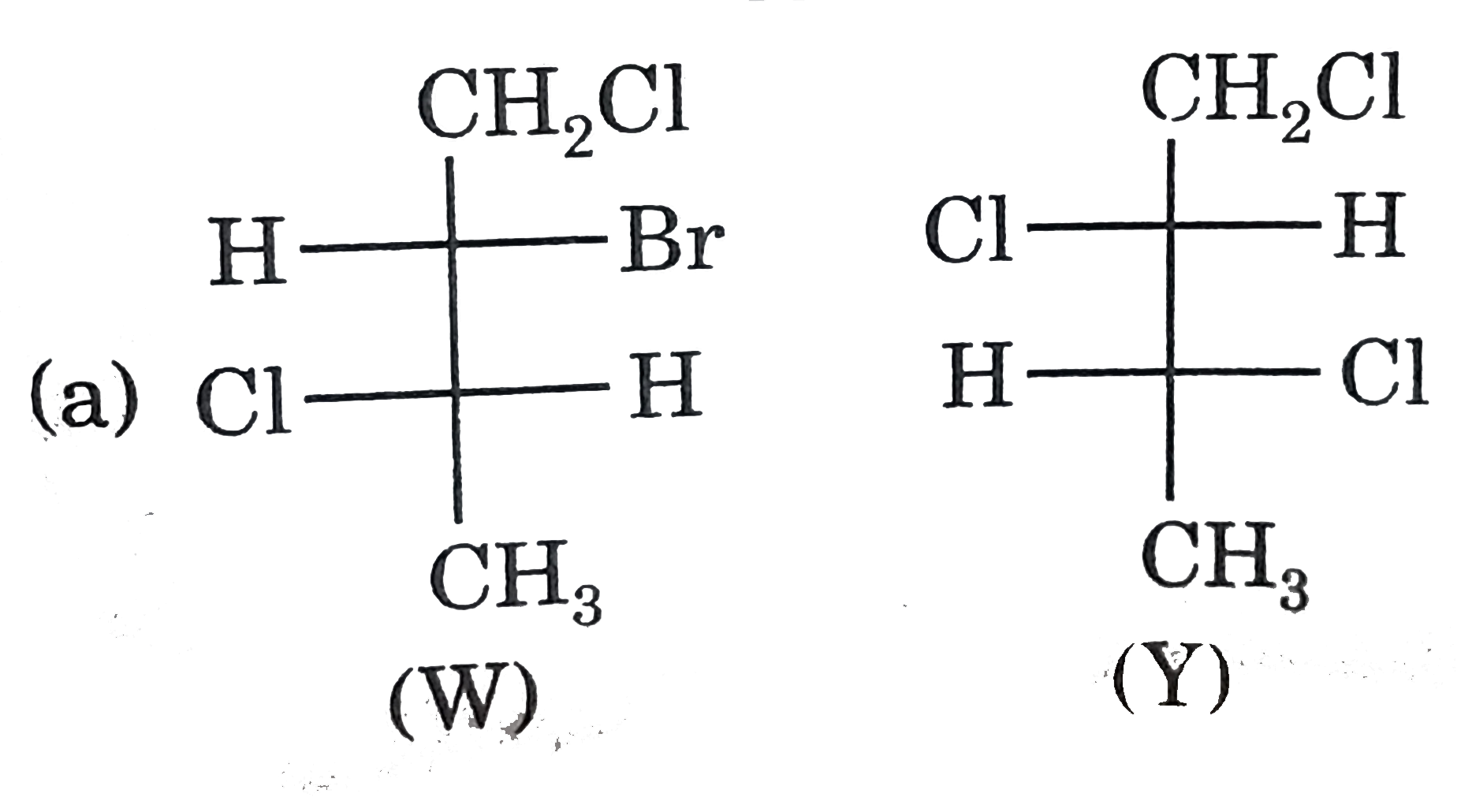 (C ) All (W,X,Y,Z) are optically active. 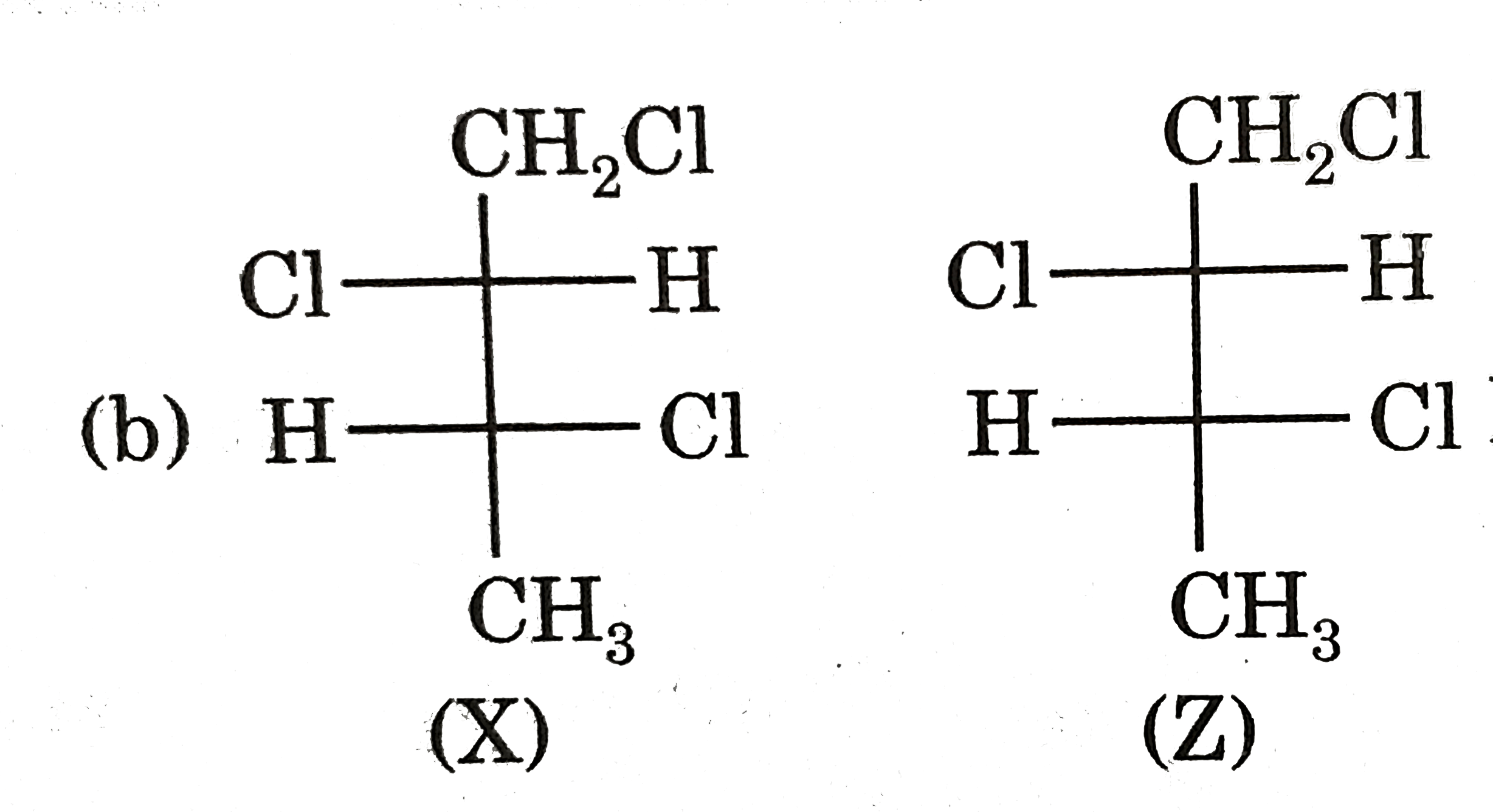
|
|
| 44. |
Consider the following statements regarding Sommerfeld's model. Select the correct statement/s. |
|
Answer» Around the nucleus, some of the paths are elliptical and others are circular |
|
| 45. |
Consider the following statements: It is not possible for the carbon to form either C^(4-) (or) C^(4-) (ii) Carbon can form ionic bonds. (iii) In compounds of carbon, it form covalent bonds. Which of the above statement is//are not correct? |
| Answer» Answer :d | |
| 46. |
Consider the following statements. (i) The process of reduction using sodium in liquid ammonia is called as Brich reduction. (ii) Brich reduction is stereospecific in reaction. (iii) Alkynes can be reduced to cis-alkenes using Brich reductionWhich of the above statement is/are correct ? |
| Answer» Solution :(i) and (ii) | |
| 47. |
Consider the following statements. (i) S_(N^(2)) reaction is a bimolecular nucleophilic first order reaction. (ii) S_(N^(2)) reaction take place in one step. (iii) S_(N^(2))reaction involves the formation of a carbocation.Which of the above statements is/are not correct? |
| Answer» ANSWER :C | |
| 48. |
Consider the following statements (i) Oxidation number of He= zero (ii) Increase in oxidation number results in reduction . (iii) The substance undergoing increase in oxidation number is reducing agent. Which among the above statement(s) is/are correct ? |
|
Answer» only (i) |
|
| 49. |
Consider the following statements I NO is formed from N_(2) and O_(2) when lighting occurs at high altitude. II NO is formed when N_(2) is oxidized by O_(3) (III) NO is oxidized to NO_(2) by O_(2) or by O_(3) in the stratosphere. (IV) N_(2)O is formed by the reaction of N_(2) with O_(3) or with atomic oxygen in the upper atmosphere and also by microbiological process. Select the correct statements |
|
Answer» I,III and IV `N_(2)+O_(2) rarr 2NO` When lightning OCCURS THUS (I) is correct. `NO+O_(3) rarr NO_(2)+O_(2)` in the stratosphere thus (III) is correct. `N_(2)+O_(3) rarr N_(2)O+O_(2)` `N_(2)+Orarr N_(2)O` Thus, (IV) is correct. |
|
| 50. |
Consider the following statements . (i) Lindlar's catalyst is CaCO_3 supported in Pd. (ii) Lindlar's catalyst is stereospecific catalyst (iii) Using Lindlar's catalyst alkynes undergoes reduction of form trans-alkenes.Which of the above statement is/are not correct ? |
|
Answer» (i) only |
|