Saved Bookmarks
This section includes 7 InterviewSolutions, each offering curated multiple-choice questions to sharpen your Current Affairs knowledge and support exam preparation. Choose a topic below to get started.
| 1. |
Considering the chemical properties, atomic weight of the element 'Be' was corrected based on |
|
Answer» Valency |
|
| 2. |
Considering the basic strength of amines in aqueous solution, which one has the smallest pK_(b) value ? |
|
Answer» `(CH_(3))_(2)NH` |
|
| 3. |
Considering the atomic number and position in the periodic table, arrange the following elements in the increasing order of metallic character : Si , Be, Mg, Na, P. |
| Answer» Solution :Metallic character increases down a group and decreases along a period as we MOVE from LEFT to right. HENCE the order of INCREASING metallic character is : `P lt Si lt Be lt Mg lt Na`. | |
| 4. |
Consideringthe atomicnumberand positionin theperiodicarrange the followingelements in theincreasingorder tometalliccharacter:Si, Be, Mg, Na, P |
|
Answer» <P> Solution :Arrangingthe elements intodifferentgroupsand periods in orderof theirincreasingnumberwe have.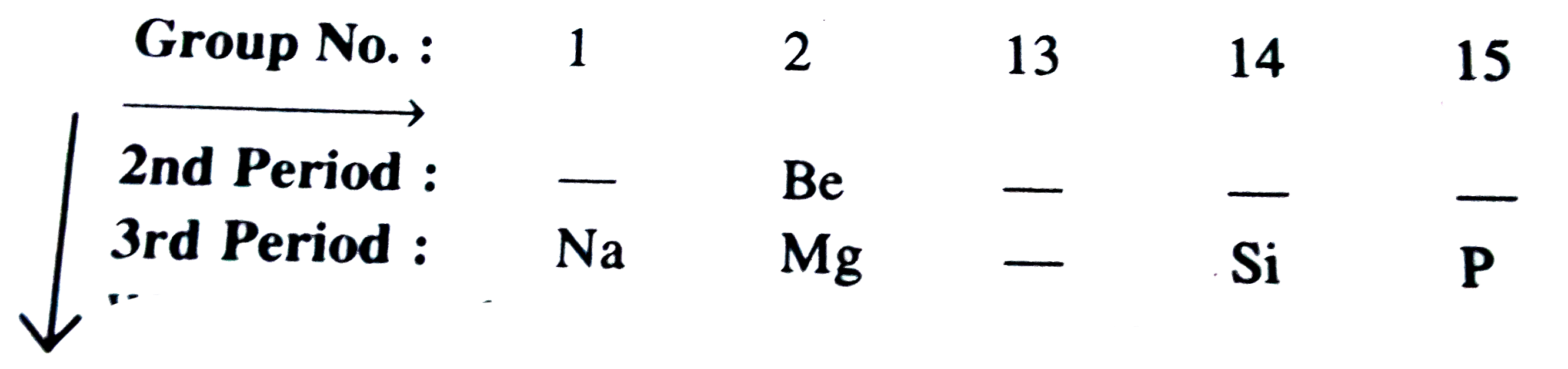 We knowthat themetalliccharacterincreasesdown agroupandalonga periodas wemove fromleftto right. THEREFORE, Na is themostmetallicelementfollowedby Mg and Si, WhileP is theleast metallicelement. AmongBe andMg , Mg is moremetallicthan Be. thereforethe overall increasing ORDER to metalliccharacter is `P LT Si lt Be lt Mg lt Na` |
|
| 5. |
Considering greater polarization in LiCl compared to that in NaCl, which of the statements you would expect to be wrong? |
|
Answer» LiCl has lower MELTING point that NaCl |
|
| 6. |
Considering entropy (S) as a thermodynamic parameter, the criterion for the spontaneity of any process is |
|
Answer» `DeltaS_("system") -DeltaS_("surrounding") gt 0` |
|
| 7. |
Considering entropy (s) as a thermo dynamic parameter, the criterion for the spontanity of any process is |
|
Answer» `Delta S_("sys") + Delta S_("SURR") GT 0` |
|
| 8. |
Consider three one-litre flasks labeled A, B and C filled with the gases NO, NO_(2) and N_(2)Orespectively, each at 1 atm and 273 K. In which flask do the molecules have the highest average kinetic energy? |
|
Answer» Flask C |
|
| 9. |
Consider this reaction. 2NO(g)+Cl_(2)(g) hArr 2NOCl(g)""DeltaH=-78.38"kJ" What conditions of temperature and pressure will produce the highest yield of NOCl at equilibrium? |
|
Answer» <P>`{:("T","P"),("HIGH","high"):}` |
|
| 10. |
Consider thiol anion (RS^(Θ)) and alkoxy anion (RO^(Θ)). Which of the following statement is correct ? |
|
Answer» `RS^(Θ)` is less basic and less nucleophilic than `RO^(Θ)` |
|
| 11. |
Consider the van der Waals' constants, a and b, for the following gases:{:(gas, Ar, Ne, Kr, Xe),(a//(atm " dm"^6 mol^(-2)),1.3,0.2,5.1,4.1),(b//(10^(-2)dm^3 mol^(-1)),3.2,1.7,1.0,5.0):} Which gas is expected to have the highest critical temperature? |
|
Answer» Xe |
|
| 12. |
Consider the titratonof potassium dichromate solution with acidfied mohr salt solution using dmiethylamine as incdicator the number of moles of mohr salt required per mole of dichromate |
|
Answer» 3 `Fe^(2+)RARRFE^(3+)+e^(-)]xx6` `Cr_(2)O_(7)^(-)+14H^(+)+6e^(-)rarr2Cr^(3+)+7H_(2)O` `6Fe^(2+)+Cr_(2)O_(7)^(2-)+14H^(+)rarr6Fe^(3+)+2Cr^(3+)+7H_(2)O` thus 1 mole of `Cr_(2)O_(7)^(2-)` ION will oxidise 6 MOLES of Mohr 's salt |
|
| 13. |
Consider the titration of potassium dichromate solution with acidified Mohr's salt solutionusing diphenylamine as indicator. The number of moles of Mohr's salt required per mole of dichromate is : |
|
Answer» 3 1 MOLE of dichromate oxidises SIX MOLES of ferrous ion present in Moh's salt |
|
| 14. |
Consider the titration of 0.1000 M NH_(3)(K_(b) = 1.76 xx 10^(-5)) with 0.1000 M HNO_(3). The pH at the equivalence point is |
|
Answer» between `2.0` and `4.0` |
|
| 15. |
Consider the three solutions of 1 M concetration (1) Sodium acetate (CH_3COONa) (2)Acetic acid +Sodium acetate (CH_3COOH+ CH_3COONa) (3)Acetic acid (CH_3COOH) pH of these solutions will lie in the following sequence: |
|
Answer» <P>` 3 lt 2 lt 1 ` (2) For buffer `, pH =P^(KA) ` (3)For acid, pH =` (P^(Ka))/( 2) ` |
|
| 16. |
Jagadeesh: How can we predict the nature of a salt, sodium acetate (CH_3COONa)? Leela: Explained the doubt of Jagadeesh by asking some questions. Here their conversation is given in incomplete sentence. Frame the questions and fill in it. Leela: ...................................................................? Jagadesh : CH_3COONa (Sodium acetate) is basic in nature. |
|
Answer» <P>` 3 LT 2 lt 1 ` (2) For buffer `, pH =P^(KA) ` (3)For acid, pH =` (P^(Ka))/( 2) ` |
|
| 17. |
Consider the system at equilibrium: NH_(4)HS(s) hArr NH_(3)(g)+H_(2)S(g)""DeltaHgt0 Factors which favour the formation of more H_(2)S(g) include which of the following? (P) adding a small amount of NH_(4)HS(s) at constant volume (Q) increasing the pressure at constant temperature (R) increasing the temperature at constant pressure |
|
Answer» <P>P only |
|
| 18. |
Consider the system at equilibrium: 2SO_(2)(g) + O_(2)(g) hArr 2SO_(3)(g) for which DeltaHlt0. Which change(S) will increase the yield of SO_(3)(g)? (P) Increasing the temperature (Q) Increasing the volume of the container |
|
Answer» <P>P only |
|
| 19. |
Consider the structure of Al_(2)Me_(6) compound and find the value of x/y Where, x = total number of atoms that are sp^(3) hydridised and y = total number of 3c2e bonds. |
|
Answer» |
|
| 20. |
Consider the statements : I . Bond length in N_(2)^(+) is 0.002 Å greater than in N_(2) II. Bond length in NO^(+) is 0.09 Å less than in NO III. O_(2)^(2-) hasshorter bond length than O_(2) which of the following statements are ture ? |
|
Answer» I and II Greater the bond order , shorter is the bond length HENCE order of NO is 2.5 and that of `NO^(+)` is 3 THUS , bond length of `NO^(+)` is shorter . Hence ,II is TRUE Bond order of `O_(2)`is 2 while that ` O_(2)^(2-)` is 1. Thus, bond length of `O_(2)` is shorter . Hence , III is not ture . |
|
| 21. |
Consider the same expansion, to a final volume of 10 liters conducted reversibly. |
|
Answer» SOLUTION :We have `Q= -W = 2.303 xx 10 "LOG" (10)/(2)` `= 16.1` litre-atm. |
|
| 22. |
Consider the same expansion, but this time against a constant external pressure of 1 atm. |
|
Answer» <P> Solution :We have `q=-2 = p_(ex) (8) = 8` litre - ATM |
|
| 23. |
Consider the same exapansion, but this time against a constant external pressure of 1 atm. |
| Answer» Solution :We have `q=-w=p_(EX)(10-2)=1(8)=8 `litre ATM. | |
| 24. |
Consider the redox reaction 2S_(2)O_(3)^(2-)+I_(2)rarrS_(4)O_(6)^(2-)+2I^(-) |
|
Answer» `S_(2)O_(3)^(2-)+I_(2)rarrS_(45)O_(6)^(2)+2I^(-)` |
|
| 25. |
Consider the reactions:(P)S ("rhombic") +(3)/(2)O_(2)(g) to SO_(3)(g), ""DeltaH_(1)(Q) S("Monoclinic")0 +(3)/(2)O_(2)(g) to SO_(2)""DeltaH_(2)(R) S("rhiombic")+O_(3)(g) to SO_(3)(g)""DeltaH_(3) (S)S("monoclince")+O_(3)(g) to SO_(3)(g)""DeltaH_(4) |
|
Answer» `DeltaH_(1)ltDeltaH_(2)LT DeltaH_(4)`(magnitude only) |
|
| 26. |
Consider the reactions (i) H_2O_2 + 2HI to I_2 + 2H_2O (ii) HOCl + H_2O_2 to H_3O^(+) + Cl^(-) + O_2 Which of the following statements is correct about H_2O_2 with reference to these reactions ? Hydrogen peroxide is ………. |
|
Answer» an oxidising AGENT in both (i) and (ii)  In above reduction `H_2O_2` ACTS as a Reducing agent and CONVERT HOCL into `Cl^(-1)` |
|
| 27. |
Consider the reactions given below. On the basis of these reactions find out which of the algebric relations given in options( a) to (d) is correct ? (i) C(g) + 4H(g) rarrCH_(4)(g), Delta_(r) H= x kJ mol^(-1) (ii) C( graphite, s) + 2H_(2)(g) rarrCH_(4)(g), Delta_(r)H= y kJ mol^(-1) |
|
Answer» `x=y` |
|
| 28. |
Consider the reactions given below. On the basis of these reactions find out which of the algebric relations given in options (a) to (d) is correct ? (i) C_((g))+4H_((g))rarrCH_(4(g)),Delta_(r)H=x" kJ mol"^(-1) (ii) C_("(graphite, s)")+2H_(2(g))rarrCH_(4(g)),Delta_(r)H="y kJ mol"^(-1) |
|
Answer» x = y |
|
| 29. |
Consider the reactions given below. On the basis of these reactions find out which of the algebraic relations given in options (A) to (D) is correct? (1) C_((g)) + 4H_((g)) to CH_(4(g)) , Delta_(r) H= x "kJ mol"^(-1) (2) C_(("graphite") ) + 2H_(2(g)) to CH_(4(g)) , Delta_(r) H = " y kJ mol"^(-1) |
|
Answer» `x=y` As energy is absorbed when bonds are broken, energy released in reaction (1) is greater than that in reaction (2) hence, `x gt y` |
|
| 30. |
Consider the reactions C_(6)H_(5)CHO(l)+2Cu^(2)+(aq)+5OH^(-)(aq)to no change observed What interference do you draw about the behaviour of Ag^+ & Cu^(2+) from these reactions? |
| Answer» SOLUTION :This reaction indicates that explain `CU^(2+)` ion is not capable of OXIDISING `C_(6)H_(5)CHO` This explain `Cu^(2+)`ion is a weaker oxidising agent than `Ag^(+)`iom. | |
| 31. |
Consider the reactions : (a) H_(3)PO_(2) (aq) + 4 AgNO_(3) (aq) +2 H_(2)O (1) to H_(3) PO_(4) ( aq) +4 Ag(s) + 4HNO_(3)(aq) (b) H_(3)PO_(2) (aq) + 2Cu SO_(4)(aq) + 2H_(2)O(1) to H_(3) PO_(4)(aq) + 2 Cu(s) + H_(2)SO_(4)(aq) (c) C_(6)H_(5) CHO(1) + 2[Ag (NH_(3))_(2)]^(+) (aq) + 3 OH^(-) (aq) to C_(6)H_(5)COO^(-)(aq) + 2Ag(s) + 4NH_(3)(aq) + 2 H_(2)O(1) (d) C_(6)H_(5)CHO(1) + 2Cu^(2+) (aq) + 5 OH^(-) (aq) toNo change observed . What inference do you draw about the behaviour of Ag^(+) and Cu^(2+) from these reactions ? |
|
Answer» Solution :These reactions SUGGEST that `Ag^(+)` ION is a stronger oxidising agent than `Cu^(+)` ion. It is evident from the following facts. (i) Reactions (a) and (b) suggest that both `Ag^(+)` and `Cu^(2+)` ions can oxidise `H_(3)PO_(3)` to `H_(3)PO_(4)`. Thus, both are oxidising agents. (ii) REACTION (c) suggests that `[Ag(NH_(3))_(2)]^(+)` can oxidise `C_(6)H_(5)CHO` to `C_(6)H_(5)COOH`, but reaction (d) indicates that `Cu^(2+)` ions are unable to do so. Hence, it may be concluded that although both `Ag^(+)` and `Cu^(2+)` act as oxidising agents, yet `Ag^(+)` is a stronger oxidising agent than `Cu^(2+)`. |
|
| 32. |
Consider the reactions : (a) H_(3)PO_(2(aq))+4AgNO_(3(aq))+2H_(2)O_((l))toH_(3)PO_(4(aq))+4Ag_((s))+4HNO_(3(aq)) (b) H_(3)PO_(2(aq))+2CuSO_(4(aq))+2H_(2)O_((l))toH_(3)PO_(4(aq))+2Cu_((s))+H_(2)SO_(4(aq)) ( c) C_(6)H_(5)CHO_((l))+2[Ag(NH_(3))_(2)]_((aq))^(+)+3OH_((aq))^(-)toC_(6)H_(5)COO_((aq))^(-)+2Ag_((s))+4NH_(3(aq))+2H_(2)O_((l)) (d) C_(6)H_(5)CHO_((l))+2Cu_((aq))^(2+)+5OH_((aq))^(-)to No change observed. What inference do you draw about the behaviour of Ag^(+)andCu^(2+) from these reactions ? |
|
Answer» Solution :In REACTION (a) and (b) `Ag^(+)` oxidises `C_(6)H_(5)CHO" to "C_(6)H_(5)COO^(-)`, but in reaction (d) `Cu^(+2)` COULD not oxidises `C_(6)H_(5)CHO`. Therefore, we can say that `Ag^(+)` is strong oxidizing agent then to `Cu^(+)`. |
|
| 33. |
Consider the reactions : (a) 6CO_(2(g))+6H_(2)O_((l))toC_(6)H_(12)O_(6(aq))+6O_(2(g)) (b) O_(3(g))+H_(2)O_(2(l))toH_(2)O_((l))+2O_(2(g)) Why it is more appropriate to write these reactions as : (a) 6CO_(2(g))+12H_(2)O_((l))toC_(6)H_(12)O_(6(aq))+6H_(2)O_((l))+6O_(2(g)) (b) O_(3(g))+H_(2)O_(2(l))toH_(2)O_((l))+O_(2(g)) Also suggest a technique to investigate the path of the above (a) and (b) redox reactions. |
|
Answer» SOLUTION :(a) Process of photosynthesis is very complex so it occurs in two steps. Step - 1 : `H_(2)O` decompose in presence of chlorophyll and `H_(2)andO_(2)` is obtained. Step - 2 : `H_(2)` reduce `CO_(2)` in `C_(6)H_(12)O_(6)` and some molecules of `H_(2)O` are obtained.  We must have to write this equation for total reaction of photosynthesis reaction. So, `12H_(2)O` USED for production of 1 MOLE carbohydrate and `6H_(2)O` produce during this reaction. (b) `O_(2)` write two times because `O_(2)` is obtained from two DIFFERENT reactants.  For deciding reaction of path (a) `H_(2)O^(18)orH_(2)O` is used. For deciding reaction of path (b) `H_(2)O_(2)^(18)orO_(3)^(18)` is used. |
|
| 34. |
Consider the reactions (A) H_(2)O_(2)+ 2HI to I_(2)+2H_(2)O (B) HOCl + H_(2)O to H_(3)O^(+)+Cl^(-) + O_(2) Which of the following statements is correct about H_(2)O_(2) with reference to these reactions ? Hydrogen perioxide is …......... . |
|
Answer» an oxidising AGENT in both (A) and (B) Thus, in reaction (A), `H_(2)O_(2)` acts as an oxidising agent since `O_(2)` is not evolved but in reaction (B), it acts a reducing agent because `O_(2)` is evolved , i.e., option (b) is correct. |
|
| 35. |
Consider the reactions : (a) 6CO_2(g) +6H_2O(l) rarr C_6H_(12)O_6(aq) +6O_2(g) (b) O_s(g) +H_2O_2(l) rarr H_2O(l) +2O_2(g) Why it is more appropriate to write these reactions as : (a) 6CO_2(g) +12H_2O(l) rarr C_6H_(12)O_(6)(aq)+6H_2O(l)+6O_2(g) (b) O_3 (g) +H_2O_2(l) rarr H_2O(l)+O_2(g)+O_2(g) Also suggest a technique to investigate the path of the above (a) and (b) redox reactions . |
|
Answer» Solution :It is believed that the PHOTOSYNTHESIS reaction occurs. In two steps . In the first step , `H_2O` decomposes to give `H_2 and O_2` in the pressure of CHLOROPHYLL and the `H_2` produced reduces `CO_2 " to " C_6H_(12)O_6` in the second step , During the second step , some `H_2O` molecules are also produced and therefore , the reaction occurs as : `{:("(i)"12H_(2)O(l)rarr12H_(2)(g)+6O_(2)(g)),("(II)"6CO_(2)(g)+12H_(2)(g)rarrC_(6)H_(12)O_(6)(s)+6H_(2)O(l)),(bar("(iii) "6CO_(2)(g)+12H_(2)O(l)rarrC_(6)H_(12)O_(6)(s)+6H_(2)O(l)+6O_(2)(g)"")):}` Therefore , it is more appropriate to write the reaction for photosynthesis as (iii) because it MEANS that 12 moleules of `H_2O` are used per molecule of carhydrate and `6H_2O` molecules are produced per molecule of carbohydrate during the PROCESS. (ii) `O_2` is written two times in the product which suggests that `O_2` is being obtained from the two reactants as `{:(""O_3(g) rarrO_2(g)+O(g)),(H_2O_2(l)+O(g)rarrH_2O(l)+O_2(g)),(bar((O_3)(g)+H_2O_2(l)rarrH_2O(l)+O_2(g)+O_2(g))):}` The path of the reaction can be studies by using `H_2O^(16)` in reaction (a) or by using `H_2O_2^(18) " or" O_3^(18)` in reaction (b). |
|
| 36. |
Consider the reactions : (a) 6 CO_(2) (g) + 6 H_(2)O (1) to C_(6) H_(12) O_(6) (aq) + 6 O_(2)(g) (b) O_(3)(g) + H_(2)O_(2)(1) + 2 O_(2)(g) Why it is more appropriate to write these reactions as : (a) 6 CO_(2) (g) + 12 H_(2)O(1) to C_(6)H_(12)O_(6) (aq) + 6 H_(2)(1) + 6 O_(2)(g) (b) O_(3)(g)+ H_(2)O_(2)(1)to H_(2)(1) + O_(2)(g) + O_(2)(g) Also suggest a technique to investigate the path of the above (a) and (b) redox reactions . |
|
Answer» Solution :This reaction EXPRESSES the process of photosynthesis which is a very complicated process and occurs in several steps. In this reaction, 12H_(2)O` molecules first decompose to give `H_(2)` and `O_(2)` in the presence of chlorophyll and the `H_(2)` thus produced reduces `CO_(2)` to `C_(6)H_(12)O_(6)`. Thus, in a simple way, the reaction can be expressed as follows. `{:(""12H_(2)O(l)to12H_(2)(g)+6O_(2)(g)""....(i)),(6CO_(2)(g)+12H_(2)(g)toC_(6)(g)+12H_(2)(g)toC_(6)H_(12)O_(6)(s)+6H_(2)O(l)......(ii)),(bar(6CO_(2)(g)+12H_(2)O(l)toC_(6)H_(12)O_(6)(s)+6H_(2)O(l)+6O_(2)(g))........(iii)):} Therefore, it is more appropriate to WRITE the reaction as (iii). This representation involves the participation of `12H_(2)O` molecules and liberation of `6H_(2)O` molecules in the reaction. (b) The given reaction actually takes PLACE as follows: `{:(""O_(3)(g)toO_(2)(g)+O(g)""......(i)),(H_(2)O_(2)(l)+O(g)toH_(2)O(l)+O_(2)(g)""......(ii)),(bar(O_(3)(g)+H_(2)O_(2)(l)toH_(2)O(l)+O_(2)(g)+O_(2)(g))""......(iii)):}` The representation of the reaction as (iii) SUGGESTS that one `O_(2)` molecule is obtained from `O_(3)` while the other from `H_(2)O_(2)`. Therefore, it is a more appropriate representation of the reaction. The path of the REACTIONS (a) and (b) can he investigated by tracer technique, i.e., by using `H_(2)O^(18)` in reaction (a) and by using `H_(2)O_(2)^(18)` (or `O_(3)^(18)` ) in reaction (b). |
|
| 37. |
consider the reactions: 6CO_(2)(g)+6H_(2)O(l)toC_(6)H_(12)O_(6)(aq)+6O_(2)(g) O_(3)(g)+H_(2)O_(2)(l)toH_(2)O(l)+2O_(2)(g) Why it is more approporiate to write these reactions as: 6CO_(2)(g)+12H_(2)O(l)toC_(6)H_(12)O_(6)(aq)+6H_(2)(l)+6O_(2)(g) O_(3)(g)+H_(2)O_(2)(l)toH_(2)O(l)+O_(2)(g)+O_(2)(g) Also suggest a technique to investigate the path of the above 1 and 2 redox reactions. |
|
Answer» Solution :`6CO_(2)(g)+12H_(2)O(l)toC_(6)H_(12)O_(6)(s)+6O_(2)(g)+6H_(2)O(l)` Thus ,equation (3) will be more APPROPRIATE for representing photosynthesis reaction because it gives the ACTUAL stoichiometryof the REACTANTS and the products involved in the given reaction. |
|
| 38. |
Consider the reactions : 2S_(2)O_(3(aq))^(2-)+I_(2(s))toS_(4)O_(6(aq))^(2-)+2I_((aq))^(-) 2S_(2)O_(3(aq))^(2-)+2Br_(2(l))+5H_(2)O_((l))to2SO_(4(aq))^(2-)+4Br_((aq))^(-)+10H_((aq))^(+) |
|
Answer» Solution :In `S_(2)O_(3)^(-2)`, OXIDATION number of S is +2. Where in `S_(4)O_(6)^(-2)` is +2.5. In `SO_(4)^(-2)`, oxidation number of S is +6. `Br_(2)` is STRONG oxidising agent than `I_(2)`. So `Br_(2)` is convert `S_(2)O_(3)^(-2)` into `SO_(4)^(-2)`. In which oxidation number of oxygen is `S_(2)O_(3)^(-2)` is (+2) and `SO_(4)^(-2)` is (+6). So, it is oxidise (+2) into (+6). While `I_(2)` is weak oxidizing agent. Therefore, it oxidised `SO_(3)^(-2)` (S = +2) to `S_(4)O_(6)^(-2)` (S = +2.5). Therefore, it gives different reactions. |
|
| 39. |
Consider the reactions : 2S_(2)O_(3)^(2-)(aq)+l_(2)(s)toS_(4)O_(6)^(2-)(aq)+2l^(-)(aq) S_(2)O_(3)^(2-)(aq)+2Br_(2)(l)+5H_(2)O(l)to2SO_(4)^(2-)(aq)+4Br^(-)(aq)+10H^(+)(aq) Why does the same reductant, thiosulphate react differently with iodine and bromine? |
|
Answer» Solution :The oxidation numbers of S in the INVOLVED species are as follows: `S_(2)O_(3)^(2-):+2,S_(4)O_(6)^(2-):+2.5,SO_(4)^(2-):+6` Bromine is a stronger oxidising agent than `l_(2)`. Therefore, it oxidises `S_(2)O_(3)^(2-)` (O.N. of S=+2) to `SO_(4)^(2-)` (O.N. of S=+6) in which is in a higher oxidation state. `l_(2)` being a weaker oxidising agent is able to oxidise `S_(2)O_(3)^(2-)` to `S_(4)O_(6)^(2-)` (O.N. of S = 2.5) in which S is in a lower oxidation state. This is why `S_(2)O_(3)^(2-)` REACTS differently with bromine and IODINE. |
|
| 40. |
Consider the reaction where K_(p)=0.5 at a particular temperature PCl_(5)(g)hArrPCl_(3)(g)+Cl_(2)(g) If the three gases are mixed in a container so that the partial pressure of each gas is initially 1 atm, then which one of the following is true |
|
Answer» more `PCl_(3)` will be PRODUCED |
|
| 41. |
Consider the reaction where K_P = 0.5 at a particular temperature PCl_5(g) hArr PCl_3(g) + Cl_2(g) if the three gases are mixed in a container so that the partial pressure of each gas is initially1 atm,then which one of the following is true? |
|
Answer» more `PCl_3` will be produced `Q = (P_(PCl_5).P_(Cl_2))/(P_(PCl_5))` `Q = (1xx1)/1` `Q GT K_P` `:.` Reverse reaction is favoured, i.e., more `PCl_5` will be produced. |
|
| 42. |
Consider the reaction where , K_P = 0.5at a particular temperaturePCl_(5)(g) hArr PCl_3 (g) + Cl_2 (g) if the three gases are mixed in a container so that the partial pressure of each gas is initially 1 atm, then which one of the following is true. |
|
Answer» <P>more `PCl_3` will be PRODUCED `Q=(P_(PCl_3) * P_(Cl_2))/(P_(PCl_5))` `Q= (1xx1)/1` `Q gt K_p` `THEREFORE ` REVERSE reaction is favoured , i.e. more `PCl_5` will be produced. |
|
| 43. |
Consider the reaction where K_(p) = 0*497 "at 500 K PCl_(5) (g) hArr PCl_(3) (g) + Cl_(2) (g)If the three gases are mixed in a rigid container so that the partial pressure of each gas is initially1 atm, which is true ? |
|
Answer» More `PCl_(5)` will be PRODUCED As `Q_(p) gt K_(c)` , equilibrium will go in the BACKWARD direction , i.e., more `PCl_(5)` will be produced . |
|
| 44. |
Consider the reaction The end product of the reaction is |
|
Answer»
 The REDUCTION of thioacetal is takes place in neutral solution and can be used for compounds that are senstitive to both acids and bases. |
|
| 45. |
Consider the reaction sequence below : |
|
Answer»
|
|
| 46. |
Consider the reaction of water with F_(2) and suggest , in terms of oxidation and reduction, which species are oxidised /reduced ? |
|
Answer» Solution :`underset("Oxidant")(2Fe_(2)(g))+ underset("Reductant")(2H_(2)O(l))to O_(2)(g) + 4H^(+)(aq) + 4F^(-)(aq)` or `underset("Oxidant")(3Fe_(2)(g))+ underset("Reductant")(3H_(2)O(l)) to O_(3)(g) + 6H^(+)(aq) + 6F^(-)(aq)` In these reactions, water acts as a reducing AGENT and HENCE itself gets oxidised to EITHER `O_(2)` or `O_(3)` while `F_(2)` acts as an oxidising agent and hence is itself reduced to `F^(-)` ion. |
|
| 47. |
Consider the reaction of water with F_(2) and suggest in terms of oxidation and reduction whichh species are oxidised/reduced |
Answer» SOLUTION :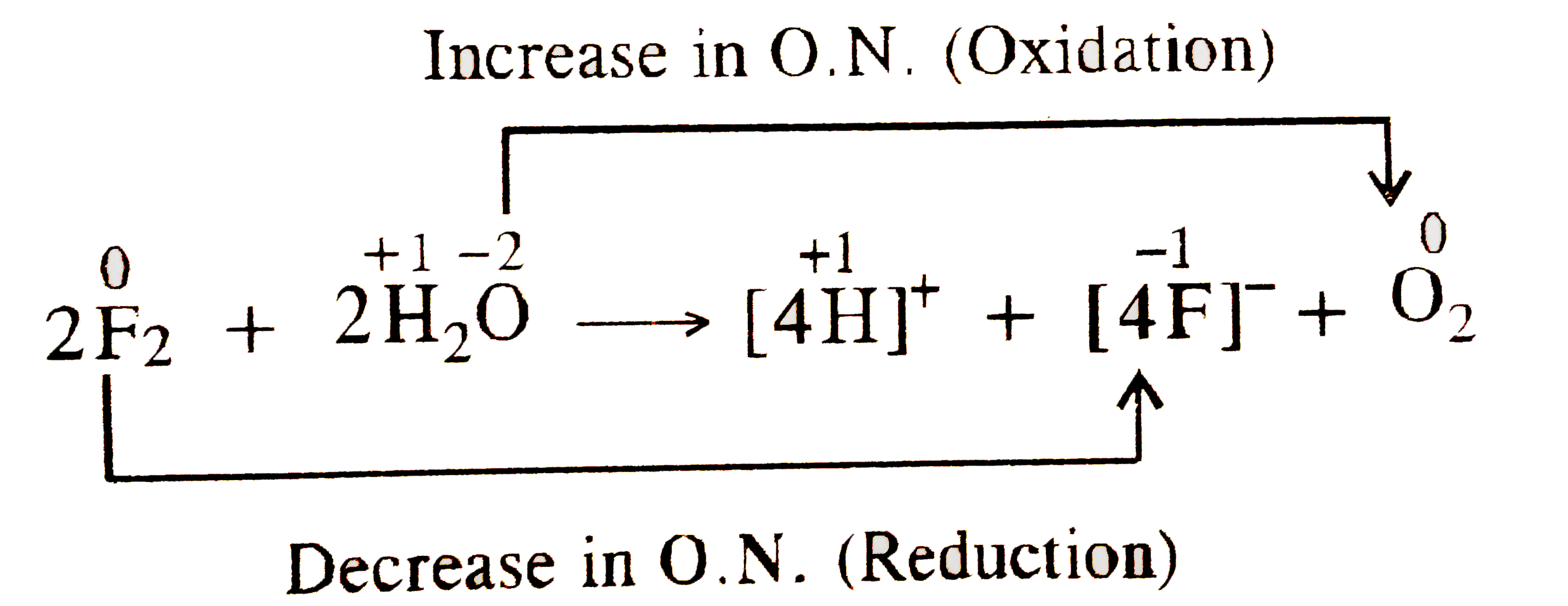 (I) Water `(H_(2)O)` is oxidised to `O_(2)`. (ii) Fluorine `(F_(2))` is REDUCED to `F^(-)` ions or HF |
|
| 48. |
Consider the reaction of water with F_2 and suggest in terms of oxidation and reduction, which species are oxidised reduced. |
|
Answer» Solution :`2F_(2(g)) + 2H_(2)O_((l)) to O_(2(g)) + 4H_((AQ))^(+) + 4F_((aq))^(-)`Reduction/oxidation In above reaction water act as a REDUCING agent so, it accept oxygen while fluorine act a oxidising agent. It release Fluorine ion `(F^-)` . |
|
| 49. |
Consider the reaction NH_(4)COONH_(2)(s) hArr 2NH_(3)(g) + CO_(2)(g)at a certain temperature, the equilibrium pressure of the system is 0.318atm. Find K_(p) of the decomposition of ammonium carbonate. |
|
Answer» SOLUTION :`P_("total") = 3P "" :. P = 0.318//3 = 0.106 ` ` kp = 4P^(3) = 4.76 xx 10^(-3)` |
|
| 50. |
Consider the reaction, N_(2)(g)+3H_(2)(g) hArr 2NH_(3)(g) . Explain the effect of pressure on this equilibrium reaction. |
|
Answer» Solution :`N_(2)(g) + 3H_(2)(g) HARR 2NH_(3)(g)` In the above equlibirum, if the pressure is increased, the volume will decrease, The system responds to this effect by reducing the number of gas molecules , i.e, It favours the FORMATION of ammonia. If the pressure is reduced, the volume will increase. It favours the decomposition of ammonia. |
|