

Saved Bookmarks
This section includes 7 InterviewSolutions, each offering curated multiple-choice questions to sharpen your Current Affairs knowledge and support exam preparation. Choose a topic below to get started.
| 1. |
For the reaction H_(2) (g) + I_(2) (g) hArr 2 HI (g) , the equilibrium constant K_(C) is ……… |
| Answer» SOLUTION :`([HI]^(2))/([H_(2)][I_(2)])` | |
| 2. |
For the reaction : H_(2) (g) + CO_(2) hArr CO(g) + H_(2) O (g) , if the intial pressure of [H_(2)]=[CO_(2)] and x moles / litre of hydrogen is consumed at equilibrium , the correct expression of K_(p) is |
|
Answer» <P>`x^(2)/(1-x)^(2)` ` K_(c) = (x xx x)/((1-x)(1-x))=x^(2)/(1-x)^(2)`. `K_(p)= K_(c)"" ( :' Deltan_(g)= 0)` |
|
| 3. |
For the reaction Fe_(2)S_(3)+5O_2 to 2FeSO_4 +SO_(2) the equivalent weight of Fe_(2)S_(3) is- |
|
Answer» `M/4` |
|
| 4. |
For the reaction , FeCO_(3(s)) rarr FeO_((s)) + CO_(2(g)), Delta H= 82.8kJ " at " 25^(@)C, what is (Delta E or Delta U) " at " 25^(@)C? |
|
Answer» 82.8kJ `= 82.8 - (1 XX 8.314 xx 298)/(1000) = 80.32KJ` |
|
| 5. |
For the reaction : F_(2)+H_(2)O overset("Ice cold") underset("temperature") rarrHOF + HF which one is not correct ? |
|
Answer» It is INTRAMOLECULAR redox reaction It is not intermolecular redox reaction . |
|
| 6. |
For the reaction C(s) + CO_(2) (g) hArr 2CO(g). the partial pressures of CO_(2) and CO are 2.0 and 4.0 atm respectively at equilibrium. What is the value of K_(p)for this reaction? |
|
Answer» <P>0.5 |
|
| 7. |
For the reaction C(s) + CO_(2) (g) to 2 CO (g) K_(p) = 63 " atm at " 100 K . If at equilibriump_(CO) = 10_(p_(CO_(2)) , then the toal pressure of the gases at equilibrium is |
|
Answer» `6*3` atm `K_(p)=(p^(2) CO)/p_(CO_(2)) or 63 = ((10p_(CO_(2))))/(p_(CO_(2)))` or `p_(CO_(2)) = 63/100 = 0.63 " atm"` ` p_(CO)= 10p_(CO_(2))= 10 xx 0.63 " atm " =6.3 " atm"` ` :. p_("TOTAL")= p_(CO_(2)) + p_(CO) = 0.63 + 6.3 = 6.93 " atm"` |
|
| 8. |
For the reaction, CO_((g))+Cl_(2(g))hArrCoCl_(2(g)), the value of K_(p)//K_(c) is equal to |
| Answer» ANSWER :D | |
| 9. |
For the reaction CO(g) + Cl_(2) (g) hArr COCl_(2)(g) , K_(p)//K_(c) is equal to |
|
Answer» Solution :` K_(p) = K_(c) (RT)^(Delta n )` For the given REACTIONS, ` Delta n = 1 - 2 = - 1` ` :. (K_(p))/(K_(c)) = (RT)^(-1) = 1/(RT)` |
|
| 10. |
For the reaction CO_((g))+CI_(2(g)) harr COCI_(2(g)).The K_p // K_c is equal to |
| Answer» Solution :`(K_(P))/(K_(C))=(RT)^(Delta ng)` | |
| 11. |
For the reaction CO_((g))+2H_(2(g))hArrCH_(3)OH_((g)). If active mass of CO is kept constant and active mass of H_(2) is tripied, the rate of forward reaction will become |
|
Answer» Three TIMES |
|
| 12. |
For the reaction, CaCO_(3(g))hArrCaO_((s))+CO_(2(g))K_(p) is equal to |
|
Answer» `K_(c)` |
|
| 13. |
For the reaction C_(3) H_(8(g)) + 5O_(2(g)) to 3CI_(2(g)) + 4H_(2) O_((l)) , Delta H - Delta K=…..... |
|
Answer» `RT` |
|
| 14. |
For the reaction, C_2H_6(g) hArr C_2H_6(g) + H_2(g).K_p is 0.05 at 900 K. If an initial mixture comprising 20 mol of C_2H_6 and 80 mol of inert gas is passed over a dehydrogenation catalyst at 900 K, what is the equilibrium mole percentage of C_2H_6 in the gas mixture ? The total pressure is kept at 0.5 bar : |
|
Answer» 4.3 |
|
| 15. |
For the reaction between KMnO_(4) " and " H_(2)O_(2) the number of electrons transferred per mole of H_(2)O_(2) is : |
|
Answer» ONE |
|
| 16. |
For the reaction at 300 K A_((g)) harr V_((g))+ S_((g) . Delta_(t) H^(@) = - 30 "KJ/mol" Delta_(t)S^(@) = - 0.1 K.J. K^(-1)."mole"^(-1) What Is the value of equilibrium constant ? |
|
Answer» 0 |
|
| 17. |
For the reaction at 298K, A+ B rarr C, DeltaH =400 kJ mol^(-1) and DeltaS = 0.2 kJ K^(-1) mol^(-1) . At what temperature will be thereaction become spontaneous considerting DeltaHand DeltaS to be constant over the temperature range. |
|
Answer» Solution :`DeltaG = DeltaH - T DELTAS` For the reaction to be spontaneous , `DeltaG` should be negative,i.e.,` Delta H - T DeltaSlt0` or `DeltaH lt T Delta S` or `T Delta S gt DeltaH` or `T gt (DeltaH)/( DeltaS) ` or`T gt ( 400 kJ MOL^(-1))/( 0.2 kJ K^(-1)mol^(-1))` or `T gt 2000K` This method can be applied only when `DeltaH ` and `DeltaS` both are `+ve`. ALTERNATIVELY, for equilibrium , `DeltaG= 0 `. Hence, `T DeltaS = DeltH` or `T = ( DeltaH )/( DeltaS = 0.2 = ( 400KJ mol^(-1))/( 0.2 kJ K^(-1) mol^(-1))= 2000 K `. For SPONTANEITY, `DeltaG = -ve`. This can be so only when `T gt 2000K`. ( so that `TDeltaS gt DeltaH`is magnitude). |
|
| 18. |
For the reaction at 298 K, 2A + Bto C Delta H = 400 "kJ mol"^(-1) and Delta S = 0.2 "kJ K"^(-1) "mol"^(-1) At what temperature will the reaction become spontaneous considering Delta H and Delta S to beconstant over the temperature range. |
|
Answer» Solution :For balanced REACTION `Delta G =0` `therefore Delta G = Delta H - T Delta S` `O = Delta H - T Delta S` `therefore T = (Delta H )/ (Delta S ) = (400)/(0.2) = 2000 K` `therefore` At 2000 K temperature of the reaction is equilibrium. So the reaction will be spontaneous over the RANGE of the temperature 2000 K. |
|
| 19. |
For the reaction at 298 K : 2A +B to C DeltaH="400 KJ mol"^(-1) , DeltaS ="0.2 JK"^(-1) "mol"^(-1) Determine the temperature at which the reaction would be spontaneous . |
|
Answer» Solution :Given: T=298 K `DeltaH=400 "J mol"^(-1) =400 "J mol"^(-1)` `DeltaS=0.2 JK^(-1) mol^(-1)` `DELTAG=DeltaH-TDeltaS` If T=2000 K `DeltaG`=400 -(0.2 x 2000) =0 if T > 2000 K `DeltaG` will be negative The reaction WOULD be spontaneus only BEYOND 2000 K . |
|
| 20. |
For the reaction at 25^(@)C,X_(2)O_(4(l))to2XO_(2(g)),DeltaH=2.1kcal and DeltaS=20" cal "K^(-1). The reaction would be |
|
Answer» spontaneous |
|
| 21. |
For the reaction at 298 K, 2A+BtoC DeltaH=400 kJ mol^(-1) and DeltaS=0.2 kJ K^(-1)mol^(-1). At what temperature will the reaction becomes spontaneous considering DeltaH and DeltaS to be constant over the temperature range? |
| Answer» SOLUTION :`GT 200 K` | |
| 22. |
For the reaction Ag(CN)bar(2) hArr Ag^(+) 2 CN^(-), K_(c)" at "25^(@)C" is "4 xx 10^(-19) . Calculate [Ag^(+)] in solution which was originally 0*1 M in KCN and 0*03M in AgNO_(3). |
|
Answer» SOLUTION : Orignally on mixing KCN and `AgNO_(3)` , the reaction is `{:(,2 KCN,+,AgNO_(3),to,"Ag"(CN)_(2)^(-),+,KNO_(3),+,K^(+)),("Intial amounts",0*1 M,,0*03 M,,0,,0,,0),("Amounts after reaction ",(0*1-0*06),,0,,0*03 M,,0*03M,,0*03),(,=0*04 M,,,,,,,,):}` Thus , in the solution , now we have `[Ag (CN)_(2^(-)) ] = 0*3 M , [CN^(-)] = 0* 04 M .`SUPPOSE x is the amount of `Ag(CN)_(2)^(-)`dissociated at equilibrium . Then ` {:(,AG(CN)_(2)^(-),hArr,AG^(+),+,2CN^(-)),("Intial amounts",0*03,,0,,0*04),("Amounts at eqm.",(0*03 -x),,x,+,0*04 + 2x):}` ` K_(c) = [ AG^(+) [CN^(-)]^(2))/([Ag(CN)_(2)^(-)])= (x (0*04 + 2x)^(2))/(0*03 - x) = 4 xx 10^(-19) ("Given")` As `K_(c)`is very small , DISSOCIATION of `Ag(CN)_(2)^(-)` is very smalli.e., x is very small . Hence , `0*04 + 2x approxand 0*3 - x approx0*03 .` ` :. (x( 0*04)^(2))/(0*03 )= 4 xx 10^(-19)or x = 7*5 xx 10^(-18)` Thus at equilibrium , `[Ag^(+)] = 7* 5 xx 10^(-18)M` |
|
| 23. |
For the reaction Ag_(2)O(s)rarr 2Ag(s) + (1)/(2) O_(2)(g) , DeltaHis 30.56kJ mol^(-1) and Delta Sis 66JK^(-1) mol^(-1) at one atmosphere pressure. Calculate the temperature at which Delta G for it will be zero. What will be the direction of the reaction at this temperatureand at temperature above or below this temperature and why ? |
|
Answer» `DeltaG = DELTA H - T DeltaS `. Above 463K `, DeltaG = -ve` ( because `DeltaH ` and `Delta S` both are `+ve`) . Below 463K, `DeltaG = + ve`. |
|
| 24. |
DeltaH and DeltaS for the reaction Ag_(2)O_((s))rarr2Ag_((s))+1/2O_(2_((g))) " are "30.56 kJ mol^(-1) and 66.0 Jk^(-1) mol^(-1)respectively. Calculate the temperature at which the free energy for this reaction will be zero.What will be the direction of reaction at this temperature and at temperature below this and why ? Given: DeltaH=30.56kJ mol^(-1)=30560 J mol^(-1) DeltaS=66.0JK^(-1)mol^(-1) DeltaG=0 |
|
Answer» Solution :Given: `DELTAH=30.56 "kJ mol"^(-1)` `=30560 J mol^(-1)` `DeltaS=6.66 xx 10^(-3) kJ K^(-1) "mol"^(-1)` T=? At which `DeltaG=0` `DeltaG=DeltaH-TDeltaS` `0=DeltaH-TDeltaS` `T=(DeltaH)/(DeltaS)` `T=("30.56 kJ mol"^(-1))/(6.66xx10^(-3) kJ K^(-1) "mol"^(-1))` T=4589 K (i) At 4589 K , `DeltaG=0` , the reaction is in equilibrium . (ii)At temperature below 4598 K, `DeltaH > TDeltaS` `DeltaG=DeltaH-T DeltaS > 0`, the reaction in the FORWARD direction, is non-spontaneous. In other words the reaction occurs in the backward direction. |
|
| 25. |
For the reaction, Ag_(2)O_((s)) hArr 2Ag_((s)) + (1)/(2) O_(2(g)) Delta H, Delta S and T are 40.63 kJ mol^(-1), 108.8 JK^(-1) mol^(-1) and 373K respectively. Free energy change Delta G of the reaction will be _____ |
|
Answer» `= 40.43 - (373 xx 108.8)/(1000) = 0.476 KJ ~~0` |
|
| 26. |
For the reaction A(g) + B(s) hArr C (g)+ D (g), K_(c) = 49 mol dm^(-3) at 127^(@)C. Calculate K_(p). |
|
Answer» |
|
| 27. |
For the reaction A_((g)) + 3B_((g)) hArr 2C_((g))at 27^(@)C.2 mole of A, 4 moles of B and 6 moles of C are present in 2 lit vessel. If K_(c) for the reaction is 1.2, the reaction will proceed in |
|
Answer» FORWARD direction |
|
| 28. |
For the reaction A_((g))+B_((g)) harr C_((g))+D_((g)) K is 0.63 at 700^(@)C and 1.66 at 1000^(@)C. Then DeltaH^(@) is x KCal. What is x? |
|
Answer» `log((1.66)/(0.63))=(DeltaH^(@))/(2.303R)[(1)/(973)-(1)/(1273)]` `DeltaH^(@)=8000` cal= 8 kcal |
|
| 29. |
For the reaction, A_((g))+2B_((g))hArr 3C_((g))+3_((g)),K_(p)=0.05" atm at "1000K. The value of K_(c) is represented by |
|
Answer» `5XX10^(-4)R` |
|
| 30. |
For the reaction, ADP+"phosphate" hArr ATP, DeltaG^circ=30.50kJmol^-1. What is the value of a equilibrium constant, K for this process under physiological conditions of 37.5^circC?. |
|
Answer» `4.5xx10^-6` |
|
| 31. |
For the reaction AB(g)hArrA(g)+B(g), at equilibrium AB is 20% dissociated at a total pressure of P, The equilibrium constant K_(p) is related to tha total pressure by the expression |
|
Answer» <P>`P=24K_(p)` |
|
| 32. |
For the reaction, AB(g) hArr A(g)+ B(g), at equilibrium, AB is 20% dissociated at a total pressure of P. The equilibrium constant K_p is related to the total pressure by the expression……………… . |
|
Answer» `P = 24 K_P` 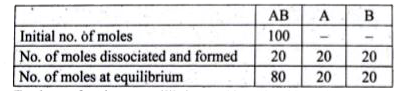 Total no. of moles at equilibrium`= 80+ 20 + 20 + 120` `K_P = (P_a.P_B)/(P_(AB)) = ((20/120xxP)(20/120 xx P))/((80/120xxP)) = P /24` `24 K_P = P` |
|
| 33. |
For the reaction AB (g) hArr A(g) + B(g), ABis 33 % dissociated at a totalpressure of P . Therefore, P is related to K_(p)by one of the following options |
|
Answer» `P=K_(p)` `0.67` Total moles at eqm. =1.33 `p_(A) =(0.33/1.33)P, p_(B)=(0.33/1.33) P,p_(AB)=(0.67/1.33)P` `K_(p) = (p_(A) xxp_(B))/p_(AB) = (0.33 xx 0.33 xx P)/(0.67 xx 1.33)` `P/K_(p)=8 or P =8 K_(p).` |
|
| 34. |
For the reaction AB_(2(g)) hArr AB_((g)) + B_((g)) if alpha is negligiable w.rt 1 then degree of dissociation (alpha) of AB_(2) is proportional to |
|
Answer» `1/p` Total moles = `1+alpha` `K_(P)=(Palpha^(2))/(1-alpha^(2)), alpha LT lt IMPLIES K_(P)=P alpha^(2) implies alpha(1)/(sqrt(P))` & `P alpha(1)/(V)` |
|
| 35. |
For the reaction: A_2(g)+ B_2(g) hArr 2AB(g): DeltaH is -ve. |
Answer» Solution :The FOLLOWING MOLECULAR scrnes represent different reaction mixture (A - DARK grey, B - light grey) 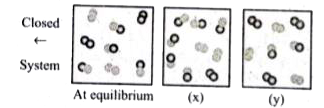 (i) Calculate the equilibrium constant `K_P and K_C`. (ii) For the reaction mixture represented by scene (X), (y) the reaction proced in which direactions ? (iii) What is the effectof increase in pressure for the mixture at equilibrium. |
|
| 36. |
For the reaction A to B , Delta E = 85 kJ mol^(-1) , if the system proceeds from A to B by a reversible path and returns to A by an irreversible path , the net change in internal energy (in KJ) is |
|
Answer» 170 |
|
| 37. |
For the reaction (A to B+C), the energy profile diagram is given in the figure . |
|
Answer» z |
|
| 38. |
For the reaction A rarr B,DeltaH = + 24kJ //mole For the reaction B rarrC , DeltaH= -18 kJ // mole . The decreasing order of enthalpy of A,B,C follows the order : |
|
Answer» A,B,C `B rarr C, DeltaH = -ve` means that`H(B) gt H(C )` or `H(C ) lt H(B)` Addingthe given equations,we get `A rarrC, DeltaH = + 6 kJ mol^(-1)`. This means that `H(A)lt H(C )` COMBINING the above results. `H(A) lt H (C ) lt H(B)` or `H( B) gt H( C) gt H(A)` . Hence, decreasing ORDER of ENTHALPY is B,C,A. |
|
| 39. |
For the reaction A+BhArrC+D, the equilibrium constant is 0.05 at 300K. Calculate the equilibrium constant for C+DhArrA+B at the same temperature. |
|
Answer» SOLUTION :`A+BhArrC+D""K=([C][D])/([A][B])` at EQUILIBRIUM For `C+DhArrA+B,""K'=([A][B])/([C][D])` at equilibrium `thereforeK'=1/K=1/0.05=20`. |
|
| 40. |
For the reaction, A+BhArr2C K_(C)=1. If the initial concentration of A,B and C are 1m, 1m and 2m respectively then, at equilibrium. |
|
Answer» `[A]=[B]=[C]` |
|
| 41. |
For the reactionA + B hArr C+ D , the concentrations of A and B are equal . The equilibrium concentration of C is twice that of A . K_(C) of the reaction is |
|
Answer» `1//4` |
|
| 42. |
For the reaction A+ 2B to C: 5 moles of A and 8 moles of B will produce |
| Answer» Answer :B | |
| 43. |
For the reaction: 5A(g)+3B(g)+7C(g) to 5D(g)+4E(l) DeltaH=-56kcal//"mole" Find heat exchanged when 2 moles of A, 1.5 moles of B and 2.1 moles of C react in a closed rigid container to 300K: |
|
Answer» `-62 KCAL` |
|
| 44. |
For the reaction 2SO_(2)(g)+O_(2)(g) to 2SO_(3)(g). What is the realation between DeltaH and DeltaE ? |
|
Answer» SOLUTION :`DeltaH=Delta E+DeltanRT` `Deltan=n_(P)-n_(R)=2-3=-1` `DeltaH=DELTAE-RT" (or) "DeltaH +RT =DeltaE` Therefore, the ralationship Between `DeltaH" and" DeltaE` is `DeltaH lt DeltaE` |
|
| 45. |
For the reaction : 2SO_(2)(g)+O_(2)(g) hArr2SO_(3)(g),DeltaH=ve. An increase in temperature shows: |
|
Answer» more dissociation of `SO_(3)` and a DECREASES in `K_(c)` |
|
| 46. |
For the reaction, 2SO_(2)(g)+O_(2)(g) hArr 2SO_(3)(g)""DeltaH^(@)lt0 Which change(s) will increase the fraction of SO_(3)(g) in the equilibrium mixture? (P) Increasing the pressure (Q) Increasing the temperature (R) Adding a catalyst |
| Answer» Answer :A | |
| 47. |
For the reaction : 2NO(g) + O_(2)(g) rarr 2NO_(2)(g), the enthalpy and entropy changes are - 113.0 kJ mol^(-1) and -145 JK^(-1) mol^(-1) respectively. Find the temperature below which this reaction is spontaneous. |
|
Answer» For reaction to be SPONTANEOUS , `Delta G ` should be -ve which can be so if temperature is below ` 779.3K` |
|
| 48. |
For the reaction, 2NOCl(g)hArr2NO(g)+Cl_(2)(g) the value of K_(c)=3.75xx10^(-6) at 1069K. Calculate K_(p). |
|
Answer» Solution :Since unit is not mentioned, it is to be assumed that the concentration is EXPRESSED in mol `L^(-)`. HENCE, R = 0.0831 L BAR `K^(-1)mol^(-1).DELTAN` for the REACTION is 3 - 2 = 1. `K_(p)=K_(c)(RT)^(Deltan)` becomes `K_(p)=K_(c)RT` `K_(p)=(3.75xx10^(-6))0.0831xx1069=3.33xx10^(-4)`. |
|
| 49. |
For the reaction 2NOCl_((g)) hArr 2NO_((g)) + Cl_(2(g)) the value of equilibrium constant K_p is 0.033 bar at 1060 K temp. then calculate value of K_c. |
| Answer» SOLUTION :`K_c=3.7xx10^(-4)` | |
| 50. |
For the reaction, 2NO_(2)(g) hArr N_(2)O_(4)(g) at 300 K The value of K_(P) is 2 atm^(-1). The total pressure at equilibrium is 10 atm. If volum of cantainer become two times of its original volume, what will be its equilibrium pressure at 300 K? |
|
Answer» `6.4` ATM |
|