

Saved Bookmarks
This section includes 7 InterviewSolutions, each offering curated multiple-choice questions to sharpen your Current Affairs knowledge and support exam preparation. Choose a topic below to get started.
| 1. |
In the lollowing reuction. AgCl +KIhArr KCl + Agl. As Kl is added, the cquilibrium is shifted towards right giving more Agl precipitate, because |
|
Answer» Both AgCl and Agl are sparingly soluble `AgI_((s)) hArr Ag^(+) +I^(-) ,KsP_2` ` AgCl+I^(-) hArr AgI +Cl^(-),K =(Ksp_1)/(Ksp_2) ` as ` I^(-) `is ADDED equation shifts to the right ` rArr K gt 1 rArr (Ksp_1)/(Ksp_2) gt 1 ` |
|
| 2. |
In the following reaction: 4NO_(2)(g) + O_(2)(g) to 2N_(2)O_(5)(g),DeltaH = - 110 kJ, if N_(2)o_(5)(s) is formed instead of N_(2)O_(5)(g) in the reaction, the enthalpy change (in kJ) would be (enthalpy of sublimation of N_(2)O_(5)(s) is + 53 kJ mol^(-1)). |
|
Answer» `-216` GIVEN that (ii) `N_(2)O_(5)(s) to N_(2)O_(5)(g) , DeltaH = 53 kJ"mol"^(-1)` (iii)`2N_(2)O_(5)(s) to 2N_(2)O_(5)(g), DeltaH = 106 kJ"mol"^(-1)` Subtracting eq.(iii) from (i), `4NO_(2)(g) +O_(2)(g) to 2N_(2)O_(5)(s)` then `DeltaH = -110-106 = -216 kJ"mol"^(-1)` |
|
| 3. |
In the following reaction, A and B respectively are Aoverset(HBr)rarrC_(2)H_(5)Broverset(B)rarrA |
|
Answer» `C_(2)H_(4)` and alcoholic `KOH//Delta` |
|
| 4. |
In the following reaction : 3A(g)+B(g) hArr 2C(g)+D(g) initial mol of B is double of A.At equilibium mol of A and C are equal . Hence % dissociation of B is : |
|
Answer» |
|
| 5. |
In the reaction 3Br_(2) + 6CO_(3)^(2-) + 3H_(2)O to 5Br^(-) + 2BrO_(3)^(-)+6HCO_(3)^(-) |
|
Answer» OXIDIZED and CARBONATE is REDUCED |
|
| 6. |
In the followingquestions morethan one correlation is possible betweenoptions of both columns. Match the following : {:((i),"Entropy of vaporisation",(a),"decreases"),((ii),"K for spontaneous process",(b),"is always positive"),((iii),"Crystalline solid state",(c ) , "lowest entropy"),((iv),DeltaU" in adiabatic expansion of ideal gas",(d) ,(DeltaH_(vap))/(T_(b))):} |
|
Answer» (ii) `Delta_(r)G^(@)= - RT ln K `. If K is `+ve`, `Delta_(r)G^(@) = -ve` ad reaction is spontaneous . Hence, (ii) `rarr`(b). (iii) Crystalline solid state has lowest entropy. Hence , (iii) `rarr` (c ) (iv) During adiabaticexpansion of an ideal gas , `q=0`. Hence, `DeltaU = q+W` GIVES`DeltaU = w ,` i.e., work done is at the cost of internal energy which decreases . Hence, `(iv) rarr (a)`. |
|
| 7. |
In the followingquestions morethan one correlation is possible betweenoptions of both columns. Match the following :Delta( Parameters)Description {:(,Delta_(r)H^(c-),Delta_(r)S^(c-),Delta_(r)G^(c-),,),((i),+,-,+,(a),"None-spontaneous at high temperature"),((ii),-,-,+ "at high T",(b),"Spontaneous at all temperatures"),((iii),-,+,-,(c ),"Non-spontaneous at all temperatures"):} |
|
Answer» (II) `Delta_(r)G^(@) = + ve` at highT means the reaction is non-spontaneous at high temperature, i.e., (ii) `rarr` (a) . (iii) `Delta_(r) H^(@) = -ve` means it favours ,`Delta_(r)S^(@)= + ve`means it ALSO favours. `Delta_(r)G^(@)= -ve` means reaction is spontaneous at all temperatures, i.e, (iii) `rarr`(a). |
|
| 8. |
In the followingquestions morethan one correlation is possible betweenoptions of both columns. Match the following :{:( ,A,,B),((i),"Adiabatic process",(i),"Heat"),((ii), "Isolated system",(b),"At constant volume"),((iii),"Isothermal change",(c ) , "First law of thermodynamics"),((iv), "Path function" ,(d) ,"No exchange of energy and matter"),((v),"State function", (e) ,"No transfer of heat"),((vi) , DeltaU=q,(f),"Constant temperature"),((vii),"Law of conservation of energy",(g),"Internal energy "),((viii),"Reversible process",(h),p_(ext)=0),((ix) ,"Free expansion" , (i) ,"At constant pressure"),((x),DeltaH =q,(j),"Infinitely slow process which proceeds through a series of equilibrium states."),((xi) ,"Intensive property",(k) , "Entropy"),((xi),"Extensive property",(l),"Pressure"),(,,(m),"Specific"):} |
|
Answer» |
|
| 9. |
In the followingquestions morethan one correlation is possible betweenoptions of both columns. Match the following : {:(,"Reaction",,"Entropy change"),((i) ,"A liquid vaporises",(a),DeltaS=0),((ii),"Reaction is non-spontaneous at all temperatures and " DeltaH " is positive",(b),DeltaS="positive"),((iii),"Reversible expansion of an ideal gas ",(c ) , DeltaS = "negative"):} |
|
Answer» (ii) When `DeltaH = +ve. i.e.,` energy factor oppose . The process is non-spontaneous at all TEMPERATURE if entropy factor also opposes the process, i.e., `DeltaS = - ve` . Hence,`(ii) rarr (c )` (iii) In the REVERSIBLE expansion of an ideal gas, the SYSTEM REMAINS in equilibrium at EVERY stage. Hence, `DeltaS =0, i.e., (iii) rarr (a)`. |
|
| 10. |
In the following questions a statement of Assertion (A) followed by a statement of Reason (R ) is given. Choose the correct option out of the choices given below. Assertion (A) : Spontaneous process is an irrerversible process and may be reversed by some external agency. Reason (R ) : Decrease in enthalpyisa contributory factor for spontaneity. |
|
Answer» |
|
| 11. |
In the following questions a statement of Assertion (A) followed by a statement of Reason (R ) is given. Choose the correct option out of the choices given below. Assertion (A) : A liquid crystallises into a solid andis accompanied by decrease in entropy. Reaction (R ) : In crystals, molecules organise in an ordered manner. |
|
Answer» |
|
| 12. |
In the following questions a statement of Assertion (A) followed by a statement of Reason (R ) is given. Choose the correct option out of the choices given below. Assertion (A) : Combustion of all organic compounds is an exothermic reaction. Reaction (R ) : The enthalpies of all elements in their standard state are zero. |
|
Answer» |
|
| 13. |
In the following questions a statement of Assertion (A) followed by a statement of Reason (R) is given. Choose the correct option out of the choices given below each question. Assertion (A) : A liquid crystallizes into a solid and is accompanied by decrease in entropy. Reason (R) : In crystals, molecules organise in an ordered manner. |
|
Answer» Both A and R are TRUE and R is the correct explanation of A. When a liquid crystallises, entropy decreases because in CRYSTALLINE form the MOLECULES are more ORDERED as compared to the liquid. |
|
| 14. |
In the following questions a statement of Assertion (A) followed by a statement of Reason (R) is given. Choose the correct option out of the choices given below each question. Assertion (A): Combustion of all organic compounds is an exothermic reaction. Reason (R) : The enthalpies of all elements in their standard state are zero. |
|
Answer» Both A and R are TRUE and R is the correct EXPLANATION of A. Correct explanation : In a combustion reaction, sum of enthalpies of reactants is greater than the sum of the enthalpies of PRODUCTS. |
|
| 15. |
In the following questions a statement of Assertion (A) followed by a statement of Reason (R) is given. Choose the correct option out of the choices given below each question. Assertion (A) : Spontaneous process is an irreversible process and may be reversed by some external agency. Reason (R) : Decrease in enthalpy is a contributory factor for spontaneity. |
|
Answer» Both A and R are TRUE and R is the correct explanation of A. Spontaneous processes are accompanied by decrease in energy and increase in randomness. |
|
| 16. |
In the following question, a statement of assertionn is followed by a statement of reason. Mark the correct choice. Assertion: Greater the value of van der waals constant 'a' easier is the liquifaction of a gas. Reason: 'a' indirectly measures the magnitude of attractive forces between the molecules. |
|
Answer» both ASSERTION and reason are true and reason is the CORRECT EXPLANATIONN of assertion |
|
| 17. |
In the following question, a statement of assertion is followed by a statement of reason. Mark the correct choice. Assertion: Simple distillation can help in separating a mixture of propan-1-ol (boiling point 97^(@)C) and propanone (boiling point 56^(@)C) Reason: Liquids with a difference of more than 20^(@)C in their boiling points can be separated by simple distillation. |
|
Answer» both assertion and REASON are TRUE and reason is the correct explanationn of assertion |
|
| 18. |
In the following question, a statement of assertion is followed by a statement of reason, mark the correct choice. Assertion: When Q_(c)=K_(c), reaction is at equilibrium. Reason: At equilibrium, DeltaG^(@) is 0. |
|
Answer» both assertion and reason are TRUE and reason is the correct explanationn of assertion |
|
| 19. |
In the following questiona statement of Assertion (A) followed by a statement of Reason (R)isgiven. Choose the correct option out of the choices given below each eqestion. Assertion (A) : Sodium chloride formed by the action of chlorine gas on sodium metal is a stable compound Reason (R) : This is because sodium and chloride ions acquire octet in sodium chloride formation. |
|
Answer» A and R both are CORRECT, and R is the correct ecplanation of A. |
|
| 20. |
In the following pairs , each number produces the same gas when reacts with water ? |
|
Answer» `K , KO_(2)` `Ca + 2 H_(2) O to Ca(OH)_(2) + H_(2)` `CaH_(2) + 2 H_(2)O to Ca(OH)_(2) + 2H_(2)` In contrast, K reacts with `H_(2)O` to produce `H_(2)` but `KO_(2)` produces `O_(2)` (or `O_(2) + H_(2)O`) , Na produces `H_(2)` but `Na_(2)O_(2)` produces `O_(2)`. Similarly , Ba produces `H_(2)` but `BaO_(2)`produces `O_(2).` |
|
| 21. |
In the following monobromination reaction, the number of possible chiral products is |
| Answer» | |
| 22. |
In the following equation CrO_(4)^(2-)+S_(2)O_(3)^(2-)+overset(ɵ)(O)Hto[Cr(OH)_(4)]^(-1)+SO_(4)^(2-) What volume of 0.2 M Na_(2)S_(2)O_(3) solution. |
|
Answer» 30 mL Ew of ``CrO_(4)^(2-)=(Mw)/(3)` (II). `undersetunderset(2x=4)(2x-6=-2)(S_(2)O_(3)^(2-)toundersetunderset(2x=12)(2x-6=-4)(2SO_(4)^(2-)+8e^(-)` " Eq of "`S_(2)O_(3)^(2-)=(Mw)/(8)` `N_(1)V_(1)(CrO_(4)^(2-))=N_(2)V_(2)(S_(2)O_(3)^(2-))` i.e., `m" Eq of "CrO_(4)^(2-)=m" Eq of "S_(2)O_(3)^(2-)` `V_(1)xx0.2xx3=30xx0.2xx8` `V_(1)=(30xx0.2xx8)/(0.2xx3)=80mL` |
|
| 23. |
In the following correct statements are |
|
Answer» IUPAC NAME of pyruvic acid is 2-oxopropanoic acid |
|
| 24. |
In the following compounds The order of acidity is |
|
Answer» `III gt IV gt I gt II` |
|
| 25. |
In the following compounds, The order of acidity is : |
|
Answer» `III gt IV gt I gt II` |
|
| 26. |
In the following compound, the number of 'sp' hybridized carbonis {:(CH_(2)=C=CH-CH-C-=CH),("|"),(""CN):} |
|
Answer» 2 |
|
| 27. |
In the following compound the favourable site/s for protonation is/are: |
|
Answer» a and e |
|
| 28. |
In the following compound H - overset(1) C-=overset(2)C-overset(3)(CH_(2))-overset(4)(CH_(3) thehybridization of C2 and C3 carbons are respectively . |
|
Answer» `SP^(3) and sp^(3)` |
|
| 29. |
In the following chemical reactions, the compounds A and B are respectively: |
|
Answer» BENZENE DIAZONIUM CHLORIDE and benzonitrile |
|
| 30. |
In the following chemical reaction H-C-=CHunderset((2)CH_(3)CH_(2)Br)overset(NaNH_(2)//liq.NH_(3))rarr X=underset((2)CH_(3)CH_(2)Br)overset((1)NaNH_(2)//liq.NH_(3))rarrY X and Y are : |
|
Answer» X = 1-Butyne , Y = 3-Hexyne |
|
| 31. |
In the following chemical effect, the bonded pair of electron leaves the octet |
|
Answer» INDUCTIVE |
|
| 32. |
In the following change, 3Fe + 4H_(2)O rarr Fe_(3)O_4 + 4H_2If the atomic mass of iron is 56, then its equivalent mass will be : |
|
Answer» 42 `3overset(0)(FE) rarr OVERSET(+8/3)(Fe_(3)O_4), E=(56)/(8/3)=21` |
|
| 33. |
In the following carbocation, H//CH_(3) that is most likely to migrate to the positively charged carbon is {:(""H""H),("|""|"),(H_(3)overset(1)(C)-.^(2)C-._(3)overset(+)C-C^(4)-overset(5)(C)H_(3)),("|""|""|"),(""HO""H""CH_(3)):} |
|
Answer» `CH_(3)` at C-4 (i) the +ve CHARGE GENERATED on C-2 in I is in CONJUGATION with the n-electrons of the O atom 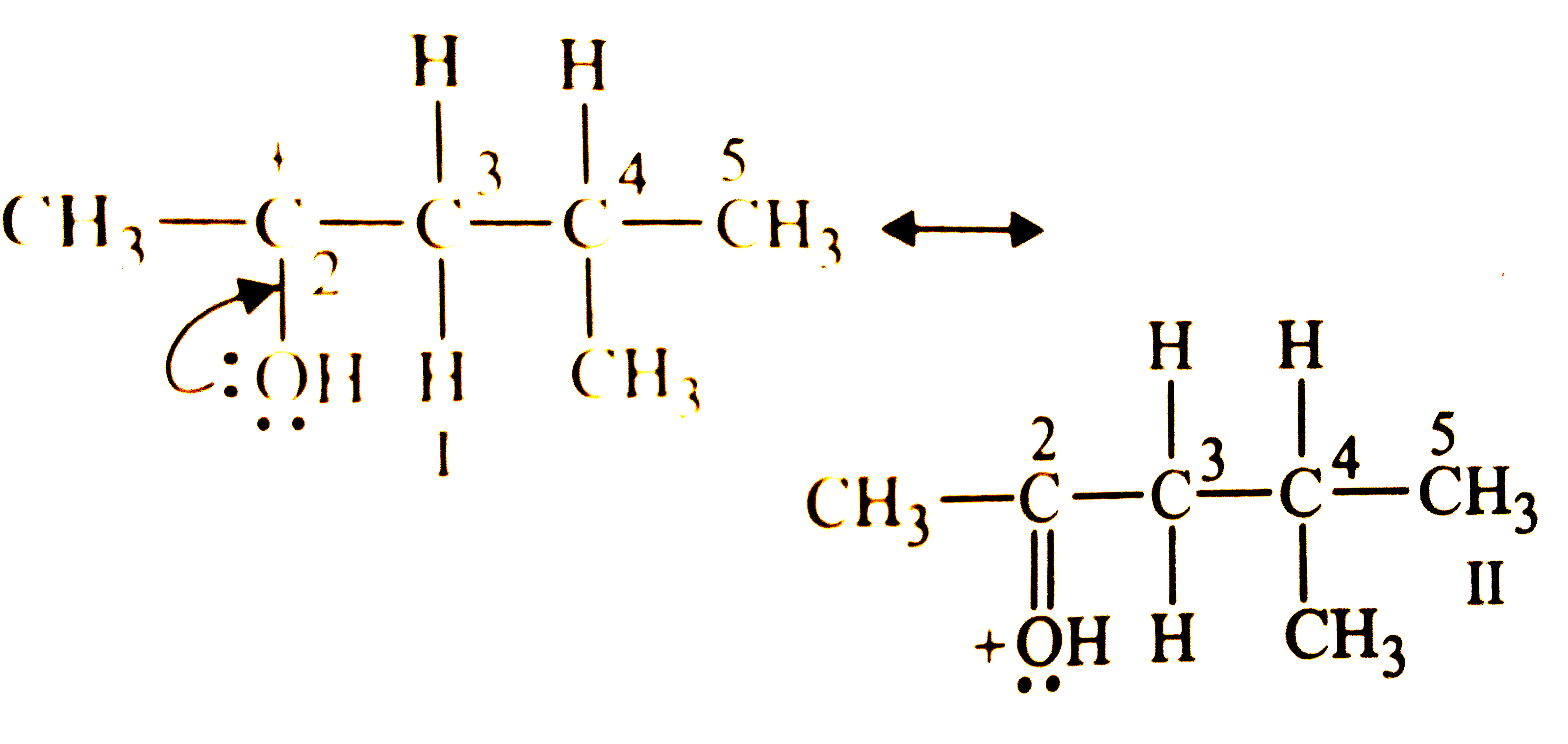 (ii) It is STABILIZED by +I EFFECT of `CH_(3)` group. |
|
| 34. |
In the following case(s), hybridisation of the underlined atom is affected, when- |
|
Answer» `underline(P)Cl_(5)` (solid) dissociated into `PC l_(4)^(+) and PC l_(6)^(+)` |
|
| 35. |
In the following benzyl/allyl system R-CH=CH_(2)and(R is alkyl group) Then decreasing order of inductive effect is : |
|
Answer» `(CH_(3))_(3)C-GT(CH_(3))_(2)CH-gtCH_(3)CH_(2)-` |
|
| 36. |
In the first translation series the incoming electron enters the |
|
Answer» 4 d- orbital |
|
| 37. |
In the figure given below show the location of atoms in three crystallographic planes in a fcc lattice. Draw the unit cell of the corresponding structure and identify these planes in your diagram |
|
Answer» |
|
| 38. |
In the figure shown the pressure of the confined gas will be: |
|
Answer» 30 CM of Hg |
|
| 39. |
In the facecentred cubic unit cell, edge length is |
|
Answer» `a/sqrt3r` |
|
| 40. |
In the extraction of silicon by reduction of sand (silica), an excess of sand is always used to prevent the formation of |
|
Answer» Silicon oxide |
|
| 41. |
In the extraction of Fe from Fe_(2)O_(3) the reducing agent is |
|
Answer» C |
|
| 42. |
In the extraction of copper from its sulphide ore, the metal is finally obtained by the reduction of cuprous oxide with |
|
Answer» Copper (I) sulphide |
|
| 43. |
In the estimation of sulphur in an organic compound, fuming nitric acid is used to convert sulphur into : |
|
Answer» `SO_(2)` |
|
| 44. |
In the estimation of sulphur by Carius method, 0.480 f og an organic comppund gives 0.699 g of barium sulphate. The percentage of sulphur in this compound is (atomic masses : Ba = 137, S = 32 and O = 16) |
|
Answer» 0.2 |
|
| 45. |
In the estimation of sulphur by Cari us method, 0.480 g of an organic compound gives 0.699 g of barium sulphate. The percentage of sulphur in this compound is (Atomic masses : Ba= 137, S =32, O = 16) (a) 20% (b) 15% ( c) 35% (d) 30% (e) 40% |
|
Answer» |
|
| 46. |
In the estimation of sulphur by Carius method, 0.468g of an organic sulphur compound afforded 0.668g of barium sulphate. Find out the percentage of sulphur in the given compound. (Ba= 137, S=32, O=16) |
|
Answer» Solution :molar mass of `BaSO_(4)= 137 + 32 (16 xx 4)= 233g` `UNDERSET(32g)(S) rarr underset(233g)(BaSO_(4))` contain 32g sulphur, `:. 0.668g BaSO_(4)` contain Sulphur `= (32 xx 0.668)/(233) gm` % `S = (32)/(233) xx (0.668)/(0.468) xx 100` = 19.60% |
|
| 47. |
In the estimation of nitrogen present in an organic compound by Dumas method 0.35 g yielded 20.7 mL of nitrogen at 15^(@)C and 760 mm Hg pressure. Calculate the percentage of nitrogen in the compound. |
|
Answer» Solution :Weight of ORGANIC compound= 0.35 g `"VOLUME of moist nitrogen" (V_(1)) = 20.7 ml = 20.7 xx 10^(-3) L` `"Temperature"= T_(1) =15^(@)C = 273 + 15^(@)C = 288K` `"PRESSURE of moist nitrogen" P_(1)=760 "mmHg"` `(P_(1)V_(1))/(T_(1))=(P_(0)V_(0))/(T_(0))` `V_(0)=(P_(1)V_(1))/(T_(1)) xx (T_(0))/(P_(0))=(760 xx 20.7 xx 10^(-3))/(288) xx (273K)/(760)` `V_(0)=19.62 xx 10^(-3) L` `"Percentage of nitrogen"=(28)/(22.4) xx (V_(0))/(W) xx 100=(28)/(22.4) xx (19.62 xx 10^(-3))/(0.35) xx 100` `=(28)/(22.4) xx (19.62)/(0.35) xx 10^(-1)=56.05 xx 10^(-3) xx 100= 7.007%` `implies` Percentage of nitrogen= 7.007% |
|
| 48. |
In the estimation of nitrogen by Duma's method 1.18 g of an organic compound gave 224 ml of N_(2)at NTP. The percentage of nitrogen in the compound is about |
|
Answer» 20 |
|
| 49. |
In the estimation of nitrogen by Duma's method 1.18g of an organic compound gave 224 ml of N_(2) at STP. The percentage of nitrogen in the compound is |
|
Answer» `20.0` `=(224)/(1.18).(28)/(22400).100=23.7%` |
|