

Saved Bookmarks
This section includes 7 InterviewSolutions, each offering curated multiple-choice questions to sharpen your Current Affairs knowledge and support exam preparation. Choose a topic below to get started.
| 1. |
In the estimation of halogen 0.18 g of an organic compound gave 0.12 g of silver bromide. What is the perecentage of bromine in the compound? (Molar mass of AgBr = 188, Atomic weight of Br= 80) |
|
Answer» 30.64 |
|
| 2. |
In the estimation of carbon and hydrogen, if the substance also contains nitrogen, then near the exit, it is placed: |
|
Answer» a roll of silver |
|
| 3. |
In the equilibrium reaction CaCO_3 (s) hArr CaO (s) + CO_(2) (g) whose concentration remains constant at a given temperature ? |
|
Answer» CaO |
|
| 4. |
In the equilibrium reaction CO_(2(g))+C_((s))hArr 2CO_((g)) the partial pressure of CO2 and CO are 0.78 atm and 1.22 atm respectively at equilibrium. Calculate the equilibrium constant |
|
Answer» |
|
| 5. |
In the equilibrium reaction, AgCl(s)+2NH_(3)(aq) hArr Ag(NH_(3))_(2)^(+)(aq)+Cl^(-)(aq) Increase in the concentration of Cl^(-)(aq) causes : |
|
Answer» AGCL(s) to decompose |
|
| 6. |
In the equilibrium process of ammonia if deuterium is added than which new components are observed ? |
| Answer» SOLUTION :`NH_3, N_2,H_2` and `D_2 , HD, ND_3,NHD_2 , NH_2D` should be PRESENT . | |
| 7. |
In the equilibrium NH_(4)HS_((s)) |
|
Answer» ADDING some more `NH_(4)HS` |
|
| 8. |
In the equilibrium CO(g) + 3H_(2(g)) hArr CH_(4(g)) + H_2O_((g))if the volume made half than what is the effect on K ? Why ? |
| Answer» Solution :At constant temperature K is constant. So there is no EFFECT on K. As the volume decreases pressure INCREASES. So reaction MOVES in forward direction TILL `Q_c = K`. and again equilibrium ESTABLISHED. but K remain constant. | |
| 9. |
In the equilibrium, 2A(g) hArr 2B(g)+ C_2(g) the equilibrium concentrations of A, B and C_2 at 400 K are 1 xx 10^(-4) M,2.0 xx 10^(-3) M, 1.5 xx 10^(-4)Mrespectively. The value of K_C for the equilibrium at 400 K is ………………… . |
|
Answer» Solution :`[A] = 1xx 10^(-4) M, [B] = 2XX 10^(-3) M, [C] = 1.5 xx 10^(-4) M` `2A(g) hArr 2B(g) + C_2(g)` `K_C = ([B]^2[C_2])/([A]^2)=((2xx 10^(-3))^2(1.5 xx 10^(-4)))/((1xx 10^(-4))^2)` `= 6.0 xx 10^(-2) = 0.06` |
|
| 10. |
In the equilibrium, 2A (g) hArr 2B(g) + C_(2)(g) the equilibrium concentration of A, B and C_(2) at 400 K are 1 xx 10^(-4) M, 2.0 xx 10^(-3) M, 1.5 xx 10^(-4) M respectively. The value of K_(C) for the equilibrium at 400 K is ………… . |
|
Answer» 0.06 `2A(g) HARR 2B(g) + C_(2) (g)` `K_(C) = ([B]^(2) [C_(2)])/([A]^(2)) = ((2 xx 10^(-3))^(2) (1.5 xx 10^(-4)))/((1 xx 10^(-4))^(2)) =6.0 xx 10^(-2) = 0.06` |
|
| 11. |
In the equilibrium, 2A(g)hArr2B(g)+C_(2)(g) the equilibrium concentrations of A, B and C_(2) at 400 K are 1xx10^(-4)M,2.0xx10^(-3)M, 1.5xx10^(-4)M respectively. The value of K_(C) for the equilibrium at 400 K is |
|
Answer» Solution :`2A(g)hArr 2B(g)+C_(2)(g)`, equilibrium concentrations `[A] = 1xx10^(-4)M` `[B] = 2.0xx10^(-3)M` `[C_(2)]=1.5xx10^(-4)M` `K_(C )=([B]^(2)[C_(2)])/([A]^(2))` `K_(C )=([2.0xx10^(-3)]^(2)[1.5xx10^(-4)])/([1xx10^(-4)]^(2))` `K_(C )=6XX10^(-2)` |
|
| 12. |
In the equation xP+ HNO_(3) to HPO_(3)+yNO +H_(2)O |
|
Answer» x=5,y=5 Step -II. Writing the oxidation number of the ELEMENTS `P+HNO_(3) to HPO_(3)+NO+H_(2)O` `0+ +5 ""+5 ""+2` Thus here P is oxidized (0 to +5) and N in `HNO_(3)` is reduced (+5 to +2). Writing seperate EQUATION for the reducing agent (P) and oxidising agent `("N in "HNO_(3))`. Oxidation `P^(0) to P^(+5) uparrow 5` Reduction `N^(+5) to N^(+2) downarrow 3` Step -III. Adding electrons according to change in oxidation number. `P^(0) to P^(+5) +5e^(-) .......(i)` `N^(+5) +3e^(-) to N^(+2) .......(ii)` Step -IV. Multiply equation (i) by (3) and (ii) by 5. `3P^(0) to 3P^(+5) +15e^(-)..........(iii)` `5N^(+5)+15e^(-) to 5N^(+2) .......(iv)` Adding (iii) and (iv) `3P^(0)+5N^(+5) to 3P^(+5) +5N^(+2)` Therefore, the required reaction can be WRITTEN as `+5HNO_(3) to 3HPO_(3)+5NO` Hence the required balanced equation can be REPRESENTED as below `3P+5HNO_(3) to 3HPO_(3)+5NO+H_(2)O` |
|
| 13. |
In the equation PV=RT, the value of R will not depend on (one or more) |
|
Answer» the nature of the gas |
|
| 14. |
In the equation PV = nRT, the gas constant R is not equal to |
|
Answer» `8.31 xx 10^(7) erg K^(-1) mol^(-1)` |
|
| 15. |
In the equation, NO_(2)^(- ) +H_(2)O rarr NO_(3)^(-)+ 2H^(+) + "ne"^(-).n. stands for |
|
Answer» `H^+` |
|
| 16. |
In the equation , 4M + 8CN^(-) + 2H_(2)O + O rarr 4[M(CN)_2]^(-) + 4OH^(-) , the metal is |
|
Answer» Copper |
|
| 17. |
In the equation 2H_(2)(g)+O_(2)(g)to2H_(2)O(L), DeltaH=-571.6KJ"mol"^(-1) What is the enthalpy of formation of a water molecule. |
| Answer» SOLUTION :ENTHALPY of FORMATION of WATER MOLECULE is `(-571.6)/2=-285.8` kJ/mol. | |
| 18. |
what happens when hydrogen reacts with alkali metals ? |
| Answer» | |
| 19. |
In the electronic structure of acetic acid there are |
|
Answer» 16 shared and 8 UNSHARED valence electrons |
|
| 20. |
In the electrolysis of aqueous solutoin of copper suphate using copper stirps as anode and cathode the anode rection is |
|
Answer» `Cu^(2+)+2e^(-)rarrCu` `Cu(s)rarrCu^(2)+2E^(-)+2E^(-),E^(@)=-0.80 v` `2H_(2)O(l)rarrO_(2)(g)+4H^(+)(AQ)+4E^(-),E^(2)=-1.23` V since oxidation potential of Cu ishigher than that of`H_(2)O` melecules thus OPTION (b) is correct |
|
| 21. |
In the electrolysis of alumina, cryolite is added to |
|
Answer» lower tha MELTING point of alumina |
|
| 22. |
In the electrochemical reaction 2Fe^(3+)+Zn to Zn^(2+) + 2Fe^(2+) Increasing the concentration of Fe^(2+) |
|
Answer» increases cell emf `E_("cell")=E_("cell")^(@)-(2.303RT)/(2F)"log"([ZN^(2+)][Fe^(2+)]^(2))/([Fe^(3+)]^(2))` Increasing `[Fe^(2+)]` will decrease the `E_("cell")`. |
|
| 23. |
In the Duma's method for the estimation of nitrogen, the gas collected in nitrometer is : |
|
Answer» `N_2` |
|
| 24. |
In the Dumas method for the estimation of nitrogen , 0.0237 grams of organic compound gave 2.21 mL of nitrogen at 754.32 mm of Hg pressure at 18^@C . (Aqueous tension at 18^(@)Cis 15.4 mm of Hg) therefore the percentage of nitrogen in the compound is |
|
Answer» 0.2067 |
|
| 25. |
In the disproportionation reaction 3 HCIO_(3) rarr HCIO_(4) +CI_(2) + 2 O_(2) +H_(2)O What is the equivalent weight of the oxidising agent ? (Give molecular mass of HCIO_(3) =84.45 u) |
|
Answer» Solution :`3 HCIO_(3) rarr HCIO_(4)+CI_(2)+2O_(2)+H_(2)O` SINCE O.N of CI decreases from +5 inch `HCIO_(3)` to O in `CI_(2)` therefore `HCIO_(3)` acts as the oxidising agent in other words O.N DECREASE by 5 5 and the equivalent mass of the oxidising agent `(HCIO_(3))` i.e `=Mol mass //5 =84.45//5 =16.89` |
|
| 26. |
In the disproportionation reaction, 3HClO_(3) to HClO_(4)+Cl_(2)+2O_(2)+2H_(2)O, the equivalent mass of the oxidising agent is (molar mass of HClO_(3)= 84.45) |
|
Answer» 16.89 |
|
| 27. |
In the disociation of HI, 20 % HI is dissociated at equilibrium at a certain temperature. Calculate (K_(p)) for the decomposition reaction, HI (g) hArr 1/2 H_(2) (g) + 1/2 I_(2) (g). |
|
Answer» `K_(c) = ((0*1)^(1//2)(0*1)^(1//2))/(0*80)=0*125, K_(p)=K_(c) = 0*055` |
|
| 28. |
In the direction , N_(2) + 3 H_(2) hArr 2 NH_(3)at equilibrium , helium gas is injected into the vessel without disturbing the overallpressure of the system. What will be the effect on the equilibrium ? |
|
Answer» Solution :` K_(C) =[NH_(3)]^(2) /([N_(2) ] [ H_(2)]^(3)) ` As PRESSURE is kept constant, volume will increase. HENCE molar concentration of `NH_(3), N_(2) and H_(2)` will DECREASE. As there are two concentrations terms in numerator and four concentration terms in the DENOMINATOR , to keep `K_(c)` constant, decrease in`NH_(3)` should be more i.e, equilibrium will shift in teh backward direction. |
|
| 29. |
In the diazotisation of aniline with sodium nitrate and hydrochloric acid, an excess of hydrochloric acid is used primarily to: |
|
Answer» SUPPRESS the CONCENTRATION of free aniline available for coupling |
|
| 30. |
In the determination of molecular mass by Victor - Meyer's Method 0.790 g of a volatile liquid displaced 1.696 xx 10^(-4) m^(3) of moist air at 303 K and at1 xx 10^(5) Nm^(-2) pressure. Aqueous tension at 303 K is4.242 xx 10^(3) Nm^(-2) . Calculate the molecular mass and vapour density of the compound . |
|
Answer» Solution :Mass of the ORGANIC compound =0.79 g Volume of VAPOUR = `V_1 = 1.696 xx 10^(-4) m^(3)` Volume of air displaced = Volume of vapour. `P_1 `= ( atmospheric pressure - aqueous tension ) `=(1.0 xx 10^5) - (4.242 xx 10^(3)) = 0.958 xx 10^(5) Nm^(-2)` `T_1 `= 303 K 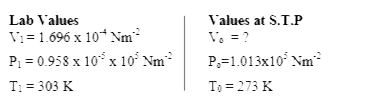 `(P_1 V_1)/( T_1) = (P_0 V_0)/( T_0)` `V_0 = (P_1 V_1 T_0)/(P_0 T_1)` `V_0 = (0.958 xx 10^(5) xx 1.696 xx 10^(-4))/(1.013 xx 10^(3)) xx (273)/(303)` `V_0 = 1.445 xx10^(-4) m^3` The mass of `1.445 xx 10^(-4)m^(3)` of vapour at S.T.P= 0.79 g . The mass of ` 2.24 xx 10^(-2) m^(3)` of vapour of S.T.P is `= (2.24 xx 10^(-2) xx 0.79)/( 1.445 xx 10^(-4))` The molecular mass of the substance = 122 .46 Vapour density of the compound `=(" molecular mass ")/(2)` `= (122.46)/(2) = 61.23` |
|
| 31. |
In the determination of molar mass of A^(+) B ^(-) using a colligative property, what may be the value of van't Hoff factor if the solute is 50% dissociates ? |
|
Answer» `0.5` `(i-1)/(2-1) =0.5` `I -1 =0.5` `THEREFORE I =0.5 +1=1.5` |
|
| 32. |
In the detection test of nitrogen the prussion blue colour is due to which compound? |
|
Answer» Solution :Formula: `Fe_(4) [FE(CN)_(6)]_(3) xH_(2)O` NAME: IRON (III) Hexacynoferrate (II) OR Feri-fero cynide |
|
| 33. |
In the decomposition of H_(2) O_(2), The concentration of colloidal platinum used is of order |
|
Answer» `10^(-8) " MOL DM"^(-3)` |
|
| 34. |
In the cubic crystal of CsCl (d=3.97 "g cm"^(-3)), the eight corners are occupied by Cl^- ions with a Cs^+ ion at the centre and vice-versa. Calculate the distance between the neighbouring Cs^+ and Cl^- ions . What is the radius ratio of the two ions ? |
|
Answer» Solution :In CsCl, `Cl^-` IONS per unit cell =`8xx1/8`=1 `Cs^+`ions per unit cell =1 Thus, the unit cell of CsCl contains one CsCl molecule, i.e., Z=1 `rho=(ZxxM)/(a^3xxN_0)` `THEREFORE 3.97 =(1xx168.36)/(a^3xx6.023xx10^23)`[Mol. MASS of CsCl=132.91+35.45 =168.36] or `a=4.13xx10^(-8)` CM or a=4.13 Å For a cube of side length (a) equal to 4.13 Å, body diagonal `AE=sqrt3a=sqrt3xx4.13Å`=7.15 Å As `Cl^-` ions A and E touch`Cs^+` ion, `therefore AE=2r_++2r_-` `therefore 2r_+ + 2r_(-)`=7.15 Å or `r_++ r_-` =3.57 Å i.e., Distance between neighbouring `Cs^+` and `Cl^-` =3.57 Å Assuming that the two `Cl^-` ions touch each other , length of the unit cell `=2r^(-)` =a=4.13 Å `thereforer_(-)` =2.06Å `therefore r_+` =3.57-2.06=1.51 Å `therefore r_+//r_-` =1.51/2.06=0.73 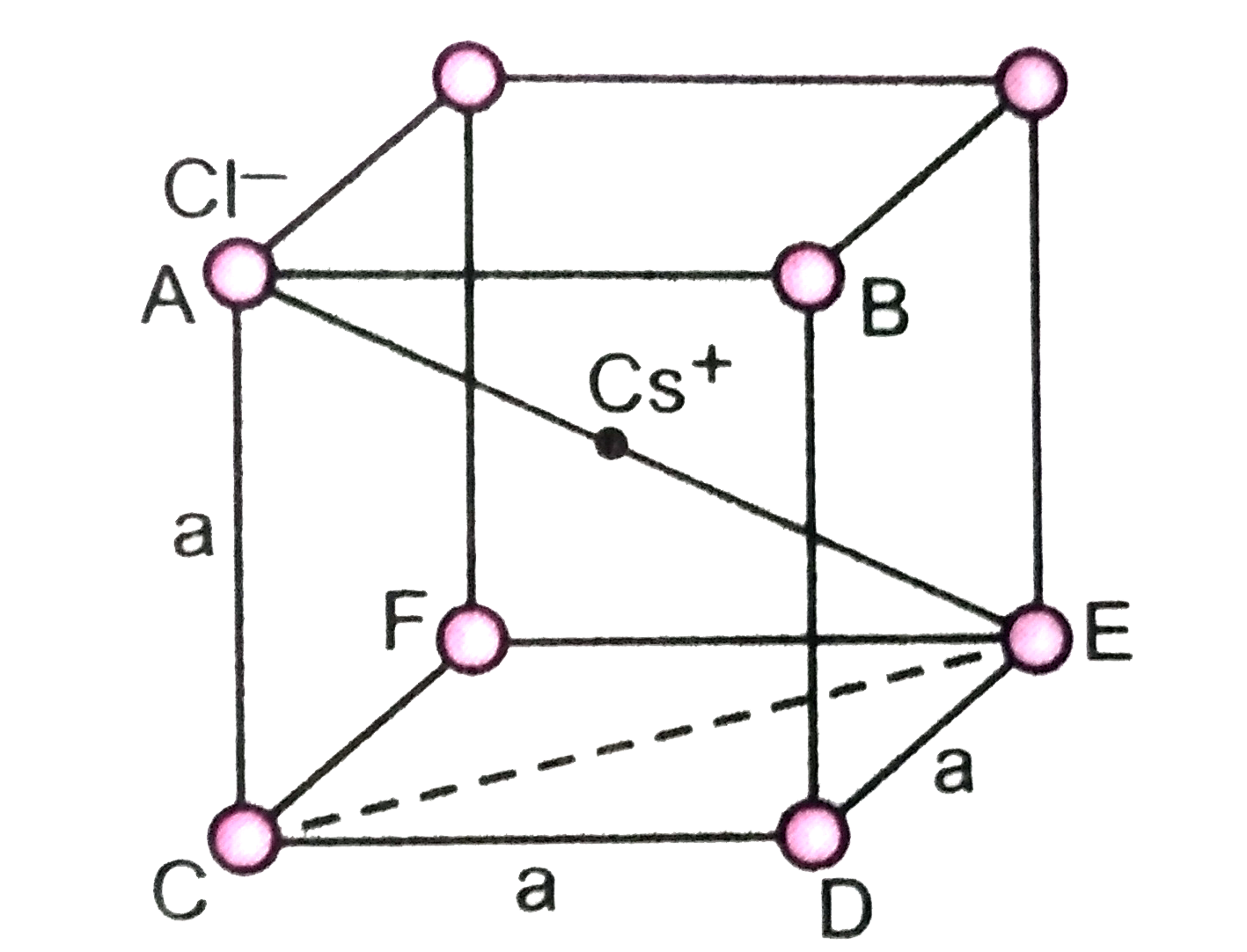
|
|
| 35. |
In the cubic crystal of CsCl (d = 3.97g" cm "^(-3) )the eight corners are occupiedbyCl^(-)ions with aCs^(+)ionthe centre and vice -versa. Calculate the distnacebetween the neighbouring Cs^(+) and Cl^(-) ions . What is the radius ratio of the two ions ?[ At masses of Cs = 132.91 and Cl = 35 . 45] |
|
Answer» Solution : In CsCl , ` Cl^(-)`IONS per UNIT cell ` = 8 xx 1/8 =1` ` Cs^(+)` ions per unit cell = 1 Thus, the unit cell of CsCl contains one CsCl molecule, i.e, Z =1 ` p = ( Zxx M)/(a^(3) xx N_(0))` ` 3.97 = ( 1 xx 168.36)/ (a^(3) xx 6.023 xx 10^(23)) ` ora =`4.13 xx 10^(-18)m ora = 4.13 Å` For a cube of side length (a) equal to 4.13 Å , body diagonal AE =` SQRT3 a = sqrt3 xx 4.13 Å = 7.15 Å` As `Cl^(-)` ions A and E touch `Cs^(+) and Cl^(-) = 3.57 Å` ` 2r^(+) + 2r^(-) = 7.15 Å or r_(+) + r_(-)= 3.15 Å` i.e, Distance between neighboring `Cs^(+) and Cl^(-) = 3.57 Å` Assuming that the two ` Cl^(-)`ions toucheach other. Lengthof the unit cell = ` 2r^(-)=a= 4.13 Å` ` r_(-) = 2.06 Å therefore r_(+)= 3.57 -2.06 = 1.51 Åthereforer_(+)//r_(-) = 1.51// 2.06 = 0.73` 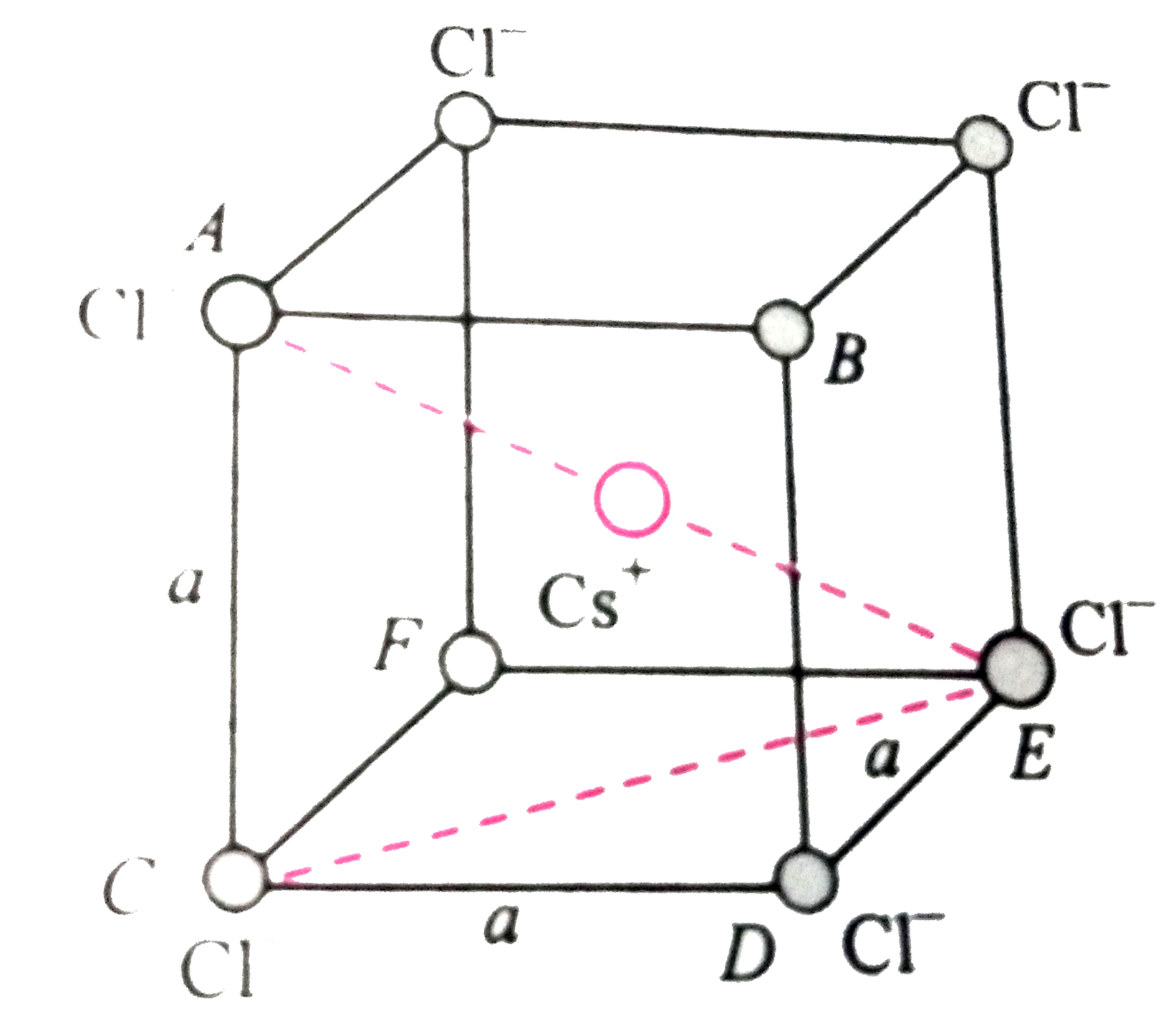
|
|
| 36. |
In the cubic close packing , the unit cell has…… |
|
Answer» 4 tetrahedral voids each of which is shared by FOUR ADJACENT UNIT cells. |
|
| 37. |
In the cubic close packing , the unit cell has ______ |
|
Answer» 4 TETRAHEDRAL voids each of which is shared by four adjacent UNIT cells. |
|
| 38. |
In the copper zinc cell |
|
Answer» Reduction OCCURS at the copper cathode |
|
| 39. |
In the conversion of K_(2)Cr_(2)O_(7) to K_(2)CrO_(4) the oxidation number of the following changes |
|
Answer» K |
|
| 40. |
In the conversion of Br_(2) " to " BrO_3the oxidation state of bromine changes from |
|
Answer» 0 to + 5 |
|
| 41. |
In the conversion of alkyne to trans -alkene by birch reduction using alkali metals (such as Na orK) in liquid NH_3 and alcohol (MeOH or EtOH), The mechanism takes place in the formation of intermediate species in the following sequence: |
|
Answer» RADICAL ANION`to`VINYLIC radical`to`TRANS-vinylic anion`to`trans-alkene |
|
| 42. |
In the conversion of CrO_(4)^(-2)rarrCr_(2)O_(7)^(-2), the oxidation number of oxygen |
|
Answer» increases `X +4 (-2) =-2 implies x = + 6` `2x +7(-2) =-2 implies x= +6` |
|
| 43. |
In the compound gives below, the correct order of acidity of the positions (X), (Y) and (Z) is |
|
Answer» `Z gt X gt Y` |
|
| 44. |
In the compound CH_(2)=CH-CH_(2)-CH_(2)-C -=CH " the " C_(2)-C_(3) bond is of the type |
|
Answer» `sp- sp^(2)` When a double and a triple bond are present in a chain, triple bond has higher priority (less no) than double bond in NAMING |
|
| 45. |
In the compound AX, the radius of A^+ ion is 95 pm and that of X^- ion is 181 pm. Predict the crystal structure of AX and write the coordination number of of each of the ions. |
| Answer» SOLUTION :Radius ratio, `r_+ // r_-` =95/181=0.525 which lies in the range 0.414-0.732. HENCE, the structure is OCTAHEDRAL and coordination number is 6. | |
| 46. |
In the compound AX, the radius ofA^(+)ion is 95 pm and that ofX^(-) ion is 181 pm. Predict the crystal structure of AX and write the coordination number of each of the ions. |
| Answer» SOLUTION :Radius ratio m ` r_(+) //r_(-) = ` 95/181 = 0.525 which in the range0.414- 0.732 . HENCE , the structure is octahedral and COORDINATION NUMBER is 6. | |
| 47. |
In the compound C_6H_5Z which of the following is predominantly ortho/para directing? |
|
Answer» `Z=- NO_2 , - Cl, -OH` |
|
| 48. |
In the borax compound, if the (a) Number of B - O - B bonds is 'x' , (b) Number of B - B bonds is 'y' , (c ) Number of sp^(2) hybridised 'B' atoms is 'Z' then calculate the value of (x+y+z). (x+y+z) |
|
Answer» `x + y + z = 5 + 0 + 2 = 7 ` |
|
| 49. |
In the commercial manufacture of ethyl alcohol from starchy substances by fermentation process, which enzymes complete the fermentation reaction |
|
Answer» Diastase, MALTASE, zymase `C_(12)H_(22)O_(11)+H_(2)O overset("Maltose")rarr 2C_(6)H_(12)O_(6)` `C_(6)H_(12)O_(6) overset("Zymase")rarr 2C_(2)H_(5)OH+2CO_(2)` |
|
| 50. |
In the commercial gasonlines , the type of hydrocarbons which are more desirable is |
|
Answer» LINEAR UNSATURATED hydrocarbon |
|