

Saved Bookmarks
This section includes 7 InterviewSolutions, each offering curated multiple-choice questions to sharpen your Current Affairs knowledge and support exam preparation. Choose a topic below to get started.
| 1. |
What is potassium chloride sometimes violet instead of pure white ? |
| Answer» Solution :In presence of exvess of potassium , `Cl^(+)` ions leave their LATTICE SITES creating anion vacancies which are occupied by ELECTRONS given out by potassium. These are called F-centres and are RESPONSIBLE for COLOUR. | |
| 2. |
Which of the following carbocation is most stable? |
|
Answer» `(CH_(3))_(3) C . Overset(+)(C )H_(2)` |
|
| 3. |
Which of the following is sparingly soluble in water? |
|
Answer» `BeSO_(4)` |
|
| 4. |
Which of the following reactions is said to be entropy driven? |
|
Answer» ENDOTHERMIC REACTION with POSITIVE entropy CHANGE and high temperature |
|
| 5. |
Which of the following process refers to ionisation potential ? |
|
Answer» `X_((s)) to X_((g))^(+) + E^(-)` |
|
| 6. |
What is the maximum number of orbitals that can be identified with the following quantum numbers ? n = 3, l = 1, m_1 = 0 |
|
Answer» 1 |
|
| 7. |
When carbon tetrachloride is treated with excess of Benzene in presence of AlCl_3, the productformed is. |
|
Answer» Only`(C_6H_5)_3 C Cl` `(C_6H_3)_3 C Cl overset(AlCl_3)to underset("Highly stable")((C_6H_5)_3 C^(oplus) AlCl_4^(Ɵ))` Due to steric FACTOR 4th nucleo philic cannot attack atcarbon atom. |
|
| 8. |
Use the following data to calculate Delta_("lattice") H^(Θ) " for " NaBr. Delta_("Sub")H^(Θ) for sodium metal = 108.4 kJ mol^(-1), ionisation enthalpy of sodium = 496 kJ mol^(-1), electron gain enthalpy of bromine = -325 kJ mol^(-1), bond dissociation enthalpy of bromine = 192 kJ mol^(-1), Delta_(f) H^(Θ) " for " NaBr(s) = - 360.1 kJ mol^(-1) |
|
Answer» Solution :Given that, `Delta_("SUB") H^(Θ)` for `Na` metal `= 108.4 kJ mol^(-1)` IE of `Na = 496 kJ mol^(-1) " of " Br = - 325 kJ mol^(-1), Delta_("diss") H^(Θ) " of " Br = 192 kJ mol^(-1), Delta_(f) H^(Θ) " for " NaBr = - 360.1 kJ mol^(-1)` Born-Haber CYCLE for the FOMATION of `NaBr` is as 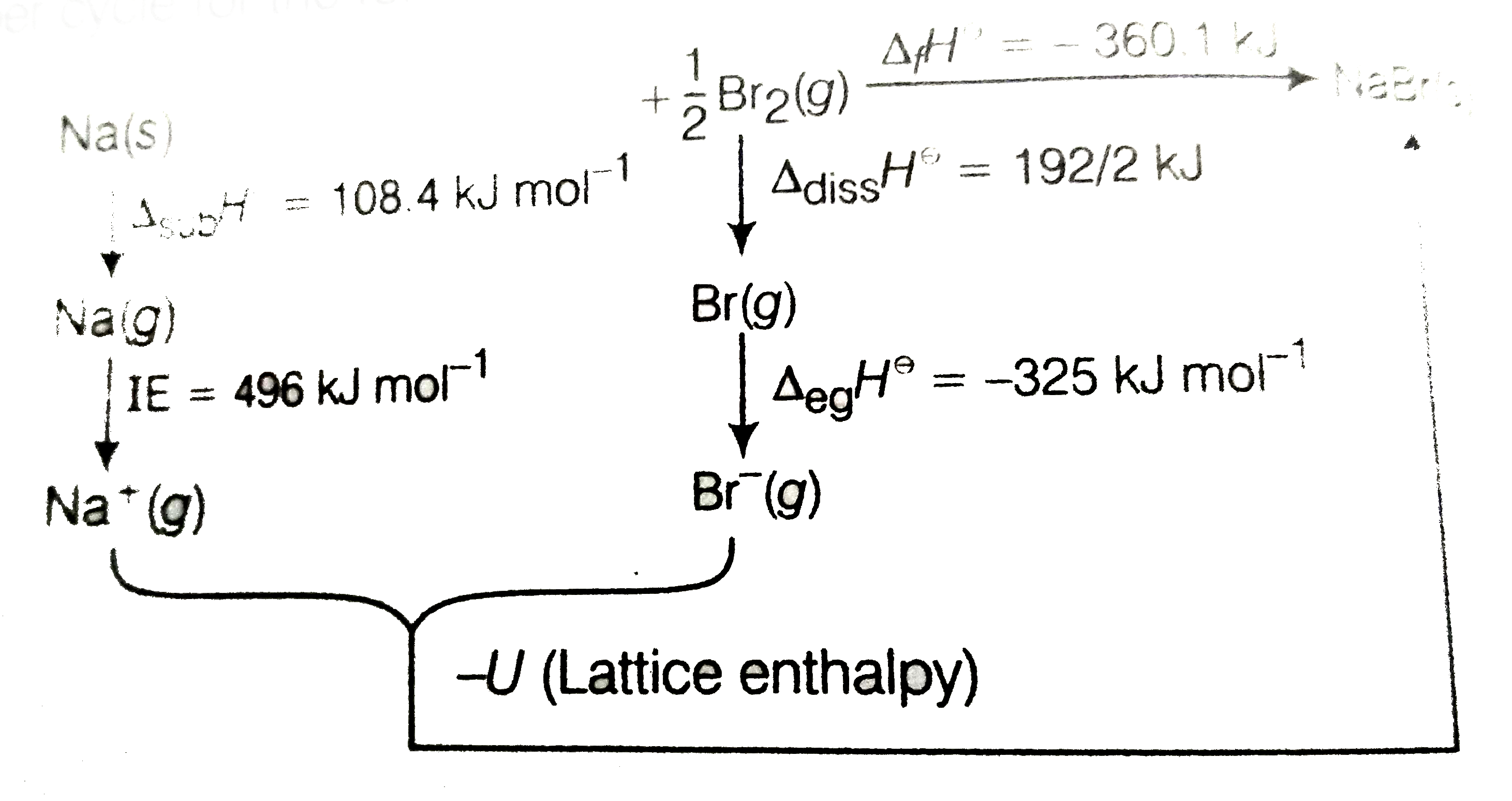 By APPLYING Hess's law, `Delta_(f) H^(Θ) + IE + Delta_("diss") H^(Θ) + Delta_("eg") H^(Θ) + U` `-360.1 = 108.4 + 496 + 96 + (-325) - U` `U = + 735.5 kJ mol^(-1)` |
|
| 9. |
Two elements X and Y react separately with highly electropositve metal to form binary compounds, which upon hydrolysis yield mixture of boranes and silances. X and Y respectively are |
|
Answer» B, Si |
|
| 10. |
Which has the maximum number of atoms ? |
|
Answer» `6.022 xx 10^(21)` MOLECULES of `CO_(2)` |
|
| 11. |
Which of the following metallic chloride has covalent character |
|
Answer» `BeCI_(2)` |
|
| 12. |
Which of the following hydrocarbons is used for the major industrual synthesis of acetylene? |
|
Answer» `CH_4` The reaction proceeds (although it is highly endothermic) because there are twice as many moles of products (4 mol) as reactants (2 mol). This cause a significant increase in entropy and at this HIGH temperature, the `TDELTAS` term in the equation `DeltaG=DeltaH-TDeltaS` predominates, makin `DeltaG` negative even though `DeltaH` is positive. The optimum time for this reaction is a mere 0.01s because if kept too long at this temperature `C_2H_2` (an endothermic compound) would decompose. |
|
| 13. |
What happens when the temperature of a reversible reaction at equilibrium is increased, if enthalpy change is positive? |
| Answer» SOLUTION :EQUILIBRIUM SHIFTS to the RIGHT. | |
| 14. |
What will be the pressure of the gas mixture when 0.5 L of H_(2) at 0.8 bar 2.0 L of oxygen at 0.7 bar are introduced in a 1L vessel at 27^(@)C ? |
|
Answer» Solution :Calculation of partial pressure of `H_(2)` in 1L VESSEL `P_(1)=0.8 bar,"" V_(1)=0.5 L` `P_(2)=? "" V_(2)=1.0 L` As temperature remains constant, `P_(1)V_(1)=P_(2)V_(2)` `(0.8" bar")(0.5 L)=P_(2)(1.0 L)"or"P_(2)=0.40" bar", i.e., p_(H_(2))=0.40"bar"` Calculation of partial pressure of `O_(2)` in 1L vessel `P'_(1)V'_(1)=P'_(2)V'_(2)` `(0.7" bar")(2.0 "bar")=P'_(2)(1 L) or P'_(2)=1.4" bar", i.e., P_(O_(2))=1.4 "bar"` `:."" "TOTAL pressure"=P_(H_(2))+P_(O_(2))=1.4 "bar"+1.4" bar"=1.8" bar"` |
|
| 15. |
The treatment of CH_3MgXwith CH_3 C -= C -H produces |
|
Answer» `CH_4` |
|
| 16. |
Which of the following molecules is likely to possess functional isomerism |
|
Answer» `CH_(3)OH` |
|
| 17. |
Which of the following does not conlribute towards the formation or photochemical smog? |
|
Answer» NO |
|
| 18. |
Which of the two :O_(2)^(-) or O_(2)^(2-) has higher bond order and why? |
| Answer» SOLUTION :`O_(2)^(-)` has HIGHER bond order (1.5) than `O_(2)^(2-)(1.0)` because `O_(2)^(-)` has lesser NUMBER of electrons in antibonding MOS. | |
| 19. |
Which one of the following pairs of species have the same bond order ? |
|
Answer» `O_(2)^(-) and CN^(-)` |
|
| 20. |
The solubility of PbCl_2 will be given by the equation |
|
Answer» `(K_(sp))^(1/3)` `K_(SP)=[Pb^(24)]XX[2Cl^-]^2` `K_(SP)=(S)(2S)^2` `K_(SP)=4S^3` `therefore S=root3((K_(SP))/4)` |
|
| 22. |
What is thesignificanceof the terms ' isolatedgaseousatom' and' groundstatewhiledefiningtheionizationenthalpy and elecron gain enthalpy ? |
|
Answer» Solution :(i) Ionizationenthalpyis theminimumamount of theenergyrequiredto remove themostloosely boundelectrons increases isolatedgaseous atom so as to convert it into a gaseouscation. The forcewithwhichan ELECTRON isattractedby the nucleus of an atom isappreciablyaffected bypresence ofotheratomswithinit molecule or in theneighbourhood. Therefore for the purposeof determination of theionizationenthalpy it isessential that these interatimic forces of attraction should be minimum . sincein thegaseous state theatom arewidely separated thereforetheseinteratomicforces areminimum. furthersince it is not possible to isolatea singleatom for the purpose ofdetermination of its ionization enthalpy therefore, the interatomic distancesare furtherreduced by carrying out themeasurementat a lowpressure of the gaseous atom,. It isbecause of theseresons that theterm isolated gaseousatomhas beenincludedin the definition of ionization enthalpy. (ii)Electron gainenthalpy is theenergyreleasedwhen anisolatedgaseousatom in thegroundstate acceptsan extraelectronto formthe gaseousnegative ion. Thetermisolatedgaseous atom has laready beenexplained above. thetermgroundstateheremeans that the atom mustbe present in themost stablestate i.e.,the GROUND state. Thereason beingthatwhen the isolatedgaseousatom isin the EXCITED state LESSER amount of energy will bereleasedwhen itgets converted into gaseous anion after ACCEPTING an electron. Thereforefor comparisonpurposes, the electron gainenethalpies ofgaseous atom must bedetermined in theirrespectivemoststablestate i.e.,ground state. |
|
| 23. |
What is the relation between K and ""^(@)C ? |
|
Answer» `K=""^(@)C+273` |
|
| 24. |
Write Lewis dot structure of CO molecule. |
|
Answer» Solution :(i) C [He] `2S^(2) 2p^(2)`, So valence electron = 4 O [He] `2s^(2) 2p^(4)`, So valence electron = 6 `therefore` Total valence electron in CO = 10 (ii) The skeletal structure of CO is written as C - O . (iii) Draw a single hnnci (ONE shared electron pair) between C and O and complete the octet on O, the remaining two electrons are the lone pair on C.  OR `:C underset(larr)(=) O: ` Lewis structure `xx` Electron of C (iv) This does not complete the octet on carbon and hence we have to resort to multiple bonding (in this case a triple bond) between C and O atoms. This satisfies the octet rule condition for both atoms.  C and O has triple bond. Two COVALENT bond one coordinate bond. Note: Triple bond is three. One coordinate bond and two covalent bond between C and O. In co- ordinate bond both electron is DONATED by oxygen. |
|
| 25. |
What do we notice in Lassaigne's test if the compound contains both nitrogen and sulphur ? |
| Answer» SOLUTION :A blood RED colouration is noticed due to the formation of `FE(CNS)_(3)`. | |
| 26. |
Which of the following statements are not correct for the following reaction : 2MnO_4^(-) +6I^(-) +4H_2O rarr 2MnO_2+3I_2+8OH^(-) |
|
Answer» OXIDATION number of in `MnO_4^(-) and MnO_2` are same |
|
| 27. |
Which of the following alkali metal carbonates decomposes easily by heat |
|
Answer» `Li_(2)CO_(3)` `Li_(2)CO_(3) rarrLi_(2)O+CO_(2)` |
|
| 28. |
What is difference and similarities between Mg and Mg^(2+). |
|
Answer» SOLUTION :Difference : Mg is neutral atom and Atomic radius is more than `Mg^(2+)`. Mg contain 12 electrons. Mg is parent atom `Mg^(+2)` is positive ION. IONIC radius is less than Mg. `Mg^(+2)` ion contain 10 electrons. `Mg^(+2)` is positive ion obtain from Mg. Similarity : Mg and `Mg^(2+)` having same atomic NUMBER . |
|
| 29. |
Which of the following statement(s) is/are not true about the following decomposition reaction. 2KCIO_3to 2KCI+3O_2 (i) Potassium is undergoing oxidation (ii) Chlorine is undergoing oxidation (iii) Oxygen is reduced (iv) None of the species are under going oxidation and reduction . |
|
Answer» only (IV) |
|
| 30. |
What is the change in oxidation number and electric charge in following balance redox reaction CuS+SO_(4)^(2-)toCuO+SO_(2) ? |
Answer» Solution : `CuS+3SO_(4)^(-2)+6H^(+)toCuO+4SO_(2)^(-)+3H_(2)O` Change in oxidation number = 6, Charges = 0 |
|
| 31. |
What steps should be taken to reduce the production of acid rain ? |
|
Answer» SOLUTION :By reducing the emission of SULPHUR dioxide and nitrogen dioxide in the atmosphere can HELP to reduce acid rain. . We should use less vehicles driven by fossil fuels. We should use less sulphur content fossil fuels for power PLANTS and industries. We should use natural gas which is a better fuel than coal or use coal with less sulphur content. Catalytic converters MUST be used in cars to reduce the effect of exhaust fumes on the atmosphere. We can also reduce the acidity of the soil by adding powdered limestone to neutralise the acidity of the soil. |
|
| 32. |
Which one of the following is correct order of increase of size..... |
|
Answer» `MG lt NA^(+) lt F^(-) lt Al` |
|
| 34. |
Write the reduction reaction and Wurtz reaction of 1-chloropropane ? |
Answer» Solution :`underset("1-Chloropropane")(CH_(3)CH_(2)CH_(2)Cl+H_(2))underset("Rediction")OVERSET(Zn, H^(+))rarr underset("PROPANE")(CH_(3)CH_(2)CH_(3))+HCL`  Here, there is isomerization of n-Hexane. |
|
| 35. |
Whichof the followingis notpermissiblearrangementof electronin an atom ? |
|
Answer» `N= 5,1 =3 m=0 , s=+(1)/(2)` |
|
| 36. |
Which one of the following reactions is an example for calcinaion process ? |
|
Answer» 2Ag + 2HCL + [O] `RARR` AgCl + `H_(2)O` `MgCO_3` `rarr` MgO + CO_2 `UARR` |
|
| 37. |
Which one of the following elements is a non-metal ? |
|
Answer» BORON |
|
| 38. |
Which one of the following is correctly matched? |
|
Answer» Emulsion-Curd |
|
| 39. |
Which type of deviation shows by gas from graph pV to V? H_(2), He, CO, CH_(4) |
| Answer» Solution :`H_(2)` and He shows POSITIVE DEVIATION and CO, `CH_(4)` shows NEGATIVE deviation. | |
| 40. |
Which of the following catalysis is/are used for partial reduction of alkyne ? |
|
Answer» `Na//NH_(3)(l)` |
|
| 41. |
Which one of the following demonstrates a decrease in entropy ? |
|
Answer» DISSOLVING a solid into solution |
|
| 42. |
Write one reducing property of nitrous acid. Also give equation. |
|
Answer» Solution :Since oxidation STATE of N in `HNO_(2)`. +3, therefore, it can be increased to its MAXIMUM O.N. of +5 and hence it acts as a reducing it. For example, it reduces `KMnO_(4)` to MANGANES salts. `2KMnO_(4)+5HNO_(2)+3H_(2)SO_(4)toK_(2)SO_(4)+2MnSO_(4)+5HNO_(3)+3H_(2)O` For more such reactions, refer to 'Supplement Your Knowledge' |
|
| 43. |
Using the following thermochemical equations (i) S(Rh) + 3/2 O_(2)(g) to SO_(3), DeltaH = -2x (kJ)/(mol) (ii)SO_(2)(g) + 1/2O_(2)(g) to SO_(3)(g), Delta H = - y (kJ)/(mol) Find ut the heat of formation of SO_(2)(g) in (kJ)/(mol) |
|
Answer» `(2x + y)` `S(Rh) +O_(2)(g) to SO_(2)(g)`, `Delta_(F)H = DeltaH_(1) - DeltaH_(2)` ` = -2x + y` |
|
| 45. |
Two solids X and Y dissociate into gaseous products at a certain temperature as follows: i. X(s) hArr A(g)+C(g) and ii. Y(s) hArr B(g)+C(g) At a given temperature, pressure over excess solid 'X' is 40 mm of Hg and total pressure over solid 'Y(s)' is 60 mm of Hg. Now, answer the following questions: Ratio of K_(p) for reaction (i) to that of reaction (ii), is: |
|
Answer» `4:9` `K_(P_(1))=20xx20=400 mm^(2)` and `{:(Y(s),hArr,B(g),+,C(g),),(,,30 mm,,30 mm):}` `K_(P_(2))=30xx30=900 mm^(2)` `:. K_(p_(1))/K_(p_(2))=4/9` |
|
| 46. |
Which one of the following is the correct order of inoic radii ? |
|
Answer» `Na^(+) lt MG^(2+) lt AL^(3+) lt Si^(4+)` |
|
| 47. |
The volume of oxygen needed for the complete combustion of 25 mJ of C_(x) H_y is |
|
Answer» x ml |
|
| 48. |
Which of the following metals will not react with solution of CuSO_4 ? |
|
Answer» Fe |
|
| 49. |
Which of the following is a hydrophilic colloidal sol? |
|
Answer» BARIUM SULPHATE sol. |
|
| 50. |
Write name of the pollutant found in Troposphere. |
|
Answer» Solution :TROPOSPHERIC pollution occurs due to the presence of undesirable solid or gaseous PARTICLES in the air. The following are the major gaseous and PARTICULATE pollutants present in the troposphere : (i) Gaseous air pollutants : Oxides of SULPHUR, nitrogen and carbon, hydrogen sulphide, hydrocarbons, ozone and other oxidants. (ii)Particulate pollutants : These are dust, MIST, fumes, smoke, smog etc. |
|