

Saved Bookmarks
This section includes 7 InterviewSolutions, each offering curated multiple-choice questions to sharpen your Current Affairs knowledge and support exam preparation. Choose a topic below to get started.
| 1. |
One end of string of length 1.5 m is tied to a stone of mass 0.4 kg and the other end to a small pivot on a smooth vertical board. What is the minimum speed of the stone required at its lowermost.point so that the string does not slack at any point in its motion along the vertical circle ? |
|
Answer» Solution :The MINIMUM SPEED of the stone REQUIRED at its lowermost so that the STRING does not slack at,any point = `v_("min") = sqrt(5gR)`.[See derivation under MOTION in a vertical circle.] `v_("min") = sqrt(5 xx 9.8 xx 1.5) = 8.57 ms^(-1)` |
|
| 2. |
The terminal velocity of a tiny droplet is v. N number of such identical droplets combine together forming a bigger drop. Find the terminal velocity of the bigger drop. |
|
Answer» Solution :`nu=(2)/(9)[(g(sigma-rho)r^(2))/eta]` `implies "" (nu)/(r^(2))=(2g)/(9eta)(sigma-rho)"" CDOTS(1)` Similarly , `"" (nu)/(R^(2))=(2g)/(9eta)(sigma-rho)"" cdots(2)` `(nu)/(nu)=(r^(2))/(R^(2))impliesv=nu((R)/(r))^(2)` If N drops coalesce, then VOLUME of one big drop = Volume of N droplets `(4)/(3)piR^(3)= N((4)/(3)pir^(3))` R `"" =N^(1//3)r` `:.` Terminal velocity of bigger drop `=((R)/(r))^(2) XXV` from equation (1) `=N^(2//3) nu` from equation (2) |
|
| 3. |
Three identical solid spheres moves down three incline A, B and C - all of the same dimensions. A is without friction, the friction between B and sphere is sufficient to cause rolling without slipping, the friction between C and sphere causes rolling with slipping. The kinetic energies A, B, C at the bottom of the inclines are E_(A), E_(B), E_(C ) |
|
Answer» `E_(A)=E_(B)=E_(C )` |
|
| 4. |
A mason worker throws the bricks ot a height of 10m, at which the bricks reach with a velocity of 6ms^(-1). The percentage of energy he is wasting is nearly (g=10ms^(-2)0 |
|
Answer» 0.15 |
|
| 5. |
Two sitar wires A and Bproducing the note "Dha" are slightly out of tune and produce 5 beats per second. When the tension in the wire B is slighly increased, the beat frequency decreases to 3 Hz. If frequency of A is 512 Hz, what should be original and final frequency of B ? |
| Answer» SOLUTION :Original FREQUENCY of `B=507 HZ` and final frequency of `B =509 Hz` | |
| 6. |
When current density of (2.5+-0.5)A is passed from wire, then there is a difference of (20+-1)V in electric potential. The resistance of wire is |
|
Answer» |
|
| 7. |
A circular disc is rotating about its natural axis with angular velocity of 10" rads"^(-1) . A second disc of same mass is joined to it coaxially. If the radius of disc is half of the radius of the first, then they together rotate with an angular velocity of |
|
Answer» `2.5" rads"^(-1)` |
|
| 9. |
What is mass? Write effect of external factor on mass. |
|
Answer» Solution :Quantity of matter present in body is called mass. Mass is INHERENT (fundamental property of any object. Mass do not DEPEND on the temperature, pressure or location of the object in space. SI unit of mass is KILOGRAM. The PROTOTYPES of the international standard kilogram supplied by the International Bureau of Weights and Measure (BIMP) are avaiable in MANY other laboratories of different countries. In India this prototype is available at the National Physical Laboratory (NPL) New Delhi. |
|
| 10. |
When work is done to pull the surface of a soap film to increase its surface area, do you think its surface tension also increases? |
| Answer» Solution :No, surface TENSION is CONSTANT for a given liquid. It is INDEPENDENT of surface area. | |
| 11. |
Two SHMs are represented by the equations y_(1)= 10sin(3pit+pi//4) and y_(2)= 5[sin3pit+ sqrt(3)cos3pit] Their amplitudes are in ratio |
|
Answer» 1:2 |
|
| 12. |
What happens to the pressure inside a soap bubble when air is blown into it ? |
|
Answer» <P> SOLUTION :When air is blown into a SOAP bubble, the pressure inside a bubble is decreased `P = (4T)/R` |
|
| 13. |
What is latent heat of vaporization ? |
| Answer» Solution :It is the HEAT required to convert UNIT MASS of liquid into gas (vapour) without CHANGING its temperature. | |
| 14. |
The angle made by the resultant of normal reaction and limiting value of frictional force with normal to the surface is called |
|
Answer» Angle of repose |
|
| 15. |
A ballon rises from rest on the ground with acceleration g/8. A stone is dropped when ballon is at a height of 39.2m The taken by stone to reach ground is |
|
Answer» 2 sec |
|
| 16. |
A ballon rises from rest on the ground with acceleration g/8. A stone is dropped when ballon is at a height of 39.2m Velocity of stone when it strikes ground is |
|
Answer» 2G m/s |
|
| 17. |
A block of quartz of mass 13.5 g is weighed in aniline at 0^(@)Cand100^(@)C. The weighings are 8.905 g and 9.29 g respectively, Calculate the coefficient of cubicat expansion of aniline, assuming the coefficient of cubical expansion of quartz to be zero. |
|
Answer» SOLUTION :We know the ratio of thrusts or loss of weight in liquid is `W_(2)/W_(1)=(Th.)/(Th)=(V^(1)sigma^(1)g)/(Vsigmag)=((1+gamma_(s)Deltatheta))/((1+gamma_(L)Deltatheta))=1/((1+gamma_(L)Deltatheta))` `thereforegamma_(s)=0` In this problem, `W_(1)=(13.5-8.905)xx10^(-3)xxgN` = `4.595xx10^(-3)xxgN,t_(1)=0^(@)C,` `W_(2)=(13.5-9.29)xx10^(-3)xxgN` = `4.21xx10^(-3)xxgN,t_(2)=100^(@)C,gamma_(s)=0` Substituting in the above equation. `(4.21)/(4.595)=1/(1+gamma_(L)100)rArr1+gamma_(L)100=4.595/4.21` `gamma_(L)=0.385/(4.21xx100)=9.166xx10^(-4)//""^(@)C` |
|
| 18. |
A mass M attched to a horizontal spring executes SHM with an amplitude A_(I). When mass M passes through its mean position a smaller mass m is placed over it and both of them move together with amplitude A_(2). The ratio ((A_(1))/(A_(2))) is |
|
Answer» Solution :`T_(1)=2pisqrt(M/K),T_(2)=2pisqrt(((m+M))/k)` USING law of conservation of linear momentum `MV_(1)=(m+M)V_(2)` `M(A_(1)omega_(1))=(m+M)(A_(2)omega_(2))` `(A_(1))/(A_(2))=((m+M))/M(omega_(2))/(omega_(1))=((m+M))/M sqrt(k/(m+M))sqrt(M/k)=sqrt(((m+M))/M)` |
|
| 19. |
A thin circular ring of mass M and radius R is rotating about an axis perpendicular to the plane of the ring and passing through the centre with an angular velocity omega. Two bodies each of mass m are placed gently on thering. The angular velocity with which thering is rotating now is given by |
|
Answer» `(OMEGAM)/(M+m)` |
|
| 20. |
If a particle is moving on a curve path, the component of acceleration in the direction of velocity is tangential acceleration, while the component of acceleration perpendicular to velocity is normal or centripetal acceleration. A particle is moving on a curved path. Its acceleration and velocity at point P is (hat(i) + 2hat(j) - 2hat(k)) ms^(-2) and (hat(i)+ 2hat(j) + 2 hat(k)) ms^(-2). Choose the correct option (s) . |
|
Answer» The tangential acceleration at POINT P is `4//3 MS^(-2)` |
|
| 21. |
Four particle each of mass 1kg are at the four orners of a square of side 1m. The workdine to move one of the particles to infinity |
|
Answer» `2sqrt(2)G` |
|
| 22. |
Moment of inertia of an annular disc about an axis passing through the centre and perpendicula to the plane of disc is |
|
Answer» `(M)/(2)(R_(1)^(2)+R_(2)^(2))` |
|
| 23. |
A particle of mass 1 kg is moving along x-axis. It's velocity is 6m/sec at x=0. Acceleration (a), displace (x) curve and potential energy (u) -displacement (x) curve of the particle are shown. |
|
Answer» The WORK done by all forces is 704 J |
|
| 24. |
A trolley C can run on a smooth horizontal table. Two, much smaller but equal masses A and B are hung by string which pass over smooth pulleys : The string are long enough that when C is in equilibrium. A and B both are just on the ground. The trolley is pulled slow to one side and released as shown below. The graph of its velocity v against 't' will be as : |
|
Answer»
|
|
| 25. |
The length , breadth and thickness of a rectangular sheet of metal are 4.234 m, 1.005 m, and 2.01 cm respectively. Give the area and volume of the sheet to correct significant figures. |
| Answer» SOLUTION :`8.72 CM^(2)`, `0.0855 m^(3)` | |
| 26. |
A rocket is launched from the suface of the earth vertically upward from rest. It moves under acceleration 8 m//s^(2). After 15 s the fuel is finished, the rocket moves under gravity and ultimately strickes the ground. Assuming upward direction position and launching point as the origin, sketch the v-t, s-t and a-t graph. |
Answer» Solution :Here the motion is in two parts: first acceleration and then motion under gravity. 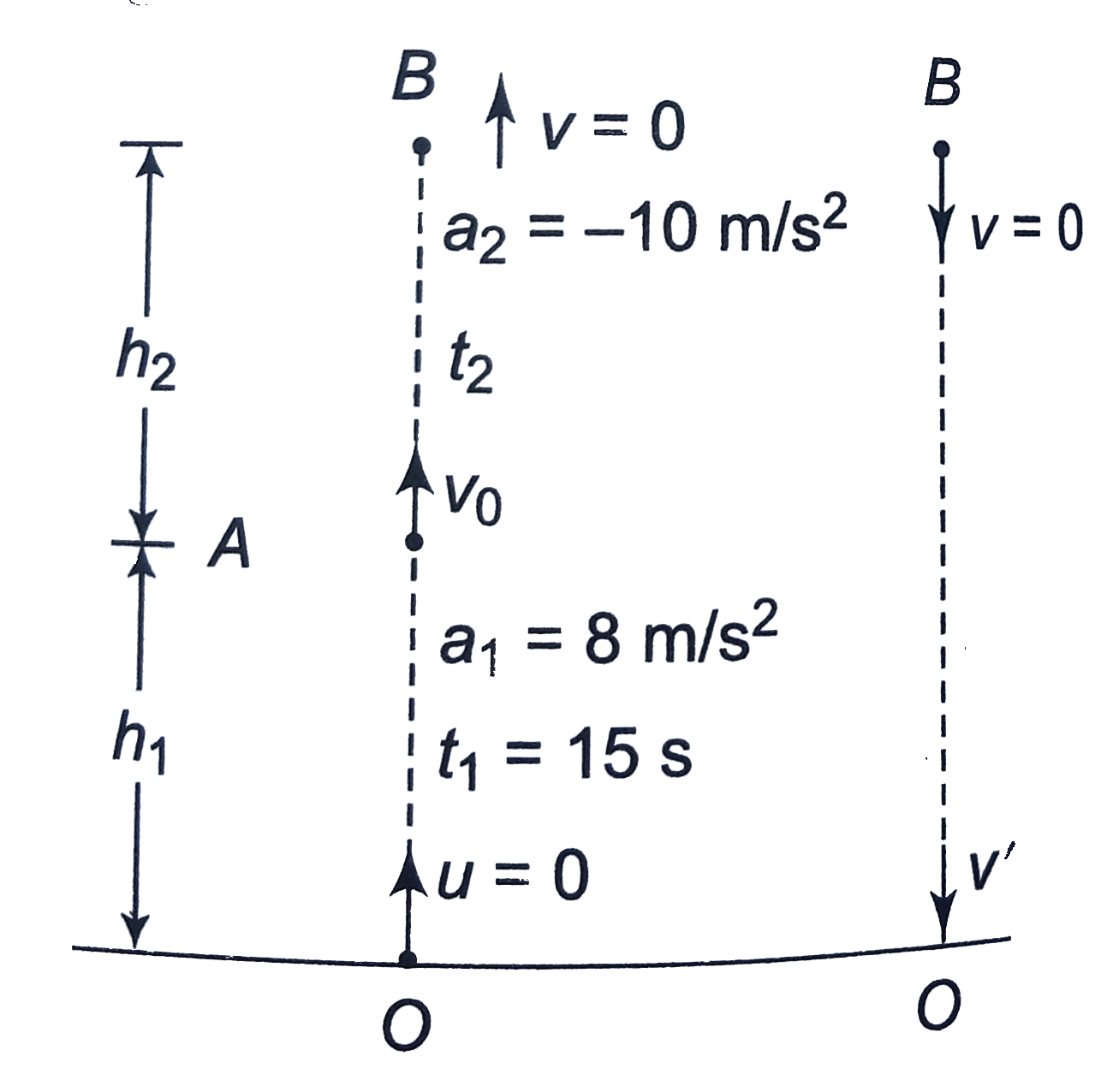 Acceleration motion O to A: `h_(1)=0+1/2a_(1)t_(1)^(2)=1/2xx8xx(15)^(2)=900 m` A to O through B A: ORIGIN Displacement`=-900 m` `S=ut-1/2 at^(2)` `-900=v_(0)t_(2)-1/2 a^(2)t_(2)^(2)=120 t_(2)-5t_(2)^(2)` `t_(2)^(2)-24t_(2)-180=0` `t_(2)=(24+-sqrt((-24)^(2)-4(1)(-180)))/2` `=(24+-36)/2` `t_(2)=30 s`, the rocket will strike the ground after 30 s (after the fuel is finished) `v^(')=u-g t_(2)` `=v_(0)-g t_(2)` `=120-10xx30=-180 m//s` The velocity of the rocket will be zero after TIME `t_(3)`. So, `0=120-10t_(3)impliest_(3)=12 s` To obtain the maximum HEIGHT attained by the rocket above A, we have `0=(v_(0))^(2)-2xx10xxh_(2)impliesh_(2)=720 m` at time `t^(')=12 s` TOTAL time of journey `=15+30=45 s` v-t graph `t=0, v=0` `t=15 s, v=120 m//s` `t=27 s, v=0` `t=45 s, v=-180 m//s` `t=0` to `t=15 s`, `v=8t` (straight line) `t=15` to `t=45s` `v=120-10(t-15)` (straight line) `[15 s lt = t lt = 45 s]` 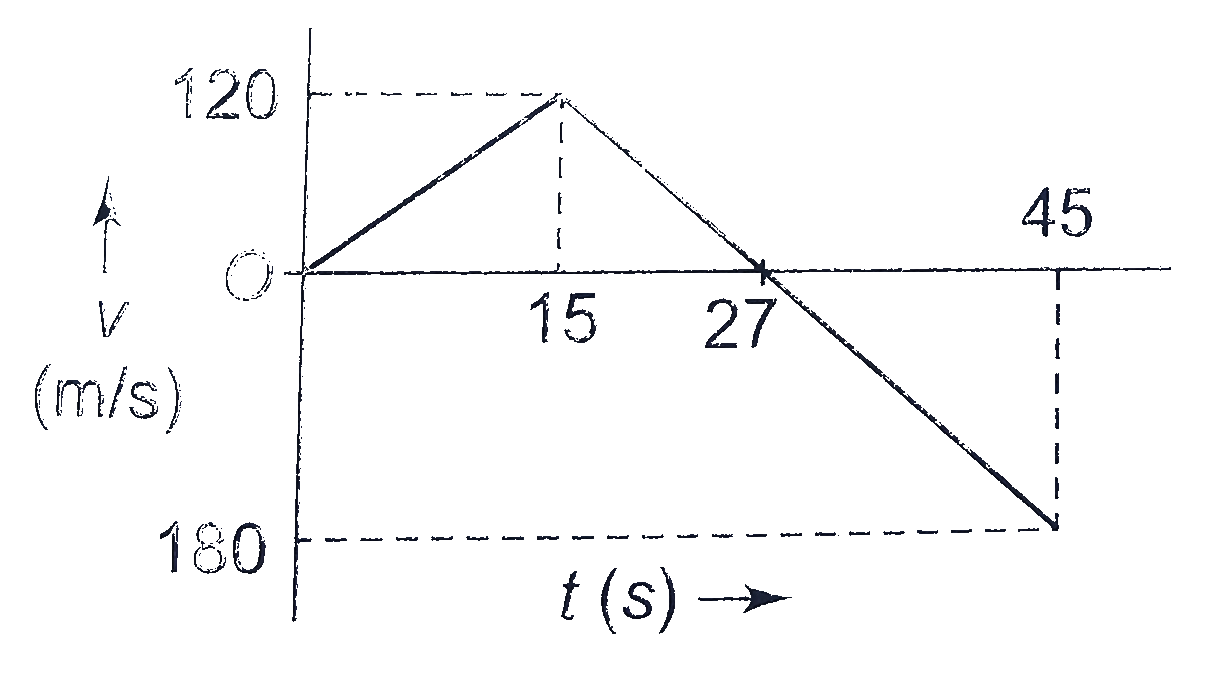 s-t graph `t=0, s=0` `t=15 s, s=900 m` `t=27 s, s, s=900+720=1620 m` `t=45 s, s=0` `t=0` to `t=15 s`, `s=1/2 a_(1)t^(2) implies s=4t^(2)` Shape: `y=4x^(2)` (parabola, open upward) `t=15 to 45 s` `s=900+v_(0)(t-15)-1/2a_(2)(t-15)^(2)` `=900+120(t-15)-5(t-15)^(2)` Shape: `y=900+120x-5x^(2)` (parabola, open downward) 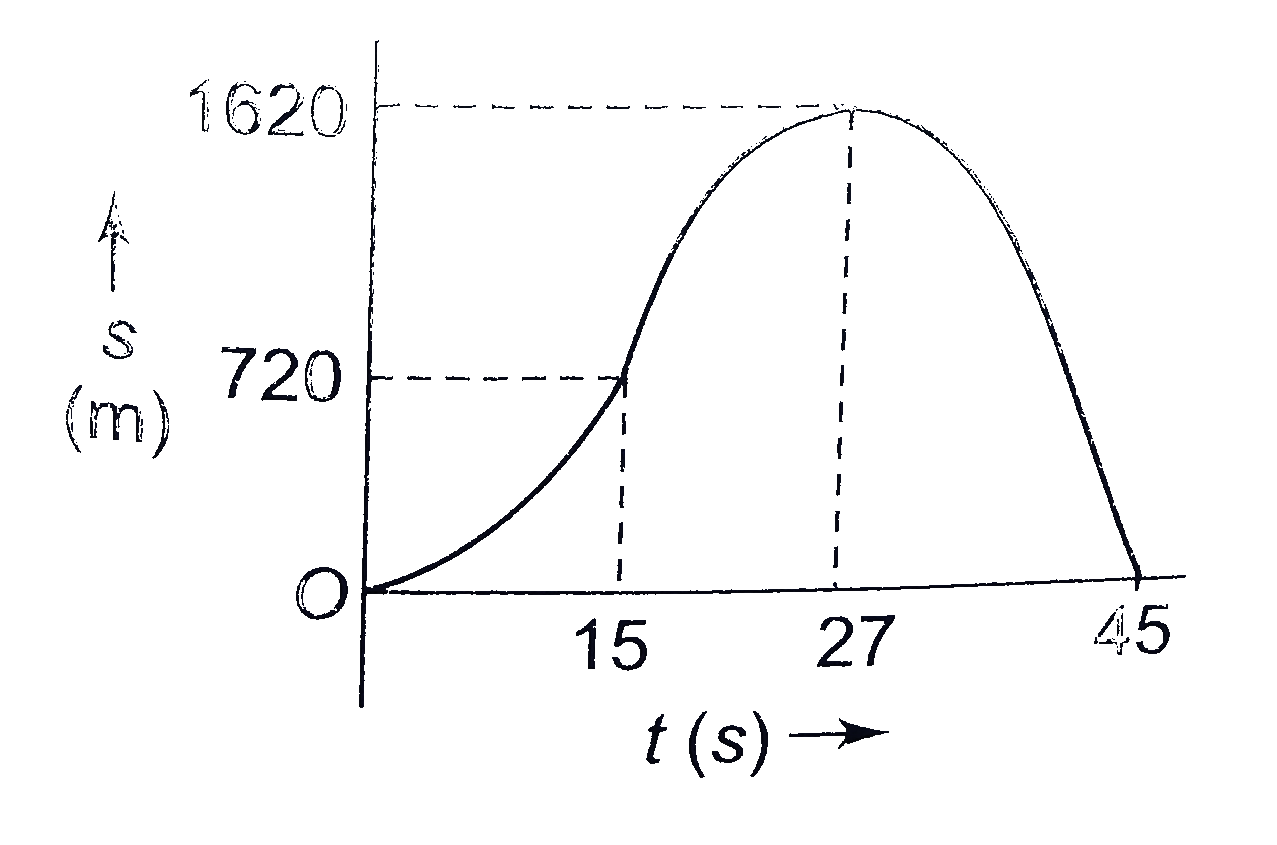
|
|
| 27. |
A liquid of mass M and specific heat S is heated to a temperature T. Another liquid of mass M/3 and specific heat 2S is heated to a temperature 2T. If these two liquids are mixed, the resultant temperature of the mixture is |
| Answer» Answer :D | |
| 28. |
When a current of (5 +- 0.5) A flows through a wire, it developes a potential difference of (40 +- 1)V. The resistance of wire is |
|
Answer» `(8+-1)OMEGA` |
|
| 29. |
The maximum and minimum distances of a cornet form Sun are 1.4 xx 10^(12) m and 7 xx 10^(10) m. If velocity nearest to Sun is 6 xx 10^(4) ms^(-1), what is velocity if cornet when it is farthest from the Sun ? |
| Answer» SOLUTION :`I_(1)omega =I_(2)omega(2) , mr_(1)^(2)(v_(1)//r_(1)) = m_(2)^(2) xx v_(2)//r_(2), 6 xx 10^(4) xx 7 xx 10^(10) = v_(2) xx 1.4 xx 10^(12), v_(2) = 3000 ms^(-1)` | |
| 30. |
A vertical disc has three grooves directed along chords AB, AC and AD. Three bodies begin to slide down the respective grooves from A simultaneously. If AB > AC > AD, the respective time intervals to reach the bottoms of the respective grooves t_1 , t_2 and t_3 are |
|
Answer» `t_1 GT t_2 gt t_3 ` |
|
| 31. |
A block A of mass 6kg is applied on a frictionless table . A thread tied to it passes over a frictionless pulley and carries a body B of mass 4kg at the other end . Find the acceleration of the system and tension in the thread(given g=10ms^(-2)) |
|
Answer» |
|
| 32. |
A solid sphere of uniform density and radius 4 units is located with its centre at the origin of coordinates, O. Two spheres of equal radii of 1 unit, with their centres at A (-2,0,0) and B(2,0,0) respectively, are taken out of the solid sphere, leaving behind spherical cavities as shown in the figure (a)The gravitational force due to this object at the origin is zero (b) The gravitational force at the point B(2,0,0) is zero (c) The gravitational potential is the same at all points of the circle y^(2) + z^(2) = 36 (d) The gravitational potential is the same at all points on the circle y^(2) + z^(2) = 4 |
|
Answer» only a & B are TRUE |
|
| 33. |
A block is placed on an inclined plane whose angle of inclination is greater than the angle of repose. If the coefficient of friction is mu (a) find force P applied parallel to incline that will keep it in equilibrium (minimum and maximum value of force). (b) Find the range of P if it is applied horizontally on the block. ( c) What is the minimum value of P if it is applied perpendicular to the inclined plane? |
|
Answer» SOLUTION :(a) (i) If the block has tendency to move down , friction will act in the upward direction `_|_^(AR)` to the PLANE : `N = mg cos theta , f = mu N = mu mg cos theta` Along the plane : `P + f = mg sin theta rarr P = mg sin theta - f` `P_(min) = mg sin theta - mu mg cos theta` `= mg ( sin theta - mu cos theta)` (ii) If the block has tendency to move up , friction will act in the downward direction `P = mg sin theta + f` `P_(max) = mg ( sin theta + mu cos theta)` (b) (i) If the block has tendency to move down , friction will act in the upward direction `_|_^(ar)` to the plane : `N = mg cos theta + P sin theta` `f = mu N = mu (mg cos theta + P sin theta)` Along the plane : `P cos theta + f = mg sin theta` `P cos theta + mu(P sin theta + mg cos theta) = mg sin theta` `P (cos theta + mu sin theta) = mg ( sin theta - mu cos theta)` `P = (mg (sin theta - mu cos theta))/((cos theta + mu sin theta))` `P_(min) = (mg (tan theta - mu))/((1 + mu tan theta))` (ii) If the block has tendency to move up , friction will act downwards `P_(max) = (mg (tan theta + mu))/(( 1 - mu tan theta))` ( c) `_|_^(ar)` to the plane : `N = P + mg cos theta , f = mu N = mu (P + mg cos theta)` Along the plane : `mg sin theta = f = mu(P + mg cos theta)` `P_(min) = mg((sin theta)/(mu) - cos theta)`    
|
|
| 34. |
Deduce dimensional formulae of - (i) Boltzmann's constant (ii) mechanical equivalent of heat. |
|
Answer» Solution :(i) BOLTZMANN CONSTANT: `k = ("Heat")/("TEMPERATURE") rArr [k] = ([ML^(2)T^(2)])/([K]) = [M^(1)L^(2)T^(-2)K^(-1)]` (ii) [J] = `[("WORK")/("Heat")] = ([M^(1)L^(2)T^(-2)])/([M^(1)L^(2)T^(-2)]) = [M^(0)L^(0)T^(0)]` |
|
| 35. |
The correctness of an equation is checked using the principle of homogeneity. For an equatioit,x=a+bt+ct^2 where .xds in metre and t in second, what will be the dimension of 'b'? |
| Answer» SOLUTION :`X=a+bt+ct^2[B]=[[x]]/[[t]]=[[L]]/[[T]]=[m^0LT^-1]` | |
| 36. |
A 70 kg man stands in contact against the inner wall of a hollow cylindrical drum of radius 3 m rotating about its vertical axis with 200 rev/min.The coefficient of friction between the wall and his clothing is 0.15.What is the minimum rotational speed of the cylinder to enable the man to remain stuck to the wall (without falling) when the floor is suddenly removed ? |
| Answer» Solution :The horizontal force N by the wall on the MAN provides the needed centripetal force :` N = m R OMEGA^2`.The frictional force f (vertically upwards) opposes the weight mg.The man remains stuck to the wall after the floor is removed if `mg = fltmu N i.e. mgltmu m R omega^2` .THEMINIMUM ANGULAR speed of rotation of the cylinderis `omega_("min") = sqrt( G// mu R ) = 5 s^(-1)` | |
| 37. |
Suppose, the torque acting on a body is given by tauT=KL+xl/omega. Where L = angular momentum, E moment of inertia, omega= angular speed. The dimensional formula for Kx is same as that for |
|
Answer» `"TIME"^2` |
|
| 38. |
Two particles of masses 2m and 3m are at a distance 'd' apart. Under their mutual gravitational force, they start moving towards each other. The acceleration of their centre of mass when they are d//2 apart is |
| Answer» Answer :D | |
| 39. |
A compartment of an uniformly moving train is suddenly detached from the train and stops after covering some distance. The distance covered by the compartment and distance covered by the train in the given time |
|
Answer» both will be equal |
|
| 40. |
What points to be considered during multiplication and division of significant numbers ? |
|
Answer» Solution :For different types of SIGNIFICANT numbers in multiplication and division following points should be followed : (1) In multiplication or in division the final result should retain as many significant as there are in the original number with leastsignificant (2) When two number are to be multiplied or divided and out of them which is not a measurement is a definite number, the integers and fraction that occur in general in physical equations are definite number. For EXAMPLE, (1) Length and breadth of a PLATE are 1.567 cm and 10.4 cm RESPECTIVELY then AREA of plate `1.567 xx 10.4 = 16.2968 cm^(2)` But `10.4` represent number with 3 significant digit (minimum) hence area of plate should be rounded off to`=16.3 cm^(2)` (2) Let mass of an object is 8.254g and volume is `2.68 cm^(3)` `"Density"=("mass")/("volume")` `=(8.254)/(2.68)` `=3.07895074626 gcm^(-3)` The number 2.68 is with 3 significant digit hence result also should be represented with 3 significant digit hence it will be `3.08 g cm^(-3)` (3)If any number used in calculation have many infinite) significant figure then it should be rounded off to finite significant digit during calculation as per requirement in specific cases. (4) In any equation constant like `pi, epsi_(0) mu_(0), eta` are part of equation, then it should be rounded off to one digit more than given significant number For example, `pi` = 3.1415926 then depending on requirement of calculation it should be rounded off to 3.14, 3.142, 3.1416 while using calculation. |
|
| 41. |
The frequency of a source of sound is f. A sound wave from this source is moving horizontally twoards right. The wave is reflected from a large vertical plane moving towards left with a speed v. The speed of sound in medium is C. Find the (a) number of waves striking the surface per second. (b) Wavelength and frequency of reflected wave. (c) beat frequency. |
|
Answer» Solution :f = original frequency of source of sound. The speed of sound in medium = C (a) NUMBER of waves encountered by vertical PLANE per unit TIME = frequency = f. = `("distance travelled/sec.")/("wavelength")` `= (C + upsilon)/(LAMBDA) = (C)/(lambda) (1 + (upsilon)/(C))` Let the wave is reflected from a vertical plane and is received by an observer at rest. (b) Let f.. = frequency of wave reflected by plane `f.. = (1)/(1 - (upsilon)/(C)) f.` `= (f ((C + upsilon)/(C)))/(1 - (upsilon)/(C)) = (f (1 + (upsilon)/(C)))/((1 - (upsilon)/(C)))` `f.. = (f(C + upsilon))/((C - upsilon))` `lambda.. = (C)/(f..) = (C (C - upsilon))/(f(C + upsilon))` Beat frequency = f.. - f `= (f(C + upsilon))/((C - upsilon)) - f` `= f ((C+upsilon)/(C - upsilon) - 1)` `= f((C + upsilon - C + upsilon)/(C - upsilon)) = (2 v f)/(C - upsilon)` |
|
| 42. |
Draw (a) acceleration - time (b) velocity - time (c) position - time graphs representing motion of an object under free fall. Neglect air resistance. |
Answer» SOLUTION :The OBJECT falls with UNIFORM ACCELERATION EQUAL to.g. 
|
|
| 43. |
A torque of 10 Nm is applied to a flywheel of mass 10 kg and radius of gyration 50 cm. What is the resultant angular acceleration ? |
| Answer» Solution :`rau = 10 N, I = MK^(2)=10 xx 0.5^(2) = 2.5 kgm^(2), ALPHA = tau//l = 10//2.5 = 4 "rads"^(-2)` | |
| 44. |
The system of unit not only based on length, mass and time is |
|
Answer» FPS |
|
| 45. |
An ice cube of size a = 10 cm is floating in a tank (base area A= 50 cm xx 50 cm ) partially filled with water. The change in gravitational potential energy, when the ice melts completely is ( density of ice = 900 "kg/m"^(3) ) |
|
Answer» `-0.072` J |
|
| 46. |
Molar volume is the volume occupied by 1 mole of any (ideal) gas at standard temperature and pressure (STP : 1 atmospheric pressure , 0^(@)C) . Show that it is 22.4 litres. |
|
Answer» 11.2 Litres |
|
| 47. |
Figures 14.25 correspond to two circular motions. The radius of the circle, the period of revolution, the initial position, and the sense of revolution (i.e. clockwise or anti-clockwise) are indicated on each figure. Obtain the corresponding simple harmonic motions of the x-projection of the radius vector of the revolving particle P, in each case. |
|
Answer» SOLUTION :(a) x = - 3 SIN `pit` where x is in cm. (B) x = - 2 COS `pi/2t` where x is in cm. |
|
| 49. |
At what stage of the star do most of the elements originate? |
| Answer» SOLUTION :SUPERNOVA EXPLOSION. | |
| 50. |
Consider Example 22. Takin the coefficient of friction, mu to be 0.5, calculate the maximum compression of the spring. |
|
Answer» Solution :In the PRESENCE of friction, boththe SPRING force and the frictional force f act so as to oppose the COMPRESSION of the spring. WORK done by the two forces `W=-(1)/(2)kx_(m)^(2)-f(x_(m))` `W=-(1)/(2)kx_(m)^(2)-mumg(x_(m))` `( :' f=muR=mumg)` and change in K.E. `DeltaK=K_(f)-K_(i)=0-(1)/(2)mv^(2)` Applying work energy theorem, `DeltaK=W` `:. -(1)/(2)mv^(2)=-(1)/(2)kx_(m)^(2)-mumg(x_m)` `:.kx_(m)^(2)+2mumg(x_(m))-mv^(2)=0` It is a quadratic equation in `x_(m)` `:. x_(m)=(-2mumg+[4mu^(2)m^(2)g^(2)+4mkv^(2)]^(1//2))/(2K)` Putting the numerical values and solving, we get `_(m)=1.35m` |
|


