

Saved Bookmarks
This section includes 7 InterviewSolutions, each offering curated multiple-choice questions to sharpen your Current Affairs knowledge and support exam preparation. Choose a topic below to get started.
| 1. |
If the rms velocity of oxygen molecule at certain temperature is 0.5 km/s, the rms velocity for hydrogen molecule at the same temperature will be |
|
Answer» 2 km/s |
|
| 2. |
Inanisothermalprocess |
|
Answer» <P> Solution :Isothermal process: It is a process in which the temperature remains constant but the pressure and volume of a thermodynamic system will change. The ideal gas equation is`PV = muRT` Here, T is constant for this process So the equation of state for isothermal process is given by `"PV = Constant...(1)"` This implies that if the gas goes from one equilibrium state `(P_(1)V_(1))` to ANOTHER equilibrium state `(P_(2)V_(2))` the following relation HOLDS for this process `(P_(1)V_(1))` =`(P_(2)V_(2))"…(2)"` Since `"PV = constant,"` P is inversely proportional to `V(P prop (1)/(V))`. This implies that PV graph is a hyperbola. The pressure-volume graph for constant temperature is also called isotherm. We know that for an ideal gas the internal energy is a function of temperature only. For an isothermal process since temperature is constant, the internal energy is also constant. This implies that `dU or DELTAU = 0`. For an isothermal process, the first law of thermodynamics can be written as, `"Q = W…(3)"`  From equation (3), we infer that the heat supplied to a gas is used to do only external work, It is a common misconception that when there is flow of heat to the system, the temperature will increase. For isothermal process this is not true. The isothermal COMPRESSION takes place when the piston of the cylinder is pushed. This will increase the internal energy which will flow out of the system through thermal contact. 
|
|
| 3. |
What should be the orbit radius of a communications satellite so that it can cover 75% of the surface area of earth during its revolution. |
|
Answer» |
|
| 4. |
A man of mass M standing at a height h from the floor in a gravity free space throws a ball of mass m straight down with a speed u. When the ball reaches the floor, find the distance of the man above the floor. |
|
Answer» Solution :When the MAN THROWS the ball with velocity U, he recoils with velocity V. mu = MV  `V=(m u)/(M)` time taken by the ball to reach the GROUND `y=(h)/(u)` Distance moved by man in this time `t=v.t=(m u)/(M).(h)/(u)=(m)/(M).h` Height of man at the time the ball strikes the ground is `H=h+(m)/(M)h "" H=h(1+(m)/(M))` |
|
| 5. |
When a man of mass 60 kg sits inside a car, the centre of gravity of the car descends by 0.3 cm. If the mass of the car is 1000 kg, calculate the frequency of oscillation of the empty car. |
|
Answer» Solution :Frequency of OSCILLATION of the car, `N=1/(2pi)SQRT(k/m)`. The force constant of the spring of the car, `k=F/x=(60xx9.8)/(0.3xx10^(-2))=196xx10^(3)N*m^(-1)` `therefore"Frequency",n=1/(2xx22/7)sqrt((196xx10^(3))/1000)` = `(14xx7)/44=2.23s^(-1)`. |
|
| 6. |
On what factors does the elasticity of a material depend ? |
| Answer» SOLUTION :ANNEALING, hammaring, CHANGE of TEMPERATURE, IMPURITY. | |
| 7. |
Volume of 10^(-3)m^(3) wateris subjected to a pressureof 10 atmosphere. Thechangein volumeis 10^(-6)m^(3). Findthe bulkmodulus of water. (Atomospheric pressure =1xx10^(5)Nm^(-2)) |
|
Answer» SOLUTION :`V=10^(-3) m^(3), DeltaV=-10^(6)m^(3) , DeltaP=10`atm `=10xx10^(5) = 1xx10^(6)Nm^(-2)` `B= -((DeltaP)/(DeltaV)) V` `V=(-1xx10^(6))/(-10^(-6))xx10^(-3)=1xx10^(9)Nm^(-2)` |
|
| 8. |
What is the value of linear velocity vecv if vecomega = 3hati - 4hatj + hatk and vecr = 5 hati - 6hatj + 6hatk ? |
|
Answer» Solution :`vecv =vecomega xx VECR` `vecv = |{:(hati , hatj , HATK) , (3 , -4 , 1) , (5 , -6 , 6):}| = hati (-24 + 6) - hatj (18-5) + hatk (- 18 + 20)` `vecv = -18hati - 13 hatj + 2 hatk` |
|
| 9. |
A ray of light is incident normally on one of the faces of a prism of apex angle 30^@and refractive index sqrt2. The angle of deviation of the ray is ……degree. |
|
Answer» Solution :Apply Snell.s LAW of refraction at P `(sin 30^@)/(sin r)=1/sqrt2` `or sin r=sqrt2 times 1/2=1/sqrt2 = sin 45^@ or r=45^@` `therefore delta=r-30^@=45^@-30^@=15^@, therefore`DEVIATION of ray=`15^@` 
|
|
| 10. |
(A) : When a vector is rotated, itws magnitude remains constant. ( R) The magnitude of a vector is independent of the coordinate system. |
|
Answer» Both (A) and ( R) are ture and ( R) is the CORRECT EXPLANATION of (A) |
|
| 11. |
A rope is tightly wound along the equator of a large sphere of radius R. The length of the rope is increased by a small amountl (lt lt R) and it is pulled away from the surface at a point to make it taut. To what height (h) from the surface will the point rise ? If the radius ofthe earth isR=6400 km and l =10 mm, find the value of h. Does the value surprise you. [For small theta take tan theta=theta +(theta^(3))/(3) and sec theta=1+(theta^(2))/(2). "Also take" (2.3)^((2)/(3))=1.74] |
|
Answer» |
|
| 12. |
A cylinder of length 1.5 m and diameter 4 cm is fixed at one end. A tangential force of 4 xx 10^(5) N is applied at the other end. If the rigidity modulus of the cylinder is 6 xx 10^(10) Nm^(-2) then, calculate the twist produce in the cylinder. |
|
Answer» Solution :Torsion of a cylinder `tau = (pi eta r^4 phi)/(2l)` Twist produced in the cylinder `phi = (tau xx (2l))/(pi eta r^4) = ((F xx l) xx (2l))/(pi eta r^4)` `= (4 xx 10^5 xx 2 xx (1.5)^2)/(3.14 xx 6 xx 10^(10) xx (2 xx 10^(-2))^(4)) = (18 xx 10^(5))/(3.01 xx 10^(-6) xx 10^(10))` `phi = 59.80` |
|
| 13. |
A parachute is dropped from an aeroplane. The parachute opens after 10 s and then comes down with a uniform retardation of 2.5 "m.s"^(-2). If the aeroplane was at a height of 2.495 km and g = 10 "m.s"^(-2) , then the velocity at which the parachute touches the ground is |
|
Answer» 2.5 `"m.s"^(-1)` |
|
| 14. |
A ball of mass 1 kg moving with a velocity of 5 m//s collides elastically with rough ground at an angle theta with the vertical as shown in Fig. What can be the minimum coefficient of friction if ball rebounds vertically after collision? (given tantheta=2) |
|
Answer» `intN dt=m(v+5costheta)`………….i `intf dt=m5sintheta` `muintN dt=m5sintheta`……..ii `impliesmum(v+5costheta)=m5sintheta` 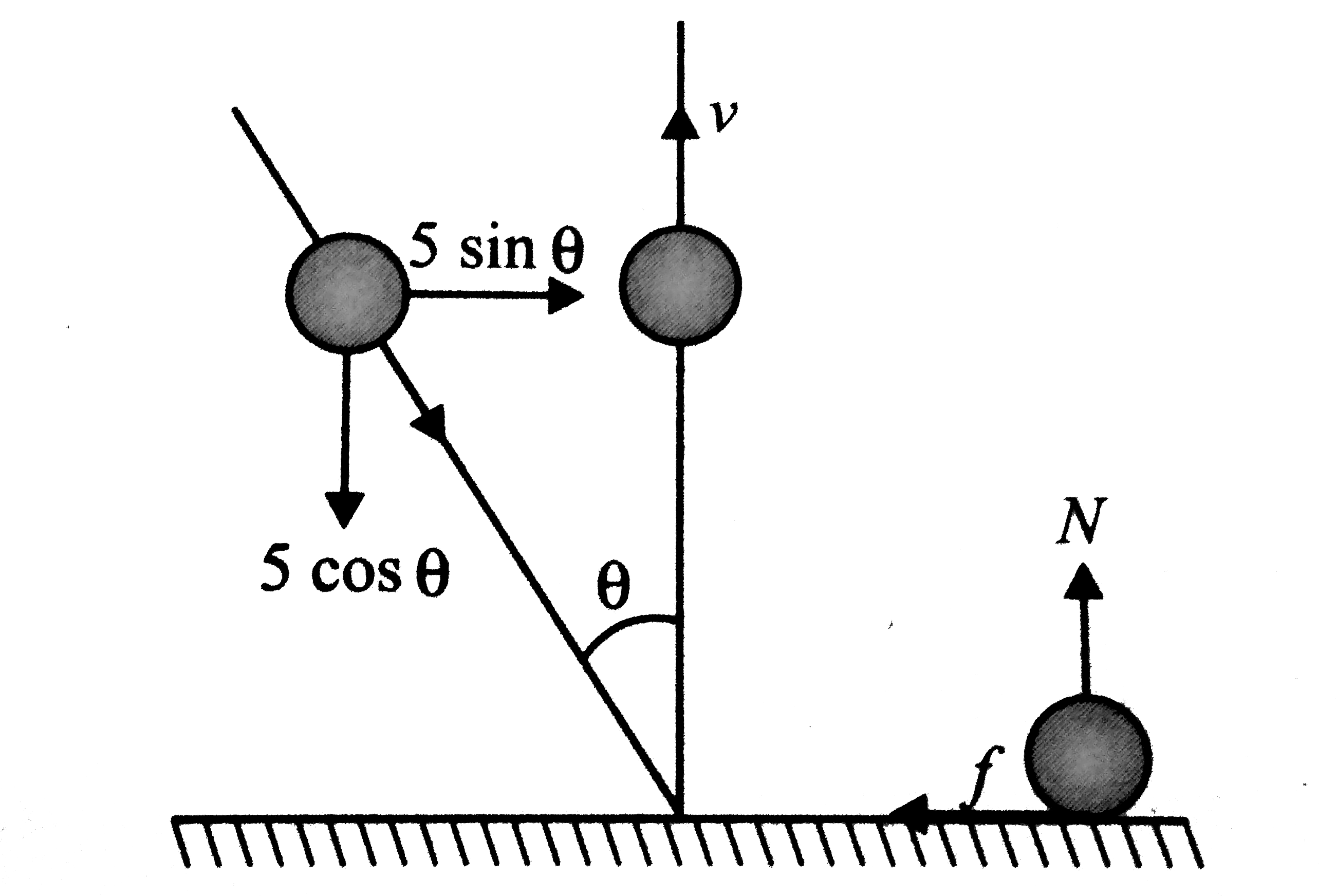 According to Newton's law of RESTITUTION `v=35costheta` SOLVE to GET `mu=1` |
|
| 15. |
A horizontal force F is applied through the center of mass of a solid sphere of mass m and radius R which lies on a horizaontal rough surface. If the sphere rolls without slipping, the acceeleration of the center of mass of the sphere will be (g= 10 m//s^(2)) |
|
Answer» `3/5 F//M` |
|
| 16. |
Distinguish between a closed system and an open system. |
| Answer» Solution : If a SYSTEM can exchange both MATTER and energy with the SURROUNDINGS it is CALLED open system. If the system EXCHANGES only energy with the surroundings it is called closed system. | |
| 17. |
A slab of ice is one half covered with black cloth and the other half with white cloth. This is then placed in sunlight. After same time the pieces of cloth are removed. Which of the following statements is correct ? |
|
Answer» ICE has melted qually under both the PIECES |
|
| 18. |
During an adiabatic process , the pressure of a gasis proportional to the cube of its temperature . The value of C_(I)//C_(v) for that gas is |
|
Answer» `3//5` |
|
| 19. |
An equilateral triangle ABC formed a uniform wire two small identical beads initially located at A. The triangle is set rotating abut the vertical axis AO. Then the beads are released from rest simultaneously and allowed to slideshown, one along AB and the other along AC as shown. Neglecting frictional effects, the quantities that are not conserved as the beads slide down, are |
|
Answer» Angular velocity and total ENERGY (kinetic energy and POTENTIAL energy) |
|
| 20. |
If two objects moving with a velocities of V_(A)andV_(B) at an angle of theta betweenthem, the relative velocity is |
|
Answer» `V_(AB)=SQRT(V_(A)^(2)+V_(B)^(2)-2V_(A)V_(B)costheta)` |
|
| 21. |
A disc of radius R and mass M is pivoted at the rim and is set for small oscillations. If simple pendulum has to have the same period as that of the disc, the length of the simple pendulum should be |
| Answer» Answer :D | |
| 22. |
The mean orbital radius of the earth around the sun is 1.5xx10^8km Calculate the mass of the sun if G = 6.67xx10^(-11) Nm^2 kg^-2. |
|
Answer» same on both PLANET |
|
| 23. |
Explain escape speed. |
|
Answer» Solution :`implies` SUPPOSE a body is at distance `r (r gtR_E)`from the centre of earth. This body is stationary. E = K.E. + Potential energy `E = - (GM_(E)m)/r` `E=-(GM_(E) m)/((R_(E) +h))""....(1)` `implies`If by supply this amount of energy, its total energy becomes zero. It will go to infinite distance from the earth. This energy is known as escape energy. `implies` To speed to be given to the body to give the kinetic energy equal to the escape energy`:. 1/2 mv_(e)^(2) = (GM_(E)m)/((R_(E)+h) )""...(2)` `implies`Here, `v_(e)`is called escape speed. `implies` "The minimum amount of energy with which a body should be projected from the surface of the earth, so that it escape from the earth.s gravitational field is called escape speed (velocity). `implies` From equation (2), `v_(e)^2 =(2GM_E)/((R_(E)+h))` `:. v_(e) = sqrt((2GM_E)/((R_(E)+h)))""...(3)` `implies`If body is lying on the surface of earth h = 0, hence escape speed, `:. v_(e) = sqrt((2GM_E)/(R_(E)))""...(4)` ` :. v_(e)=sqrt((2GM_(E))/(R_E^2).R_E)` `:. v_(e)= sqrt(2g R_E)""...(5)` where g acceleration due to gravity of earth , `implies` In equation (4), TAKING mass of earth `M_(E) = 4/3 pi R_(E)^3 rho` ( `rho` = density of earth) `v_(e) = sqrt((2G)/R_(E)(4/3piR_(E)^2))` `:.v_(e) = sqrt((8pi)/3(GR_(E)^(2))rho)"".....(6)` `implies` Equation 3, 4, 5, are the necessary equations for escape velocity. `implies`It is cleared from all equation that escape velocity does not depend on the mass of the body. Heavier or LIGHTER, both bodies as same escape of velocity. `implies`In equation (4), `G = 6.67 x 10^(-11) (Nm^2)/(kg^2)` Putting the value of `M_E = 6 x 10^(24) kg, R_E = 6400` km escape velocity will be `v_e = 11.2 km//s.` |
|
| 24. |
Consider two simple harmonic motion along x and y- axis having same frequencies but different amplitudesas x=A sin (omegat+varphi) (along x axis) and y= B sin omega t( along y axis). then show that (x^(2))/(A^(2))+(y^(2))/(B^(2))-(2xy)/(AB) cos varphi = sin^(2) varphi and also discuss the special cases when varphi =(pi)/(4) Note : when a particle is subjected to two simple harmonic motion at right angle to each other the particle may move along different paths. |
|
Answer» Solution :Given : `x=A sin (omega t- PHI) ""...(1)` `y= B sin omega t""...(2)` In equation (1) use, `sin (A-B)= sin A cos B+ cos A sin B` (1) `rArr x= A sin omega t. + A phi A cos omega t. sin phi x-Asin omega t. cos phi= A cos omega t sin phi` Squaring on both SIDES we get, `(x-A sin omega t. cos phi)^(2)=A^(2) cos^(2) omega t sin^(2) phi ....(3)` In equation (2) ` sin omega c` can be re- written as, `(Y)/(b)` [ from equation (2)]. Also, use, `cos^(2) omega t=I- sin^(2) omega t` in equation (3) `:. (3)` becomes `(x-A(y)/(B). cos phi)^(2)=A^(2)(1-(y^(2))/(B^(2))) sin ^(2) phi` On expansion. `x^(2)+(A^(2)y^(2))/(B^(2)) cos^(2) phi-(2xAy)/(B) cos phi` `=A^(2) sin^(2) phi-(A^(2)y^(2))/(B^(2)) sin phi....(4)` `x^(2)+(A^(2)y^(2))/(B^(2))( sin^(2) phi+ cos^(2) phi)-(2xyA)/(B) cos phi` `=A^(2) sin^(2) phi "" ( -: byA^(2))` we get, `(x^(2))/(A^(2))+(y^(2))/(B^(2))*1 -(2xy)/(AB) cos phi= sin^(2) phi ""...(5)` Hence PROVED. Special cases : `varphi=(pi)/(4), "cos" (pi)/(4)=(1)/(sqrt(2)) & "sin" (pi)/(4)=(1)/(sqrt(2))` in equation (5) we get, `(x^(2))/(A^(2))+(y^(2))/(B^(2))-((sqrt(2))xy)/(AB)=(1)/(2)` The above equation is an equation of tilted ellipse. |
|
| 25. |
The opposite faces of cubical block of cross section 9 x 10^(-4) m^2 is kept in contact with steam and melting ice. Find the amount of ice melted in 10 minutesif coefficient of thermal conductivity of iron is 63 Wm^(-1) K^(-1). |
| Answer» SOLUTION :`03385` KG | |
| 26. |
Consider two simple harmonic motion along x and y- axis having same frequencies but different amplitudesas x=A sin (omega t+varphi) (along x axis) and y= B sin omega t( along y axis). then show that (x^(2))/(A^(2))+(y^(2))/(B^(2))-(2xy)/(AB) cos varphi = sin^(2) varphi and also discuss the special cases when varphi=(pi)/(2) and A=B Note : when a particle is subjected to two simple harmonic motion at right angle to each other the particle may move along different paths. |
|
Answer» Solution :Given : `x=A sin (OMEGA t- phi) ""...(1)` `y= B sin omega t""...(2)` In equation (1) use, `sin (A-B)= sin A COS B+ cos A sin B` (1) `rArr x= A sin omega t. + A phi A cos omega t. sin phi x-Asin omega t. cos phi= A cos omega t sin phi` Squaring on both sides we get, `(x-A sin omega t. cos phi)^(2)=A^(2) cos^(2) omega t sin^(2) phi ....(3)` In equation (2) ` sin omega c` can be re- written as, `(Y)/(b)` [ from equation (2)]. ALSO, use, `cos^(2) omega t=I- sin^(2) omega t` in equation (3) `:. (3)` becomes `(x-A(y)/(B). cos phi)^(2)=A^(2)(1-(y^(2))/(B^(2))) sin ^(2) phi` On expansion. `x^(2)+(A^(2)y^(2))/(B^(2)) cos^(2) phi-(2xAy)/(B) cos phi` `=A^(2) sin^(2) phi-(A^(2)y^(2))/(B^(2)) sin phi....(4)` `x^(2)+(A^(2)y^(2))/(B^(2))( sin^(2) phi+ cos^(2) phi)-(2xyA)/(B) cos phi` `=A^(2) sin^(2) phi "" ( -: byA^(2))` we get, `(x^(2))/(A^(2))+(y^(2))/(B^(2))*1 -(2xy)/(AB) cos phi= sin^(2) phi ""...(5)` HENCE proved. Special cases : `varphi =(pi)/(2)` and A=B in equation (5) `(x^(2))/(A^(2))+(y^(2))/(A^(2))=1 rArr x^(2)+y^(2)=A^(2)` The above equation of a circle whose centre is origin. |
|
| 27. |
Mark the correct statements. |
|
Answer» Gravitational potential at the centre of curvature of a thin hemispherical shell of radius `R` and mass `M` is equal to `GM//R`. Gravitational field strength at a point, lying on the axis of a thin uniform circular ring of radius `R`, can be calculated by considering two equal elemental lengths of the ring such that these considering two equal elemental lengths of the ring such that these are length lying on the ends of a diameter and thus the expression given in option b is obtained. Hence, option b is correct. Newton's law of gravitation is applicable to only those bodies which have spherically symmertric distribution of mass. For example, if we consider two solid hemispheres of equal RADII, one made of wood and the other made of iron. These two hemispheres are JOINED together to form a shape of complete sphere we cannot apply Newton's gravitational law of this sphere, so option c is correct. |
|
| 28. |
Consider two simple harmonic motion along x and y- axis having same frequencies but different amplitudesas x=A sin (omega t+varphi) (along x axis) and y= B sin omega t( along y axis). then show that (x^(2))/(A^(2))+(y^(2))/(B^(2))-(2xy)/(AB) cos varphi = sin^(2) varphi and also discuss the special cases when varphi=(pi)/(2) Note : when a particle is subjected to two simple harmonic motion at right angle to each other the particle may move along different paths. |
|
Answer» Solution :Given : `x=A SIN (omega t- phi) ""...(1)` `y= B sin omega t""...(2)` In equation (1) use, `sin (A-B)= sin A COS B+ cos A sin B` (1) `rArr x= A sin omega t. + A phi A cos omega t. sin phi x-Asin omega t. cos phi= A cos omega t sin phi` Squaring on both sides we GET, `(x-A sin omega t. cos phi)^(2)=A^(2) cos^(2) omega t sin^(2) phi ....(3)` In equation (2) ` sin omega c` can be re- written as, `(Y)/(b)` [ from equation (2)]. Also, use, `cos^(2) omega t=I- sin^(2) omega t` in equation (3) `:. (3)` becomes `(x-A(y)/(B). cos phi)^(2)=A^(2)(1-(y^(2))/(B^(2))) sin ^(2) phi` On expansion. `x^(2)+(A^(2)y^(2))/(B^(2)) cos^(2) phi-(2xAy)/(B) cos phi` `=A^(2) sin^(2) phi-(A^(2)y^(2))/(B^(2)) sin phi....(4)` `x^(2)+(A^(2)y^(2))/(B^(2))( sin^(2) phi+ cos^(2) phi)-(2xyA)/(B) cos phi` `=A^(2) sin^(2) phi "" ( -: BYA^(2))` we get, `(x^(2))/(A^(2))+(y^(2))/(B^(2))*1 -(2xy)/(AB) cos phi= sin^(2) phi ""...(5)` Hence proved. Special cases : `varphi=(pi)/(2)` in equation (5) `(x^(2))/(A^(2))+(y^(2))/(B^(2))=1` The above equation of an ellipse whose CENTRE is origin. |
|
| 29. |
Consider two simple harmonic motion along x and y- axis having same frequencies but different amplitudesas x=A sin (omegat+varphi) (along x axis) and y= B sin omega t( along y axis). then show that (x^(2))/(A^(2))+(y^(2))/(B^(2))-(2xy)/(AB) cos varphi = sin^(2) varphi and also discuss the special cases when varphi =pi Note : when a particle is subjected to two simple harmonic motion at right angle to each other the particle may move along different paths. |
|
Answer» Solution :Given : `x=A sin (omega t- phi) ""...(1)` `y= B sin omega t""...(2)` In equation (1) use, `sin (A-B)= sin A COS B+ cos A sin B` (1) `rArr x= A sin omega t. + A phi A cos omega t. sin phi x-Asin omega t. cos phi= A cos omega t sin phi` Squaring on both SIDES we get, `(x-A sin omega t. cos phi)^(2)=A^(2) cos^(2) omega t sin^(2) phi ....(3)` In equation (2) ` sin omega c` can be re- written as, `(Y)/(b)` [ from equation (2)]. Also, use, `cos^(2) omega t=I- sin^(2) omega t` in equation (3) `:. (3)` becomes `(x-A(y)/(B). cos phi)^(2)=A^(2)(1-(y^(2))/(B^(2))) sin ^(2) phi` On expansion. `x^(2)+(A^(2)y^(2))/(B^(2)) cos^(2) phi-(2xAy)/(B) cos phi` `=A^(2) sin^(2) phi-(A^(2)y^(2))/(B^(2)) sin phi....(4)` `x^(2)+(A^(2)y^(2))/(B^(2))( sin^(2) phi+ cos^(2) phi)-(2XYA)/(B) cos phi` `=A^(2) sin^(2) phi "" ( -: BYA^(2))` we get, `(x^(2))/(A^(2))+(y^(2))/(B^(2))*1 -(2xy)/(AB) cos phi= sin^(2) phi ""...(5)` Hence PROVED. Special cases : `varphi=pi` in equation (5) `(x^(2))/(A^(2))+(y^(2))/(B^(2))+(2xy)/(AB)=0` (or) `((x)/(A)+(y)/(B))^(2)=0` (or) `(x)/(A)-=(y)/(B) rArr y=-(B)/(A).x` The above equation isa equation of a striaght line passing through origin with negative slope. |
|
| 30. |
Consider two simple harmonic motion along x and y- axis having same frequencies but different amplitudesas x=A sin (omegat+varphi) (along x axis) and y= B sin omega t( along y axis). then show that (x^(2))/(A^(2))+(y^(2))/(B^(2))-(2xy)/(AB) cos varphi = sin^(2) varphi and also discuss the special cases when varphi=0 Note : when a particle is subjected to two simple harmonic motion at right angle to each other the particle may move along different paths. |
|
Answer» Solution :Given : `X=A sin (omega t- phi) ""...(1)` `y= B sin omega t""...(2)` In equation (1) use, `sin (A-B)= sin A cos B+ cos A sin B` (1) `rArr x= A sin omega t. + A phi A cos omega t. sin phi x-Asin omega t. cos phi= A cos omega t sin phi` Squaring on both sides we get, `(x-A sin omega t. cos phi)^(2)=A^(2) cos^(2) omega t sin^(2) phi ....(3)` In equation (2) ` sin omega c` can be re- written as, `(Y)/(b)` [ from equation (2)]. Also, use, `cos^(2) omega t=1- sin^(2) omega t` in equation (3) `:. (3)` becomes `(x-A(y)/(B). cos phi)^(2)=A^(2)(1-(y^(2))/(B^(2))) sin ^(2) phi` On expansion. `x^(2)+(A^(2)y^(2))/(B^(2)) cos^(2) phi-(2xAy)/(B) cos phi` `=A^(2) sin^(2) phi-(A^(2)y^(2))/(B^(2)) sin phi....(4)` `x^(2)+(A^(2)y^(2))/(B^(2))( sin^(2) phi+ cos^(2) phi)-(2xyA)/(B) cos phi` `=A^(2) sin^(2) phi "" ( -: byA^(2))` we get, `(x^(2))/(A^(2))+(y^(2))/(B^(2))*1 -(2xy)/(AB) cos phi= sin^(2) phi ""...(5)` Hence proved. Special cases : `varphi=0` in equation (5) we get, `(x^(2))/(A^(2))+(y^(2))/(B^(2))-(2xy)/(AB)*1=0` (or) `((x)/(A)-(y)/(B))^(2)=0` (or) `(x)/(A)=(y)/(B) rArr y=(B)/(A) x` The above equation resmbles equation of a striaght line passing through ORIGIN with positive slope. |
|
| 31. |
A mass attached to a spring is free to oscillate, with angular velocity omega, in a horizontal plane without friction or damping. It is pulled to a distance x0 and pushed towards the centre with a velocityv_0 at time t=0 . Determine the amplitude of the resulting oscillations in terms of the parameters omega, x_0 and v_0 . x= A cos (omega t + theta) |
|
Answer» Solution :velocity, `(dx)/(dt) = - A omega sin (omega t + theta)` When `t= 0 , x = x_0 and (dx)/(dt)= - v_0 "" THEREFORE x_0 = A COS theta""……..(i)` `-v_0 =- A omega sin theta ` (or) `A sin theta = v_0//omega ""…….(ii)` Squaring and ADDING (i) and (ii) , we get `A^2 (sin^2 theta + cos^2 theta) = (v_0^2//omega^2) + x_0^2` `A-[v_0^2//omega^2 + x_0^2]^(1//2)` |
|
| 32. |
For the damped oscillator, the mass m of the block is 200g, k = 90 Nm^(-1) and the damping constant b is 40 gs^(-1). Calculate time taken for its amplitude of vibrations to drop to half of its initial value. |
|
Answer» Solution :`x(t) = AE^(-(bt)/(2m)) cos (omega. t+ phi)` `t= 0 IMPLIES cos (omega. t+ phi)= 1` `THEREFORE x(t) = Ae^(-(bt)/(2m))` `therefore (A)/(2)= Ae^((-bt)_((1)/(2))/(2m))` `therefore 2= e^((bt)_((1)/(2))/(2m))` `therefore ln2= (bt)_(1/2)/(2m)` `(0.693 xx 2m)/(b)= t_(1/2)` `(0.693xx 2XX 200)/(40)= t_(1/2)` `therefore t_(1/2) = 6.93s`. |
|
| 33. |
For the damped oscillator, the mass m of the block is 200g, k = 90 Nm^(-1) and the damping constant b is 40 gs^(-1). Calculate the period of oscillation. |
|
Answer» Solution :`SQRT(km) = sqrt(90xx0.2)` `sqrt(18)= 4.2426 APPROX 4.243 kgs^(-1)" and "b = 0.04 kgs^(-1)` `THEREFORE b lt lt sqrt(km)` The time period `T= 2PI sqrt((m)/(k))` `= 2xx3.14 sqrt((0.2)/(90))` `= 6.28xx 0.471 = 0.296` `therefore T approx 0.3s`. |
|
| 34. |
Mention the magnitude of g and G on the centre of earth. |
| Answer» SOLUTION :`IMPLIES` On the CENTRE of EARTH g = 0 and `G = 6.67 xx 10^(-11) NM^(2)//kg^2` | |
| 35. |
The velocity acquired by a body in falling to the surface of earth from a point at a height equal to the radius of the earth is approximately |
|
Answer» `4kms^(-1)` |
|
| 36. |
For the damped oscillator, the mass m of the block is 200g, k = 90 Nm^(-1) and the damping constant b is 40 gs^(-1). Calculate the time taken for its mechanical energy to drop to half its initial value. |
|
Answer» Solution :Mechanical energy of a damped oscillatior at time t `THEREFORE E(t)=E_(0)e^((-BT)/(m)" where "E_(0)= (1)/(2) kA^(2)` If `E(t)= (E_0)/(2) implies t= t_(1/2)` `therefore (E_0)/(2)=E_(0)e^(((-bt)_(1/2))/(m))` `therefore 2=e^(((-bt)_(1/2))/(m))` `ln_(2)= (bt)_(1/2)/(m)` `ln_(2)=(ln2xxm)/(b)` `= (0.693xx 200)/(40)` `therefore t_(1/2) = 3.465s`. |
|
| 37. |
A ball falling with velocity vec(v_(i))=(-0.65hati-0.35hatj)ms^(-1) is subjected toa net impulse vecI=(0.6hati+0.18 hatj)Ns. If the ball has a mass of 0.275 kg, calculate its velocity immediately following the impulse. |
|
Answer» Solution :`MVEC(v_(f))-mvec(v_(i))=VECI, VEC(v_(f))=vec(v_(i))+(vecI)/(m)` `vec(v_(f))=-0.65hati-0.35hatj+(0.6hati+0.18hatj)/(0.275)` `vec(v_(f))=-0.65hati-0.35hatj+2.18hati+0.655hatj` `vec(v_(f))=(1.53hati+0.305hatj)ms^(-1)` |
|
| 38. |
During the collision a relatively large force acts on each colliding particle for a relatively _____ time |
|
Answer» SHORT |
|
| 39. |
A particle suspended by a thread of length T is projected horizontally with a velocity sqrt(3gl)at the lowest point. The height from the bottom at which the tension in the string becomes zero is: |
| Answer» ANSWER :A | |
| 40. |
The length of one edge of a glass plate of thickness 0.2 cm is 9.8 cm. If this edge of the glass plate touches the surface of a liquid of' surface tension 60 dyne/cm, then it is pulled down with a force of (Assume that angle of contact to be zero) |
|
Answer» 1100 DYNE |
|
| 41. |
Four capillary tubes T_(1),T_(2),T_(3)andT_(4) having bores of radii 0.1cm, 0.2cm, 0.3cm and 0.4cm are dipped vertically in water. Descending order of capillary rises is |
|
Answer» `T_(2),T_(3),T_(4),T_(1)` |
|
| 42. |
The length of a zinc rod and platinum rod each equal to 50m at 0^(0)C. Calculate the difference in lengths of the two rods at 60^(0)C if alpha for zinc is 25xx10^(-6)" "^(0)C^(-1) and for platinum is 9xx10^(-6)" "^(0)C^(-1). |
|
Answer» |
|
| 43. |
A body having natural frequency v_(0)is executing forced oscillations under driving force of frequency v. The system will vibrate |
|
Answer» With the frequency of driving force V |
|
| 44. |
A body of mass m is suspended to anideal spring of force constant K. The expected change in the position of the body due to an additional force F acting vertically downwards is, |
|
Answer» `(3F)/(2K)` |
|
| 45. |
A bird is tossing (flying to and fro) between two cars moving towards each other on a straight road. One car has a speed of 18 km/h while the other has the speed of 27 km/h. The bird starts moving from first car towards the other and is moving with the speed of 36 km/h and when the two cars were separated by 36 km. What is the total distance covered by the bird? |
|
Answer» Solution :Given, Speed of first car `V _(1) = 18 km//h` Speed of second car `v _(2)= 27 km//h` `therefore` Relative speed of each car w.r.t. each other `= v _(1) + v_(2)` (as both are in opposite) `=18 + 27=45 km//h` Distance between the CASE = 36 km `therefore ` TIme of meeting the cars (t) `= ("Distance between the cars")/("Relative speed of cars") = (36)/(45) =4/5 h = 0.8 h` Speed of the bird (v) = 36 km/h `therefore ` Distance covered by the bird `= v xx t = 36 xx 0.8 =28.8 km` |
|
| 46. |
Why do spring balances show wrong readings of weight after they have been used for a long time? |
| Answer» Solution :After repeated use of a spring balance for a long time, there is a LOSS of elastic strength of its spring as a RESULT the spring balance GIVES wrong READINGS. | |
| 47. |
A slab of ice is one half covered with black cloth and the other half with white cloth. This is then placed in sunlight. After some time the pieces of cloth are removed. Which of the following statements is correct ? |
|
Answer» Ice has melted EQUALLY under both the pieces |
|
| 48. |
A machine gun fires 240 bullets per minute with certain velocity. If the mass of each bullet is 10^(-2) kg and the power of the gun is 7.2 kW, find the velocity with which each bullet is fired. |
|
Answer» Solution :MASS of each BULLET `m=10^(-2)KG` Power = 7.2 kW `= 7.2xx10^(2) W2` `(n)/(t)=240` BULLETS/min `= (240)/(60)` bullets / sec. Power `= (n((1)/(2)mv^(2)))/(t)=7.2xx10^(3)=(240xx(1)/(2)xx10^(-2)XX v^(2))/(60)` `v^(2)=(7.2xx10^(3)xx2)/(4xx10^(-2))=(7.2)/(2)xx10^(5)=3.6xx10^(5)` v = 600 m/s. |
|
| 49. |
A particle executes SHM represented by the equation , y= 0.02sin(3.14t+ (pi)/(2)) meter. Find time period |
|
Answer» Solution :comparing EQUATION `y= 0.02sin(3.14t+ (PI)/(2))`with the GENERAL from of the equation , `y= A SIN(omegat+phi_(0))` Time period (T ) is given by `T= (2pi)/(omega)` or `T= (2pi)/(3.14)= 2s` |
|
| 50. |
If a gas has 'f' degrees of freedom, find the ratio of C_(p) and C_(v). |
|
Answer» `2/f+1` |
|