

Saved Bookmarks
This section includes 7 InterviewSolutions, each offering curated multiple-choice questions to sharpen your Current Affairs knowledge and support exam preparation. Choose a topic below to get started.
| 1. |
When a body of mass .m., density d_(B) is suspended from a wire, its elongation is .e. when the body is in air. If the body is completely immersed in a non-viscous liquid of density d_(l) when its elongation is |
Answer» Solution : `F=W_(a)=MG` `F^(1)=W_(l)=mg(1-(d_(l))/(d_(B)))` as `e=(Fl)/(AY)` e `alpha` F (as `l`, A, Y are same in both cases) `(d^(1))/(e )=(F^(1))/(F)=(cancel(mg)(1-(d_(l))/(d_(B))))/(cancel(mg))rArr e^(1)=e(1-(d_(l))/(d_(B)))` |
|
| 2. |
The amplitude and time period of a simple pendulum bob are 0.05m and 2 s respectively. Then the maximum velocity of the bob is : |
|
Answer» `0.157 ms^(-1)` ` = 0.05 ((2pi)/(2) ) =0.05 XX 3.14 ` ` V_(rms) = 0.157 ms^(-1)` |
|
| 3. |
A train is moving forward at a velocity of 2.0m/s. At the instant the train begins to accelerate at 0.80 m//s^2a passenger drops a coin which takes 0.50s to fall to the floor. Relative to a spot on the floor directly under the coin at release, it lands. |
|
Answer» 1.1 m towards the REAR of the TRAIN |
|
| 4. |
Volume of water is maximum at 4^(@)C. |
| Answer» SOLUTION :DENSITY is MAXIMUM and VOLUME is MINIMUM. | |
| 5. |
A hunter has a machine gun that can fire 50g bullets with a velocity of 900 ms^(-1). A 40 kg tiger springs at him with a velocity of 10 ms^(-1). How many bullets must the hunter fire into the tiger in order to stop him in his track? |
|
Answer» Solution : Mass of bullet, m = 50g = 0.05kg , VELOCITY of bullet, v = 900 `ms^(-1)` Mass of tiger, M = 40 kg , Velocity of tiger, V = `10 ms^(-1)` Let n be NUMBER of bullets reqired to be pumped into the tiger to stop him in his track. If the bullets and the tiger are SUPPOSED to constitute ONE isolated system, then the magnitude of the momentum of n bullets should be equal to the magnitude of momentum of the tiger. `:.n xx mv = MV ( or) n=(MV)/(mv) :. n=(40 xx 10)/(0.05 xx 900) = 8.89 ~~9` |
|
| 6. |
A sphere , a cube and a thin circular plate, all of same material and same mass are initially heated to same high temperature. |
|
Answer» Plate will cool fastest and cube the slowest  As we know density `=("mass")/("volume")`. But for all THREE, mass and density are same hence, volume is also same. As the thickness of plate is least, its area is MAXIMUM. From Stefan-Boltzman law, `:.HalphaA` Now, `H_("sphere"):H_("solid"):H_("plate")=A_("sphere"):A_("solid"):A_("plate")` But area of plate is maximum hence, loss of heat is maximum and for sphere it is maximum Hence, plate will be cooled down QUICKLY than sphere as its area is minimum. |
|
| 7. |
In uniform circular motion the centripetal force is perpendicular to the displacement. The work done by the force is …………. |
|
Answer» Minimum |
|
| 8. |
A bodyof mass 'm' moving with velocity v_(1) alongX - axis undergo elastic collision with another bodyof same mass 'm' movingvelocity v_(2) alongX - axis . The velocityof secondbody aftercollision is equal to |
|
Answer» `v_(1)` `m_(1) = m , m_(2) = m ` `:. v_(2) = ((2M)/(2m))v_(1) +((m-m)/(2m))v_(2)` ` :. V_(2) = v_(1) + 0 ` ` :. v_(2) = v_(1)` |
|
| 9. |
Is the angular velocity of planet dependon mass? |
| Answer» SOLUTION :`IMPLIES`No, because orbital velocity vo is ACCORDING to e.q `v_(0) = SQRT((GM_e)/r)` , does not depend on MASS . | |
| 10. |
A ray of light moving along a vector (3sqrt(2) hat(i)-3 hat(j)-3 hat(k)) undergoes refraction at an interface of two media which is y-z plane. The refractive index for x le 0 is 1 while for x ge 0 it is sqrt(2). Then, |
|
Answer» Refracted ray bend towards y-axis |
|
| 11. |
Can a body will remain in partial equilibrium? Explain with illustration. |
Answer» Solution :A body may be in partial equilibrium, means it may be in TRANSLATIONAL equilibrium and not in rotational equilibrium, or it may be in rotational equilibrium are not in translational equilibrium.  Consider a light rod of negligible mass AB at the its two ends of which two parallel forces both equal in magnitdue are applied perpendicular to the rod as shown in above figure. C be the midpoint of AB. `therefore CA=CB=a` assumed. The moment of the forces at A and B will both be equal in MAGNITUDE (aF), but opposite in SENSE as shown. The net moment on the rod will be zero. The system will be in rotational equilibrium, but it will not be in translational equilibrium : `sum vecFne0`  Now consider a light rod of negligible mass and length 2a. Its two ends A and B of which two equal and opposite forces `VECF` applied perpendicuarlto the rod. C be the midpoint of AB. `therefore AC=BC=a` Hence, both the torque on the rod in the same direction, cause anti-clockwise rotation of the rod. So, the total force on the body is zero, so the body is in translational equilibrium, but it is not in rotational equilibrium due to torque. If rod is fixed at C, then it undergoes pure rotational motion. |
|
| 12. |
the proper potential Energy of gravitation interaction of matter (i.e self energy), forming a uniform solid sphere of mass M and radius R is given by -(nGM^(2))/(10R), the value of n is ? [Given G = universal constant and gravitational potential at infinity = 0] |
|
Answer» |
|
| 13. |
Concrete blocks of masses m_A and m_B are balanced on two identical vertical springs m_A = 2m_B . The gravitational potential energy of each system is zero at the equilibrium position of the springs. Which statements is true for the total mechanical energy of the systems when the blocks are balanced on the springs? |
|
Answer» `E_A = E_B` |
|
| 14. |
Compute the magnitude of the necessary launch velocity at B and angle alpha. If the projectile trajectory is to intersect the earth's surface so that the angle beta equals 90^(@). The altitude at the highest point of the trajectory is 0.5 R. |
|
Answer» |
|
| 15. |
Classify the following motions as periodic and non-periodic motions? (a) Motion of Halley's comet. (b) Motion of clouds. (c ) Moon revolving around the Earth. |
| Answer» SOLUTION :(a) Period MOTION (B) Non-periodic motion (C ) Periodic motion | |
| 17. |
The escape velocity for a planet is upsilon_e.A tunnel is dug along a diameter of the planet and a small body is dropped into it at the surface. If R is the radius of the planet and g is the acceleration due to gravity at its surface then the body will reach the centre of the planet in time |
|
Answer» `2pisqrt(R//g)` |
|
| 18. |
The escape velocity for a planet is upsilon_e.A tunnel is dug along a diameter of the planet and a small body is dropped into it at the surface. When the body reaches the centre of the planet , its speed will be |
|
Answer» `upsilon_e` |
|
| 19. |
In a hydraulic press, the diameters of two pistons are 6 cm and 60 cm. The force exerted on the larger piston is n xx 7200 kg wt if 100 kg wt is placed on smaller piston. Find the value of n. |
|
Answer» Solution :`A_(1)=pi (5/2)^(2) cm^(2)=pi (2.5)^(2) xx 10^(-4) m^(2)` `A_(2)=pi (60/2)^(2) cm^(2)=pi (30^(2) xx 10^(-4) m^(2)` `F_(1)=100 kg WT` In hydraulic press `F_(2)/F_(1)=A_(2)/A_(1)` `F_(2)=F_(1) A_(2)/A_(1)=(100 xx pi (30)^(2) xx 10^(-4))/(pi (2.5)^(2) xx 10^(-4))` `=14400 kg wt` |
|
| 20. |
A thermally insulated vessel is divided in to two parts by a heat insulating piston which can move in the vessel without the friction. The left part of the vessel contains one mole of an ideal monatomic gas, & the right part is empty. The piston is connected to the right wall of the vessel through a spring whose length in free state is equal to the length of the vessel as shown in the figure. Determine the heat capacity C of the system, neglecting the heat capacity of the vessel, piston and spring. |
Answer» 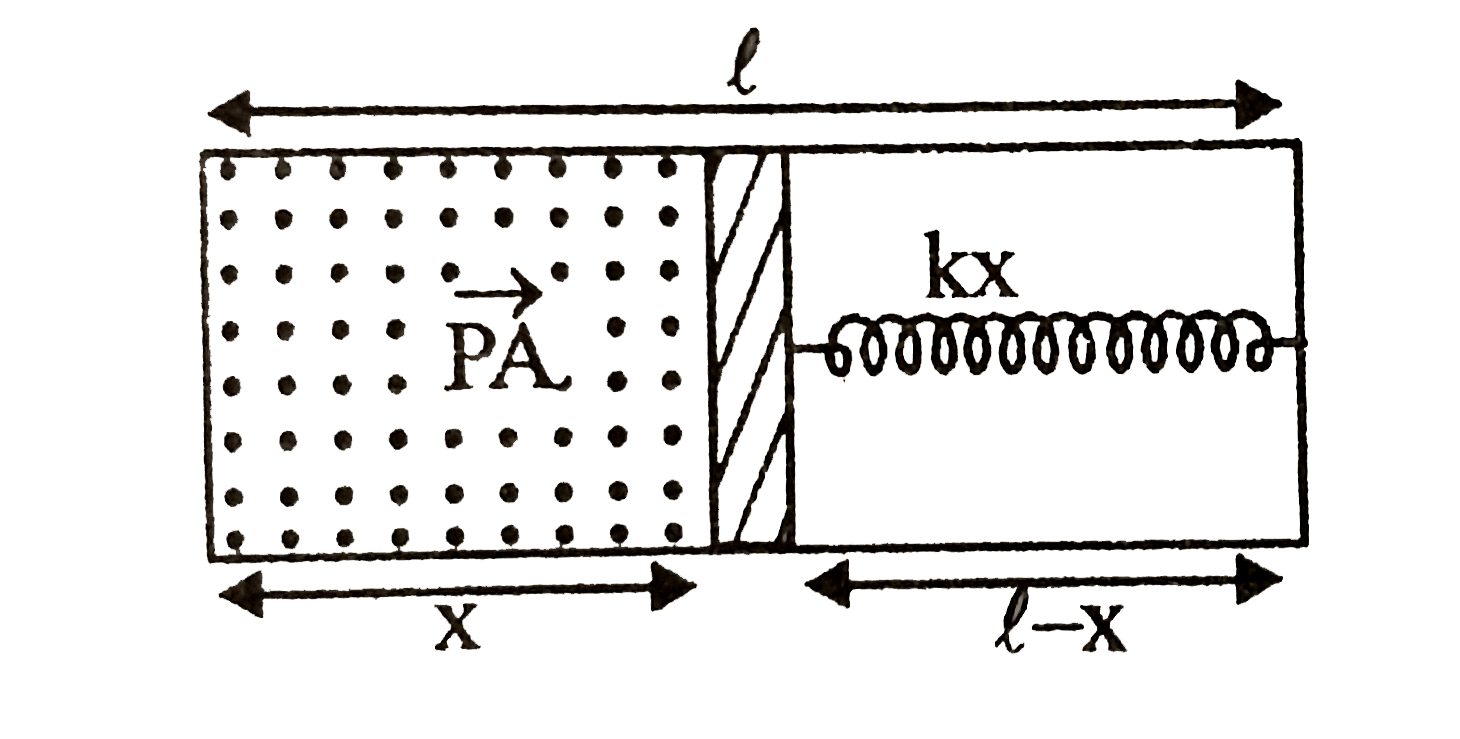 `C=C_(v)+(PDV)/(ndT)` `C=(3R)/(2)+(pdv)/(ndT)` `PV=RT` `P(Ax)=RT ""PA=KX` `rArrP=(RT)/(Ax)rArrP=(kx)/(A)` `(kx)/(A)=(RT)/(Ax)kx^(2)=RT` `2kx dx=RdT` `dv=ADX` `RARR(P(Adx))/(2kxdx)xxR` `thereforePA=kx` `rArr(Pdv)/(ndT)=(R)/(2)` `C=(3R)/(2)+(R)/(2)=2R` |
|
| 21. |
Is it necessary that work done in the motion of a body over a closed loop is zero for every force in nature? |
| Answer» SOLUTION :No. It is TRUE only in the CASE of CONSERVATIVE FORCE. | |
| 22. |
300g of water at 25°C is added to 100g of ice at 0°C. The final temperature of the mixture is |
|
Answer» `(-5)/( 3) ° C` |
|
| 23. |
A small rubber ball strikes a rough horizontal surface with a velocity v, at an angle thetawith vertical. If the coefficient of restitution and coefficient of friction between the ball and horizontal surface are e and u respectively, find the velocity of the ball just after the impact. |
Answer» Solution :As the particle collides with the rough horizontal impulse of `int `N dt and horizontal impulse be `int F dt` where friction `F = muN ….(i)`  Writing the impulse momentum equation for the particle in x-direction, we have, `mv _(0) sin theta - int F dt = mv _(x) .....(ii)` Similarly, the impulse momentum equation in y-direction gives `- mv _(0) cos theta + int N dt = mv _(y)....(iii)` The coefficient of RESTITUTION along y-direction (normal) gives `v _(y) =- e (- v _(0) cos thea)` Then`v_(y) = ev _(0) cos theta ""...(iv)` We have four equations for four UNKNOWN quantities , i.e., `int dt , int N dt, v _(x) and v _(y).` Substituting `F = mu N ` in eq. (ii) and eliminating `int N dt` from eqs. (ii) and (iii), we have `v _(x) = v _(0) [ sin theta - mu (1 + e ) cos theta ] ......(v)` From eqs. `(iv) and (v),` we have, `[ v _(0) sin theta - mu (1 + e ) cos theta ] hati + ev _(0) cos theta hatj.` |
|
| 24. |
A material particle of mass m is revolving along a horizontal circular path of radius r under theinfluenece of the centripetal force = -(k)/(r^(2)) (k = constant ). What will be the total kinetic energy of the particle ? |
|
Answer» |
|
| 25. |
A boy weighing 42 kg eats bananas whose energy is 980 calories. If the energy is used to go to a height h, find the value of h. (1 cal = 4.2 J) |
|
Answer» |
|
| 26. |
A metal ball is suspended from the roof of a train by a string. When the train is in uniform motion, will the string remain vertical? What happens to the string if the train accelerates? |
| Answer» Solution :When the train moves in a STRAIGHT line with a uniform speed, the speeds of the string and the ball are the same as that of the train. Hence the string remains VERTICAL. When the train ACCELERATES, the speed of the attached end of the string increases but the metal ball, because of its inertia of rest, tends to resist the change. As a RESULT, the string shifts obliquely backwards with RESPECT to the vertical, i.e., shifts oppositeto the direction of acceleration. | |
| 27. |
Assuming the length of a chain to be L and coefficient of static friction mu calculate the maximum length of the chain which can be held outside a table without sliding ? |
|
Answer» Solution :Let y be the MAXIMUM length of the chain, which can be HELD outside the table WITHOUT SLIDING Length of the chain on the table `= (L-y)` Weight of this part of chain `W = (M)/(L) (L-y) g` Weight of hanging part of chain `= W= (M)/(L) yg` For equilibrium force of FRICTION `(f) = wt` of hanging part of chain `mu R = W` `mu W =W ` `mu (M)/(L) (L-y) g = (M)/(L) yg` `mu Mg - mu (M yg)/(L) = (M)/(L) gy, mu Mg = (M)/(L) yg (1 + mu)` `y = (mu L)/((1 + mu ))`  . |
|
| 28. |
Two wires of same radius and length are subjected to the same load. One wire is of steel and the other is of copper. It the Young's modulus of steel is twice that of copper, the ratio of elastic energy stored per unit volume in steel to that of copper wire is |
|
Answer» `1:2` |
|
| 29. |
A circular track of radius 400 m is kept with outer edge raised to make 5 degree with the horizontal. Obtain an expression for the maximum permissble speed considering the force of friction. |
| Answer» SOLUTION :REFER SECTION 5.25 | |
| 30. |
A ball thrown in vertically upward direction attains maximum height of 16 m. At what height would its velocity be half of its initial velocity ? |
|
Answer» Solution :For motion of a ball in vertically upward direction, Suppose `v _(0) =` initial velocity, v = velocity at MAX. HEIGHT (of 16 m) `=0, a =-g, d = 16 m` `THEREFORE` From equation` 2ad = v ^(2) - v _(0) ^(2) ` we have `= 2g XX 16 = (0) ^(2) -v_(0) ^(2)` `therefore -32 g =-v _(0) ^(2)` ` therefore v _(0) ^(2) - 32 g ...(i)` Now suppose velocity at height `h = v = (v_(0))/(2)` From the equation `2 ad = v ^(2) - v _(0) ^(2) ` we get, `-2gh = (v_(0) ^(2))/(4) - v _(0) ^(*2),` where `a =- g , d = h , v = (v _(0))/(2)` `therefore - 2gh = (-3 v _(0) ^(2))/(4)` `therefore h = (3v _(0) ^(2))/(4 xx 2g)` `therefore h = ( 3 xx 32 g )/(8g) ` (From EQ. (i)) =12 m. |
|
| 31. |
A gas may expands either adiabatically or isothermally. A number of p-V curves are drawn for the two process over different ranges of pressure and volume. It will be found that a) Two adiabatic curves do not intersect b) Two isothermal curves do not intersect c) An adiabatic curve and an isothermal curve may intersect d) The magnitude of the slope of an adiabatic curve is greater than the magnitude of the slope of an isothermal curve for the same values of pressure and volume |
|
Answer» only a,B are correct |
|
| 32. |
A circular track of radius 400 m is kept with outer edge raised to make 5 degree with the horizontal. Calculate the maximum permissible speed of the car if the coefficient of friction is 0.2. |
|
Answer» SOLUTION :`R =400 m, THETA = 5^@, mu_s = 0.2` ` v_max = SQRT Rg(tan theta + mu_s)/1-mu_s tan theta = sqrt 400 xx9.8 (tan 5^@ + 0.2) /1-0.2 xx tan 5^@ = 33.87 MS^(-1)` |
|
| 33. |
A particle of mass 0.5kg is executing SHM along a straight line. Its path length is 10cm and time period is 8s. Calculate its KE, PE and TE when its phase angle is pi/6 radian. |
|
Answer» `1.592 XX 10^(-4) J, 0.562 xx 10^(-4) J , 1.652 xx 10^(-4)J` |
|
| 34. |
A system of masses and pulleys is arranged in a vertical plane as shown in Figure 5.24 her. If m_(A) : m_(B):m_(C)=3:2:1. Find their accelerations. |
|
Answer» |
|
| 35. |
Rotational kinetic energy is given by |
|
Answer» `(1)/(2) MR^(2)` |
|
| 36. |
An ideal gas initially at pressure P_0, volume V_0, and temperature T_0 is taken through a cycle as described in figure. (a) Find the net work done by the gas per cycle. (b) What is the net heat added to the system per cycle ? (c) Obtain a numerical value for the net work done per cycle for one mole of gas initially at 0^@ C |
| Answer» SOLUTION :`W_("net")=4P_0 V_0 , (b )Q_("net") =4P_0 V_0(C)9074.52 J ` | |
| 37. |
A circular track of radius 400 m is kept with outer edge raised to make 5 degree with the horizontal. What do you call this type of construction of tracks ? |
| Answer» SOLUTION :BANKING of TRACKS | |
| 38. |
A ray of light is incident normally on one face of30^(@)-60^(@)-90^(@)prism of refractive index 5//3immersed in water of refractive index4//3as shown in figure. |
|
Answer» The EXIT angle `theta_(2)`of the ray is `SIN^(-1)(5//8)`  Taking refraction at surface `BC` `(5)/(3)xxsin30^(@)=(4)/(3)xx sintheta_(2)` `(5)/(3)xx(1)/(2)=(4)/(3)"sin"theta_(2)` `"sin"theta_(2)=(5)/(8) rArr theta_(2)=sin^(-1)(5)/(8)` For I.T.R.to happen at P `60^(@)gtC rArr sin60^(@)gtsin C......(1)` for C `(5)/(3) "sin"C=(3)/(5)mu_(w)xx sin90^(@) rArr mu_(w)=(5)/(3)Sin C` `sinC=(3)/(5)mu_(w)....(2)` `(SQRT(3))/(2)ge(3)/(5)mu_(w)` `(5)/(2sqrt(3))gemu_(w)` |
|
| 39. |
These question consists of two statements each printed as Assertion and Reason. While answering these question you are required to choose any one of the following five responses. Assertion: If a body is good absorber of green light then it will be good reflector or red light. Reason: At a given temperature, the ratio of emissive power to absorptive power is same for all substances. |
|
Answer» If both Assertion and Reason are correct and Reason is also a GOOD absorber of RADIATION at a GIVEN wavelength. |
|
| 40. |
These question consists of two statements each printed as Assertion and Reason. While answering these question you are required to choose any one of the following five responses. Assertion: Emissive power of a perfectly black body is one. Emission: Absorptive power of perfectly black body is one. |
|
Answer» If both Assertion and Reason are CORRECT and Reason is ALSO a good absorber of radiation at a GIVEN wavelength. |
|
| 41. |
A ball of radius R=20 cm has mass m=0.75 kg and moment of inertia (about its diameter ) I=0.0125 kgm^(2). The ball rolls without sliding over a rough horizontal floor wilth velocity v_(0)=10 ms^(-1) towards a smooth vertical wall if coefficient of resutitution between the wall and the ball is e=0.7, calculate velocity v of the ball long after the collision. (g=10ms^(-2)) |
|
Answer» Solution :Since the ball is rolling without sliding, therefore, its angular velocity `(omega_(0))` just before collision with WALL is, `(v_(0))/R=10/0.2=50 rads^(-1)` Translation velocity of centre of ball, just after collision. `ev_(0)=0.7xx10=7ms^(-1)`(Right wards) Since the wall is smooth, therefore no TANGENTIAL force is applied by the wall. Hence angular velocity `w_(0)` of ball remains UNCHANGED during collision. Now surface of ball slides on flor to the right as shown in the figure. Let coefficient of friction between ball and the floor be m. Considering free body diagram of ball while sliding. for verticla forces `N=mg` For horizontal forces `muN=ma` Taking moment (about `O`) of forces acting on the ball, `muNR=Ialpha` or `alpha=120 MU` 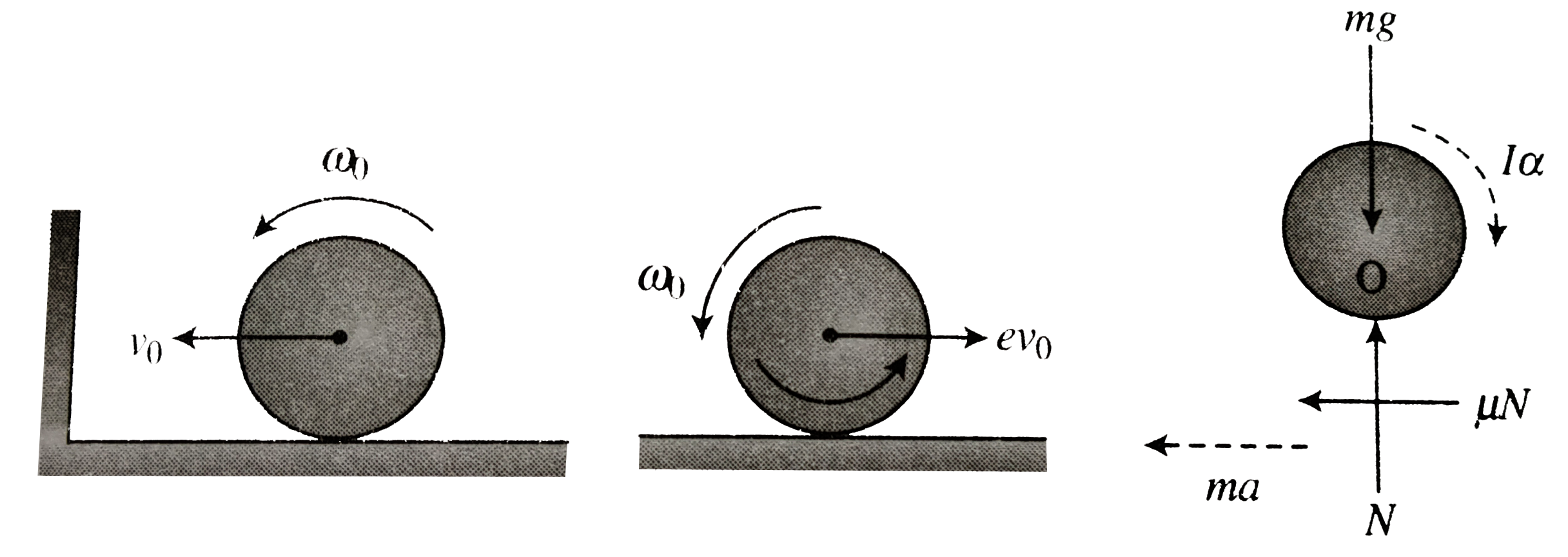 Long after the collision there will be no sliding or it wil be pure rolling Let sliding stop after a time `t` after collision, then final translational velocity `v=(7-at)` or `v=7-10mut` and final angular velocity. `omega=(-omega_(0))+alphat` `omega=(120mut-50)rads^(-1)` (clockwise) But at that instant `v=Romega` `(7-10mut)=0.2(120mut-50)` `mut=0.5` `v=2ms^(-1)` |
|
| 42. |
These question consists of two statements each printed as Assertion and Reason. While answering these question you are required to choose any one of the following five responses. Assertion: Good conductors of electricity are also good conductors of heat Reason: In good conductors of electricity, there are large numbers of free electrons. |
|
Answer» If both ASSERTION and Reason are CORRECT and Reason is also a good ABSORBER of radiation at a given WAVELENGTH. |
|
| 43. |
These question consists of two statements each printed as Assertion and Reason. While answering these question you are required to choose any one of the following five responses. Assertion: Water vapours at 100^(@)C will buirn you more than water at 100^(@)C. Reason: Heat required to convert total mass of any substances from one state to another state is called latent heat. |
|
Answer» If both Assertion and Reason are correct and Reason is also a good ABSORBER of RADIATION at a given WAVELENGTH. |
|
| 44. |
These question consists of two statements each printed as Assertion and Reason. While answering these question you are required to choose any one of the following five responses. Assertion: Two conducting rods of material and same lengths are joined end to end as shown in figure. Heat current H is flowing through them as shown. Temperature differences across rod-1 is more than the temperature difference across of rod-2. |
|
Answer» If both Assertion and REASON are correct and Reason is also a good ABSORBER of RADIATION at a given wavelength. `R_(1)gtR_(2)` Further, TD=`HxxR` or `TD alpha R` `therefore` `(TD)_(1) GT (TD)_(2)` |
|
| 45. |
These question consists of two statements each printed as Assertion and Reason. While answering these question you are required to choose any one of the following five responses. Assertion: Gravity plays very important role inthe process of natural convection. Reason: Convection mainly takes place in liquids and gases. |
|
Answer» If both Assertion and Reason are correct and Reason is also a good absorber of radiation at a GIVEN wavelength. |
|
| 46. |
A body is projected up with a velocity 50ms^(-1) after one second if acceleration due to gravity disappears then body |
|
Answer» FLOATS in air |
|
| 47. |
A pendulum beating seconds at one place (g = 985cm//"sec"^(2)) is taken to another place (g = 981cm//sec^(2)). If it is to beat seconds at another place, its length is to be decreases by |
|
Answer» 0.1cm |
|
| 48. |
A particle executing SHM has an acceleration of 64cm//s^(2) with its displacement is 4 cm. Its time period, in seconds is…………… |
| Answer» Solution :`a=omega^(2)yimpliesomega=sqrt((a)/(y))impliesT=2pisqrt((y)/(a))=2pisqrt((4)/(64))=(pi)/(2)` | |
| 49. |
Fill in the blanks using the word from the list appended with each statement. For a fluid in steady flow the increase in flow speed at a constriction follows from cdots (conservation of mass /Bernoulli's theorem) |
|
Answer» |
|