

Saved Bookmarks
This section includes 7 InterviewSolutions, each offering curated multiple-choice questions to sharpen your Current Affairs knowledge and support exam preparation. Choose a topic below to get started.
| 1. |
What is simple pendulum? Deduce an expression for the time period of simple pendulum. |
|
Answer» Solution :Simple pendulum : ..A system of small massive body suspended by a light inexcusable and twice less STRING from a fixed (rigid) support is called a simple pendulum... Whole MASS of simple pendulum iks concentred on the centre of gravity of suspended body. The distance from the point of suspension to the centre of mass of the bob is called length of pendulum. An ideal pendulum is not possible but a simple pendulum as shown in figure can be taken in practice.  Derivation of expression for PERIODIC time of simple pendulum : Consider simple pendulum a small bob of mass m tied to an inextansible massless string of length L. The other end of the string is fixed to a support in the ceiling. The bob oscillates in a plane about the vertical line through the support. Let `theta` be the angle made by the string with the vertical. There are two forces acting on the body : (1) Tension T along the string (2) Vertical force due to gravity = mg The force mg can be resolved into two components. (1) Parallel component `mg cos theta` which is redial component along string. (2) Perpendicular components `mg sin theta` which is a tangential component. The motion of the bob is along a circle of the length L and centre at the support point, the bob has a radial acceleration `(omega^(2)L)` and also a tangential acceleration. The resultant radial force is `T-mg cos theta` and tangential force is `mg sin theta`. Torque is zero due to radial force because line of force passing through support point. From `tau = rF sin theta` Torque due to tangential force `tau = -L(mg sin theta)""".........."(1) [therefore tau = rF sin theta]` This is a restoring torque that tends to reduce angular displacement hence the negative sign is there in formula. By Newton.s law of ROTATIONAL motion `(F= ma), tau = I alpha """..........."(2)` Where I is the moment of inertia of the system about the support and `alpha` is the angular acceleration From equation (1) and (2) `I alpha = -L mg sin theta` `therefore alpha= -(mg L)/(I).sin theta"""........"(3)` If `theta` is very small and in radian then `sin theta= theta-(theta^3)/(3!)+(theta^5)/(5!)+"....."` [neglecting higher power terms] `sin theta approx theta` Equation (3) will be written as `alpha = -(mgL)/(I)*theta"""..........."(4)` Here, `(mgL)/(I)=` constant `therefore alpha OO - theta` If in a linear motion `a propto -x` and this is condition of linear simple harmonic motion. Hence `alpha oo -theta`, is the condition for angular simple harmonic motion. Hence, motion of simple pendulum is a simple harmonic motion. Acceleration in a linear simple harmonic motion `a= -omega^(2)x` From equation (4) `omega^(2) = (mgL)/(I)` `therefore omega = sqrt((mgL)/(I))` `therefore (2pi)/(T) = sqrt((mgL)/(I))` `therefore T = 2pi sqrt((I)/(mgL))` is the periodic time of simple pendulum. Since the string of simple pendulum is massless, the moment of interia I is simply `mL^(2)`, where m = mass of bob. The period of a simple pendulum, `T = 2 pi sqrt((L)/(g))` So for small oscillation period of a simple pendulum `T propto sqrt(L)` and inversely proportional to `T propto (1)/(sqrt(g))`. (Square root of gravitational acceleration of the place) The period of simple pendulum does not depend on the kind of material. |
|
| 2. |
A rocket is movig at a speed of 200 m/s towards a stationary target. While moving, it emits a wave of frequency 1000 Hz. Some of the sound reaching the target gets reflected back to the rocket as an echo. Calculate (a) the frequency of the sound as detected by the target and (b) the frequency of the echo as detected by the rocket. |
|
Answer» Solution :(a) Here, `upsilon_(0) = 0` `upsilon_(s) = 200 m//s, upsilon = 330` m/s As the speed of the SOURCE is COMPARABLE to that of the sound wave, the observed frequency is `V. = v ((upsilon - upsilon_(0))/(upsilon - upsilon_(s))) = 1000 ((330 - 0)/(330 - 200))` `= (1000 XX 330)/(130) = 2538.5` Hz (b) Now, target is the source (source of echo) and the rocket.s detector is the OBSERVER. Therefore, the frequency of the echo as detected by the rocket is `v.. = ((upsilon + upsilon_(0))/(upsilon - upsilon_(s))) xx v.` Here, `upsilon_(0) = 200` m/s `upsilon_(s) = 0` `therefore""v.. = (330 + 200)/(330 - 0) xx 2538.5` `~~` 4077 Hz |
|
| 3. |
By what acceleration the boy must go up so that 100 kg block remains stationary on the wedge. The wedge is fixed and is smooth. (g=10 m//s^(2)) |
|
Answer» Solution :For the block to REMAIN STATIONARY, `T = mg sin THETA` `T=100xx10xx sin 53` `= 100xx ""^(2)cancel(10)xx(4)/(cancel(5))=800N` FBD for man `T-mg=ma` T = m (G + a) `80 cancel(0)=5cancel(0)(10+a)` `a=6 m//s^(2)` 
|
|
| 4. |
Four identical positive point charges Q are fixed at the four corners of a square of side length l. Another charged particle of mass m and charge +q is projected towards centre of square from a large distance along the line perpendicular to plane of square. The minimum value of initial velocity v_(0) (in m/s) required to cross the square is ? (m = 1 gm, l = 4 sqrt(2) m, Q =1 mu c, q = 0.5 muc) |
|
Answer» |
|
| 5. |
A ball A of mass m is suspended by a thread of length r = 1.2 m. Another ball B of mass 2m is projected from the ground with velocity it u= 9 m//s such that at the highest point of its trajectory it collides head-on elastically with ball A. It is observed that during subsequent motion, tension in the thread at the highest point is equal to mg. ltrgt At highest point of B, the velocity of ball A is |
|
Answer» `6sqrt(2)m//s` 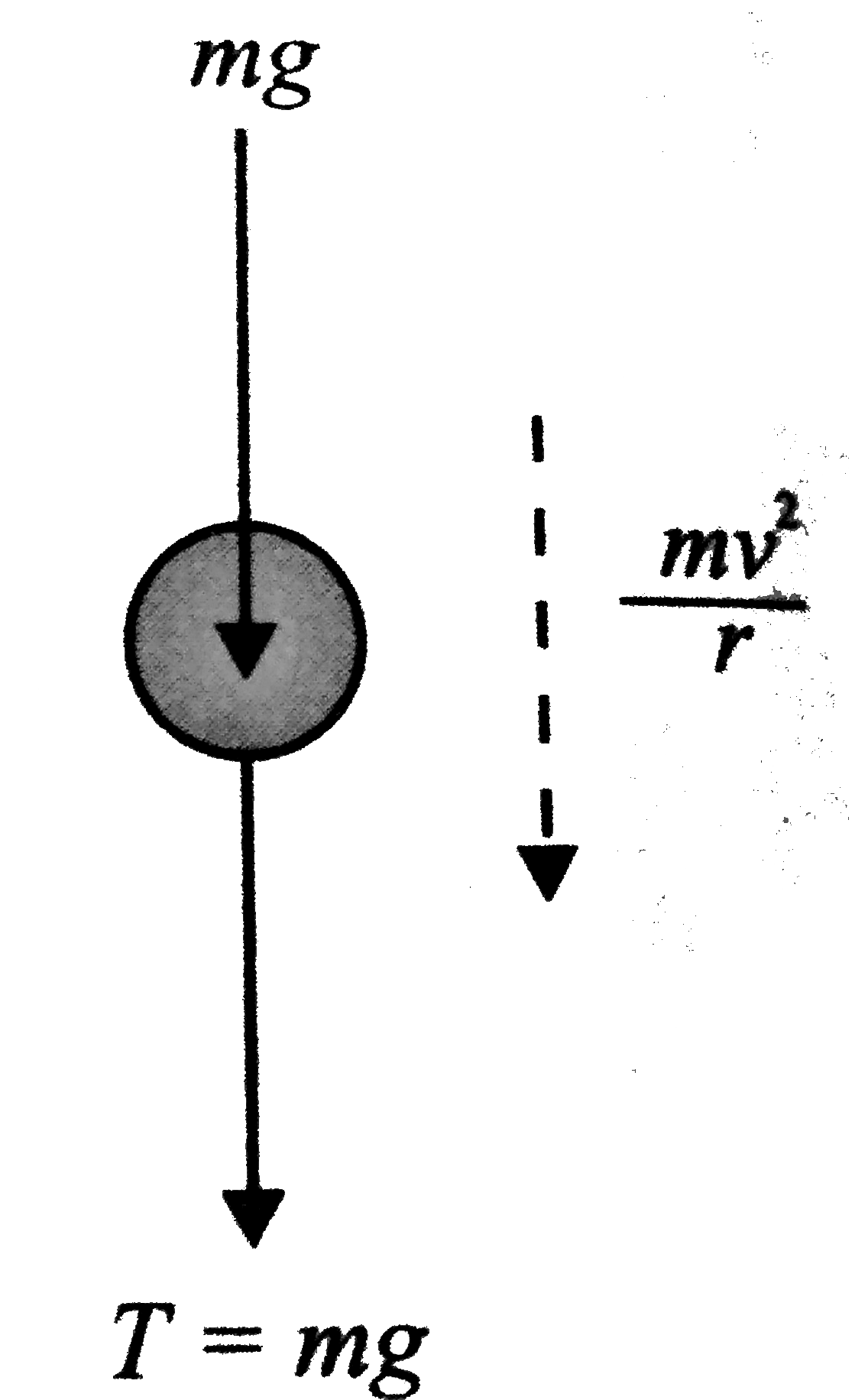 `mg+ T=(MV^(2))/r` where` T=mg` `IMPLIES v^(2)=2rg` `implies v=sqrt(2rg)=2sqrt(6)m//s` If the velocity of ball `A` just after the collisin is `v_(1)` then according to law of CONSERVATION of energy its `KE` at `A=(KE+PE)` at highest point `1/2mv_(1)^(2)=1/2mv^(2)+mg(2r)` `v_(1)=sqrt(6rg)` or `v_(1)=6sqrt(2)m//s` If angle of project of ball `B` is `theta`, then horizontal component of its velocity will be `9 costheta` and it remains constant. 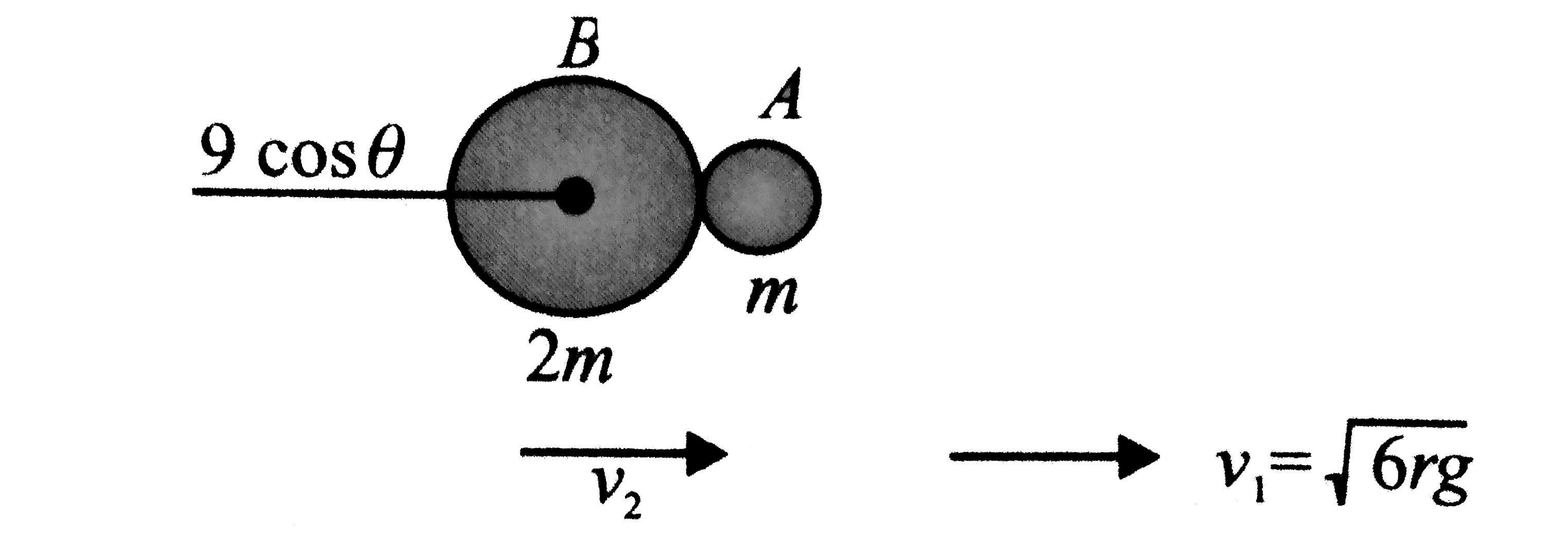 Now considering collision of balls `B` and `A`, let velocitiesof balls `A` and `B`, just after the collision, be `v_(1)` and `v_(2)` respectively as shown in FIGURE. Then according to the law of conservation of momentum `mv_(1)+2mv_(2)=2m(9costheta)` ...........i Since collision is elastic, therefore `e=1` `(v_(1)-v_(2))/(9costheta)=1` or `v_(1)-v_(2)=9costheta` ........ii Solving eqn i and ii we get `costheta=1/(sqrt(2))` or `theta=45^(@)` `v_(2)=3/(sqrt(2))ms^(-1)` height of initial position of ball `A` (lowest position) is equal to maximum height ascened by the ball `B`. It is equal to `H=((9sintheta)^(2))/(2g)=81/40m` Height of point of suspension from the ground is `H=r=129/40m` |
|
| 6. |
Define the term degrees of freedom. |
|
Answer» Solution :The minimum number of independent coordinates needed to SPECIFY the position and connguration of a thermo-dynamical system in space is CALLED the DEGREE of freedom of the system. Example: 1. A free particle moving along x-axis needs only one COORDINATE to specify it completely. So its degree of freedom is one. 2. Similarly a particle moving over a plane has two degrees of freedom. 3. A particle moving in space has THREE degrees of freedom. |
|
| 7. |
In the measurement of a physical quantity X = A^(2)B/C^(1//3)D^(3) The percentage errors introduced in the measurement of the quantities A, B, C and D are 2%, 2%, 4% and 5% respectively. Then, the minimum amount of percentage error in the measurement of X is contributed by |
|
Answer» Solution :`X=(A^(2)B)/(C^(1//3)C^(3)), (DeltaA)/Z%=2%(DELTAB)/B%=2%(DeltaC)/c%=4%,(DeltaD)/D%=5%` `(DeltaX)/X=2(DeltaA)/A+(DeltaB)/B+1/3 (DeltaC)/C+1/3(DeltaD)/D` Percentage error in `X=(DeltaX)/X xx100=2(DeltaA)/A xx100+(DeltaB)/Bxx100+1/3(DeltaC)/C+3xx(DeltaD)/D` |
|
| 8. |
A ball A of mass m is suspended by a thread of length r = 1.2 m. Another ball B of mass 2m is projected from the ground with velocity it u= 9 m//s such that at the highest point of its trajectory it collides head-on elastically with ball A. It is observed that during subsequent motion, tension in the thread at the highest point is equal to mg. The angle of projection (theta) of ball B is |
|
Answer» `30^(@)` 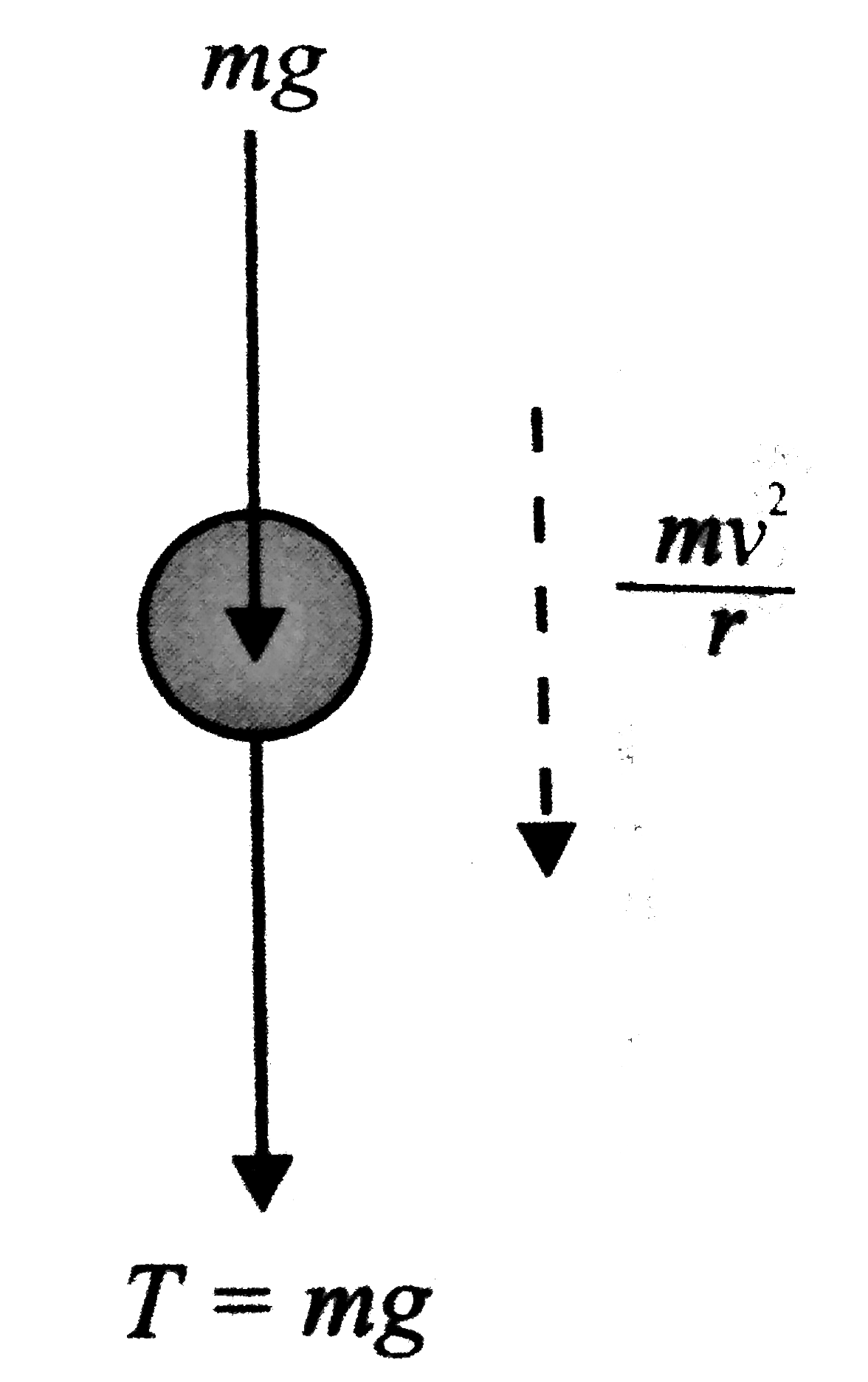 `MG+ T=(mv^(2))/r` where` T=mg` `implies v^(2)=2rg` `implies v=sqrt(2rg)=2sqrt(6)m//s` If the velocity of ball `A` just after the collisin is `v_(1)` then according to law of conservation of energy its `KE` at `A=(KE+PE)` at highest point `1/2mv_(1)^(2)=1/2mv^(2)+mg(2r)` `v_(1)=sqrt(6rg)` or `v_(1)=6sqrt(2)m//s` If angle of PROJECT of ball `B` is `theta`, then horizontal component of its velocity will be `9 costheta` and it remains constant. 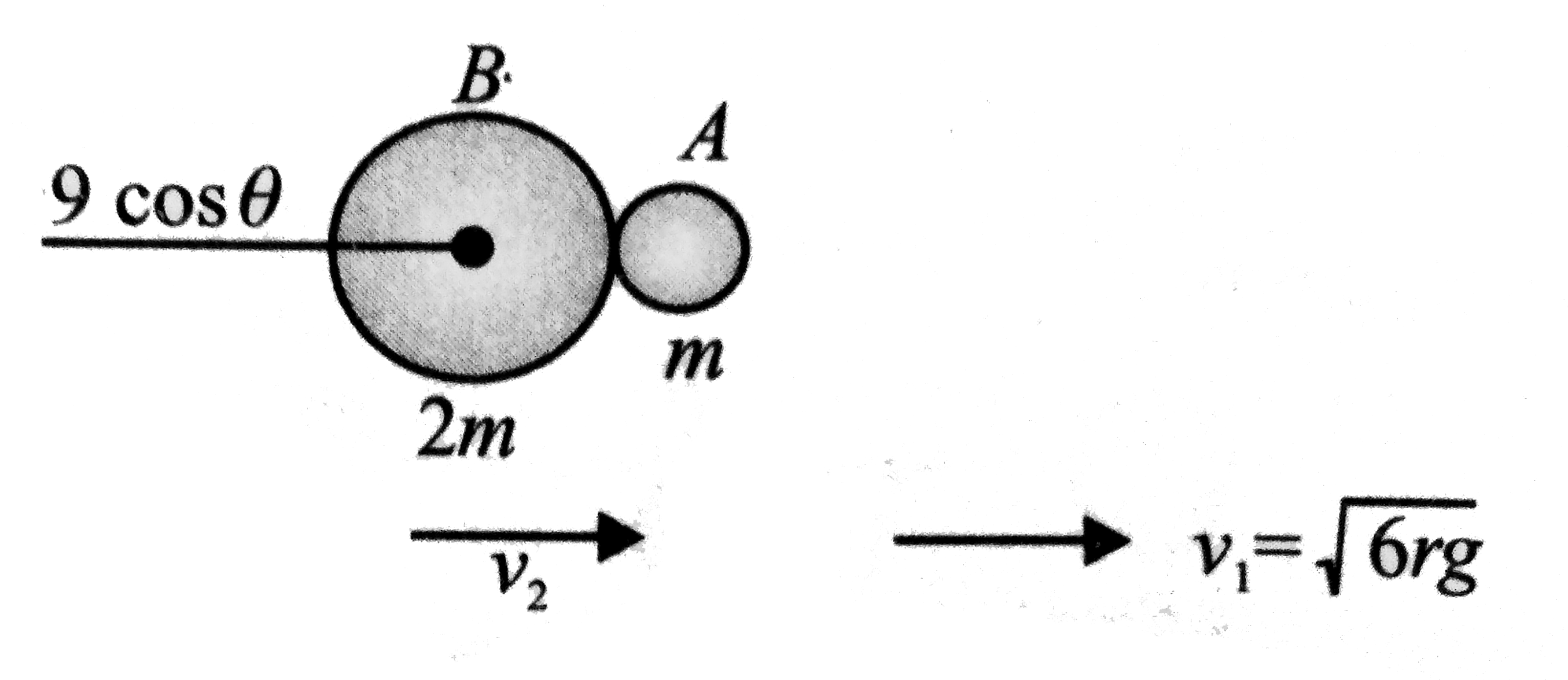 Now considering collision of balls `B` and `A`, let velocitiesof balls `A` and `B`, just after the collision, be `v_(1)` and `v_(2)` respectively as shown in figure. Then according to the law of conservation of momentum `mv_(1)+2mv_(2)=2m(9costheta)` ...........i Since collision is elastic, therefore `e=1` `(v_(1)-v_(2))/(9costheta)=1` or `v_(1)-v_(2)=9costheta` ........ii Solving eqn i and ii we GET `costheta=1/(sqrt(2))` or `theta=45^(@)` `v_(2)=3/(sqrt(2))ms^(-1)` height of initial position of ball `A` (lowest position) is EQUAL to maximum height ascened by the ball `B`. It is equal to `H=((9sintheta)^(2))/(2g)=81/40m` Height of point of suspension from the ground is `H=r=129/40m` |
|
| 9. |
A ball A of mass m is suspended by a thread of length r = 1.2 m. Another ball B of mass 2m is projected from the ground with velocity it u= 9 m//s such that at the highest point of its trajectory it collides head-on elastically with ball A. It is observed that during subsequent motion, tension in the thread at the highest point is equal to mg. The height of the point of suspension of ball A from the ground is |
|
Answer» `81/40m` 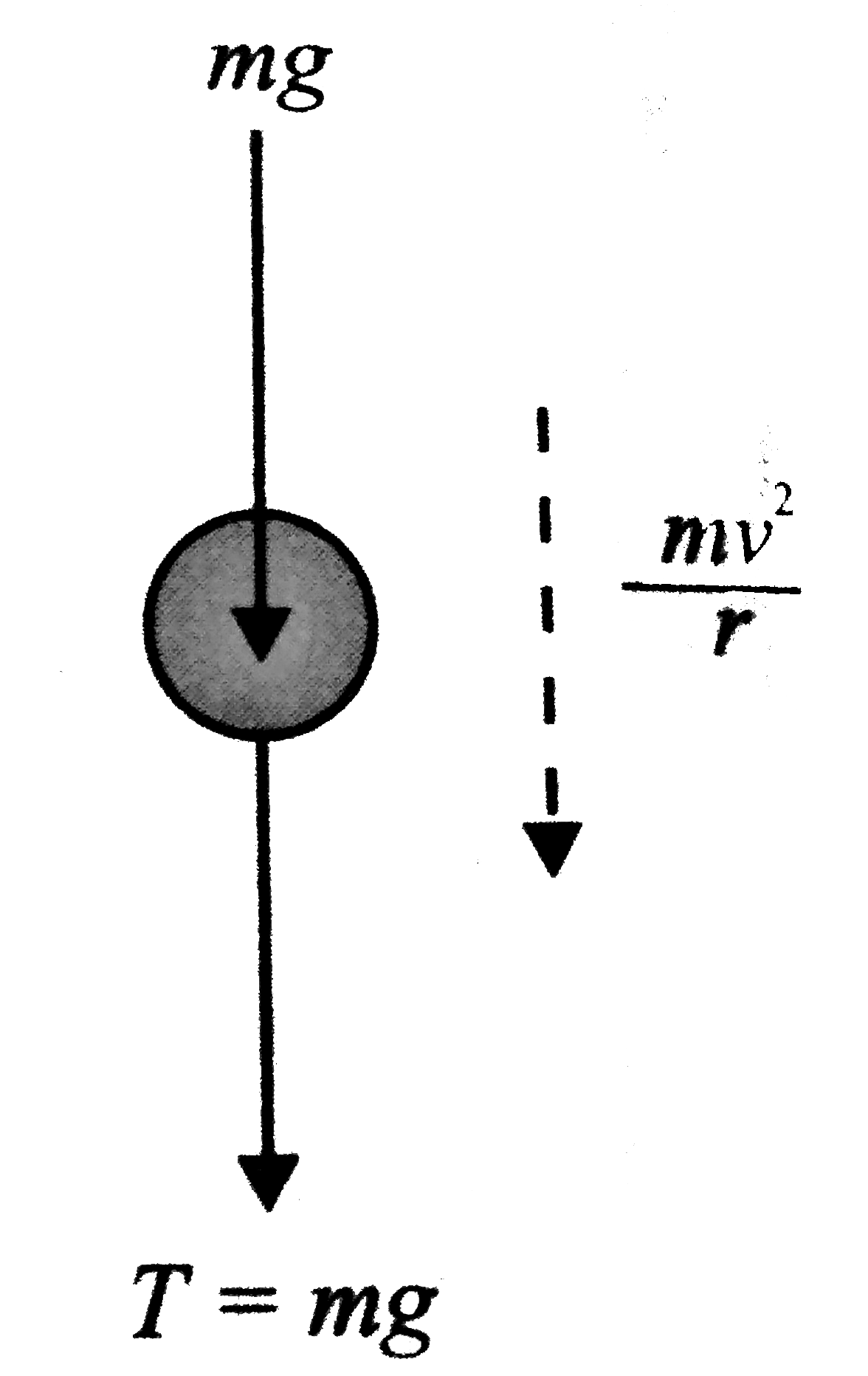 `mg+ T=(mv^(2))/r` where` T=mg` `implies v^(2)=2rg` `implies v=sqrt(2rg)=2sqrt(6)m//s` If the velocity of ball `A` just after the collisin is `v_(1)` then according to law of conservation of energy its `KE` at `A=(KE+PE)` at highest point `1/2mv_(1)^(2)=1/2mv^(2)+mg(2r)` `v_(1)=sqrt(6rg)` or `v_(1)=6sqrt(2)m//s` If angle of project of ball `B` is `theta`, then horizontal component of its velocity will be `9 costheta` and it remains constant. 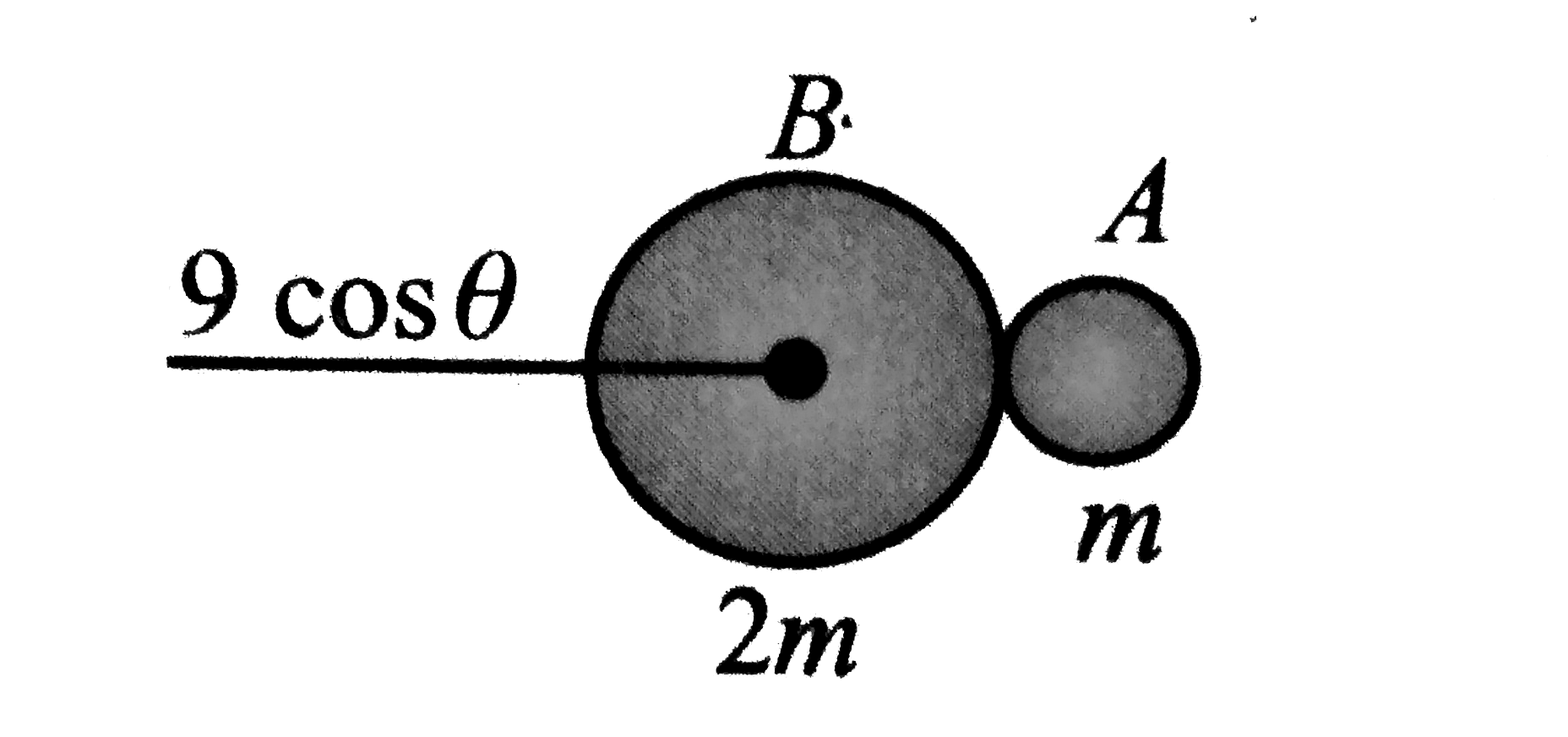 Now considering COLLISION of balls `B` and `A`, let velocitiesof balls `A` and `B`, just after the collision, be `v_(1)` and `v_(2)` respectively as shown in figure. Then according to the law of conservation of momentum `mv_(1)+2mv_(2)=2m(9costheta)` ...........i Since collision is ELASTIC, therefore `e=1` `(v_(1)-v_(2))/(9costheta)=1` or `v_(1)-v_(2)=9costheta` ........ii Solving eqn i and ii we get `costheta=1/(sqrt(2))` or `theta=45^(@)` `v_(2)=3/(sqrt(2))ms^(-1)` height of initial position of ball `A` (LOWEST position) is equal to maximum height ascened by the ball `B`. It is equal to `H=((9sintheta)^(2))/(2G)=81/40m` Height of point of suspension from the ground is `H=r=129/40m` |
|
| 10. |
If velocity (in ms^(-1)) varies with time as V = 5t, find the distance travelled by the particle in time interval of t = 2s to t = 4 s. |
|
Answer» 24 m `therefore (dx)/( dt) = 5t (because V = (dx)/(dt))` `therefore dx= 5t dt` TAKING integration `int _(20) ^(x) DZ = 5 int _(2) ^(4) t dt` `(because t = 2s ` to `t = 4s)` `therefore x =5 [ (t ^(2))/( 2) ] _(2) ^(4) = 5 [8-2]` `therefore x = 30,` |
|
| 11. |
A satellite orbits the earth at a height of 400 km above the surface. How much energy must be expended to rocket the satellite out of the gravitational influence of earth ? Mass of the satellite is 200kg, mass of the earth =6.0 xx10^(24)kgradius of the earth6.4 xx10^(6)m.G = 6.67 xx10^(-11) Nm^(2)kg^(-2). |
|
Answer» Solution :Total ENERGY of ORBITING satellite at a height `h = (-GMm)/(2(R+h))` Energy expended to rocket the satellite out of the earth .s gravitational field = - (total energy of the satellite) `=(GMm)/(2(R+h))=((6.67xx10^(11))XX(6xx10^(24))xx200)/(2(6.4xx10^(6)+4xx10^(5)))=5.9 xx10^(9)J` |
|
| 12. |
A glass of water contains ice cubes floating on it. When all ice melts the level of water in the glass |
|
Answer» INCREASES |
|
| 13. |
What do you understand by forced vibration ? Draw a graph to show how the amplitude of forced vibration depends on frequency. Obtain the condition for resonance from this graph. |
|
Answer» Solution :1ST PART : N/A 2nd Part : The resonance takes place when the frequency of the FORCED vibration matches the natural frequency of a VIBRATING body. Here, the resonance is `f_0`. So, the required graph is as shown in FIG. 2.7. 
|
|
| 14. |
Graph shows magnitude of electric field (E), charge enclosed (q_("enclosed:)) within the concentic sphere and net flux (phi) through a concentric spherical Gaussian surface as a function of distance (r) from centre of a uniformly positive charged solid sphere of radius R. Choose the correct option (s): |
|
Answer»
|
|
| 15. |
A 90 kg man runs up an escalator while it is not in operation in 10s. What is the average power developed by the man. Suppose next that the escalator is running so that the escalator steps move at a speed of 0.6 m/s. What is then the power developed by the man as seen by the ground reference if he moves at the same speed relative to the escalator steps as he did when the escalator is not in operation ? |
|
Answer» Solution :Work done by the man in CLIMBING the escalator W = mgh `= 90 xx 9.8 xx 17 sin 45^(@)` = 10611 J With the escalator stationary, man takes 10s to climb up THEREFORE, average power `P = (W)/(t) = (10611)/(10) = 1061.1` W Speed of the man when escalator is stationary `v = (17)/(10) = 1.7 m//s` In the SECOND CASE the speed of the man relative to the moving escalator is also 1.70 m/s. His speed relative to ground = 0.6 + 1.7 = 2.3 m/s. Accordingly the time taken by the man for climbing is = `(17)/(2.3) = 7.4` s The power developed by the man as seen from the ground reference is then, on the average : `rArr "Power" = (W)/(t) = (10611)/(7.4) = 1434` W. |
|
| 16. |
A source S of acoustic wave of frequencyv_(0) = 1700Hz and a recelverR are located at the same point . At the instant t = 0 , the source starts from rest to move away from the receiver with a constant acceleration omega. The velocity of sound in air is v = 340 ms^(-1) .Ifomega = 10 m * s^(-2), the apparcent frequency that will be recorded by the stationary receiver at t = 10 s will be |
| Answer» SOLUTION :N/A | |
| 17. |
An asteroid of mass m is approaching earth, initially at distance of 10R_(e ) with speed v_i. It hits the earth with speed vf (Re and M_e are radius and mass of the earth then |
|
Answer» `v_(F)^(2)= v_(i)^(2) +(2Gm)/(M_(E )R) (1-(1)/(10))` |
|
| 18. |
In the system shown in figure, mass m is released from rest from position A. Potential energy of m at point A with respect to point B is E. Volume of m is negligible and all surfaces are smooth. When mass m reaches at point B. |
|
Answer» <P> |
|
| 19. |
A source S of acoustic wave of frequencyv_(0) = 1700Hz and a recelverR are located at the same point . At the instant t = 0 , the source starts from rest to move away from the receiver with a constant acceleration omega. The velocity of sound in air is v = 340 ms^(-1) .Ifomega = 0fort gt 10 s, the apparent frequency recorded by receiver at t = 15 s will be |
| Answer» Solution :N/A | |
| 20. |
A source S of acoustic wave of frequencyv_(0) = 1700Hz and a recelverR are located at the same point . At the instant t = 0 , the source starts from rest to move away from the receiver with a constant acceleration omega. The velocity of sound in air is v = 340 ms^(-1) .Ifomega = 10 m * s^(-2) , the apparent frequency that will be recorded by the stationary receiver just at the Instant when the source is exactly 1 km away from the receiver will be . |
| Answer» SOLUTION :N/A | |
| 21. |
The values of two resistors are (5.2pm0.2)" k"Omega and (10.0pm0.1)" k"Omega. What is the percentage error in the equivalent resistance when they are connected in parallel? |
|
Answer» 0.02 |
|
| 22. |
The definition of metre based on velocity of light is considered to be absolutely constant, why? |
| Answer» Solution :Velocity of light does not change with space or time. It is an absolute constant. It does not depend on the frame of REFERNECE or observer c can be MEASURED with HIGHER precision and ACCURACY. | |
| 23. |
A satellite orbits the earth at a height of 400 km above the surface. How much energy must be expended to rocket the satellite out of the earth's gravitational influence? Mass of the satellite = 200 kg, mass of the earth = 6.0xx 10^(24)kg, radius of the earth = 6.4 xx 10^(6) m, G = 6.67 xx 10^(-11) Nm^(2) kg^( 2) |
|
Answer» Solution :`implies` Height of SATELLITE from the surface of earth, H = 400 km `= 0.4 xx 10^(6) m` Mass of satellite m = 200 kg Radius of earth `R_e= 6.4 xx 10^(6) m` Mass of earth Me = `6xx 10^(24) kg` ` G = 6.67 xx 10^(-11)NM^(2)//kg^(2)` Energy required to SEND the satellite out of its orbit = - (BOUND energy) `=(GM_Em)/((2R_E+h))` `= (6.67 xx10^(-11)xx6xx10^(24)xx200)/(2[6.4xx10^6+0.4 xx10^6])` `=(6.67 xx10^(15)xx12)/(2xx6.8 xx10^6)` `= 5.885 xx10^9` `= 5.9 xx 10^(9) J` |
|
| 24. |
Two identical cylinders contain helium at 2.5 atm and argon at 1 atm respectively.If both the gases are filled in one of the cylinders,the pressure would be |
|
Answer» 3.5 atm |
|
| 25. |
What will be the nature of change in internalenergy in case of precesses shown below ? |
|
Answer» `+ ve` in all cases |
|
| 26. |
A hunter aims his gun and fires a bullet directly at a monkey on a tree. At the instant the bullet leaves the barrel of the gun, the monkey drops. Will the bullet hit the monkey? |
|
Answer» Solution :Suppose the gun situated ato directed towards the MONKEY at POSITION M. Let bullet leaves the barrel of the gun with velocity u at an angle `theta` with the horizontal. Let bullet CROSSES the VERTICAL line MB at A after time t. Horizontal distance travelled `OB=x=ucos thetat` or `t=x/(u COS theta)`  For motion of bullet from O to B, the vertical height `AB=u sin theta t-1/2"gt"^(2)=u sin theta(x/(u cos theta)-1/2"gt"^(2))` `=x tan theta-("gt"^(2))/2`......i Also `MB=x tan theta` Now `y=Ma=MB-AB=xtan theta-(x tan theta-("gt"^(2))/2)=1/2"gt"^(2)` Thus in the time t bullet through A a vertical distance `1/2"gt"^(2)` below M The vertical distance through which the monkey fall in time t. `s=1/2"gt"^(2)` Thus, the bullet and the monkey will always reach at point A at the same time. |
|
| 27. |
The magnitudes of two vectors are 3 and 4 units and their scalar product is 6 units. The angle between the vectors is |
| Answer» Answer :A | |
| 28. |
(A) : Comets move around the sun in elliptical orbits. The gravitational force on the comet due to sun is not normal to the comet's velocity but the work done by the gravitational force over every complete orbit of the comet is zero. (R ): Gravitational force is a non conservative force. |
|
Answer» Both 'A' and 'R' are TRUE and 'R' is the correct EXPLANATION of 'A's |
|
| 29. |
A container, whose bottom has round holes with diameter 0.1 mm is filled with water. The maximum height in cm upto which water can be filled without leakage will be (Surface tension = 75 xx 10^(-3) "N/m" and g= 10 "m/s"^(2) ) |
|
Answer» 20 cm |
|
| 30. |
Two identical rods each of length 2 m and having same mass are connected from end to end by means of a spring of spring cpnstant (3+2sqrt(2)) N/m. The other two ends of the rods are riveted to ground at O and are on a smooth horizontal surface. These two rods are free to rotate about the rivet on the horizontal surface. When the spring is in natural length the angle between the two rods is 60^(@). From this position each rod is pulled away from each other by an angle of 15^(@) and released. Then the force on the rivet when they come back to their initial position in Newton is |
|
Answer» |
|
| 31. |
The year in which there is total solar eclipes is called a …………….. . |
|
Answer» |
|
| 32. |
A body suspended from a spring balance is immersed in water. If the coefficient of cubical expanison of water is twice that of the suspended body, then on heating the liquid, which one of the following would occur ? |
|
Answer» The reading on the spring balance increases |
|
| 33. |
Astretched vibrating string is touched at a distance of(1)/(3)rdof its length from one end. What would happen to the musical sound emitted ? |
|
Answer» |
|
| 34. |
At room temperature the rms speed of the mole-cules of a certain diatomic gas is found to be 1930 m/s. The gas is |
|
Answer» `H_2` |
|
| 35. |
The gravitational field due to a mass distribution is given by E= K"/"x^(3) in x-direction. Taking the gravitatioanl potential to be zero at infinity, its value at a distance x. |
|
Answer» `(K)/(2X^2)` |
|
| 36. |
At a depth of 1000m in an ocean (a) What is the absolute pressure? (b) what is the gauge pressure? (c ) find the force acting on the window of area 20cm times 20 cm of a submarine at this depth, the interior of which is maintained at sea level atmospheric pressure. the density of sea water is 1.03 times 10^3 kg m^-3. g=10 ms^-2 |
|
Answer» Solution :Here h=1000m and `p=1.03 times 10^3 kg m^-3` (a) From Eq. 10.6 absolute pressure `P=P_a+pgh` `=1.01 times 10^5 Pa` `+1.03 times 10^3 kg m^-3 times 10 ms^-2 times 1000m` `=104.01 times 10^5 Pa` =104 atm (b) Gauge pressure is `P-P_a=pgh=P_s` `P_l=1.03 times 10^3 kg m^-3 times 10 ms^2 times 1000m` `=103 atm` (C ) the pressure outside the submarine is `P=P_a+pgh` and the pressure inside it is `P_a`. hence the net pressure ACTING on the WINDOW is gauge pressure `P_g=pgh` SINCE the area of the window is `A=0.04 m^2` the force acting on it is `F=P_gA=103 times 10^6Pa times 0.04 m^2=4.12 times 10^5 N` |
|
| 37. |
Three uniform circular discs, each of mass 0.5 kg and radius 10 cm, are kept in contact with each other as shown in the figure. Find the moment of inertia of the system when it rotates about the axis AB |
|
Answer» Solution :`I=I_(1)+I_(2)+I_(3)` `I=(5MR^(2))/(4)+(5MR^(2))/(4)+(MR^(2))/(4) RARR I=(11MR^(2))/(4)` `M=0.5 kg r=10 cm =10xx10^(-2) m` `:.` Moment of INERTIAOF the system `I=(11MR^(2))/(4)=(11xx0.5xx(0.1)^(2))/(4)` `=1.375xx10^(-2) kg m^(2)` 
|
|
| 38. |
Assume that the gas inside the sun behvaes very much like the perfect gas, the temperature at the centre of the sun is nearly (the number density of gas particles (2rho)/(M_(H)), Boltzmann constant k_(B)=1.4xx10^(-23)J.K^(-1) and mass of proton M_(H)=1.67xx10^(-27) kg ) |
|
Answer» `3xx10^(7) K` |
|
| 39. |
(a) Show that for a projectile the angle between the velocity and the X-axis as a function of time is given by theta(t)=tan^(-1) [(v_(oy)-"gt")/(v_("ox"))] (b) Show that the projection angle theta_(0) for a projectile lunched from the origin is given by theta_(0)=tan^(-1)((4 h_(m))/(R)), where the symbols have their usual meanings . |
Answer» Solution :(a) LET a PROJECTILE be fired with velocity `v_(0)` making an angle `theta` with X-axis , as shown in the figure . The X-component of velocity remains constant throughout the motion of the projectile but the y-component changes .  From the figure , we have `tan theta (t) =(v_(y))/(v_(x))` and `v_(y)=u_("OY")+a_(y)t=u_("oy")="gt"[:.a_(y)=-g]` and `v_(x)=u_("ox")` Putting the values of `v_(x)v_(y)` in equation (1) we get `tan theta (t) =(u_("ox")-"gt")/(u_("ox"))` or `theta(t) =tan ^(-1) ((u_("oy")-"gt")/(u_("ox")))` (b) In ANGULAR projection Let `theta=theta_(0)` The maximum height attained by the projectile `h_(m)=(u_(0)^(2) sin ^(2) theta)/(2g)` The horizontal range of projectile is given by `R=(u_(0)^(2) sin 2theta)/(g)=(u_(0)^(2) sin theta COS theta)/(g) ` therefore , `(h_(m))/(R)=(u_(0)^(2) sin ^(2) theta)/(2g) . (g)/(u_(0)^(2) 2 sin theta cos theta)` `=(tan theta)/(4)` or `tan theta=(4 h_(m))/(R)` or `theta=tan ^(-1) ((4 h_(m))/(R))` Hence , `theta_(0) =tan ^(-1) ((4h_(m))/(R))` |
|
| 40. |
A person sitting in a train moving at constant velocity throws a ball vertically upwards. How will the ball appear to move to an observer? (i) Sitting inside the train (ii) Standing outside the train |
|
Answer» SOLUTION :(i) Vertical straight LINE MOTION. (ii) PARABOLIC path. |
|
| 41. |
Which one of the following is not a fundamental quantity? |
|
Answer» length |
|
| 42. |
A string 1 m long can just support a weight of 16 kg. Amass of 1 kg is attached to one of its ends. The body is revolved in a horizontal circle about the other fixed end of the string. Find the greatest number of revolutions made by the mass per second ? (Take g = 10 ms^(-2)) |
|
Answer» |
|
| 43. |
Two rods of same length and areas of cross-section A_(1) and A_(2) have their ends maintained at same temperature. If K_(1) and K_(2) are their thermal conductivities, c_(1) and c_(2) are the specific heats of their material and rho_(1),rho_(2) their densities, then for the rate of flow by conduction through them to be equal |
|
Answer» `(A_(1))/(A_(2))=(K_(1))/(c_(1)rho_(1))(c_(2)rho_(2))/(K_(2))` |
|
| 44. |
Which of the following statements is correct about the average velocity of a particle? (The average stands for average of the quantity over the time interval , t_1 " to "t_2 ) |
|
Answer» `vecv_("AVERAGE")=(vecv(t_2)-vecv(t_1))/2` |
|
| 45. |
A boy is carrying a fish in one hand and a bucket full of water in the other hand. He then places the fish in the bucket thinking that in accordance with Archimedes principle, he is now carrying less weight as the weight of the fish is reduced due to upthrust from water. Is he right? |
|
Answer» Solution :No, when he places the fish in water in the BUCKET, no doubt, the WEIGHT of the fish is reduced due to upthrust . But the reaction FORCE to B acts on the water in the downward DIRECTION which increases the weight of water by the same amount. So, the total weight carried by him REMAINS unchanged. |
|
| 46. |
Water is flowing through a long horizontal tube. Let P_(A) and P_(B) be the pressure at two points A and B of the tube. |
|
Answer» <P>`P_(A)` must be equal to `P_(B)` |
|
| 47. |
Obtain the general expression of centre of mass for distributed n particles of system in three dimension. |
|
Answer» Solution :Suppose the coordinates of n particles of masses `m_(1),m_(2),…,m_(n)` are `(x_(1),y_(1),z_(1)),(x_(2),y_(2),z_(2)),…,(x_(n),y_(n),z_(n))` respectively. `therefore` The position of centre of mass, `(x,y,Z)=(m_(1)(x_(1),y_(1),z_(1))+m_(2)(x_(2),y_(2),z_(2))+...+m_(n)(x_(n),y_(n),z_(n)))/(m_(1)+m_(2)+...+m_(n))` `=(Sigmam_(i)(x_(i),y_(i),z_(i)))/(Sigmam_(i))` where `i=1,2,3,....,n` OR X-coordinate, Y-coordinate and Z-coordinate of centre of mass of a system, `X=(m_(1)x_(1)+m_(2)x_(2)+...+m_(n)x_(n))/(m_(1)+m_(2)+...+m_(n))=(Sigmam_(i)x_(i))/(M)` `Y=(m_(1)y_(1)+m_(2)y_(2)+...+m_(n)y_(n))/(m_(1)+m_(2)+...+m_(n))=(Sigmam_(i)y_(i))/(M)` `Z=(m_(1)z_(1)+m_(2)z_(2)+...+m_(n)z_(n))/(m_(1)+m_(2)+...+m_(n))=(Sigmam_(i)z_(i))/(M)` where `i=1,2,3,...,n` and `m_(1)+m_(2)+.....+m_(n)=Sigmam_(i)=M` is the total mass of system. If we want to find the position vector of centre of mass in i then position vector of `VECR=x_(i)hati+y_(i)hatj+z_(i)hatk` and the position vector of centre of mass `vecR=(Xhati+Yhatj+Zhatk)` `therefore vecR=(Sigmam_(i)vecr_(i))/(M)` If the origin of frame of reference (coordinate system) TAKEN as centre of mass of a system then for the system of particles `Sigmam_(i)vec(r_(i))=0` |
|
| 48. |
If different planets have the same density but different radii then the acceleration due to gravity (g) on the surface of the planet will depend on its radius (R) as |
|
Answer» `G PROP 1/R^2` |
|
| 49. |
The magnifying power of a telescope can be increased by |
|
Answer» Increasing FOCAL LENGTH of the system |
|


