

Saved Bookmarks
This section includes 7 InterviewSolutions, each offering curated multiple-choice questions to sharpen your Current Affairs knowledge and support exam preparation. Choose a topic below to get started.
| 1. |
A coin slides down an inclined plane of inclination phi at a constant speed. Prove that if the coin is pushed up with a velocity u on that plane it can rise up to(u^(2))/(4 g "sin"phi) , and from there it will not slide down again. |
|
Answer» Solution :Since the coin slides down Fig with a uniform speed it has no ACCELERATION along the plane. So, `mu.R= mg sin phi` Downward force acting on the coin as it is pushed up, F = mg sin `phi+mu. R = mg sin phi +mg sin phi = 2 mg sin phi` Retardation , a = `(2mg sin phi)/(m) = 2 G sin phi`. If the coin moves up to s then, `u^(2) = 2as or , s = (u^(2))/(2(2g sin phi)) = (u^(2))/(4 g sin phi)`. As the coin stops and attempts to COME down limiting friction acts on it. Downward force mg sin `phi` along the plane is EQUAL to `mu.` R which is always less less than `mu`R , as `mu gt mu.` (since Hence the coin cannot slide down again. 
|
|
| 2. |
The velocity if a swimmer (v) in stil water is less than the velocity of water (u) in a river. Show that the swimmer must aim himself at an angles cos^-1 (v//u) with upstream in order to cross the river along the shortest possible path. Find thr drifting (distance moved along the direction of stream in crossing the river) of the swimmer along this shortest possible path. |
|
Answer» `cos prop = (v)/(u) rArr prop = cos^-1 ((v)/(u))` We can GET `x = ((u - (v^2)/(u))(d)/(v))/(SQRT(1 - (v^2)/(u^2))) = ((sqrt(u^2 - v^2))d)/(v)`. 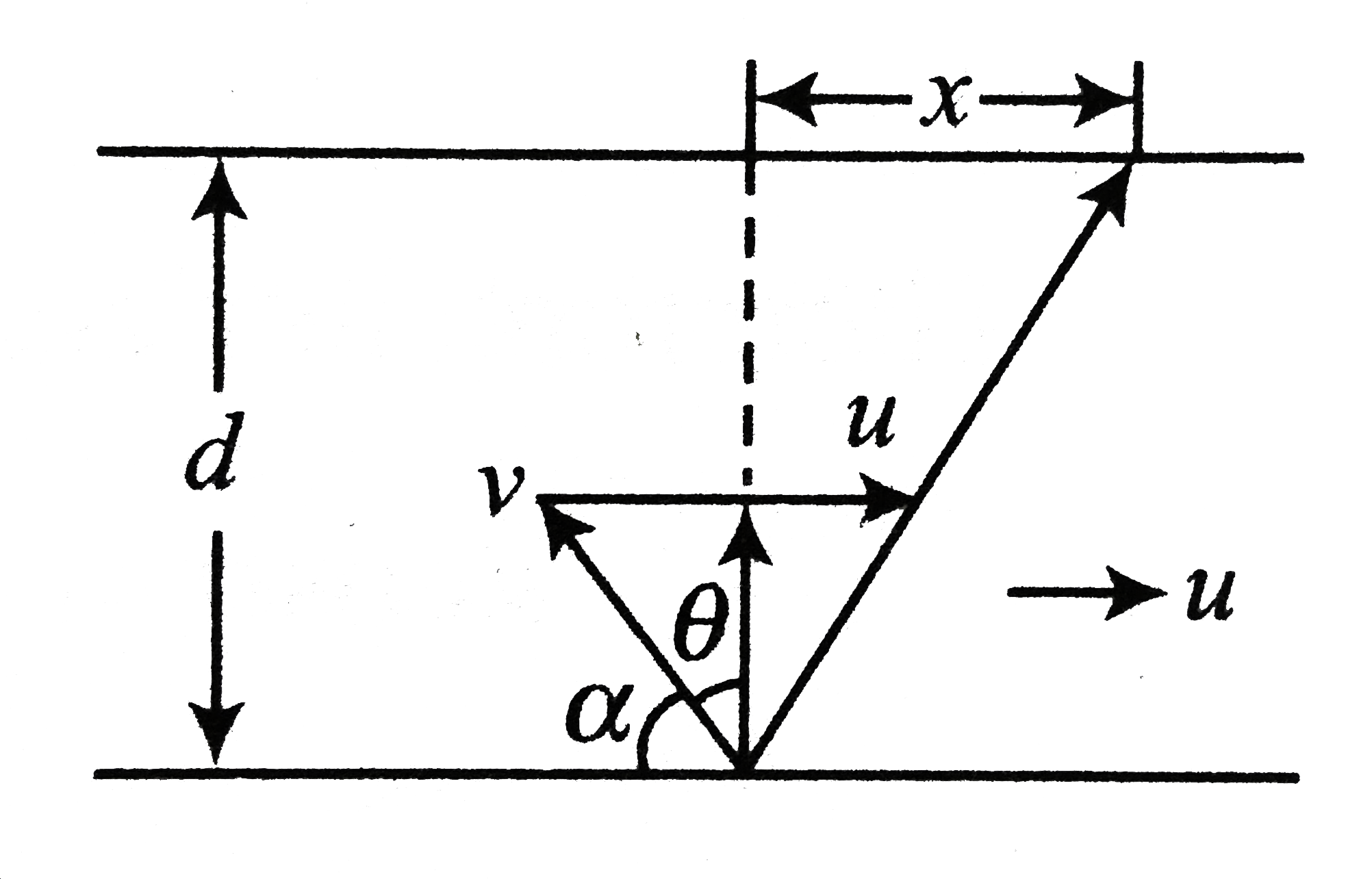 . .
|
|
| 3. |
a particle is moving in a straight line such that its velocity varies is given by v=10-2t, where v isin the first 8 second. |
|
Answer» Solution :This problem can be solved by drawing the v-t graph. `v=10-2t` `t=0, v=10 m//s` `t=8 s, v=-6 m//s` `v=0implies10-2t=0impliest=5 s` SHAPE: `y=10-2x` (STRAIGHT line) `y=c+mx` `c=10`, +ve `m=-2`, -ve 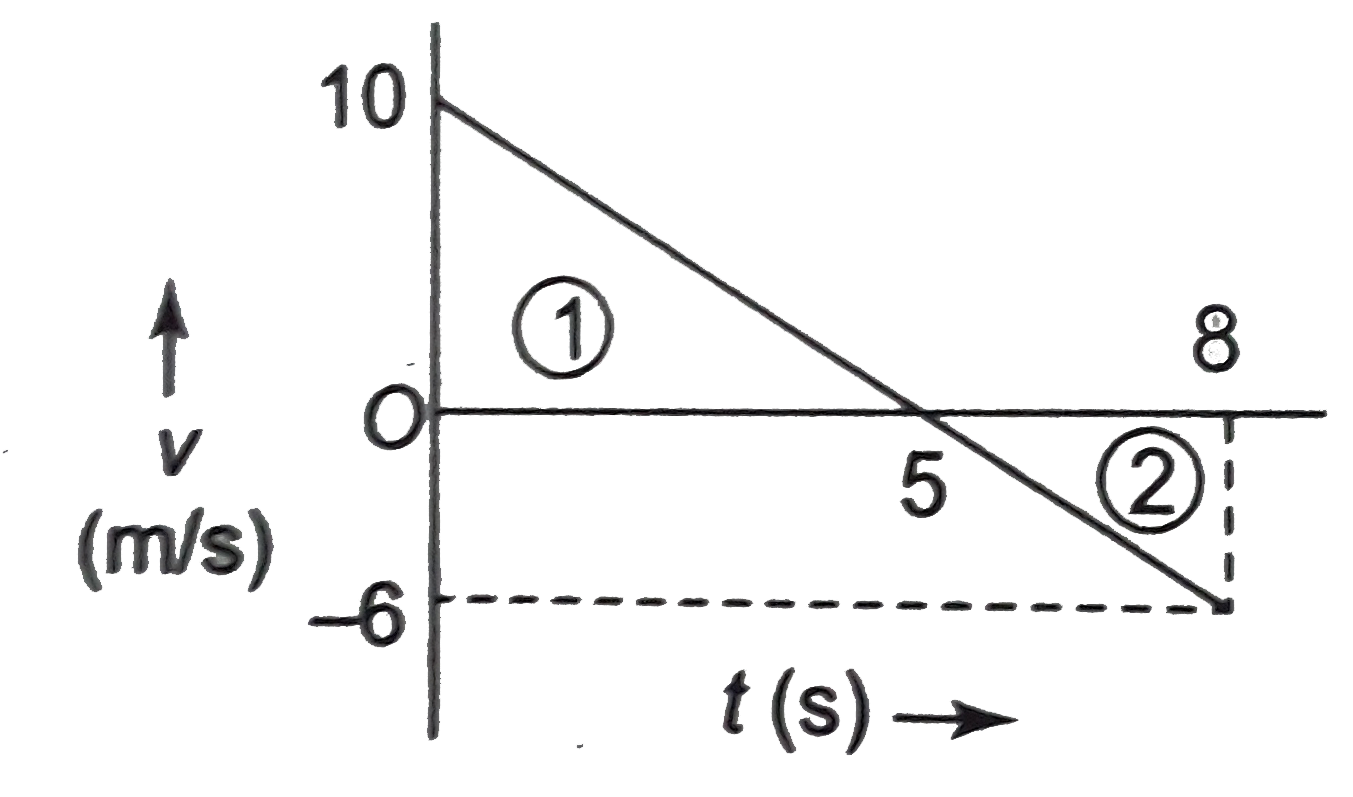 `Area(1)=25, Area(2)=9` The area of the v-t graph gives the DISPLACEMENT//distance Displacement`=25-9-16 m` Displacement`=25+9=34 m` |
|
| 4. |
If a bullet of mass 5g moving withg a velocity of 100m/spenetrates a wooden block upto 6cm . Find the average force imposed . |
|
Answer» SOLUTION :u=100 m/s , v=0 , ` s =6 XX 10^(-2) m , a=? ,v^(2)-u^(2)=2as` `0^(2)-(100)^(2) = 2 xx a xx 6 xx 100^(-2)` ` a=(-100 xx 100)/(2 xx 6 xx 10^(-2)), a=(-1)/(12) xx 10^(6) m//s` `F=ma = 5 xx 10^(-3) xx [(-1)/(12) xx 10^(-6)],F=(-5000)/(12)=-417 N` RETARDING force F= 417 N |
|
| 5. |
A person in an elevator accelerating upwards with an acceleration of 2 m/s^(2), tosses a coin vertically upwards with a speed of 20 ms^(-1) .After how much time will the coin fall back into his hand ? (g = 10 ms^(2)) |
Answer» SOLUTION : Accelerationof elevatoris =2`m//s^(2)` in upwarddirection Resultantacceleration g = g + `a_(p)` `=10 + 2` `=12 m//s^(2)` Initialvelocityof coinis 20 `m//s^(2)` `t = (20)/(12) = (5)/(3)` Coinwill takeequaltime to comebacktotaltime takescoin to fall back into Hand`=(5 )/( 3) + (5)/(3 ) = (10)/(3 ) = 3.33 SEC ` |
|
| 6. |
The Brownian motion refers to |
|
Answer» The MOTION of molecules in FLUID medium |
|
| 7. |
Athin circular ring of mass .m. and radius R is rotating about its axis with a constant angular velocity omega. Tho objects each of mass M are attached gently to he opposite ends of a diameter of the ring. The new angular velocity of ring is com |
|
Answer» `(OMEGA m)(M+m)` |
|
| 8. |
A motor of power 2.45 kW draws water from a well of depth 20 m. If it fills a tank of capacity 3000 lit in 7 minutes. The height of the tank above ground is |
|
Answer» 5 m |
|
| 9. |
Resultant of the two vector is maximum when angle between them is : |
|
Answer» `90^(@)` `= sqrt(P^(2) +Q^(2) +2PQ) = P +Q` |
|
| 10. |
Give examples where the centre of mass coincides with the geometrical centre of the body. |
| Answer» Solution :For SYMMETRICALLY shaped BODIES of uniform composition (Eg: sphere, cylinders, rectangular SOLIDS), the CENTRE of mass is located at the geometricla centre of the body. | |
| 11. |
Pressure of an ideal gas is increased by keeping temperature constant. What is the effect on the kinetic energy of molecules? |
|
Answer» increase |
|
| 12. |
A plate of area 100 cm^2 is placed on the upper surface of castor oil 2mm thick . Taking the coefficient of viscosity to be 15.5 poise. Calculate the horizontal force necessary to move the plate with a velocity of 3 cms^(-1) ? |
|
Answer» Solution :`A = 100 cm^2 , dv = 0-3 = - 3 cm s^(-1) , dx = 2 mm, ETA = 15.5 ` poise From F = `-eta (dV)/(dx) , F = -15.5 xx 100 xx (-3)/(0.2) = 232.5 xx 10^(2) ` DYNE `= 232.5 xx 10^(-3)` N |
|
| 13. |
A car moves with a constant tangential acceleration a_(c)= 0.62m//sec^(2) along a horizontal surface = circumscribing a circle of radius R = 40m. The coefficient of sliding friction between the wheels of the car and the surface is mu = 0.2. The car can ride without sliding upto a distance 12x meters if at the initial moment of time its velocity is eucal to zero. The the value of x is ......... |
|
Answer» |
|
| 14. |
Simplify the following : (i) (0.05246)^(1//8) - 2.6055 (ii) (3.142xx(80.2)^(1//2))/((9.8)^(1//2) |
|
Answer» |
|
| 15. |
Accuracy of cesium clock is |
|
Answer» 1 part in `10^7` |
|
| 16. |
The property due to which a material can be hammered into thin sheet is called |
|
Answer» Ductility |
|
| 17. |
The cross-sectional area of a cylinder is 4cm^(2). It floats vertically in water and alcohol with 8 cm and 10 cm immersed respectively. Determine the mass of the cylinder and the density of alcohol. |
|
Answer» |
|
| 18. |
A mass of 2.9 kg is suspended from a string of length 50 cm and is at rest. Another body of mass 100 g which is moving horizontally with any velocity of 150 m/s strikes and sticks to it subsequently when the string makes an angle of 60^(@) with the vertical. The tension in the string is (g=10 m//s^(2)) |
|
Answer» 140 N |
|
| 19. |
The bar is subjected to equal and opposite forces as shown in the figure PQ is plane making angle with the cross-section of the bar. If the area of cross-section be 'a', then what is the tensile stress on PQ ? |
|
Answer» F/a |
|
| 20. |
A car starts from rest and moves with wwiform acceleration .a.. At the same instant from the same point a bike crosses with a uniform velocity .u.. When and where will they meet ? What is the velocity of car with respect to the bike at the time of meeting? |
|
Answer» SOLUTION :LET the CAR and bike will meet after COVERING a DISTANCE S in a time .t. sec. For car `S=1/2 at^(2) ……(1)` for bike S=ut ……..(2) Since they cover same distance `ut=1/2 at^(2) rArr t=(2u)/a` The car and bike will meet after a time of `(2u)/a` sec The velocity of car after .t. sec is `V_("car")=at=a((2u)/a)=2u` The velocity of car w.r.t. bike is `V_("rel")=2u-u=u` |
|
| 21. |
An air bubble of volume 1.0 cm^(3) rises from the bottom of a lake 40 m deep at a temperature of 12^(@)C. To what volume does it grow when it reaches the surface. which is at a temperature of 35^(@)C ? |
| Answer» SOLUTION :`5.3 XX 10^(-6)m^(3)` | |
| 22. |
A ball is attached to a string of length L and the ball is given velocity v_0 at its lowest point. Find the speed of the ball at point B,C and D. Assume that the ball is moving in vertical circle. |
|
Answer» Solution : Here FORCES acting on the ball are gravitational force and TENSION in the string. Gravitational force is conservative and work done by tension is zero, because it is always PERPENDICULAR to displacement. Hence, conservation of mechanical energy is applicable. Assuming a HORIZONTAL line through A as the reference line, 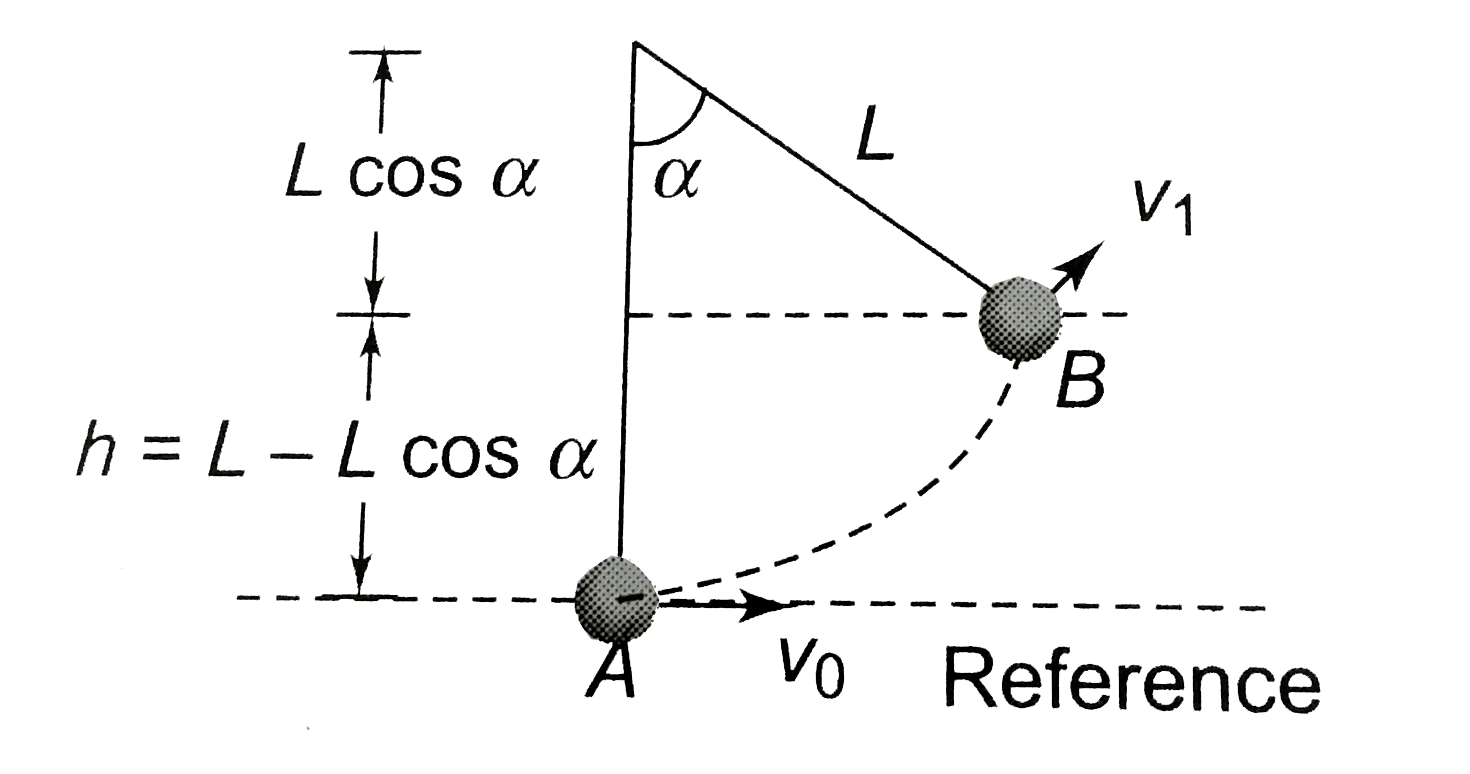 `K_A=(1)/(2)mv_0^2`,`U_A=0` `K_B=(1)/(2)mv_1^2`,`U_B=mg=mgL(1-cosalpha)` `K_A+U_A=K_B+U_B` `(1)/(2)mv_0^2+0=(1)/(2)mv_1^2+mgL(1-cosalpha)` `v_1=sqrt(v_0^2-2gL(1-cosalpha))` 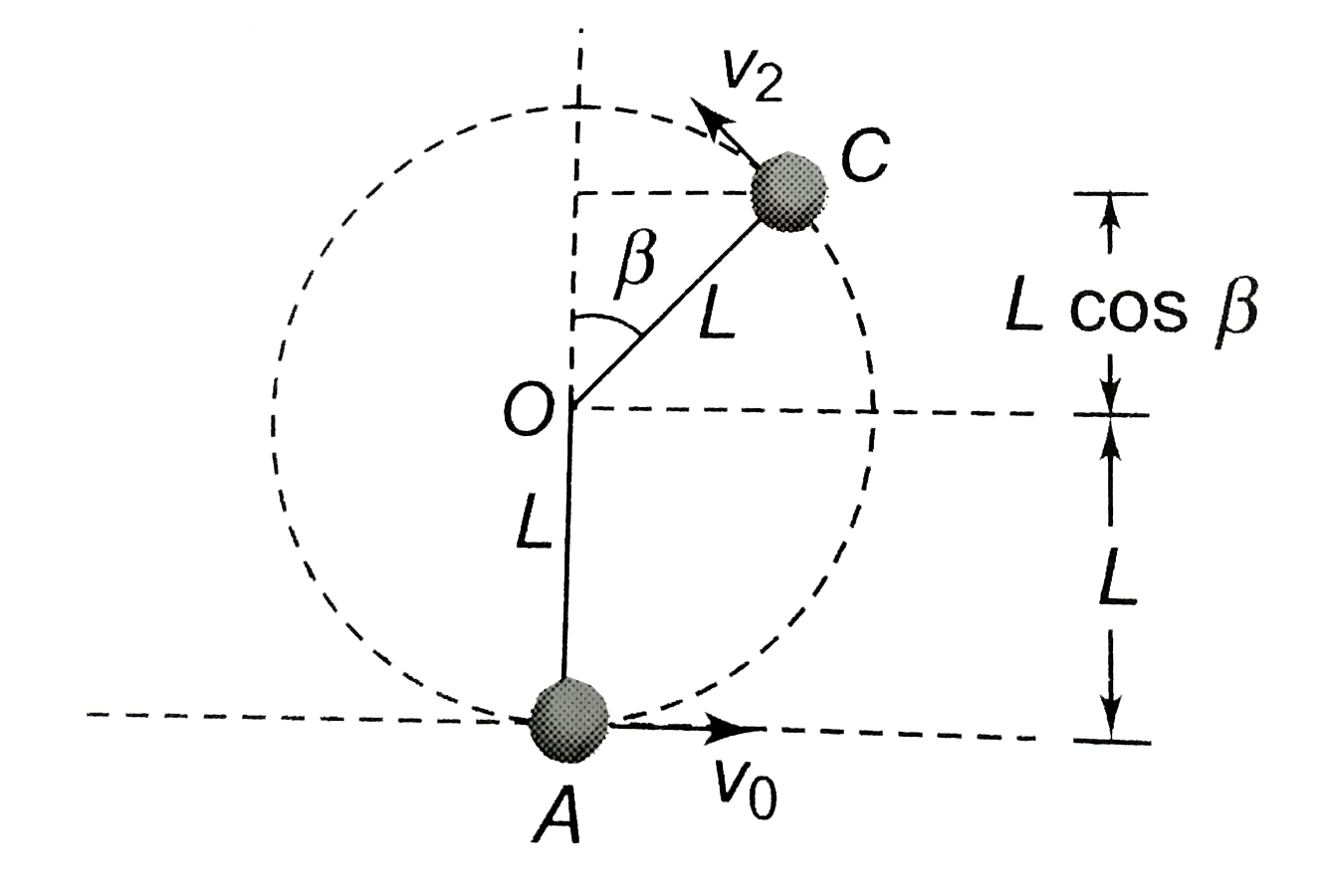 `K_C=(1)/(2)mv_2^2`,`U_C=mg(L+Lcosbeta)` `K_A+U_A=K_C+U_C` `v_2=sqrt(v_0^2-2gL(1+cosbeta))` 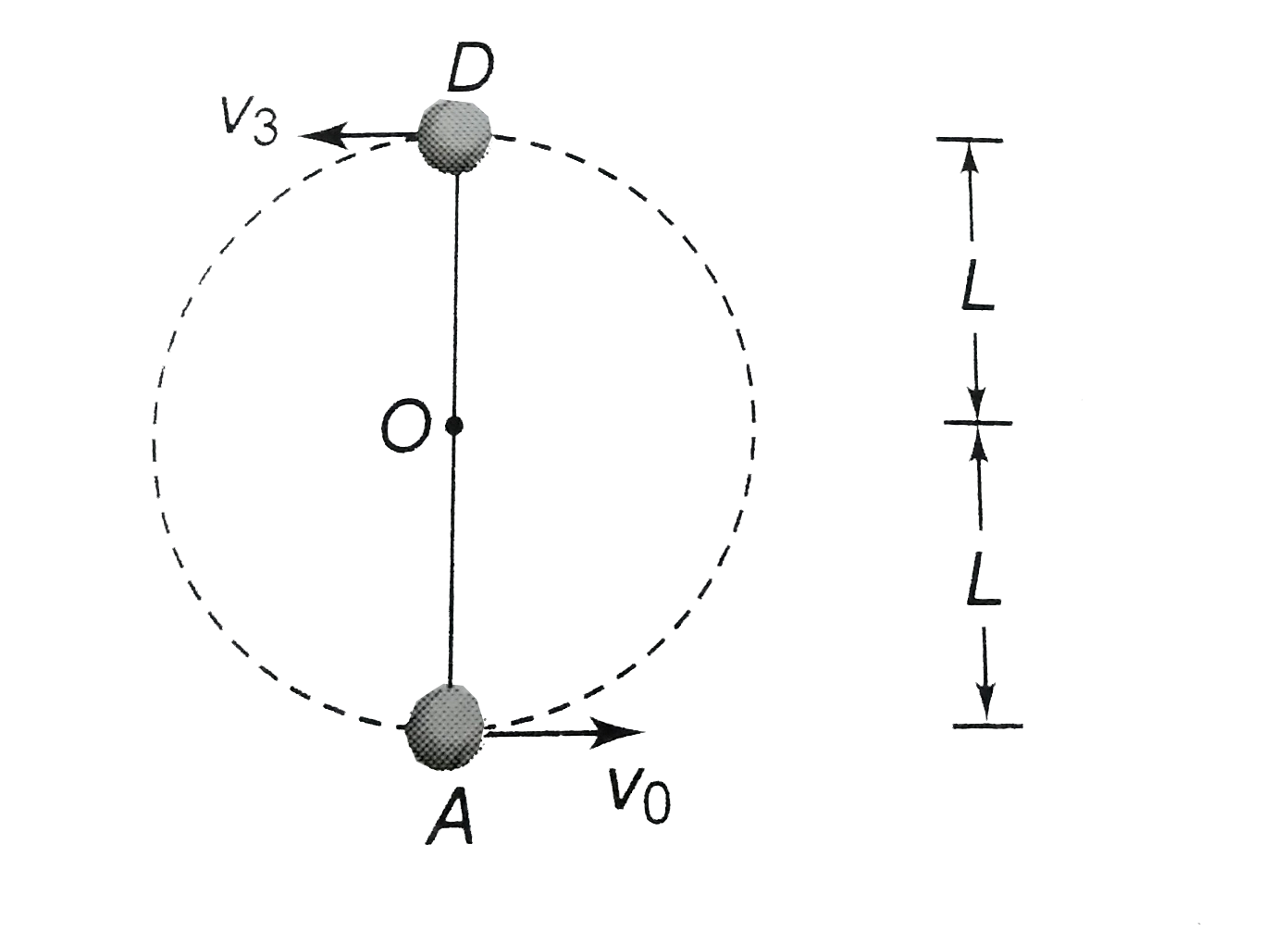 `K_D=(1)/(2)mv_3^2`,`U_D=mgxx2L` LTBEGT `K_A+U_A=K_D_U_D` `v_3=sqrt(v_0^2-4gL)` |
|
| 23. |
A block of mass 1kg lies on a horizontal surface in a truck. The coefficient of friction between the block and the surface is 0.5. if the acceleration of the truck is 6ms^(-2), find the acceleration of the block. |
|
Answer» SOLUTION :`m=1 kg, mu=0.5, a=6ms^(-2), g=10ms^(-2)` ACCELERATION of the BLOCK with RESPECT to the truck=`a-mug |
|
| 24. |
We are living at the bottom of the gravitational well. Comment. |
|
Answer» Solution :Suppose Earth a spherical body of MASS `M` and radius `R`. The gravitational FORCE on the body of mass `m` placed at a distance `r` from the CENTRE of Earth, (where `r LT R)` is `F = - (GMm)/(R^(3))r`, i.e., `- F prop r` When body is OUTSIDE the Earth, then the gravitational force on the body is `F = - (GMm)/(r^(2))`, i.e., `- F prop (1)/(r^(2))` ltbr If we plot a graph between gravitational force `F` and distance `r` of body from the centre of Earth we get the curve as shows in Fig. From the graph it is clear that the gravitational force is minimum at the surface of teh Earth. `(r = R)` which is like the bottom of a well. Hence we are living at the bottom ofa gravitational well. 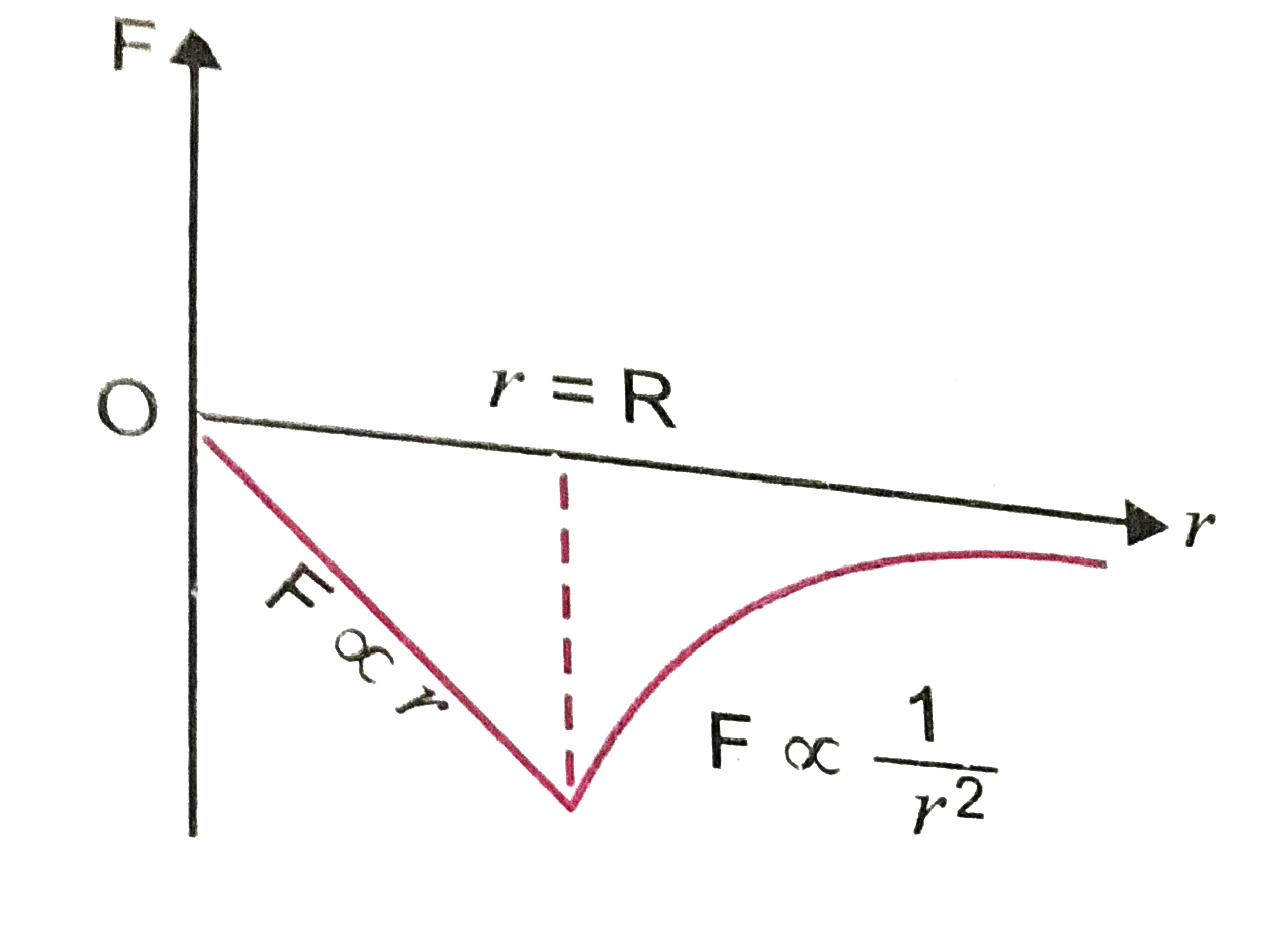
|
|
| 25. |
In the temperature range 0 to 1000 ^(@)C the average specific heat of copper is 378J kg ^(-1) K ^(-1). If 2 kgof copper is heated from 0 to 1000^(@)C by how much does its mass increase ? |
|
Answer» |
|
| 26. |
Values of the acceleration A of a particle moving in simple harmonic motion as a function of its displacement x are given in the table below. {:(A (mm s^(-2)), 16, 8,0,-8,-16),(x(mm),-4,-2,0,2,4):} The period of the motion is |
|
Answer» `1/PI s` |
|
| 27. |
Modulus of rigidity of lilquids is |
|
Answer» infinity |
|
| 28. |
The position vector of a moving particle at't' sec is given by vecr = 3hati + 4t^(2)hatj - t^(3)hatk . Its displacement during an interval of t = Is to 3 sec is |
|
Answer» `hat(j) - hat(k)` |
|
| 29. |
A small block of mass m resting at the bottom of a hemispherical cup of radius R is displaced a little and released. Determine the period of oscillations of the block, assuming the cup to be smooth and fixed rigidly to the table on which it rests. How will period change if the cup is free to move on the table, it is smooth and its mass is M? |
|
Answer» |
|
| 30. |
A physical balance of least count 0.1 gram is used to measure the mass of an object. Write the results if mean value of the observed reading is 125.4g. |
|
Answer» Solution :LEAST COUNT = 0.1 GRAM. MEASURED mass, `m=(125.4 pm 0.1)` gram. |
|
| 31. |
A train is moving with a uniform velocity of (2hat(i)-hat(j)+4hat(j))ms^(-1). If the force required to overcome friction is (hat(i)-3hat(j)+2hat(k))N, the power of the engine is |
| Answer» Answer :C | |
| 32. |
A perfectgasundergoesthe followingthreeseparateand distinctprocessto executea cycle. (I )constantvolumeprocesswhich80 KJof heatis suppliedto thegas(ii)constantpressureprocessduringwhich85 KJof heatis lostto thesurroundingand 20KJof workis doneon it . (iii)adiabaticprocesswhich restores the gasbackto itsintitalstate . Evaluate the workdoneduringadiabaticand thevalueof internalenergyat allthe statepointsif initiallyits valueis 95 KJ . |
|
Answer» Solution :Thisexampleillustratesthe applicationof non - flowenergyequationand the1 stlawappliedto acyclicprocess process1-2`Q_(1-2) = 80KJ, W_(1-2) =0` , ` U_2-U_1= Q_(1-2) - W_(1-2) = 80 -0 = 80 KJ` `thereforeU_2 = 80 + 95 =175KJ` process2-3: `Q_(2-3)=- 85KJ , W_( 2-3) =- 20 KJ` ` thereforeU_3 =- 65+ 175= 110KJ` forthecompletecycle` ointdeltaQ=ointdelta w ` that is `Q_(1-2)+Q_(2-3)+Q_(3-1)= W_(1-2) +W_(2-3) +W_(3-1)` `80-85 + 0 =0 +(-20) +W_(3-1)` ` therefore `workdoneduringadiabaticprocess `W_( 3-1)= 15 KJ` |
|
| 33. |
It is possible to add n vectors of different magnitude and get zero. (a) True , (b) False |
|
Answer» |
|
| 34. |
Consider the situation shown in figure. Initially the spring is unstretched when the system is released from rest. Assuming no friction in the puley, find the maximum eleongation of the spring. |
|
Answer» LET the ELONGATION be x `So, 1/2 kx^2=mgh` `rarrx=2 mg/k` 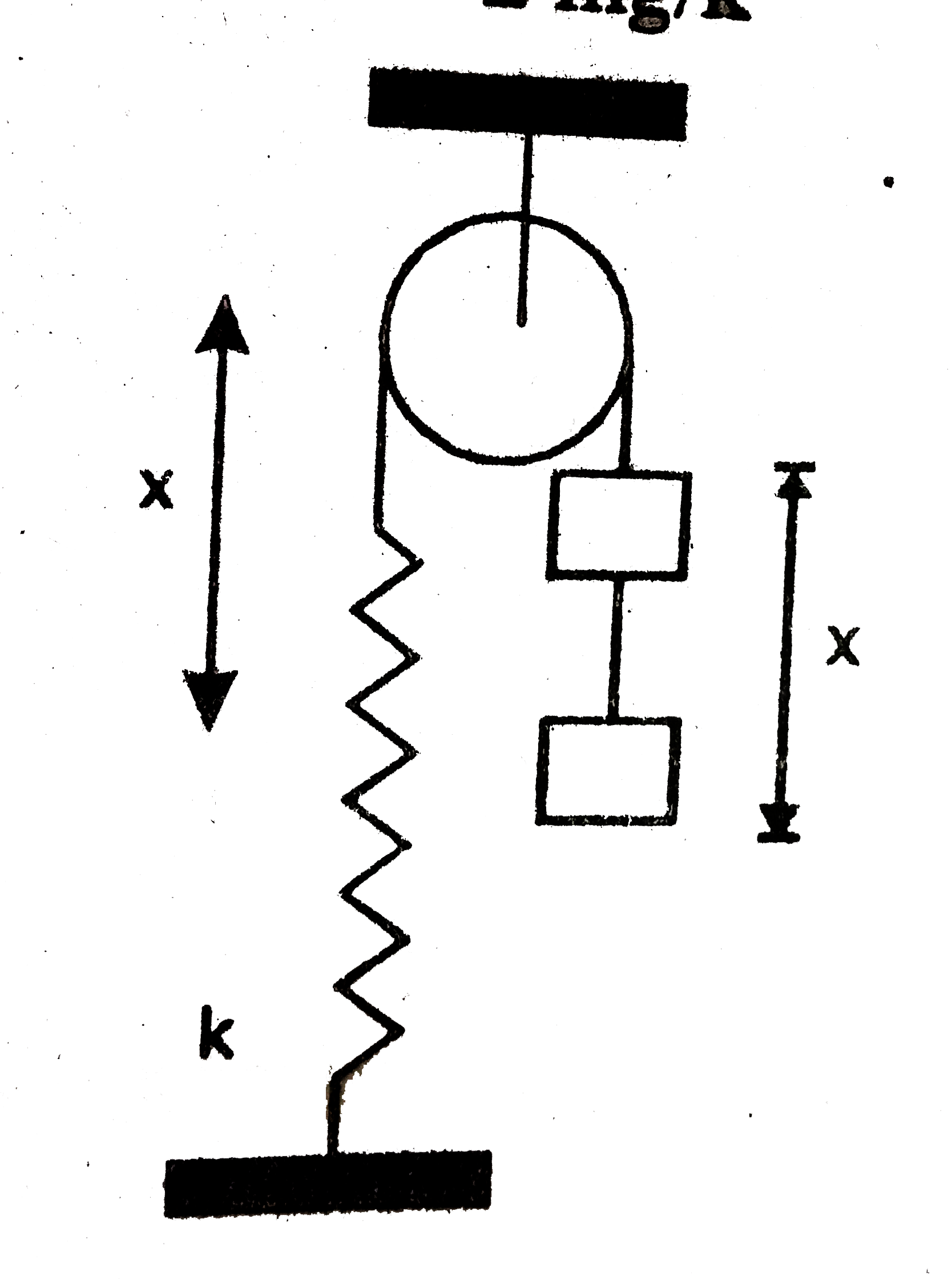
|
|
| 35. |
Can there be a physical quantity that has no units and no dimensions? |
| Answer» SOLUTION :YES. STRAIN has no UNITS and no DIMENSIONS. | |
| 36. |
In the following question, statement 1 refers assertion and statement 2 refers reason. Statement 1: If there is no external torque on a body about its centre of mass, then the velocity of the centre of mass remains constant. Statement 2: The linear momentum of an isolated system remains constant. Which one of the following statement is correct? |
|
Answer» Statement 1 and 2 are TRUE and statement 2 is a correct explanation for statement 1. The linear momentum of an isolated system remains constant because no external force acts on such a system. Thus statement 2 is true. |
|
| 37. |
A uniform chain of mass M and length L is held vertically in such a that its lower end just touches the horizontal floor. The chain is released from rest this position. Any portion of chain that strikes the floor comes to rest. Assuming that the chain does not form a heap on the floor. Then |
|
Answer» Force exterted by chain on the floor when a length x has REACHED the floor is `(3Mgx)/(L)` |
|
| 38. |
Determine the kinetic energy of a circular disc rotating with a speed of 60 rpm about an axis passing 185 through a point on its circumference and perpendicular to its plane. The circular disc has a mass of 5 kg and radius 1 m. |
|
Answer» Solution :n=60 RPM =`(60)/(60)`=1 RPS,mass m=5 kg ,radius r=1m angular VELOCITY `omega =2pirn=2pi` rad/s KINETIC energy K.E. =`(1)/(2)Iomega^(2)=(1)/(2)(3MR^(2))/(2)(2pi)^(2)=(1)/(2)(3MR^(2))/(2)4pi^(2)` `(1)/(2)(3xx5xx1^(2))/(2)xx4xxpi^(2)=15xx(3.14)^(2)=148.1J` |
|
| 39. |
P = excess pressure value of different curvatures, r – radius, d - diameter, T - surface Tension |
|
Answer» |
|
| 40. |
A perfectly right and wightless rod of length l is hinged at ine end to a vertical wall and is held horizonatal by two vertical wirs of the same length ,radius and material , which are tied at distance a and b grom the hinged end of the rod . |
|
Answer» |
|
| 41. |
A wind with speed 40 m/s blows parallel to the roof ofa house. The area of the roof is 250 m^(2). Assuming that the pressure inside the house is atmospheric pressure, the force exerted by the wind on the roof and the direction of the force will be: (rho_("air")=1.2kg//m^(3)) |
|
Answer» <P>`2.4xx10^(5)N`, upwards `UNDERSET("inside")ubrace(P_(1)+(1)/(2)rhov_(1)^(2))=underset("outside")ubrace(P_(2)+(1)/(2)rhov_(2)^(2))` Assuming that the roof width is very small, pressure difference, `P_(1)-P_(2)=(1)/(2)rho(v_(2)^(2)-v_(1)^(2))` Here, `rho=1.2kgm^(-3),v_(2)=40ms^(-1),v_(1)=0,A=250m^(2)` `P_(2)-P_(2)=(1)/(2)xx1.2(40^(2)-0^(2))` `P_(1)-P_(2)=(1)/(2)xx1.2xx1600=960Nm^(-2)` Force acting on the roof `F=(P_(1)-P_(2))xxA` `=960xx250` `=2.4xx10^(5)N` upwards |
|
| 42. |
When a satellite is going round the earth in a circular orbit of radius .r. and with a velocity V. If it loses some of the energy, then |
|
Answer» R and v both will INCREASE |
|
| 43. |
State examples for free oscillations. |
|
Answer» Solution :Examples for FREE oscillations are (i) Vibrations of tuning fork. (II) Vibrations is a stretched string (iii) Oscillations of SIMPLE pendulum. (iv) AIR blown gently across the MOUTH of a bottle. |
|
| 44. |
A meter long narrow bore held horizontally (and closed at one end) contains a 76 cm long mercury thread, which traps a 15 cm column of air. What happens if the tube is held vertically with the open end at the bottom? |
|
Answer» |
|
| 45. |
A cylinder of ideal gas is closed by an 8 kg movable piston of area 60cm^2 . The atmospheric pressure is 100 kPa. When the gas is heated from 30^@C to 100^@Cthe piston rises 20 cm. The piston is then fastened in the place and the gas is cooled back to 30^@C. If Delta Q_1is the heat added to the gas during heating and Delta Q_2is the heat lost during lost cooling, find the difference. |
|
Answer» |
|
| 46. |
A fluid is contained in a cylinder by a spring loaded, frictionless piston so that the pressure in the fluid is a linear function of volume (p = a +bV). The internal energy of the fluid in kJ is given by the expression U= 32 +3 pV where p is in kPa and V is in mo. The initial and final pressures are 150 kPa and 350 kPa and the corresponding volumes are 0.02 m^3 and 0.05 m^3Make calculations for the direction and magnitude of work and heat interactions. |
|
Answer» Solution :Relation between pressure and volume, p= a +bV. The values of constant a and b can be determined form the values of pressure and temperature at the initial and final state POINTS. `150 = a +0.02 b and 350 = a +0.05 b` From these expressions : a = 16.67 and b = 6666.67 The LAW of expansion BECOMES : p= 16.67 +6666.67 V a) Work involved during the process `W_(12)= int_(1)^(2)p dV= int_(1) ^(2)( 16.67 + 6666.670) dv` `= 16.67(V_2 -V_1)+(6666.67 )/(2)(V_(2)^(2) - V_(1)^(2))` `= 16.67 (V_2 -V_1) +(6666.67 )/(2)( 0.05^2- 0.02^2) = 7.5 J` SINCE `W_(12)`is positive, the work has been done by the system, the magnitude being 7.5 kJ. (b) Change in internal energy of the fluid during the process `U_2 -U_1-(32-3p_2 - V_2)-(32 - 3p_1 . V_1)` Applying non-flow energy equation , `delta Q =delta W + dU.` the heat interaction is `Q_(12)= 7.5 + 43.50 = 50.50 kJ` since ` Q_2`is positivetheheatflowsintothe system, themagnitudebeing50.5 KJ. |
|
| 47. |
A gas is compressed to half its volume in two different ways : (i) very rapidly. In which process will the work done on the gas behigher? |
|
Answer» Solution :LET the initial state of the gas be represented by the point A on a pV DIAGRAM. (i) When the gas is compressed very rapidly. It is an adiabaticprocess. This COMPRESSION from VOLUME V to volume `V/2` is represented by the curve AB. So the work done on the gas = area under there curve AB = area ABDEA. Then clearly, area ABDEA > area ACDEA. This MEANS that a higher amount of work will be done on the gas in the rapid process. 
|
|
| 48. |
Figure shown a hydraulic press with the larger piston if diameter 35 cm at a height of 1.5 cm at a height of 1.5 m relative to the smaller piston of diameter 10cm. The mass on the smaller piston is 20 kg. What is the force exerted on the load by the larger piston? The density of oil in the press is 750 kh//m^(3) . (Take g=9.8 m//s^(2)) . |
|
Answer» Pressure on the larger piston`=(F)/(pixx(17.5xx10^(-2))^(2)) N/m^(2)` The difference between the two pressure `=h rho g` where, `h=1.5 m` and ` rho=750 kg//m^(3)` Thus,`(20xx9.8)/(pi xx(5xx10^(-2))^(2))-(F)/(pixx(17.5xx10^(-2))^(2))=1.5xx750xx9.8` which gives, `F=1.3xx10^(3)N`. |
|
| 49. |
Consider with a car of mass 1000 kg moving with a speed 18.0 km/h on a road and colliding 6.25 xx 10^(3) Nm^(-1). Taking the coeffici-ent of friction, mu to be 0.5 what is the maximum compression of the spring? |
|
Answer» Solution :In presence of friction, both the spring force and the frictional force act so as to oppose the compression of the spring. We invoke the WORK - energy theorem, rather than the conservation of mechanical energy. The CHANGE in kinetic energy is `DeltaK=K_(f)=0-(1)/(2)m u^(2)` The work done by the net force is `W=-(1)/(2)kx_(m)^(2)-mumgx_(m)` Equating we have `(1)/(2)mu^(2)=(1)/(2)kx_(m)^(2)+mumgx_(m)` Now `mu MG=0.5xx10^(3)xx10=5xx10^(3)N` `("taking g" = 10.0s^(2))`. After rearranging the above equation we obtain the following quadratic equation in the unknown `x_(m)`. `kx_(m)^(2)+2mu mgx+_(m)-m u^(2)=0` `x_(m)=(-mu mg+[mu^(2)m^(2)g^(2)+mku^(2)]^(1//2))/(k)` Where we take positive square root since `x_(m)` is positive. Putting in numerical values we obtainthe following quadratic equation in the unknown `x_(m) = 1.35m.` |
|
| 50. |
Delhi is at a distance of 200 km from Ambala. Car A set out from Ambala at a speed of 30 kmh^(-1) and car B set out at the same time from Delhi at a speed of 20 kmh^(-1). When they will meet each other ? What is the distance of that meeting point from Ambala ? |
|
Answer» `4h``100 km` 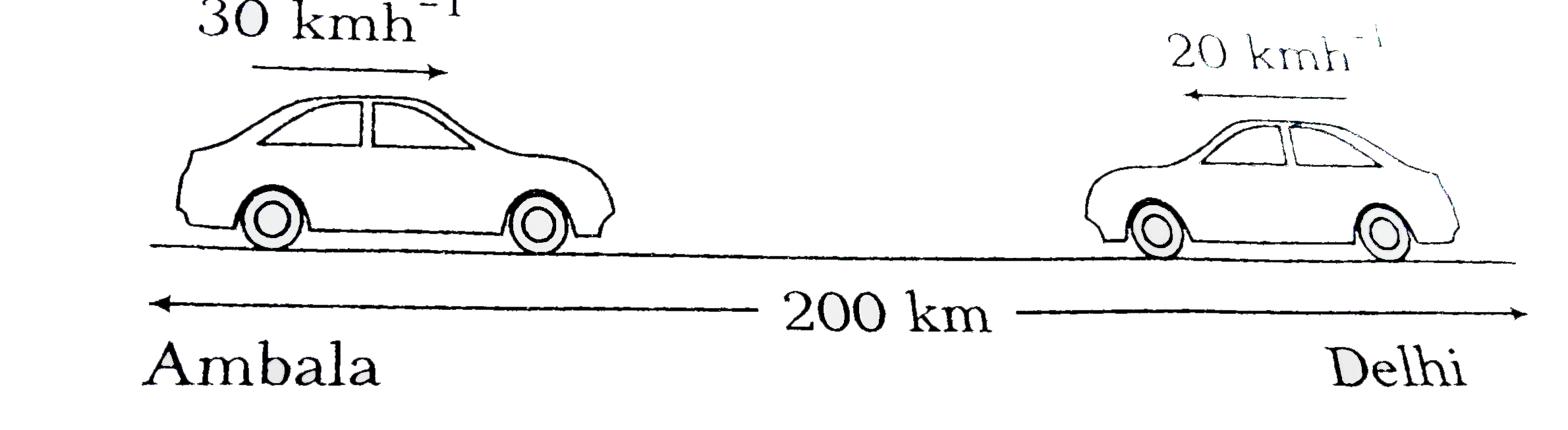 They will mwwt after time t `t=(s)/(v_(AB))=(200)/(50)=4h` Distance from Ambala where they will meet `x = 30xx4=120 km` |
|