

Saved Bookmarks
This section includes 7 InterviewSolutions, each offering curated multiple-choice questions to sharpen your Current Affairs knowledge and support exam preparation. Choose a topic below to get started.
| 1. |
When a quantity of liquid bismuth at its melting point is transferred to a calorimeter containimg oil, then the temerature of oil rises from 12.5^(@)C to 27.6^(@). The expeiment is repeated under identical condition except that bismuth is solid, the temperature of the oil reses to 18.1^(@)C . The specific heat of bismuth is 0.032 cal//g'C The latent heat of fusion of bismuth is 6.7 K cal//g .Then determine the value of K1 Melting point of bismuth is 271^(@)C . |
|
Answer» Solution :Energy with `5`kg of `H_(2)O` at `20^(@)C` to become ice at `0^(@)C` `E_(1)=5000xx1xx20=100000` cal Energy to raise the temperature of `2` kg ice from `-20^(@)C` to `0^(@)C` `E_(1)=5000 xx 0.5xx20=20000` cal `(E_(1)-E_(2))=80000` cal is available to BELT ice at `0^(@)C`. So only `1000 g or 1 kg` of ice would have MELT. So, the amount of water available `1+5=6 kg` |
|
| 2. |
The positon of center of mass can be written in the vector form as |
|
Answer» `SUM m_(i) VEC r_(i)` |
|
| 3. |
The diameter of a sphere is 4.24 m . Calculate its surface area with due regard to significant figures. |
|
Answer» Solution :Diameter `d=4.24` m Radius `r= (d)/(2) = (4.24)/( 2) = 2.12` surface area of sphere `= 4pir^(2)` `= 4 xx 3.1428 xx 2.12 xx 2.12` In the above MULTIPLICATION 2.12 has 3 SIGNIFICANT figures. HENCE 3.1428 is rounded off to have `3+1 = 4` significant figures. It becomes `3.143`. Surface area `= 4 xx 3.143 xx 2.12 xx 2.12 = 56.50` 56.50 this to be rounded off to have 3 significant figures. `therefore` Area is 56.5 `m^(2)`. |
|
| 4. |
A smooth hemisphere of mass m and radius R at rest. A smooth solid sphere of mass 2m and radius R moving with velocity V_(0) between two horizontal smooth surfaces separated by a distance slighly greater than 2R as shown in figure. Dolid sphere collides with the hemisphere. If coefficient of restitution is 1/2, then |
|
Answer» The speed of HEMISPHERE after collision is `V_(0)` |
|
| 5. |
A constant torque acting on a uniform circular wheel changes its angular momentum from A to 4A in 4S. The torque acted on it is |
| Answer» Answer :A | |
| 6. |
A ring of mass M and radius R is released on an inclined as shown. If the coefficient of friction mu lt 1/2 tan theta, then during a displacement l: |
|
Answer» Acceleration of the RING `=g//2sintheta` |
|
| 7. |
The mass and radius of a planet are double that of earth. If the time period of a simple pendulum on the earth is T. The time period on the planet is |
| Answer» ANSWER :C | |
| 8. |
In Davisson-Germer experiment an electron beam accelerated with 54 volt is diffracted at an angle of 50^@ by a nickel crystal and produces first diffraction maxima. The interatomic distance in Nickel crystal is |
|
Answer» 1 Å |
|
| 9. |
The span area of the wings of an aeroplane is 50 cm. When it is running on the runway the pessure of air at the bottom and top of the wings are found to be 0.75x10^(5) pascal and 0.70x10^(5) pascal respectively. Find the dynamic lift on the wings. |
| Answer» SOLUTION :`2.5xx10^(5)N` | |
| 10. |
Can you visualize how a car reaches high speeds an dhow a person scales high cliffs? |
|
Answer» Solution : A car REACHING high speeds acquires knetic energy and a person scaling high cliffs acquires potential energy. In the case of car, the source of K.E. is petrol`//` dieseland OXYGEN from air. In case of humans, the source of P.E. is food and oxygen. In both the cases fuel and oxygen are combined chemically, and the process is called combustion or BURNING. We MAY visualize the combustion process as removing some of the energy stored in th ebonds between the atoms. This energy is called chemical energy. which is essentially a FORM of otential energy as it depends on the position of atoms. Thus K.E. of car and P.E. of person, both are coming from chemical energy`//`potential energy stored in th ebonds between the atoms of fuel and oxygen. |
|
| 11. |
The averageK.E.of a hydrogen gas molecule at STP will be (Boltmann canstant k_(B)=1.38xx10^(-23)JK^(-1)....... |
|
Answer» `0.186xx10^(-28)J` |
|
| 12. |
There are two identical small holes on the opposite sides of a tank ocntaining a liquid. The tank is open at the top. The difference in the height between the two holes is h. As the liquid comes out of the two holes, the tank will experience a net horizontal force proportional to |
| Answer» ANSWER :B | |
| 13. |
Circular disc of mass 2kg and radius 1 metre is rotating about an axis perpendicular to its plane and passing through its centre of mass with a rotational kinetic energy of 8Joules. The angular momentum in (J sec) is |
| Answer» ANSWER :B | |
| 14. |
What is the significance of Kirchhoff's law ? |
| Answer» SOLUTION :GOOD EMITTERS are good ABSORBERS. | |
| 15. |
An athelete jumps at an angle of30^@ with a maximum speed of9.4 m//s.What is the shape of the path followed by the athlete in the jump? |
| Answer» SOLUTION :PARABOLA | |
| 16. |
The menscus of a liquid in a capillary tube is concave. If F_(C) is theforce of cohesion and F_(A) is the force of adhesion between molecules of the liquid, then |
|
Answer» `F_(C)=F_(A)` |
|
| 17. |
The force required just to move a body up an inclined plane of angle of inclination theta is double the force required just to prevent the body sliding down. Find the coefficient of friction between the body and the plane. |
|
Answer» SOLUTION :`1/3tantheta` |
|
| 18. |
Explain heat convection. |
|
Answer» Solution :Propagation of heat in fluids is due to heat convection. When fluid is heated from bottom, the volume of the fluid of that part increases and consequently density DECREASES. Due to force of buoyancy light fluid rises upward and the cooler fluid, moves down to take its place. The whole fluid gets heated as a result of such continuous process. This process of heating is called the ..heat convection... Heat convection can be natural or forced. Natural convection : If the motion of fluid takes place due to difference of density, it is called natural convection. In atmosphere, hot and cold air currents are formed by natural convection due to unbalanced heat flow.  Forced convection : If the motion of fluid takes place with the help of some device like PUMP, FAN, STIRRER etc. it is called forced convection. In human body, the HEART acts as a pump and by circulating blood in all parts of the body, it maintain temperature of the body forced convection. |
|
| 19. |
Find the minimum height of the obstacle so, that the sphere can stay in equilibrium. |
|
Answer» `R/(1+costheta)` `costheta=(R-h)/Rimplies h=R-Rcostheta` 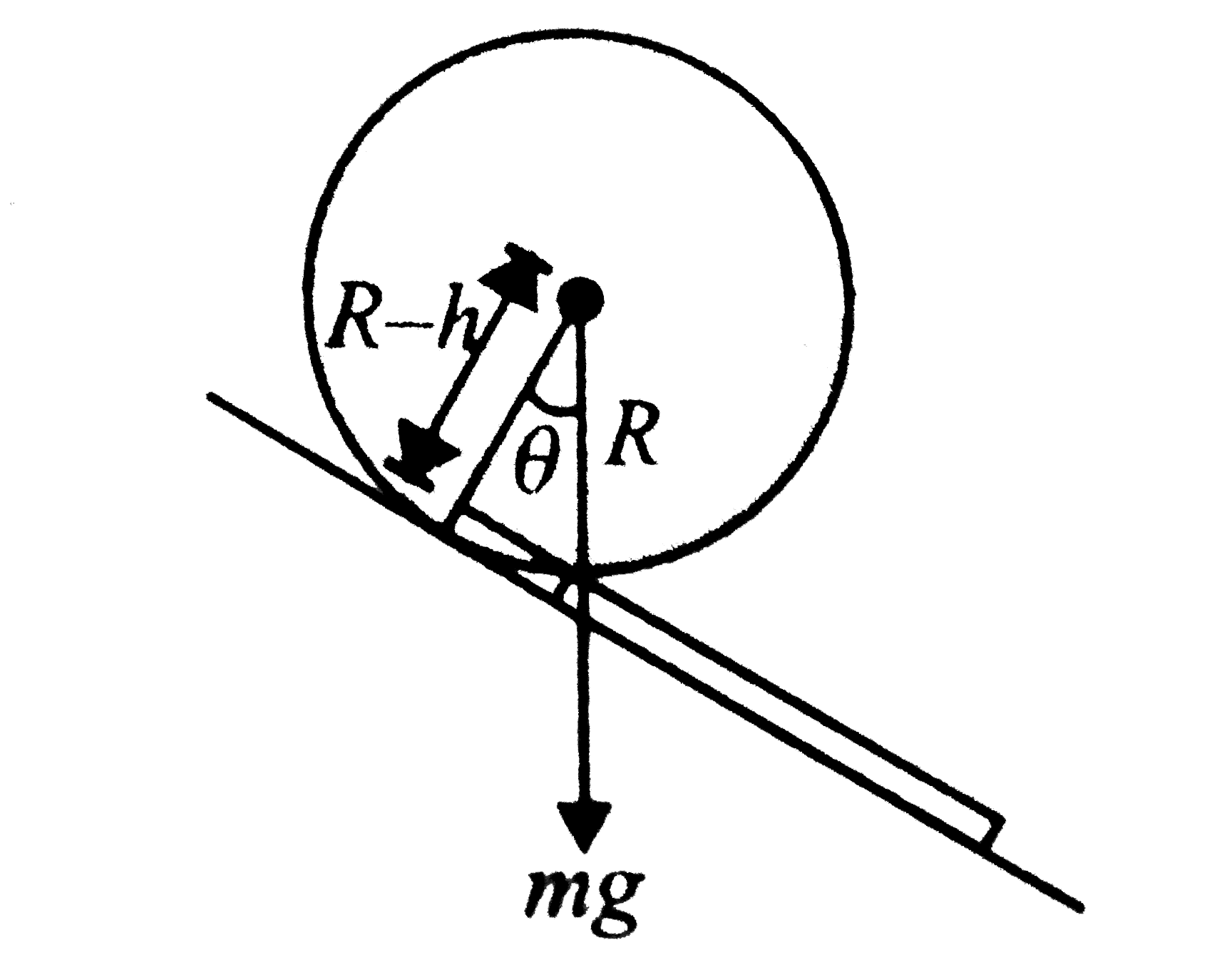
|
|
| 20. |
A scuba diver is deep inside the sea when a source produces loud sound in air which can be heard from far distance. Even though the speed of sound is greater in water, reason out a possibility for why he is not able to hear that sound ? |
|
Answer» Solution :The speed of sound in water is four times the speed of sound in air. Now, from Snell's LAW of refraction, `mu = (sin i)/(sin r) = ("Speed of sound in air")/("Speed of sound in water") = (1)/(4) = 0.25` For REFREACTION, `r_(MAX) = 90^(@)`. So, `(sin i)_(max) = 0.25 or i_(max) = 14^(@)`. As a result, most of the sound generated by the source in air and incident at ANGLE `i gt 14^(@)` gets reflected back in air and only a very small amount is refracted into water. So, the SCUBA diver deep inside the sea will not be able to hear even a loud sound. |
|
| 21. |
What is meant by steady state in thermal conduction ? |
| Answer» SOLUTION :Under steady state heat conduction, the temperature of each section of the object through which heat conducts REMAINS constant with TIME. In this CASE same quantity of heat crosses every layer in one second. | |
| 22. |
y-x graph of a transverse wave at a given instant is shown in figure. Match the following two columns. |
|
Answer» `a-r,b-p,c-rd-s` Slope at B is negative so velocity is positive, acceleration is ZERO. |
|
| 23. |
The power radiated by a black body is P and it radiates maximum energy at wavelength, lamda_(0). If the temperature of the black body is now changed so that it radiates maximum energy at wavelength 3/4lamda_(0), the power radiated by it becomes nP. The value of n is |
|
Answer» `3/4` `P=sigmaAT^(4)""[becausee=1]` `:.PpropT^(4)""[becausesigma" and A equal"]` Now, from Wein.s DISPLACEMENT law, `Tprop(1)/(lamda_(m))` `:.Pprop(1)/(lamda_(m)^(4))` `:.(P_(2))/(P_(1))=((lamdam_(1))/(lamdam_(2)))^(4)=((lamda_(0))/(3/4lamda_(0)))^(4)` `:.(nP)/(P)=((4)/(3))^(4)=(256)/(81)` `:.n=(256)/(81)` |
|
| 24. |
A man walks up a stationary escalator in 90 sec. When this man stands on a moving escalator he goes up in 60 sec. The time taken by the man to walk up the moving escalator is |
|
Answer» 30 s |
|
| 25. |
At which position in the string of simple pendulum has maximum tension? |
|
Answer» SOLUTION :At mean position, Tension in string `T= MG cos theta`. If `cos 0^(@)`, then `cos theta` has maximum value and hence tension forced ALSO maximum. |
|
| 26. |
A metal piece of 50 g specific heat 0.6 cal/g^(@)C initially at 120^(@)C is dropped in 1.6 kg of water at 25^(@)C. Find the final temperature or mixture. |
|
Answer» SOLUTION :`m_(1)c_(1)(theta_(1)-theta) "" = m_(2)c_(2)(theta-theta_(2))` `=m_(2)c_(2)(theta-theta_(2))` `:. "" c_(2)=1 cal//gm^(@)C` `:. "" 50xx0.6xx(120-theta)=1.6xx10^(3)xx1xx(theta-25)` `theta = 26.8^(@)C` |
|
| 27. |
In a sound wave , a displacement node is a pressure antinode and vice-versa. Explain, why ? |
| Answer» Solution :At the point, where a COMPRESSION and a RAREFACTION meet, the DISPLACEMENT is minimum and it is called displacement NODE. At this point, pressure differenceis maximum i.e at the same point it is a pressure antinode. On the other hand, at the mid-point of compression or a rarefaction, the displacement VARIATION is maximum i.esuch a point is pressure node, as pressure variation is minimum at such point. | |
| 28. |
A trolley filled with sand moves on a smooth horizontal surface with a velocity V_(0). A small hole is made at the base of it from which sand is leaking out vertically down at constant rate. As the sand leaks out(a) the velocity of the trolley remains constant (b) the velocity of the trolley increases(c ) the velocity of trolley decreases(d) the momentum of trolley + leaked out sand is conserved |
|
Answer» a & B are CORRECT |
|
| 29. |
A body of mass 4 kg is attached to another body of mass 2 kg with a mass less rod. If 4 kg mass is at (2hati + 5hatj)m, and 2 kg mass at (4hati + 2hatj)m, find the centre of mass of that system. |
|
Answer» Solution :Mass of the FIRST BODY, `m_(1)` = 4KG Mass of the second body,`m_(2) = 2k` POSITION vector of first body `vecr_(1) = (2hati + 5hatj)m` , Position vector of second body, `vecr_(2) = (4hati + 2hatj)` m Centre of mass of the system , `vecr_(CM) = (m_(1)vecr_(1) + m_(2)vecr_(2))/(m_(1) + m_(2)) =(4(2hati + 5hatj)+2(4hati + 2hatj))/(4+2) = 1/3[8hati + 12hatj]m` |
|
| 30. |
The standard fixed point for temperature measurements in use today is |
|
Answer» melting POINT of ice at ONE ATMOSPHERIC pressure |
|
| 31. |
A constant torque of 1000 Nm turns a wheel of of M.I. 200"kg m"^(2) about an axis through centre. The angular velocity after 3s is : |
|
Answer» `15" RAD s"^(-1)` |
|
| 32. |
A steel ball initially at a pressure of 1.0 xx 10^(5) Pa is heated from 20^(@) C to 120^(@) C keeping its volume constant. Find the pressure inside the ball. Coefficient of line expansion of steel = 12 xx 10^(-6)//^(@) C and bulk modulus steel = 1.6 xx 10^(11) N/m^(2) |
|
Answer» `2.5 xx 10^(8) Pa` |
|
| 33. |
A train accelerating uniformly passes three successive kilometre posts at time t = 0, t= 75 and t = 125 (all in second), In respect of this motion, which of the following statement are true ? |
|
Answer» The acceleration of the train is `((8)/(75)) m//s^(2)` `2 + s =xx 125 + (1)/(2) a xx (125)^(2)` |
|
| 34. |
(A) : Every component of a null vector is zero ( R) : Orighin and terminus of null vector are at the same point |
|
Answer» Both (A) and ( R) are ture and ( R) is the CORRECT explanation of (A) |
|
| 35. |
Uniform rod AB is hinged at A in the horizontal position as shown in Fig. The other end is connected to a block through a massless stsring m as shown. The pulley is smooth and massless. Masses of block and rod are same and equal to m. Then acceleration of the block just after release from the position is 3g/b where 'b' is |
|
Answer» |
|
| 36. |
Four moles of an ideal gas at a pressure of 4 atm and at a temperature of 70^(@)C expands is othermally to four times its initial volume : What is (i) the final temperature and (ii) the final volume ? |
|
Answer» Solution :INITIAL VOLUME `= V _(1)` Initial pressure `=P _(1) = 4 atm` INTIAL temperature `= T _(1) = 70 + 273 = 343 K` Final volume = ` V _(2) = 4V_(1)` The process is ISOTHERMAL. So the temperature remains constant Final pressure `P _(2) = ?` `P _(2) V _(2) = P _(1) V_(1)` `P _(2) = (P _(1) V _(1))/( V _(2)) = ( 4 xx V _(1))/( 4 V _(1)) = 1 ` atm |
|
| 37. |
Parsec is the unit of |
|
Answer» distance |
|
| 38. |
(A) : In a position - time graph, the direction of velocity vector is always along the tangent to the path (R): The slope of tangent to path always measure the magnitude of velocity at that point |
|
Answer» Both (A) and (R) are true and (R) is the CORRECT EXPLANATION of (A) |
|
| 39. |
The …………. Of systematic error are………….. . Therefore, such errors can be…………….. |
|
Answer» |
|
| 40. |
A student plotted the following four graphs, figure. Representing variation of velocity of sound in a gas with the pressure P. Which ons is correct and why? |
Answer» Solution :The speed of SOUND in a gas does not depend upon PRESSURE of the gas, till temperature remains constant, i.e., speed remains the same WHATEVER be the pressure. THEREFORE, graph (d) is correct.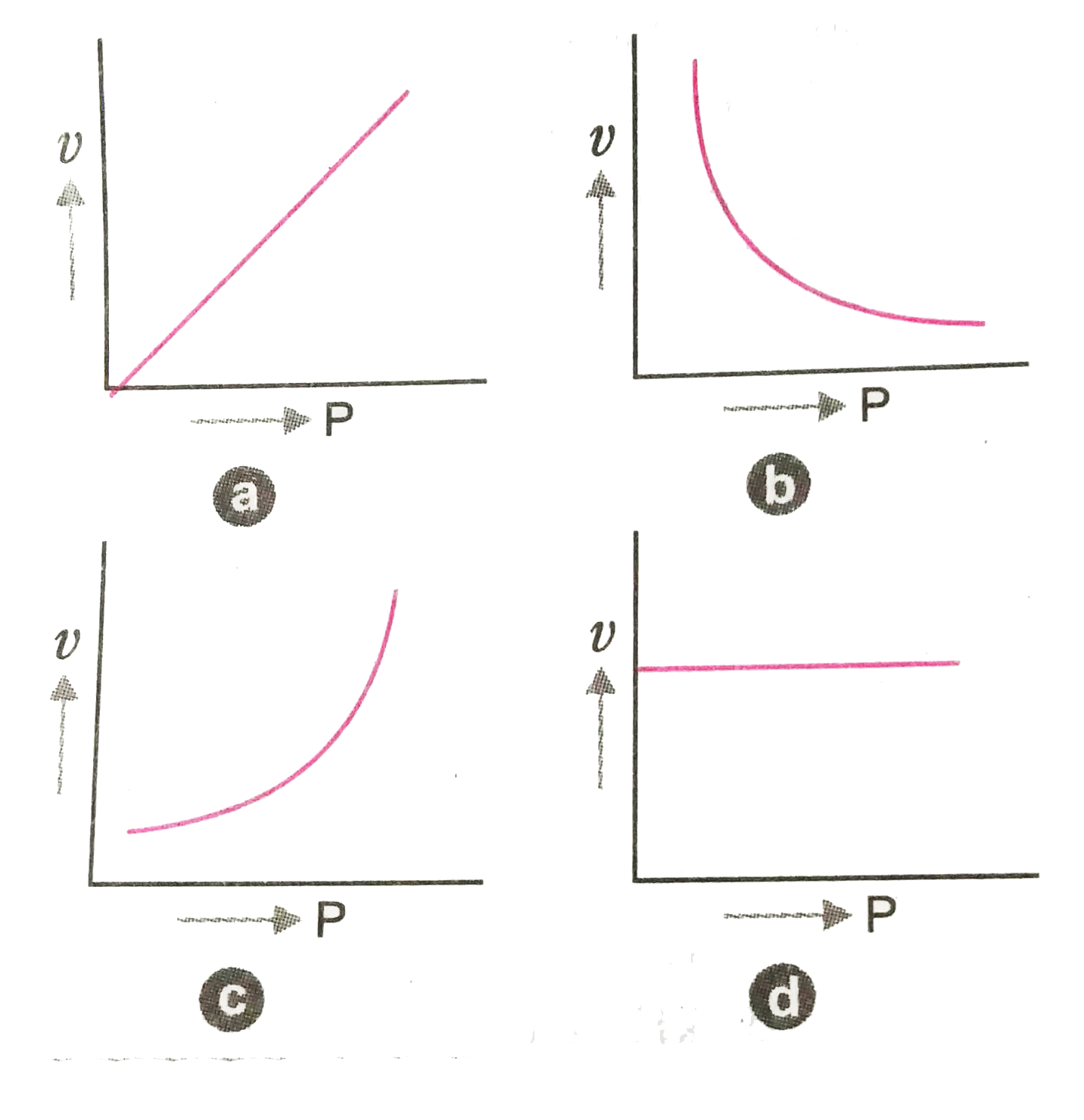
|
|
| 41. |
A bullet of mass 10xx10^(-3) moving with a speed of 20ms^(-1) hits an ice block (0^(@)C) of 990g kept at rest on a frictionless floor and gets embedded in it. If ice takes 50% of K.E, the amount of ice melted (in grams) approximately is (J=4.2J/cal) (latent heat of ice=80cal/g) |
|
Answer» 6 |
|
| 42. |
A block kept on a inclined plane slides down the plane with constant velocity when the slope angle of the plane is theta. It is then projected up with an initial velocity u. How far up the incline will it move before coming to rest ? Will it slide down again ? |
|
Answer» |
|
| 43. |
A ball A has twice the diameter that of another ball B of the same material and with same surface finish. A and B are both heated to the same temperature and allowed to cool radiatively, then |
|
Answer» rate of cooling of A is same as that of B |
|
| 44. |
A disc of mass m and radius R is moving on a smooth horizontal surface with the flat circular face on the surface. It is spinning about its centre with angular peed omegaand has a velocity V (see figure). It just manages to hit a stick AB at its end A. The stick was lying free on the surface and stick to the disc. [The combined object becomes like a badminton racket]. Mass and length of the stick are m and 2R respectively. (a) Calculate the angular speed of the combined object assuming V = R omega (b) Calculate loss in kinetic energy. Why is energy lost ? (c) If V = eta (R omega), loss in kinetic energy is minimum. Find eta. (Assume omega is given] |
|
Answer» (b) `Delta E = (5)/(68)mV^(2) + (7)/(34)mR^(2)OMEGA^(2) - (3)/(17)mV R omega` (c) `eta = (6)/(5)` |
|
| 45. |
A projectile shot at a angle of 45^(@) above the horizontal strikes a building 30 m away at a point 15 m above the point of projection. Find a. the speed of projection(b) the magnitude and direction of velocity of projectile when it strikes the building. |
|
Answer» Solution :Let u is the speed of projection a. Let P be the point on the building wher projectile hits it. Taking point of projection as origin COORDINATES of P are (30,15) Using the equation of trajectory. `y=xtan THETA-(gx^(2))/(2u^(2)cos^(2)theta)implies15=30tan45^(@)-(g(3)^(2))/(2u^(2)cos^(2)45^(@))impliesu=24.2ms^(-1)`  b. At `p,v_(x)=u_(x)=24.2cos 45^(@)=17.11ms^(-1)` `v_(y)^(2)=u_(y)^(2)+2a_(y)s_(y)impliesv_(y)^(2)=u^(2)sin^(2)45^(@)-2g(15)` `v_(y)^(2)=(60g)(0.5)-30g=0impliesv_(y)=0` At P projectile is at its highest point and hence moving horiontally. |
|
| 46. |
Can we add a velocity vector to a displacement vector ? |
| Answer» Solution :No, only VECTORS representing same PHYSICAL quarities by nature can be ADDED TOGETHER . | |
| 47. |
Aflat plate of area 0.05 m^(2)is separated from another large plate at rost by a liquid layer of uniform thickness 1mu m. The tangential force needed to move the smaller plate with a constant velocity of 10 cm s ^(-1)i s 20 N. Calculate the coefficent of viscosity of the liquid. |
|
Answer» |
|
| 48. |
A satellite is revolving round the earth in an elliptical orbit, then (a) gravitational force exerted by the earth is equal to centripetal force at same point only ( b) power associated with gravitational force is zero at every point (c) workdone by gravitational force is zero in some small parts of the orbit (d) at some points, the magnitude of gravitational force is greater than that of centripetal force |
|
Answer» only a and B are TRUE |
|
| 49. |
A body is released from the top of a smooth inclined plane of inclination q. It reaches the bottom with velocity v. If the angle of inclination is doubled for the same length of the plane, what will be the velocity of the body on reaching the ground: |
|
Answer» `v` |
|
| 50. |
Explain this statement clearly : (i) To call a dimensionless quantity 'large' or 'small' is meningless without specifying a standard for comparison. (ii) in view of this, reword the following statements, where necessary. (a) Atoms are very small objects (b) A jet plane moves with great speed (c ) The mass of jupiter is very large (d) the air inside this room constains a large number of moelcules (e ) A proton in much more massive than an electron (f) The speed of sound is much smaller then the speed of light. |
|
Answer» Solution :(i) the statement is true. This is becaue a DIMENSIONLESS quantity can be LARGE or small only in comparison to some standerd. For example angle is dimensionless. `/_theta = 60^@` is LARGER then `/_ theta =30^@`, but smaller then `/_theta = 90^@` (ii) (a) The size of an atom is smaller then the sharp tip of a pin. (b) A jet plane moves faster is very then a superfast train. (c ) the mass of jupiter is very large COMPARED to the mass of EARTH. (d) The air inside theis room contains more number of molecules then in one mole of air. (e ) The statement is already correct (f) the statement is already correct. |
|