

Saved Bookmarks
This section includes 7 InterviewSolutions, each offering curated multiple-choice questions to sharpen your Current Affairs knowledge and support exam preparation. Choose a topic below to get started.
| 1. |
(A) : A wooden cube of side ' a' floats in a non viscous liquid of density 'p' When it is slightly pressed and released it executes SHM (R ) :The net force responsible for SHM is the resultant of buoyancy force and true weight of the body. |
|
Answer» Both 'A' and 'R' are ture and 'R' is the CORRECT EXPLANATION of 'A' |
|
| 2. |
Two masses (M+m) and (M-m) are attached to the ends of a light inextensible string and the string is made to pass over the surface of a smooth fixed pulley. When the masses are released from rest, the acceleration of the system is |
|
Answer» `gm//M` |
|
| 3. |
A particle of mass m is driven by a machine that delivers a constant power k watts. If the partilcle starts from rest the force on the particle at time t is |
|
Answer» <P>`sqrt(2 MK) t^(-1//2)` or `P = k or (dW)/(DT) = k, dW = kdt` INTEGRATING both sides, `int_0^W dW = int_0^t k dt` `IMPLIES W = kt` Using work energy theorem, `W = 1/2 mv^2 - 1/2 m(0)^2` `kt = 1/2 mv^2 " or " v = sqrt((2kt)/(m))` Acceleration of the particle, `a = (dv)/(dt) = 1/2 sqrt((2k)/(m) = 1/(sqrtT)) = sqrt((k)/(2mt))` Force on the particle , `F = ma = sqrt((mk)/(2t)) = sqrt((mk)/(2)) t^(-1//2)`. |
|
| 4. |
(A) : A person standing on a rotating platform suddenly stretched his arms, the platform slows down. (R) : In case of person on a rotating angular momentum is constant. |
|
Answer» Both 'A' and 'R' are true 'R' is the CORRECT explanation of 'A' |
|
| 5. |
For a gas, R/C_V = 0.67. This gas is made up of molecules, which are |
|
Answer» DIATOMIC |
|
| 6. |
Explain why are water storage dam walls thicker at the bottom. |
| Answer» Solution :The pressure of liquid column of height h is P= `hrhog`. Therefore ,the pressure is very high at the bottom of the DAM .To TOLERATE this pressure, the WALLS of dam are MADE thick at the bottom. | |
| 7. |
A body covers 200 cm in the first 2 sec and 220 cm in the next 4 sec under constant acceleration . Then find the velocity of the body after 7 sec. |
|
Answer» |
|
| 8. |
Plot the corresponding SHM of particle. Indicate the intial (t=0) position of the particle, the radius of the circle and angular speed of the rotating particle. Consider sense of rotation to be anticlockwise and x in cm and tis in s. (d) x=2 cos pit |
|
Answer» SOLUTION :`x=2 cos pit` Comparing this with `x=A cos (omegat+phi)` We get, `A=2cm, OMEGA =pi" rad s"^(-1), phi=0` 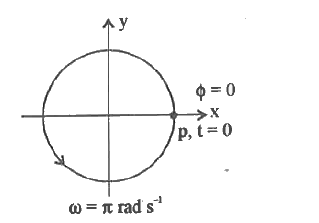
|
|
| 9. |
Plot the corresponding SHM of particle. Indicate the intial (t=0) position of the particle, the radius of the circle and angular speed of the rotating particle. Consider sense of rotation to be anticlockwise and x in cm and tis in s. (c ) x=3sin(2pit+(pi)/(4)) |
|
Answer» Solution :`x=3sin(2pit+(pi)/(4))` `"i.e."x=3cos {((3PI)/(2)+(2pit+(pi)/(4)))}` `x=3cos(2pit+(7pi)/(4)).` Hence `A=3cm, OMEGA =2pi" rad s"^(-1),PHI=(7pi)/(4)" rad"` 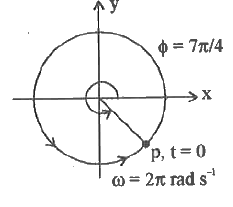
|
|
| 10. |
Define one light year. |
| Answer» Solution :The DISTANCE TRAVELLED by the light in 1 year, with a velocity of `3xx 10^(8) m"/"s`, is known as ONE light year. It is equal to `9.46xx10^(15) m`. | |
| 11. |
A body is moving in a circle with a uniform speed 'v' In moving from a point to another diametrically opposite point ………………… . |
|
Answer» the momentum CHANGES by 'mv' |
|
| 12. |
What is significance of first law of thermodynamics ? |
| Answer» SOLUTION :First law expresses the RELATION between HEAT and work. This SIGNIFIES that heat can only be produced at the expenditure of some other form of energy. This means we cannot make a machine with PERPETUAL motion or we cannot get work without spending energy. | |
| 13. |
What is meant by the principle of homogeneity ? |
| Answer» SOLUTION :All TERMS of any physical relation must have the same DIMENSIONS . If `X=ab+c^(2)` then the dimensions of X, ab and `c^(2)` must be same. | |
| 14. |
A solid cube of wood of side 2a and mass M is resting on a horizontal surface. The cube is constrained to rotate about an axis passing through D and perpendicular to face ABCD. A bullet of mass m and speed v is shot at a height of 4a//3 as shown in the figure. The bullet becomes embedded in the cube. Find the minimum value of v required to topple the cube. Assume mgt gtM. |
Answer» SOLUTION :Let `omega` be the angular velocity of cube just after collison about an axis passing through `D`. From conservation of the angular mometum about an axis passing through `D`. 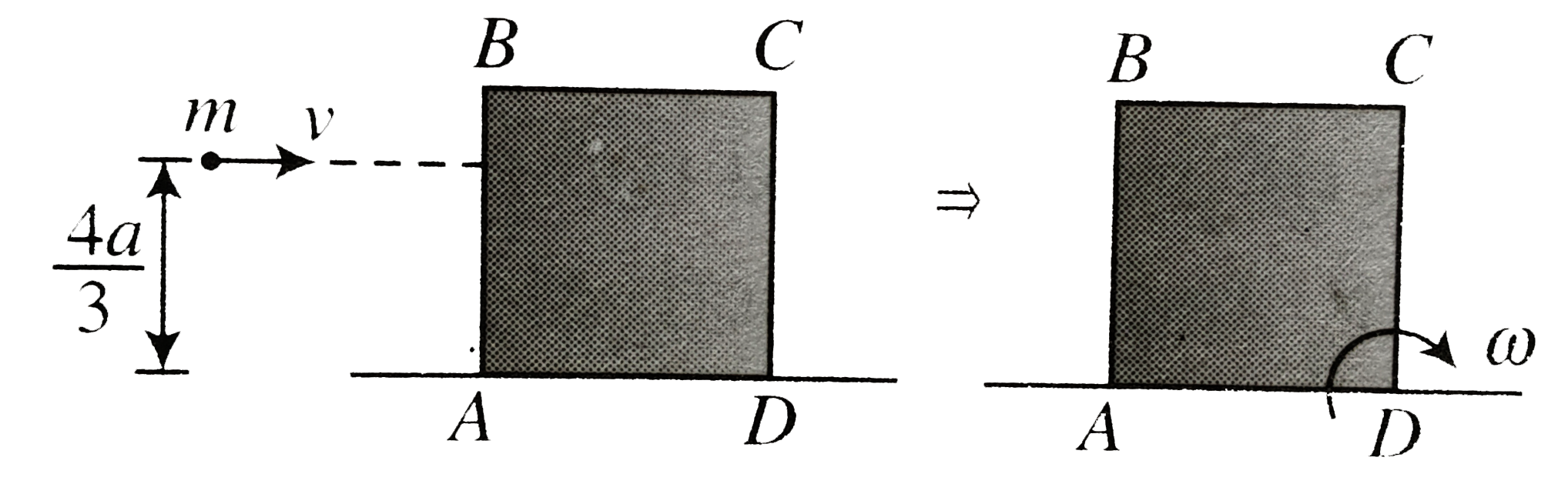 `mv((4A)/3)=I_(D).omega` Here `I_(D)=I_(com)+mr^(2)` where `r=` perpedicular distance of axis of ROTATION passing through `D` from centre of mass (com) of the cube `=sqrt(2)a` or `(4mva)/3=[M((4^(2)+4a^(2))/12)+M(2a^(2))]omega` or `(4mva)/3=8/3Ma^(2).omega` `omega=1/2 (mv)/(Ma)`........i The cube will topple if its `COM` is just able to reach in a vertical height `h_(2)` as shown in figure. 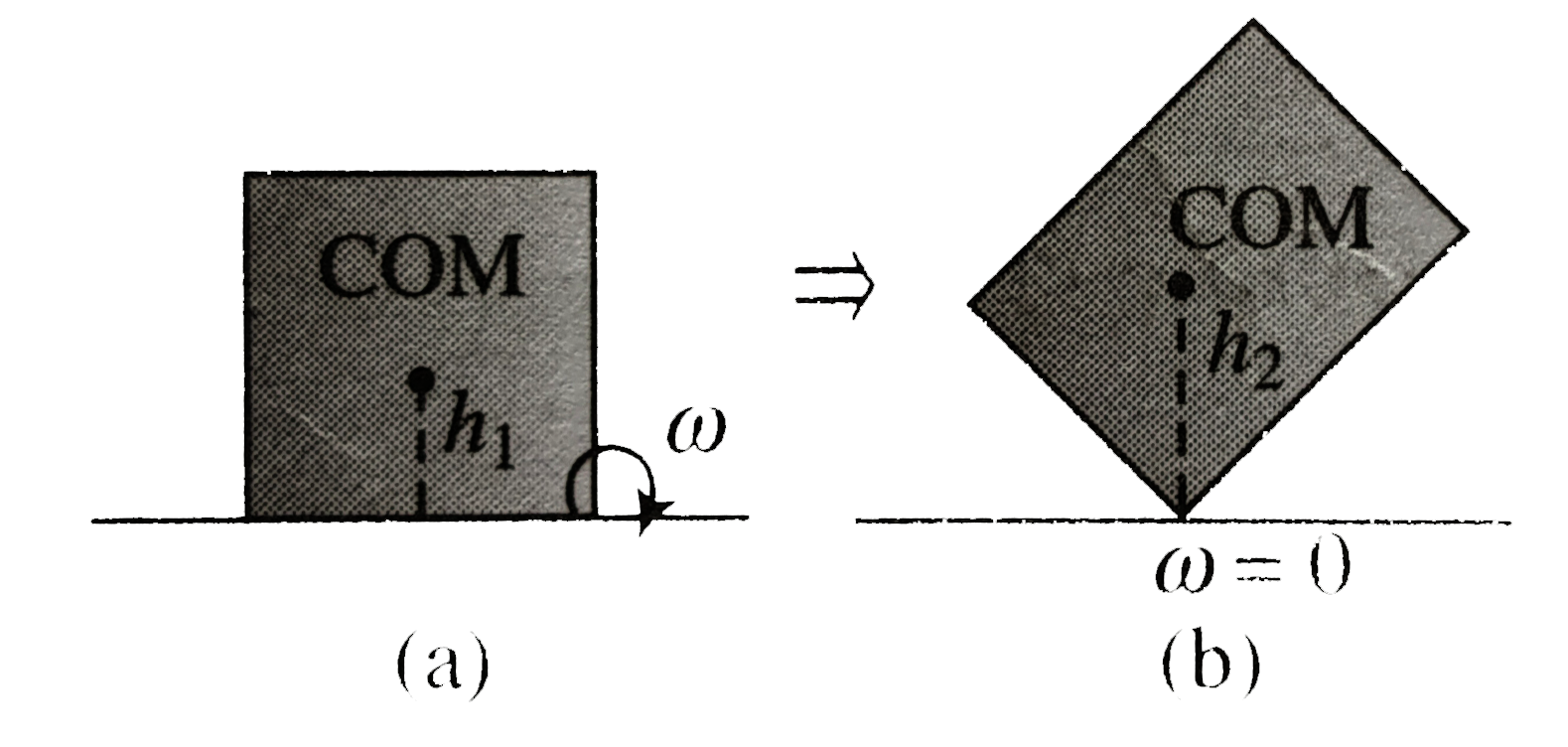 Hence applying conservation of mechanical energy `1/2I_(D)omega^(2)=Mg(h_(2)-h_(1))` (`:'I_(D)=8/3Ma^(2))` or `1/2 (8/3Ma^(2)).{1/2(mv)/(Ma)}^(2)=Mg(sqrt(2-1)a` or `1/2(m/M)^(2)v^(2)=ag(sqrt(2)-1)` or `v=M/m[3ag(sqrt(2)-1)]^(1/2)` |
|
| 15. |
By inserting a capillary tube upt a depth 1 in water th rises to a height h. If the lower end of the capillary tubes is closed water and the capillary is taken out and closed and opened, to what height the water will remain in thetube when 1gth |
| Answer» ANSWER :C | |
| 16. |
In the previous question, suppose contact angle is not zero, but it is theta (the surface not hemispherical) now find pressure at point 'A'. |
Answer» Solution : DRAW normal (radial lines) at point `A` and `B` of periophery. The point `(C)` WHERER radial lines meet is called centre of curvture. If contact angle is `theta`, from `Delta ACM, r_(C) = R sectheta` So RADIUS of curvature of the surface `r_(C) = R sectheta` Point to remember : If the LIQUID surface is hemispherical `(theta = 0)` then `r_(c) = R` If liquid surface is not hemispherical `(theta ne 0)` then `r_(c) = R sec theta` 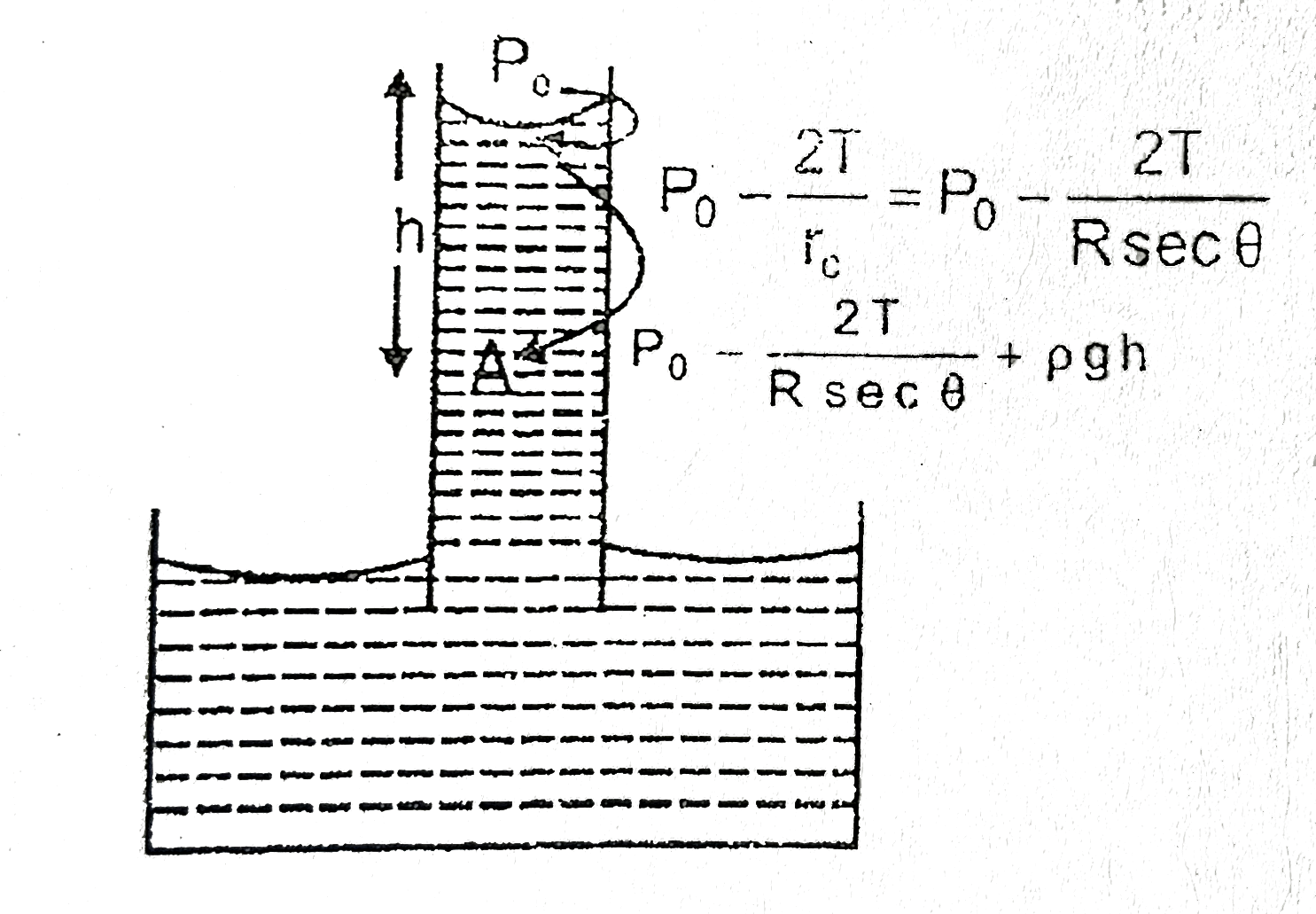 So pressure at `A` is `P_(0) - (2T)/(Rsectheta) + rhogh` |
|
| 17. |
Some amount of gas is compressed adiabatically at 27^(@)C and standard atmospheric pressure. If the final volume of the gas becomes 1/3 rd of its initial volume, what will be the final pressure and temperature of the gas? If the gas is compressed isothermally, what will be the final pressure? (gamma = 1.4) |
|
Answer» |
|
| 18. |
A motor car running at the rate of 7m//s can be stopped by brakes in 10m. Prove that the total resistance to the motion when the brakes are on is one-fourth of the weight of the car. |
| Answer» Solution :`a=v^(2)-U^(2)//2s=-7^(2)//2xx10m//s^(2)`. `MU=ma//MG=-49/20xx9.8=-1//4`. Resistance = `mu mg =mg//4` | |
| 19. |
A particle P is attached to two fixed points O_(1) and O_(2) in a horizontal line, by means of two ight inextensible strings of equal length l. It is projected with a velocity just sufficient to make it describe a circle, in a vertical plane, without the strings getting slack and with the anglelt O_(2)O_(1)P = lt O_(1)O_(2)P = theta. When the particle is at its lowest point, the string O_(2)P breaks and the subsequent path of the particle was found to be a circle of radius l "cos" theta. Find theta. |
|
Answer» |
|
| 20. |
Two metal rods are fixed end to end between two rigid supports as shown in figure. Each rod is of length l and area of cross - section is A. When the system is heated up, determine the condition when the junction between rods does not shift ? (Given : Y_(1) and Y_(2) are Young.s modulus of materials of the rods, alpha_(1) and alpha_(2) are coeffi-cients of linear expansion) |
|
Answer» Solution :Since, each rodis PREVENTED from EXPANSION so, they are under compression and mechanical strain. The net strain in each rod. `epsilon_(1)=alpha_(1)lDeltaT-(Fl)/(AY_(1)), epsilon_(2)=alpha_(2)lDeltaT-(Fl)/(AY_(2)) rArr epsilon_(1)=epsilon_(2)=0` `alpha_(1)l DeltaT-(Fl)/(AY_(1))=0 and alpha_(2)lDeltaT-(Fl)/(AY_(2))=0, alpha_(1)lDeltaT-(Fl)/(AY_(1))=0 and alpha_(2)lDeltaT-(Fl)/(AY_(2))=0` Solving, we get`alpha_(1)Y_(1)=alpha_(2)Y_(2)` |
|
| 21. |
In figure find the acceleration of m assuming that there is friction between m and M and all other surface are smooth and pulleys light and mu = coefficient of friction between m and M |
Answer» 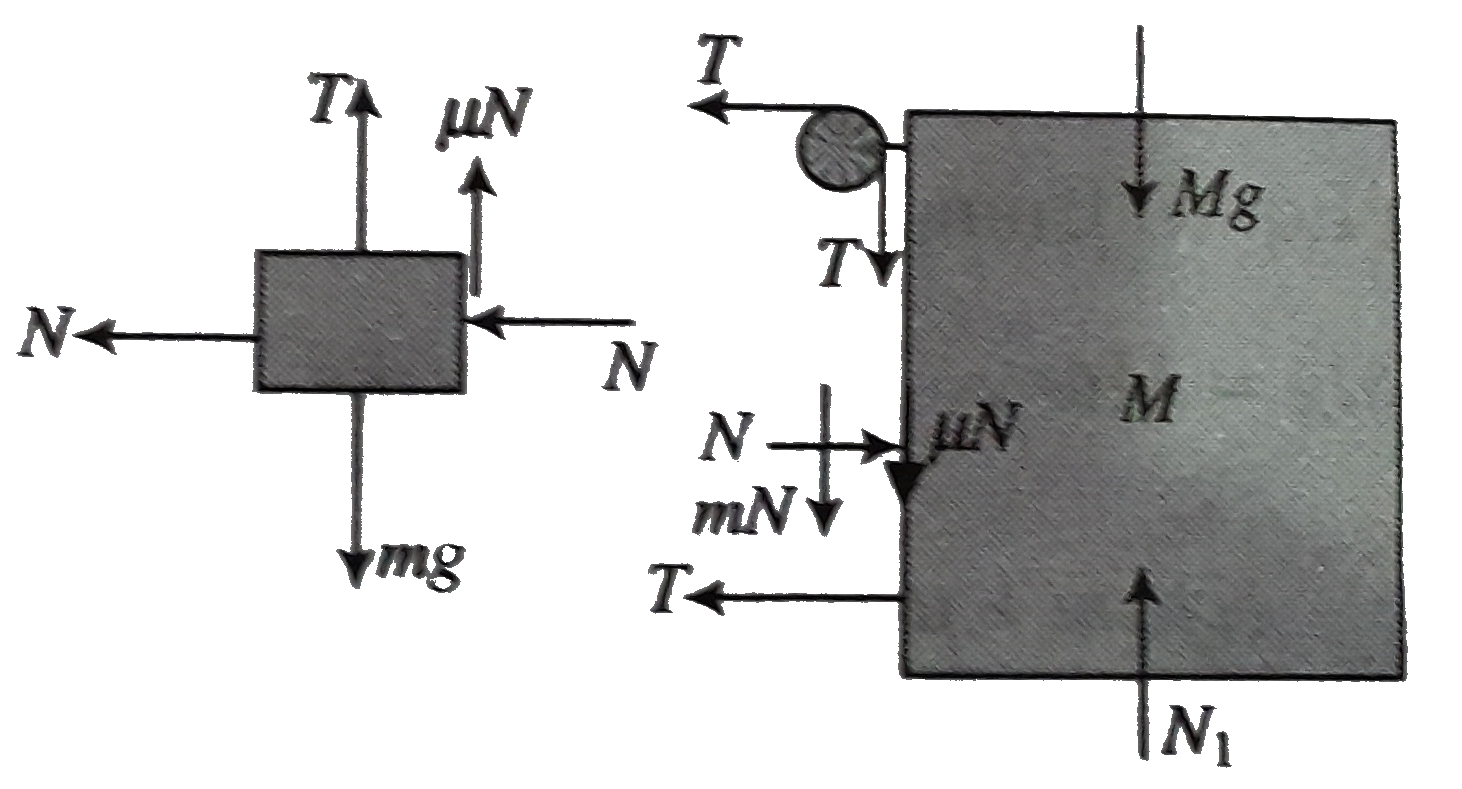 ` x = X rArroverset(..)x = overset(..)X rArr a_(x) = A_(x)` and `l_(1) - x + l_(2) + _(3) - x +l_(4) + y =l_(1) + l_(2) + l_(3) + l_(4)` where`l_(1), l_(2), l_(3), l_(4)`are the instantaneous length of the segments of the STRING `rArr 2x = y rArr 2 overset(..)x = overset(..)y rArr 2a_(x) = a_(y)` `N = ma_(x)` and `MG - mu N - T = ma_(y)` and `2T - N = MA_(x) = Ma_(x)` Eliminating `T,A` and `N` `a_(x) = (2mg)/(M + 5m + 2 mu m)` and`(4mg)/(M + 5m + 2 mu m)` `:. a = sqrt(a_(x)^(2) + a_(y)^(2)) = (2sqrt(5)mg)/(m + 5m + 2mu m)` |
|
| 22. |
Velocity - time graph for a body of mass 10 kg is shown in figure. Work - done on the body in first two seconds of the motion is : |
|
Answer» `-9300 J` |
|
| 23. |
A particle of mass m moving with velocity v_(0) collides with sphere of same mass at rest , as shown. If the surface of contact is smooth and the collision is elastic, find the velocities of particle and sphere after the collision. |
Answer» SOLUTION :The PARTICLE and SPHERE will perpendicular after the collision.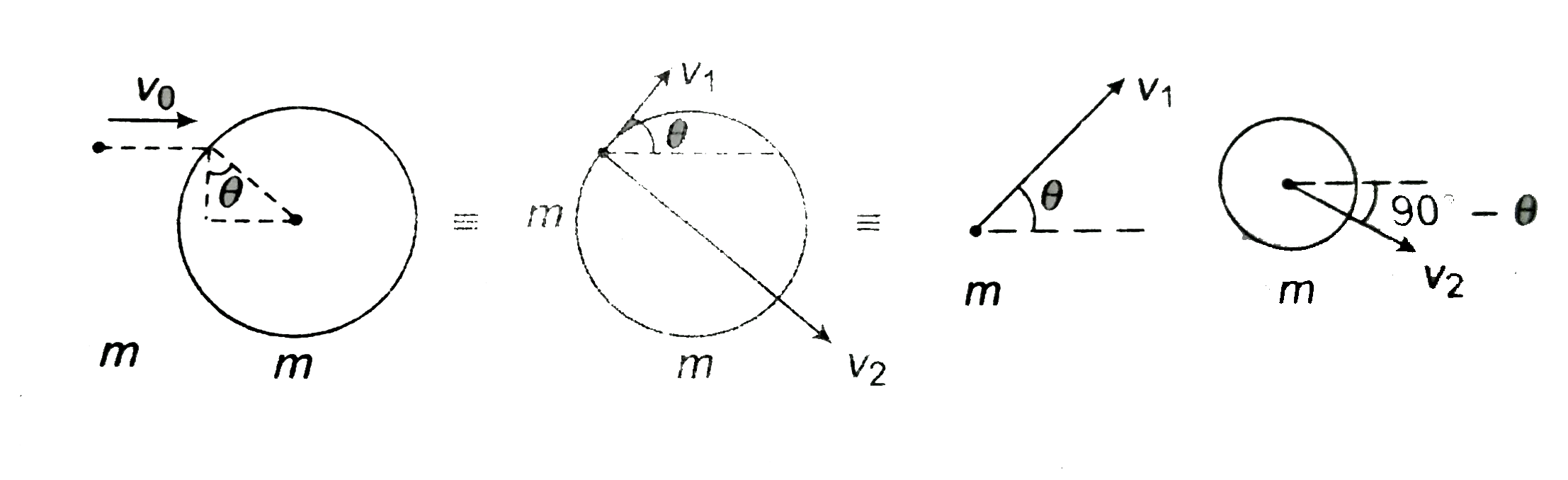 By the momentum conservation: x-ax is: `mv_(0) = mv_(1) cos theta + mv_(2) cos theta(90 - theta)` `v_(0) = v_(1) cos theta + v_(2) sin theta`(i) `y-ax is: mv_(1) sin theta - mv_(2) sin (90 - theta)` `0 = v_(1) sin theta - v_(2) cos theta` Solving (i) and (II), `v_(1) = v_(0) cos theta , v_(2) = v_(0) sin theta` `cos theta = (1)/(2) , sin theta = (sqrt(3))/(2)` `v_(1) = (v_(0))/(2) , v_(2) = (sqrt(3) v_(0))/(2)` 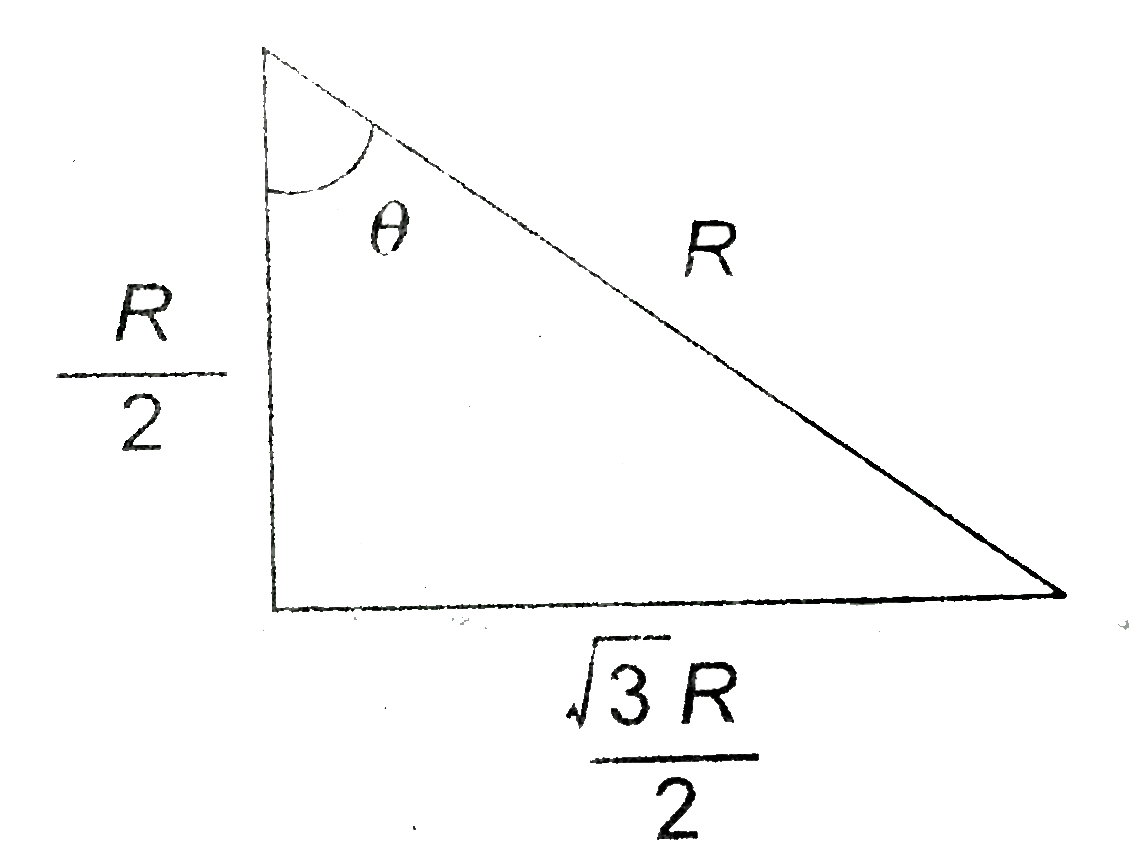
|
|
| 24. |
Assertion: Two point masses freely positioned at rest move under mutual gravitational force of attraction. Velocity of C.M. of the system is zero at any instant. Reason : Gravitational force of attraction is an internal force of the system |
|
Answer» Both Assertion and Reason are TRUE and Reason is the correct EXPLANATION of Assertion |
|
| 25. |
Using dimensional analysis show that 1N//m^(2)=10"dyne"//cm^(2). |
|
Answer» Solution :PRESSURE =Force /Area `=[ML^(-1)T^(-2)]n_(2)=n_(1)(M_(1)//M_(2))^(x)(L_(1)//L_(2))^(y)(T_(1)//T_(2))^(z)` From the two equations `x=1,y=-1,z=-2, M_(1)//M_(2)=1kg//g=1000` `L_(1)//L_(2)=100cm//CM=100,T_(1)//T_(2)=1, n_(2)=n_(1)(1000)^(1)(100)^(-1)XX(1)^(-2)=n_(1)xx10` `n_(1)=1, n_(2)=10,n_(1)N//m^(2)=n_(2)` dyne /`cm^(2)` i.e.`1N//m^(2)=10"dyne"//cm^(2)` |
|
| 26. |
A body is falling freely under the action of gravity alone in vacuum. Which of the following quantities remain constant during the fall? |
|
Answer» KINETIC energy |
|
| 27. |
A car is moving with a constant speed on a straight line. What is the net work done by the external force on the car? |
| Answer» Solution :SINCE there is friction between the tyres and the ROAD, work done by the EXTERNAL force is positive and is EQUAL to `"force" xx DISPLACEMENT`. If friction is not considered, work done = 0. | |
| 28. |
What is significant figures? |
| Answer» Solution :The significant FIGURES REFERS to the number of IMPORTANT single digits in the COEFFICIENT of an expression in scientific NOTATION. | |
| 29. |
A block A of mass 8 kg is placed on a frictionless horizontal table . A thread tied to it passes over a frictionless pulley and carries a body B of mass 2 kg at the other end . Find the acceleration of the system . Alsofind the tension in the thread . If the thread is cut into two and tied to the ends of a spring of forceconstant 1600N//m,Find the amount of stretching of the spring . Neglect the mass of thread and of spring (g=9.8 m//s^(2)). |
|
Answer» Solution :Figure (A) represents the ARRANGEMENT of the first part of the problem . Here `m_(1)=8 kg, m_(2)=2kg` If a is acceleration of system and T the tension in string ,  then we have for the motion of block B, `m_(2)g-T= m_(2)a`....(1) and for the motion of block A,`T=m_(1)a`....(2) (since WEIGHT `m_(1)g` is balanced by normal REACTION R) Adding (1) and (2) , we get `m_(2)g=(m_(1)+m_(2)) `a`:."acceleration " a= m_(2)/(m_(1)+m_(2))g`....(3) SUBSTITUTING this in (2) , we get, Tension , `T=(m_(1)m_(2))/(m_(1)+m_(2))g`....(4) In second part the spring is introduced and the arrangement is shown in figure (b). The spring is pulled byTension `T=(m_(1)m_(2))/(m_(1)+m_(2)) g` If X is the strtching of spring , then we have `T=Kx "(or) x=T/K =(m_(1)m_(2)g)/((m_(1)+m_(2))K)` substituting `m_(1) =8kg , m_(2)=2kg`, `K=1600N//m `in (3),(4) and (5) , we get acceleration `a=m_(2)/(m_(1)+m_(2))g=2/(2+8)xx9.8=1.96 m//s^(2)` Tension `T=(m_(1)m_(2))/(m_(1)+m_(2))g=(2xx8)/(2+8)xx9.8= 15.68N` and stretching `x=T/K=(15.68)/(1600)=0.0098m` |
|
| 30. |
1 mole of an ideal gas is contained in a cubical volume V, ABCDEFGH at 300K (Fig.) One face of the cube (EFGH) is made up of a material which totally absorbs any gas molecule in4ident on it. At any given time, |
|
Answer» the PRESSURE on EFGH WOULD be zero |
|
| 31. |
Two consecutive harmonics in stationary waves produced in a string of length 100 cm have frequencies 300 Hz and 400 Hz. It has maximum amplitude 10 cm. Obtain equation of stationary waves in this string when it oscillates with fundamental frequency. |
|
Answer» SOLUTION :We have `f _(n) = n f _(1)` `f _(n +1) = (n +1) f _(1)` ` therefore f _(n +1) 1 -f _(n) =nf _(1) + f _(1) - nf _(1)` `therefore 400 -300 =f _(1)` `therefore f _(1) = 100 Hz` `therefore omega _(1) = 2pi f _(1) = 200 pi rad//s` Also we have, `lamda_(n) = (2L)/(n)` `therefore lamda_(1) = (2 xx 100)/(1) = 200 cm` `therefore k _(1) = (2pi )/( lamda_(1)) = (2pi )/( 200) = (pi)/(100) (rad)/(cm)` Required EQUATION is, `y =-2 A SIN (k _(1) x ) COS (omega _(1) t )` `y =-10 sin ((pi )/(100 ) x) cos (200 pit)` |
|
| 32. |
Which of the following docs not characterize thethermodynamic state of matter |
|
Answer» VOLUME |
|
| 33. |
What is meso- scopic Physics? |
|
Answer» SOLUTION :Meso - scopic Physics deals with the PHENOMENA intermediate between microscopic and MACROSCOPIC DOMAINS. It deals with a few tens or hundreds of atoms. |
|
| 34. |
A ball is bouncing down a flight of stairs. The coefficient of restitution is e. The height of each step is d and the ball descends on step each bounce. After each bounce it rebounds to a height h above the next lower step. The width of step so that the impacts are effectively head - o n. Find the relationship between h and d. |
|
Answer» `H=(d)/(1-e^(2))` |
|
| 35. |
Masses 8,2,4,2 kg are placed at the corners A, B, C,D respectively of a square ABCD of diagonal 80cm. The distance of centre of mass from A is |
| Answer» ANSWER :B | |
| 36. |
A horizontal aluminium rod of diameter 4.8 cm remains projected 5.3 cm outwards from a wall. A load of 1200 kg is hung from the free end of the rod. If the modulus of rigidity of aluminium is 3 times 10^10 N.m^-2 and the mass of the rod is negligible , then calculate the shearing stress and normal displacement of the free end of the rod. |
|
Answer» Shearing strain, `theta=("DEPRESSION of the f ree end (d)")/("HORIZONTAL l eng th of the found" )`, Modulus of RIGIDITY, `n=S//theta`. So d can be found out] |
|
| 37. |
The pendulum of a certain clock has time period 2.04s. How fast or slow does the clock run during 24 hour ? |
|
Answer» 28.8 MINUTES SLOW |
|
| 38. |
The pulley arrangements shown in figure are identical, the mass of the rope being negligible. In case I, the mass m is lifted by attaching a mass 2m to the other end of rope with a constant downward force F = 2mg, where g is acceleration due to gravity. The acceleration of mass m in case I is |
|
Answer» zero `T=2mg` also `T-mg=ma^(1)` Finally ` ALT a^(1)` |
|
| 39. |
Which of the following statement is incorrect regarding significant figures? |
|
Answer» All the non-zero digits are significant |
|
| 40. |
The value of 117.4 x 0.0025 is |
|
Answer» 0.2935 |
|
| 41. |
A force vec(F)=5hat(i)-3hat(j)+2hat(k) moves a particle from vec(r_(1))=2hat(i)+7hat(j)+4hat(k) to vec(r_(2))=5hat(i)+2hat(j)+8hat(k). Calculate the workdone. |
|
Answer» 38 UNITS |
|
| 42. |
There is always an excess of pressure inside drops and bubbles. State true or false: "A drop of liquid under no external forces is always spherical in shape." |
|
Answer» |
|
| 43. |
The escape velocity from the surface of earth is v_e . The escape velocity from the surface of a planet whose mass and radius are 3 times those of the earth will be ........... |
|
Answer» `v_e` If the mass and RADIUS are 3 TIME those of the earth EVEN the escape velocity remain the same . |
|
| 44. |
The largest and the shortest distance of the earth from the sun are r_1and r_2respectively . Calculate the distance from the sun when it is at perpendicular distance to major axis of the orbit drawn from the sun |
|
Answer» SOLUTION :Since `e=(c)/a implies c = EA` `:.r_(1) = a + c = a + ea = a (1+e)` `r_(2) = a - c = a - ea - a (1-e) ` we have `r_1+r_2=2a and r_1-r_2 = a (1+e) - a (1-e) = 2ae` `implies e= (r_1-r_2)/(r_1+r_2)` we know that `SP + S^(1)P = 2a` `S^(1) P = 2a - SP = 2a - L = sqrt(L^(2)+(2ae)^2)` on simplification , `L = a (1-e^2)=a(1-e)(1+e)=a(r_1)/a(r_2)/a=(r_1r_2)/a` `=(r_1r_2)/((r_1+r_2)//2)"" L (2r_1r_2)/(r_1+r_2) ("or")2/L=1/r_(1)+1/r_2` |
|
| 45. |
A thin circular metal disc of radius 500.0 mm is set rotating about a central axis normal to its plane. Upon raising its temperature gradually, the radius increases to 507.5mm. The percentage change in the rotational kinetic energy will be |
|
Answer» `1.5 %` |
|
| 46. |
Which of the following statements is an incorrect statement?If M_(E) is the mass of the Earth,G - Gravitational constantR_(E) is the radius of the Earth andg is acceleration due to gravity the: |
|
Answer» gravitational field intensity is `E=-(GM_(E))/(m)VEC(r)` |
|
| 47. |
A particle of mass m moving with a speed v strikes a stationary particle of mass 2 m and sticks to it. The speed of the system after collision will be |
|
Answer» `v/2` |
|
| 48. |
int (dx)/(sqrt(2ax-x^(2)))= a^(n)sin^(-1)((x)/(a)-1) The value of n is |
|
Answer» 0 |
|
| 49. |
If g is acceleration due to gravity on the surface of the earth and R is radius of the earth, the height from which a body should be released so that it reaches the ground with velocity sqrt(gR//2) is |
| Answer» ANSWER :B | |