

Saved Bookmarks
This section includes 7 InterviewSolutions, each offering curated multiple-choice questions to sharpen your Current Affairs knowledge and support exam preparation. Choose a topic below to get started.
| 1. |
"norm" of the vector represents |
|
Answer» only MAGNITUDE |
|
| 2. |
If R is radius of the earth , the height above the surface of the earth where the weight of a body is 36% less than its weight on the surface of the earth is |
|
Answer» 4R/5 |
|
| 3. |
Two containers of sand S and H are arranged like the blocks figure (a) The container alone have negligible mass, the sand in them has a total mass M_("tot") , the sand in the hanging container H has mass m. You are to measure the magnitude a of the acceleration of the system in a series of experiments where m varies from experiment to experiment by M_("tot") does not, that is, you will shift sand between the containers before each trial m/(M_("tot")) is taken on the horizontal axis for all the plots. The curve which gives tension in the connecting string (taken on y-axis) as a function of ratio (m/M_("tot")) is: |
|
Answer» 1 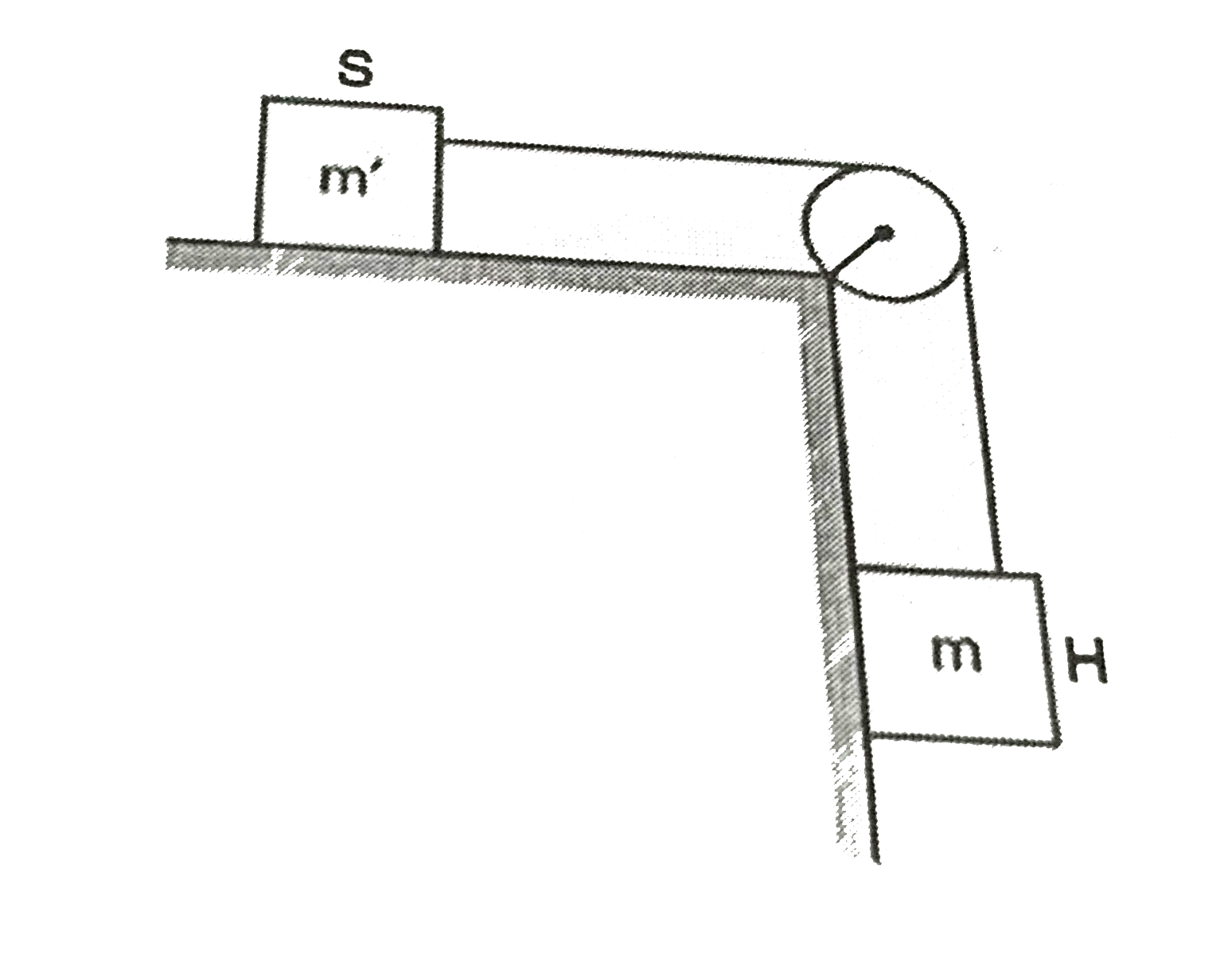 `mg-T=ma` …(i) `T-m'G=m'a` ….(II) ADDING (i) and (ii) `g(m-m')=a(m+m')` `g(m-m')=M_("TOTAL")+a` As `m+m' =M_("total")` So, `m'=(M_("total")-m)` |
|
| 4. |
A body is kept on the floor of a topless lift at rest. The lift starts descending at an acceleration 'a' then A) If a > g, the displacement of the body in a time 't' is 1/2 "gt"^2w.r.t ground. B) If a < g, the displacement of the body in a time 't' is 1/2 at^2w.r.t ground |
|
Answer» Both A & B are true |
|
| 5. |
A horizontal pipe line carries water in a streamline flow. At a point along the pipe where the cross-sectional area is 10 cm^(2) the velocity of water ist m/s and the pressure is 2000 Pa. What is the pressure at another section where the cross-sectional area is 5 cm^(2) ? |
|
Answer» <P> Solution : According to equation of continuity `A_(1)V_(1)=A_(2)V_(2),V_(2)=10//5xx1=2m//s`Now according to Bernouli,s equation ,`P_(1)+(1)/(2)rhoV_(1)^(2)=P_(2)+(1)/(2)rhoV_(2)^(2)` (horixonatial PIPE) `2000+(1)/(2)10^(3)(I)^(2)=O_(2)+(1)/(2)(10^(3))(2^(3)) THEREFORE P_(2)=500 pa` |
|
| 6. |
Match the technology in column A to its related scientific principle in column B |
|
Answer» 1-B, 2-d, 3-c, 4-a |
|
| 7. |
Find the magnitude and direction of the resultant of two vectors A and B in terms of theirmagnitudes and angle theta between them . |
|
Answer» Solution :Let OP and OQ represent two vectors A and B making an angle `theta` (Fig . 4.10) . Then , using the parallelogram method of vector addition , OS represents the resultant vector R: R = A+B SN is normal to OP and PM is normal to OS . From the geometry of the figure, `OS^(2)=ON^(2)+SN^(2)` but`ON=OP+PN=A+Bcostheta` `SN=BSINTHETA` `OS^(2)=(A+Bcostheta)^(2)+(Bsintheta)^(2)` or , `R^(2)=A^(2)+B^(2)+2ABcostheta` `R=sqrt(A^(2)+B^(2)+2ABcostheta)` In `DeltaOSN SN =OS sinalpha=Rsinalpha,and` in `DeltaPSN,SN=PSsintheta=Bsintheta` Therefore ,` R sinalpha=Bsintheta` or`(R)/(SINTHETA)=(B)/(sinalpha)` similarly `PM=Asinalpha=Bsinbeta` or `(A)/(sinbeta)=(B)/(sinalpha)` or Combining Eqs . (4.24b) and (4.24c),we GET `(R)/(sintheta)=(A)/(sinbeta)=(B)/(sinalpha)` Using EQ . (424a). or , `tanalpha=(SN)/(OP+PN)=(Bsintheta)/(A+Bcostheta)` Equation (4.24a) gives the magnitude of the resultant and Eqs . (4.24e) and (4.24f) its direction.Equantion (4.24a) is KNOWN as the Law of cosines and Eq . (4.24d) as the Law of sines. 
|
|
| 8. |
Which principle of conservation can explain the flight of a rocket? |
| Answer» Solution :Flight of a ROCKET can be explained by the the principle of conservation of momentum. The initial momentum of the rocket, along with its fuel, is zero. The burnt fuel is EJECTED backwards through a HOLE, with some momentum. This momentum should be cancelled by an equal and OPPOSITE momentum, so that the NET momentum is still zero. this requirement for an equal and opposite momentum is responsible for the forward motion of the rocket. | |
| 9. |
A pendulum has time period T for small oscillations. An obstacle P is situated below the point of suspension O at a distance 3l//4 . The pendulum is released from rest. Throughout the motion the moving string makes small angle with vertical. Find the time after which the pendulum returns back to its initial position. |
|
Answer» Solution :After P LENGTH of pendulum becomes `(1)/(4)` Now as `T prop SQRT(L)` , So after P time PERIOD will become `T^(1)= T//2`. Therefore, the DESIRED time will be : `t= (T)/(2)+ (T)/(2)= (T)/(2)+ (T)/(4)= (3T)/(4)` |
|
| 10. |
Using orbital radius r and the corresponding periodic time T of different satellite revolving around a planet, what would be the slope of graph of log T rarrlog r ? |
|
Answer» `3/2` `T = kr^(3/2 )` where `k = (4pi2)/(GM)`constant `:. logT = logk +3/2` logr comparing this equation with y = c + nxslope `m = 3/2` |
|
| 11. |
ab and bc curves in the figure represent an isothermal and an adiabatic process respectively. Show that at the point b the ratio of the slopes of isothermal and adiabatic curves is equal to C_P/C_V. |
|
Answer» Solution :For an adiabatic PROCESS `PV^gamma` =CONSTANT `THEREFORE P_gamma V^(gamma-1) dV+V^gamma dP=0` `therefore (P_gamma V^gamma)/V dV+V^gamma dP=0` `therefore dP=-P_gamma/V dV` `therefore ("dP"/"dV")_"adiabatic"=-gamma P/V`….(1) For an ISOTHERMAL process PV = constant, `therefore VdP+PdV=0` `therefore ((dP)/(dV))_"isothermal"=-P/V` ...(2) `("dP"/"dV")_"adiabatic"/("dP"/"dV")_"isothermal"=(-gamma P/V)(-V/P)=gamma=C_P/C_V` |
|
| 12. |
A block of mass m is pulled by a constant power P placed on a rough horizontal plane. The coeficient of friction between the block and surface is mu. Find the maximum velocity of the block. |
|
Answer» Solution :Power`""` P=F.V=constant `F=(P)/(v) " or "Fprop(1)/(v)` as v increases, F decreases. when `F=mumg`, net force on block BECOMES zero, i.e., it has MAXIMUM or terminal velocity `:. P=(mumg)v_(max) " or "v_(max) " or " v_(max)=(P)/(mumg)` |
|
| 13. |
Angular momentum is associated with |
|
Answer» ROTATIONAL MOTION |
|
| 14. |
Which one of the following statement is a correct statement When two surfacesare coated with a lubricant thenthey |
|
Answer» stickto each other |
|
| 15. |
All particles of a body are situated at a distance R from the origin. The distance of centre of mass of the body from the origin is |
|
Answer» `=R` |
|
| 16. |
Imagine a light planet is revolving round a very masstive star in a circular orbit of radius R with a time period of revolutionT. If the gravitiational force of attraction between the star andplanets propostional to R^(-n), then T^(2) is propostional to |
|
Answer» `R^(n+1)` |
|
| 17. |
The acceleration due to gravity at the latitude 45^(@) on the earth becomes zero if the angular velocity of rotation of earth is equal to |
|
Answer» `SQRT((2)/(GR))` |
|
| 18. |
The speed (v) of ripples on surface of water depends upon the surface tension (sigma)density rhoand wave length (lamda) the speed v is proportional to |
|
Answer» `((SIGMA)/(RHO LAMDA))^(1//2)` |
|
| 19. |
A uniform tube closed at one end contains some air confined by a mercury thread of length 15 cm. When the tube is held vertically,with the open end at the top,the air column is 10 cm long at 27^@C. IF the tube is inverted, the length of the air column becomes 15 cm. At what temperature will the air column be 20 cm long in its inverted position. |
|
Answer» |
|
| 20. |
Given veca+vecb+vecc+vecd=vec0.Show that : the magnitude of (veca+vecc) equals the magnitude of (vecb+vecd) |
|
Answer» |
|
| 21. |
Three particles of masses 1g, 2g and 3g are at distances of 1 cm, 2 cm and 3 cm from the axis of rotation. Find (i) the moment of inertia of the system and (ii) the radius of gyration of the system. |
|
Answer» SOLUTION :(i) The MI of the system, `I=m_(1)r_(1)^(2)+m_(2)r_(2)^(2)+m_(3)r_(3)^(2)` `= 1xx1^(2)+2xx2^(2)+3xx3^(2)` `= 1+8+27=36g cm^(2)` (ii) The radius of gyration, `K=sqrt((I)/("Total mass"))=sqrt((36)/(1+2+3))=sqrt(6)=2.449 cm`. |
|
| 22. |
In the flow ofa viscous liquid over a flat horizontal surface, the velocity is 0.25 cm/sec at 20 mm distance above the flat surface at rest. What is the velocity gradient |
|
Answer» 0.0625 /sec |
|
| 23. |
A boy is projected from a point with different angles of projection 20^(@), 35^(@), 45^(@),60^(@) with the horizontal but with the same initial speed. Their respective horizontal ranges are R_(1), R_(2), R_(3) and R_(4). Identify the correct order in which the horizontal ranges are arranged in increasing order |
|
Answer» `R_(1), R_(4), R_(2), R_(3)` |
|
| 24. |
A small mass m is moved slowly from the surface of the earth to a height h above the surface. The work done (by an external agent) in doing this is a) mgh, for all values of h b) mgh, for h lt lt R c)1/2 -mgR,for h = R d)-1/2 mgR , for h = R |
|
Answer» only a & B are TRUE |
|
| 25. |
2kg ice block should be dropped from .x km.height to melt completly. The 8 kg ice should be dropped from a height of |
|
Answer» ` 4xx KM` |
|
| 26. |
The glass windows of a room have a total area of 5m^(2) and glass thickness is 3mm. Calculate the rate at which heat escapes from the room per minute by conduction when the inside of the windows is at a temperature 15^(@) C and the outside temperature is -10^(@)C. Thermal conductivity =0.84 "Wm"^(-1) "K"^(-1). |
|
Answer» |
|
| 28. |
How does rise in temperature effect (i) viscosity of gases (ii) viscosity of liquids ? |
| Answer» SOLUTION :VISCOSITY of GASES INCREASES while viscosity of liquid DECREASES. | |
| 29. |
A ball is projected horizontal with a speed v from the top of a plane inclined at an angle45^(@) with horizontal. How far from the point of projection with the hall strike the plane? |
|
Answer» `(v^(2))/(g)` |
|
| 30. |
A body of mass 8 kg is moved by a force F=3x N, where x is the distance covered . Initial position is x=2m and final position is x - 10m . If initialy the body is at rest , find the final speed . |
|
Answer» SOLUTION :`F=ma:F=m.(DV)/(DT)` `3x=m.(dv)/(dx).(dx)/(dt) ,3x=8.(dv)/(dx)v,3x dx =8v dv` `3int_(2)^(10) X dx = 8int_(0)^(v) v dv , 3[(x^(2)/2]_(2)^(10)=8[v^(2)/2]_(0)^(v) ,3[100-4] =8v^(2), v^(2)=(3xx96)/8=36, v=6 m//s` |
|
| 31. |
Read each statement below carefully and state with reasons and examples, if it is true or false , A particle in one-dimensional motion (a) with zero speed at an instant may have non-zero acceleration at that instant (b) with zero speed may have non-zero velocity, (c) with constant speed must have zero acceleration, (d) with positive value of acceleration must be speeding up. |
| Answer» Solution :(a) True,, (b) FALSE, (C) True (if the particle rebounds INSTANTLY with the same speed, it IMPLIES infinite acceleration which is unphysical), (d) False (true only when the chosen positive direction is along the direction of motion) | |
| 32. |
In the system as shown infigure, the blocks have masses m_(1) and m_(2), the spring constant is k, coefficient of friction between the block of mass m_(1) and the surface is mu. The system is released with zero initial speed from the position where the spring is in its natural length. |
|
Answer» The maximum POSSIBLE speed of the blocks is `G(m_(2)-mum_(1))/(sqrt(K(m_(1)+m_(2))))` |
|
| 33. |
How will you distinguish between a hard boiled egg and a raw egg by spinning it on a table top? |
| Answer» SOLUTION :For same EXTERNAL TORQUE, angular acceleration of raw egg will be SMALL than that of Hard BOILED egg | |
| 34. |
A particle moves along circle of radius ((20)/(pi)) m with constant tangential acceleration. If the speed of the particle is 80 m//s at the end of the second revolution after motion has begun, the tangential acceleration is |
|
Answer» `160 pi m//s^(2)` |
|
| 35. |
Explain why bullets of gun are cylinder in shape ? |
| Answer» Solution :SPINNING cylinder moves in STRAIGHT path in the direction of its rotational axis ,so MAGNUS effect cannot be oberved and hence cylinder is not deviated from its original path .For this reason BULLETS of gun are cylinder in shape. | |
| 36. |
A spherical ball A of mass 4 kg, moving along a straight line strikes another spherical ball B of mass 1 kg at rest. After the collision, A and B move with velocities v_1 ms^(-1) and v_2 m s^(-1) respectively making angles of 30^@and 60^(@) with respect to the original direction of motion of A. The ratio (v_1)/(v_2) will be |
|
Answer» `(sqrt3)/(4)`  Applying the law of CONSERVATION of linear momentum ALONG a direction perpendicular to the direction of MOTION (i.e., along y -AXIS) , we get `0 + 0 = 4v_1 sin 30^@ - v_2 sin 60^@` `(v_1)/(v_2) = (sin 60^@)/(4 sin 30^@) = (sqrt3)/(4)`. |
|
| 37. |
{:("Column-I","Column-II"),("A) Thermal expansion","P) Pendulum clock"),("B)" alpha"," beta "," gamma,"Q) Depends, on dimensions Material Temperature"),("C) Bimetallic strip","R) Depends on nature of the material only"),("D) lnvar steel","S) Balance wheel of a watch"):} |
|
Answer» |
|
| 38. |
The pitch of a screw guage is 1 mm and there are 100 divisions on the circular scale. While measuring diameter of a thick wire, the pitch scale reads 1 mm and 63rd division on the circular scale coincides with the reference. The length of the wire is 5.6 cm. Then |
|
Answer» The LEAST COUNT of SCREW guage is 0.001 mm |
|
| 39. |
To construct a barometer, a tube of length 1 m is filled completely with mercury and is inverted in a mercury cup. The barometer reading on a particular day is 76 cm. Suppose a 1 m tube is filled with mercury up to 76 cm and then closed by a cork. It is inverted in a mercury cup and the cork is removed. The height of mercury column in the tube over the surface in the cup will be |
| Answer» ANSWER :D | |
| 40. |
10 litres of hot water at 70^(@)C is mixed with an equal volume of cold water at 20^(@)C. Find the resultant temperature of the water. (Specific heat of water = 4200 J/Kg K) |
|
Answer» Solution :Resultant TEMPERATURE, t = `(m_(1)s_(1)t_(1)+m_(2)s_(2)t_(2))/(m_(1)s_(1)+m_(2)s_(2))`. Here, `m_(1)=m_(2)=10kg`, since mass of 1 litre of water is 1 kg. `t_(1)=70^(@)C,t_(2)=20^(@)C` and `s_(1)=s_(2)=4200J//kgK` `t=(10xx4200xx70+10xx4200xx20)/(10xx4200+10xx4200)=45^(@)C`. |
|
| 41. |
For a damped oscillation of a particle, show that time taken for the amplitude to drop to half of its initial value =(2m ln (2))/(b), where b is a damping constant. |
|
Answer» SOLUTION :Instantaneous displacement of a PARTICLE `=x(t)=Ae^(-bt//2m)COS(OMEGA^(1)t+phi)` Taking `cos(omega.t+phi)=1" for "omega.t+pi=0 and x(t)=(A)/(2)` We get`""(A)/(2)=(A)/(e^(bt//2m))i.e. e^(bt//2m)=2` `therefore""t=(2.303log2)(2m)/(b)=(2m ln 2)/(b)` |
|
| 42. |
Law of conservation of linear momentumis applicable even in those cases where: |
|
Answer» NEWTON's I LAW of MOTION does not hold good |
|
| 43. |
In slipping the rotational motion is …………….than the translation motion. |
|
Answer» constant |
|
| 44. |
The absolute temperature of a gas increases 3 times. The root mean square velocity of the molecules will become |
|
Answer» 3 TIMES |
|
| 45. |
One mole of a gas is made to undergo a process in which its temperature varies as T=aV^(2)-bV^(3) where a and b are constants. Find maximum pressure of the gas. |
|
Answer» |
|
| 46. |
A solid cube is placed on rough horizontal surface. The coefficient of friction between them is mu, where mu = lt 1//2. A variable horizontal force is applied on the cub's upper face perpendicular to one edge and passing through mid point of that edge. The maximum acceleration with which it can move without toppling is [Acceleration due to gravity 'g'l |
|
Answer» `MUG` |
|
| 47. |
Two objects of masses m_(1) and m_(2) fall from the heights h_(1) and h_(2) respectively. The ratio of the magntidue of their momenta when they hit the ground is |
|
Answer» `sqrt((h_(1))/(h_(2)))` |
|
| 48. |
Find the acceleration of center of mass of the blocks of masses m_(1) and m_(2) (m_(1)gt m_(2)) in Atwood's machine : |
|
Answer» Solution :We KNOW from Newton.s laws of motion MAGNITUDE of acceleration of each block is `a=((m_(1)-m_(2))/(m_(1)+m_(2)))g` Now acceleration of their C.M is `a_(cm)=(m_(1)a+m_(2)(-a))/(m_(1)+m_(2))=((m_(1)-m_(2))/(m_(1)+m_(2)))a` `a_(cm)=((m_(1)-m_(2))/(m_(1)+m_(2)))((m_(1)-m_(2))/(m_(1)+m_(2)))g` `therefore` ACCLERATION of centre of MASS `a_(cm)=((m_(1)-m_(2))/(m_(1)+m_(2)))^(2)g` 
|
|
| 49. |
Which of the following is not a scalar? |
|
Answer» viscosity |
|
| 50. |
A boy recalls the relation for relativistic mass (m) in terms of rest mass (m_(0)) velocity of particle v, but forgets to put the constant c (velocity of light). He writes m= (m_(0))/((1-v^(2))^(1//2)) correct the equation by putting the missing 'c'. |
|
Answer» SOLUTION :SINCE quantities of similar NATURE can only be added or subtracted, `v^(2)` cannot be subtracted from 1 but `v^(2) // C^(2)` can be subtracted from 1 . `:. m = (m_(0))/(SQRT(1-v^(2)//c^(2)))` |
|