

Saved Bookmarks
This section includes 7 InterviewSolutions, each offering curated multiple-choice questions to sharpen your Current Affairs knowledge and support exam preparation. Choose a topic below to get started.
| 1. |
The acceleration due to gravity at the poles is 10ms^(-2)and equitorial radius is 6400km for the earth. Then the angular velocity of rotation of the earth about its axis so that the weight of a body at the equator reduces to 75% is |
|
Answer» `1/(1600) "rads"^(-1)` |
|
| 2. |
The value of acceleration due to gravity is maximum at the …………..(1)poles(2)equator(3)centre of the earth |
|
Answer» poles |
|
| 3. |
A circular platform is mounted on a vertical frictionless axle. Its radius is r=2m and its moment of inertia is I=200kg-m^(2). It is initially at rest. A 70kg man stands on the edge of the platform and begins to walk along the edge at speed V_(0)=1.0 m/s relative to the ground. Find the angular velocity of the platform. |
|
Answer» Solution :ANGULAR momentum of man `=` angular momentum of PLATFORM in OPPOSITE direction or `mv_(0)r=Iomega` `omega=0.7`rad/s |
|
| 4. |
A hammer of mass 1 kg strikes on the head of a nail with a velocity of 2 ms^(-1). It drives the nail 0.01 m into a wooden block. Find the force applied by the hammer and the time of impact. |
|
Answer» `200 N , 10^(-2)sec`. |
|
| 5. |
A ball falls towards the earth. Which of the following is correct ? |
|
Answer» if the SYSTEM contains BALL, the momentum is conserved |
|
| 6. |
By explaining different scales of temperature write the equation of their relation. |
|
Answer» Solution :In general, CELSIUS and Fahrenheit are famous temperature scales. (1) Celsius scale : If the temperature on the Celsius scale is represented by `T_(C)` and on the Kelvin scale, temperature is denoted by T, then `T_(C)=T-273.15^(@)` Where `T_(C)` = temperature in Celsius scale and T = temperature in Kelvin scale. Temperature of triple point of water on Celsius scale becomes, `T=273.16^(@)-273.15^(@)` `=0.01^(@)C` In this scale temperature is considered as `100^(@)C` when equilibrium is achieved between pure water and its vapour at atmospheric pressure, its value in Kelvin scale, `T=100+273.15=373.15K` (2) Fahrenheit Scale : Relation between Temperature on Fahrenheit scale `T_(" F")^(@)` and Celsius scale `T_(" C")^(@)` is : `T_(" F")^(@)=9/5T_(" C")^(@)+32^(@)C` If boiling point and freezing point is in one temperature scale then it can easily shown in ANOTHER scale. In figure Kelvin, Celsius and Farheheit scales are compared.  To REPRESENT the temperature in Celsius and Fahrenheit scales, the letter C and F used respectively such as, `0" "^(@)C=32" "^(@)F` NEGATIVE temperature in Kelvin scale is not possible for any substance because absolute zero temperature is LOWEST temperature on kelvin scale. |
|
| 7. |
A smll block of mass m slides along a smooth track as shown in the fig. (i) If it starts from rest at P, what is the resultant force acting on it at Q? (ii) At what height above the bottom of the loop should the block be released so that the force it exerts against the track at the top of the loop equals its weight? |
|
Answer» Solution :By conservation of mechanical energy between points P and Q. `mg (5R) = mgR + (1)/(2) mv^(2)` Now is case of circular motion, N(or T) `= (mv^(2))/(R ) + mg cos theta` And as at Q, `theta = 90^(@)`  `N=(mv^(2))/(R)=(m(8gR))/(R)=8mg` So resultant force on m at Q. `F=sqrt((8mg)^(2)+(mg)^(2))=(sqrt(65))mg`(ii) At highest point `N = (mv^(2))/(R) - mg` `(as theta = 180^(@))` But according to GIVEN PROBLEM N = mg `so(mv^(2))/(R)=mg+mg,i.e, v=sqrt(2gR)` If for achieving it h the height, by conservation of mechanical energy again `MGH.=(1)/(2)mv^(2)+mg(2R)` `orh.=2R + (v^(2))/(2g)=2R+(2gR)/(2g)=3R` |
|
| 8. |
For aluminium, the bulk modulus and modulus of rigidity are 7.5xx10^(10)N//m^(2) and 2.01xx10^(10)N//m^(2) respectively. Find the velcoity of longitudinal and transverse wave in the medium. Given desity of aluminium is 2.7xx10^(3)kg//m^(3). |
|
Answer» Solution :Here, `K=7.5xx10^(10)N//m^(2)`, `eta=2.1xx10^(10)N//m^(2),` `rho=2.7xx10^(3)kg//m^(3).` velocity of longitudinal WAVES in SOLIDS `v=sqrt((K+(4)/(3)eta)/(rho))` `=sqrt((7.5xx10^(10)+(4)/(3)xx2.1xx10^(10))/(2.7xx10^(3)))` `=sqrt((10.3xx10^(10))/(2.7xx10^(3)))=6.18xx10^(3)m//s` And, velocity of transverse waves in solids `v=sqrt((eta)/(rho))=sqrt((2.1xx10^(10))/(2.7xx10^(3)))=2.7xx10^(3)m//s` |
|
| 10. |
A body of mass 5kg has linear momentum of 20 kgm/s. If a constant force of 5N acts on its in the direction of its motion for 10 s. The change in kinetic energy of the body is |
|
Answer» 320 J |
|
| 11. |
An astronaut orbiting in a spaceship round the earth , has centripetal acceleration2.45m//s^2 Find the height of the spaceship . (Take R=6400 km) |
|
Answer» Solution :As centripetalacceleration equals to acceleration due to gravity at that gravity at that height , then `a=g_h=(GM)/r^2=(GM)/(R+h)^2 =(gR^2)/(R+h)^2` `rArr a=(gR^2)/(R+h)^2 =(R/(R+h))^2 = a/g =2.45/9.8=1/4` `rArr R/(R+h)=1/2 rArr R+h=2R ` R=h=6400 KM `THEREFORE` SPACESHIP is at a height 6400 km. |
|
| 12. |
A body is uniformly rotating about an axis fixed in an interial frame of reference . Let vecA be a unit vector along the axis of rotation and vecB be the unit vector along the resultant force on a particle P of the body away from the axis. The value of veca.vecB is |
| Answer» Answer :C | |
| 13. |
Passage - I : When the force F is applied the body may topple about A or it may translate. If the block be a cube of edge a and mu=0.2 then |
|
Answer» The BODY will TRANSLATE |
|
| 14. |
Length AB in the figure shown in 5 m. The body is released from A. Friction issufficient for pure rolling to take place. In the above case suppose we have four bodies ring, disc, solid sphere and hollow sphere. The angle theta is now gradually increased. Which body will start slipping very fast. All the bodies have same mass and radius. Coefficient of friction is also same ? |
|
Answer» Ring |
|
| 15. |
Length AB in the figure shown in 5 m. The body is released from A. Friction issufficient for pure rolling to take place. The maximum time which anybody (which can roll) can take to reach the bottom is |
|
Answer» 8 s |
|
| 16. |
Which of the following expressions corresponds to simple harmonic motion along a straight line, where x is the displacement and a,b,c are positive constants ? |
|
Answer» `BX^(2)` |
|
| 17. |
Explain in detail the isochoric process. |
| Answer» SOLUTION :It is a THERMODYNAMIC process which occurs at a CONSTANT volume. | |
| 18. |
If vecAandvecB are two vectors which are acting along x,y respectively, then vecAxxvecB lies along |
|
Answer» x |
|
| 19. |
A rod PQ of mass M and length L is hinged at end P. The rod is kept horizontal by a massless string tied to point Q as shown in figure. When string is cut, the intial angular acceleration of the rod is |
|
Answer» `(3g)/(2L)` 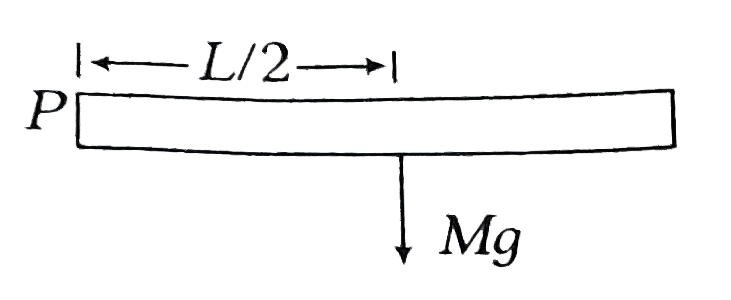 Torque on the rod = Moment of weight of the rod about P, `tau = "Mg" (L)/(2)` ….(i) `because` Moment of INERTIA of rod about P, `I = (ML^(2))/(3)` ….(ii) As `tau = I alpha` From Eqs. (i) and (ii), we GET `"Mg"(L)/(2)=(ML^(2))/(3)alpha` `:.` The initial angular acceleration of the rod `alpha = (3g)/(2L)` |
|
| 20. |
A uniform rod of length l is held vertically on a horizontal floor fixing its lower end, the rod is allowed of fall onto the ground. Find (i) its angular velocity at that instant of reaching the ground (ii) The linear velocity with which the tip of rod falls to floor. |
|
Answer» Solution :(i) The rod rotates about an axis through one end. From the principle of conservation of mechanical ENERGY. Loss of P.E of the rod is EQUAL to its gain in rotational K.E. `:.mg(1)/(2)=(1)/(2)OMEGA^(2)` `impliesmg(1)/(2)=(1)/(2).(mI^(2))/(3)omega^(2)` on solving `omega=SQRT((3g)/(L))`  (ii) `V=romega` or `V=Iomega=Isqrt((3g)/(l))=sqrt(3gl)` |
|
| 21. |
The dimensional formula of Planck's constand h is |
| Answer» Answer :A | |
| 22. |
Give two examples of dimensionless variables. |
| Answer» SOLUTION :STRAIN and REFRACTIVE INDEX. | |
| 23. |
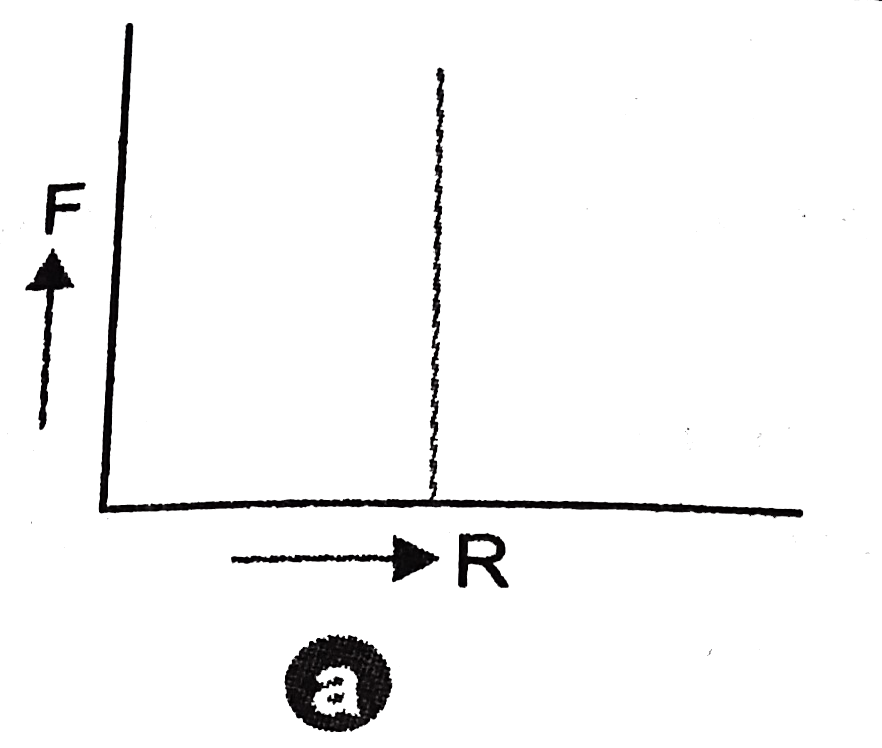
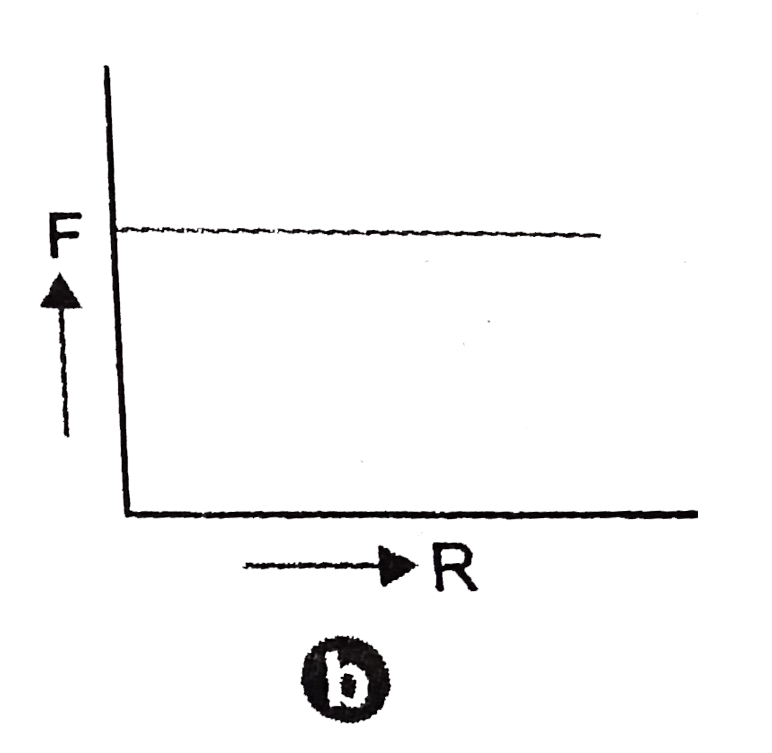
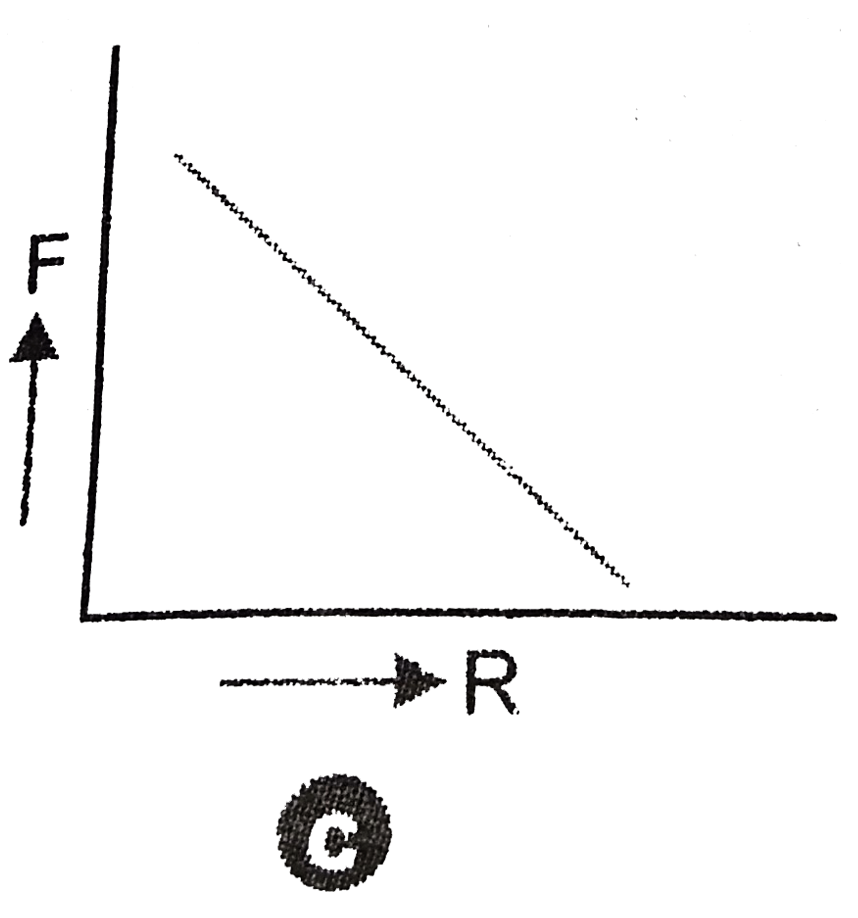
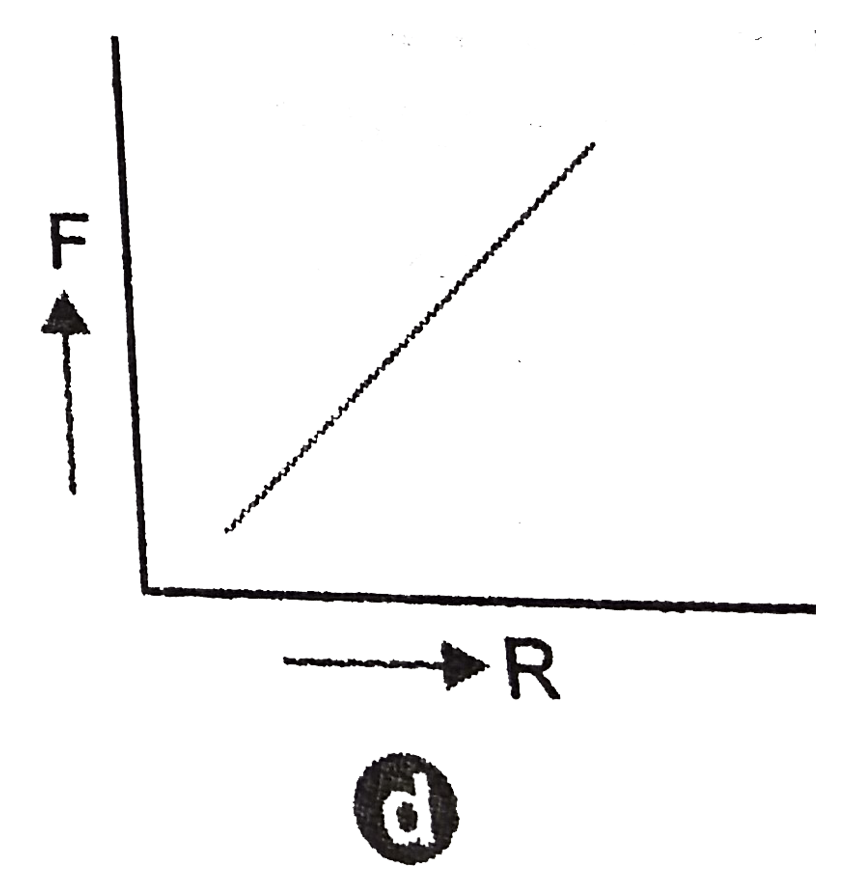
In a laboratory experiment four students plotted graphs between force of limitingfriction (F) and normal reaction (R) Which one is correct . |
|
Answer» |
|
| 24. |
A wire of length 60 cm is bent into a circle with a gap of 1 cm at its ends. On heating it by 100^(@) C. the length of the gap increases to 1.02 "cm".alpha of material of wire is |
|
Answer» `2 xx 10^(-4) //^(@) C` |
|
| 25. |
Apiece of metal weighs 46 gin air. When it is im mersed in a liquid of specific gravity 1.24 " at " 27^(@)C, it weighs 30 g. When the temperature of the liquid is raised to 42^(@)C, the metal piece weighs 30.5 g. Specific gravity of liquid at 42^(@)C is 1.2. Calculate the coefficient of linear expansion of the metal. |
|
Answer» Solution :Loss of weight of a body at `27^(@) C = 46 - 30 = 16 g ` Loss of weigth of body at `42^(@) C = 46 - 30.5= 15.5 ` g If V is the valume of body at `27^(@)` C , volume at `42^(@) C (V^(1)) = V (1 + gamma_(S) t )` `V^(1) = V (1 + gamma_(s)) ` where `gamma_(s)` is the volume coefficient of expansion of solid. Since loss of weigth of body = weight of the liquid displaced = `Vd_(j) g ` We have 16 = VD { d = DENSITY at `27^(0)` C } 15.5 = `V^(1) d^(1) {d^(1) = "density at " 42^(0) C }` `(16)/(15.5) = (V)/(V^(1)).(d)/(d^(1)) " or " (32)/(31) = (V)/(V^(1)) .(d)/(d^(1))` or `(32)/(31) = (1)/(1 + 15_(gamma_(s))) xx (31)/(30)` `rArr 1 + 15 gamma_(s) = (31)/(30) xx (31)/(32) = (961)/(960)` `15 gamma_(s) = (961)/(960) -1 = (1)/(960)` `gamma_(s) = (1)/(960) xx (1)/(15)= 3 alpha_(s) , " where " alpha_(s)` is the linear coefficient of expansion of solid. `alpha_(s) = (1)/(960 xx 45) = 0.000024 xx 10^(-5)`/R |
|
| 26. |
An airplane is observed by two observers traveling at 60 km h^-1 in two vehicles moving in opposite directions on a straight road. To an observer in one vehicle, the plane appears to cross the road track at right angles while to the other appears to be 45^@. At what angle does the plane actually cross the road track and what is its speed relative to ground ? |
|
Answer» In case (i), `vec v_(P_1) = vec v_p - vec v_1` `vec v_P = vec v_(P_1) + vec v_1` Vector diagram is shown in (Fig. S5.46). Note that according to observer in car `1`, the plane crosses the road at right ANGLES. Similarly, in case `2 vec v_P = vec v_(p_2) + vec v_2` We can combine (Figs S5.45) (a) and (S5.45) (B), `tan 45^@ = (AC)/(AB)` `v_(P_1) = (v_1 + v_2) tan 45^@ = 120 xx 1 = 120 km h^-1` `v_p = [60^2 +120]^(1//2) = 134.16 km h^-1` `tan theta = (v_(P_1))/(v_1) = (120)/(60) = 2` Hence, `theta = tan^-12`. 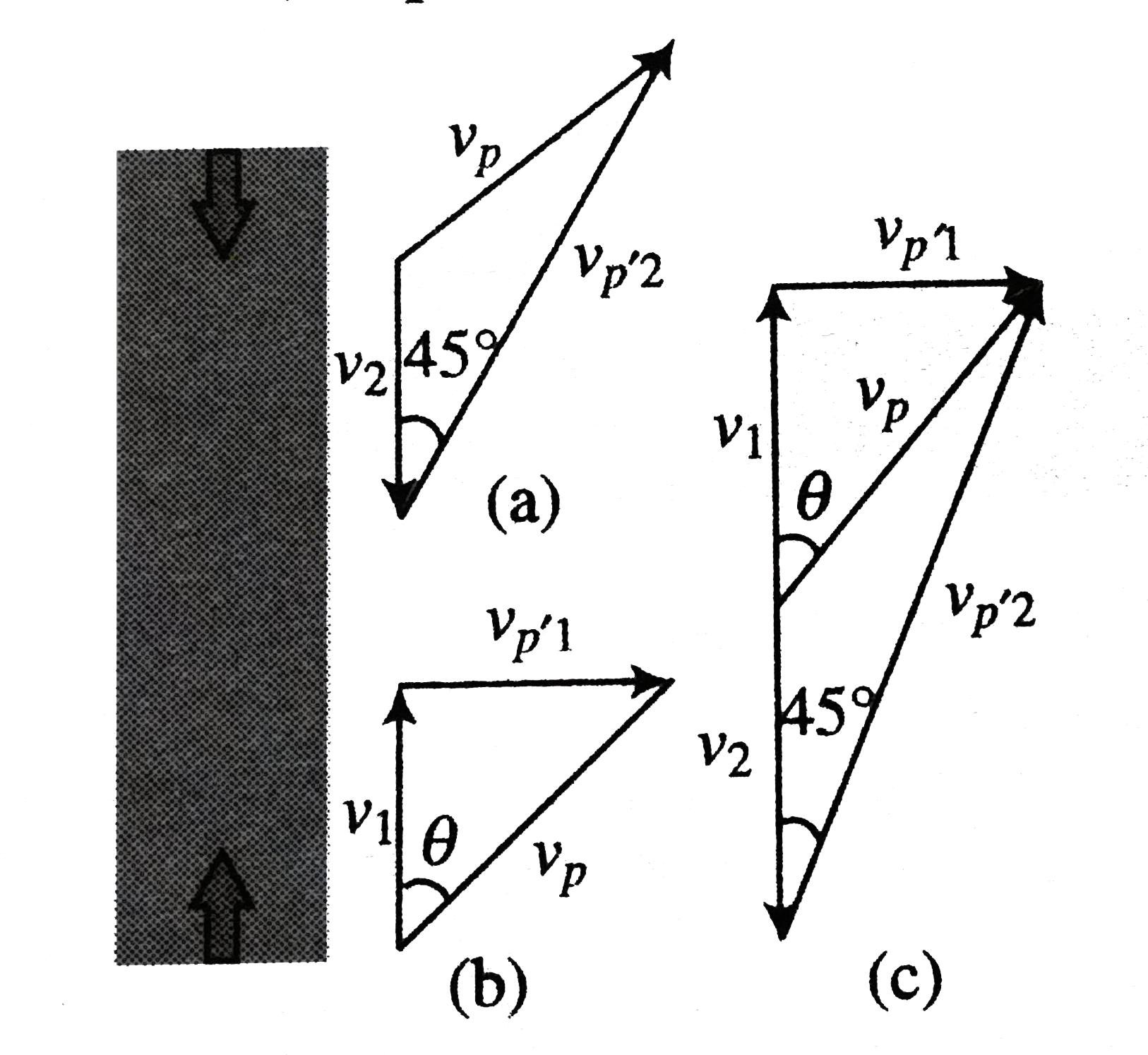 , ,  . .
|
|
| 27. |
The top of a lake is frozen. Air in contact is at - 15°C. What do you expect the maximum temperature of water (i) in contact with the lower surface of ice an (ii) at the bottom of the lake ? |
| Answer» SOLUTION :(i) `0^(@) C` (II) `4^(@) C` | |
| 28. |
If an object reaches a maximum vertical height of 23.0m when thrown vertically upward on earth how high would it travel on the moon where the acceleration due to gravity is about one sixth that on the earth? Assume that initial velocity is the same. |
|
Answer» |
|
| 29. |
Does it matter if one uses gauge instead of absolute pressures in applying Bernoulli's equation. Explain. |
| Answer» Solution :No. UNLESS the ATMOSPHERIC pressures at the two POINTS where Bernoulli’s EQUATION is applied, are significantly different. | |
| 30. |
''The earth is not in thermal equilibrium with the sun.'' Why ? |
| Answer» Solution :EARTH radiates AWAY the HEAT ABSORBED during day-time. | |
| 31. |
In the figure one fourth part of a uniform disc of radius R is shown. The distance of the centre of mass of this object from centre 'O' is : |
|
Answer» `(4R)/(3PI)` |
|
| 32. |
A boy throws a ball with initial speed sqrt(ag) at an angle theta to the horizontal. It strikes a smooth vertical wall and returns to his hand. Show that if the boy is standing at a distance 'a' from the wall, the coefficient of restitution between the ball and the wall equals 1/((4sin2theta-1)).Also show that theta cannot be less than 15^(@). |
Answer»  `T=t_(OA)+t_(AO)` or `(2usintheta)/g=a/(ucostheta)+a/(eucostheta)` Multiplying the EQUATION by `ucostheta` we get `(2u^(2)sinthetacostheta)/g=a(1+1/e)` or `((5g)(sin2theta))/g=a(1+1/e)` `u=2sqrt(ag)` or `4sin2theta=1+1/e` `e=1/(4sin2theta-1)` Hence 4sintheta-1ge1` or sin2thetage1/2` or `2thetage30^(@)` or `thetage15^(@)` |
|
| 33. |
If the energy E=G^(p)h^(q)c^(r ) where G is the universal gravitational constant, h is the planck's constant and c is the velocity of light, then the values of p, q and r are respectively:a) -1/2,1/2 and 5/2 b) 1/2, -1/2 and -5/2 c) -1/2,1/2 and 3/2 d) 1/2, -1/2 and -3/2 |
|
Answer» `-(1)/(2), (1)/(2) and (5)/(2)` Using dimensions we can write, `[ML^(2)T^(-1)]=[M^(-1)L^(3)T^(-2)]^(p)[ML^(2)T^(-1)]^(q)[LT^(-1)]^(r )` `therefore [M^(1)L^(2)T^(-2)]=[M^(-p)L^(3p)T^(-2p)][M^(q)L^(2Q)T^(-q)][L'T^(-r )]` `=M^(-p+q)L^(3p_r)T^(-2p-q-r)` Comparing the powers of M, L and T we GET `therefore -p+q=1"...(2)"` `3p+2q+r=2"...(3)"` `-2p-q-r=-2` `therefore 2p+q+r=2"...(4)"` Solving (3) and (4) we get `{:(" 3"p+2q+r=2),("2"p+q+r=2),("(-)(-)(-)(-)"),(bar(""p+q=0" ")"...(5)"),(""-p+q=1"...(2)"),(bar(""2q=1" ")):}` `q=(1)/(2)` From (5) `therefore p=-q=-(1)/(2)` `therefore p=-(1)/(2)` From (4) `therefore r=2-2p-q` `=2-2(-(1)/(2))-(1)/(2)` `=2+1-(1)/(2)=2(1)/(2)=(5)/(2)` `r=(5)/(2)` `therefore p=-(1)/(2), q=(1)/(2) and r=(5)/(2)` |
|
| 34. |
The angle of inclined plane with the horizontal such that an object placed on it begins to slide is |
|
Answer» ANGLE of friction |
|
| 35. |
A diverging beam of light from a point source S having divergence angle a falls symmetrically on a glass slab as shown. The angles of incidences of the two extreme rays are equal. IF the thickness of the glass slab is t and its refractive index is n, then the divergence angle of the emergent beam is |
|
Answer» Solution :Divergence angle will remain unchanged because in case of a glass SLAB EVERY emergent ray is parallel to the incident ray. However, the rays are displaced slightly TOWARDS OUTER side. (In the figure `OA||BC|| and OD||EF)` 
|
|
| 36. |
The example of a couple is |
|
Answer» to opena lidof bottle by FINGERS |
|
| 37. |
A body of mass 1.5 kg is allowed to slide down along a quadrant of a circle from the horizontal position. In reaching to the bottom, Its velocity is 8 m"/"s. The work done in overcoming the friction is 12 J. The radius of circle is (g= 10ms^(-2)) |
| Answer» ANSWER :A | |
| 38. |
A black body is at a temperature of 2880K. The energy of radiation emitted by this object between wave length 4990A^(0) and 5000A^(0) is U_(1), between 9990A^(0) is U_(2) and between 14990A^(0) and 15000A^(0) is U_(3). The Wien.s constant b=2.88xx10^(-3) mK, then |
|
Answer» `U_(2)GT U_(1)` |
|
| 39. |
A particle is dropped from a tower in a uniform gravitational field at t = 0. The particle is blown over by a horizontal wind with constant velocity. The slope (m) of the trajectory of the particle with horizontal and its kinetic energy vary according to curves. Here, x is the horizontal displacement and h is the height of particle from ground at time t. |
|
Answer»
Hence, for the particle, initial velocity `u = v_0` and angle of projection `theta = 0^@`. We know equation of trajectory is `y = x tan theta - (gx^2)/(2 u^2 cos^2 theta)` Here, `y = -(gx^2)/(2 v_0^2)` `("putting" theta = 0^@)` The slope of the trajectory of the particle is `(dy)/(dx) = -(2gx)/(2 v_0^2) = -(g)/(v_0^2) x` Hence, the curve between slope and `x` will be a straight line passing through the origin and will have a NEGATIVE slope. It means that option (b) is correct. Since horizontal velocity of the particle remains constant, `x = v_0 t`. We get `(dy)/(dx) = - ("gt")/(v_0)` So the graph between `m` and time `t` will have the same shape as the graph between `m and x`. Hence, option (a) is wrong. The vertical component of velocity OD the particle at time `t` is equal to `"gt"`. Hence, at time `t`, `KE = (1)/(2)m [("gt")^2 + (v_0)^2]` It means, the graph between `KE` and time `t` should be a parabola having value `(1)/(2) mv_0^2 at t = 0`. Therefore, option ( c) uis correct. As the particle falls, its HEIGHT decreases and `kE` increases. `KE = (1)/(2) mv_0^2 + mg (H - h)`, where `H` is the initial height. The `KE` increases linearly with height of its fall or the graph between `KE` and height of the particle will be a straight line having negative slope. Hence, option (d) is wrong. |
|
| 40. |
A sphere of mass 50 xx 10^(-3) kg moving with a velocity of 2 ms^(-1) hits another sphere which is at rest. Assuming the collision to be head - on collision and it they stick together after collision and move in the same direction with a velocity of 0.5 ms^(-1), find the moss of the second sphere |
|
Answer» SOLUTION :`50 xx 10^(-3) kg, u_(1) = 2 ms^(-1), u_(2) = 0.` `v = 0.5 ms^(-1), v = v_(1) = v_(2) = 0.5 ms^(-1)`. `m_(1)u_(1) + m_(2)u_(2) = (m_(1) + m_(2)) v` `(50xx10^(-3))(2)+m^(2)(0)=[(50xx10^(-3))+m^(2)]0.5` `m_(2)=(50xx10^(-3)xx2-50xx10^(-3)xx0.5)/(0.5)` `=((100-25)/(0.5))xx10^(-3)=150xx10^(-3)kg` |
|
| 41. |
The balls are released from the top of a tower of heigh H at regular interval of time. When first ball reaches at the grund, the nthe ball is to be just released and ((n+1))/(2) th ball is at some distance h from top of the tower. Find the value of h. |
|
Answer» `((n+1)/(2)` th ball will reach at height `KH` in time ` [(( n+1))/(2)-1]xxt`. because first ball is thrown at time ZERO. ` kH=(1)/(2) g [((n+1)/(2)-1)t]^(2)`(i) and `H=(1)/(2) g (n-1)t]^(2)` (ii) Fromequation (i) ` (2Hk)/(8) =((n-1)/(2))^(2)t^(2), (n-1)^(2)=(8kH)/(g t^(2))` From equation (ii),`(n-1)^(2)=(2H)/(g t^(2))` Comaring, `k=(1)/(4)` HEITHT `=H-(H)/(4) =(3H)/(4)`. |
|
| 42. |
List some applictions of capillarity from daily life. |
|
Answer» Solution :(i) Due to capillary action, oil rises in the cotton within an earthern lamp. Likewise, sap rises from the roots of a PLANT to its LEAVES and branches. (ii) Absorption of ink by a blotting PAPE. (iii) Capillary action is also essential for the tear fluid from the eye to drain constantly. (iv) Cotton dresses are preferred in SUMMER because cotton dresses have fine pores which act as capillaries for sweat. |
|
| 43. |
A disc at rest at the top of an inclined plane of heigh 'h' rolls down without slipping and acquires a velocity 'v' on reaching the bottom. If the same disc slides down a smooth incline and aequires the same velocity on reaching the bottom the height of smooth incline is |
| Answer» Answer :C | |
| 44. |
Let 2.4 xx 10^(-4) J of work is done to increase the area of a film of soap bubble from 50 cm^(2) to 100 cm^(2). Calculate the value of surface tension of soap solution. |
|
Answer» SOLUTION :A soap bubble has two free surfaces, therefore increase in surface area `Delta A = A_2 - A_1 = 2(100 - 50) xx 10^(-4) m^(2) = 100 xx 10^(-4) m^(2)` SINCE, work done `W = T xx DELTAA implies T = W/(DeltaA) = (2.4 xx 10^(-4)J)/(100 xx 10^(-4) m^2) = 2.4 xx 10^(-2) NM^(-1)`. |
|
| 45. |
A vetical spring fixed at its upper end can be elongated by 2 cm under the action of a stretching force of (80g) g. A body of mass 600g is attached to its free end , and then the systemis displaced fromits equilibrium position by 8 cm . Find the energy of the system at this position. The mass is then released. if the energy is conserved , find the velocity of the body 4 cm away from its equilibrium position [g=1000 cm *S^(-2)] |
|
Answer» SOLUTION :Spring constant, `k=(80g)/2=40xx1000=40000 dyn *cm^(-1)` Elongation of spring due to a force of (80g) g=2 cm `therefore` Extension of the spring due tothe mass of `600 g =(2xx600)/(80) =15 cm`. Potential ENERGY of the spring at this stage `=1/2 kx^2=1/2 *40000*(15)^2=45xx10^5 erg` Energy required for a further 8 cm elongation `=1/2 xx40000 xx8^2=12.8xx10^5` erg `therefore` Total energy of the SYSTEM `=(45xx10^5+12.8xx10^5)=57.8xx10^5` erg. Again, potential energy for a DISPLACEMENT of 4 cm from the equilibriumposition `=1/2 xx40000xx4^2=3.2xx10^5` erg `therefore` Kinetic energy in this condition `=12.8 xx10^5-3.2xx10^5 =9.6xx 10^5 erg`. If the velocity of the body is v , then `1/2 mv^2 =9.6xx10^5 or, v_2=(2xx9.6xx10^5)/(600)` or, `v=56.568 cm*s^(-1)`. |
|
| 46. |
inelastic collision of two sphere of right body ……… |
|
Answer» total kinetic ENERGY is converted |
|
| 47. |
If is often said that the world is witnessingnow a second industrial revolution, which will transform the society as radically as did the first. List some key contemporary areas of science and technology which are responsible for the revolution. |
| Answer» Solution :Computers, PARAN, lap TOP, Nanotechnology, DEALING with nanoscopes like nanorobots READY to do aa hell a job for you, biotechnology, genetic engineering etc. | |
| 48. |
A calorimeter contains 400 gm of water at a temperature of 5^@C . Then 200 gm of water at a temperature of +10^@C and 400 gm of ice at a temperature of -60^@C are added. Specific heat capacity of water = 100 cal/k . Specific latent heat of fusion of ice =80xx1000 cal/kg K.Relative specific heat of ice= 0.5 . Ratio between masses of ice and water in equilibrium state is ....... |
|
Answer» |
|
| 49. |
When equal volumes of two metals are mixed together, the specific gravity of alloy is 4. When equal mass of the same two metals are mixed together, the specific gravity of the alloy becomes 3. Find specific gravity of each metal. |
|
Answer» Solution :In case of mixture ,`rho_(,mix)=(m_(1)+m_(2))/(v_(1)+v_(2))` When equal volumes are mixed, `4=(vrho_(1)+vrho_(2))/(v+v)=(rho_(1)+rho_(2))/(2)`………(i) When equal MASSES are mixed, `3=(m+m)/((m)/(rho_(1))+(m)/(rho_(2)))=(2rho_(1)rho_(2))/(rrho_(1)+rho_(2))`.......(ii) THEREFORE, from (1) and (ii), specific gravity of the metals are 2 and 6. |
|
| 50. |
An object of mass 10kg is whirled round a horizontal circle of radius 4m by a revolving string inclined 30^(@) to vertical. If the uniform speed of the object is 5 m//sec, the tension in the string (approximately) is |
|
Answer» 720 N |
|
 .
. .
. .
. .
. .
. .
. .
. .
.