

Saved Bookmarks
This section includes 7 InterviewSolutions, each offering curated multiple-choice questions to sharpen your Current Affairs knowledge and support exam preparation. Choose a topic below to get started.
| 1. |
Eight equal drops of water are falling through air with a steady velocity of 0.1 ms^(-1) combine to form a single drop, what should be the new terminal velocity. |
|
Answer» Solution :Let v be the terminal velocity of each small drop and the terminal velocity of the bigger drop ` "" (V)/(v)= (R^(2))/( r^(2))` VOLUME of one BIG drop - Volume of 8 drops ` "" (4)/(3)pi R^(3)= 8 xx (4)/(3) pi r^(3)` ` "" R = 2r` ` ""( R^(2))/( r^(2))= 4 ` Substituting in equation (1) ` ""(V)/(v)= 4 , V = 4 xx v =4 xx 0.1 = 0.4 ms^(-1)` |
|
| 2. |
For identicalrods AB, CD , CFand DF are connected as shown in figure . Thelength, cross - sectional areaand thermalconductivityof eachrod areL,A,K respectively. The ends A, E,Fare maintainedat temperaturesT_(1),T_(2) andT_(3)respectively. Assuming no loss of heatto theatmosphere, calculate the temperature at B . Let T_(B)be thetemperature at B . |
|
Answer» Solution :AB = CD = EF = L , CB = BD`= (L)/(2)""therefore FCB = EDB = (3L)/(2)` Heat flowingper second towardsB from E via A is `H_(1) = (KA(T_(2) - T_(a)))/((3L)/(2))` Heat flowingper second towards B from F via C is `H_(2) =(KA(T_(3) - T_(a)))/((3L)/(2))` Heat flowing per secondtowards A from Bis `H_(3) = (KA(T_(B) - T_(1))^(2))/(L)` In STEADYSTATE`H_(1) + H_(2) = H_(3)` `(KA(T_(2) - T_(B)))/((3L//2)) + (Ka(T_(3) - T_(B)))/((3L//2)) = (KA(T_(B) - T_(1)))/(L) = rArr (2)/(3) (T_(2) - T_(B)) + (2)/(3) (T_(3)- T_(B))- T_(B) - T_(1)` (or) `rArr (2)/(3)T_(2) - (2)/(3) T_(B) + (2)/(3) T_(B)= T_(B) - T_(1)` `therefore T_(B) + (4)/(3) T_(B) = (2)/(3) T_(2) + (2)/(3)T_(1)` `rArr "" T_(B) = (2T_(2) + 2T_(3) + 3T_(1))/(7)` |
|
| 4. |
In Column I some physical quantities related to translational motion are given, while in Column II physical quantites associated with rotational motion are mentioned. |
|
Answer» |
|
| 5. |
If an iron wire is stretched by 1%, what is the strain on the wire? |
|
Answer» 0.01 |
|
| 6. |
Which of the following shows the correct relationship between the pressure and density of an ideal gas at constant temperature ? |
|
Answer»
|
|
| 7. |
List the salient feastures of heat radiations. |
|
Answer» 1. Can TRAVEL through vaccum. 2. travel with a velocity of `3 xx 10^(8) m//sec` 3. travel in straight line. 4. obey the law of reflection. 5. reduce ther intensity with square of the distance FORM source. |
|
| 8. |
The distance between the towers at the ends of the main span of a bridge is 2400m.The sag of the cable half -way between the towers at 30^(@)C is 500m. If bar(alpha)=12xx10^(-6)K^(-1) for the cable, calculate the change in length of the cable betwen the towers and the change in sag midway between the towers for a change in temperature from 10^(@)C to 42^(@)C |
|
Answer» |
|
| 9. |
Water rises in a capillary tube upto a height of 10 cm whereas mercury depresses in it by 3.42cm. If the angle of contact and density of mercury are 135^(@) and 13.6gm//cc respectively, then the ratio of the surface tension of water and mercury will be nearly |
|
Answer» `13:2` |
|
| 10. |
Bernoulli's equation is an example of conservation of …………… |
| Answer» Solution :energy | |
| 11. |
train , standing at the outer signal of a railway station blows awhistle of frequency 400 Hz in still air . (i) What is the frequency of the whistle for a platfrom observer when the trian (a) approaches the platform with a speed of 10 ms^(-1) (b) recedes from the platfrom with a speed of 10 ms^(-1)? (ii) What is the speed of sound in each case ? The speed of sound in still air can be taken as340 m * s^(-1) . |
|
Answer» |
|
| 12. |
Column-1 shows certain situations with certain conditions and column-2 shows the parameters in which situations of column-1 match. Which can be possible combination. |
|
Answer» |
|
| 13. |
In the arrangement shown in figure, m_(A) = 1 kg and m_(B) = 2 kg, while all the pulleys and strings are massless and frictionless. At t = 0, a force F = 10 t starts acting over central pulley in vertically upward direction. If the velocity of A is x xx 10 m//s when B loses contact with floor, find x. |
|
Answer» |
|
| 14. |
A thin rod of length L is lying on the X-axis with its end at x = 0 and x = L. Its linear density varies with x as K(x/L)^(n) ,where n can be zero or any positive number. If the position of centre of mass of the rod is plotted against .n. which of the following graph best approximates the dependence of X_("cm") on n ? |
|
Answer»
|
|
| 15. |
In a two dimensional motion, instanteous speed v_(0) is a positive constant. Then which of the following are necessarily true? |
|
Answer» The ACCELERATION of the particle is zero |
|
| 16. |
If a body travels along a circular path with uniform speed then its acceleration |
|
Answer» ACTS ALONG its CIRCUMFERENCE |
|
| 17. |
Figure shows a horizontal cylindical container of length 30cm, which is partitioned by a tight fitting separator. The separator is diathermic but conducts heat very slowly. Initially the separator is in the state shown in figure. The temperature of left part of cylinder is 100 K and that on right part is 400K Initially the separator is in equilibrium. As heat is conducted from right to left part, seprator displaces to the right. Find the displacment of separaJor after a long time, when gases on the parts of cylinder are in thermal equilibrium. |
|
Answer» Solution : It is given that initially the SEPARATOR is in equli- brium thus pressures of the GAS on both sides of the separator are equal say, it is `P_(i)`.,, If A be the area of cross-section of CYLINDER, number of moles of gas in left and right PARTS, `n_(1) and n_(2)` can be given as `n_(1) = (P_(i) (10A))/(R (100)) and n_(2) = (P_(i) (20A))/(R (400))` Finially, if separator is displaced to right by a distance x, we have `n_(1) = (P_(f) (10 + x) A )/(RT_(f)) and n_(2) = (P_(f) (20 - x)A)/(RT_(f))` Where `P_(f) and T_(f)` be the final pressure and temperature on both sides after a long time. Now if we equate the RATIO of moles `(n_(1))/(n_(2))` in initial and final states, we get `(n_(1))/(n_(2)) = ((10 A //100))/((20 A // 400 )) = ((10 + x)A)/((20 - x ) A )`or 2(20 - x) = 10 + x (or ) x = 10 cm Thus in final state, when gases in both parts are in thermal equilibrium, the pistion is displaced to 10 cm right from its initial postion. |
|
| 18. |
Rain drops are falling vertically downward with a velocity 4kmph. The velocity with which they appear to fall down to a man travelling at 2 kmph horizontal is |
|
Answer» `SQRT(12)` KMPH |
|
| 19. |
One solar mass is ........ |
|
Answer» `2 xx 10^(30)` kg |
|
| 20. |
A brass wire is 2.0 m long at 40.02^@C and is held taut with a little tension between the two rigid supports. The wire is now cooled down to -47.5^@C. If the tension developed in the wire is now T and theradius of the wire is 1.0 mm, find (T)/(100) - 3. Take, Coefficient of linear expansion of brass = 2.0 xx 10^(-5)""^@C^(-1)Young's modulus of brass = 0.91xx 10^11 Pa |
|
Answer» `R = 1.0 mm = 10(-3) m` `alpha = 2 xx 10^(-5) ""^@C^(-1) , Y = 0.91 xx 10^4 Pa` ` DELTA l = alpha(t_2 - t_1)xx l` Stress = strain x young.s modulus ` = alpha (t_2 - t_1) xx Y` ` = 2 xx 10^(-5) xx (-47.5 - 40.02 ) xx 0.91 xx 10^11` ` = 1.593 xx 10^8 Nm^(-2)` Tension developed in the wire is T = Stress x Area `= 1.593 xx 10^8 xx 3.14 xx (1.0 xx 10^(-3))^2` = 500 N ` (T)/(100) - 3 = 500/100 - 3= 5 - 3 = 2` |
|
| 21. |
Prove that moment of inertia of uniform ring of mass M and radius R about its geometric axis is MR^(2) |
|
Answer» Solution :ASSUME the DX is the element of length dx on the ring as shown in fig. The mass per unit length of the ring.  `LAMBDA=(M)/(2piR)` `therefore` Mass of length dx is dx, `m=lambdadx` `therefore m=(M)/(2piR).dx....(1)` `therefore` The moment of inertia about the axis ZZ. `dI=mR^(2)` `=(M)/(2piR)R^(2)dx` `therefore dI=(MR)/(2PI)dx` `therefore` For the moment of inertia along the whole ring take the integral from `x=0` to `x=2piR` `therefore I=intdI` `=underset(0)overset(2piR)int(M)/(2pi)Rdx=(MR)/(2pi)underset(0)overset(2piR)intdx` `=(MR)/(2pi)[x]_(0)^(2piR)=(MR)/(2pi)[2piR-0]` `therefore I=MR^(2)` |
|
| 22. |
The string between blocks of masses 'm' and '2m' is massless and inextensible.The system is suspended by a massless spring as shown. If the string is cut, the magnitudes of accelerations of masses 2m and m (immediately after cutting) |
|
Answer» G, g |
|
| 23. |
Water rises up to a height h in a certain capillary tube of a particular diameter. Another capillary tube is taken whose diameter is half that of the previous tube. The height up to which water will rise in the second tube is |
|
Answer» `3h` Here, `r.=(r)/(2) or, r=2r.` `THEREFORE (h)/(h.)=(r.)/(2r.) or, h.=2h` |
|
| 24. |
Theshortestdistancetravelledby aparticleexecutingSHMform meanpositionin2 seconds isequalto( sqrt(3))/(2 ) timesof itsamplitude. Determineitstimeperiod . |
|
Answer» Solution :GIVENDATA: `t=2 s,y= ( sqrt(3))/(2)A , T= ?` DISPLACEMENT` y=Asinomega t = ASIN( 2pi )/( T ) t` ` ( sqrt(3))/(2)A = Asin"" ( 2pi xx 2 ) /( t), SIN "" ( 4pi ) /( T)= ( sqrt(3))/(T ) = ( sqrt(3))/(2 ) = sin "" (pi )/(3)` ` therefore( 4pi )/(T )= (pi )/(3 ), T= 12 s` |
|
| 25. |
The wall with a cavity consists of two layers of brick separated by a layer of air. All three layers have the same thickness and the thermal conductivity of the brick is much greater than that of air. The left layer is at a higher temperature than the right layer and steady state condition exists. Which of the following graphs predicts correctly the variation of temperature T with distance d inside the cavity ? |
|
Answer»
|
|
| 26. |
The dimension of pressure is |
|
Answer» `MLT^(-2)` |
|
| 27. |
A heavier sphere moving eastward with a certain velocity .v. collides with a lighter sphere at rest. If it is perfect elastic head on collision, then after collision |
|
Answer» v |
|
| 28. |
Two artificial satellites A and B of same mass are revolving round the earth at heights h, and h, in circular orbits. If h_(2) lth, the satellite possessing greater KE is |
|
Answer» A |
|
| 29. |
Consider two organ pipes of same length in which are organ is closed and another organ pipe is open. If the fundamental frequency of closed pipe is 250 Hz. Calculate the fundamental frquency of the open pipe. |
|
Answer» Solution :FUNDAMENTAL frequency of closed organ pipe `f_(c) = (V)/(4l) = 250 Hz` Fundamental frequency of open organ pipe `f_(o) = (v)/(2l) = ?` `(f_(c))/(f_(o)) = (v)/(4l) xx (2l)/(v) = (1)/(2)` `f_(o) = 2f_(c) = 2 xx 250` `f_(o) = 500` Hz |
|
| 30. |
A cyclinder containing one gram mole of a gas was put on boiling water bath and compressed adibatically till its temperature rose by 70^(@)C. Calculate the work done and heat developed in the gas, gamma= 1.5, R= 2cal. mol e^(-1)K^(-1) |
|
Answer» |
|
| 31. |
Give the definitions of conservative force . |
|
Answer» Solution :(1) A force F(x) is CONSERVATIVE if it can be derived from a scalar quantity V(x) by the RELATION `DeltaV =-F(x)Deltax` .The three dimensional generalization requires the use of a vector derivative which is outside the scope of the TOPIC . (2) The work done by the conservative force dependsonly on the end points . This can be seen from the relation . `W = K_(f) -K_(i) = V(x_(i))-V(x_(f))` (3) Work done by this force in a closed path is zero . This can be seen from the `K_(i)+V(x_(i))= K_(f)+V(x_(f))` For a closed path `x_(i) = x_(f)` |
|
| 32. |
A simple pendulum of time period 1s and length l is hung from a fixed support at O, such that the bob is at a distance H vertically above A on the ground (figure). The amplitude is theta_(0). The string snaps at theta=theta_(0)//2. Find the time taken by the bob to hits the ground. Assume theta_(0) to be small so that sintheta_(0)~~theta_(0) andcostheta_(0)~~1 |
|
Answer» SOLUTION :Here, `theta_(0)` is the angular amplitude of simple pendulum and time period, `T=1s`. The angular displacement of the bob of the pendulum at any inisant t is given by `THETA=theta_(0)sinomegat=theta_(0)sin((2pi)/(T))t` `=theta_(0)sin((2pi)/(1))t=theta_(0)sin2pit` ..(i) `( :' T=1s.)` At time `t_(1)`, let `theta=theta_(0)//2` then from (i), we have `(theta_(0))/(2)=theta_(0)sin 2pit_(1)` or `2pit_(1)=(pi)/(6) or t_(1)=(1)/(12)s` Differentiating (i) w.r.t. t, we have `(d theta)/(dt)=2pitheta_(0)cos2pit` When `t=t_(1)=(1)/(12),` then `(d theta)/(dt)=2pithet_(0)cos2pixx(1)/(12)=2pitheta_(0)xx(sqrt(3))/(2)=sqrt(3)pitheta_(0)` Angular velocity of the bob ofsimple pendulum is `omega=(d theta)/(dt)=sqrt(3)pitheta_(0)` velocity of the bob of simple pendulum, `v=romega=lomega=L(sqrt(3)pitheta_(0))` It is acting perpendicular to STRING. The vertical COMPONENT velocity of bob, `v_(y)=vsin(theta_(0)//2)=l sqrt(3)pitheta_(0)sin(theta_(0)//2)` Horizontal component velocity of bob, `v_(x)=vcos(theta_(0)//2)=lsqrt(3)pitheta_(0)cos(theta_(0)//2)` The height of the bob when the pendulum snaps is , `H^(')+H+lcos(theta_(0)//2)=H+l[1-cos(theta_(0)//2)]` If `t'` is the time taken by the bob to fall through height `H(')` , then using the relation , `S=ut+(1)/(2)at^(2)`, we have `s=H^('), u^(')=v_(y)=lsqrt(3)pitheta_(0)sin(theta_(0)//2), t=?` `:. H^(')=[sqrt(3)pitheta_(0)lsin(theta_(0)//2)]t+(1)/(2)g t^(2)` or`t^(2)+[(2sqrt(3)pitheta_(0)lsin(theta_(0)//2))/(g)]t-(2H^('))/(g)=0` `:. t=(-[(2sqrt(3)theta_(0)lsin(theta_(0)//2))/(g)]+-sqrt([(12pi^(2)theta_(0)^(2)l^(2)sin^(2)(theta_(0)//2))/(g^(2))]+4xx2H^(')lg))/(2)` `=(-[sqrt(3)pitheta_(0)lsin(theta_(0)//2)]+-sqrt(3pi^(2)theta_(0)^(2)l^(2)sin^(2)(theta_(0)//2)+2H^(')g))/(g)` `=(-sqrt(3)pi(theta_(0)//2)+- sqrt(3pi^(2)theta_(0)^(2)(theta_(0)^(2)//4)+2H^(')g))/(g)` As `theta_(0)` is small so the terms with `theta_(0)^(2)` beign very very small can be neglected. `:. t=(sqrt(2H^(')g))/(g)=sqrt((2H^('))/(g)` Now, `H^(')=H+l-lxxl=H` `[:'cos(theta_(0)//2)=1]` ` :. t=sqrt((2H^('))/(g))=sqrt((2H)/(g))` The horizontal distance travelled by bob after snapping `x=v_(x)t=[sqrt(3)lpitheta_(0)cos(theta_(0)//2)]sqrt((2H)/(g))=sqrt(3)lpitheta_(0)xx1xxsqrt(2H//g)=sqrt((6H)/(g))xxtheta_(0)lpi`j At the time of snapping, the horizontal distance of the bob from point A is `=lsin(theta_(0)//2)=l theta_(0)//2` Thus the distance of bob from A where it meets the ground is `=(l theta_(0))/(2)-sqrt((6H)/(g))l pi theta_(0)=l theta_(0)[(1)/(2)-pisqrt((6H)/(g))` 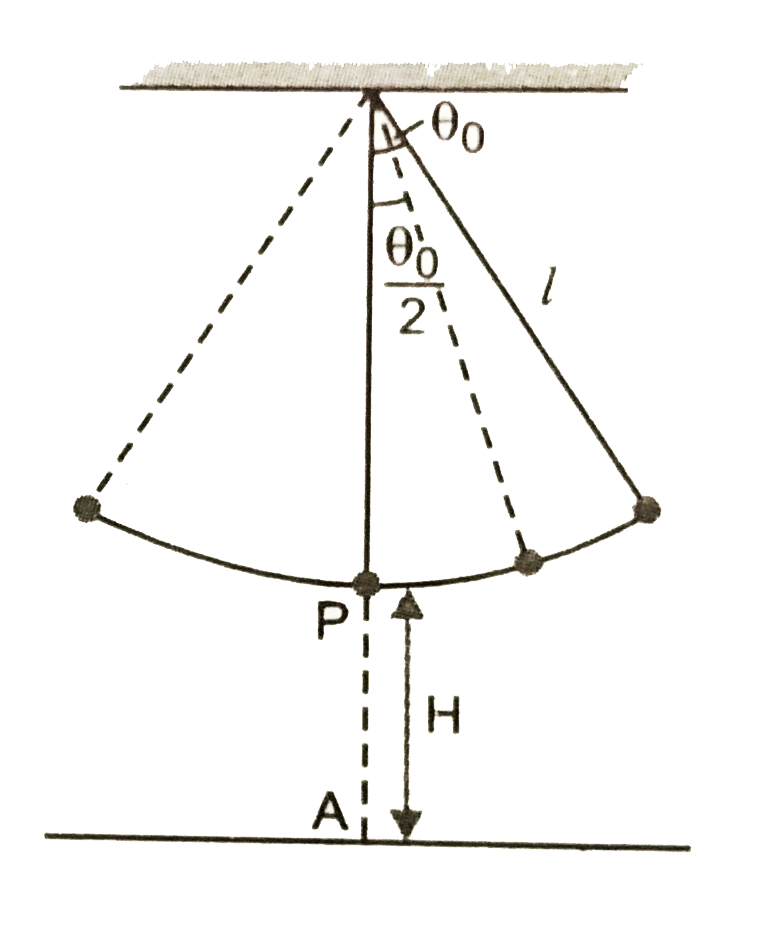
|
|
| 33. |
Answer carefully, with reasons : (a) In and elastic collision of two billiard balls, is the total kinetic energy conserved during the short time of collision of the balls (i.e., when they are in contact) ? (b) Is the total linear momentum conserved during the short time of an elastic collision of two balls ? (c) What are the answers to (a) and (b) for an inelastic collision ? (d) If the potential energy of two billiard balls depends only on the separation distance between their centres, is the collision elastic or inelastic ? |
|
Answer» Solution :(a) No, K.E. is not conserved during the given elastic collision. K.E. before and after collision is the same. Infact, during collision, K.E. of the balls gets converted into potential energy. (b) Yes, the TOTAL linear momentum is conserved during the short time of an elastic collision of two balls. (c) In an inelastic collision, total K.E. is not conserved during collision and EVEN affter collision.The total linear momentum is however, conserved during as well as after collision. (d) The collision is elastic, because the forces INVOLVED are conservative. |
|
| 34. |
A furnace is at a temperature of 2000K. At what wavelength will it radiate maximum intensity. Is it in visible region? |
|
Answer» |
|
| 35. |
Which of the following pairs is a correct pair with reference to a satellite? |
|
Answer» Potential energy `=-(GmM)/(R)`, |
|
| 36. |
Solve with due regard to significant figures. (i) 46.7 - 10.4 = "" (ii) (3.0 xx 10^(-8)) + (4.5 xx 10^(-6)) = |
|
Answer» Solution :(i) `46.7 - 10.04` Here 46.7 has one decimal PLACE, and 10.04 has TWO decimal places. `THEREFORE 46.7 - 10.04 = 36.66` The result should have only one decimal place. The result is 36.7. (ii) `3.0 XX 10^(-8) + 4.5 xx 10^(-6)` `= 0.03 xx 10^(-6) + 4.5 xx 10^(-6)` `= 4.53 xx 10^(-6)` Here ` 4.5 xx 10^(-6)` has only one decimal place and`0.03 xx 10^(-6)` can have two decimal places. This result should be rounded off to one decimal place. `therefore (3.0 xx 10^(-8) ) + (4.5 xx 10^(-6) ) = 4.5 xx 10^(-6)` |
|
| 37. |
A force (2hati+3hatj-hatk)newtons acts on a particle having position vector (hati-hatj+2hatk) . Find the torque of the force about origin. |
|
Answer» |
|
| 38. |
The limiting friction between two surfaces depends |
|
Answer» on the NATURE of TWO surfaces |
|
| 39. |
Identical springs of steel and copper are equally stretched. On which more work will have to be done? |
|
Answer» Solution :Work done in STRETCHING a spring, `W=1/2 F xx DELTAL` where `Delta l` increases in length DUE to applying force, ` therefore W prop Delta l[ because (1)/(2) , F` CONSTANT] `therefore W prop (l)/(Y) [ because Delta l = (Fl )/(AY), F, l, A` are constant] `therefore (W_("steel "))/(W_("copper")) = (Y _("copper "))/( Y _(steel"))` but ` Y _("steel " ) lt W _("copper")` `therefore ` Hence, more work will be done in CASE in spring made of copper. |
|
| 40. |
A platform makes SHM in vertical plane, with amplitude of oscillation being 0.2m. If a coin is placed on the top, what is the least period of the oscillation so that the coin may not loose the contact? |
|
Answer» SOLUTION :For Coin not to LOOSE CONTACT `m(g-a_("MAX"))= 0"" g= a_("max")` `g= A((2PI)/(T))^(2)"" T= (2pi)/(T)` |
|
| 41. |
The quantity of motion of a body is best represented by |
| Answer» Answer :D | |
| 42. |
If the rms speed of the molecules of a gas at 27^(@) C is 141.4 m/s , the rms speed at 327^(@) C will be nearly _________ . |
|
Answer» `1000ms^(-1)` `nu_(anu)/nu_(rms)=sqrt(8/(3pi))=0.9216` `nu_(anu)=0.9216xxnu_(rms)=921.6ms^(-1)` |
|
| 43. |
Radius of gyration of a disc of mass 5 kg about a transverse axis passing through its centre is 14.14cm. Find its radius of gyration about its diameter and hence calculate its moment of inertia about its diameter |
|
Answer» Solution :Radius of gyration of a DISC about a TRANSVERSE axis PASSING through its centre `K=sqrt((I)/(M))=sqrt((MR^(2))/(2M))=(R)/(sqrt2)=14.14cm` `(,.I=(MR^(2))/(2))` Radius of the dise, `R=14.14xxsqrt2=20cm` Radius of gyration of the disc about its diameter. `K=sqrt((I)/(M))=sqrt((MR^(2))/(4M))=(R)/(2)=(20)/(2)=10cm` Moment of inertia about its diameter = `(MR^(2))/(4)=(5(0.2)^(2))/(4)=5.00xx10^(-2)kgm^(2)` |
|
| 44. |
The internal energy of an ideal gas is givenby U = 1.5 PV. It expands from 10 cm^(3)to 20 cm^(3)against a constant pressure of 2 xx 10^(5) Pa. heat absorbed by the gas in the process is |
| Answer» ANSWER :B | |
| 45. |
A boat is floating in still water. A man walks from one end of the boat to the other . What will be the displacement of the boat? |
|
Answer» Solution :Initial MOMENTUM of the MAN-boat system is zero, and no external force acts on it. So, the person walks from one end of the boat to the other, the boat moves backward as PER the law of conservation of momentum. Let the length of the boat = L, t = time required by the man to move from one end to the other. in this time, let the distance which the boat moves back by be x. Hance, average velocity of the boat = `(x)/(t)`, and average velocity of the man with respect to the bank = `(L - x)/(t)`. Let the MASS of the boa be M and that of the man be m. So, `m(l -x)/(t) - (Mx)/(t) = ` from the conservation law of momentum . `therefore` Displacement of the boat , x = `(mL)/(m + M)` |
|
| 46. |
A uniform circular disc of radius 50 cm at rest is free to turn about an axis which is perpendicular to its plane and passes through its centre. It is subjected to a torque which produces a constant angular acceleration of 2.0 rads^(-2). Its netacceleration in ms^(-2) at the end of 2.0 s is approximately |
|
Answer» `7.0` |
|
| 47. |
Which type of energy of the following given to a system changes its internal energy? a) Electromagnetic b) Electrical c) Nuclear. |
| Answer» SOLUTION :All the THREE. | |
| 48. |
Stainless steel cooking pans are preferred with an extra copper bottom. Why? |
| Answer» SOLUTION :The thermal CONDUCTIVITY of copper is greater than that of steel. So the heat CONDUCTED through copper is more and the food GETS COOKED early. | |
| 49. |
When some load is attached to the spring of spring constant then it clogates through 0.8m. If it is further stretches by 0.05m then the period of oscillation is |
|
Answer» `(2pi)/7` SEC |
|
| 50. |
Assertion: The trajectory of an object moving under the same accleration due to gravity can be straight line or a parabola depending on the initial conditions. Reason: The shape of the trajectory of the motion of an object is determined by the acceleration alone. |
|
Answer» |
|


