

Saved Bookmarks
This section includes 7 InterviewSolutions, each offering curated multiple-choice questions to sharpen your Current Affairs knowledge and support exam preparation. Choose a topic below to get started.
| 1. |
Product of mass and momentum of body is called linear momentum. |
|
Answer» |
|
| 2. |
Force F is given in terms of time t and distance x by F= A sinCt+ B cosDx. Then dimensions of (A)/(B) and (C)/(D) are |
|
Answer» `[M^(0)L^(0)T^(0)], [M^(0)L^(0)T^(-1)]` `:. [(A)/(B)]= ([F])/([F])= [M^(0)L^(0)T^(0)]` As `sintheta` is dimensionless, `:. [Ct]= 1` or `[C]=(1)/([t])= (1)/([T])= [T^(-1)]` `[DX]=1` or `[D]= (1)/([X])= (1)/([L])= [L^(-1)]` `:. [(C)/(D)]= ([T^(-1)])/([L^(-1)])= [M^(0)LT^(-1)]` |
|
| 3. |
A body is projected vertically up with velocity 98ms^(-1). After 2s if the acceleration due to gravity of earth disappears, thevelocity of the body at the end of next 3s is |
|
Answer» `49ms^(-1)` |
|
| 4. |
How do science and technology differ ? |
|
Answer» Solution :Science is the study of nature's rules. TECHNOLOGY is application of THS KNOWLEDGE to practical problems. |
|
| 5. |
The Moon orbits the Earth once in 27.3 days in an almost circular orbit. Calculate the centripetal acceleration experienced by the Moon? (Radius of the Earth is 6.4 xx 10^6 m ). |
|
Answer» Solution :The centripetal ACCELERATION is given by ` a = (v^2)/(R )`.This expression EXPLICITLY depends on Moon.s SPEED which is nontrivial. We can work with the formula `omega^2 R_m = a_m` `a_m`is centripetal acceleration of the Moon due to Earth.s gravity. `omega `is angular velocity. `R_m`is the DISTANCE between Earth and the Moon, which is 60 times the radius of the Earth. `R_m = 60R = 60 xx 6.4 xx 10^6 = 384xx 10^6 m` As we know the angular velocity `omega = (2pi)/(T)`and T = 27.3 days = `27.3 xx 24 xx 60 xx 60`second = `2.358 xx 10^6` sec By substituting these values in the formula for acceleration `a_m = ((4pi^2)(384 xx 10^6) )/((2.358 xx 10^6 )^2) = 0.00272 ms^(-2)` The centripetal acceleration of moon towards the earth is `0.00272 ms^(-2)` |
|
| 6. |
Caculate the compressionalforce required to prevent the metallic rod of length I cm and cross- sectional area A cm^(2) when heated through t^(@)C, from expanding along lengthwise. The young's modulus of elasticity of the metal is E and mean coeJJ'icient of linear expansion is alphaperdegreecelsius : |
|
Answer» Solution :The change in natural length = `Delta_(t) = 1 alpha t ` The natural length of rod at temperature `t^(@)` C is 1 + `alpha` t The decrease in natural length due to developed stress ` = Delta ` l But the length of rod remains constant. `THEREFORE Delta l_(t) - Delta l = 0"" therefore Delta l = Delta l_(t) = l alpha t ` `therefore E = ("stess")/("strain") = (((F)/(A))/(-Delta L))/(l + Delta l_(t))` `therefore F = (EA Delta l )/(l + Delta l_(t)) = (- E A l alpha t )/(l + l alpha t ) = - (E A alpha t )/( (1 + alpha t ) )` Here, negative sign indicates that the forces is compressive in NATURE. |
|
| 7. |
Two particles of masses 1 kg and 3 kg have position vectors 2hati+3hatj+4hatk and -2 hati +3 hatj-4hatk respectively. The centre of mass has a position vector |
|
Answer» `hati + 3hatj - 2hatk` `vecr_(1) = 2hati +3hatj + 4hatk , vecr_(2) = -2hati + 3hatj - 4hatk` The POSITION vector of CENTRE of MASS is `vecR_(CM) = (m_(1) vecr_(1) + m_(2) vecr_(2))/(m_(1) + m_(2)) = ((1) (2 hati + 3hatj + 4hatk) + (3) (-2hati + 3hatj - 4hatk))/(1 + 3)` `= (2 hati + 3hatj + 4hatk - 6hati + 9hatj - 12 hatk)/(4) = (-4hati + 12hatj - 8hatk)/(4) = - hati + 3hatj - 2hatk` |
|
| 8. |
A person can see clearly objects lying between 15cm and 100cm from the eye. What will be the range of his vision if he wears close fitting spectacles having a power of -0.8D? |
|
Answer» `-17CM & -500CM` |
|
| 9. |
g_( e) and g_(p) denote the acceleration due to gravity on the surface of earth and another planet mass and radius are twice that of the earth, then |
|
Answer» `g_(p) = g_(E )` |
|
| 10. |
Consider the moment of inertia I of the rigid homogerneous disc of mass M as shown in the figure about an axis through its centre (different shadings only differentiate the two parts of the disc each with equal mass M//2). Which one of the following statements concerning I is correct? |
|
Answer» The inner and outer PARTS of the disc, each with mass `M//2`, contribute equal AMOUNTS to /. |
|
| 11. |
Rising and setting of the sum appears to be reddish because of |
|
Answer» Reflection |
|
| 12. |
The angle of contact between glass and water is 0^(@) and it rises ina capillary upto 5 cm when its surface tension is 70 dynes/cm. Another liquid of surface tension 140 dyne/cm angle of contact 60^(@)and relative density 2 will rise in the same capillary by |
|
Answer» 12 cm |
|
| 13. |
When an object is kept at a distance of 30cm from a concave mirror, the image is formed at a distance of 10 cm. if the object is moved with a speed of 9 cm/s, find the speed (in cm/s) with which image moves. |
|
Answer» |
|
| 14. |
A tube one metre long is filled with liquid of mass 1 kg. The tube is closed at both the ends and is revolved about one end in a horizontal plane at 2 rev/s. The force experienced by the liquid at the other end is |
| Answer» Solution :` F=mromega^2= 1 xx 1/2xx 4 pi^2 xx 2 xx 2 N= 8 pi ^2 N` | |
| 15. |
A disc of radius R starts at time t=0 moving along the positive x-axis with linear speed v and angular speed omega. Find the x and y coordinates of the bottom most poitn at any time t. |
|
Answer» <P> Solution :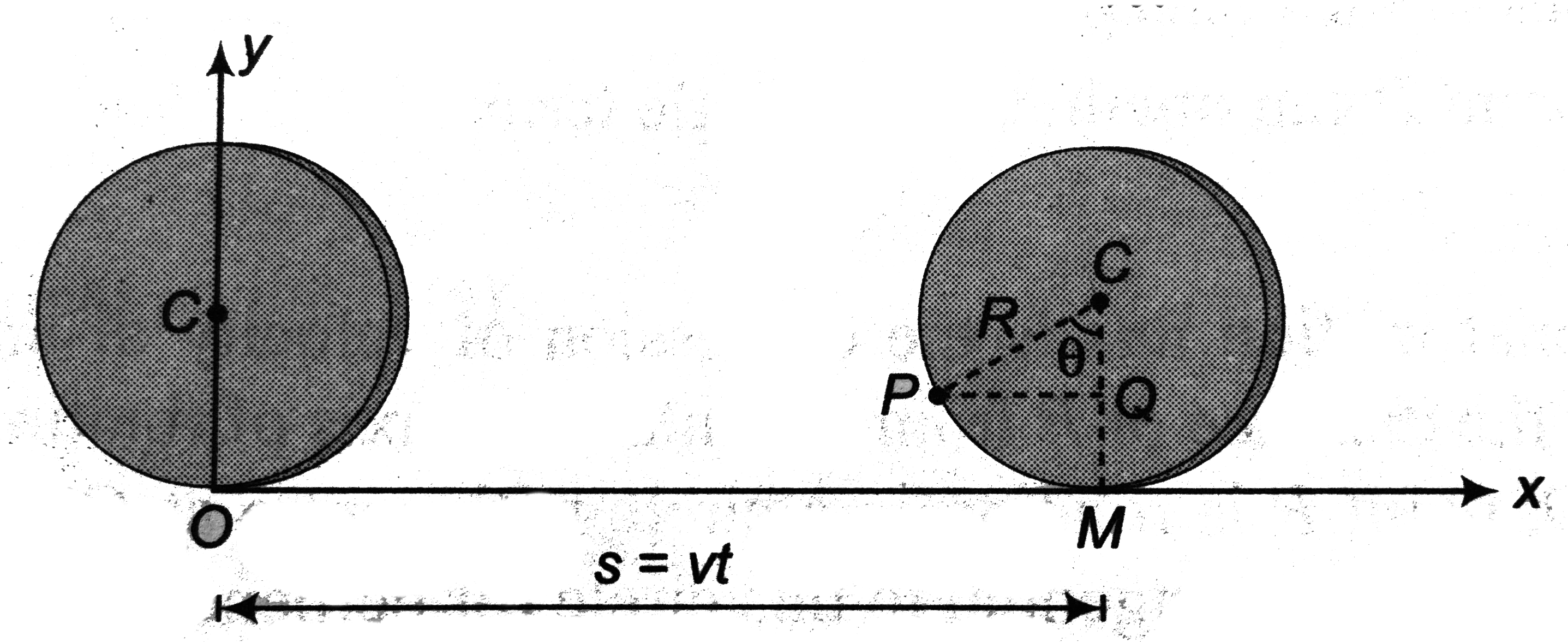 At time `t` the bottommost poit will ROTATE and ANGLE `theta=omegat` with respect to the centre of the disc C. The centre C will travel a distance `s=vt`. In the FIGURE, `PQ=Rsintheta=Rsinomegat` and `CQ=Rcostheta=Rcosomegat` COORDINATES of point P at time t are `x=OM-PQ=vt-Rsinomegat` and `y=CM-PQ=R-Rcosomegat` `therefore(x,y)=(vt-Rsinomegat,R-Rcosomegat)` |
|
| 16. |
A hollow sphere of simple pendulum is first filled with mercury and then with water. The time periods are in the ratio if their densities are in the ratio 13.6:1 |
|
Answer» `1:1` |
|
| 17. |
Two satellites are at heights h_1,h_2The ratio of their orbital angular speeds is |
|
Answer» `(h_1/h_2)^(3//2)` |
|
| 18. |
A businessman uses a faulty balance of unequal arms. He buys some old papers from a person and for this he uses a (1)/(2) kg counterpoising weight. He then readily agrees to weigh the papers alternately by changing the pans of the balance during successive weighings. Show that he gains in every 1 kg of purchase. [ Upthrust due to air is neglected.] |
|
Answer» SOLUTION :Let the length of the left and the right arms of the faulty balance be x and y ( `x gt y)` Fig. Suppose `W_(1)` kg of paper on the right pan balances the `(1)/(2)` kg counterpoising weight on the left pan. `:.""(1)/(2).x=W_(1).y" ""or",W_(1)=(1)/(2).(x)/(y)` Suppose `W_(2)` kg of paper is required on the left pan to balance `(1)/(2)` kg counterpoising weight on the right pan. `:. ""W_(2)x=(1)/(2)x" ""or", W_(2)=(1)/(2).(y)/(x)` Paper received by the businessman, `W_(1)+W_(2)=(1)/(2)((x)/(y)+(y)/(x))=(1)/(2).((x^(2)+y^(2))/(xy))` `=(1)/(2).[2+(x-y)^(2)/(xy)]=1+(1)/(2)((x-y)^(2))/(xy)` As `XGT0, ygt0 " ""and" " "(x-y)^(2)gt0, W_(1)+W_(2)GT1`kg Hence the businessman gains in EVERY kilogram of purchase. 
|
|
| 19. |
A uniform beam of mass m is inclined at an angle theta to the horizontal. Its upper end produces a ninety degree bend in a very rough rope tied to a wall, and its lower end rests on a rough floor (a) If the coefficient of static friction between beam and floor is mu_(s) determine an expression for the maximum mass M that can be suspended from the top before the beam slips. (b) Determine the magnitude of the reaction force at the floor and the magnitude of the force exerted by the beam on the rope at P in terms ofm, M and mu_(s) . |
Answer» Solution :We can use `sumF_(x)=sumF_(y)=0` and `sumtau=0` with pivot point at the contact on the floor. 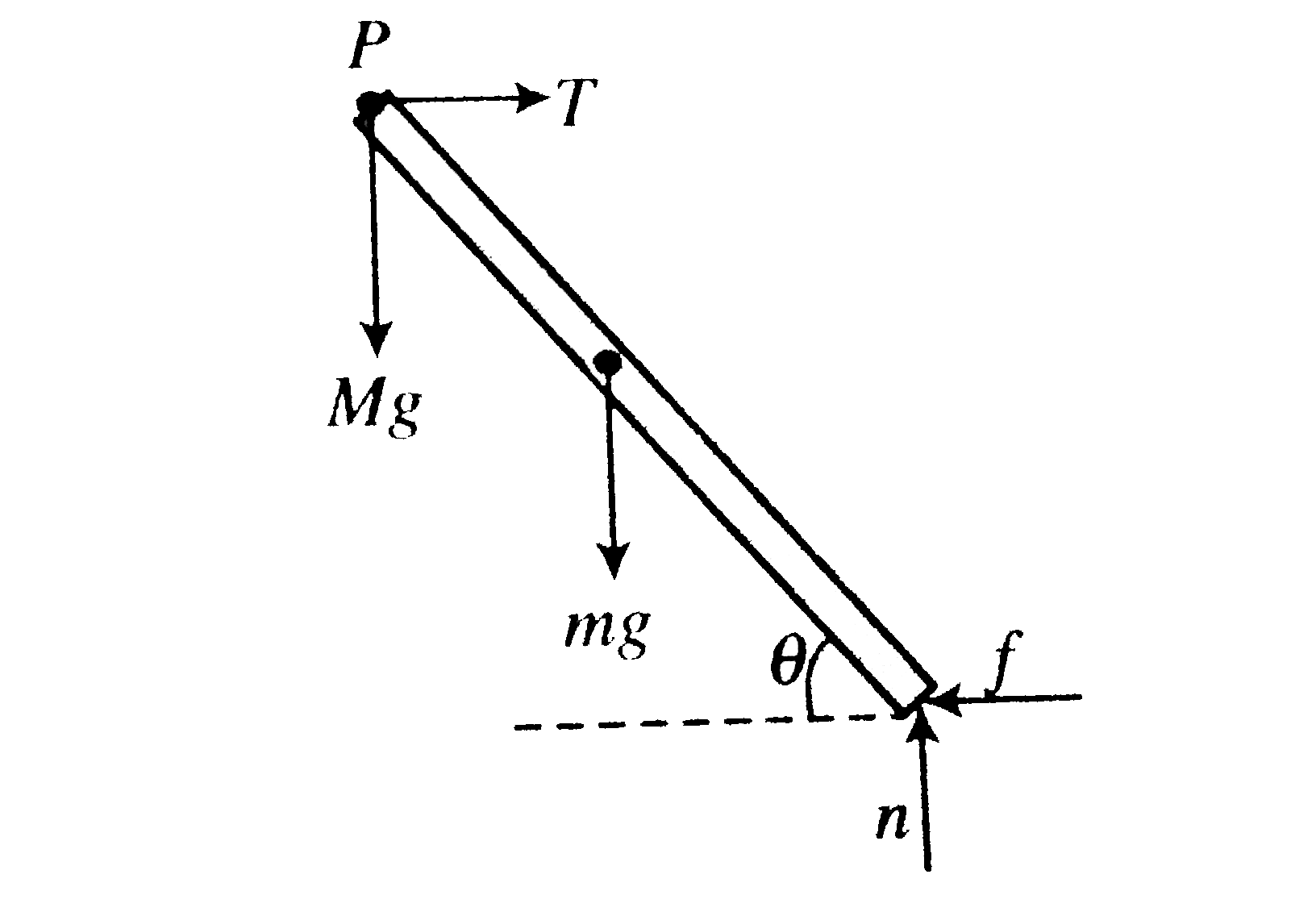 Then `sumF_(x)=T-mu_(s)n=0` `sumF_(y)=n-Mg-mg=0` `sumtau=Mg(Lcostheta)+mg(L/2costheta)-T(Lsintheta)=0` Solving the above equations gives `M=m/2((2mu_(s)sintheta-costheta)/(costheta-mu_(s)sintheta))` This answer is the maximum value of`M` if`mu_(s)ltcottheta`. If `mu_(s)ge cot theta`, the MASS `M` can increase without limit. it has no maximum value, and part b. cannot be answered an stated EITHER. In the case `mu_(s)ltcottheta,`we proceed. b. At the floor we have the NORMAL force in the `y`-direction and frictional force in the `x`-direction. The REACTION force then is `R=sqrt(n^(2)+(mu_(s)n)^(2))=(M+m)g sqrt(1+mu_(s)^(2))` At point `P`, the force of the beam on the rope is `F=sqrt(T^(2)+(Mg)^(2))=gsqrt(M^(2)+mu_(s)^(2)(M+m)^(2))` |
|
| 20. |
A body is revolving in a vertical circle with constant mechanical energy. The speed of the body at the highest point is sqrt(2rg). The speed of the body at the lowest point is |
|
Answer» `SQRT(7GR)` |
|
| 21. |
Name the technique used in locating. (a) an under water obstacle (b) position of an aeroplane in space. |
|
Answer» SOLUTION :(a) SONAR `to` SOUND NAVIGATION and Ranging. (b) RADAR `to` Radio Detection and Ranging. |
|
| 22. |
Three blocks masses 4kg 6kg and 8kg are connected by a string they are placed on a frictionlesssurface if the system is pulled by a forceof F=36 N then acceleration of the body is a = and tension acting on the sting is T=Which of the following pair is correct |
|
Answer» `a=4 m//s^(2),T=14 N` `= (36)/( 4+ 6+8) = (36)/(18)= 2m//s^(2)` ByNewtonsecondlaw 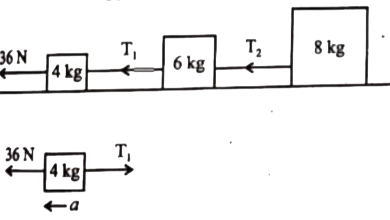 `4a = 36 - T_(1)` `=36 - 4 XX 2` `=36-8` `28N` |
|
| 23. |
A cylinder of mass 5 kg and radius 30 cm, free to rotate about its axis, receives an angular impulse of 3kgms^(-1) initially followed by a similar impulse after every 4s. What is the angular speed of the cylinder 30 s after the initial impulse if the cylinder is at rest initially? |
|
Answer» Solution :In 30S the CYLINDER receives 8 angular impulses INCLUDING the initial IMPULSE `sumtauxxt=I(omega_(2)-omega_(1))` `8xx3=(MR^(2))/(2)omega_(2)(since omega_(1)=0)` `8xx3=(5xx(0.3)^(2))/(2)omega_(2)` On solving `omega_(2)=106.7rads^(-1)`. |
|
| 24. |
A body of mass 10kg is raised from certain depth. By the time it is raised by 10m, if its velocity is 2ms^(-1), work done during this time is, |
|
Answer» 980J |
|
| 25. |
A wire ring of 9/11 cm. radius and negligible weight rests flat on the surface of a liquid and then raised. The pull required is 3 gm wt. before the flim breaks. If g=10m//s^(2) calculate the surface tension of the liquid. |
|
Answer» |
|
| 26. |
In the given arrangement, for the system to remain under equilibrium, the 'theta' should be |
|
Answer» `0^(@)` |
|
| 27. |
A body of mass M is pressed between two hands. Each hand exerts a horizontal force F. hands. Each hand exerts a horizontal force F. The net horizontal force acting on the body is |
|
Answer» F |
|
| 28. |
A reversible heat engine operates with an efficiency of 50 %. If during each cycle it rejects 150 cal to a reservoir of heat at 30^(@)C, then (i) what is the temperature of the other reservoir and (ii) how much work does it carry out per cycle ? |
|
Answer» |
|
| 29. |
Four capillary tubes p, q, r & s of same length and radii in the ratio 1:2:6:4 respectively are dipped in a beaker containing water. The ascending order of mass of water in the capillary tubes are |
|
Answer» p, Q, r, s |
|
| 30. |
The shaft of a motar is making 1260rpm. The torque supplied by the motar is 100Nm. The power of motar is |
|
Answer» `100KW` |
|
| 31. |
The resultant of two forces 2P and sqrt(2)P is sqrt(10)P The angle between the forces is |
|
Answer» `30^(@)` |
|
| 32. |
A cyclotron accelerates a proton to a final speed of 3 xx 10^(7) ms^(-1) which is initially at rest. Find how much work is done on the proton by electrical force of the cyclotron. Mass of the proton is 1.67 xx 10^(-27) kg. |
|
Answer» |
|
| 33. |
Derive an expression for kinetic energy in rotation and establish the relation between rotational kinetic energy and angular momentum. |
|
Answer» Solution :Let a rigid body of moment of inertia I rotate with ANGULAR velocity`omega ` The angular momentum of a rigid body is,` L=I omega ` The rotational kin e TIC energy of the rigid body is,` KE= 1/21 omega^2` By MULTIPLYING the numerator and denominator of the above EQUATION with I, we get a relation between L and KE as, ` Ke = 1/2(I^2omega ^2)/(I )= ।/2(( omega )^2)/(I)` ` KE = (L^2)/( 2l)` |
|
| 34. |
The amplitude of a damped oscillator decreases to 0.9 times its original value in 5s. In another 10s it will decreases to a alpha times its original magnitude, where alpha is |
|
Answer» 0.81 |
|
| 35. |
In the adjacent figure what is the tention in left string immediately after cutting the right string. |
| Answer» SOLUTION :We can write `sumF=ma,sumtau =IALPHA` and CONSTRAINT relation. Solving these three equations we END up `T=(mgsintheta)/(1+3sin^(2)theta)` | |
| 36. |
A player caught a cricket ball of m ass 150 g moving at a rate of 20 m //s^(- 1) . If the catching process is com pleted in 0.1 s, the force of the blow exerted by the ball on the hand of the player is equal to ..... |
|
Answer» Solution :The forceof the blowexertedby the ball onthehandof theplayer= thechangein momentumof the ball `F=m(v_(1) -v_(2))/( t )` `=(0.15(20 - 0))/( 0.1)` `F= 30 N` `m =150 g = 0.150 kg` `v_(1)= 20 m//s` `v_(2) =0` `t=0.1s` |
|
| 37. |
(a) A 10-kg block is supported bycord that runs to a spring scale, which is supported by another cord from the ceiling as shown in fig. What is the reading on the scale? (b) In Fig. the block is supported by a cord that runs around a pulley and to a scale. The opposite end of the scale is attached by a cord to a wall. What is the reading of the scale? (c ) In fig. the wall has been replaced with a second 10-kg block, what is the reading on the scale now? . |
|
Answer» Solution :In all the three CASES the spring balance reads 10 kg. Let us cut a section inside the spring as shown in FIG 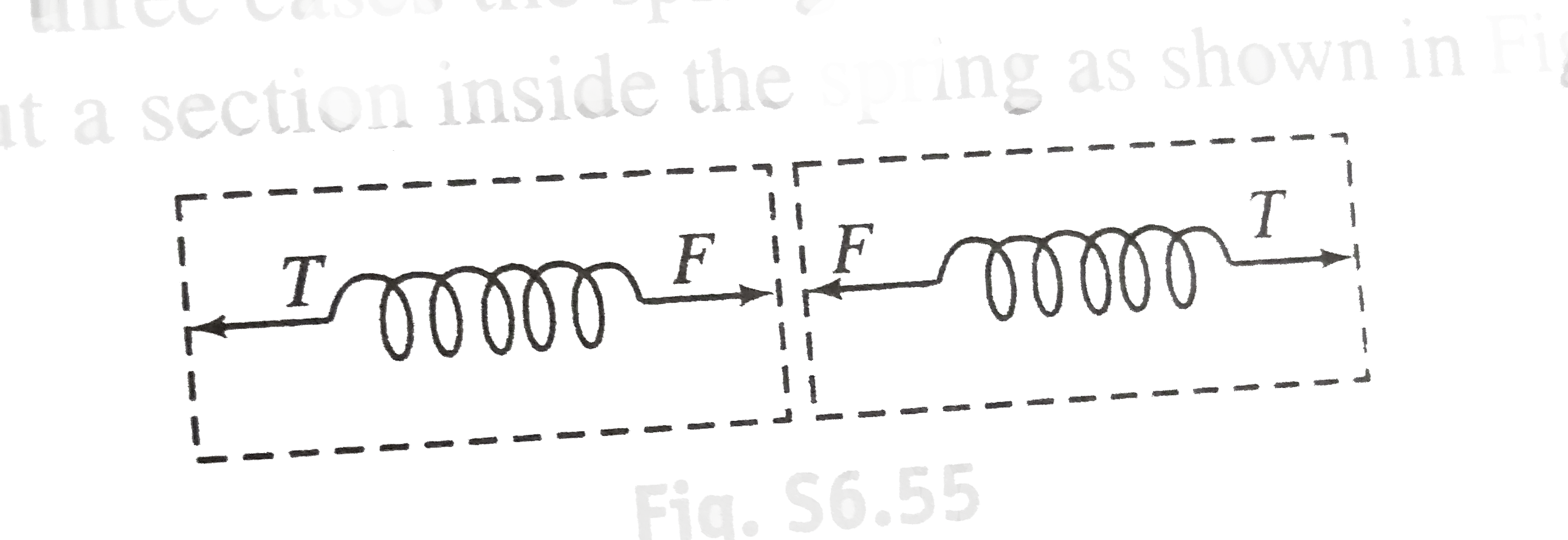 As each part of the spring is at REST , so `F=T`. As the block is STATIONARY, so `T=F=100N`. |
|
| 38. |
Two particles, due to their mutual attraction approach each other. Given the value of velocity of the centre of mass of the system at the moment when their relative velocity isv. |
|
Answer» |
|
| 39. |
A rod AB of length l is pivoted at an end A and freely rotated in a horizontal plane at an angular speed co about a vertical axis passing through A.If coefficient of linear expansion of materiol of rod is alpha , find the percenlllge change in its angular velocity if temperature of system is increased by DeltaT. |
|
Answer» Solution :If temperature of surrounding iricreases by `DELTA T,` the new length of rod becomes l. = l `(1 + alpha Delta T)` Due .io change in length, MOMENT of inertia of rod also changes and moment of inertia about an end AAND is given as `I._(A) = (Ml^(2))/(3)` As no EXTERNAL force or torque is acting on rod, its angular momentum remains constant during heating. Thus we have `I_(A) omega = I_(A) .omega. `[ where `omega`. is the final angular velocity of rod after heating ] or `(Ml^(2))/(3) omega = (Ml^(2) (1 + alpha Delta T )^(2))/( 3 ) omega . ` or `omega. = omega (1 - 2 alpha Delta T )` [u sing binomial expansion for small `alpha` ] Thus percentage change in angular velocity of rod due to heating can be given as` Delta omega = (omega - omega )/(omega) xx 100% = - 2 alpha Delta T xx 100`% |
|
| 40. |
If c=axxb, then |
|
Answer» the DIRECTION of `c` CHANGES, when the ANGLE between `AXXB` increases up to `theta(theta lt 180^(@))` `c` is perpendicular to `a` and `b` as show in figure. The direction of `c` does not change when the angle between `a` and `b` is increases or decreased. 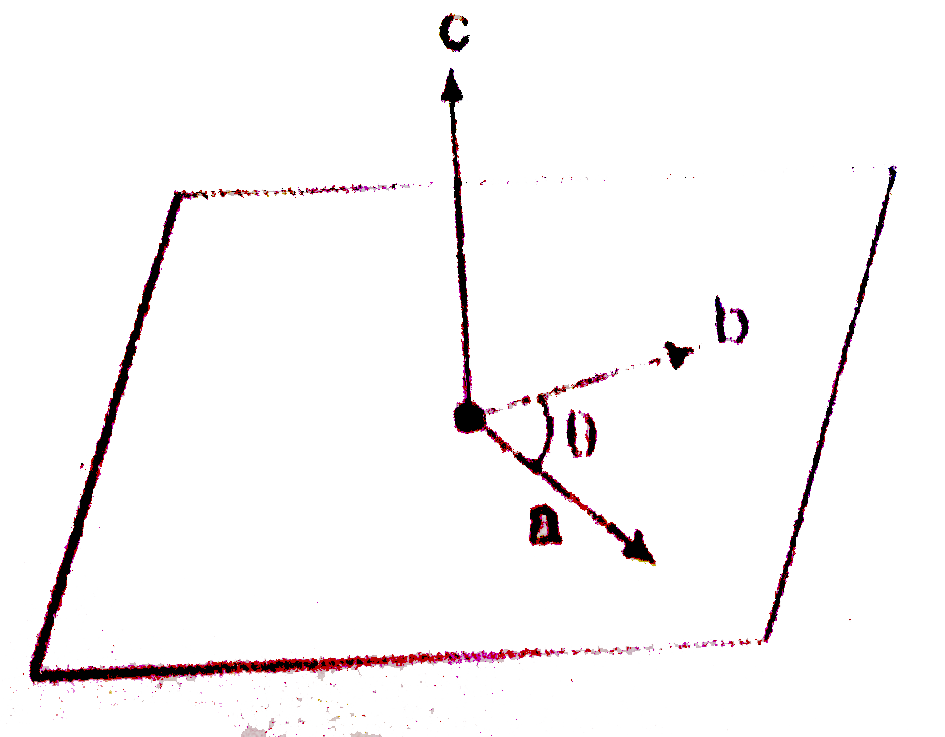
|
|
| 41. |
The length of a pendulum is measuredas 1,01 m and time for 30 oscillation is measured as one minute 3 s. Error length is 0.01 m and error in the 3 s. The percentage error in the measurement of acceleration due to gravity id, |
|
Answer» 1 |
|
| 42. |
If a planet were suddenly stopped in its circular orbit, how much time it would take to fall onto the Sun. Assume the planets time-period of revolution as T. |
Answer» Solution : For the circular orbit, `T^(2)PROPR^(3)`. When the planet is falling onto the SUN, we can think of its path as a completely flattened ellipse, WHOSE semi-major axis `=(r)/(2)`. `rArr(T')^(2)prop((r)/(2))^(3)` Now,`((T')/(T))^(2)=((r//s)/(r))^(3)`, `(T')^(2)=(T^2)/(8)`, `T'=(T)/(2sqrt2)` The required TIME is `(T')/(2)` `rArrt=(T')/(2)=(T)/(4sqrt2)` (or) `t=(Tsqrt2)/(8)` |
|
| 43. |
A thin meter scale is kept vertical by placing its one end on floor, keeping the end in contact stationary, it is allowed to fall. Calculate the velocity of its upper end when it hit the floor. |
Answer» Solution : P.E. of the metre scale in the vertical POSITION = Rotational K.E. when the end B just touches the FLOOR. P.E. of metre scale `=MG. l/2` The weight of scale ACTS through its C. G. l = 1m Rotational K.E. = `1/2 I omega^(2)` M.I. of scale about one end `mg l/2 = 1/2 I omega^(2) =1/2 (ML^(2))/3 xx v^(2)/l^(2)= (mv^(2))/6` `v^(2) = 3gl, v= sqrt(3gl) = sqrt(3 xx 9.8 xx 1) = 5.422 ms^(-1)` |
|
| 44. |
The phase difference between two waves, represented byy _(1) = 10 ^(-65) sin [100 t + (x //50) + 0.5]m y_(2) = 10 ^(-6) cos [100 t + (x //50)]m (where x is expressed in metres and t is expressed in seconds is approximately ..... |
|
Answer» `15` RADIAN and `y _(2) = 10 ^(-6) cos (100 t + (x)/(50) ) m ""…(2)` `therefore y _(2) =10 ^(-6) sin ((pi)/(2) + 100 t + (x)/( 50)) ""…(3)` `{because cos theta = sin ((pi)/(2) +theta)}` From equation (1), phase of first wave at time t, `theta _(1) = 100 t + (x)/(50) + 0.5` From equation (3) phase of second wave at time, t, `theta_(2) = (pi)/(2) + 100 t + (x)/(50)` `implies `Phase difference between second and first wave at time t is, `theta_(2) -theta_(1) = (pi)/(2) =0.5` `= (3.14)/(2) -0.5` `= 1.57 -0.5` `= 1.07 RAD` |
|
| 45. |
Is it possible for a body to have inertia but no weight? |
| Answer» Solution :If a BODY is TAKEN at the CENTRE of EARTH, then body can have inertia, but not weight. | |
| 46. |
Two heavy spheres each of mass 100 kg and radius 0.10 m are placed 1.0 m apart on a horizontal table. What is the gravititional field and potential at the mid point of the line joining the centres of the spheres? Is an object placed at that point in equilibrium ? If so, is the equilibrium stable or unstable. |
|
Answer» Solution :Gravititional field at the mid-point of the line joining the CENTRES of the two spheres `=(GM)/(r//2)^2(-hatr)+(GM)/(r//2)^2 hatr=0` Gravititional potential at the mid point of the line joining the centres of the two spheres is `V=(-GM)/(r//2) + ((-GM)/(r//2))=(-4GM)/r=(-4xx6.67xx10^(-11)xx100)/1.0=-2.7xx10^(-8)` J/kg As the EFFECTIVE FORCE on the body placed at mid point is zero, so the body is in equilibrium. If the body is displaced a little TOWARDS either mass body from its equilibrium position, it will not return back to its initial position of equilibrium. Hence, the body is in UNSTABLE equilibrium |
|
| 47. |
Tooth paste contains a small quantity of oil. Is it for any reason connected with the surface tension? |
| Answer» Solution :Yes. SURFACE tension of water decreases with addition of oil in the tooth paste. HENCE the water or the FOAM easily spreads over the mouth and cleans the TEETH. | |
| 48. |
A calorie is a unit of heat (energy in transit) and it equals about 4.2 J where 1J= 1 kg m^(2) s^(-2). Suppose we employ a system of units in which the unit of mass equals alpha kg, the unit of length equals betam, the unit of time is gammas. Show that a calorie has a magnitude 4.2alpha^(-1)beta^(-2)gamma^(2) in terms of the new units. |
|
Answer» SOLUTION :1 clorie =4.2 J DIMENSIONAL formula of THEAT energy `=[M^(1)L^(2)T^(-2)]`  `:.n_(2)[M_(1)^(2)L_(2)^(2)T_(2)^(-2)]=n_(1)[M_(1)^(1)L_(1)^(2)T_(1)^(-2)]` `n_(2)=n_(1)((M_(1))/(M_(2)))^(1) ((L_(1))/(L_(2)))^(2) ((T_(1))/(T_(2)))^(-2)` `=n_(1)((1)/(alpha))^(1)((1)/(beta))^(2)((1)/(GAMMA))^(-2)` `n_(2)=n_(1)(alpha^(-1)beta^(-2)gamma^(+2))` `n_(2)=4.2alpha^(-1) beta^(-2) gamma^(2)` |
|
| 49. |
The uncertainty in a measurement is called as………… |
|
Answer» ERROR |
|
| 50. |
Select the odd man out from the following statements. |
|
Answer» Pressure of a gas P `=1/3 nmv^2` |
|