

Saved Bookmarks
This section includes 7 InterviewSolutions, each offering curated multiple-choice questions to sharpen your Current Affairs knowledge and support exam preparation. Choose a topic below to get started.
| 1. |
A wooden block of cross sectional area 10cm^(2) remains floating upright in water. The volume of the immersed part of the block is 200cm^(3). If the block is depressed slightly and then released, determine the time period of its oscillation. |
|
Answer» |
|
| 2. |
1 kg m^(2)s^(-2) =………. g cm^(2) s^(-2) |
|
Answer» SOLUTION :`1kg m^(2)s^(2)=1(10^(3)G)(10^(2)cm^(2)) s^(-2)` `=1xx10^(3)xx10^(4)g cm^(2) s^(-2)` `=10^(7)g cm^(2) s^(-2)` |
|
| 3. |
Using the information given in example 2, find (i) the greatest height reached by the stone above the ground. (ii) the velocity with which it strikes the ground (iii) time taken to reach the maximum height |
|
Answer» Solution :Let.s be the HEIGHT covered in upward motion then `v^(2)=u^(2)+2gs` `0=(14.7)^(2)+2xx(-0.8)s` `rArr s=((14.7)^(2))/(19.6)=11.025m` `therefore` The greatest height above the ground =s+s =11.025+196 =207.025m (ii) For the DOWNWARD motion of the stone, u=0,g=`9.8m//s^(2)`, s=207,028m USING `v^(2)=u^(2)+2gs` `=0+2xx(9.8)xx207.025` `rArr v=63.7m//s` (iii) Let t be the TIME taken to REACH the maximum height. Then, for the upward motion `u=14.7m//s, v=0g=-9.8m//s^(2)` Using v=u+gt, we get `t=(v-u)/(g)=(0-14.7)/(-9.8)=1.5s` |
|
| 4. |
A bullet moving with speed 150 m/s strikes a tree and penetrates 3.5 cm before stopping. Find the magnitude of its acceleration and the time taken to stop. |
|
Answer» `32.14xx10^(5)m//s^(2), 4.67xx10^(-4)s` |
|
| 5. |
The linear density of a wire is 0 . 0 5g * cm^(-1) . The wire is stretched with a tension of4 . 5 xx 10^(7)dyn between two rigid supports . A drivingfrequency of 420 Hzresonatesthe wire. At the next higherfrequency of 490 Hz , another resonance is observed. Find out the length of the wire . |
|
Answer» Solution :LET 420 Hz frequency ofthe p- th harmonic . So , 490 Hz = frequency of the (p + 1) - th harmonic . Then, 420 ` = (p)/(2l) sqrt((T)/(m)) and 490 = (p + 1) / (2l) sqrt((T)/(m))` `:. (420)/(490) = (p)/(p + 1) or , p = 6 ` So , we get, ` 420 = (6)/(2l) sqrt((T)/(m))` or , `l = (6) /(2 xx 420) sqrt((4 . 5 xx 10 ^(7))/(0 . 0 5 )) = 214 . 3 CM ` |
|
| 6. |
Magnetic confinement of plasma is the basis of ……….. |
|
Answer» |
|
| 7. |
In what time after its motion began, will a particle oscillating according to the equation x = 7 sin (0.5 pit)move from the mean position to the maximum displacement ? |
|
Answer» |
|
| 8. |
A body of mass m is attached to the lower end of a spring whose upper end is fixed. The spring has negligible mass when the mass m is slightly pulled down and released, it oscillates with a time period of 3s. When the mass m is increased by 1 kg, the time period of oscillations becomes 5s. The value of m in kg is........... |
|
Answer» `(16)/(9)` `T= 2pi sqrt((m)/(K))` `therefore 3= 2pi sqrt((m)/(k))"""…….."(1)` Periodic time when 1 kg is ADDED to m and `5= 2pi sqrt((m+1)/(k))"""…….."(2)` Taking ratio of eqn. (2) and (1) `(5)/(3) = sqrt((m+1)/(m))` `therefore (25)/(9)= (m+1)/(m)""` [squaring] `therefore 25M = 9m+9` `therefore 16m = 9` `therefore m= (9)/(16)`. |
|
| 9. |
If the centre of mass of three particles of masses of 1kg, 2kg, 3kg is at (2,2,2), then where should a fourth particle of mass 4kg be placed so that the combined centre of mass may be at (0,0,0). |
|
Answer» Solution :Let `(x_(1),y_(1),z_(1)),(x_(2),y_(2),z_(2))` and `(x_(3),y_(3),z_(3))` be the positions of masses `1kg`, `2kg`, `3kg` and let the co-ordinates of centre of mass of the three particle system is `(x_(cm),y_(cm),z_(cm))` respectively. `x_(cm)=(m_(1)x_(1)+m_(2)x_(2)+m_(3)x_(3))/(m_(1)+m_(2)+m_(3))` `implies2=(1xx x_(1)+2xx x_(2)+3XX x_(3))/(1+2+3)` (or) `x_(1)+2x_(2)+3x_(3)=12`.............`(1)` Suppose the FOURTH particle of mass `4kg` is placed at `(x_(1),y_(1),z_(1))` so that centre of mass of NEW system SHIFTS to `(0,0,0)`. For X-co-ordinate of new centre of mass we have `0=(1xx x_(1)+2xx x_(2)+3xx x_(3)+4xx x_(4))/(1+2+3+4)` `impliesx_(1)+2x_(2)+3x_(3)+4x_(4)=0`...........`(2)` From equations `(1)` and `(2)` `12+4x_(4)=0impliesx_(4)=-3` Similarly `y_(4)=-3` and `x_(4)=-3` Therefore 4kg should be placed at `(-3,-3,-3)`. |
|
| 10. |
On a planet a body is left freely from a height 2m reaches the ground sqrt(2) seconds. If the length of a simple pendulum is 2m on that planet, its time period is |
|
Answer» `3.14 SEC` |
|
| 11. |
Temerpature of a furnace is more than 500^(@)C. Discuss a method of measuring the temperature of the furnace with the help of a thermometer graduated up to 100^(@)C. |
|
Answer» SOLUTION :Let the temperature of the FURNACE `=t^(@)C`. A small METLA piece of mass m and specific heat s is put into the furnace. Obvioulsy the melting point of the metal should be greater than the temperature of the furnace so that it does not melt. Now, water of mass M is taken is a vessel of water equivalent W and its temperature is recorded. Let the temperature be `t_(1)^(@)C(ltlt 100^(@)C)`. Now the HOT metal piece is dropped in the water. As a result a small quantity OFWATER is vapourised which is negligible. After a while, when the metla piece and water reach thermal equili - brium, the final temperature is measured by the thermometer. If that temperature is `t_(2).^(@)C`, heat lost by the metal piece = `ms(t-t_(2))` and heat hained by the vessel and water `=(W+M)s_(w)(t_(2)-t_(1))`, where `s_(w)` is the specific heat of water. From calorimetric principle, `ms(t-t_(2))=(W+M)s_(w)(t_(2)-t_(1))` Value of t can be calculated from this equation if values of all the other quantities are known. Thus, measuring temperatures `t_(1) and t_(2)` with the help of a thermometer graduated up to `100^(@)C`, a much greater temperature t can be determined. |
|
| 12. |
An object released near the surface of the earth is said to be in free fall. (Neglect the air resistance) Area under velodty-time graph gives……….. |
| Answer» SOLUTION :DISPLACEMENT | |
| 13. |
An object released near the surface of the earth is said to be in free fall. (Neglect the air resistance) Choose the correct aiternative from the clues given at the end of the statement.a Free fail is an example of accelerated motion.”'(unifornly /non-uniformly^foamy/non-Uniformly) |
| Answer» SOLUTION :UNIFORMLY | |
| 14. |
Discuss the experiment verifying Newton's law of cooling. |
|
Answer» Solution :Newton.s law of cooling can be verified with the help of the experimental setup which consists of a double walled vessel (V) containing WATER in between the two walls. A copper calorimeter (C) containing hot water is placed inside the double walled vessel. This calorimeter is CLOSED tightly by cock with two holes. Two thermometers through the corks are used to note the TEMPERATURES `T_(2)` of water in calorimeter and `T_(1)` of hot water in between the double walls respectively. Temperature of hot water in the calorimeter is noted after equal intervals of time. A graph is plotted between `log_(e)(T_(2)-T_(1))` and time (t). The nature of the graph is observed to be a straight line having a negative SLOPE It is like `log_(e)(T_(2)-T_(1))=-"Kt"+C` and It is similar to `y=-"mx"+C` |
|
| 15. |
A small body of superdense material, whose mass is twice the mass of the earth but whose size is very small compared to the size of the earth, satrts from rest at a height H lt lt R above the earth's surface, and reaches the earth's surface in timet. Then i is equal to |
|
Answer» `SQRT(2H//g)` |
|
| 16. |
20 J work is required to stretch a spring through 0.1 m. Find the force constant of the spring If the spring is further stretched through 0.1 m, calculate work done |
|
Answer» Solution :P.E. of spring when stretched through a distance 0.1 m `U=W.D.=1/2K.x^(2)=20J or k=4000N/m` when spring is fruther stretched through 0.1 m, then P.E. will be: `U^(.)=1/2k(0.2)^(2)=80J` `W.D.=U^(.)-U=80-20=60J` |
|
| 18. |
If co-ordinates ofa moving point at time t are given by x=a (l+sint) and y=a(1-cost), then: |
|
Answer» the slope of accelration time GRAPH is zero `v=sqrt(((dx)/(dt))^(2)+((dy)/(dt))^(2))` `a=sqrt(((d^(2)x)/(dt^(2)))^(2)+((d^(2)y)/(dt^(2)))^(2))` |
|
| 19. |
The co-efficient of friction between an insect and bowl is ul and the radius of the bowl is r. The maximum height to which the insect can crawl in the bowl is |
|
Answer» `r [ 1- (1)/(SQRT (1 + MU ^(2))) ]` |
|
| 20. |
Find the time taken for height of water level to fall from 'h' to 'h'in a vessel, if water comes out from a small hole at the bottom |
|
Answer» SOLUTION :From EQUATION of continity for an incompressible liquid `Av^(1)=asqrt(2gh)` (or) `v^(1)=((a)/(A))sqrt(2gh)` where `v^(1)` is the RATE of descendence of the LEVEL of free surface. So, `v^(1)` can be WRITTEN as: `V^(1)=(-dh)/(dt)` `therefore (-dh)/(dt)=((a)/(A))sqrt(2gh)` (or) `overset(h^(1))underset(h)int(dh)/(sqrt(h))=-((a)/(A))sqrt(2g)overset(t)underset(t=0)intdt` `therefore 2(sqrt(h^(1)-sqrt(h))) =-((a)/(A))(sqrt(2g))t` (or)`t=(2A)/(asqrt(2g))(sqrt(h^(1))-sqrt(h))prop t` |
|
| 21. |
A particle moves in a straignt line with retardation proportional to its displacement. Its loss of kinetic energy for ay displacement x is proportional to: |
| Answer» ANSWER :A | |
| 22. |
In adiabatic process, the pressure is increased by 2//3%. Ifgamma=3//2then the volume decreases by nearly – |
|
Answer» `(4)/(9)%` `(DeltaP)/(DeltaV)=-(gammaP)/(V)` `(DeltaP)/(P) xx 100 = -gamma (DeltaV)/(V)xx 100 =(2)/(3)` `(DeltaV)/(V) xx 100 = -(1)/(gamma) xx (2)/(3)` `= -(2)/(3) xx (2)/(3) = -(4)/(9)%` |
|
| 23. |
A body thrown horizontally from the top of a tower touches the ground at a distance of 160 m from the foot of the tower. If the velocity of projection is 40 m/s then the height of the towers is |
|
Answer» 98 m |
|
| 24. |
One mole of an ideal gas (gamma=1.4) is compressed adiabatically , so that its temperature is increased from 27^@ C " to " 35^@C If R = 8.31 J/K/mole then the change in the internal energy of the gas is : |
|
Answer» 168 J `DELTA = 8K` `C_P - C_V = R` `C_P/C_V-1R/C_V` `:. C_V = R/ (r-1)` `DeltaU =(nRDeltaT)/(r-1) = (1xx8.31xx8)/(1.4-1)` `DeltaU = 166J` |
|
| 25. |
Let V, T, L, K and r denote the speed, time period, angular momentum, kinetic energy and radius of satellite in circular orbit, then (a) V prop r^(-1)(b) L prop r^(1//2) (c) T prop r^(3//2)(d) K prop r^(-2) |
|
Answer» only a & B are TRUE |
|
| 26. |
The co - ordinates of centre of mass of particle of mass 10, 20 and 30 gm are (1, 1, 1) cm. The position co - ordinates of mass 40 gm which when added to the system, the position of combined centre of mass be at (0, 0, 0) are, |
|
Answer» (3/2, 3/2, 3/2) |
|
| 27. |
To study the laminar flow of a liquid through a narrow tube, the following formula is used V=(pi P r^(4))/(8 eta l). Given P = 76 cm of Hg , r = 0.28 cm , V = 1.2 cm^(2)s^(-1) , l = 18.2 cmIf these quantities are measured to the accuracy of 0.5 cm of Hg, 0.01 cm, 0.1 cm^(3) s^(-1) and 0.1 cmrespectively, find maximum percentatge error in the value of eta. |
|
Answer» `18.83%` |
|
| 28. |
A metal sphere is weighed in a liquid at 0^(@)C and 100^(@)C. At what temperature does it weigh more? |
| Answer» Solution :When a metal SPHERE in a liquid is heated from `0^(@)C `to `100^(@)C,` the decrease in DENSITY of liquid is more than the decrease in density of the metal sphere. Hence the metal sphere weights more in liquid at `100^(@)C.` | |
| 29. |
A block of mass m is pushed momentarily along a horizontal surfacewith an initial velocity u. If mu_kis the coefficient of kinetic friction between the object and surface, find the time at which the block comes to rest. |
Answer» SOLUTION : When the block slides, the force acting on the block is kinetic friction which is equal to `f_k = mu_s MG`. From Newton.s second law ma= `-mu_s mg ` The NEGATIVE sign implies that force ACTS on the opposite direction of motion. The acceleration of the block while sliding ` a= - mu_s G` The negative sign implies that the acceleration is in opposite direction of the velocity. Note that the acceleration depends only on g and the coefficient of kinetic friction We can apply the following kinematic equation v=u + at The final velocity is zero. `t = (u)/(mu_k g)` |
|
| 30. |
One day in the morning, Ramesh filled up 1/3 bucket of hot water from geyser, to take bath. Remaining 2/3 was to be filled by cold water (at room temperature) to bring mixture to a comfortable temperature. Suddenly Ramesh had to attend to something which would take take some times, say 5-10 minutes before he could take bath. Now he had two options : (1) fill the remaining bucket completely by cold water and then attend to the cork, (2) first attend to the work and fill the remaining bucket just before taking bath. Which option do you think would have kept water warmer ? Explain. |
| Answer» Solution :In first option, WATER will be hot (warm) and CONVENIENT to bath because according to proportion to TEMPERATURE difference of SUBSTANCE and surrounding is direct and in this first option temperature differnce is low hence COOLING rate is also low hence water will not become very cool. | |
| 31. |
The walls of buildings facing east or west are usually built with hollow bricks. Explnin Why. |
|
Answer» Solution :The thermal conductivity of the insulating brick is 0.15`Wm^(-1)K^(-1)` and that of CONCRETE is 0.8 `Wm^(-1)K^(-1)` and that of air is `0.024Wm^(-1)K^(-1)`. Since air is a bad conductor of heat, heat from the SUN falling on the wall is poorly conducted into the ROOMS. This renders the living rooms and bed rooms cooler than ones not using the hollow BRICKS. |
|
| 32. |
At what displacement is the KE of a particle performing SHM of amplitude 10 cm, three times its PE? |
|
Answer» 10 cm |
|
| 33. |
A stone is dropped into a well of 20 m deep. Another stone is thrown downward with velocity v one second later. If both stones reach the water surface in the well simultaneously, v is equal to (g=10ms^(-2)) |
| Answer» Answer :B | |
| 34. |
Four moles of a diatomic gas (g = 1.4) at a temperature of 300 K were cooled isochorically, so that the final pressure was 1/3 times the original pressure. The gas was allowed to expand isobarically till its temperature got back to its original value. Calculate the total amount of heat absorbed during the process. R = 8.31 J mol ^(-1) K ^(-1). |
|
Answer» Solution :NUMBE of MOLES `n = 4` `gamma = 1.4` Initial temperature `T_(1) = 300 K` At the end of the isochoric process the pressure becomes three times the initial pressure. So the temperature becomes `(T_(1))/( 3).` Heat absorbed during the process is `Q_(1).` `Q_(1) = Delta U _(1)+ P Deltaa V, Delta V =0` for an isochoric process. `Q _(1) = (n RT Delta T)/( gamma -1) = ( n R)/( gamma -1) ((T_(1))/( 3) - T_(1))` `= ( n RT_(1))/( gamma -1)((1-3)/(3))` `= ( 4 xx 8.31 xx 300 xx ((-2)/(3)))/(1.4 - 1) = - 16620J` |
|
| 35. |
A simple pendulum of length L carries a bob of mass m. when the bob is at its lowest position, it is given that the monimum horizontal speed necessary for it to mvoe in a vertical circle about the point of suspension. When the string in horizontal, the net force on the bob is |
| Answer» Answer :C | |
| 36. |
The surface area of a soap-bubble is 2.0xx10^(-3) m^(2). How much work will be done in blowing the bubble twice its surface area? Surface tension of soap solution =3.0 xx 10^(-2) "Nm"^(-2). |
|
Answer» |
|
| 37. |
Two blocks of masses 5 kg and 2 kg are kept in contact with each other on a frictionless horizontal surface. If a force of 14 N is applied on the larger block what is the acceleration of the system ? What is the contact force between the two blocks ? |
|
Answer» |
|
| 38. |
Potential energy of a particle executing SHM is assumed to be zero at equilibrium position then average KE of the particle is equal to: (where barv is average speed over one oscillation) |
|
Answer» average potential ENERGY. |
|
| 39. |
The sum of moments of masses of all the particles in a system about the center of mass is |
|
Answer» minimum |
|
| 40. |
(A) : Work done by gravitational force in moving a body is path independent(R ) : Gravitational force is non conservative force. |
|
Answer» Both (A) and (R ) are true and (R ) is the CORRECT EXPLANATION of (A) |
|
| 41. |
The wheels of an airplane are set into rotation just before landing so that wheels do not slip on the ground. If the airplane is travelling in the east. Direction, what should be the direction, what should be the direction of angular velocity vector of the wheels ? |
|
Answer» east 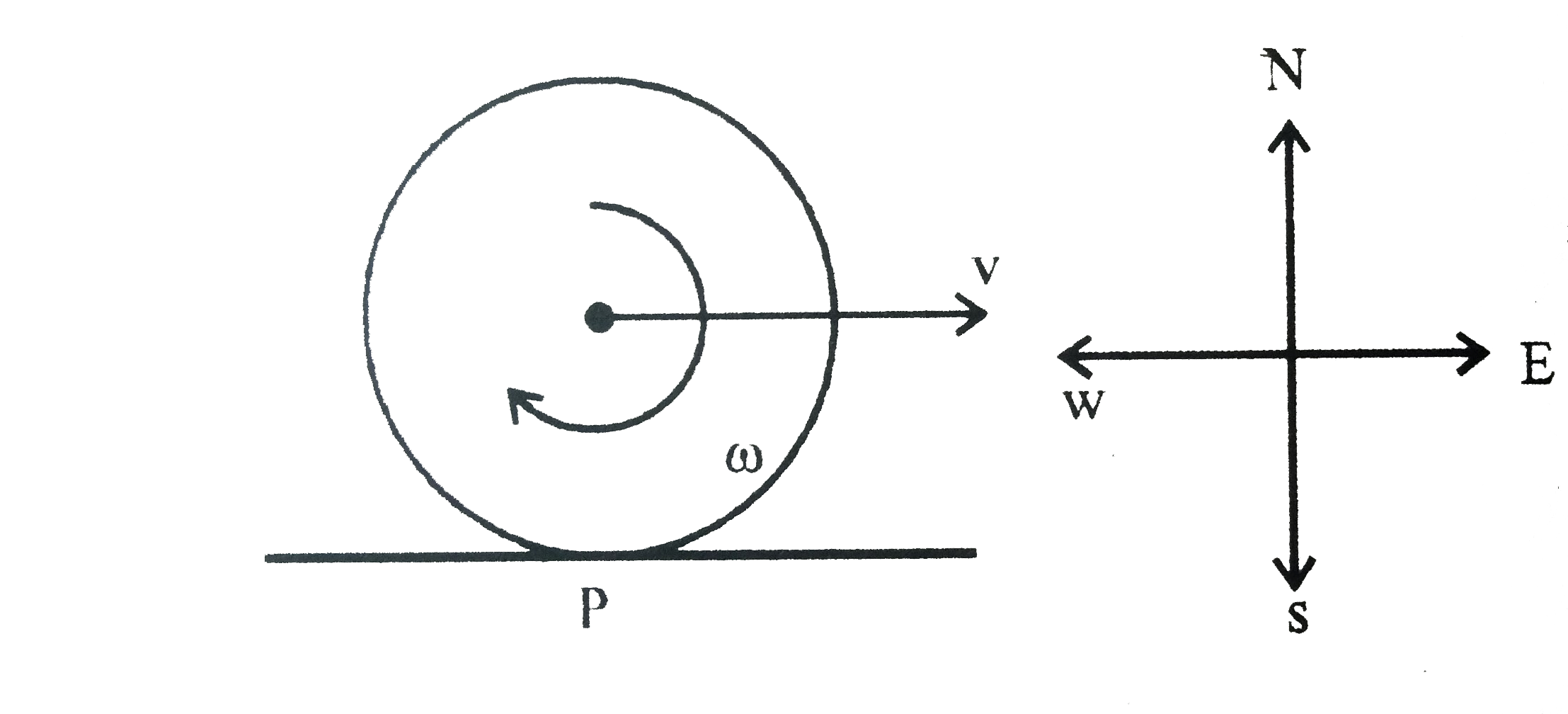 to have pure rolling POINT of contact must be REST. So ROTATION should be clockwise. Therefore ANGULAR velocity should be ALONG north. |
|
| 42. |
Two wheels are connected by a belt. The radius of the larger wheel is three times that of the smaller one. What is the ratio of the moment of inertia of larger wheel to the smaller wheel, when both wheels have same angular momentum? |
|
Answer» 3  As the belt does not SLIP , `v_(A) = v_(B)` or `r_A omega _A = r_(B) omega_(B) or (omega_(A))/(omega_(B)) = (r_(B))/(r_(A)) = 3` If both the wheels have same angular momentum , then `I_(A) omega_(A) = I_(B) omega_(B) or (I_(B))/(I_(A)) = (omega_(A))/(omega_(B)) = 3` |
|
| 43. |
A body of mass 100 gm is suspended from a massless spring of natural length 1 m. If the spring stretches through a vertical distance of 20 cm, the potential energy stored in the spring is (g = 10 ms^(-2)) |
|
Answer» 1.2 J |
|
| 44. |
Anaeroplane is flying eastward witha speed of 600 km*h^(-1) wind in blowing southwardwith a speed of 100 km*h^(-1) . Calculate the speed and direction ofthe aeroplane withrespect of the ground. |
|
Answer» |
|
| 45. |
A uniform rope of length L and mass m, hangs vertically from a rigid support. A block of mass m_(2)is attached to the free end of the rope. A transverse pulse of wavelengthlamda_(1)is produced at the lower end of the rope. The wavelength of the pulse when it reaches the top of the rope is lamda_(2). . The ratio lamda_(2)//lamda_(1)is ...... |
|
Answer» `sqrt (( m _(1) + m_(2))/( m _(2)))` (ii) At the UPPER end of wire, `T_(2) = (m _(1) + m _(2)) g ` Now, we have `v = f LAMDA = sqrt ((T)/(MU))` `therefore v _(1) = f lamda_(1) = sqrt ((T_(1))/( mu))` `v _(2) = f lamda_(2) = sqrt ((T_(2))/( mu ))` Taking ratio, `(lamda _(1))/( lamda _(2)) = sqrt (( T _(1))/( T _(2)) ) = sqrt (( m _(2) g )/( (m _(1) + m _(2)) g ))` `therefore (lamda _(2))/( lamda _(1)) = sqrt (( m _(1) + m _(2))/( m _(2)))` 
|
|
| 46. |
what is meant by elastic potential energy? Deerive an expression for the elastic potential energy of streched wire. Prove that its elasic energy density is equal to 1/2 x stress x strain |
|
Answer» Solution :ENERGY Density = `("Energy")/("VOLUME") =((1)/(2) (AY)/(L)x^(2))/(AL)` `=(1)/(2)((AY x)/(L))(x)/(L)` `=(1)/(2)(F)/(A)xx(x)/(L) ""[because Y=(FL)/(Ax)]` `=(1)/(2)"stress" xx"STRAIN"` |
|
| 47. |
The mass of a planet is half that of the earth and the radius of the planet is one - fourth that of earth . If we plan to send an artificail satellite from the planet , the escape velocity will be ( escape velocity on earth v_e= 11km-s^-1) |
|
Answer» `11 KMS^(-1)` |
|
| 48. |
A man who wears glasses of power 3D must hold a newspaper at least 25cm away to see the print clearly. How far would the newspaper have to be if he took off his glasses and still wanted clear vision? |
| Answer» Answer :C | |
| 49. |
The coefficient of kinetic friction between a 20 kg box and the floor is 0.40. How much work does a pulling force do on the box in pulling it 8.0 m across the floor at constant speed? The pulling force is directed 37^@ above the horizontal. |
| Answer» Solution :482 J | |
| 50. |
Define Lami's theorem. |
| Answer» Solution :If a system of three concurrent and coplanar FORCES is in EQUILIBRIUM, then Lami.s THEOREM states that the magnitude of each force of the system is proportional to SINE of the angle between the other two forces. The constant of proportionality is same for all three forces | |