

Saved Bookmarks
This section includes 7 InterviewSolutions, each offering curated multiple-choice questions to sharpen your Current Affairs knowledge and support exam preparation. Choose a topic below to get started.
| 1. |
A bird is sitting at the bottom of a cage and, in this condition, the cage is weighed with the help of a spring balance. Now, the bird starts flying inside the cage. Will the reading of the balance change? |
| Answer» Solution :The reading of the spring balance on the design of the bottom of the cage. SUPPOSE the bottom of the cage is totally covered with a METAL sheet. As SOON as the bird STARTS flying, it flaps its wings. Hence, due to an extra thrust developed in each flapping acting on the bottom of the cage, the reading of the spring balance fluctuates. But, if the bottom of the cage is covered with a net, then the reading of the spring balance will decrease. Because the spring balance will then give the reading of the weight of the cage only. | |
| 2. |
Assertion In isochoric process p-V graph is straight line parallel to p-axis. Reason In isochoric process density p remains constant. |
|
Answer» If both Assertion and REASON are correct and Reason is the correct explanation of Assertion. |
|
| 3. |
A liquid is filled into a vessel at rest with a hole in the wall closed by a valve. It is filled with the liquid to a height .h. above the valve. What horizontal acceleration .a. should be given to the vessel, so that the liquid does not come out of hole valve is opened ? The base length of vessel is |
| Answer» Answer :A | |
| 4. |
A uniform cube of slide a and mass m rests on a rough horizontal table. A horizontal force F is applied normal to one of the face at a point directly above the centre of the face, at a height 3a/4 above the base. What is the minimum value of F for which the cube begins to topple about an edge ? |
Answer» SOLUTION :In the limiting cse normal REACTION will PASS through O. The cube will TOPPLE about O if torque of F ecceeds the torque of MG. `rArr F((3a)/(4))gt mg((a)/(2)), rArr F gt (2)/(3)mg` So, the minimum value of F is `(2)/(3)mg`. |
|
| 5. |
A vertical glass tube, closed at the bottom contains mercury to a height of 100cm at 30°C. The height of mercury column at 50°C is. ( gamma for Hg = 1.8 xx 10^(-4)//""^(@) C, alpha_(g) = 8 xx 10^(-6)//""^(@) C) |
|
Answer» 100.329 cm |
|
| 6. |
A drop of water detaches itself from the exit of a tap when [sigma= surface tension of water, rho= density of water, R = radius of the tap exit, r = radius of the drop] |
|
Answer» ` R gt (2/3(Rsigma)/(rho g))^((1)/(3))`  `=Fsintheta=sigmaxx2piR sin theta` `=sigmaxx2piRxxR/r=(2pisigmaR^2)/(r )` Weight of the drop of water = MG `=4/3 pi r^3 rho g` The drop will detach if, `4/3pi r^3 rho g gt (2pi sigma R^2)/(r ) or, r^4 gt (3 sigma R^2)/( 2 rho g)` `thereforer gt ((3)/(2) (sigma R^2)/(rho g))^(1/4)` NONE of the options are CORRECT. |
|
| 7. |
The gravitationl potential due to a mass distribution isV = (A)/(sqrt(x^(2) + a^(2))), then the gravitational. Field is. |
|
Answer» `(AY)/((X^(2) + a^(2))^(1//2))`in the x-direction |
|
| 8. |
Consider the 6 idential rods as shown in figure, the conductivity of x is double that of y. The temperatre of the junciton B is |
|
Answer» `30^(@)C` `R_(x) = R, R_(y) = 2 R` Let temperature of `B` is `theta`. Current will flow in the ROD `DE` `i= (60 - theta)/(R ) = (theta - 10)/((3R)/(2))` `180 - 3 theta = 2 theta - 20` `5 theta = 200` `theta = 40^(@)C` 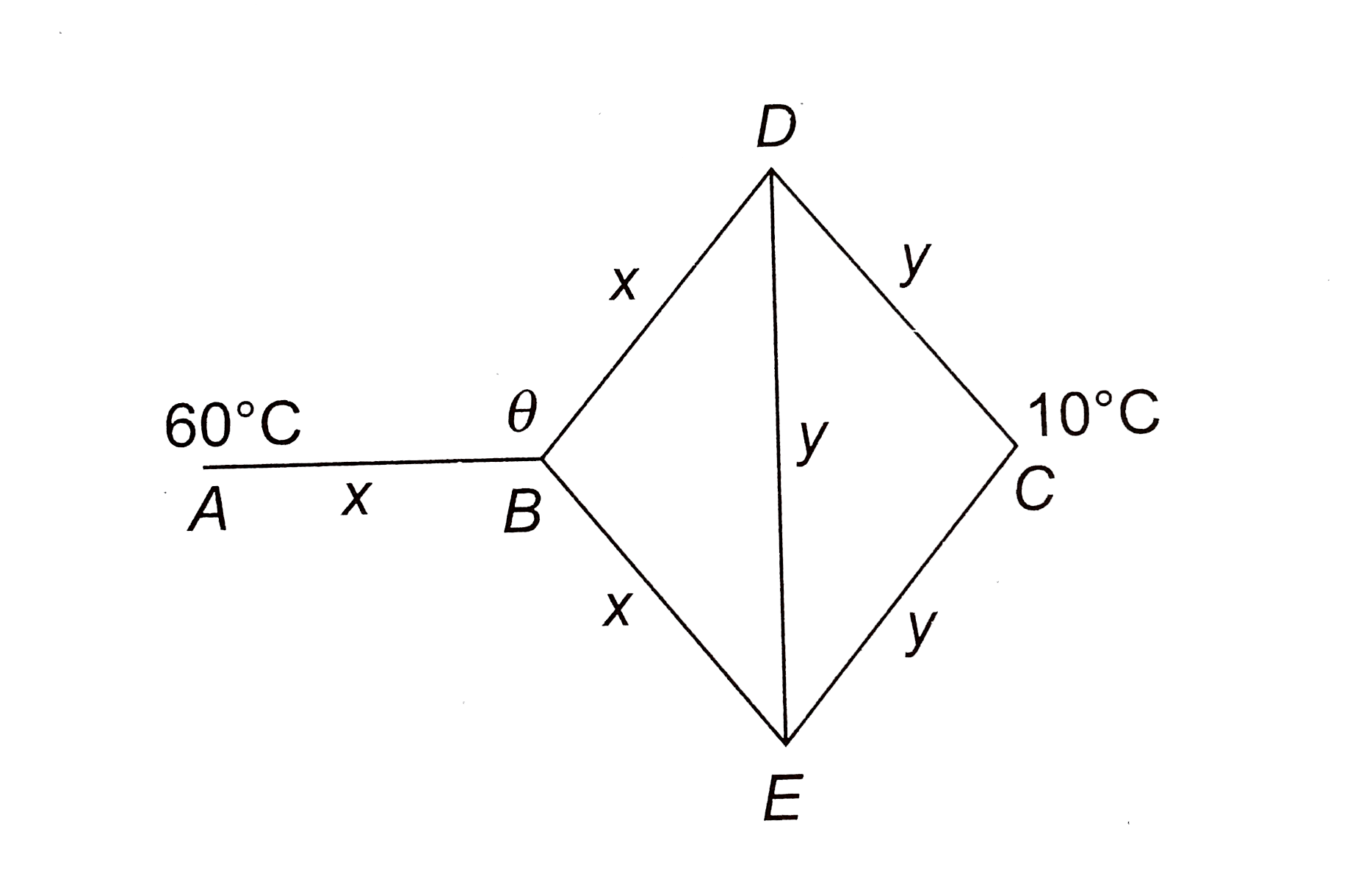  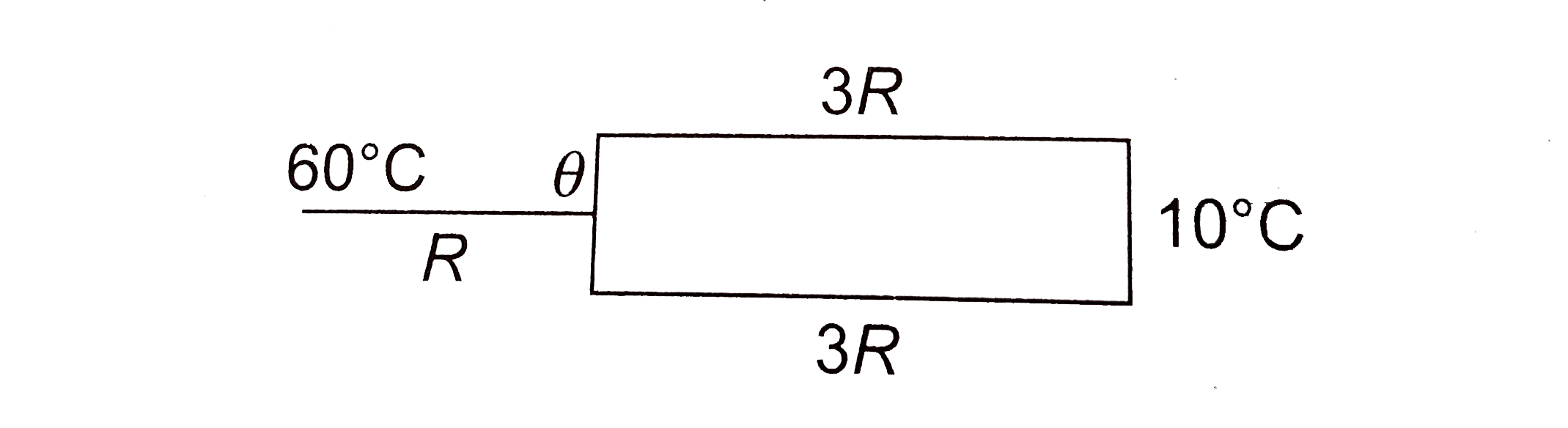
|
|
| 9. |
A small body of superdense material, whose mass is half the mass of the earth but where size is very small compared to the size of the earth. Starts from rest at a hight H lt lt Rabove the earth.s surface and radius the earth.s surface in time .t., then .t. is equal to |
|
Answer» `SQRT(2H//g)` |
|
| 10. |
What should be the length of a day on the earth when a body has no apparent weight at the equatorial region? (Radius of the earth = 6400 kg)or, should be the time period of rotation of the earth about its own axis so that a person on the equator feels weightless?(Equatorial radius = 6400 km,g = 9.8 mcdot s^(-2)) |
|
Answer» Solution :Weight mg of a body acts towards the centre of the earth. If the radius of the earth is R, at the EQUATORIAL region, the centrifugal FORCE experiencedby the body is `m omega^(2)` R, where, `omega` is the angular velocity of the earth about its own axis. When the centrifugal force acting on the body becomes equal and opposite ot the weight of the body, the apparent weight of the body becomes zero. In that case, mg = m`omega^(2)` R or,` "" omega = sqrt((g)/(R))` So, length of a day = time period of rotation of the earth (T) ` = (2pi)/(omega) = 2pi sqrt((R)/(g)) = 2pi xxsqrt( (6400 xx 10^(3))/(9.8) ) =` 5077.6 s = 1 h 24.6 min. |
|
| 11. |
A beam of light from a source L is incident normally on a plane mirror fixed at a certain distance x from the source. The beam is reflected back as a spot on a scale placed just above the source L, when the mirror is rotated through a small angle theta the spot of the light is found to move through a distance y on the scale. The angle theta is given by: |
| Answer» ANSWER :B | |
| 12. |
The change in temperature of a substance , when a given quantity of heat is absorbed or rejected by it is characterised by the heat capacity. Define specific heat capacity, molar specific heat capacity at constant presssure and molar specific heat capacity at constant volume. Give the reason for using water as a coolant in automobile radiators. |
|
Answer» SOLUTION :For definations, The reason for using water as a coolant is its HIGH SPECIFIC heat CAPACITY. |
|
| 13. |
If the length of a cylinder is measured to be 4.28cm with an error of 0.01cm. The percentage error in the measured length is nearly |
|
Answer» 0.004 |
|
| 14. |
An open pipe made up of glass is immersed in mercury in such a way that a length of 8 cm extends above the mercury level. The open end of the tube is then closed and sealed and the tube is raised vertically up by additional 46 cm. What will be length of the air column above mercury in the tube now?(atm pressure =76 cm of HG) |
|
Answer» 16cm So, initially volume of the above MERCURY `V_1=8A cm^3`, pressure `=p_1 76 cmHg` When the top of the pipe is (46+8) or 54 cm higher than the outer mercury level [Fig.1.9] let x=rise of mercury level INSIDE the pipe Then volume of air inside the pipe, `v_2=(54-x)a cm^3` and its pressure `p_2(76-x)cmHg` From Boyle.s law `p_1V_1=p_2V_2` or, `76 times 8a=(76-x)(54-x)a` or, `608=1404-130x+x^2` or, `x^2-130x+3496=0` or, `(x-38)(x-92)=0`, So x=38 cm or, x=92 cm The only physically meaningful solution is x=38 cm. Therefore the LENGTH of the air column in the pipe above mercury =`54-38=16 cm` 
|
|
| 15. |
A ball released from a heightof 20m, hits the ground and rebounds to a height of 16m. The percentage loss of energy during collision is |
|
Answer» 0.2 |
|
| 16. |
The simple harmonic oscillation of a particle are according to the equation x=5os(2pit+(pi)/4) metre. Find the (i) displacement (ii) velcoity and (iii) acceleration at t=0. |
|
Answer» SOLUTION :Comparing with the general equation `x=A COS (omegat +phi_(0))` Amplitude `A=5m` and `omega=2pi` (i) Displacement `x=5 cos (2pit+(pi)/4)` metre when `t=0, x=x_(0)=5"cos"(pi)/4=5xx1/(sqrt(2))=3.54m` (ii) velocity `v=omega sqrt(A^(2)-x^(2))` when `t=0, v=v_(0)=omegasqrt(A^(2)-x_(0)^(2))` `=2pisqrt(5^(2)-(5/(sqrt(2)))^(2))=2pisqrt(25-25/2)` `=2pisqrt(25/2)=22.2ms^(-1)` (III) Acceleration `a=-omega^(2)x` when `t=0=a=a_(0)=-omega^(2)-omega^(2)x_(0)` `=-(2pi)^(2)3.54=-4pi^(2)(3.54)^(2)` `:.a_(0)=139.42ms^(-2)` |
|
| 17. |
Match lists I and II |
|
Answer» |
|
| 18. |
A block is placed at the top of an inclined plane 5 m long. The plane makes an angle of 60^(@) with the horizontal. If the coefficient offriction between the wood and the plane is 0.3, find the time taken by the block of slide down the bottom of the plane. |
| Answer» SOLUTION :`t=SQRT(2S//a)=sqrt(2s(sintheta-mucostheta)G)=sqrt(2xx5(sin60-0.3cos60)xx9.8)=1.19s` | |
| 19. |
A person fire bullet of 40 g w ith speed of 1200 m /s from his rifle. If rifle can w ithstant maximum recoil force of 144 N. How many bullet he can fire every second ? |
|
Answer» 1 `m= 40 g= 40 xx10^(-3)kg` `v=1200 m//s` Momentumof one buller= mv Letpersone firen bulleteverysecond Totalmomentumof nbullet `=nmv ` RECOIL FORCE NowF= MNV `n=(F)/(m v) = (144)/( 40 xx 10^(-3)xx 1200)` `= 3` Person can fire3 bulleteverysecond |
|
| 21. |
The surface tension of a liquid decreases with a rise in |
|
Answer» DIAMETER of container |
|
| 22. |
For a concave mirror of focal length 20 cm, match the following |
|
Answer» <P> |
|
| 23. |
A black body emits radiations of maximum intensity at wavelength of 5000Å When the temperature of the body is 1227^(@)C. If the temperature of the body is increased by 1000^(@)C, the maximum intensity of emitted radiation would be observed at. . . . . . . |
|
Answer» `3000Å` `lamda_(m)T=` constant `:.lamda_(m_(1))T_(1)=lamda_(m_(2))T_(2)` `:.lamda_(m_(2))=lamda_(m_(1))XX(T_(1))/(T_(2))` `lamda_(m_(1))=5000Å` `T_(1)=1227^(@)C=1500K` `T_(2)=2227^(@)C=2500K` `lamda_(m_(2))=?` `=5000xx(1500)/(2500)` `:.lamda_(m_(2))=3000Å` |
|
| 24. |
These questions consists of two statements each printed as Assertion and Reason. While answering these question you are required to choose any one of the following four responses Assertion A particle is thrown vertically upwards. If air resistance is taken into consideration then retardation in upward journey is more than the acceleration in downward journey. Reason Some mechanical energy is lost in the form of heat due to air friction. |
Answer»  Acceleration in downward journey, `a_(2)=(w-F)/(m)` `THEREFORE a_(1) gt a_(2)` |
|
| 25. |
These questions consists of two statements each printed as Assertion and Reason. While answering these question you are required to choose any one of the following four responses Assertion In the diagram shown in figure, string is massless and pulley is smooth, Net force on 1 kg block is (10)/(3)N. Reason Net force on both the blocks will be same. |
Answer»  Solving we GET, `F_("net")=(10)/(3)N` |
|
| 26. |
A refrigerator is to maintain eatables kept inside at 9^@ C. If room temperature is 36^@ C, calculate the coefficient of performance of refrigerator. |
|
Answer» 10.4 `T_2`=9+273 =282 K COEFFICIENT of PERFORMANCE of refrigerator , `beta=T_2/(T_1-T_2)=282/(309-282)=282/27` `therefore beta=10.4` |
|
| 27. |
These questions consists of two statements each printed as Assertion and Reason. While answering these question you are required to choose any one of the following four responses Assertion A string has a mass m. If it is accelerated, tension is non-uniform and if it is not accelerated, tension is uniform. Reason Tension force is an electromagnetic force. |
Answer» 
|
|
| 28. |
These questions consists of two statements each printed as Assertion and Reason. While answering these question you are required to choose any one of the following four responses Assertion Static friction acting on a body is always greater than the kinetic friction acting on this body. Reason Coefficient of static friction is more than the coefficient of kinetic friction. |
|
Answer» Since `mu MG cos THETA` is more, BLOCK will remain stationary. |
|
| 29. |
Sometimes positive charged particle comes from space towards earth with high velocity. Its deviation due to the magnetic field of earth will be: |
|
Answer» TOWARDS north |
|
| 30. |
Find the depression of mensicus in the when a capillary tube of diameter 0.2 mm is dipped in a beaker containg mercury. density of mercury is 13.6xx10^(-3)Kgm^(-3), angle of contact is 130^(@) surface tension of mercury is 0.49Nm^(-1),g=9.8ms^(-2). |
|
Answer» |
|
| 31. |
These questions consists of two statements each printed as Assertion and Reason. While answering these question you are required to choose any one of the following four responses AssertionA body of mass 10 kg is placed on a rough inclined surface (mu=0.7). The surface is inclined to horizontal at angle 30^(@). Acceleration of the body down the plane will be zero. Reason Work done by friction is always negative. |
|
Answer» `MU mg COS theta=0.7xx10xx10xx(SQRT(3))/(2)=60.62N` |
|
| 32. |
The magnitude of scalar and vector products of two vector are 48 sqrt(3) and 144 respectively. What is the angle between the two vectors ? |
|
Answer» `30^(@)` |
|
| 33. |
An eraser weighing 2N is pressed against the black board with a force of 5N. The coefficient of friction is 0.4. How much force parallel to the black board is required to slide the eraser upwards |
|
Answer» 2N |
|
| 34. |
A ray of light is incident on a glass sphere of refractive index 3//2 What should be the angle of incidence so that the ray which enters the sphere does not come out of the sphere? |
|
Answer» `tan^-1(2//3)` |
|
| 35. |
These questions consists of two statements each printed as Assertion and Reason. While answering these question you are required to choose any one of the following four responses Assertion Block A is resting on one corner of a box as shown in figure. Acceleration of box is (2hati+2 hatj)ms^(-2). Let N_(1) is the normal reaction on block from vertical wall and N_(2) from ground of box. Then (N_(1))/(N_(2))=(1)/(6).(Neglect friction) Reason N_(1)=0, if lift is stationary. |
|
Answer» `N_(2)=m(g+a_(y))=12m` `THEREFORE"" (N_(1))/(N_(2))=(1)/(6)` |
|
| 36. |
These questions consists of two statements each printed as Assertion and Reason. While answering these question you are required to choose any one of the following four responses Assertion Two forces are acting on a rope lying on a smooth table as shown in figure. In moving from A to B, tension on string decrease from 2F to F. Reason Situation will becomes in determinant, if we take it a massless string. |
|
Answer» `a=(2F-F)/(0)=oo` |
|
| 37. |
These questions consists of two statements each printed as Assertion and Reason. While answering these question you are required to choose any one of the following four responses Assertion In the shown figure, tension T connected to the ceiling is 10 N lt T lt 20 N Reason System is not stationary. |
|
Answer» `T_(0)-10=1xxa` `therefore T_(0) gt 10N, 20-T_(0)=2xxa` `therefore"" T_(0) lt20N` |
|
| 38. |
These questions consists of two statements each printed as Assertion and Reason. While answering these question you are required to choose any one of the following four responses Assertion In the figure shown, block of mass m is stationary with respect to lift. Force of friction acting on the block is greater than mg sin theta. Reason If lift moves with constant velocity, then force of friction is equal to mg sin theta |
Answer»  `THEREFORE "" f=m(g+a)sin theta GT mg sin theta` |
|
| 39. |
The velocity of a rain drop attains constant value because of ………….. . |
|
Answer» (a) surface TENSION |
|
| 40. |
These questions consists of two statements each printed as Assertion and Reason. While answering these question you are required to choose any one of the following four responses Assertion In the system of two blocks of equla masses as shown, the coefficient of friction between the blocks (mu_(2)) is less than coefficient of friction (mu_(1)) between lower block and ground. For all values of force F applied on upper block, lower block remains at rest. Reason Frictional force on lower block due to upper block is not sufficient to overcome the frictional force on lower block due to ground. |
|
Answer» `(f_(1))_("max")-mu_(1)(2M)(g)` Since `(f_(1))_("max")gt (f_(2))_("max")` Lower BLOCK will not move at all. |
|
| 41. |
The length of a rectangular sheet is 1.5cm and breadth 1.203 cm. The area of the sheet is |
|
Answer» 1.8045 `cm^2` |
|
| 42. |
The Doppler effect is applicable for ………… |
| Answer» Solution :both (a) and (b) | |
| 43. |
Explain method for measurement of dimension of a planet or star. |
|
Answer» Solution :Angular diameter: From a point on surface of the earth angle subtended at diameter of the earth is called angular diameter `(alpha)`. Let diameter of the earth is d. As shown in figure from point of observation on surface of the earth a can be obtained at diametrically opposite point. DISTANCE between the earth and planet (Star) is D.  `alpha=(d)/(D)` (radian) isused to MEASURE diameter (d) of the planet. `I^(@)`(degree) =60. (MIN) I. (min)=60.. (SEC) `I^(@)=3600..` (sec) |
|
| 44. |
Air is streaming past a horizontal aeroplane wing such that the speed of air is 120 m/s over the upper surface and 90 m/s at the lower surface, with respect to the plane. If the density of air is 1.3kg/m^(3) , find the difference in pressure between the top and bottom of the wing. If the wing is 10m long and has an average width of 2m, calculate the gross lift of the wing. |
|
Answer» Solution :Neglecting the difference in gravitational potential energy across the THICKNESS of the WING, accoring to Bernouli.s EQUATION, `P_(1)+(1)/(2)rhoV_(1)^(2)` i.e. `P_(1)-P_(2)=(1)/(2)rho(v_(2)^(2)-v_(1)^(2))` `=(1)/(2)(1.3 kg//m^(3))(120^(2)-90^(2))(m//s)^(2)=4.1xx10^(3)N//m^(2)` Now, the net uplift due to the difference in pressure is `F_(up)=DeltaPxxA` `=(4.1xx10^(3)N//m^(3))(10xx2m^(2))=8.2xx10^(4)N` Note that this is not force of buoyancy (B) as B is a fluid static force. |
|
| 45. |
A river isflowing from west to east at a speed of 5 m/s. A man on the south bank of the river capable of swimming it 10 m/s in still water is to swim across the river in shortest path. The direction which he should swim is |
|
Answer» `120^(@)` opposite to the direction of FLOW of RIVER |
|
| 46. |
Which one of the following fundamental forces in nature binds protons and neutrons in a nucleus? |
|
Answer» GRAVITATIONAL force |
|
| 47. |
(i) Determine the height 'h' to which water rises when capillary tube of radius 0.2 mm is dipped vertically in a beaker containg water (Surface tension of water = 7.0xx10^(-2)Nm^(-1) and angle of contact 0^(@)) (ii) Discuss what will happen if the capillary tube is now pushed down till its height above the surface of water is 4cm. Assume that the density of water is 1000kgm^(-3) and g is 10ms^(-2). |
|
Answer» Solution :i) FORMULA : `h=(2Scostheta)/(rrhog)` Angle of contact `theta=0^(@) therefore cos0^(@)=1` Surface tension `S=7xx10^(-2)Nm^(-1)` Density of water `d=1000kgm^(-3)` Acceleration due to gravity `g=10ms^(-2)` Radius of the tube `r=(0.2//1000)m` `therefore` Height `h=(2XX(7xx10^(-2))xx1)/(((0.2)/(1000))xx(1000)xx(10))=7xx10^(-2)mor7cm`. II) However, when the capillary tube is pushed down till its height above the surface of water is 4 cm, the water rises up to 4 cm only and it will not over flow. In this SPECIAL case the angle of contact will change. `(h_(2))/(h_(1))=(costheta_(2))/(costheta_(1))impliescostheta_(2)=(h_(2))/(h_(1))costheta_(1)` here `h_(1)=7cm, h_(2)=4cm, theta_(1)=0^(@)` `costheta_(2)=cos^(-1)(0.5714)=55^(@)` |
|
| 48. |
A square lead slab of side 50 cm and thickness 10 cm is subject to a shearing force (on its narrow face) of 9.0xx10^(4)N. The lower edge is riveted to the floor How much will the upper edge be displaced ? |
|
Answer» Solution :The leadslab is fixed and the force is appliedparallelto the narrowface as shownin figure. The areaof the face parallelto which this force is appliedis `A=50cm xx 10 CM =0.05 m^(2)` THEREFORE the stressapplied is `=(9.4xx10^(4) //0.05)=1.80 xx 10^(6) N.m^(-2)`  We know thatshearing strain `=(DELTAX//L)="Stress"//G.` Therefore the dispalcement `Deltax=("Stress"xxL)//G` `=(1.8xx10^(6)xx0.5)//(5.6xx10^(9))=0.16mm` |
|
| 49. |
Two cars 1 & 2 starting from rest are moving with speeds V_1 and V_2 m//s (V_1 gtV_2). Car 2 is ahead of can '1' by 'S' metres when the driver of car '1' sees car '2'. What minimum retardation should be given to cart avoid collision |
|
Answer» `(V_1 - V_2)/(S)` |
|
| 50. |
The position of the particle is represented by y = ut-1/2 "gt"^2 (a) What is the force acting on the particle? (b) What is the momentum of the particle? |
|
Answer» Solution :To find the force, we need to find the ACCELERATION experienced by the particle. The acceleration is given by `a= (d^2 y)/(dt^2) " or" a = (dv)/(dt)` Here v= velocity of the particle in y direction ` v = (dy)/(dt) = u - "gt"` The momentum of the particle ` = mv = m ( u - "gt" )` `a = (dv)/(dt) = - g` The force ACTING on the object is given by F = ma = -mg The negative SIGN implies that the force is acting on the negative y direction. This is exactly the force that acts on the object in projectile motion. |
|