Saved Bookmarks
This section includes 7 InterviewSolutions, each offering curated multiple-choice questions to sharpen your Current Affairs knowledge and support exam preparation. Choose a topic below to get started.
| 1. |
A particle moves so that its position as a function of time in SI units is vec(r)= hat(i)+4t^(2)hat(j)+t hat(k). The trajectory of the particle is |
|
Answer» A parabola |
|
| 2. |
A and B are two points on a uniform metal ring whose centre is C. The angle ACB=theta. A and B are maintained at two different constant temperatures. When theta=180^(0), the rate of total heat flow from A to B is 1.2 W. When theta=90^(0), this rate will be |
|
Answer» `0.6` WATT |
|
| 3. |
The maximum and minimum tensions in a string of length 0.1 m with a stone 5g tied to it and whirled in a vertical circle are in the ratio 13 : 1. The velocity of the body at highest point is |
|
Answer» `0.7 ms^(-1)` |
|
| 4. |
A body of mass 5 kg climb a height of 10 m by the force of 170 N . Its velocity at this heightwil be ………. |
|
Answer» 15 m/s `= 170 xx10` ` = 1700 J ` gravitationalpotential energy U = MGH ` = 5 xx 10 xx10` = 500 J Now , kintic energy = `W - U ` ` :. 1/2 mv^(2) = 1700 - 500` ` :. 1/2 mv^(2) = 1200 J ` ` :. v = sqrt((2xx1200)/5) = sqrt((2400)/5)` ` :. v = sqrt(480)` = `21.90` ` :. v = 22` m/s (approximate) |
|
| 5. |
In Ingen Hauz's experiment ther are two identical rods, (idetical in respect of length and cross-section area) coated uniformly with wax. The material of one rod is copper, whose thermal conductivity, sp. heat capacity and density are 285, 285 and 8930 SI units, respectively and the material of the other is silver whose thermal conductivity sp. heat capacity and density are 419, 235 and 10500 SI units, respectively. Compare the lengths to which wax will melt in the two rods. In which case will the wax melt first? |
|
Answer» |
|
| 6. |
Two cylinders A and B of equal capacity are connected to each other via a stopcock. A contains a gas at standard temperature and pressure. B is completely evacuated. The entire system is thermally insulated. The stopcock is suddenly opened. Answer the following : (a) What is the final pressure of the gas in A and B ? (b) What is the change in internal energy of the gas ? (c) What is the change in the temperature of the gas ? (d) Do the intermediate states of the system (before settling to the final equilibrium state) lie on its P-V-T surface ? |
|
Answer» Solution :The GAS UNDERGOES free expansion. During this process the work done `dw=0`(zero). As the system is thermally insulated `dQ=0` (zero). Hence there is no change is internal ENERGY or temperature. a) Initial stage of gas P,V final state after expansion `P_(1), 2V` from Bolyer law `PV=P_(1) 2V` ` :. P_(1)=P/2"" :. "Pressure is halved" ` b) `dU=0` c) `dT=0` d) During the INTERMEDIATE stages, the parameters change QUICKLY and the gas does not attain equilibrium. So the gas does not obey gas equation hence they do not appear on P,V,T surface. |
|
| 7. |
Explin dynamic lift of a spinning ball? |
| Answer» SOLUTION :DUE to the PRESSURE DIFFERENCE velocity below the BALL will be increases. | |
| 8. |
Calculate excess pressure inside an air bubble of radius 1.0 mm and just below the surface of water. What will be the pressure inside the soap bubble? |
|
Answer» Solution :GIVEN `r=1 xx 10^(-3)m` `T=0.072 Nm^(-1)` EXCESS PRESSURE `=(2T)/(r)` (because it has only the inner suface= `(2 xx 0.072)/(1 xx 10^(-3))` `=144 Nm^(-2) =0.00144 xx 10^(5)` Net pressure INSIDE the BUBBLE is `=P_(0)+(2T)/(r)=1.013 xx 10^(5)+0.00144+10^(5)` Net pressure `=1.0144 xx 10^(5)Nm^(-2)` |
|
| 9. |
The value of g at a particular point is 9.8 m//s^2 Suppose the earth suddenly shrinks uniformly to half its present size without losing any mass. The value of g at the same point (assuming that the distance of the point from the centre of the earth does not shrink) will now be : .......... |
|
Answer» `4.9 m//s^2` Here MASS and radius are unchanged |
|
| 10. |
A remote - sensing satellite of earth revolves in acircular orbit at a height of 0.25 x 10⁶ m above the surface of earth. It earth's radius is 6.38 xx 10^(6)m and g = 9.8 ms^(- 2) , then the orbital speed of the satellite is .......... |
|
Answer» `6.67 kms^(-1)` `v_0 = SQRT((GM_e)/(Re+h))= sqrt((GMe)/(Re(1+h/(Re))))` `:. v_0 = sqrt((gRe)/(1+h/(Re)))""[ :. GM_e = gR_e^2]` `:. v_0 = sqrt((9.8 xx6.38 xx10^6)/(1+(0.25xx10^6)/(6.38 xx 10^6)))` `:. v_0 = sqrt(62.524 xx10^6)/(1.0392)` `:. v_0 =sqrt(60.16 xx 10^6)` `:. v_0 = 7.7566 xx 10^3 m//s` `:. v_0 ~~ 7.76 kms^(-1)` |
|
| 11. |
(A) : The spring constant of a spring is k. When it is divided into n equal parts, then spring constant of one piece is nk. (B): The spring constant is independent of material used for the spring. |
|
Answer» Both 'A' and 'R' are TURE and 'R' is the correct explanation of 'A' |
|
| 12. |
The volume of water flowing out through a pipe in a given time is V = KA^2ut, where A is the area of cross-section of the pipe, u is the speed of the flow, t is the time and K is a dimensionless constant. Check the correctness of the equation. |
|
Answer» SOLUTION :V = `KA^2ut` [LHS] - `[L^3]` [LHS] = `[L^2][LT^-1][T]` = `[L^5]` [LHS] `ne` [RHS], the EQUATION is wrong. |
|
| 13. |
What is non uniform circular motion? |
| Answer» SOLUTION :If the speed of the object in circular motion is not constant, then we have non-uniform circular motion. For example, when the bob attached to a string moves in vertical circle, the speed of the bob is not the same at all time. Whenever the speed is not same in circular motion, the PARTICLE will have both centripetal and TANGENTIAL ACCELERATION. | |
| 14. |
A satellite of mass m orbits around the Earth in an elliptical path of semi-major and semi-major axis 2a and a respectively such that the Earth is located at one of the foci of the elliptical path. Atan instant when the satellite is located at a distance of r, its velocity is n at an angle of 60^(@) with respect to the position vector of the satellite from the centre of the Earth, Consider only the gravitational force between the satellite and the Earth and assume that the Earth is perfect sphere. (Assume that mass of the satellite is neglible as compared to mass of the Earth ) |
|
Answer» Orbitalangular momentum of the satellite with respectto centre of the Earth is `(sqrt(3))/(2)` mur |
|
| 15. |
The volume of water flowing out through a pipe in a given time is V = KA^2ut, where A is the area of cross-section of the pipe, u is the speed of the flow, t is the time and K is a dimensionless constant. Name the principle that can be used to check the dimensional correctness of this equation. |
| Answer» SOLUTION :PRINCIPLE of HOMOGENEITY of DIMENSIONS. | |
| 16. |
A solid rolls down two different inclined planes of the same heights but different angle of inclination. Will it take longer to roll down one plane than the other ? |
|
Answer» Solution :We know that `a=(gsintheta)/(1+(K^2)/(R^2))` where `R^2=2/5R^2` `:. A=5/7gsintheta"":.apropsintheta` We also note that `s_1=1/2a_1t_1^2` and `s_2=1/2a_2t_2^2` i.e `s_1=1/2xx5/7gsintheta_1t_1^2=((5G)/(12))sintheta_1t_1^2` i.e `t_1^2=((12s)/(5gsintheta_1))` similarly, `t_2^2=(12s)/(5gsintheta_2)` Here `s_2>s_1` and `theta_2 i.e. Time TAKEN for the sphere in the second case with smaller inclination is more than that for the PLANE with greater inclination |
|
| 17. |
A solid rolls down two different inclined planes of the same heights but different angle of inclination. If so, which one and why ? |
|
Answer» Solution :We KNOW that `a=(gsintheta)/(1+(K^2)/(R^2))` where `R^2=2/5R^2` `:. A=5/7gsintheta"":.apropsintheta` We ALSO NOTE that `s_1=1/2a_1t_1^2` and `s_2=1/2a_2t_2^2` i.e `s_1=1/2xx5/7gsintheta_1t_1^2=((5g)/(12))sintheta_1t_1^2` i.e `t_1^2=((12S)/(5gsintheta_1))` similarly, `t_2^2=(12s)/(5gsintheta_2)` Here `s_2>s_1` and `theta_2 i.e. Time taken for the sphere in the SECOND case with smaller inclination is more than that for the plane with greater inclination |
|
| 18. |
A motor is pumping water with a velocity of 20ms^(-1) from a pump of area of cross section 10cm^(2). Its average power is |
|
Answer» 8kW |
|
| 20. |
A solid rolls down two different inclined planes of the same heights but different angle of inclination. Will it reach the bottoms with the same speed in each case ? |
Answer» SOLUTION :LINEAR KE=`1/2mv^2`ROTATIONAL K.E`=1/2Iomega^2=1/5mv^2`  `:. T.E=1/2mv^2+1/5mv^2=7/(10)mv^2`but T.E=mgh `:. Mgh=7/(10)mv^2`i.e `v=sqrt((10)/(7)gh):'vproph` v is the same for both the cases. Yes, the solid sphere will reach the BOTTOM with the same speed both the cases. |
|
| 21. |
To tighten the bolt, we prefer to use a wrench with a long arm why? |
| Answer» Solution :Torque `vect=vecrxxvecf` = long arm `XX` force. When are (r ) is long, the torque is increased. Thus a SMALLER force can produce a LARGE turning EFFECT. | |
| 22. |
The time period of a satellite orbiting Earth in a circular orbit is independent of |
|
Answer» RADIUS of the orbit |
|
| 23. |
A bomb explodes in mid-air into two equal fragments. What is the direction of motion of the two fragments? |
|
Answer» |
|
| 24. |
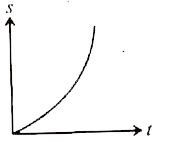
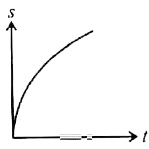
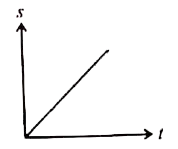
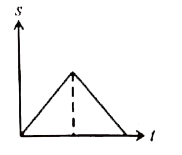
Which graph pertains to uniform acceleration . |
|
Answer»
|
|
| 25. |
A force vec(F)=Ahat(i)+Bhat(j) acts at a point whose radius vector w.r.t origin is rahat(i)+bhat(j), where a,b, A and B are constant and gt are unit vector along X and Y axes then : |
|
Answer» Torque about O is `(aB-bA)HAT(K)` |
|
| 26. |
For increase in internal energy of a system is equal to the work done on the system. Which process does the system undergo ? |
|
Answer» Isothermal `DeltaQ=DeltaU+DeltaW` Here `DeltaU=-DeltaW` `therefore DeltaQ=-DeltaW+DeltaW` `therefore DeltaQ=0` Therefore, the PROCESS is adiabatic. |
|
| 27. |
Two moles of helium gas are taken over the cycle ABCDA, as shown in below in P-T diagram. Assuming the gas to be ideal , the work done on the gas in taking it from A to B is |
|
Answer» 300 R `:. W = nRDelta T = 2 xx R xx (500 - 300) = 400 R` |
|
| 28. |
The thermal capacity of a body a) per unit volume is product of density and specific heat b) is product of mass and specific heat c) is product of volume and specific heat |
|
Answer» only a is CORRECT |
|
| 29. |
The dimensionally correct formula is |
|
Answer» `S= u + (1)/(2) a t^(2)` |
|
| 30. |
A constant volume gas thermometer show pressure reading of 50cm and 99 cm of mercury at 0^(@)C and 100^(@)C respectively. When the pressure reading is 60 cm of mercury, the temperature is |
|
Answer» `25^(@)` |
|
| 31. |
A satellite moves around the earth in a circular orbit with speed V. If.m. is the mass of the satellite, its total energy is: |
|
Answer» `-1/2mv^(2)` |
|
| 32. |
Prove that in static equilibrium the pressure exerted by a fluid decreases with its height. |
Answer» Solution :Let us assume two layers at heights h and h + dh from the base inside a fluid. Let the density of the fluid = `rho`. A PART having UNIT cross-sectional area and THICKNESS dh is considered.  So, the mass of the part = `rhodh`. Let the upward pressure on this part be p and the downward pressure = p + dp. `therefore` In EQUILIBRIUM, `(p+dp)-p+(rhodh*g)=0or,(dp)/(dh)=-rhog` `(dp)/(dh)` is negative, which indicates that with increase in h, the value of p decreases. So, it is seen that the pressure exerted by the fluid goes on DECREASING with its height from the base. |
|
| 33. |
A body starts from rest and acquires a velocit V in time T. The work done on the body is time t is proportional to |
|
Answer» `V/T t` |
|
| 34. |
Unpredictable fluctuations in temperature, voltage supply, mechanical vibrations of experimental set-ups, etc, lead to |
|
Answer» RANDOM errors |
|
| 35. |
Define inverse square law of sound intensity. |
|
Answer» Solution :Sound INTENSITY is inversely PROPORTIONAL to THA square of the distance from the SOURCE. `I=("power of the source")/(4pir^(2))` `rArr I prop(1)/(r^(2))` This is known as inverse square law of sound intensity. |
|
| 36. |
If the law of gravitational be such that the force of attraction between two particles varies inversely as the 5/2th power of their separation then the graph of orbital velocity v_(0) plotted against the distancer of a satellite from the earth's centre on a log-log scale is shown. The slope of the line is |
|
Answer» `-(3)/(4)` |
|
| 37. |
A satellite moves around the earth in a circular orbit with speed V. If.m. is the mass of the satellite, its potential energy is: |
|
Answer» `MV^(2)` |
|
| 38. |
On a two-ane road, car A is travelling with a speed of 36 km h ^(-1). Two cars B and C approach car A in opposite directions with a speed of 54 km h ^(-1) each. At a certain instant, when the distance AB is equal to AC, both being 1 km, B decides to overtake A before C does. What minmum acceleration of car B is required to avoid an accident ? |
| Answer» SOLUTION :`1 MS^(-2)` | |
| 39. |
The masses and radii of the earth and moon M_(1), R_(1) and M_(2), R_(2) respectively. Their centres are at distance d apart. What is the minimum speed with which a particle of mass m should be projected from a point midway between the two centres so as to escape to infinity ? |
|
Answer» Solution :Potential energy of m when it is midway between `M_(1)` and `M_(2)` `U = m(V_(1) + V_(2)) = m(-(GM_(1))/(d//2) + (-GM_(2))/(d//2))` `= (-2GM)/(d)[M_(1) + M_(2)]` And as potential energy at infinity is ZERO, so work required to shift m from the given position to infinity, `W = 0-U = 2Gm(M_(1) + M_(2))//d` As this, work is provided by initial kientic energy. `(1)/(2)MV^(2) = (2Gm(M_(1)+M_(2)))/(d)` or `v = 2sqrt((G(M_(1)+M_(2)))/(d))` |
|
| 40. |
A point charge q is placed at a depth d below the centre of mouth of a conical vessel, whose open end is circular having a radius r. Find the electric flux through the latest surface of the vessel ? |
| Answer» SOLUTION :`Q/(2in_0){1+(d)/(SQRT(d^2+r^2))}` | |
| 41. |
According to the kinetic theory of gases, thetemperature of a gas is a measure of average |
|
Answer» VELOCITIES of its molecules |
|
| 42. |
The mass of a box measured by a grocer's balacne is 2.3 kg. Two gold pieces of masses 20.15 g and 20.17 g are added to the box. What is(a) the total mass of the box. (b) the difference in the masses of the pieces to correct significant figures? |
|
Answer» |
|
| 43. |
The radius of the circle is 3.12 m. Calculate the area of the circkle with regard to significant figures. |
|
Answer» If the RESULT is ROUNDED off into three siunificant figure, area of the circle = 30.6 `m^(2)` |
|
| 44. |
The displacement of particle is represented by the equation y=sin^(3)omegat. The motion is |
|
Answer» non periodic |
|
| 45. |
Two particles of masses m_(1) and m_(2) in projectile motion have velocities bar(v)_(1) and bar(v)_(2) respectively at time t = 0. They collide at time t_(0). Their velocities become vec(v)_(1)^(1) and vec(v)_(2)^(1) at time 2t_(0) while still moving in air. The value of |(m_(1)vec(v)_(1)^(1) + m_(2) vec(v)_(1)^(1)) - (m_(1) vec(v)_(1) + m_(2) vec(v)_(2))| is |
|
Answer» zero |
|
| 46. |
Chronometer is used to measure |
|
Answer» TIME |
|
| 47. |
A Kundt's tube experiment is conducted with a1m long glass rod , twice , one with air and the other with hydrogen , gas filled in the tube . In the first case , there were 11 heaps of lycopodium powder within a length of 64.4 cm between the first and the last . The corresponding parameters in the second case are5 nodal heaps within99.7 cm length. Find the velocity of sound in glass and in hydrogen m if that in air be 335 m//s. |
|
Answer» Solution :In case of air , distance between TWO CONSECUTIVE nodes (heaps of powder) ` = ( 64.4 cm)/( 10) = 6.44 cm` If ` lambda_(a) and lambda_(r)` be the respective wavelengths of sound in air and in rod , then ` lambda_(a) = 2 xx 6.44 cm and lambda _(r) = 2 xx 100 cm` SINCE the frequency REMAINS the same , so ` f = (v_(a))/( lambda_(a)) = (v_(r))/( lambda_(r))` ` v_(r) = ( lambda_(r))/( lambda_(a)) v_(a) = (( 2 xx 100 cm))/(( 2 xx 6.44 cm)) xx 335 m//s = 5.2 km//s` If ` v_(H) and lambda_(h) ` corresponds to the velocity and the wavelength of sound waves in hydrogen respectively , then ` (v_(a))/( lambda_(a)) = (v_(h))/( lambda_(h)) or v_(h) = ( lambda_(h))/( lambda_(a)) xx v_(a)` `v_(h) = (( 99.7 cm //4))/( 6.44 cm) xx 335 m//s = 1.3 km//s` |
|
| 48. |
Length and breadth of a metal plate are 3.124 m and 3.002 m respectively. Area of plate upto 4 significant digit will be ……… m^(2). |
|
Answer» `9.37` `=3.124xx3.002` =9.378248 Least significant digit are 4 HENCE, RESULT should have 4 significant digit. `:.A~~9.378m^(2)` |
|
| 49. |
If the length of a cylinder is measured to be 50cm with an error of 0.25cm. The percentage error in the measured length is |
|
Answer» `0.4%` |
|