

Saved Bookmarks
This section includes 7 InterviewSolutions, each offering curated multiple-choice questions to sharpen your Current Affairs knowledge and support exam preparation. Choose a topic below to get started.
| 1. |
The pressure in a water tap at the base of a building is 3 xx 10^(6) "dynes"//cm^(2) and on its top it is 1.6 xx 10^6 "dynes"//cm^(2). The height of the building approximately …………….. . |
| Answer» Answer :B | |
| 2. |
IF the absolute temperature of a perfect gas rises to four times its initial value estimate the changes of molecular rms speed. |
|
Answer» Solution :Molecular RMS SPEED `C prop SQRT T` `T_2=4T_1` So, `c_1/c_2=sqrt(T_1/T_2)` or, `c_2=c_1sqrt(T_2/T_1)=c_1sqrt((4T_1)/T_1)=2c_1` |
|
| 3. |
A gun is mounted on a gun-carriage, movable on a smooth horizontal plane with gun elevated at an angle alpha to the horizontal. Given the mass of the gun-carriage system is 'n' times that of the shot and acceleration due to gravity is 'g'. A shot is fired and leaves the gun. The time of flight of the shot (i.e., attains the same horizontal level as the point projection) is |
|
Answer» `(2U SIN alpha)/(3)` |
|
| 4. |
The net external torque on a system of particles about an axis is zero. Which of the following are compatible with it ? |
|
Answer» theforces may be actingradiaallyfroma pointon theaxis where`theta`is anglebetweenr andF and`hatn`is a UNIT vectorperpendicularto bothr and F . (a)whenforcesact radially` theta `=0hence`|tau|=0` [ fromEq (i)] (b)whenforcesareactingon theaxisofrotation,`r=o,|tau|=0` [fromEq.(i)] (c )whenforcesactingparallelto theaxisofrotation `theta =0^(@),|tau|=0` [from Eq.(i) ] (d )whentorqueby forces are equalandopposite `tau_("net")=yau_(1)-tau_(2)=0` |
|
| 5. |
When a gas is heated its volume increases from 100 cc to 500cc, at a constant pressure of 1 atmospher. Calculate the heat needed for doing external work. |
| Answer» SOLUTION :Work DONE `PdV = 400 xx 10 ^(-6) xx 101325 = 40.53J` | |
| 6. |
What should be the maximum average velocity of water in a tube of diameter 2 em so that the flow is laminar ? Viscosity of water is 10^(-3) Ns m^(-2) ? For laminar flow R-1000. |
|
Answer» Solution :` "" R = (RHO VR)/( eta) ,v= ( RETA)/( rho r)` ` "" v= ( 1000 xx 10 ^(-3))/( 10^(3) xx 10 ^(-2)) = 0.1 MS^(-1)` |
|
| 7. |
A gun is mounted on a gun-carriage, movable on a smooth horizontal plane with gun elevated at an angle alpha to the horizontal. Given the mass of the gun-carriage system is 'n' times that of the shot and acceleration due to gravity is 'g'. A shot is fired and leaves the gun. If 'u' is the velocity of the shot relative to the gun (along the barrel), then the velocity of recoil of the recoil of gun-carriage is |
|
Answer» `(U)/(n+1)` |
|
| 8. |
A gun is mounted on a gun-carriage, movable on a smooth horizontal plane with gun elevated at an angle alpha to the horizontal. Given the mass of the gun-carriage system is 'n' times that of the shot and acceleration due to gravity is 'g'. A shot is fired and leaves the gun. If the shot leaves the gun at an angle 'theta' w.r.t to the horizontal then |
|
Answer» `tan theta = tan ALPHA` |
|
| 9. |
Two masses M_(1) and M_(2) connected by means of a string which is made to pass over light, smooth pulley are in equilibrium on a fixed smooth wedge as shown in figure. If theta = 60^(@) and alpha = 30^(@), then the ratio of M_(1) to M_(2) is |
|
Answer» `1:2` |
|
| 10. |
Two balls of same density falls in a viscous medium. The radius of first ball being double the radius of second ball, then how many times is the terminal velocity of second ball to that of first ball |
|
Answer» 1 |
|
| 11. |
(A) : Paint sticks to wood. (R ) : There is large force of adhesion between surfaces of wood and paint. |
|
Answer» Both (A) and (R ) are TRUE and (R ) is the correct explanation of (A) |
|
| 12. |
Two concentric spherical shells have masses M_(1), M_(2) and radii R_(1), R_(2)(R_(1) lt R_(2)). The force exerted by this system on a particle of mass m. If it is placed at a distance ((R_(1)+R_(2))/(2)) from the centre. |
|
Answer» SOLUTION :The GRAVITATIONAL force on .m. due to the shell of `M_(2)` is zero. The gravitational force on .m. due to the shell of `M_(1)` is given by `=(GM_(1)m)/((R_(1)+R_(2))/(2))^(2) = (4GM_(1)m)/((R_(1)+R_(2))^(2))` 
|
|
| 13. |
By some means if universal gravitational constant (G) starts decreasing then |
|
Answer» time period of revolution of EARTH will increase. Further `K.E. = (1)/(2) mv^(2) = (1)/(2)m (GM)/(r )` `K.E. prop G` If G decreases, K.E. also decreases |
|
| 14. |
A bullet of mass 10 g is fired horizontally 1000 m/s from a rifle situated at a height 50 mabove the ground. If the bullet reaches the ground with velocity 500 m/s the work done against air resistance in the trajectory of the bullet in joule is (g = 10 m/s^(-2)) |
|
Answer» 5005 |
|
| 15. |
A ball of mass m is rotated in a vertical circle with constant speed. The difference in tensions at the bottom and horizontal positions would be |
|
Answer» 6 mg |
|
| 16. |
The end B of the rod AB which makes angle theta with the floor is being pulled with a constant velocity v_(0) as shown. The length of the rod is l. At the instant when theta=37^(@) |
|
Answer» velocity of END A is `4/3v_(0)` downwards |
|
| 17. |
A smooth hemispherical bowl of radius R=0.1 m is rotating about its own axis (which is vertical) with an angular velocity 0. A particle of mass 10^(-2) kg on the inner surface of the bowl at an angled position theta (with vertical) is also rotating with same 'omega'. The particle is about a height 'h' from the bottom of thebowl. The value of 'theta' in temis of 'R' and h' is |
|
Answer» `H= R- ((G)/(omega^(2)))` |
|
| 18. |
Given that vecA + vecB + vecC=0out of three vectors two are equal in magnitude and the magnitude of third vector is sqrt(2)times that of either of two having equal magnitude. Then angle between vectors are given by |
|
Answer» `30^(@), 60^(@), 90^(@)` |
|
| 19. |
When the flow parameters of any given instant remain same at every point, then flow is said to be |
|
Answer» laminar |
|
| 20. |
A crate of mass 'm' is placed on a plank which moves with an acceleration a. The minimum value of m(ug-a) tension T required to slide the crate on the plnak is(m (mu g -a))/(sqrt (mu ^(2) +n)) where n is. |
|
Answer» |
|
| 21. |
The escape velocity of a body from the surface of earth is the minimum velocity of projection of the body from the surface, which would take the body just beyound the gravitational field of earth. Once the body crosses the gravitational field of earth, it will never return to earth on its own. The body is said to have esacped. If M is mass of earth and R is radius of earth, then esacpe velocity, V_(e) = sqrt((2GM)/(R )) = sqrt(2gR). The value of V_(e) does not depend upon mass of the body. Read the above passega and answer the following questions : (i) What is the escape velocity from the surface of earth for a body of mass 2 kg and for another body of mass 20 kg? Is the energy required in the two cases same ? (ii) What value of life do you learn from this study ? |
|
Answer» Solution :(i) As escape velocity does not depend upon MASS of the body, therefore, value of escape velocity from the surafce of earth for both the bodies is same `(= 11 km//sec)`. No, the energy required in the two CASES shell not the same. This is because, energy required `= (1)/(2) m V_(E)^(2)`, which is directly proportional to `m`. For body of mass `20 kg`, energy required is `10` times the energy required for body of mass `2 kg`. (ii) From this study, we learn that everything has a price. You pay the price and GET the thing. If you are not able to affored the price of something, you cannot get it. This is so true for anything and everthing in life. |
|
| 22. |
For the damped oscillator x(t) = x_(m)e^(-bt//2m), if m = 250gm , k = 85N/m and b = 70 g/s, the period of motion is (Hint: T=2pisqrt(m/k)) |
|
Answer» 0.34 SEC |
|
| 23. |
A heating curve for 1 g ice at -30^@Cis converted tos team, at 120°C is shown in figure. Note that X-axis shows energy added in joules and Y-axis shows temperature in ""^@CTotal amount of heat added in part B is less than that of part D because |
|
Answer» water is polar fluid |
|
| 24. |
A heating curve for 1 g ice at -30^@Cis converted tos team, at 120°C is shown in figure. Note that X-axis shows energy added in joules and Y-axis shows temperature in ""^@CRatio of latent heat of vaporisation to latent heat of fusion of water is |
|
Answer» `(2260)/360` |
|
| 25. |
A heating curve for 1 g ice at -30^@Cis converted tos team, at 120°C is shown in figure. Note that X-axis shows energy added in joules and Y-axis shows temperature in ""^@CRatio of slopes of portion Aportion C and portion E is |
|
Answer» `2090:4190:2010` |
|
| 26. |
Each side of a cube is measured to be 7.203m. What are the total surface area and the volume of the cube to appropriate significant figures ? |
|
Answer» Solution :The number of SIGNIFICANT figures in the measured length is 4. The CALCULATED area and the volume should THEREFORE be ROUNDED off to 4 significant figures. Surface area of the cube = `6(7.203)^(2)m^(2)` `=311.299254m^(2)` `=311.3 m^(2)` Volume of the cube = `(7.203)^(3) m^(3)` =`373.714754 m^(3)` =`373.7 m^(3)` |
|
| 27. |
How much amount of heat is required for 10^(-2) kg of ice at -8^(0)C to convert into steam at 100^(0)C. |
|
Answer» |
|
| 28. |
An SHM is given by x=8sin(10pit+pi/4)m.At which position will its kinetic energy become equal to its potential energy. |
|
Answer» SOLUTION :When KE=`PE,1/2momega^2(A^2-y^2)=1/2momega^2y^2` 1/2`momega^2A^2-/2momega^2y^2=1/2momega^2y^2` then `y=A/sqrt2 thereforey=8/sqrt2`=5.66m |
|
| 29. |
Two particles of masses 10 kg and 30 kg are lying on a straight line. The 10 kg mass is shifted towards the 30 kg mass by a distance of 2cm. By what distance should the 30kg mass be shifted so that the position of their centre of mass does not change |
|
Answer» 2/3 CM towards 10 kg |
|
| 30. |
A uniformly moving cricket ball is turned back by hitting it with a bat for a very short time interval. Show the variation of its acceleration with time (Take acceleration in the backward direction as positive). |
|
Answer» SOLUTION :If gravity effect is NEGLECTED, then ball will turn back with same speed once bat hit it. Before bal hit the bat, its acceleration is zero but after STRIKING it will be accelerated by impulsive force of bat. The VARIATION of acceleration with TIME is shown in graph. 
|
|
| 31. |
A rod of length is sliding such that one of its ends is always in contact with a vertical wall and its other end is always in contact with horizontal surface. Just after the rod is released from rest, the magnitude of acceleration of end points of the rod a and b respectively. The angular acceleration of rod at this instant will be |
|
Answer» `(a+B)/(L)` |
|
| 32. |
Sixteen blocks of the same material are arranged in a line, the difference in masses between any block and its preceding one being constant. When the same quantity of heat is supplied to the first and the last block, the rise in temperatures is found to be in the ratio 1 : 2. Find the ratio of the masses of the first and the eleventh block. |
|
Answer» |
|
| 33. |
Give the relationship between pressure and volume in an adiabatic process for an ideal gas. |
| Answer» SOLUTION :The relation between PRESSURE and VOLUME in an ADIABATIC process is `PV^gamma`=CONSTANT. | |
| 34. |
Prove the result that the velocity v of translation of a rolling body (like a ring, disc, cylinder or sphere) at the bottom of an inclined plane of a height h is given by v^(2)=(2gh)/((1+k^(2)//R^(2))) using dynamical consideration (i.e. by consideration of forces and torques). Note k is the radius of gyration of the body about its symmetry axis, and R is the radius of the body. The body starts from rest at the top of the plane. |
|
Answer» Solution :(a) By angular momentum conservation, the common angular speed `omega=(I_(1)omega_(1)+I_(2)omega_(2))//(I_(1)+I_(2))` (b) The LOSS is due to energy dissipation in frictional contact which brings the two discs to a common angular speed `ω`.HOWEVER, since frictional torques are internal to the system, angular momentum is unaltered. |
|
| 35. |
A particle of mass 0.1 kg is subjected to a force which varies with distance as shown in figure. If it starts its journey from rest at x = 0, its velocity at x = 12 m is |
|
Answer» `0 m//s` `= (4 xx 10)/2 + 4 xx 10 + (4 xx 10)/(2) = 80 J` According to work - energy theorem , `Delta KE = W_("net")` `:. 1/2 mv^2 - 0 = 80" or " 1/2 xx 0.1 v^2 = 80` or `v = SQRT(1600) = 40 m//s` . |
|
| 36. |
A rod of length 2 m and mass 0.5 kg is fixed at one end and allowed to hang vertically from a rigid support. Find the work done in raising the other end of the rod until it makes an angle of 60^(@) with the vertical. (g=10 ms^(-2)) |
|
Answer» SOLUTION :`m=0.5 KG, l=2 m, theta = 60^(@)` Work done `W=mg.(l)/(2)(1-cos theta)` `= 0.5xx10xx(2)/(2)(1-cos 60^(@))-5xx(1-(1)/(2))=5xx(1)/(2)=2.5 J` |
|
| 37. |
(A) : The escape velocity from the surface of Jupiter is less than that from earth's surface. (R) : The radius of jUpiter is smaller than earth. |
|
Answer» Both (A) and (R) are TRUE and (R) is the CORRECT explanation of (A) |
|
| 38. |
A uniform rod of length L and mass M is pivoted freely at one end (at bottom level) and placed in vertical position. What is the tangential linear acceleration of the free end when the rods is horizontal ? |
|
Answer» `(g)/(2)` |
|
| 39. |
A mass M kg is suspended by a weightless string. The horizontal force required to hold the mass at 60^(0) with the vertical is |
|
Answer» MG |
|
| 40. |
Of the following the scalar quantity is |
|
Answer» TEMPERATURE |
|
| 41. |
Identify the correct statement among the following |
|
Answer» The GREATER the mass of the pendulum bob, the shorter is its frequency of oscillation |
|
| 42. |
A truck accelerates from speed v to 2v. Work done during this is |
|
Answer» THREE times as the work done in ACCELERATING it from rest to V. |
|
| 43. |
8 mercury drops coalesce to form 1 mercury drop, the energy changes by a factor of |
|
Answer» 1 |
|
| 44. |
A ball is projected with 20sqrt2 m/s at angle 45^@ with horizontal, the angular velocity of the particle at highest point of its journey about point of projection is |
|
Answer» 0.1 rad/s |
|
| 45. |
A hospital uses an ultrasonic scanner to locate tumours in a tissue. What is the wavelength of sound in the tissue in which the speed of sound in 1.7kms^(-1) ? The operating frequency of the scanner is 4.2MHz. |
| Answer» SOLUTION :`4.1 XX 10^(-4)m` | |
| 46. |
According to kinetic theory of gases, molecules of a gas behave like . |
|
Answer» the pressure of a GAS is proprotional to the rms SPEED of the MOLECULES . |
|
| 47. |
Find the centre of mass of three particles at the vertices of an equilateral triangle. The masses of the particles are 100g, 150g, and 200g respectively. Each side of the equilateral triangle is 0.5m long. |
Answer» Solution :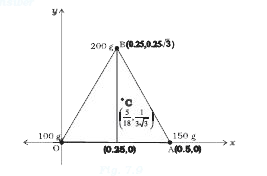 With the x–and y–axes chosen as shown in Fig. 7.9, the coordinates of points O, A and B forming the EQUILATERAL triangle are respectively (0,0), (0.5,0), `(0.25,0.25 sqrt(3))`. Let the MASSES 100 g, 150g and 200G be located at O, A and B be respectively. Then, `X=(m_(1)x_(1)+m_(2)x_(2)+m_(3)x_(3))/(m_(1)+m_(2)+m_(3))` `=(100(0)+150(0.5)+200(0.25)gm)/((100+150+200)g)` `=(75+50)/(450)m=(125)/(450)m=(5)/(18)m` `Y=(100(0)+150(0)+200(0.25sqrt(3))gm)/(450g)` `=(50sqrt(3))/(450)m=(sqrt(3))/(9)m=(1)/(3sqrt(3))m` The centre of MASS C is shown in the figure. Note that it is not the geometric centre of the triangle OAB. Why? |
|
| 48. |
Prove that in case of oblique elastic collision of two particles of equal mass if one is at rest, the recoiling particles always move off at right angles to each other. |
|
Answer» Solution :Method - I: In elastic collision momentum is conserved, So, conservation of momentum along x-axis yields `m u = m v _(1) cos theta _(1) + m v _(2) cos theta_(2) , i.e., u = v _(1) cos theta_(1) + v _(2) cos theta _(2)….(1)` and along y-axis yields, `0 = v _(1) sin thea _(1) - v _(2) sin theta _(2) ....(2)` Squaring and adding Eqns. (1) and (2), we get `u^(2) = v _(1) ^(2) + v _(2) ^(2) + 2 v _(1) v _(2) cos (theta _(1) + theta _(2)).....(3)` As the collision is elastic `1/2 m u ^(2) = 1/2 mv _(1) + 1/2 mv _(2) ^(2)` `i.e., u ^(2) = v _(1) ^(2) + v _(2) ^(2) ....(4)` In the light of Eqn. (4), (3) reduces to `2 v _(1) v _(2) cos (theta _(1) + theta_(2)) = 0` As it is given that `v _(1) ne 0 and v _(2) ne 0` so ` cos (theta _(1) + theta_(2)) =0 implies (theta_(1) + theta_(2)) = 90^(@)`  Method -II: In head on elastic collision between TWO particles, they exchange their VELOCITIES. In thsi case, the component of ball 1 along common normal direction, `v cos theta`  becomes zero after collision, wheile that of 2 becomes v `cos theta.` While the components along common tangent directio of particles remain unchanged. Thus, the components along common tangent and common normal direction of both the balls in TABULAR form are given below.  From the above table and figure, we SEE that both the balls move at right angles after collision with velocities ` v sin theta and v cos theta.` |
|
| 49. |
A 10 kg body is suspended by a rope is pulled by means of a horizontal force to make 60° by rope to vertical. The horizontal force is |
|
Answer» 10 KGWT |
|