

Saved Bookmarks
This section includes 7 InterviewSolutions, each offering curated multiple-choice questions to sharpen your Current Affairs knowledge and support exam preparation. Choose a topic below to get started.
| 1. |
A particle of mass 5 units is moving with a uniform speed of v = 3 sqrt(2) units in the XOY plane along the line y = x + 4. Find the magnitude of angular momentum. |
|
Answer» Solution :GIVEN =5 UNITS Speed `=v=3 sqrt(2)` units `y=x+4` ANGULAR momentum `=L=m(vecr xx VECV)` `=m(xhati+y hatj)xx (vhati+vhatj)=m[XV hatk-vyhatk-v(x+4)hatk]` `L=-mv hatk=-4xx5xx3sqrt(2)hatk=-60 sqrt(2)hatk` `L=60 sqrt(2)` units. |
|
| 2. |
The time period of a body suspended from a spring is T. What will be the new time period, if the spring is cut into the two equal parts and (i) the mass is suspended from one part? (ii) the mass is suspended simultaneously from both the parts? |
|
Answer» `(T)/(2sqrt(2)), (T)/(2)` |
|
| 3. |
Assertion : The water rises higher in a capillary tube of smell diameter than in the capillary tube of large diameter. Reason : Height through which liquid rise in capillary tube inversely proportional to the capillary tube. |
|
Answer» If both ASSERTION and Reason ar true and Reason is the CORRECT explanation of Assertion. So, for SMALLER r the value of h is HIGHER. |
|
| 4. |
A solid sphere of mass m and radius R is rotating about its diameter A solid cylinder of the same mass and same radius is also rotating about its geometrical axis with an angular speed twice that of the sphere . The ratio of their kinetic energies of rotation (E_("sphere") // E_("cylinder")) will be |
|
Answer» Solution :`(E_("Sphere"))/(E_("CYLINDER")) = ((1)/(2) I_(s) omega_(s)^(2))/((1)/(2) I_(C) omega_(c)^(2)) = (I_(s) omega_(s)^(2))/(I_(c) omega_(c)^(2))` Here , `I_(s) = (2)/(5) m R^(2) , I_(c) = (1)/(2) mR^(2) , omega_(c) = 2 omega_(s)` `(E_("Sphere"))/(E_("Cylinder")) = ((2)/(5) mR^(2) xx omega_(s)^(2))/((1)/(2) mR^(2) xx (2 omega_(s))^(2)) = (4)/(5) xx (1)/(4) = (1)/(5)` |
|
| 5. |
The contact force exerted by a body A on another body B is equal to the normal force between the bodies. We conclude that(a) the surfaces must be frictionless(b) the force of friction between the bodies is zero(c ) the magnitude of normal force equals that of friction(d) the bodies may be rough but they don't slip on each other. |
|
Answer» a and C are TRUE |
|
| 6. |
Two soap bubbles of different radii r_(1)andr_(2) are in contact. Determine the radius of the interface. |
|
Answer» Solution :If `p_(1)andp_(2)` be the excess PRESSURE in soap bubbles of radii `r_(1)andr_(2)` respectively, then the RESULTANT excess pressure is given by, `p=p_(1)-p_(2)` If R be the radius of the interface, then `(4sigma)/r=(4sigma)/r_(1)-(4sigma)/r_(2)` (or) `1/r=1/r_(1)-1/r_(2)` (or) `1/r=(r_(2)-r_(1))/(r_(1)r_(2))` (or) `r=(r_(1)r_(2))/(r_(2)-r_(1))` 
|
|
| 7. |
Apiece of steel wire (diameter = 0.075 cm and length 5.08 m) elongates by 0.7 cm due to a load of 12.7 kg. Find Young.s modulus of steel. |
|
Answer» |
|
| 8. |
N tuning forks are arranged in order of increasing frequency and any two successive tuning forks give n beats per second when sounded together. If the last fork gives double the frequency of the first (called as octave), Show that the frequency of the first tuning fork is f=(N-1)n. |
|
Answer» SOLUTION :`F,f+N, f+2n, ...f +(m-1)n` `f+(N-1)n=2f` `n=(f)/(N-1)` `(or) f=n(N-1)` |
|
| 9. |
A 60kg box sledge is travelling horizontally on ice at a speed of 10ms^(-1). A 90 kg packet is dropped on it vertically. The subsequent velocity of the sledge is |
|
Answer» `1 MS^(-1)` |
|
| 10. |
The mass of H_2 molecule is 3.32 xx 10^(-24) g. If 10^(23) hydrogen molecules per second strike 2 cm^(2) of wall at an angle of 45° with the normal, when moving with a speed of 10^(5) cm/s, the pressure exerted on the wall is nearly. |
|
Answer» `1350 "N/m"^(2)` |
|
| 11. |
The area enclosed by a circle of diameter 1.06 m to correct number of significant figures is |
|
Answer» `0.88 m^(2)` `"AREA enclosed" = pir^(2)= 3.14 xx (0.53)^(2)= 0.882026 m^(2) = 0.882 m^(2)` (ROUNDED to THREE significant figures) |
|
| 12. |
A body A of mass M while falling vertically downwards under gravity breaks into two parts, a body B of mass (1)/(3)M and a body C of mass (2)/(3)M. The centre of mass of bodies B and C taken together shifts compared to that of body A towards …………… |
|
Answer» body C |
|
| 13. |
(A) : No particle may have a speed as large as speed of light.(R ) : Infinite energy of any substance of system is not possible. |
|
Answer» Both (A) and (R ) are true and (R ) is the CORRECT EXPLANATION of (A) |
|
| 14. |
The image (of a real object) formed by a concave mirror is twice the size of the object. The focal length of the mirror is 20 cm. The distance of the object from the mirror is (are) |
| Answer» Answer :A::B | |
| 15. |
Whichproperties of a medium are required for the propagation of mechanical wave ? |
| Answer» SOLUTION :ELASTICITY and INERTIA. | |
| 16. |
If the minimum attainable pressure of ideal gas in the process T = T_0 + alpha V^2where T, and alphaarepositive constants and V is the volume of one mole of gas is sqrt(NR^2 alpha T_0)where N is an integer. ThenN is equal to |
|
Answer» |
|
| 17. |
If two vectors are having equal magnitude and same direction is known as |
|
Answer» EQUAL vectors |
|
| 18. |
A tank containing water ha an orifice in one vertical side. It is 10 m below the surface level of water in tank. Then velocity of efflux from that small orifice is |
|
Answer» `7ms^(-1)` |
|
| 19. |
A body of mass 5kg is moving in a circle of radius 1 m with an angular velocity of "2 rad-s"^(-1). The centripetal force acting on the body is |
|
Answer» 10 N |
|
| 20. |
The ratio of the mean KE of chlorine and oxygen molecules at the same temperature is |
|
Answer» `16:35 .5` |
|
| 21. |
An artificial satellite orbiting the earth invery thin atmosphere loses its energygradually dueto dissipation againstatmosphericresistance , however small .Why then doesits speed increase progressively as it comes closer and closer the earth ? |
| Answer» SOLUTION :K.E. INCREASES, but P.E. DECREASES, and the sum decreases due to dissipation against FRICTION. | |
| 22. |
Two rods of different materials and identical cross sectional areas, are joined face to face at one end and their free ends are fixed to the rigid walls. If the temperature of the surroundings is increased by 30°C, the magnitude of the displacement of the joint of the rod is (length of rods 1_(1) = 1_(2) = 1 unit, ratio of their young's modulii, y_(1) //y_(2) = 2, coefficients of linear expansion are alpha_(1) and alpha_(2) ) |
|
Answer» ` 5 ( alpha_(2) - alpha_(1) )` |
|
| 23. |
A large block of ice cuboid of height 'l' and density rho_(ice) = 0.9 rho_(w') has a large vertical hole along its axis. This block is floating in a lake. Find out the length of the rope required to raise a bucket of water through the hole. |
|
Answer» Solution :LET area of ICE-cuboid excluding hole `= A` weight of ice BLOCK `=` weight of liquid displaced `Arho_(ice)LG = Arho_(w) (l - h) g` `(9l)/(10) = l - h RARR h = l - (9l)/(10) = ((l)/(10))` 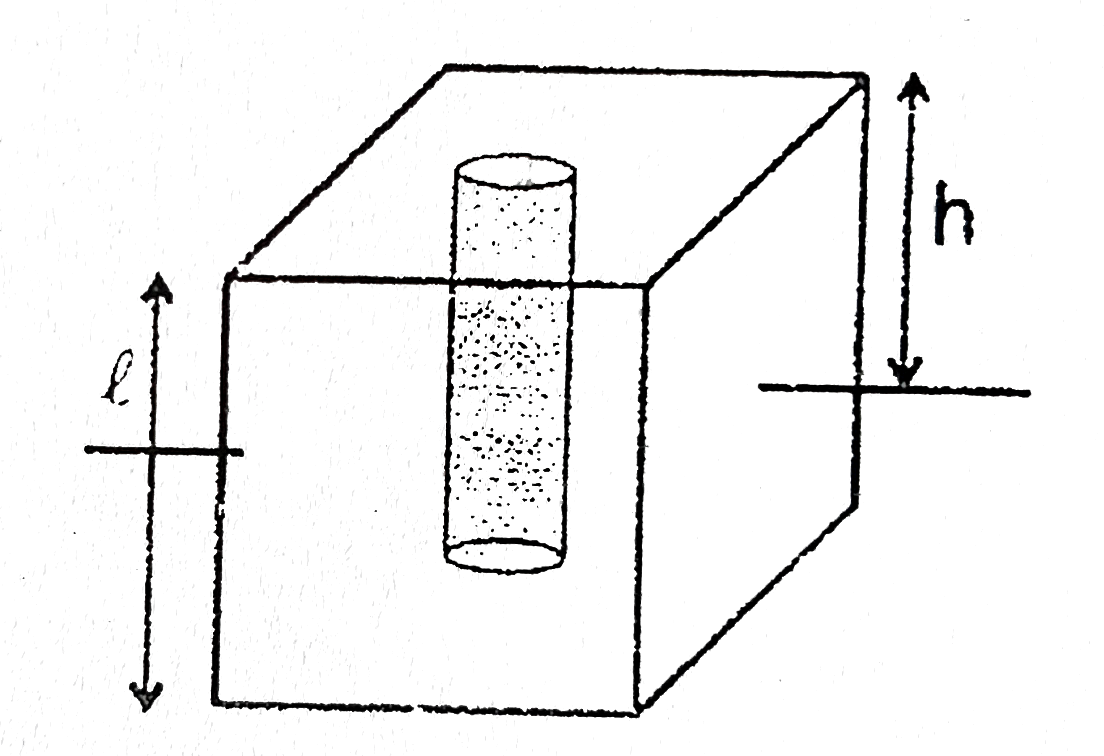
|
|
| 24. |
An aluminium cylinder 10 cm long. As a spacer between two steel walls. At 12^(@)C it juct slips in between the walls. When it warms to 23^(@)C calculate the stress in the chlinder and the total force it exerts on each wall, assuming that the walls are perfectly rigid and a constant distance apart. |
|
Answer» Solution :GIVEN, For aluminium `Y=7.0xx10^(-10)` PA and `alpha = 2.4 xx 10^(-5) K ^(-1)` Change in temperature, `DeltaT = 5.1^(@)C = 5.1 K ` Area A `= 20 cm^(2) = 20xx10^(-4) m^(2)`  `therefore STRESS=(F)/(A)=YalphaDeltaT=(0.70xx10^(11)Pa)(2.4xx10^(-5)K^(-1))(5.1K)` `= 1.68xx5.1 xx 10^(6)= 8.6 xx 10^(6)` Pa The total forcr F is the cross-seactional times thje stress. `F= "stress xx area"` `=(8.6xx10^(6)Pa)(20xx10^(-4)m^(2))=1.7 xx10^(4)N` |
|
| 25. |
A variable force F=kx^(2)acts on a particle which is initially at rest. Calculate the work done by the force during the displacement of the particle from x=0 m "to" x= 4m. (Assume the constant k=1Nm^(-2)) |
|
Answer» |
|
| 26. |
Which of the following statement(s) is / are correct ?1. The range of time scale is obtained by dividing the length scale by the speed of light |
|
Answer» The range of time scale is OBTAINED by DIVIDING the length scale by the SPEED of light |
|
| 27. |
A block slides down as incline of 30^@with the horizontal. Starting from rest, it covers 8 m in the first 2 seconds. Find the coefficient of static friction. |
|
Answer» Solution :Use ` s = UT + 1/2 at^2` ` a = (2S)/(t^2) " as " u= 0 ` `MU = (g SIN theta)/(g cos theta) ` Putting the value and solving `mu = 0.11` |
|
| 28. |
In the given (V-T) diagram , what is the relation between P_(1) "and" P_(2) ? |
|
Answer» `P_(2)=P_(1)` This shows that slope OS the GRAPH `prop (1)/(P)` Hence `P_(2) lt P_(1)` 
|
|
| 29. |
What is dimension of a physical quantity ? |
|
Answer» Solution :Any physical quantity can be represented by using dimension. Any physical quantity can be represented as combination of 7 base (fundamental) quantity. Its symbol are as follows: Mass : M Length: L Time : T Electric current: A THERMODYNAMICS temperature : K Luminous Intensity : CD Quantity of matter : mol Dimension: Power or exponent to which base quantity is reaised to is called dimension of that quantity : `=mxxmxx m` `=m^(3)` `beta` In volume dimension of length is 3 WHERES as dimension of mass and time is ZERO. Example : Force =F=ma `="maxx" xx "acceleration"` `=M^(1)xxL^(1)T^(-2)` `=M^(1)L^(1)xxT^(-2)` `:.` In force, dimension of mass, length and time is 1,1, and -2 respectively. |
|
| 30. |
A spring balance is attached to the ceiling of a lift. When the lift is at rest spring balance reads 49 N of a body hang on it. If the lift moves: (i) Downward (ii) upward, with an acceleration of 5 ms^(-2)(iii) with a constant velocity.What will be the reading of the balance in each case? |
|
Answer» Solution :(i) ` R = m (g -a)` weight = 49 N so `m = (49)/(9.8) = 5kg ` `R = 5 (9.8 - 5)` R = 24 N (II) `R = m(g + a)` R = 5(9.8 +5) R = 74 N (iii) as ` a = 0 , so R = mg = 49 N` |
|
| 31. |
A man of mass m is on the floor of a lift and lift is moving up with acceleration 'a' then :(a) normal reaction is more than his weight by ma(b) man appears to be heavier by (a/g) times his true weight |
|
Answer» A & B are CORRECT |
|
| 32. |
A block of mass M is held against a rough vertical wall by pressing it with a finger. If the coefficient of friction between the block and the wall is mu and the acceleration due to gravity is g, what is the minimum force required to be applied by the finger to hold the block against the wall? |
|
Answer» `mu MG` |
|
| 33. |
Two wires made of materials of Young.s moduli 160 and 200 GPa have lengths in the ratio 3 : 4 and radii 2:3. For the same elongation, what must be the ratio of the loads on them |
|
Answer» |
|
| 34. |
A boat moves perpendicular to the bank with a velocity of 7.2 km/h. The current carries it 150 m downstream, find the velocity of the current. (The width of the river is 0.5 km). |
|
Answer» `0.4 MS^(-1)` |
|
| 35. |
The root mean square velocity of the molecules in a sample of helium is 5/7th that of the nolecules in a sample of hydrogen. If the temperature of hydrogen sample is 0^@C, then the temperature of the heliuma sample is about |
| Answer» ANSWER :A | |
| 36. |
In old age arteries carrying blood in the human body become narrow resulting in an increase in the blood pressure. This follows from |
|
Answer» Pascal.s law |
|
| 37. |
During earthquake at one place transverse wave (S) and longitudinal wave (P) are found to be moving towards seismograph with velocities 4.5 km/s and 8.0 km/s respectively. If first P wave is detected by seismograph earlier than S wave by 4 min then epicenter of earthquake must be located approximately at ...... distance from the seismograph. |
|
Answer» Solution :Here `v _(S) = 4.5 km//s` `v_(p) = 8 km//s`  If `t _(S) and t _(p)` are time taken by S and P WAVE RESPECTIVELY to reach seismograph, then ar per the statement `t _(S) - t _(P) = 4 min = 240 s ` Now, `d = v _(P) t _(P) = 8 t _(P) ""...(1)` Also `d =v _(S) t _(S) = 4.5 (t _(P) + 240) ""...(2)` From `(1) and (2) 8t_(P) = 4.5 t _(P) + 1080` `therefore 3.5 t _(P) = 1080 ""...(3)` `therefore t _(P) = 308 . 6s ` From (1) and (3), `d = 8 xx 308.6` `therefore d = 2468.8 km` `therefore d ~~2500km` |
|
| 38. |
Two sitar strings A and B playing the note 'Dha' are slightly out of tune and produce beats of frequency 5 Hz. The tension of the string B is slightly increased and the beat frequency is found to decrease to 3 Hz. What is the original frequency of B if the frequency of A is 427 Hz ? |
| Answer» Solution :Increase in the tension of a string INCREASES its FREQUENCY. If the original frequency of B (`v_(B)`) were greater than that of A (`v_(A)`), further increase in `v_(B)` should have RESULTED in an increase in the BEAT frequency. But the beat frequency is found to decrease. this shows that `v_(B) lt v_(A)`. since `v_(A) - v_(B) = 5 Hz`, and `v_(A) = 427 Hz`, we get `v_(B) = 422 Hz`. | |
| 39. |
In the question number 77, the force acting 011 thr particle is |
|
Answer» `momega^(2)overset(rightarrow)(r)` `"VELOCITY", bar(v)=(d barr)/(DT)=(d)/(dt)(A cosomegat hati+Bsin omegathatj)` `=-A omegasin omegahati+B omega cos omegahatj` `"Acceleration", bar(a)=(dbar(v))/(dt)=-Aomega^(2) cos omegat^(2)-Bomega^(2)sin omegathatj` The force acting on the particle is `bar(F)=mbar(a)=m(-omega^(2)bar(r))=-momega^(2)bar(r)` |
|
| 40. |
A particle of mass m_(1) moves with speed v and collides head on with a stationary particle of mass m_(2). The first particle continue to move in the same direction if m_(1)//m_(2) is (e = coefficient of restitution) |
| Answer» ANSWER :B | |
| 41. |
Derive the expression for gravitational potential energy. |
|
Answer» Solution :The gravitational potential DUE to mass `m_(1)` at a POINT P which is at a distance r from `m_(1)` is obtained by making `m_(2)` equal to unity (`m_(2)` = 1kg). THUS the gravitational potential V® due to mass `m_(1)` at a distance r is `V(r)=-(Gm_1)/(r)` |
|
| 42. |
Two identical beakers with negligible thermal expansion are filled with water to the same level at 4°C. If one say A is heated while the other B is cooled, then: |
|
Answer» WATER LEVEL in A MUST rise |
|
| 43. |
The volume of one mole of an ideal gas with the adiabatic exponent gammais changed according to the relationV=(a)/(T)where a is a constant. Find the amount of heat absorbed by the gas in the process, if the temperature is increased by Delta T |
| Answer» Solution :`((2 - GAMMA)R DELTA R)/(( gamma -1))` | |
| 44. |
A ball of mass 100 g is made to loop-the-loop in a vertical circle as shown in Fig. 7.1.29. The radius of the circle is 0.5 m (i)-What is the critical velocity at the highest point of the track ? (ii) If the velocity of the ball at the highest point of the track is twice the critical velocity what is the force exerted by the ball against track? |
| Answer» Solution :`mv^(2)//mg, V = sqrt(rg) = sqrt(0.5 XX 98) = 2.2 m//s`. Force `=mv^(2)//r - mg, V = 2.2 m//s, F = 2.9 N` | |
| 45. |
In an experiment it is observed that for a liquid gamma_("Abs") = gamma_("App"). Then the vessel .... On heating . |
|
Answer» does not EXPAND |
|
| 46. |
If vec(a) = 2 hat(i) + 3hat(j) + 6hat(k) and vec(b) = 3hat(i) + 4hat(j), then ("projection of " vec(a) " on " vec(b))/("projection of" vec(b) " on " vec(a)) |
|
Answer» `7//5` |
|
| 47. |
What is the linear velocity of a person at equator of the earth due to its spinning motion? (Radius of the earth = 6400 km.) |
|
Answer» SOLUTION :The EARTH completes one ROTATION in 24 hour. Its | angular velocity. `omega=(2piN)/(t)=(2pixx1)/(24xx60xx60)=(pi)/(43,200)rads^(-1)` `R=6.4xx10^(6)` m, The linear veloctiy, `v=Romega=6.4xx10^(6)xx(pi)/(43,200)=465.5m//s` |
|
| 48. |
Block A has a mass of 30 kg and block B a mass of 15 kg . The coefficient of friction between all surface of contact are mu_(s) = 0.15 and mu_(s) = 0.10 Knowing that theta = 30^(@) and that the magnitude of the force F applied to block A is 250 N Determine (a) acceleration of block A and (b) the tension in the rope |
Answer»  ` f = mu_(k) m_(A) g COS theta`….(ii) `T - m_(B) sin theta - F - f' = m_(B) alpha`..(iii) `f' = mu_(k) .N'`…(iv) `= mu_(k) (m_(A) g cos theta + m_(B)g cos theta)` Solving above EQUATION `a_(A) = 5.2 ms^(-2), T = 215 N` |
|
| 49. |
Co-efficient of apparent expansions of a liquid in Gold vessel is G and when heated in a silver vessel is S. If coefficient of linear expansion of Gold is A, coefficient of linear expansion of Silver is |
|
Answer» `(G + S - 3A)/(3)` |
|
| 50. |
A round uniform body of radius R, mass M and moment of inertia I rolls down (without slipping) on an inclined plane making an angle theta with the horizontal. Then its acceleration is …………. |
|
Answer» `(gsintheta)/(1-(MR^(2))/(I))` `a=(gsintheta)/(1+(K^(2))/(R^(2)))` but for radius of gyration K `I=MK^(2)` `therefore K^(2)=(I)/(M)` `therefore a=(gsintheta)/(1+(I)/(MR^(2)))` |
|