Saved Bookmarks
This section includes 7 InterviewSolutions, each offering curated multiple-choice questions to sharpen your Current Affairs knowledge and support exam preparation. Choose a topic below to get started.
| 1. |
Which one is more elastic-steel or rubber?Explain. |
| Answer» Solution :Steel.Young.s modulus of steel is very much greater than that of rubber.`Y=FL//A delta L`, if a steel WIRE and a rubber wire of the same length and area of cross section are elongated by equal forces the change in the length of the rubber wire is more then thatof the steel wire SINCE Y PROP1// delta l.So steel is more ELASTIC than rubber, | |
| 2. |
Can you associate potential energy with non-conservative force? |
| Answer» SOLUTION :No, POTENTIAL ENERGY can be associated only with conservative FORCE. | |
| 3. |
A steel uniform rod of length 2L cross sectional area A and mass Mis set rotating in a horizontal plane about an axis passing through the centre. If Y is the Young's modulus for steel, find the extension in the length of the rod. |
Answer» Solution :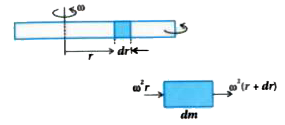 Let us CONSIDER an element of width dr at a distance r from the given AXIS of rotation as showin in the diagram. Suppose tention in the rod at r and dr distance are `T(r ) and T (r + dr)` Centripetal force acting on small length element `F = dm r omega ^(2) ""[because F _(C) = mr omega ^(2) ]` `therefore F = mu r omega ^(2) dr ""...(1)` `[because mu = (dm )/( dr) implies dm = mu dr ]` `therefore T (r) -T ( r + dr) =mu r omega ^(2) dr ` `[ because T(r) -T (r + dr) =` resultant force F] `therefore -dT = mu r omega ^(2) dr` Centripetal force and tension force are opposite to each other hence negative SIGN present. Integrating on both side. `int _(T=T) ^(T=0) dT = mu omega ^(2) int _(r ) ^(l) r dr` ` -[T] _(T) ^(0) = mu omega ^(2) [ (r ^(2))/( 2 )] _(r ) ^(l)` `therefore -[0-T] = (mu omega ^(2))/( 2) [ l ^(2) - r ^(2) ]` `therefore T = ( mu omega ^(2))/( 2) (l ^(2) -r ^(2)) ""...(2)` Now if `Delta r` is the extension in the elemente of length dr `therefore` Young.s modulus `Y = (T (r))/(A) xx (dr )/(Delta r)` `therefore (Delta r )/( dr ) = (T (r))/(YA) = (T)/(YA)` `therefore (Delta r )/(dr) = (mu omega ^(2))/( 2 YA) (l ^(2) - r ^(2))` `therefore Delta r = ( mu omega ^(2))/( 2 YA) int (l ^(2) -r ^(2)) dr` Integrating on both side, `int Delta r = (mu omega ^(2))/( 2 YA) int ( l ^(2) -r ^(2)) dr` `therefore Delta r = (mu omega ^(2))/( 2 YA) [ l ^(2) r - (r ^(3))/(3)]_(0) ^(l)` `therefore Delta r = (mu omega ^(2))/( 2 YA) [[ l ^(3) - (l ^(3))/(3)]` `therefore Deltar= (mu omega ^(2))/(2YA)xx(2L^(3))/(3)``therefore Delta r = ( mu omega ^(2) l ^(3))/( 3YA)` `therefore ` Extension of `Delta r` in both side length, then tota extension `=2 Delta r` `= ( 2 mu omega ^(2) l ^(3))/(3YA)` |
|
| 4. |
A carnot engine converts one sixth of the heat input into work. The sink temperature is reduced by 62^@ C, the efficiency of engine gets doubled. Find the source and the sink temperature. |
|
Answer» `99^@C,37^@C` `1/6=1-T_2/T_1` `therefore T_1=6T_1-6T_2` `therefore 5T_1-6T_2=0` ….(1) Now `eta_2=1-T_2/T_1` `2xx1/6=1-(T_2-62)/T_1` `1/3=1-(T_2-62)/T_1` `T_1=3T_1-3T_2+186` `therefore 2T_1-3T_2=-186`....(2) From equation (1) and (2), `2xx(6T_2)/5-3T_2=-186` `therefore 12T_2-15T_2=-930` `therefore -3T_2=-930` `therefore T_2`=310 K `rArr` From equation (1) , `T_1=(6T_2)/5 =(6xx310)/5`=372 K `therefore t_2=T_2-273` and `t_1=T_1-273` `therefore t_2=310-273` and `t_1=372-273` `therefore t_2=37^@C` and `t_1=99^@C` |
|
| 5. |
When a vibrating tuning fork moves towards a wall, why do we hear sound beats ? |
| Answer» SOLUTION :Because of SLIGHT difference between the frequencies of incident and REFLECTED SOUND. | |
| 6. |
A cube and a sphere of equaledgeand radius ,madeof thesamesubstanceare allowed to cool under identical conditions . Determine whichof the will cool ata faster rate . |
|
Answer» Solution :The rateof coolingof a bodyis givenby `(-dT)/(dt) = (Ae SIGMA)/( rho Vs) (T^(4) - T_(0)^(4))` Since, SUBSTANCEIS same for bothbodies , so `(E)/(rho s)`= constant. Further , theyare allowed to cool under identicalconditions, so `(T^(4) - T_(0)^(4)) ` = constant`therefore(-dT)/(dt) prop (A)/(V)` Let the edgeof the cubeor radius of the sphere bea, then for the cube`A = 6A^(2)` and `V = a^(3) ` , so A/V = 6/a forthesphere , `A = 4pia^(2)` and `V = (4)/(3) pi a^(3)` , soA/V = 3/a. Evidently , the RATIO A/V is more for cubecoolsat a fasterrate . |
|
| 7. |
An ideal gas is found to obey pV^(3/2) = constant during an adiabatic process. If such a gas initially at a temperature T is adiabatically compressed to half of its initial volume, then its final temperature is |
|
Answer» 2T |
|
| 8. |
Why doesa flag (or ensign) flutter when there is strong wind ? |
| Answer» SOLUTION :When there is STRONG WIND ,the kinetic energy of AIR at the end of flag is more and hence according to Bernoulli.s equation pressure is low .The pressure at support of flag is a high . So due to pressure difference FLAD flutters. | |
| 9. |
Radius of a sphere is 100cm at 0^(@)C and 100.1 cm at 100^(@)C. Coefficient of cubical expansion of the sphere is |
|
Answer» `30 XX 10^(-6)`/C |
|
| 10. |
The pulley arrangements of figures (a) and (b) are identical. The mass of the rope is negligible. In figure (a), the mass m is lifted up by attaching a mass 2m to the other end of the rope. In figure(b), m is lifted up by pulling the other end of the rope with a constant downward force F = 2 mg. Calculate the accelerations in the two cases. |
Answer» Solution :In figure (a), for the motion of mass m, T-mg=ma....... (1) For motion of MASS2 m figure (b) 2mg -T= (2m)a ........ (2) Adding equation (1) and (2), we get 2mg - mg = 2MA + ma, mg = 3ma, a = g/3 (b) In figure `T^(1) - mg=ma^(1)` But `T^(1) = 2mg , :. 2mg - mg = a^(1)`, THEREFORE `a^(1)=g` |
|
| 11. |
The relative velocity of two parallel leyers of water is 6cms^(-1) .If perpendicular distance between two layers is 0.1 mm, then velocity gradient will be ….. |
|
Answer» VELOCITY gradient `=(DV)/(dx)=(6)/(0.01)=600s^(-1)` |
|
| 12. |
A particleisthrownverticallyupwardsitsvelocityat halfof theheightis 10m/sthen themaximumheightattained byit is(g= 10m//s^2) |
|
Answer» `8 m` ` O= (10)^2+2 2(-10)s ` ` S=5 m` ` u= 10ms^(-1)` ` v=0 ms^(-1)` ` a=- 10 ms^(-2)` totalheight`= 2xx5= 10M` |
|
| 13. |
The heat generated in a circuit is dependent on the resistance, current and time of flow of electrical current. If the errors measured in the above are 1% , 2% and 1% respectively, what is the maximum error in heat ? |
|
Answer» Solution :Heat `H= (i^(2)RT)/(j)` Maximum ERROR in measuring the heat `(Delta H)/(H) xx 100 = 2 (Delta i)/(i) xx 100 + (Delta R)/(R ) xx 100 + (Delta T)/(T) xx 100` Here J is a constant Given that `(Delta R)/(R ) xx 100=1%, (Delta i)/(i) xx 100 = 2% (Delta T)/(T ) xx 100 = 1%` `(Delta H)/(H) xx 100= (2 xx 2) + 1 + 1 = 4 + 1+ 1` Maximum error in heat = 6% |
|
| 14. |
A 1 kg block situated on a rough incline is connected to a spring of spring constant 100 Nm^(-1) as shown in Fig. 6.17. The block is released from rest with the spring in the unstreched position. The block moves 10 cm down the incline before coming to rest. Find the coefficient of friction between the block and the incline. Assume that the spring has a negligible mass and the pulley is frictionless. |
| Answer» SOLUTION :`= 0.125` | |
| 15. |
A 60 kg man stands on a spring scale in the lift. At some instant he finds, scaleeading has changed from 60 kg to 50 kg for a while and then comes back to the original mark. What should we conclude? |
|
Answer» The lift was in CONSTANT MOTION upwards |
|
| 16. |
Consider the function y=x^(2). Calculate the derivative (dy)/(dx) using the concept of limit, at the point x=2. |
|
Answer» Solution :Let us take TWO points given by `x_(1)=2andx_(2)=3`, then `y_(1)=4andy_(2)=9` Here `Deltax=1andDeltay=5`, Then `(Ø_(y))/(Ø_(x))=(9-4)/(3-2)=5` If we take `x_(1)=2andx_(2)=2.5`, then `y_(1)=4andy_(2)=(2.5)^(2)=6.25` Here `Deltax=0.5=(1)/(2)andDeltay=2.25` Then `(Ø_(y))/(Ø_(x))=(6.25-4)/(0.5)=4.5` If we take `x_(1)=2andx_(2)=2.25`, then `y_(1)=4andy_(2)=5.0625`. Here `Deltax=0.25=(1)/(4),Deltay=1.0625` `(Ø_(y))/(Ø_(x))=(5.0625-4)/(0.25)=((5.0625-4))/((1)/(4))=4(5.0625-4)=4.25` If we take `x_(1)=2andx_(2)=2.1`, then `y_(1)=4andy_(2)=4.41` Here `Deltax=0.1=(1)/(10)and(Ø_(y))/(Ø_(x))=((4.41-4))/((1)/(10))=10(4.41-4)=4.1` These results are tabulated as shown below:   From the above table, the following inferences can be made. As `Deltax` TENDS to zero, `(Deltay)/(Deltax)` approaches the limit given by the number 4. At a point x=2, the derivative `(dy)/(dx)=4`. It should also be mentioned here that `Deltaxto0` does not mean that `Deltax=0`. This is because, if we substitute `Deltax=0,(Deltay)/(Deltax)` becomes indeterminate. In general, we can OBTAIN the derivative of the function `y=x^(2)`, as follows: `(Deltay)/(Deltax)=((x+Deltax)^(2))/(Deltax)=(x^(2)+2xDelta+Deltax^(2)-x^(2))/(Deltax)=(2xDelta+Deltax^(2))/(Deltax)=2x+Deltax` `(dy)/(dx)=lim_(Deltaxto0)2x+Deltax=2x` |
|
| 17. |
Which one of the following relations is wrong? |
|
Answer» 1 fermi `=10^(-14)m` |
|
| 18. |
An external device, e.g., an electric motor, supplies constant power to a rotating system e.g., a flywheel, through a torque tau. The angular angular velocity of the system is omega. Both tau and omega are variable |
|
Answer» `omegaproptau` |
|
| 19. |
State whether the length of a day will increase or decrease if the radius of the earth becomes half of its present value keeping its mass constant. |
|
Answer» |
|
| 20. |
State the conditions of equilibrium of a system of coplanar forces. |
|
Answer» Solution :(i) The algebraic sum of the upward forces is equal to the algebraic sum of the downward forces for translator EQUILIBRIM( For Parallel forces). (II) The algebraic sum of close wise moments is equal do the algebraic sum of anticlockwise moments about a point of rotation for rotatory EQUILIBRIUM (iii) The resultant of a no. of forces acting on the BODY should be equal to zero for coplanar forces. `sumx=O,sumy=O`, so that `R=sqrt(X^2+Y^2)=0` |
|
| 21. |
Two bodies of masses 4kg and 2kg are moving towards each other with 3ms^(-1) and 2ms^(-1) respectively. Then velocity of centre of mass is |
|
Answer» `0.5ms^(-1)` TOWARDS `4KG` |
|
| 22. |
A cable is cut to half its original length what will be the effect on the maximum load the wire can support? |
| Answer» SOLUTION :Stress=Force//Area. So BREAKING force=breaking stressxxarea,which is independent of the LENGTH of the wire.So the MAXIMUM load the wire can support will be the same. | |
| 23. |
A thin bulb contains air at normal atmospheric pressure and at 41^(@)C is sealed. The bulb can burst when the air in it is at a temperature of 198^(@)C. Find the pressure of the air at that temperature. |
|
Answer» SOLUTION :Initial temperature `t_(1)=41^(@)C , T_(1)=41+273=314K,` Final temperature `t_(2)=198^(@)C` `T_(2)=198+273=471K` Initial PRESSURE `P_(1)=1` atmosphere , Final pressure `P_(2)=?` From CHARLES. law, at constant volume `rArr P_(1)/T_(1)=P_(2)/T_(2)rArr P_(2)=T_(2)/T_(1)P_(1)=471/314 times 1=1.5` atmosphere |
|
| 24. |
Why are errors expressed as positive and negative? |
| Answer» Solution :There are CHANCES of the measured value to be either a little greater or a little less than its actual numerical value if there is any inaccuracy in the MEASUREMENT of any physical quantity. Hence errors are either EXPRESSED as positive or negative. | |
| 25. |
A block of mass 10 kg is moving in x-direction with a constant speed of 10 ms^(-1). It is subjected to a retarding force F = - 0.1x J m^(-1) during its travel from x = 20 m to x = 30 m. Its final kinetic energy will be |
|
Answer» 475 J `:. K_f - 1/2 xx 10 xx 10^(2) = INT F dx or K_f - 500 = int_(20)^(30) - 0.1 x dx` or `K_f - 500 = -0.1 [(x^2)/(2)]_(20)^(30) = - 0.1 [(900 - 400)/(2)] = -25` or `K_f = 500 - 25 = 475 J`. |
|
| 26. |
10 grams of steam at 100^@C is mixed with 50 gm of ice at 0^@C then final temperature is |
| Answer» Answer :C | |
| 27. |
A square wave (-1 to +1V) is applied to a P-N junction diode as shown. Draw the output wave form across the diode which is assumed to be ideal- |
|
Answer»
|
|
| 28. |
The temperature on the new scale, corresponding to a temperature of 39^(@)C on the celsius scale? |
|
Answer» `73^(@)W` `(t-39)/(239-39)=(39-0)/(100-0)RARR t = 117^(@)W` |
|
| 29. |
When the surface of a liquid is increased |
|
Answer» SURFACE tension INCREASES |
|
| 30. |
A cyclist is riding with a speed of 27 kmh^(-1). As he approaches a circular turn on the road of radius 80m, he applies brakes and reduces his speed at the constant rate of 0.5 ms^(-1) every second. The net acceleration of the cyclist on the circular turn is |
|
Answer» `0.6 MS^(-2)` |
|
| 31. |
A particle is in linear S.H.M. between two points A and B, 10 cm apart. Take the direction from A to B as the positive direction and give the signs of velocity, acceleration and force on the particle when itat the end A. |
Answer» Solution :Refer Fig., here A and B REPRESENT the two EXTREME positions of an S.H.M. For velocity, the direction from A and B is taken to be positive. For ACCELERATION and the force, the direction is taken positive if directed along AP and negative if directed along BP.  At the end A, the particle executing S.H.M. is momentarily at rest being its extreme position of motion, hence its velocity in zero acceleration is +ve because directed along AP. Force is also +ve since the force is directed towards AP i.e. +ve direction. |
|
| 32. |
Explain why, heating systems based on circulation of steam are more efficient in warming a building than those based on circulation of hot water. |
| Answer» Solution :540 cal. heat is more in 1 G `100^(@)C` steam than 1 g `100^(@)C` water. Hence heating systems BASED on circulation of steam are more EFFICIENT in warming a building than those based on circulation of HOT water. | |
| 33. |
Show that the horizontal range is the same for the angles of projection 0 and (90^@-theta). |
| Answer» Solution :`R=(mu^2sin2theta)/g=(mu^2sin180^@-2theta)/g=(mu^2sin2(90^@-theta))/g`Hence for a given speed of projection, the HORIZONTAL RANGE is the .same for the ANGLES of projection 0 and `(90^@-theta)` | |
| 34. |
A particle is in linear S.H.M. between two points A and B, 10 cm apart. Take the direction from A to B as the positive direction and give the signs of velocity, acceleration and force on the particle when itat 4 cm away from A going towards A. |
Answer» Solution :Refer Fig., here A and B represent the two extreme positions of an S.H.M. For VELOCITY, the direction from A and B is taken to be positive. For acceleration and the force, the direction is taken positive if directed along AP and negative if directed along BP.  At 4 cm AWAY from A going TOWARDS A, the particle is at S, with a tendency to move along SA which is negative direction for velocity. Therefore velocity is negative but acceleration is directed towards mean position i.e. along SP, hence +ve SIMILARLY force is also +ve. |
|
| 35. |
A particle is in linear S.H.M. between two points A and B, 10 cm apart. Take the direction from A to B as the positive direction and give the signs of velocity, acceleration and force on the particle when it at the mid point of AB going towards A. |
Answer» Solution :Refer Fig., here A and B represent the two extreme positions of an S.H.M. For velocity, the direction from A and B is taken to be positive. For acceleration and the force, the direction is taken positive if directed along AP and negative if directed along BP.  At the mid point AB going towards A, the particle is at its mean POSITION P, with a tendency to MOVE along PA i.e. -ve direction. HENCE velocity is -ve. Both acceleration and force are ZERO. |
|
| 36. |
A particle is in linear S.H.M. between two points A and B, 10 cm apart. Take the direction from A to B as the positive direction and give the signs of velocity, acceleration and force on the particle when it at the end B. |
Answer» Solution :Refer Fig., here A and B represent the TWO extreme positions of an S.H.M. For velocity, the direction from A and B is taken to be POSITIVE. For ACCELERATION and the force, the direction is taken positive if DIRECTED along AP and NEGATIVE if directed along BP.  At the end B, velocity is zero. Here acceleration and force are negative as they are directed along BP i.e. along negative direction. |
|
| 37. |
A particle is in linear S.H.M. between two points A and B, 10 cm apart. Take the direction from A to B as the positive direction and give the signs of velocity, acceleration and force on the particle when it at 3 cm away from A going towards B |
Answer» SOLUTION :REFER Fig., here A and B represent the two extreme positions of an S.H.M. For VELOCITY, the direction from A and B is taken to be positive. For acceleration and the force, the direction is taken positive if directed along AP and negative if directed along BP.  At 3 cm away from A going towards B. the particle is at R, with a tendency to move along RP, which is positive direction. Here, velocity, acceleration and force are all +ve. |
|
| 38. |
Find the period of a function f(t) = sin^2 t |
|
Answer» Solution :Given FUNCTION can be WRITTEN as `sin^2 t = sin^2 (t + pi)` COMPARING the above equation with 5.1, gives the period as `pi` Note that, after a time 2`pi` also the given function repeats itself. But the period is DEFINED as LEAST time taken to repeat the motion. |
|
| 39. |
A particle is in linear S.H.M. between two points A and B, 10 cm apart. Take the direction from A to B as the positive direction and give the signs of velocity, acceleration and force on the particle when it at 2cm away from B going towards A. |
Answer» Solution :Refer Fig., here A and B represent the two EXTREME positions of an S.H.M. For VELOCITY, the direction from A and B is taken to be positive. For ACCELERATION and the force, the direction is taken positive if directed along AP and negative if directed along BP.  At 2 cm away from B going towards A, the particle is at Q. with a tendency to MOVE along QP, which is negative direction. Here velocity, acceleration and force are all -ve. |
|
| 40. |
Which of the following measuring instruments have largest least count ? |
|
Answer» Meter scale |
|
| 41. |
Assertion: The motion of the earth around the sun is perriodic but not oscillatory. Reason: Oscillatory motion is necessarily periodic but periodic motion is not necessarily oscillatory. |
|
Answer» If both assertion and reson are true and reason is the CORRECT explanation of assertion |
|
| 42. |
If the volume of nitrogen of mass 14 kg is 0.4m^(3) at 30^(@)C. Calculate the pressure. |
|
Answer» `25 xx 10^(5) "N/m"^(2)` |
|
| 43. |
The displacement of a particle in a motion at a time t is given by x=u "sin"(pit)/4 cm, then its displacement in the time interval t=0 s to t=2s is |
|
Answer» 4cm |
|
| 44. |
The outer edge of a curved road is generally raised over the inner edge. Why? |
| Answer» Solution : In ADDITION to the FRICTIONAL force, a component of reaction force also PROVIDES centripetal force. | |
| 45. |
In van der Waal's equations (P+a/(V^(2)))(V-b)=RT, what are the dimensions of the constants a and b? |
|
Answer» Solution :`a/(V^(2))` is added to P. So `a/(V^(2))` must have the dimensions of pressure P. B is subrtracted form V. So b must have the dimensions of volume V. Dimensions of `a/(V^(2))=` Dimensions of Pressure DIMENSIONAL FORMULA of `a=[ML^(-1)T^(-2)][L^(3)]^(2)=[ML^(5)T^(-2)]` Dimensional formula of `b=[L^(3)]` |
|
| 46. |
A body is said to be doing a negative work if : |
|
Answer» it does work in the direciton of force |
|
| 47. |
(A) : In rolling, all points of a rigid body have the same linear speed. (R ) : The rotational motion donot change the linear velocity of rigid body. |
|
Answer» Both 'A' and 'R' and true and 'R' is the correct EXPLANTATION of 'A' |
|
| 48. |
A body is under the action of three forces vecF_(1),vecF_(2) and vecF_(3). In which case the body cannot undergo angular acceleration ? |
|
Answer» `vec(F_(1)), vec(F_(2)) and vec(F_(3))` are concurrent |
|
| 49. |
A and B are two points on a uniform metal ring whose centre is O. The angle AOB = theta A and B are maintained at two different constant temperatures. When theta=180^(@), the rate of total heat flow from A to B is 1.2W. When theta=90^(@) this rate will be |
|
Answer» 0.6 watt |
|
| 50. |
A small hole of area of cross-section 2mm^(2) is present near of the bottom of a fully filled open tank of height 2m. Taking g= 10 m//s^(2), the rate of flow of water through the open hole would be nearly: |
|
Answer» `6.4 XX 10^(-6) m^(3)//s` Time rate of flow of water, = AV `=A sqrt(2gh)` `=(2 xx 10^(-6)) (2 xx 10 xx 2)^(½)` `=4 sqrt10 xx 10^(-6)` `=4 xx 3.16 xx 10^(-6)` `=12.64 xx 10^(-6)` `~~ 12.6 xx 10^(-6) m^(3)//s` |
|