

Saved Bookmarks
This section includes 7 InterviewSolutions, each offering curated multiple-choice questions to sharpen your Current Affairs knowledge and support exam preparation. Choose a topic below to get started.
| 1. |
A chain of length 1 and mass m lies on the surface of a smooth sphere of radius Rgt1 with one end tied to the top of the space. A particle is projectd from a point at an angle with the horizontal at t=0. At an instant t, if p is linear momentum x is horizontal displacement y is vertical displacement and E is kinetic energy of the particle, then whcih of the following are correct? |
|
Answer» mass of the body `m=P^(2)//2E` |
|
| 2. |
A chain of length 1 and mass m lies on the surface of a smooth sphere of radius Rgt1 with one end tied to the top of the space. Find the tangential acceleration (dv)/(dt) of the chain when the chain stats sliding down. |
|
Answer» `(RG)/L(1-cos (l/R))` |
|
| 3. |
A ball is thrown straight up from the edge of the roof of a building .A second ball is dropped from the roof 1.00 s later. You may ignore air resistance. a. If the height of the buliding is 20.0 m, what must the initial speed be of the first batt if bothe are to hit the ground at the same time? Consider the same situation, but now let the initial speed v_(0) of the first ball be given and treat the height (h) of the building as an unknown. b. What must the height of the building be for both balls to reach the ground at the same time for each of the following values of v_(0): (ii) 9.5 m s^(-1_? c. If v_(0) is greater than some valus v_(max), a value of (h) does same time. Solve for v_(max). The value v_(min) also has a simple physicalinterpretation. What is it? |
|
Answer» Solution :For the purpose of doing all four farts with the least reperition of algebra, quantities will be dented symbolically. That is, let `y_(1)=H+v_(0)t-(1)/(2)g t^(1)` and `y_(2)=h-(1)/(2)g(t-t_(0))^(2)`. In this case, `t_(0)=1.00 s`. SETTING `y_(1)=y_(2)=0`, expanding the binomial `(t-t_(0))^(2)`, which can be solved for `t`, `t=((1)/(2)g t_(0)^(2))/(g t_(0)-v_(0)) =t_(0)/(2) (1)/((1-v_(0)/(g t_(0)))` Substiuting this into the expressinon for `y_(1)` and setting `y_(1)=0` and solving for `h` as a function of `v_(0)` yields after some algebra, `h=(1)/(2) g t_(0)^(2)((1)/(2)g t_(0)-v_(0))^(2)/(g t_(0)-v_(0))^(2)` a. Using the GIVEN value, `t_(0)=1.00 s` and `g=9.80 ms^(-2)`. `h=20.0 m=(4.9 m) ((4.9 ms^(-1)-v_(0))/(9.8 ms^(-2)-v_(0)))` This has two solutions, one of which is not physical [the first ball is still going up when the second is released, see part `C `]. The physical solution invlves taking the negative square root before solving for `v_(0)`, and yields `8.2 ms^(-1)` 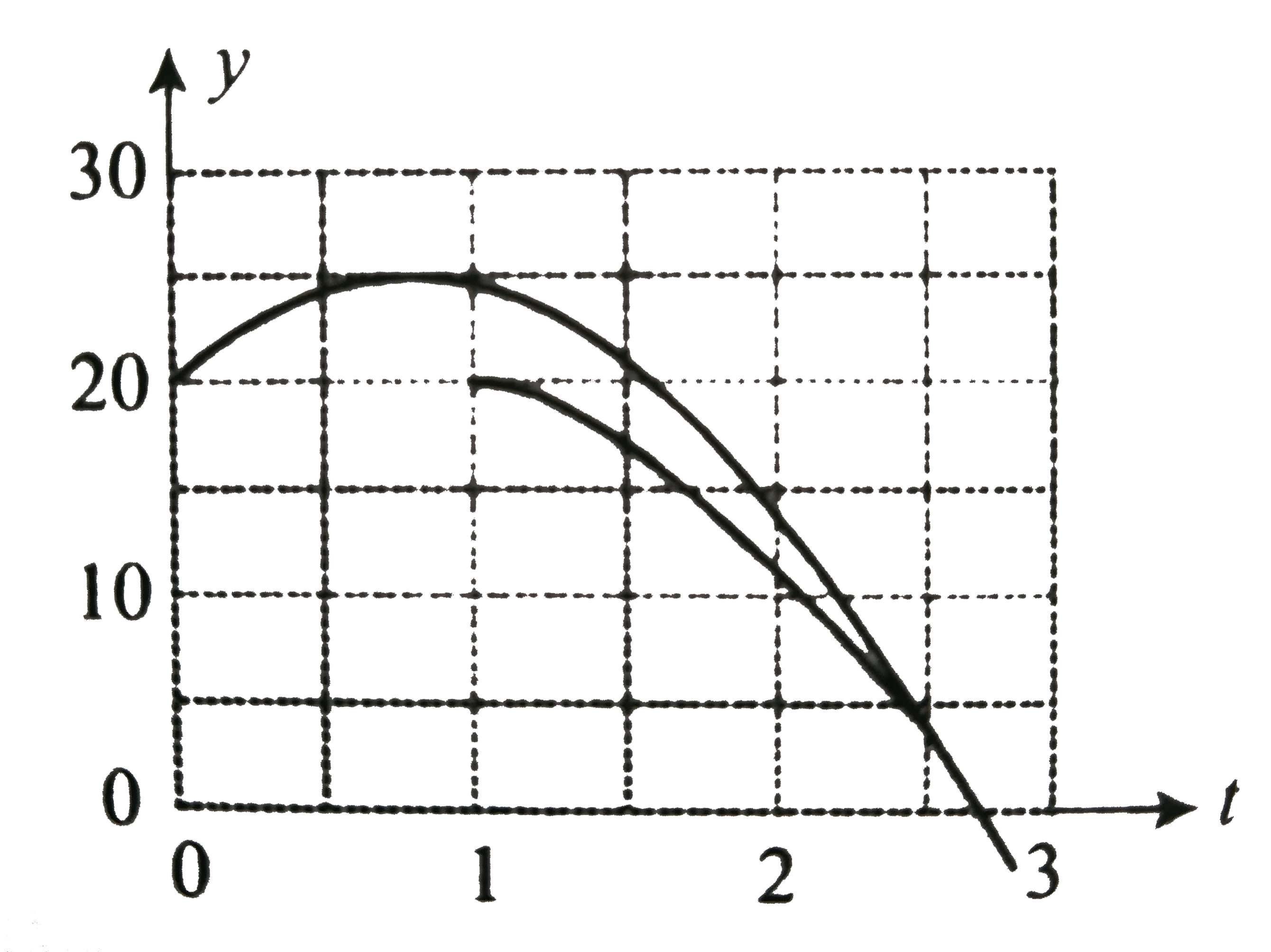 . . b. The above expression gives for (i) `0.411 m` and for (ii) `1.15 km`. C. As `v_(0)` approaches `9.8 ms^(-1)`, the height `h` becomes infinite corresponding to a relative VELOCITY at the second ball is throun that approaches zero, If `v_(0)le 9.8 ms^(-1)`, the first ball can never catch the second ball. d. As `v_(0)` approaches `4.9 ms^(-1)` the height approaches zero. This corresponds to the first ball being CLOSER and is released. If `v_(0) le 4.9 ms^(-1)`, the first ball will already have roof on the wau down nefore the second ball is released, and the second ball can catch up. |
|
| 4. |
The value of 2.2 + 4.08 + 3.125 + 6.3755 with due regard to significant places is |
|
Answer» 15.78cm |
|
| 5. |
When air is blown between two balls suspended close to each other, they move towards each other why? |
| Answer» Solution :When air is blown, the air velocity between the balls is INCREASED and HENCE the pressure is DECREASED according to Bernoulli.s THEOREM. | |
| 6. |
A particle moving in a straight line starts with a velocity u. Its retardation at any instant is proporional to the displacement. Find its displacement before coming to rest, if retardation at unit displacement is mu. |
|
Answer» `S = PM (U)/(sqrt(mu))` |
|
| 7. |
Find the angle between two vectors vec(A)=2i+j-k and vec(B)=i-k. |
|
Answer» Solution :`COS THETA = (vec(A).vec(B))/(|vec(A)||vec(B)|)` `30^(@)` |
|
| 8. |
A coin of mass m placed on a horizontal platform undergoing a S.H.M about a mean positions O in horizontal plane. If the force of friction on the coin is f, while the coin does not slip on the platform then f, is |
|
Answer» DIRECTED towards O ALWAYS |
|
| 9. |
State , for each of thefollowing physical quantities , if it is ascalar or a vector : volume , mass , speed , acceleration , density , number of moles , velocity , angular frequency , displacement , angular velocity . |
|
Answer» |
|
| 10. |
what do you know aobut SI ? Define the fundamental and supplementary units on SI ? |
| Answer» SOLUTION :1 (B) 9 | |
| 11. |
A stone is projected from the point of a ground in such a directed as so to hit a bird on the top of a telegraph post of height h and then attain the maximum height 2h above the ground. If at the instnat of projection, the bird were to fly away horizontally wit a uniform speed, find the ratio between the horizontal velocities of the bird and the stone, if the stone still hits the bird while descending. |
|
Answer» |
|
| 12. |
Draw areal velocity versus time graph for mars. |
Answer» Solution :`IMPLIES` ACCORDING to Kepler.s second LAW for planetary motion, AREAL velocity is constant with TIME. 
|
|
| 13. |
A spring having with a spring constant 1200 N m^(-1) is mounted on a horizontal table as shown in Fig. 14.24. A mass of 3 kg is attached to the free end of the spring. The mass is then pulled sideways to a distance of 2.0 cm and released. Determine (i) the frequency of oscillations, (ii) maximum acceleration of the mass, and (iii) the maximum speed of the mass. |
| Answer» SOLUTION :FREQUENCY `3.2 s^(-1)`, MAXIMUM ACCELERATION of the mass 8.0 m `s^(-2)`, maximum speed of the mass 0.4 m `s^(-1)`. | |
| 14. |
A body of mass .m. and radius .r. rolling on a horizontal floor with velocity .v., rolls up an inclined plane up to vertical height (3V^(2))/(4g). Find the momentu of inertia of body and comment on its shape |
|
Answer» Solution :The total KE of the body `K=K_(T)+K_(R )=(1)/(2)mv^(2)[1+(I)/(mr^(2))]` When rolls up an inclined plane of HEIGHT `h = (3V^(2))/(4g)`its KE is covereted into PE. So `(1)/(2)mv^(2)[1+(I)/(mr^(2))]=mg((3v^(2))/(4g))` on SIMPLIFICATION `I=(mr^(2))/(2)` HENCE the body is either a disc or cylinder. |
|
| 15. |
Calculate the efficiency of a heat engine in a gas (whose ratio of specific heat = gamma ) while it is being taken through a cycle as shown in the indicator diagram, also CD and AB are adialatric stage. |
| Answer» SOLUTION :`ETA =1-(1)/( GAMMA) ((T_4 -T_1)/(T_3 -T_2))` | |
| 16. |
An aeroplane flies along a straight path A and B and returns back again. The distance between A and B is l and the aeroplane maintains the constant speed v w.r.t. wind. There is a steady wind with a speed u at an angle theta with line A B. Determine the expression for the total time of the trip. . |
|
Answer» SOLUTION :SUPPOSE the plane is oriented at an angle `PROP` w.r.t. line `AB`, while the plane is moving from `A` to `B` : Velocity of plane ALONG `AB = v cos prop - u cos theta`, and for no - drift from line `AB` `v sin prop = u sin theta` `rArr sin prop = (u sin theta)/(v)` Time taken from `A` to `B ` : `t_(A B) = (l)/(v cos prop - u cos theta)` Suppose plane is oriented at an angle `prop` w.r.t. line `AB` while the plane is moving from `B` to `A` : velocity of plane along `BA = v cos prop + u cos` `theta` and for no drift from line `AB`. `v sin prop = u sin theta` `rArr sin prop = (u sin theta)/(v) rArr prop = prop'` Time taken from `B` to `A` : `t_(B A) = (l)/(v cos prop + u cos theta)` Total time taken `= t_(A B) + t_(B A)` `= (l)/(vcosalpha - cosalpha) + (l)/(vcosalpha + ucosalpha)` =`(2vlcosalpha)/(v^2 cos^2 prop + u^2 cos^2 theta) = (2 v l sqrt(1 - (u^2 sin^2 theta)/(v^2)))/(v^2 - u^2)`. 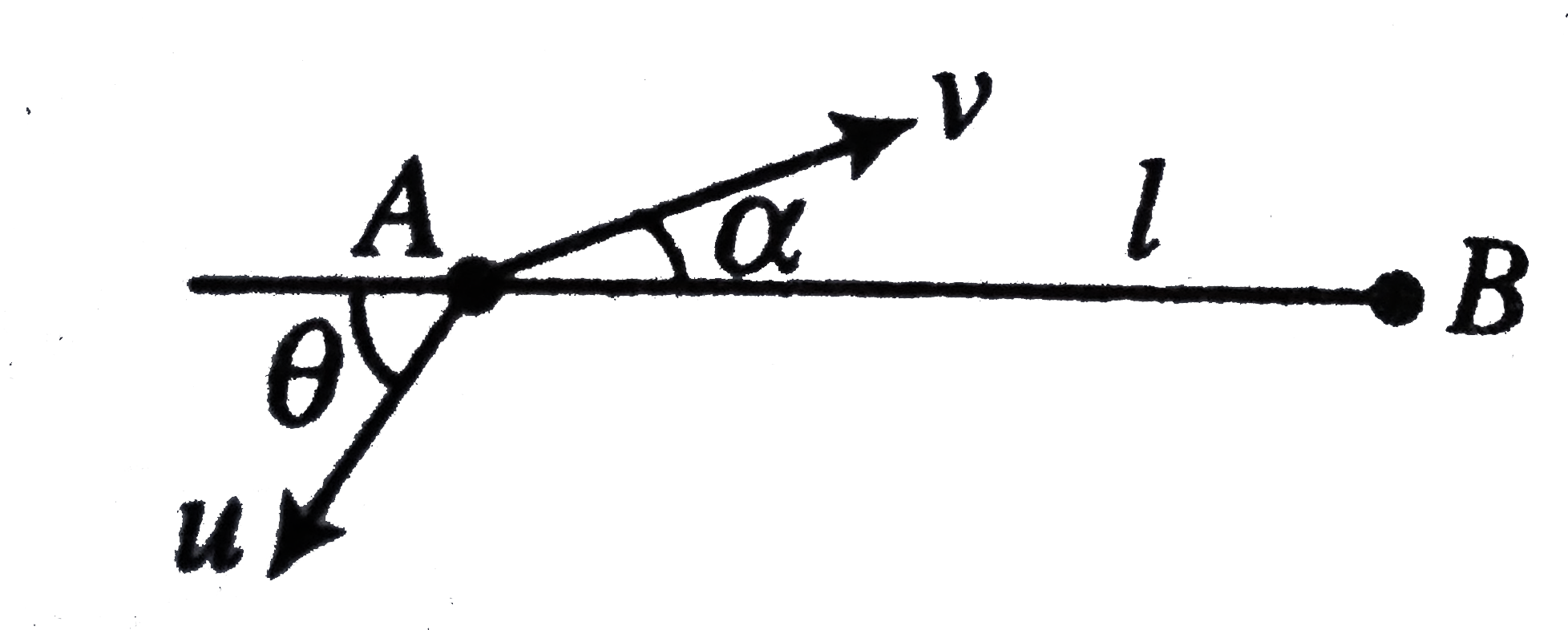 , ,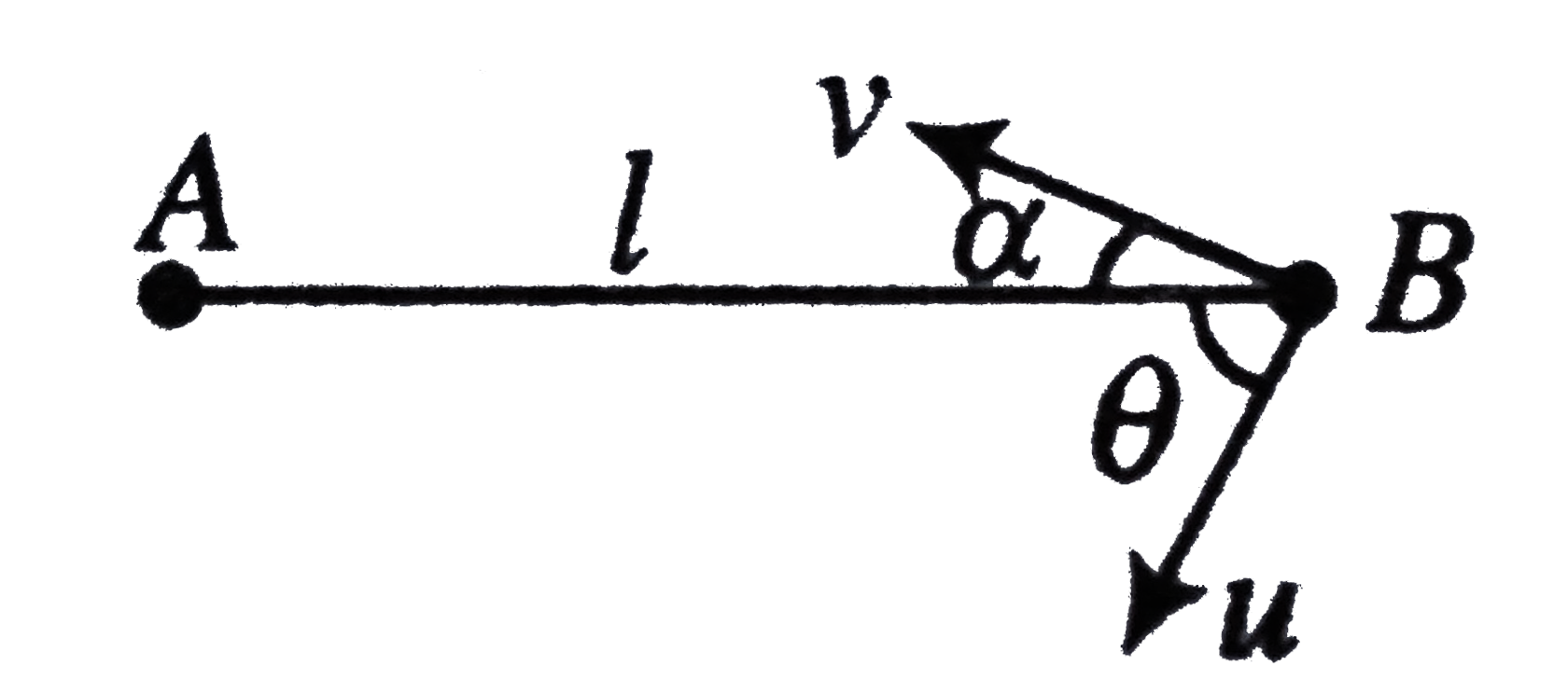 . .
|
|
| 17. |
A vector perpendicupar to the vecto (3hat(i) + 5hat(j)) is |
|
Answer» `5hat(i) - 3HAT(K)` |
|
| 18. |
If the time period t of the oscillation of a drop of liquid of density d, radius r, vibrating under surface tension s is given by the formula t=sqrt(r^(2b)s^(c)d^(a//2)). It is observed that the time period is directly proportional to sqrt((d)/(s)) . The value of b should therefore be : |
|
Answer» `3//4` |
|
| 19. |
If vecA, vecB, vecC represents the threee sides of an equilateral triangle taken in the same order then find the angle between (i) vecA and vecB (ii) vecB and vecC (iii) vecA and vecC. |
| Answer» SOLUTION :From the DIAGRAM the angle between the vectors `VECA and vecB`, the angle between `vecB and VECC` is `120^(@)`, the angle between `vecA and vecC` is `120^(@)` | |
| 20. |
(A) : The centre of mass of a two particle system lies on the line joining the two particles, being closer to the heavier particle.(R ) : Product of mas of one particle and its distace from centre of mass is numerically equal to product of mass of other particle and its distance from centre of mass. |
|
Answer» Both (A) and (R ) are TRUE and (R ) is the correct EXPLANATION of (A) |
|
| 21. |
The density of material in CGS system of units is 4gcm^(-3). In a system of units in which unit of length is 10 cm and unit of mass is 100 gm, then the value of density of material will be |
|
Answer» 0.04 |
|
| 22. |
What would be the distance covered by the particle falling freely in 1s? (g = 10 ms^(-2)) |
|
Answer» SOLUTION :`d = v _(0)t +1/2 G t ^(2)` `=0 XX 1 + 1/2 xx (10) xx (1) ^(2)` `therefore d = 5m` |
|
| 23. |
Air pressure in a car tyre increases during driving.Explain why? |
| Answer» Solution :Due to FRICTION between the road and the CAR TYRE the temperature of air inside the tyre increases reasonably. This increases the air pressure during DRIVING. | |
| 24. |
Find the volume of water that flows in 10 minutes through a tube of 0.25m length and 2mm diameter maintained at a level difference of 0.25m (eta = 0.001 Ns m^(-2)) |
| Answer» SOLUTION :0.00231 `m^3` | |
| 25. |
What are the dimensions of impedance ? |
|
Answer» `[ML^(2)T^(-3)I^(-2)]` Resistance `R= ("Voltage"V)/("Current I")= ([ML^(2)T^(-3)I^(-1)])/([I])= [ML^(2)T^(-3)I^(-2)]` |
|
| 26. |
For a particular gas gamma = (5)/(3)and is heated at constant pressure. Calculate the percentage of total heat supplied, used for external work. |
| Answer» SOLUTION :`dQ = 1 xx C _(P) xx DT, dW = PdV = RDT,` Required `% = RdT //C _(p) dT = C _(P) - C //C _(P) = 1 - (1// GAMMA) = 40%` | |
| 27. |
Which of the following process is reversible ? |
|
Answer» transfer of HEAT by radiation |
|
| 28. |
As shownbelow AB represents an infinite wall tangential to a horizontal semi-circular track. O is a point source of light on the ground at the centre of the circle. A block moves along the circular track with a speed v starting from the point where the wall touches the circle. If the velocity and acceleration of shadow along the length of the wall is respectively V and a, then : |
|
Answer» `V=vcos((vt)/(R))` |
|
| 29. |
A tank with a square base of area 1.0m^(2) is divided by a vertical partition in the middle The bottom of the partition has a small - hinged door of area 20cm^(2) . The tank is filled with water in one compartement , and and an acid (of relative density 1.7) in the other , both to a height of 4.0 m . compute the force necessary to keep the door close. |
|
Answer» Solution :For tank filled with water , `h_(1)=4m,rho_(1)=10^(3)kgm^(-3)` (density of water) Pressure due to water near door at bottom `P_(1)=h_(1)rho_(1)g` `=4xx10^(3)xx9.8` `=39.2xx10^(3)Pa` …(1) (b) For TNK filled with acid, `h_(2)=4m,(rho_(2))/(rho_(1))=1.7` `thereforerho_(2)=1.7xxrho_(1)=1.7xx10^(3)kgm^(-3)` Pressure due to acid near door at bottom, `P_(2)=h_(2)rho_(2)g` `=4xx1.7xx10^(3)xx9.8` `=66.64xx10^(3)Pa`...(2) `thereforeP_(2)gtP_(1) "" [because"From RESULT (1) and (2)"]` `therefore` Pressure DIFFERENCE, `DeltaP=P_(2)-P_(1)` `=66.64xx10^(3)-39.2xx10^(3)` `=27.44xx10^(3)Pa` Area of the HINGED door , `A=20cm^(2)=20xx10^(-4)m^(2)` To keep door closed. `therefore` The force necessary in horizontal direction from water to acid on door. F= pressure difference `(DeltaP)xx` area A `=27.44xx10^(3)xx20xx10^(-4)` `=54.88N` `thereforeF=55N` Base area does not affect the magnitude of force . |
|
| 30. |
Which component of force provide centripetal force to vehicle moving with optimum speed ? |
| Answer» SOLUTION :Horizontalcomponent of NORMALFORCE | |
| 31. |
Two identical steel cubes (masses 50 g , side 1 cm ) collide head -on face to face with a space of 10 cm/s each . Find the maximum compression of each .Young's modulus for steel= Y = 2xx10^(11) N//m^(2) |
|
Answer» Solution :Let m = 50 g = `50 xx 10^(-3)` kg L = 1 CM = 0.01 m v =10 cm/s = 0.1 m/s `Y = 2xx10^(11) N//m^(2)` Here, KE will be converted to PE `F = (YADeltaL)/l ` (Hooke.s LAW ) ` :. "Also " , F = DeltaL ` (K = spring constant) ` :. k = Y A/L = YL "" [ :. A =L^(2)] ` Intial `KE = 2XX 1/2 mv^(2) = 5xx10^(-4) J ` . Final `PE = s xx 1/2 k(DeltaL)^(2) = k(DeltaL)^(2)` ` :. k(DeltaL)^(2) = 5xx10^(-4) = sqrt((5xx10^(-4))/(2xx10^(11)xx0.1))` `= 1.58 xx10^(-7) m ` |
|
| 32. |
A gunman always keep his gun slightly tilted above the line of sight while shooting. Why? |
| Answer» SOLUTION :Because bullet follow PARABOLIC trajectory under CONSTANT downward acceleration. | |
| 33. |
Young's modulus of steel is 1.9 xx 10^(11)(N)/(m^(2)) . When expressed in ("dyne")/(cm^(2)) of it will be equal to (IN = 10^(5) "dyne" , 1 m^(2)=10^(4) cm^(2)) |
|
Answer» `1.9xx10^(10)` `Y=(1.9xx10^(12)"dyne")/(cm^(2))` |
|
| 34. |
A particle of mass m moving with a speed v hits elastically another stationary particle of mass 2m on a smooth horizontal circular tube of radius r. The time in which the next collision will take place is equal to |
|
Answer» `(pi R)/(V)` |
|
| 35. |
Two bodies A and B are moving with velocities vec(V)_(A) and vec(V)_(B)making an'theta'with each other. Determine the relative velocity of Awith respect to B. What will be the relative velocity .When two bodies are moving inthe same direction. |
|
Answer» Solution :Let us CONSIDER the VELOCITIES `vec(V)_(A) and vec(B)`at an angle `theta`between their DIRECTIONS. The relative velocity of A with respect to B,`vec(v) _(AB) = vec(v)_(A) - vec(B)` . Then , the magnitude and direction of . `vec(V)_(AB)`is GIVEN by`v_(AB) = sqrt(v_(A)^(2) + v_(B)^(2) - 2v_(A) v_(B) cos theta)`and tan `beta = (v_(B) sin theta)/(v_(A) - v_(B) cos theta)`(Here `beta`is angle between `vec(v)_(AB) and vec(v)_(B)` ) . When `theta = 0`, the bodies move along parallel straight lines in the same direction. We have `v_(AB) = (v_(A) - v_(B))`in the direction of `vec(v)_(A)`. Obviously`v_(AB) = (v_(B) - v_(A))`in the direction of `vec(v)_(B)` . |
|
| 36. |
Two bodies A and B are moving with velocities vec(V)_(A) and vec(V)_(B)making an'theta'with each other. Determine the relative velocity of Awith respect to B. What will be the relative velocity .When two bodies are moving in the apposite direction. |
|
Answer» Solution :Let us consider the velocities `vec(V)_(A) and vec(B)`at an angle `theta`between their directions. The RELATIVE velocity of A with respect to B,`vec(v) _(AB) = vec(v)_(A) - vec(B)` . Then , the MAGNITUDE and direction of . `vec(V)_(AB)`is GIVEN by`v_(AB) = sqrt(v_(A)^(2) + v_(B)^(2) - 2v_(A) v_(B) cos theta)`and tan `beta = (v_(B) sin theta)/(v_(A) - v_(B) cos theta)`(Here `beta`is angle between `vec(v)_(AB) and vec(v)_(B)`) . When `theta = 180^(@)`, the bodies move along parallel straight lines in opposite directions, We get `v_(AB) = (v_(A) +v_(B))`in the direction of `vec(v)_(A)`. Similarly ,`v_(BA) = (v_(B) +v_(A))`in the direction of `vec(v)_(B)`. |
|
| 37. |
Two bodies A and B are moving with velocities vec(V)_(A) and vec(V)_(B)making an'theta'with each other. Determine the relative velocity of Awith respect to B. What will be the relative velocity .When two bodies are moving at right angle to each other . |
|
Answer» Solution :Let us consider the velocities `vec(V)_(A) and vec(B)`at an angle `theta`between their directions. The relative VELOCITY of A with respect to B,`vec(v) _(AB) = vec(v)_(A) - vec(B)` . Then , the MAGNITUDE and direction of . `vec(V)_(AB)`is GIVEN by`v_(AB) = sqrt(v_(A)^(2) + v_(B)^(2) - 2v_(A) v_(B) cos theta)`and TAN `beta = (v_(B) sin theta)/(v_(A) - v_(B) cos theta)`(Here `beta`is angle between `vec(v)_(AB) and vec(v)_(B)`) . When `theta = 0`, the bodies move along parallel straight lines in the same direction. If the two bodies are moving at right angles to each other , then `theta = 90^(@)`. magnitude of the relative velocity of A with respect to B `= v_(AB) = sqrt(v_(A)^(2)+v_(B)^(2))` . |
|
| 38. |
A simple pendulum has time period 'T_(1)'. The point of suspension is now moved upwards according to the relation y = kt^(2), (k = 1m//"sec"^(2)) where y is the vertical displacement. The time period now becomes 'T_(2)' then find the ratio of (T_(1)^(2))/(T_(2)^(2)) (g= 10m//"sec") |
|
Answer» Solution :`y= kt^(2)=1//2at^(2)` acceleration `IMPLIES (1)/(2)a= k=1 implies a= 2m//"sec"^(2)` `T_(1)= 2pisqrt((l)/(G))` and `T_(2)= 2pisqrt((l)/(g+a))` `(T_(1)^(2))/(T_(2)^(2))= (g+a)/(g)= (10+2)/(10)= (6)/(5)` |
|
| 39. |
Four spheres A, B, C and D of different metals but of same radius and same surface finish are kept at same temperature. The ratio of their densities and specific heats are 2 : 3 : 5 : 1 and 3 : 6 : 2 : 4. Which sphere will show the fastest rate of cooling (initially) |
|
Answer» A Heat capacity = (MASS) (SPECIFIC heat) `therefore` Ratio of heat capacities will be 6 : 18 : 10 : 4. The sphere having the minimum heat capacity will show the fastest rate of cooling. `therefore` correct OPTION is (4) |
|
| 40. |
When a block of iron floats in mercury at 0^(@) C, a fraction K_1 of its volume is submerged, while at the temperature 60^(@) C, a fraction K_(2) is seen to be submerged. If the coefficient of volume expansion of iron is gamma_(Fe) and that of mercury is gamma_(Hg) then the ration (K_1)/( K_2) can be expressed as |
|
Answer» `( 1+ 60gamma_(FE))/( 1+ 60gamma_(Hg))` |
|
| 41. |
A circular disc of diameter d and a square plate of side d are placed as shown in fig. The centre of mass of this combination from centre of disc is (both the object are having same mass per unit area): |
|
Answer» `(4D)/(4+pi)` |
|
| 42. |
A mosquito net over a 7 f t xx 4 f t bed is 3 ft high. The net has a hole at one corner of the bed through which a mosquito entres the net Taking the hols as origin, the length of the bed as the x-axis, it.s width as the y-axis and vertically up as the z-axis, write the components of the displacement vector |
|
Answer» `sqrt54` FT |
|
| 43. |
Which of following quantities remain constant in a planetary motion (consider elliptical orbits) as seen from the sun? |
|
Answer» speed |
|
| 44. |
Initially a sphere of radius r is rotating with an angular velocity omega about its own horizontal axis. When the sphere falls on a surface (coefficient of friction mu), then it begins to skid first and then starts rotating without skidding. How much distance will the sphere cover before reaching this velocity? |
|
Answer» SOLUTION :Distance covered, `X=(1)/(2)at^(2)=(1)/(2)MUG((2omegar)/(7mug))^(2)=(2)/(49).(r^(2)OMEGA^(2))/(mug).` |
|
| 45. |
If Delta U and Delta W represent the increase in internal energy and work done by the system respectively in a thermodynamical process, which of the following is true? |
|
Answer» `Delta U = - Delta W` in an adiabatic process |
|
| 46. |
If the work done by force on the body is positive then its kinetic energy |
|
Answer» INCREASE |
|
| 47. |
Initially a sphere of radius r is rotating with an angular velocity omega about its own horizontal axis. When the sphere falls on a surface (coefficient of friction mu), then it begins to skid first and then starts rotating without skidding. What will be the final linear velocity of its centre of mass? |
|
Answer» Solution :Let the mass of the sphere be m. Then its moment of INERTIA about the AXIS of rotation, `I= (2)/(5) mr^(2)` Fig. Moment of frictional force `(mumg)` resists the rotational motion of the sphere. If the angular retardation is `alpha` then `mu mgr =Ialpha = (2)/(5) mr^(2)alpha` or, `alpha =(5mug)/(2r) "" cdots (1)` Due to this it the angular velocity of the sphere BECOMES `omega`. in time t, then `omega. = omega-alphat = omega- (5 mu"gt")/(2r)` The speed of a rotating point on the upper surface of the sphere, `v. = omega.r= (omega-(5mu"gt")/(2r))r ""cdots(2)` Again, due to frictional force `mu`mg if the sphere skids over the surface with an acceleration a, then `mu`mg= ma or, a =`mu`g `:.` The LINEAR velocity of the centre of mass of the sphere in time t, v = 0 +at = `mu`gt `""cdots(3)` The condition of rotational motion of the sphere with out skidding is v= v.. If the values of these two velocities become the same in time t, the sphere will undergo pure rotation. From equations (2) and (3) we get, `mu "gt"=(omega-(5mu"gt")/(2r))r=omegar-(5mu"gt")/(2)` or,`(7)/(2)mu"gt"=omegaror,t=(2omegar)/(7mug)` `:.` From equation (3) we get , `v = mugxx(2omegar)/(7mug)=(2)/(7)omegar`. 
|
|
| 48. |
Consider a block of copper of radius 5 cm. Its outer surface is coated block. How much time is required for block to cool down from 1000K to 300 K? Density of copper =9xx10^(3)" Kg"//"m"^(3) and "Sp ht"=4(KJ)/(Kg-K) |
|
Answer» 30 HRS 16 MIN |
|
| 49. |
6 bullets are fired in a second from a machine gun with velocity of 400 ms^(-1). The mass of machine gun and bullet are 10 kg and 30g respectively. What is the value of force is to be exerted on machine gun to keep it stationary ? |
|
Answer» Solution :Forceis to beexertedon machinegumchangein momentumof bullets `=nmv` `=(6 ) (30 XX 10^(-3)) (400)` `=72 N` |
|
| 50. |
Water in a storage tank stands 2.5m above the level of a valve in the side of the tank. With what speed the water will rush out of the valve (neglecting friction) |
|
Answer» 5m/s |
|