

Saved Bookmarks
This section includes 7 InterviewSolutions, each offering curated multiple-choice questions to sharpen your Current Affairs knowledge and support exam preparation. Choose a topic below to get started.
| 1. |
A closed organ pipe and an open organ pipe of same length produce 2 beats/second while vibrating in their fundamental modes. The length of the open organ pipe is halved and that of closed pipe is doubled. Then, the number of beats produced per second while vibrating in the fundamental mode is |
|
Answer» 2 `upsilon_(C)=v/(4L_(C))` where v is the velocity of sound in air and `L_(C)` is the length of the closed pipe for an organ pipe, the frequency of fundamental mode is `upsilon_(O)=v/(2L_(O))` where `L_(O)` is the length of the open pipe `becauseL_(C)=L_(O)` (Given) `thereforeupsilon_(O)=2upsilon_(C)`...(i) `upsilon_(O)-upsilon_(C)=2`(Given) ...(ii) Solving (i) and (ii), we get `upsilon_(O)=4 HZ,upsilon_(C)=2Hz` When the length of the open pipe is halved, its frequency of fundamental mode is `upsilon'_(O)=v/(2)(L_(O)/2))=2upsilon_(O)=2xx4Hz=8Hz` When the length of the closed pipe is doubled, its frequency of fundamental mode is `upsilon'_(C)=v/(4(2L_(C)))=1/2upsilon_(C)=1/2xx2Hz=1Hz` Hence number of beats produced PER second `=upsilon'_(O)-upsilon'_(C)=8-1`=7 |
|
| 2. |
Can you associate vectors with (a) the length of a wire bent into a loop , (b) aplane are a , (c ) a sphere? Explain . |
|
Answer» |
|
| 3. |
A stone is suspended in a tub of water with copper wire. Another stone of equal mass is suspended in kerosene with equal length of copper wire then |
|
Answer» Young.s MODULUS is more in the FIRST case |
|
| 4. |
At what temperature will the filament of a 100W lamp operate if it is supposed to be a perfect black body of area 1 cm^2 ? Given (sigma = 5.67 xx 10^(-5) "erg" cm^(-2) s^(-1) k^(-4)) |
| Answer» SOLUTION :`2.049 XX 10^(3) K` | |
| 5. |
What is a venturi - meter ? Explain its constuction and working.. |
|
Answer» Solution :The ven meter isa DEVICE to measure the FLOW speed of incompressible fluid. It consists of a TUBE with a broad diameter and a small contraction at the middle as shown in figure  A manometer in the form of a U- tube is also attached to it, with one arm at the broad neck point of the tube and the other at construction which is known as throat. The manometer contains a liquid of density `rho_(m)`. At point 1, cross section area is A and velocity of liquid is `v_(1)`. At point 2, cross section area is a and velocity of liquid is `v_(2)`. According to equation of continuity , `Av_(1)=av_(2)` `thereforev_(2)=(Av_(1))/(a)`.... (1) WRITING Bernoull.s equation at point 1,2. `P_(1)+(1)/(2)rhov_(1)^(2)+rhogh,=P_(2)+(1)/(2)rhov_(2)^(2)+rhogh_(2)` but `h_(1)=h_(2)` `thereforeP_(1)-P_(2)=(1)/(2)rhov_(2)^(2)-(1)/(2)rho_(1)^(2)` `thereforeP_(1)-P_(2)=(1)/(2)rho(A^(2)v_(1)^(2))/(a^(2))-(1)/(2)rhov_(1)^(2)` `thereforeP_(1)-P_(2)=(1)/(2)rhov_(1)^(2)[((A)/(a))^(2)-1]` ... (2) Here `Agta` , `thereforev_(1)ltv_(2)` so `P_(1)gtP_(2)` The pressure difference cause liquid in arm 1 coming down and in arm 2 liquid rise . Due to height difference , the equation of pressure difference `P_(1)-P_(2)=rho_(m)gh`.....(3) Comparing equation (2) and (3), `(1)/(2)rhov_(1)^(2)[(A^(2))/(a^(2))-1]=rho_(m)gh` `therefore(1)/(2)rho_(1)^(2)[(A^(2)-a^(2))/(a^(2))]=rho_(m)gh` `thereforev_(1)^(2)=(a^(2)(2rho_(m)gh))/(rho(A^(2)-a^(2)))` `thereforev_(1)=sqrt((2rho_(m)gh)/(rho(A^(2)-a^(2))))` ...(4) where `v_(1)` is the speed of fluid at wide neck |
|
| 6. |
For a good cooking vessel, the necessary characterstics are a) Large thermal conductivity b) Small specific heat c) Small coefficient of expansion |
|
Answer» a,B,C |
|
| 7. |
A block of q,uutz of mass 13.5 g is weighed in aniline at 0^(@)C and 100^(@)C. The weighings are 8.905g and 9.29g respectively. Calculate the coefficient of cubical expansion of aniline, assuming the coefficient of cubical expansion of quartz to be zero. |
|
Answer» Solution :We KNOW the ratio of thrusts or loss of weight in liquid is `(W_(2))/(W_(1)) = (Th.)/(Th) = (V^(1) sigma^(1) G)/(V sigma g) = ((1 + gamma_(s) Delta theta))/((1 + gamma_(L) Delta theta))= (1)/(( 1 + gamma_(L) Delta theta))` `therefore gamma_(s) = 0 ` In this problem , `W_(1) = (13.5 - 8.905 ) xx 10^(-3) xx g N ` = ` 4.595 xx 10^(-3) xx g N, t_(1) = 0^(@) C ` : `W_(2) = (13.5 - 9.29) xx 10^(-3) xx g N ` `= 4.21 xx 10^(-3) xx g N , t_(2) = 100^(@) C , gamma_(s) = 0 ` `(4.21)/(4.595) = (1)/(1 + gamma_(L) 100 ) rArr 1 + gamma_(L) 100 = (4.595)/(4.21)` `gamma_(L) = (0.385)/(4.21 xx 100) = 9.166 xx 10^(-4) //^(0) ` C |
|
| 8. |
A spring balance has a scale that reads from 0 to 50 kg. The length of the scale is 20 cm. A body suspended from this spring, when displaced and released, oscillates with a period of 0.60 s. What is the weight of the body ? |
|
Answer» Solution :Here `m= 50kg,l=0.2m` we KNOW `mg=kl or k=(mg)/l=(50**9.8)/0.2= 2450 Nm^(-1)` `T=0.60s`and `M` is the MASSOF the BODY, then using`T= 2pisqrt(M/k) RightarrowM=(2450**(0.60)^(2))/(4pi^(2))= 22.34 KG`.Weight of body `Mg=22.34**9.8=218.93N`. |
|
| 9. |
Define three dimensional motion . Give examples . |
|
Answer» Solution :If a particle moving in a three dimensional space , then it is called three dimensional motion . Examples : (i) A bird flying in the sky . (ii) RANDOM motion of MOLECULES . (III) Flying KITE on a windy DAY . |
|
| 10. |
If .O. is at equalibrium then the values of the tension T_(1) and T_(2) are x, y, if 20 N is vertically down. Then x, y are |
|
Answer» 20 N 30 N |
|
| 11. |
Fill in the blanks : (i) ……. Discovered famous theory of relativity. (ii) Nuclear reactors are based on the phenomena of …….. (iii) Genetic engineering helps us in finding the ……….. |
| Answer» SOLUTION :(i) EINSTEIN (II) controlled NUCLEAR CHAIN reaction (iii) role of DNA in heredity. | |
| 12. |
A metre scale is moving with uniform velocity. This implies |
|
Answer» the force acting on the scale is ZERO, but a TORQUE about the centre of mass can act on the scale. |
|
| 13. |
How is dimensional formula related to dimensional equation? |
| Answer» Solution :Dimensionalformula OFA physical QUANTITY is representation of MASS, length and timeofthe quantity. DIMENSIONAL EQUATION contains equated dimensionalformula and physical quantity. | |
| 14. |
Significant figures determine the accuracy qfthe measurement ofa physical quantity.If the percentage error in calculating the radius of the sphere is 2%what will be the percentage.error in calculating the volume? |
| Answer» SOLUTION :`V=4/3pir^3(DELTAV)/Vxx100=3xx(DELTAR)/rxx100=3xx2=6%` | |
| 15. |
A particle is executing SHM. If time is measured from when it is at one end of its path of motion, calculate the ratio of its kinetic energy to the potential energy at t=T/12. Here T is the time period of the motion. Suppose the initial phase is zero. |
|
Answer» Solution :If time is MEASURED from when the particle is at ONE end of the path of motion, then the equation of SHM is `x=Acosomegat`. If `t=T/12`, then `x=A"cos"(2PI)/T*T/12=A"cos"pi/6=(Asqrt3)/2=sqrt3/2A` Kinetic energy of the particle at that time, `K=1/2mv^(2)=1/2momega^(2)(A^(2)-x^(2))` = `1/2momega^(2)(A^(2)-(3A^(2))/4)=1/8momega^(2)A^(2)` POTENTIAL energy of the particle at that time, `U=1/2momega^(2)x^(2)=1/2m(omega^(2)*(3A^(2))/4)=3/8momega^(2)A^(2)` `therefore""K/U=(1/8momega^(2)A^(2))/(3/8momega^(2)A^(2))=1/3" "thereforeK:U=1:3`. |
|
| 16. |
An air bubble of radius 1cm rises from the bottom portion through a liquid of density 1.5g/cc at constant speed of 0.25cm/sec. If the density of air is neglected the coefficient of viscosity of the liquid is approximately (In pa. s) |
|
Answer» `13,000` |
|
| 17. |
Two capillary tubes of equal length and inner radii 2r and 4r respectively are added in series and a liquid flows through it. If the pressure difference between the ends of the whole system is 8.5 cm of mercury, find the pressure difference between the two ends of the first capillary tube. |
|
Answer» 8.0 CM of Hg |
|
| 18. |
A rectangular block of dimensions 10m xx 6m xx 3m is lying on a horizontal surface with its smallest area in contract with the surface. If the work done in arranging it with its largest area in contact with the surface is 13.86MJ, the density of the body is (g= 10 ms^(-2)) |
|
Answer» 2200gm/C.c |
|
| 19. |
In a new system of units, unit of mass is 10 kg, unit of length is 1 km and unit of time is 1 minute. The value of 1 joule in this new hypothetical system is |
|
Answer» `3.6 XX 10^(-4)` new units `n_(2)= 1[(1kg)/(10kg)]^(1)[(1m)/(1km)]^(2)[(1s)/(1min)]^(-2)` `= (1)/(10) xx (1)/(10^(6)) xx (1)/(60)^(-2)= (3600)/(10^(7))= 3. 6 xx 10^(-4)` |
|
| 20. |
8000 identical water drops are combined to form a big. drop. Then, the ratio of final surface energy to the initial surface energy of all the drops together is |
| Answer» ANSWER :C | |
| 21. |
H_2gas undergoes process where pV^2= constant. The ratio of work done by gas to modulus ofchange in its internal energy as the gas expands is 2/N. N is is equal to |
|
Answer» |
|
| 22. |
Two object A and B are moving each with velocities 10 m/s. A is moving towards East and B is moving towards North from the same point as shown. Find velocity of A relative to B (vecV_(AB)) |
Answer» Solution : `vec(V)_(AB) = vec(V)_(A) - vec(V)_(B) = 10i- 10 j` `|vec(V)_(AB)| = sqrt(10^(2)+10^(2)) = 10 sqrt(2)ms^(-1)` along SE |
|
| 23. |
A body is moved along a closed loop. Is the work done in movingthe the body necessarily zero ? If not, state the condition under which work done over a closed path is always zero. |
| Answer» Solution :No, work DONE in MOVING along a closed loop is not necessarily zero. It is zero only when all the FORCES are CONSERVATIVE forces. | |
| 24. |
(A) : For the planets orbiting around the sun, angular speed, linear speed, K.E. changes with time, but angular momentum remains constant. (R) : No torque is acting on the rotating planet. So its angular momentum is constant. |
|
Answer» Both (A) and (R) are TRUE and (R) is the correct explanation of (A) |
|
| 25. |
4 point size steel spheres each of mass 1kg are placed on a turn table and are connected by 4 strings each of length a to form a square. If the spheres are rotated with an angular velocity of (1)/(2pi)rev//secthe tension in the connecting strings in newton is |
|
Answer» a |
|
| 26. |
A force of 2hat(i)+3hat(j)+2hat(k) N acts a body for 4 s and produces a displacement of 3hat(i)+4hat(j)+5hat(k) m calculate the power ? |
|
Answer» 5W |
|
| 27. |
Can a pendulum clock be used in an earth satellite? |
| Answer» Solution :No. `T = 2pisqrt(l/G) `. INSIDE the satellite the effect of g is ZERO. So PENDULUM will not oscillate . | |
| 28. |
Round off to three significant figures (i) 9.745 g (ii) 9.835 cm (iii) 28457 m. |
|
Answer» |
|
| 29. |
Light takes time t_1 to travel a distance x_1 in vaccum and the same light takes time t_2 to travel a distance x_2 in a medium. The critical angle for that medium is |
|
Answer» `sin^-1((x_2t_2)/(x_1t_1))` |
|
| 30. |
(ii)A liquid of density rho and surface tension S rises to a height h in a capillary tube of diameter D. What is the weight of the liquid in the capillary tube? Angel of contact is 0^@. |
|
Answer» Solution :RISE of liquid in the capillary tube is given as, `H=(2Scostheta)/(rho r g) ` Here, `r=(D)/(2). Theta=0^@., cos0^@=1` So, `h=(2Sxx1)/(rhoxxD/2xxg)=(4S)/(rho DG)` Now, weight of liquid in the capillary tube, W = mass `xx` = m (volume `xx` DENSITY )`xx`g `=(pir^2xxh)xxrhoxxg` `=pi(D^2)/(4)xx((4S)/(rhoD g))xxrhoxxg=piDS` This is the required result. |
|
| 31. |
Two similar capillary tubes of sufficient length long are placed in water. One is placed vertically and the other is placed at 60^(@) with the vertical. The length of the liquid rised into tubes is in the ratio |
|
Answer» `1:3` |
|
| 32. |
A resistance R carries a current i. The power lost to the surrounding is lambda (theta - theta_(0)). Here, lambda is a constant, theta is temperature of the resistance and theta_(0) is the temperature of the atmosphere. If the corfficient of linear expansion is alpha. The strain in the resistance is |
|
Answer» `(alpha)/(lamda) l^(2)R` |
|
| 33. |
A gas may expand either adiabatically or isothermally. A number of P-V curves are drawn for the two processes over different range of pressure and volume. It will be found that |
|
Answer» An adiabatic CURVE and an ISOTHERMAL curve may intersect |
|
| 34. |
A cat is chasing a mouse as shown in the figure. The mouse runs horizontally with a speed 10m//s.The cat runs with a constant speed of 20m//s. At what angle to the horizontal should the cat run in order to catch the mouse? |
|
Answer» Solution :Method-1[Analysis of velocity components] Assume that the cat and the mouse do meet at point .D. as shown. Let D be the horizontal point above .D. . The cat has a velocity .v. which carries it to point .D. in time .t.. Since the velocity is inclined, we can resolve it to component velocities `v_(x),v_(y).v(x)` carries cat from point C to D in time t and `v_(y)` carries cat from C to D in t. We thus SEE that theX-component of velocity, `v_(x)` is responsible for keeping cat directly above mouse .  Y- component of velocity vrings cat nearer and nearer tp mouse. HENCE the cat should run such that `v_(x)=10`. `:.20 cos alpha =10 ` ` cos alpha=1//2,alpha =60^(@)` only when cat runs at this angle it will remain at the same level as the mouse at all times. to find teh time at which they meet , we analyze motion along Y-axis . the cat has a Y-component of velocity of `20 sin 60=10sqrt3=17.32m//s`. It has to TRAVEL a distance of 173m in `-ve` Y direction . Hence time taken `t=("VERTICAL distance" )/("vertical component velocity" )=(173)/(17.3)=10sec`. |
|
| 35. |
When a steady torque acts on a body it |
|
Answer» gets linerar acceleration |
|
| 36. |
Regarding pure rolling motion of a spherical body of radius R shown, the correct statement(s) are |
|
Answer» When a rigid body rolls, without slipping on a horizontal SURFACE a point on its circumference moves along a curved path called cycloid. |
|
| 37. |
Explain the types of mechanical wave. |
|
Answer» are LONGITUDINAL only |
|
| 38. |
By sucking through a straw, a student can reduce the pressure in his lungs to 750 mm of Hg (density =13.6 g//cm^(3)). Using the straw he can drink water from a glass upto a maximum depth of |
|
Answer» 10 cm |
|
| 39. |
Two discs of moments of inertia l_(1) and I_(2) about their respective axes (normal to the disc and passing through the centre), and rotating with angular speedomega_(1) and omega_(2) are brought intocontact face to face with their axes of rotation coincident, (i) What is the angular speed the two-disc system? (i) Show that the kinetic energy of the combined system is less than the sum of the initial kinetic energies of the two discs. How do you account for this loss in energy? Take omega_(1)ne omega_(2). |
|
Answer» Solution :Let `omega` be the angular speed of the TWO-dise system. Then by conservation of angular momentum `(I_(1)+I_(2)) omega=I_(1)+I_(2) omega_(2) or omega=(I_(1) omega_(1)+I_(2) omega_(2))/(I_(1)I_(2))` (ii) INITIAL K.E. of the two dises `K_(1)+(1)/(2)(I_(1)+I_(2)) omega^(2)=(1)/(2) (I_(1)+I_(2)) ((I_(1) omega_(1)+I_(2) omega_(2))/(I_(1)+I_(2)))^(2)` LOSS in `K.E. =K_(1)-K_(2)=(1)/(2)(I_(1)omega_(1)^(2)+1_(2) omega_(2)^(2))-(1)/(2(I_(1)+I_(2)))(1_(1)omega_(3)+I_(2)omega_(2))^(2)` `=(I_(1)I_(2))/(2(I_(1)+I_(2))) (omega_(1)-omega_(2))^(2)=a` positive quantity `[ :. omega_(1) ne omega_(2)]` Hence there is a loss of rotational K.E. which appears as heat. When the two discs are BROUGHT together work is done against friction between the two discs |
|
| 40. |
There are two Carnot engines A and B operating in two different temperature regions. For Engine A the temperatures of the two reservoirs are 150^(@)C and 100^(@)C. For engine B the temperatures of the reservoirs are 350^(@)C and 300^(@)C. Which engine has lesser efficiency? |
|
Answer» Solution :The EFFICIENCY for engine `A=1-(373)/(423)=0.11`. Engine A has `11%` efficiency The efficiency for engine `B=1-(573)/(623)=0.08`. Engine B has only `8%` efficiency |
|
| 41. |
A projectile of mass M is fired so that the horizontal range is 4 km. At the highest point the projectile explodes in two parts of masses M/4 and 3M/4 respectively and the heavier part starts falling down vertically with zero initial speed. The horizontal range (distance form point of fring) of the lighter part is : |
|
Answer» 16km |
|
| 42. |
A driver can stop his car from the red signal at a distance of 20m when he is driving at 36 kmph and 41.25m when he is driving at 54 kmph. Find his reaction time. |
|
Answer» Solution :Let t is reaction time of driver during which he MOVES with uniform speed Distance covered during reaction time = `S_(1)=ut` As he applies brakes, distance covered before coming to REST is `S_(2)=(u^(2))/(2a)` Total distance covered is `S=ut+u^(2)//2a` `20=10t+(100)/(2a)......(1)` `41.25=15t+(225)/(2a)......(2)` SOLVING above equation `3.75=7.5t` `t=0.5s` |
|
| 43. |
Which of the following physical quantities has different dimensional formula ? |
|
Answer» Energy per unit volume `("energy")/("volume")=(E)/(V)` `=(M^(1)L^(2)T^(-2))/(L^(3))=M^(1)L^(-1)T^(-2)` (B) Products of voltage and charge per unit volume `="Voltage" xx("Charge")/("Volume")` `=(VxxQ)/("Volume")` `=(M^(1)L^(2)T^(-2))/(L^(3))` (c) Force acting per unit area. `(F)/(A)=(M^(1)L^(1)T^(-2))/(L^(2))` `=M^(1)L^(-1)T^(-2)` (d) Angular momentum `=MVR` `=M^(1)L^(1)T^(-1)XXL^(-1)` Hence D is correct option. |
|
| 44. |
If a soap bubble of radius 3 cm coalesce in vacuum under isothermal conditions with another soap bubble of radius 4 cm find the radius of the big soap bubble so formed. |
|
Answer» SOLUTION :`r_(1)=3cm, r_(2)=4CM` Let R be the radius of the big drop Surface energy of big drop = Surface energy of first drop + Surface energy of second drop `THEREFORE 8piR^(2)S=(8pir_(1)^(2)+8pir_(2)^(2))S` `R=sqrt(r_(1)^(2)+r_(2)^(2))=sqrt(3^(2)+4^(2))=5CM` |
|
| 45. |
"There are two propellers in a helicopter," Why? |
| Answer» Solution :The helicopter would have turned in the OPPOSITE direction DUE to CONSERVATION of angular momentum, oif there was only ONE PROPELLER. | |
| 46. |
An L shaped uniform rod of mass 2M and length 2L (AB = BC = L) is held as shown in Fig. with a string fixed between C and wall so that AB is vertical and BC is horizontal. There is no friction between the hinge and the rod at A. If the string is burnt, find the angle between AB and the vertical at equilibrium position. |
|
Answer» `tan^(-1)(1/3)` 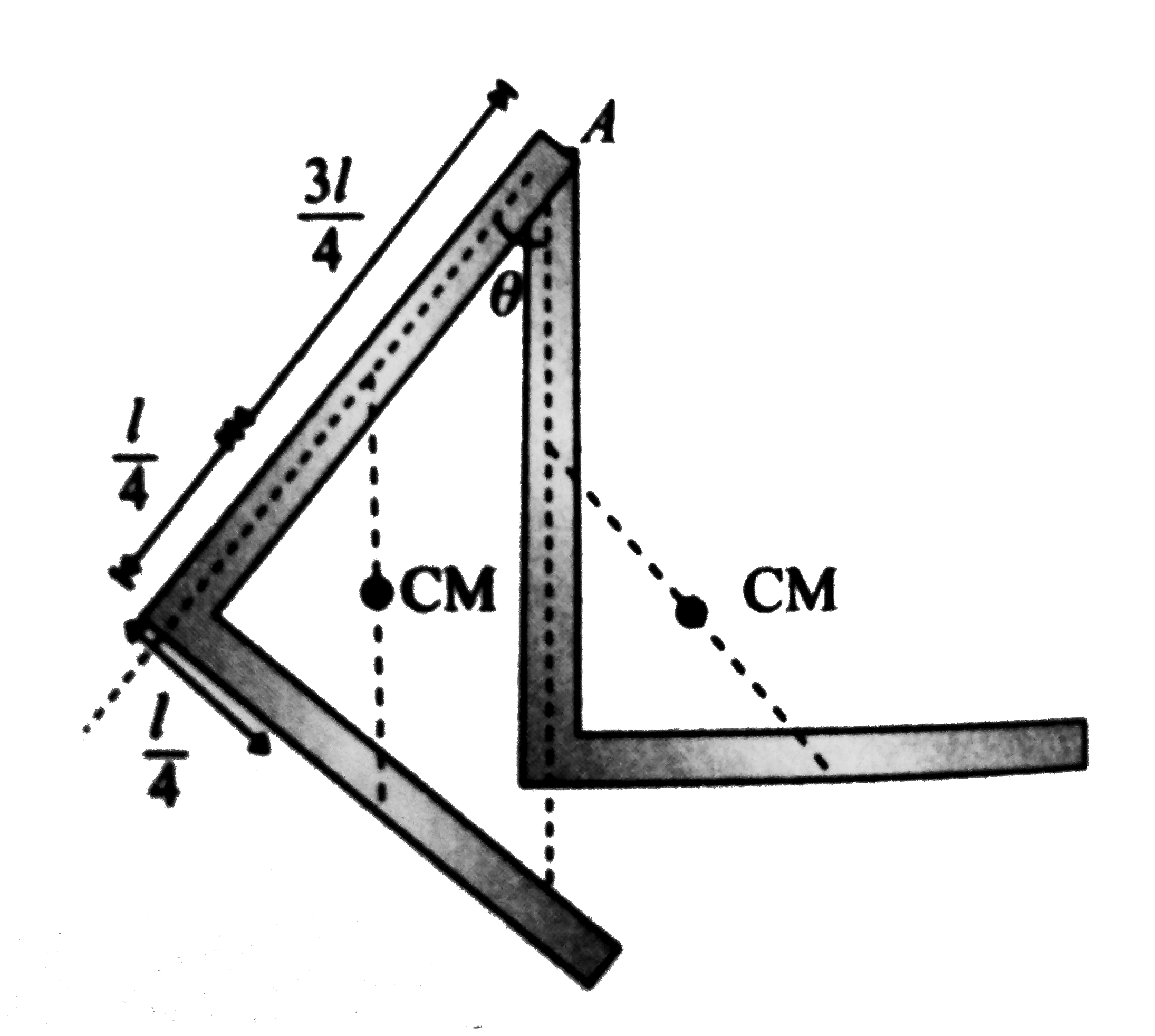 `D` is the `CM` of the rod In triangle `ADE`: `tantheta=(L//4)/(3L//4)` `implies tantheta=1/3impliestheta=tan^(-1)(1//3)` here `D` is the CENTRE of MASS. In EQUILIBRIM, `D` will be vertically below `A`. so i equilibrium `AB` will make angle `theta` as calculated above with the vertical. |
|
| 47. |
A uniform rod of mass m and length l is kept vertical with the lower end clamped. It is slightly pushed to let it fall down under gravity. Find its angular speed when the rod is passing through its lowest position. Neglect any friction at the clamp. What will be the linear speed of the free end at this instant? |
|
Answer» SOLUTION :As the rod reaches its lowest POSITION, the centre of mass is lowered by a distance `l`. its gravitational potential energy is DECREASED by `mg`. As no energy is lost against fricrtion, this should be equal to the increase in th kinetic energy. As the rotation occurs about the horizontal axis through the clamped end, the MOMENT of inertia is `I=m^(2)//3`. Thus, `1/2 Iomega^(2)=mg 1/2 ((ML^(2))/2)omega^(2)=mg` or `omega=sqrt((6g)/l)` The linear speed of the free end is `v=lomega=sqrt(6gl)` 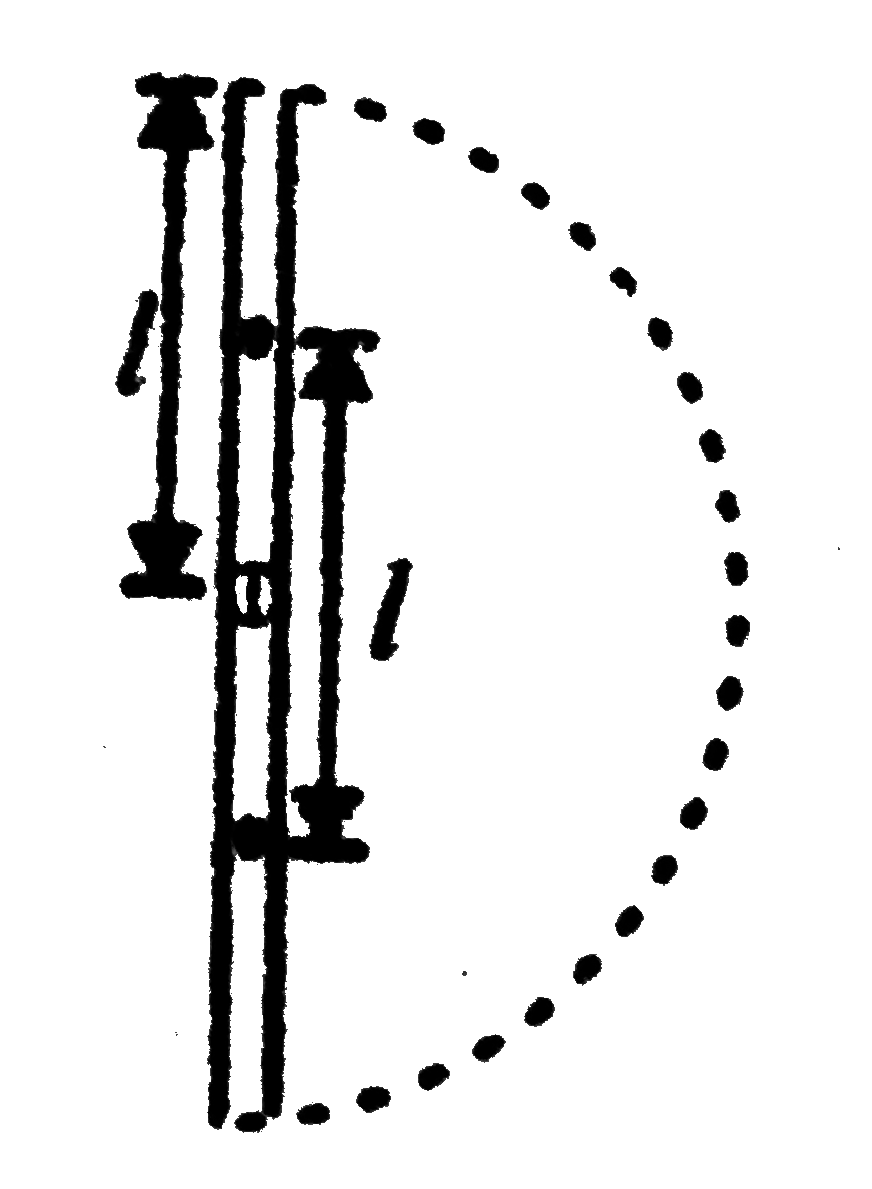
|
|
| 48. |
Two rods of different metals of coefficient of linear expansion alpha_(1) and alpha_(2)and initial length l_(1) and l_(2) respectively are heated to the same temperature. Find relation in alpha_(1), alpha_(2), l_(1) and l_(2 )such that difference between their lengths remain constant. |
|
Answer» Solution :`I_(1)^(1)=I_(1)[1+alpha_(1)(t_(2)-t_(1))]` `I_(2)^(1)=I^(1)[1+alpha_(2)(t_(2)-t_(1))]` GIVEN that the difference in their length remain CONSTANT `:. I_(2)^(1)-_(1)^(1)=I_(2)-_(1)` `I_(2)[1+alpha_(2)(t_(1)-t_(2))]-I_(1)[1+alpha_(1)(t_(2)-t_(1))]=I_(2)-I_(1)` `:. I_(2)alpha_(2)=I_(1)alpha_(1)` |
|
| 49. |
If more air is pushed in a soap bubble, the pressure it |
|
Answer» decreases |
|
| 50. |
A chain of length 1 and mass m lies on the surface of a smooth sphere of radius Rgt1 with one end tied to the top of the space. The potential energy phi, is joule, of a particle of mass 1 kg, moving in the x-y plane, obeys the law phi=3x+4y, where (x,y) are the coordinates of the particle in metre. If the particle, is at rest at (6,4) at time t=0 then |
|
Answer» The particle has constant acceleration |
|