

Saved Bookmarks
This section includes 7 InterviewSolutions, each offering curated multiple-choice questions to sharpen your Current Affairs knowledge and support exam preparation. Choose a topic below to get started.
| 1. |
Figure shows the variation of force acting on a particle of mass 400g executing simple harmonic motion. Find the frequency of oscillation of the particle |
|
Answer» Solution :The slope of the graph `= (F)/(x)= (0.5)/(5)= -0.1 NCM^(-1)s= -10Nm^(-1)` But `F= -MOMEGA^(2)x` or `(F)/(x)= -momega^(2)` so `-momega^(2)= -10` or `momega^(2)=10` or `omega^(2)= (10)/(m)` `:. omega^(2)= (10)/(4 XX 10^(-1))implies omega= (10)/(2)= 5:. f= (omega)/(2omega)= (5)/(2pi)s^(-1)` |
|
| 2. |
The farthest objects in our universe discovered by modern astronomers are so distant that light emitted by them takes billions of years to reach the earth. What is the distance in km of a quasar from which light takes 3 billion years to reach us? |
| Answer» SOLUTION :`2.8xx10^(22) KM` | |
| 3. |
Obtain an expression for the excess of pressure inside a liquid drop |
Answer» Solution : Excess of pressure inside air bubble in a liquid : CONSIDER air bubble of radius R inside a liquid having surface tension T. Let `P_1` and `P_2` be the pressures outside and insidethe air bubble, respectively. Now, the excess pressure inside the air bubble is `Delta P= P_1 -P_2` . In ORDER to find the excess pressure .inside the air bubble, let us consider the forces acting on the air bubble. For the hemispherical portion of the bubble, CONSIDERING the forces acting on it, we get (i) The force due to surface tension acting TOWARDS rightaround the rim of length `2pi R` is `F_T = 2pi RT` (ii) The force due to outside pressure `P_1`is to the RIGHT acting across a cross sectional area of ` piR^2 ` is `F_(P_1) = P_1 pi R^2` (iii) The force due to pressure `P_2` inside the bubble, acting to the left is `F_(P_2) = P_2 pi R^2` As the air bubble is in equilibrium under the action of these forces, ` F_(P_2) = F_T + F_(P_1)` Excess pressure is `DeltaP = P_2 - P_1 = (2T)/(R )` |
|
| 4. |
A wire of radius r stretched without tension along a straight line is tightly fixed at A and B. What is the tension in the wire when it is pulled in the shape ACB? Assume Young's modulus of material of the wire to be Y. |
Answer» Solution : LET 2L be the original length of wire AB, i.e., L = 2l, when wire is pulled into shape ACB, the INCREASE in length, `DeltaL=(AC+CB)-AB` `=2(l^(2)+d^(2))^(1//2)-2l` longitudinal strain `=(DeltaL)/(L)` `=(2(l^(2)+d^(2))^(1//2)-2l)/(2l)` `=(2l[1+((d^2)/(l^2))^(1//2)-1])/(2l)` `=[1+(1)/(2)(d^2)/(l^2)-1]=(d^2)/(2l^2)` longitudinal stress `=("tension")/("area")=(F)/(pir^2)` `THEREFORE` Young's modulus, `Y=("longitudinal stress")/("longitudinal strain")` `(F//pir^2)/(d^2//2l^2)` `therefore` Tension in the wire `F=Yxxpir^(2)xx(d^2)/(2l^2)` |
|
| 5. |
Calculate the power of an engine which can pull a mass of 500 metric ton up an incline rising 1 in 100 with a velocity of 10 ms^(-1). |
|
Answer» <P> Solution :`sin theta =(1)/(100). V=10 m//s, m=500xx10^(3)kg``F = mg sin theta = 500xx10^(3)xx9.8xx(1)/(100)=49xx10^(3)N` Power `P = FV = 49xx10^(3)xx10=49xx10^(4)` WATT = 490 KW. |
|
| 6. |
Four particle each of mass 1 kg ar the four corners of a square of side 1m. The workdone to move one of the particles to infinity |
|
Answer» `2sqrt(2)` G |
|
| 7. |
Gravel is falling on a conveyor belt at the rate of 12kg s^(-1). The extra power required to move the belt with a velocity of 5ms^(-1) is |
|
Answer» 15W |
|
| 8. |
The force required by a man to move his limbs immersed in water is smaller than the force for the some movement in air Why? |
| Answer» Solution :By ARCHIMEDES principle, there is an APPARENT loss of WEIGHT of a body when it is under in any liquid and it is equal to weight of liquid displaced. Here, water exerts uphrust on his limbs and HENCE less force is required to move his hands. | |
| 9. |
Can the x totgraph of a moving object be parallel to the position axis ? Why? |
| Answer» Solution :No. Because the MOVING object is at DIFFERENT PLACES at different time but in this graph its POSITION is same which is not possible. | |
| 10. |
Find the acceleration of center of mass of the blocks of masses m_(1) and m_(2) (m_(1)gtm_(2)) in Atwood.s machine: |
|
Answer» SOLUTION :We know from Newton.s laws of motion magnitude of acceleration of each block is `a=((m_(1)-m_(2))/(m_(1)+m_(2)))G`  Now acceleration of their C.M is `a_(cm)=(m_(1)a+m_(2)(-a))/(m_(1)+m_(2)),a_(cm)=((m_(1)-m_(2))/(m_(1)+m_(2)))a` `a_(cm)=((m_(1)-m_(2))/(m_(1)+m_(2)))((m_(1)-m_(2))/(m_(1)+m_(2)))g` `:.` ACCLERATION of centre of mass `a_(cm)=((m_(1)-m_(2))/(m_(1)+m_(2)))^(2)g` |
|
| 12. |
A stone of mass 2 kg is tied to a string of length 0.5 m. If the breaking tension of the string is 900 N, then the maximum angular velocity, the stone can have in uniform circular motion is |
|
Answer» `30rads^(-1)` Massof thestone`,m= 2kg ` Lengthof thestring` R= 0.5m` Breakingtension ` T = 900N` As `T= m r omega^2` ` thereforeomega^2 = (T) /(mr) = ( 900 )/(2 xx0.5 ) =900` ` oromega = 30 rad s^(-1)` |
|
| 13. |
If the two directional cosines of a vectors are (1)/(sqrt(2)) and (1)/(sqrt(3)) then the value of thirs directional cosine is |
|
Answer» `(1)/(SQRT(6))` |
|
| 14. |
If the K.E of a rotating body about an axis is decreased by 36%, its angular momentum about that axis |
|
Answer» INCREASES by 72% |
|
| 15. |
A gas may expand adiabatically or Isothermally. If P, V graphs are drawn and if s_(1)and s_(2)are the slopes of the process then a) s_(1) gt s_(2) b) adiabatic curve and Isothermal curve mayintersect c)s_(1) gt s_(2) |
|
Answer» both a and B are TRUE |
|
| 16. |
"It is more important to have beauty in the equations of physics than to have them agree with experiments". The great British physicist P. A. M. Dirac held this view. Criticize this statement. Look out for some equations and results in this book which strike you as beautiful. |
| Answer» Solution :Generally it is considered that physics is a dry subject and its main aim is to give qualitative and quantitative treatment i.e. any derived relation or equation must be verified through EXPERIMENTATION. It is felt that turth of an equation is more IMPORTANT than the simplicity, wonderfulness, symmetry or beauty of the equation. But frankly, if a relation is true to experimentation and simultaneously it is simple, interesting, symmetrical, wonderful or BEAUTIFUL, it will certainly add to the charm of the relation. | |
| 17. |
A rope remains wrapped over the circumference of a wheel of radius r and of moment of inertia I about its axis. If a mass m is suspended from the lower end of the rope what will be the angular acceleration ofthe wheel ? |
|
Answer» |
|
| 18. |
Explain hydrostatic paradox with suitable example. |
|
Answer» Solution :Hydrostatic paradox : The pressure exerted by a liquid column depends only on the HEIGHT of the liquid column and not on the shape of the containing vessel. Let us consider three vessels A , B and C of different shapes. These vessels are connected at the BOTTOM by a horizontal pipe. when they are filled a liquid (say water), it occupies the same level even though the vessels hold different amount of water. It is true because the liquid at the bottom of each section of the vessel EXPERIENCES the same pressure. 
|
|
| 19. |
A cord is wound over the rim of a flywheel of mass 20 kg and radius 25 cm. A mass 2.5 kg attached to the cord is allowed to fall under gravity. The angular acceleration of the flywheel is |
|
Answer» `25 rad//s^(2)` `I = (MR^(2))/(2) = ((20 kg) (25 xx 10^(-2) m)^(2))/(2)` `= 25 xx 25 xx 10^(-3) kg m^(2)` Torque acting on the flywheel , `TAU = FR = mg R ` `= (2.5 kg) (10 m//s^(2)) (25 xx 10^(-2) m)` `=25 xx 25 xx 10^(-2) Nm` ANGULAR acceleration of the flywheel , `ALPHA = (tau)/(I) = (25 xx 25 xx 10^(-2))/(25 xx 25 xx 10^(-3)) = 10 "rad/s"^(2)` 
|
|
| 20. |
Whatis PVdiagram ? |
|
Answer» <P> Solution :PV diagram is a graph between pressure P and volume V of the SYSTEM. The `P-V` diagram is used to calculate the AMOUNT of work DONE by the gas during expansion or on the gas during compression. |
|
| 21. |
A saturn is 29.5 times the earth year . how far is the saturn from the sun if the earth is 1.5xx10^9km away from the sun ? |
|
Answer» SOLUTION :`T_E^2 PROP R_E^3, T_S^2 prop R_S^3` `T_E^2/T_S^2` = `R_E^3/R_S^3, R_S` = `1.432xx10^(13)m` |
|
| 22. |
A car starts moving rectilinearly ( initial velocity zero) first with an acceleration of 5 ms^(-2) then uniformly and finally decelerating at the same rate till it stops. Total time of journey is 25 s and average velocity during the journey is 72 km/h. Car travels with uniformspeed for time |
|
Answer» 1.5 s |
|
| 23. |
The relation between U, P and V for an ideal gas is U = 2 +3PV. What is the atomicity of gas. |
|
Answer» Solution :For an adiabatic process `dQ=0=dU +DW or 0=dU+PdV…..(1)` From the given equation`dU = 3(PdV +VdP)` `:. 0=3(PdV+VdP)+PdV ` (from (1)) or `4P (dV)+3V (DP) =0 or 4 ((dV)/(V))= -3((dP)/(P))` On intergrating, we get In `(V^(4)) +"In "(P^(3))=` constant (or) `PV^(4//3)=` constant i.e., `gamma=(4)/(3)` i.e., gas is polyatomic . |
|
| 24. |
The earth moves round the sun in an elliptical orbit. O is the focus of ellipse and A &B are two points in the path such that (OA)/(OB)= KThe ratio of the speed of the earth at B and at A is nearly |
|
Answer» `sqrtK` |
|
| 25. |
A car starts moving rectilinearly ( initial velocity zero) first with an acceleration of 5 ms^(-2) then uniformly and finally decelerating at the same rate till it stops. Total time of journey is 25 s and average velocity during the journey is 72 km/h. Total distance travelled by the car is |
|
Answer» 5m |
|
| 26. |
A car starts moving rectilinearly ( initial velocity zero) first with an acceleration of 5 ms^(-2) then uniformly and finally decelerating at the same rate till it stops. Total time of journey is 25 s and average velocity during the journey is 72 km/h. Maximum speed attained during the journey is |
|
Answer» `2.5 MS^(-1)` |
|
| 28. |
A block of mass m hangs by means of a string which goes over a pulley of mass m and moment of inertia l, as shown in the diagram. The string does not realtive to the pulley. Find the frequencyof small oscillations. |
Answer» Solution :Suppose the block is depresed by x. The PULLEY (OWING to the constant) is depresed by `x//2`. Suppose the tension in the string are T and T' on both sides . We can write 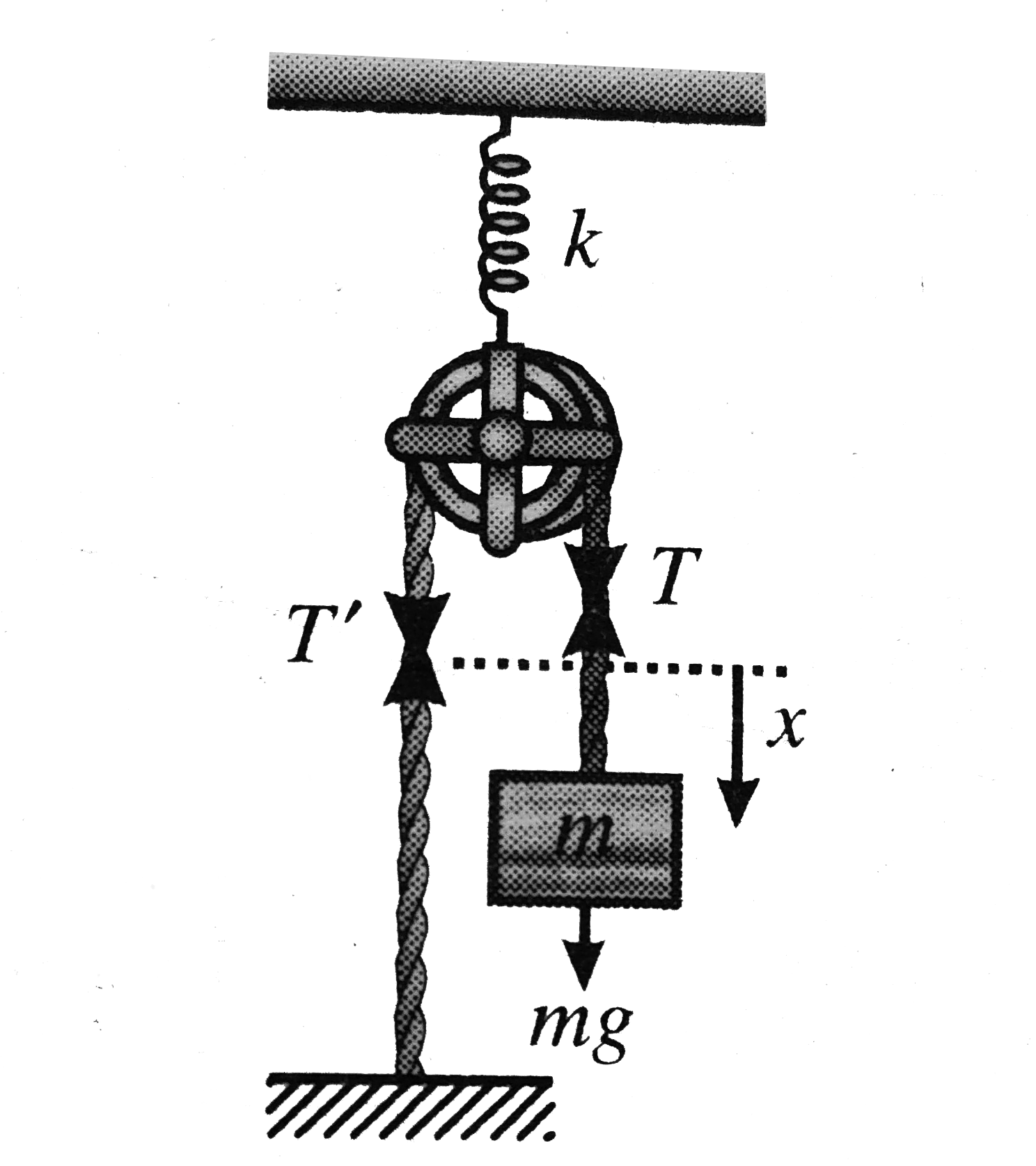 for block `mg - T = mx` (i) For pulley, `T + T' + mg - k (x + x_(0)) = m (x)/(2)` (ii) The angular acceleration of the pulley , `alpha = (x//2)/(2 R)` (iii) `(T - T' ) R = l (x)/(2 R)` (iv) From the Eqs. (i), (ii), (iii) and (iv), we get `3 mg - k (x + x_(0)) = ((5 m)/(2) + (l)/(2 R^(2))) x` The frequency of small oscllation `f = (1)/(2 PI) sqrt((k)/((5m)/(2) + (l)/(2 R^(2)))` |
|
| 29. |
On a winter day when the atmospheric temperature drops to -10^(@)C, ice form on the surface of a lake. (a) Calculate the rate of increases of thickness of the ice when 10 cm of ice is already formed. (b) Calculate the total time taken in forming 10 cm of ice. Assume that the temperature of the entire water reaches 0^(@)C before the ice starts froming. Density of water = 1000 kg//m^(3), latent heat of fusion of ice = 3.36 xx 10^(5) J//kg and thermal conductivity of ice = 1.7 W//m-^(@)C. Neglect the expansion of water on freezing |
|
Answer» Solution :(a) Let a time `t`, thickness of ice formed is `x` Let in time `dt`, thickness of ice formed is `dx`. RATE of heat flow through ice `(dQ)/(dt) = (KA [0 - (- theta)])/(x)` Let in time `dt`, mass of ice formed is `dm` `dQ = dmL = rho A dx L` From (i) and (ii) `(rho A dx L)/(dt) = (KA theta)/(x)` `(dx)/(dt) = (K theta)/(rho LX) = (1.7 xx 10)/(1000 xx 3.36 xx 10^(5) xx 0.1) = 5 xx 10^(-7) m//s` (b) `int dt = (rho L)/(2 K theta) int_(0)^(x) x d x` `t = (rho L x^(2))/(2 K theta) = (1000 xx 3.36 xx 10^(5) xx (0.1)^(2))/(2 xx 1.7 xx 10)` `= 976605 = 2.71 hr` 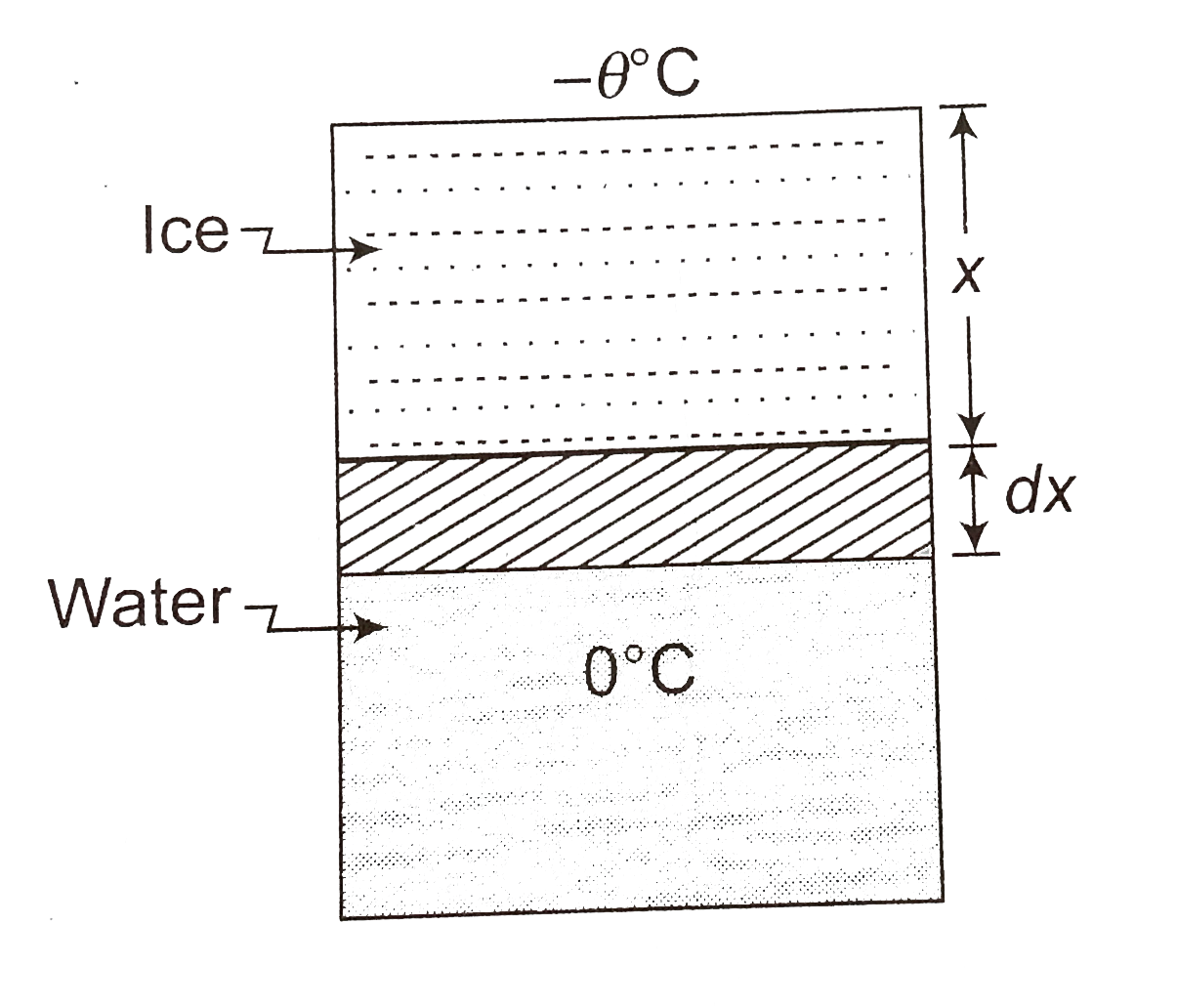
|
|
| 30. |
When two bodies are saparated by certain distance, the gravitational force between then is F. If distance is increased by 100% , then gravitational force becomes - |
|
Answer» `F/4` |
|
| 31. |
The pressure on the top surface of an aeroplane wing is 0.7xx10^(3)Pa and pressure on the bottom surface is 0.75xx10^(3)Pa. If the srea of each surfac is 50m^(2), the dynamic lift on the wing is |
|
Answer» `25xx10^(4)N` |
|
| 32. |
A body is thrown vertically up with a velocity of 100m//s and another one is thrown 4 sec after first one. How long after the first one is thrown will they meet? |
|
Answer» Solution :LET them meet after t sec. `S_(1)=100t-1/2gt^(2) and S_(2)=100(t-4) -1/2g(t-4)^(2)` `100t-1/2gt^(2)=100(t-4)-1/2g(t-4)^(2)` `400=1/2g[t^(2)-(t-4)^(2)]=1/2 G.4 (2t-4)` `2t-4=(800)/(4G)=20," if g =10m/"s^(2)` t=12sec |
|
| 33. |
The fraction of ice that melts by mixing equal masses of ice al -10^@Cand water at 60^@Cis |
|
Answer» `6/11` |
|
| 34. |
A light bullet is fired from a heavy gun. By using a suitable conservation law in physics, prove your above anser. |
|
Answer» Solution :Before firing, total linear momentum = O, SINCE no external FORCE involved, total linear momentum after is ZERO. `i.e, vec P_G + vec P_B = O` `THEREFORE vec P_G = - VEC P_B` |
|
| 35. |
A ball of mass m moving with a horizontal velocity v strikes the bob of the pendulum at rest. Moss of the bob of the pendulum is also m. During this collision the ball sticks with the bob. The height to which the combined mass rises (g=acceleration due to gravity) |
| Answer» Answer :B | |
| 36. |
In non-elastic collision, both momentum and kinetic energy are conserved. |
|
Answer» |
|
| 37. |
When walking on ice one should take short steps why ? |
| Answer» SOLUTION :When we takelongsteps the angleof ourlegwithverticalincreases. Hencenormalreactioncomponent increaseswhichpromotesslipping So, it isadvisable to takesmallstepsto avoidslipping . | |
| 38. |
A rod of length l is given two velocities v_(1) and v_(2) in opposite directions at its two ends at right angles to the length. The distance of the instantaneous axis of rotation from v_(1) is |
|
Answer» ZERO |
|
| 39. |
The radius of gyration of a solid sphere of radius r about a certain axis is r. The distance of this axis from the centre of the sphere is |
|
Answer» R |
|
| 40. |
A vernier calipers has 1mm marks on the main scale. It has 20 equal divisions on the vernier scale, which match with 16main scale divisions. For this vernier calipers the least count is |
|
Answer» 0.02mm |
|
| 41. |
The clouds float in the atmosphere because of |
|
Answer» LOW temperature |
|
| 42. |
A uniform ring of radius R is given a back spin of angular velocity V_(0)//2R and thrown on a horizontal sorgh surface with velocity of centre V_(0). The velocity of the centre of the ring when it starts pure rolling will be |
|
Answer» `V_(0)//2` |
|
| 43. |
The acceleration of a particle is found to be non zero when no force acts on the particle. This is possible if the measurement is made from |
|
Answer» INERTIAL frame |
|
| 44. |
In case of surface of one fluid in contact with other fluid or solid surafce , surface tension/surface energy depends on what ? Explain with illustration. |
|
Answer» Solution :In the CASE of surface of one fluid in CONTACT with other fluid or surface ,the surface tension depends on the materials on both SIDES of the surface. For EXAMPLE : (i) If the molecules of the material attract each other , surface energy is reduced. (ii) If they repel each other the surface energy is increased. Thus , more appropriately , the surface energy is the energy of the INTERFACE between two materials and depends on both of them . |
|
| 45. |
A body of mass 'm' at rest is applied with a force F = (2 + 4t)N. The change in momentum of the interval one second to two second is |
|
Answer» ` 3kg - ms^(-1)` |
|
| 46. |
Ata certical height a shell at rest explodes into two equal fragments. One of the fragments receives a horizontal velocity u. The time interval after which. The velocity vectors will be inclined at120^(@) to each other is |
|
Answer» `(U)/(sqrt(3)G)` |
|
| 47. |
(A) : Total energy is negative for a bound system. (R ) : Potential energy of a bound system is negative and more than kinetic energy. |
|
Answer» Both (A) and (R ) are TRUE and (R ) is the correct EXPLANATION of (A) |
|
| 48. |
Two Electric bulbs have filaments of lengths 1 and 21, diameters 2d and d. The emissivity's of the bulbs are 3e, 4e with temperatures in the ratio 2:3. Their radiant powers will be in the ratio |
|
Answer» `4:27` |
|
| 49. |
The two thigh bones (femurs), each of cross sectional area 10cm^2 support the upper part of a human body of mass 40kg. Estimate the average pressure sustained by the femurs? |
|
Answer» Solution :Total cross sectional are of the femurs is `A=2 times 10^-4 m^2`. The force acting on them is F=40 KG wt =400n . This force is acting vertically down, and hence, NORMALLY on the femurs. That the average pressure is `P_(av)=F/A=2 times 10^ N m^-2` |
|
| 50. |
velocity of a monkey, running on the roof of the train A against itsmotion with a velocityof 18 km/h with respect to the train, as observed bya man standing on the ground. |
|
Answer» Solution :LET the VELOCITY of the MONKEY with respect to ground be `v_m` . So, the velocity of monkey with respect to A =`v_m-v_A=-18km//h=-56m//s` `THEREFORE v_m=v_A-5=15-5=10m//s` TOWARDS north . |
|