Saved Bookmarks
This section includes 7 InterviewSolutions, each offering curated multiple-choice questions to sharpen your Current Affairs knowledge and support exam preparation. Choose a topic below to get started.
| 1. |
You are given a thread and a metre scale. How will you estimate the diameter of the thread ? |
|
Answer» Solution :GIVEN string is wound on PENCIL in such a way that tums are very close to each other tightly packed. We get no. of TURNS by measuring with scale let length of this loop is L Let number of turns in loop are n. `:.` Length of each TURN = thickness of each `turn=(l)/(n)` This thickness will be equal to diameter (thickness) of string. |
|
| 2. |
A particle of mass 0.3 kg is subjected to a force F=-kx with k=15N//m. What will be its initial acceleration if it is released from a point 20 cm away from th origin? |
|
Answer» `5m//s^(2)` `THEREFORE |F|= 15xx0.2=3N` `therefore ` Acceleration `= (F)/(m) =(3)/(0.3)= 10m//s^(2)` |
|
| 3. |
The product of Energy and Moment of Inertia has the dimensions same as |
|
Answer» the SQUARE of LINEAR momentum |
|
| 4. |
Consider a cycle followed by an engine as shown in figure, 1 to 2 is isothermal 2 to 3 is adiabatic 3 to 1 is adiabatic Such a process does not exist because |
|
Answer» heat is completely converted to mechanical energy in such a PROCESS, which is not possible. So , dU=0 Now, from first law of thermodynamics , dQ=dU+dW `therefore` dQ=0+dW `therefore` dQ=dW Hence, heat energy supply to system converts totally into mechanical work which is not possible by second law of thermodynamics verifies option (A). (C) Here, two curves are intersecting when the gas expands adiabatically from 2 to 3. It is not possible to RETURN to the same state without being heat supplied. Hence, the process 3 to 1 cannot be adiabatic. |
|
| 5. |
Two blocks A and B are released on the inclined plane of angle 30^(@) and a circular track of radius R from different heighhts h_(1) and h_(2) respectively. The mass of each block is m. If F_(1) and F_(2) are the respective forces experienced by two blocks at the bottom most point of the tracks and F_(1)=F_(2) , then find the value of h_(2) for R=8m. |
| Answer» ANSWER :B | |
| 6. |
four balls are dropped from the topof a tower at intervals of one - one secnod. Thefrist ball reaches the ground after 4s of dropping . What are the distance between first and second , second and third, third and fourth balls at this instant ? |
|
Answer» |
|
| 7. |
The vessel shown in the figure has two sections of area sof cross section A_(1) and A_(2). A liquid of density rho fills both the sections, up to a height h in each. Neglect atmoispheric pressure. a. The pressure at the base of the vessel is 2 h rho g. b. The force exerted by the liquid on the base of the vessel is 2 h rho g A_(2). c. The weight of the liquid is lt 2 h rho g A_(2). d. The walls of the vessel at the vessel X exert a downward force hrhog(A_(2)-A_(1)) on the liquid. |
|
Answer» a, and C are correct |
|
| 8. |
If liquid enters a section of tube of radius 5 cm with a velocity 10m/s, with what velocity does the liquid leave another section of the tube of radius 4 cm? The tubes is horizontal |
|
Answer» 0.625 m/s |
|
| 9. |
The temperature- entropy diagram of a reversi-ble engine cycle is given in figure What is its efficiency? |
|
Answer» <P> Solution :Entropychange`= int_(A)^(p)(DQ )/(T ) (S-S_0) =Q``Q_1=T_0S_0 +1/2 T_0 S_03/2 T_0 S_0` `Q_2 =T_0(2S_0 -S_0) T_0 S_0` `Q_3 =0 , eta=(W)/( Q_1) = (Q_1 -Q_2)/(Q_1) = 1 -(Q_2)/(Q_1) = 1-(T_0 S_0 )/( 3/2T_0 S_0) = 1/3` |
|
| 10. |
At. N.T.P. 28 g Nitrogen occupies 22.4 litres. Nitrogen at 38cm of Hg pressure and 273^(@)C temperature |
| Answer» Solution :`PV = (m)/(M)RT, PV prop MT` | |
| 11. |
If the error in measurement of radius of a shpere is 2% then the error in determination of volume of the sphere will be ………… |
|
Answer» 0.04 |
|
| 12. |
An object is placed at the focus of an equiconvex lens. Match the following |
|
Answer» <P> |
|
| 13. |
Suppose that the earth revolves around the sun in a perfectly circular orbit. Does the sun do any work on the earth? |
| Answer» Solution :When the earth revolves around the sun in a perfectly circular orbit the force of the sun on the earth is along the RADIUS while displacement of the earth is along the TANGENT to the orbit. Now in a circle, radius and tangent are always orthogonal i.e., ANGLE between them at any point on the orbit is `90^(@)` and so,work done by the sun on the earth is ZERO. | |
| 14. |
A disc is free to rotate about a smooth horizontal axis passing through its centre of mass. A particle is fixed at the top of the disc. A slight push is given to the disc and it starts rotating. During the process. |
|
Answer» only mechanical energy is CONSERVED |
|
| 15. |
A body is projected horizontally from a height of 78.4 m with a velocity 10 ms^(-1). Its velocity after 3 seconds is [g = 10 ms^(-2)] (Take direction of projectile on hat(i) and vertically upward direction on hat(j)). |
|
Answer» `10hat(i) - 30hat(J)` |
|
| 16. |
For a certain mass of gas Isothermal relationsbetween .P. and .V. are shown by graphs at two different temperatures T_(1)and T_(2)then |
|
Answer» `T_(1) = T_(2)` |
|
| 17. |
Lengths of the arms of a balance are equal but the weights of the pans are different. When an object is put on theleft pan, it weighs W_(1) andon the right pan it weighs W_(2). What is the actual weight of the object? |
|
Answer» |
|
| 18. |
A balloon with its contents weighing 160 N is moving down with an acceleration of g//2 ms^(-2)The mass to be removed from it so that the balloon moves up with an acceleration of Activate Wind g//3 ms^(-2)is (g = 10ms^(-2)) |
| Answer» ANSWER :B | |
| 19. |
A Particle excites simple harmonic motion between x=-A&x=+A , the time taken for it to go from O to A/2 is T_(1) & to go from A/2to A is T_(2) then |
|
Answer» `T_(1)ltT_(2)` |
|
| 20. |
There are four situations given in Table-1 involving a magnetic dipole of dipole moment M placed in uniform external magnetic field B. Table-2 gives corresponding results. Match the situations in Table-1 with the corresponding results in Table-2. |
|
Answer» <P> |
|
| 21. |
A drop of water breaks into two droplets of equal size. In this process which of the following statements is incorrect ? |
|
Answer» the SUM of temperature of the two droplets together is equal to the ORIGINAL temperature of the drop |
|
| 22. |
What is the direction of velocity in a simple harmonic motion ? |
| Answer» SOLUTION :EITHER towards or AWAY from the MEAN position. | |
| 23. |
Figure shows three blocks of mass m each hanging on a string passing over a pulley. Calculate the tension in the string connecting A to B and B to C? |
|
Answer» Solution :NET force = 2mg -mg = mg Total MASS = m + m + m = 3m Acceleration , ` a=(mg)/(3m) =(g)/(3)` Considering BLOCK A, `T_1 - mg = ma or T_1 = mg + ma(or)` `T_1 = mg + m((g)/(3)) (or)` `T_1 = (4)/(3) mg ` , Considering block C , `mg-T_2 = ma (or) T_2 = mg-ma(or)` `T_2 = mg - (mg)/(3) = (2)/(3) mg ` . 
|
|
| 24. |
A particle P will be in equilibrium inside a hemispherical bowl of radius 0.5 m at a height 0.2 m from the bottom when the bowl is rotated at an angular speed ( g = 10 m/sec2) |
|
Answer» `10//sqrt3 rad//sec` |
|
| 25. |
A load m is attached to a spring of force constant k and stretched it throug x and rlweased it makes oscillation in a vertical plane with a time period T. It is further pulled down through another x and released. Now the time period of vertical oscillation will be |
|
Answer» `T//2` |
|
| 26. |
Match the following :{:("Column I","Column II"),(1."Work","(i) Supplementary unit in SI system"),(2."Torque","(ii)Kinematics"),(3."Plane angle","(iii)Motion"),(4."Meaning of Kinema","(iv)Vector"),(,"(v)Scalar"):} |
|
Answer» 1 - (i) , 2 - (iii), 3- (IV), 4 - (v) |
|
| 27. |
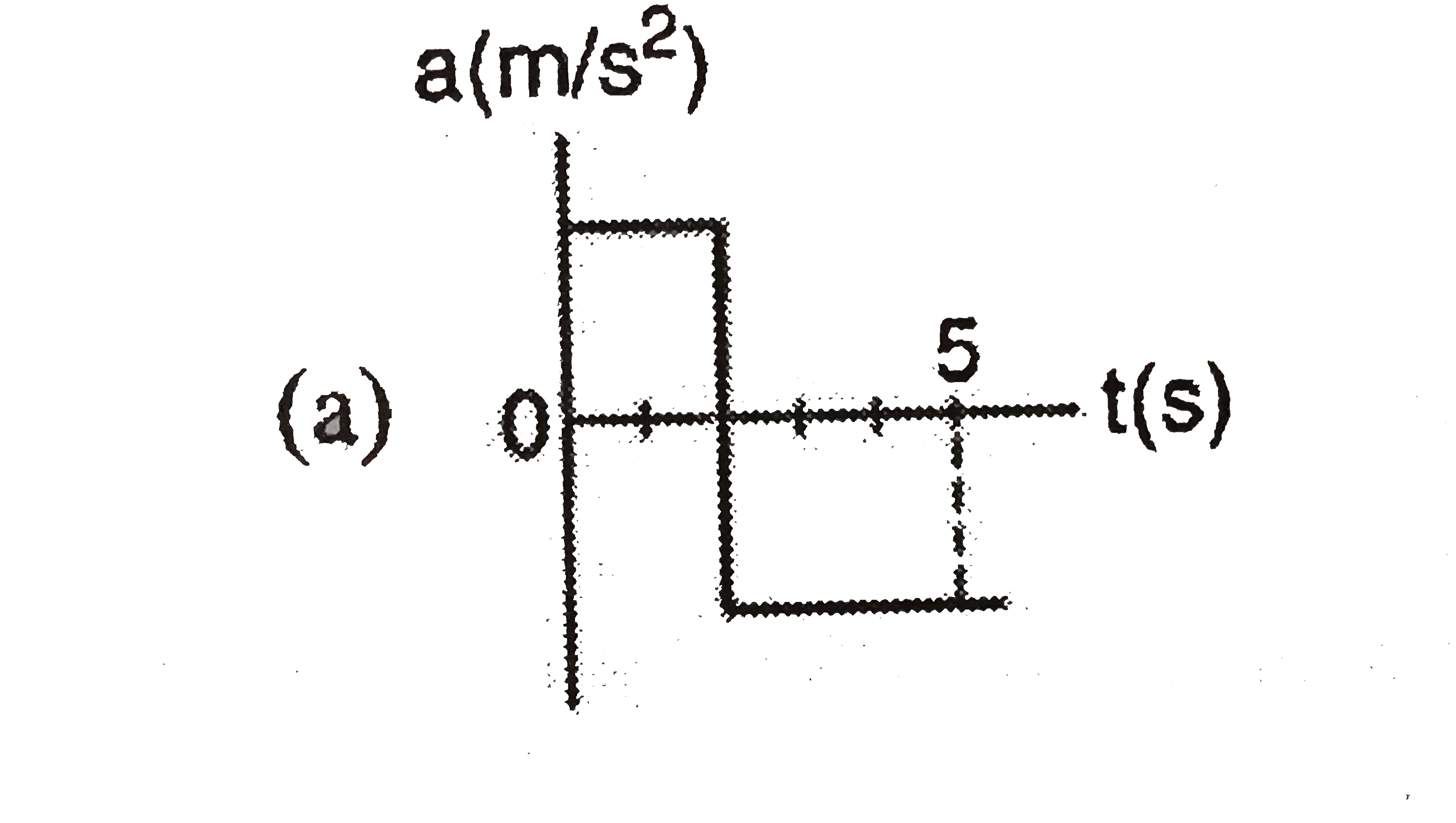
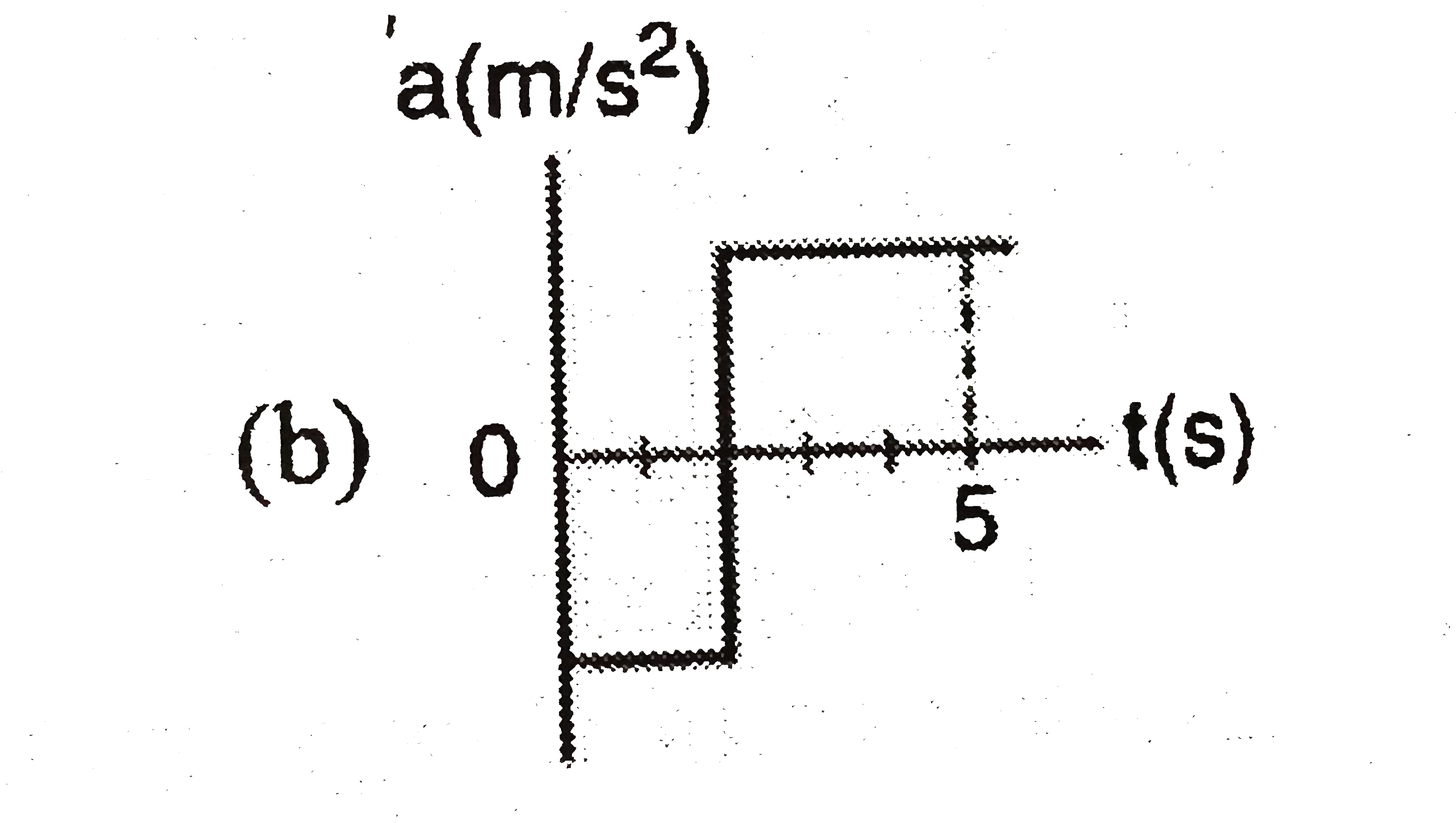
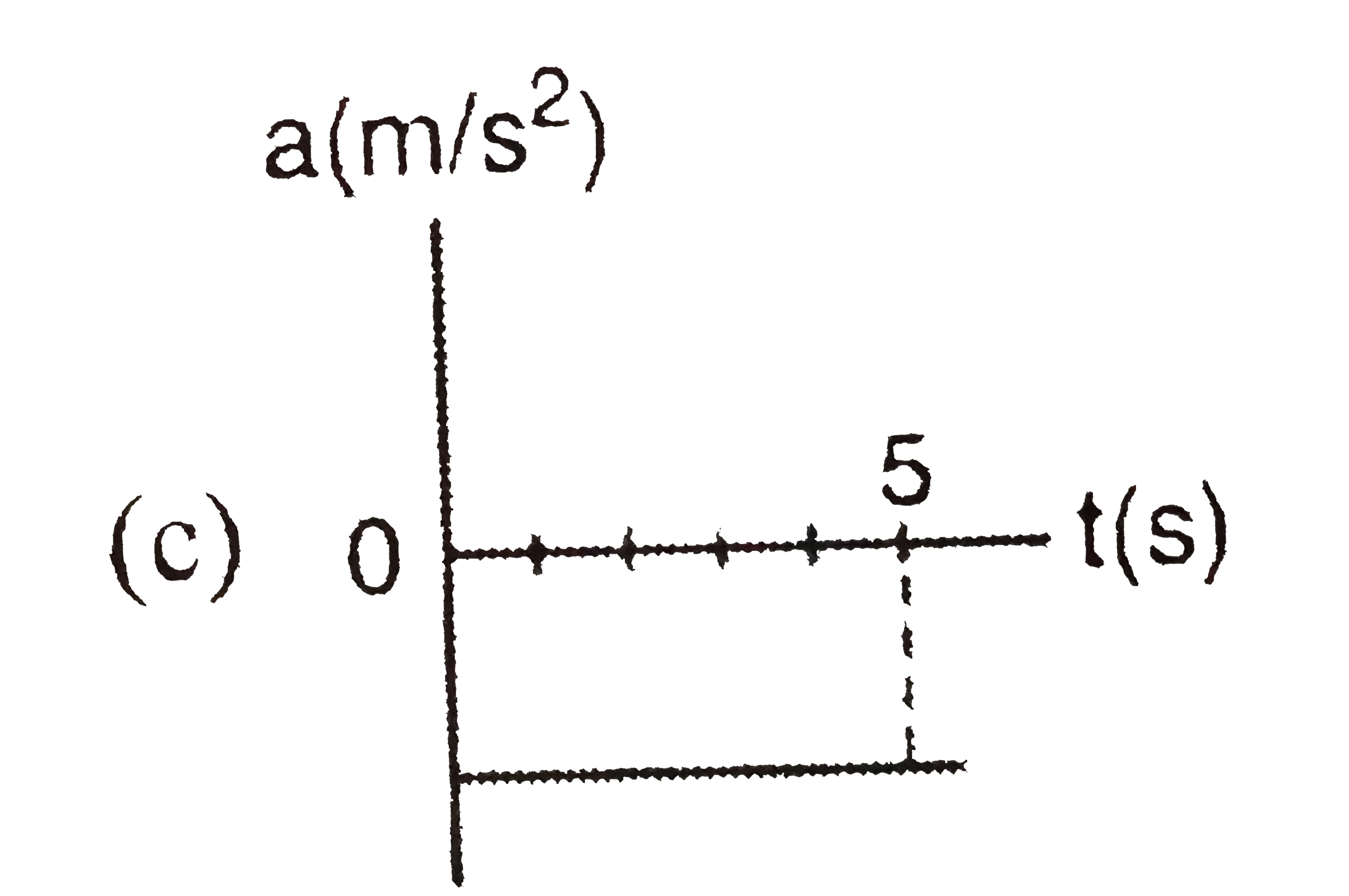
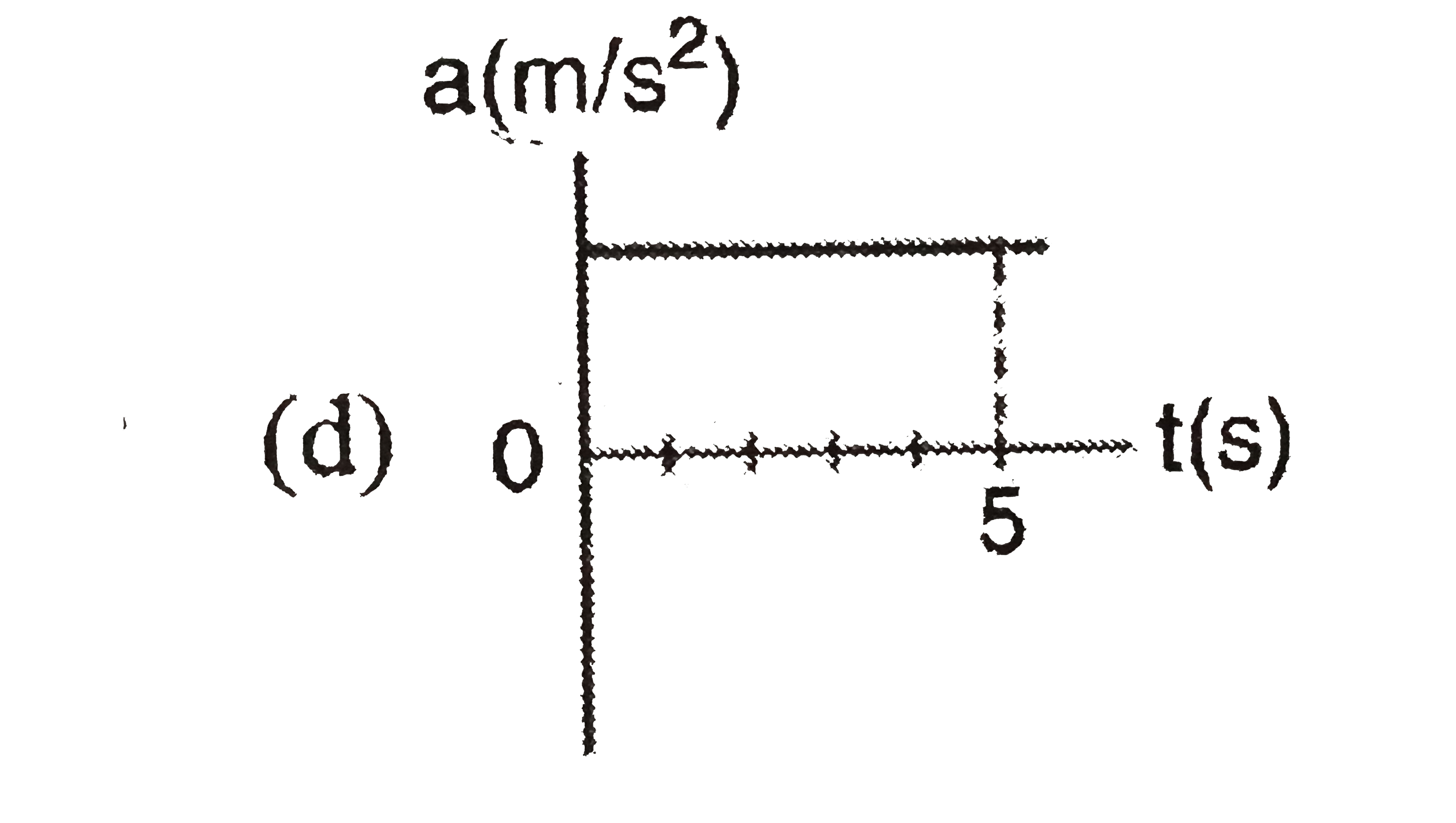
A person standing on the roof of a building throws a ball vertically upward at an instant t = 0. The ball leaves his hand with an upward speed 20 m/s and it is then in free fall. The ball rises to a certain height and then moves down. On its way down, the ball just misses to hit the roof of the building and keeps falling towards the earth. the ball hits earth at t = 5sec. considering that (i) the vertically upward direction is the positive Y-direction (ii) the position of ball at t = 0 is the origin (iii) the ball does not rebound and comes to rest at the same place where it hits earth and (iv) air resistance is negligible. (Take g = 10 m//s^(2)) Maximum displacement of the ball from the initial position is : |
|
Answer» `45 hat(j) m` POSITION 1 st increases then DECREASES. Velocity 1 st decrease then increases. Acceleration REMAINS constant. |
|
| 28. |
A satellite moving in a circular orbit at an altitude of 1000 km completes one revolution round the earth in 105 minutes. What is (z) its angular velocity andspeed? Radius of the earth =6.4 xx 10^(6)m. |
|
Answer» Solution :Orbital radius of the satellite = r `=1000 xx 10^(3) + 6.4 xx 10^(6) m = 7.4 xx 10^(6)` m Period = T = 105 minutes = `105 xx 60s` Angular velocity `=OMEGA = (2pi)/T = (2 xx 3.14)/(105 xx 60) = 9.97 xx 10^(-9)` rad/s Speed `v= romega = 7.4 xx 10^(6) xx 997 xx 10^(-4) = 7.38 xx 10^(3)` m/s `=7.38 xx 10^(3)` m/s |
|
| 29. |
A person standing on the roof of a building throws a ball vertically upward at an instant t = 0. The ball leaves his hand with an upward speed 20 m/s and it is then in free fall. The ball rises to a certain height and then moves down. On its way down, the ball just misses to hit the roof of the building and keeps falling towards the earth. the ball hits earth at t = 5sec. considering that (i) the vertically upward direction is the positive Y-direction (ii) the position of ball at t = 0 is the origin (iii) the ball does not rebound and comes to rest at the same place where it hits earth and (iv) air resistance is negligible. (Take g = 10 m//s^(2)) Average velocity of the ball from t = 0 to t = 5 sec |
|
Answer» `10 hat(j) m//s` Position 1 ST increases then DECREASES. Velocity 1 st decrease then increases. ACCELERATION remains constant. |
|
| 30. |
A person standing on the roof of a building throws a ball vertically upward at an instant t = 0. The ball leaves his hand with an upward speed 20 m/s and it is then in free fall. The ball rises to a certain height and then moves down. On its way down, the ball just misses to hit the roof of the building and keeps falling towards the earth. the ball hits earth at t = 5sec. considering that (i) the vertically upward direction is the positive Y-direction (ii) the position of ball at t = 0 is the origin (iii) the ball does not rebound and comes to rest at the same place where it hits earth and (iv) air resistance is negligible. (Take g = 10 m//s^(2)) Acceleration of the ball will vary with time as: |
|
Answer»
POSITION 1 ST INCREASES then decreases. Velocity 1 st decrease then increases. Acceleration remains CONSTANT. |
|
| 31. |
If x = a/b, then the maximum percentage error in the measurement of 'x' will be |
|
Answer» `((Delta a)/( a) )/( (DELTAB)/( b) ) XX 100` |
|
| 32. |
The three vectors not lying in a plane can never add up to give a bull vector . The three vectors not lying in a plane can not be represented by the three sedes of a traingel taken in the same order. |
|
Answer» (a) Statement-1 is TRUE , Statement-2 is true , Statvement -2 is correct explanation of Statement-1 . |
|
| 33. |
A small body of superdense material, whose mass is half the mass of the earth but where size is very small compared to the size of the carth. Starts from rest at a height Hlt lt Rabove the earth.s surface and radius the earth.s surface in time .t., then .t. is equal to |
|
Answer» `SQRT(2H//g)` |
|
| 34. |
An ideal gas enclosed in a vertical cylindrical container supports a freely moving pistion of mass M. The pistion and the cylinder have equal cross sectional area A. When the pistion is in equilibrium, the volume of the gas is V_(0) and its pressure is P_(0). The pistion is slightly displaced from the equilibrium position and released. Assuming that the system is completely isolated from its surrounding, the pistion executes a simple harmonic motion with frequency |
|
Answer» <P>`(1)/(2pi) (A gamma P_(0))/(V_(0) M)` `Mg = P_(0) A` `P_(0) V_(0)^(gamma) = (P_(0) + Delta P_(0)) (V_(0) - Delta V_(0))^(gamma)` `= (P_(0) - gamma P_(0) (Delta V_(0))/(V_(0)) + Delta P_(0))` or `Delta P_(0) = gamma P_(0) (Delta V_(0))/(V_(0))` But `Delta V = Ax` where A is then area of cross - section of the PISTION `Delta P_(0) = (gamma P_(0) A)/(V_(0)) x` RESTORING force `F =- Delta P_(0) xx A =- (gamma P_(0) A^(2))/(V_(0))x` Compare above equation with `f_(res) =-kx` `f = (1)/(2pi) sqrt((gamma P_(0) A^(2))/(MV_(0)))` |
|
| 35. |
There are two types of rods : Rod 1 : Length L, Thermal conductivity D, Area of cross section A Rod 2 : Length 2L, Thermal conductivity K, Area of cross section A Four possible arrangements of these rods in steady state are shown in Table-1 and Table-2 gives the temperature of the junction. Match Table-1 with Table-2 |
|
Answer» <P> |
|
| 36. |
Assertion :Oscillations of hard spring are slow than soft spring. Reason : For hard spring constant is larger than soft spring constant. |
|
Answer» Both are TURE and the REASON is the correct EXPLANATION of the assertion. |
|
| 37. |
A uniformcylindricalrod of massm and length L is rotatingis perpendicularto its axis ofsymmetryand passes through one of its edgfaces . Ifthe roomtemperatureincreases by't' and the coeffcient of linearexpansion is alpha , th changein its angular velocity is |
|
Answer» `2alpha OMEGA t` |
|
| 38. |
The dimensional formula for acceleration, velocity and length are alphabeta^(-2), (alphabeta)^(-1) as and alphagamma. What is the dimensional formula for the coefficient of friction? |
|
Answer» `alphabetagamma` `:. alpha= L, beta= T, L= alphagamma :. Gamma =(L)/(alpha)= (L)/(L)= 1` Coefficient of friction `mu= (F)/(R)= [M^(0)L^(0)T^(0)]` Check all the four given expressions and find which one is DIMENSIONLESS. `alpha^(0)beta^(0)gamma^(-1)= [L^(0)T^(0)(1)^(-1)]=1` Which is dimensionless. |
|
| 39. |
A man of weight 75 kg is standing in an elevator which is moving with an acceleration of 5m//s^(2) in upward direction the apparent weight of the man will be (g=10m//s^(2)) |
|
Answer» 1425 N |
|
| 40. |
A wheel of radius 20 cm rotate about its centre. A string is wrapped over its rim and is pulled by a force of 10 N tangential to pulley. If the angular acceleration produced is "4 rad s"^(-2), then the moment of inertia of the wheel in kg m^(2) is |
|
Answer» 25 |
|
| 41. |
When a gas is compressed to half of its initialvolume, if it is comparision between isothermal and adiabatic process, then a) Work done is less if the change is Isothermal b) Final pressure is more if the change isadiabatic c) Final pressure is less if the change isIsothermal |
|
Answer» both a and B are TRUE |
|
| 42. |
A harmonic wave has been set up on a very long string which travels alongthe length of string. The wave has frequency of 50 Hz. Amplitude 1 cm and wavelength 0.5 m. for the above described wave. Statement (i): time taken by a point on the string to travel a distance of 8 m along the length of strime is 0.32 s. Statement (ii): time taken by a point in the string to travel a distance of 8m, once the wave has reached at that point and sets it into motion is 0.32 s. |
|
Answer» Both the statement are CORRECT Here,`T=1//f=0.02 s` Wave speed, `v=flambda=25 m//s` Time taken by wave to travel a distance of 8 m, `t_(1)=8//25 s=0.32 s`. Time taken by particle on string to travel a distance of 8 m. `t_(2)=(8xxT)/(4 "times amplitude") =(8)/(4xx0.01)xx0.02=4 s` |
|
| 43. |
A ball is released from a height of 10 m. If it loses 20% of its energy on hitting the ground, the height to which it bounces is |
|
Answer» 7.5 |
|
| 44. |
A parachutist drops freely from an aeroplane for 8s before the parachute opens out. Then he descends with a netretardation of 2ms^(-2)reaching the ground with a velocity of6ms^(-1).The height from which he bails out of the aeroplane is (g=10ms^(-2)) |
|
Answer» 1929 m |
|
| 45. |
The dimensional formula for angular velocity is |
|
Answer» `M^(-1) L^(1) T^(0)` |
|
| 46. |
What will happen to two soap bubbles fo different radii, which are in contact with each other? Why? |
| Answer» Solution :As the PRESSURE inside a BUBBLE is inversely proportional to its radius, the smaller bubble which is at GREATER pressure will MERGE into the BIGGER one. | |
| 47. |
A cubic block having square cross-section of side 2m and of mass M = 10kg is resting over a platform moving at constant acceleration a="m/s"^(2). Coefficient of friction between the block and the platform is mu=0.1. A force F acts at the top of the cube as shown in Fig. Now match Column-I with Column-II {:("Column-I","Column-II"),((A)F=0,"(P)Block neither topples nor slips over the platform"),((B)F=45N,"(Q)Block topples but does not slip over the plateform"),((C)F=15N,"(R) Block slips but does not topple over the platform"),((D)F=25N,"(S) Block slips as well as topples on the platform"):} |
|
Answer» |
|
| 48. |
If energy (E), velocity (V) and force (F) are taken as fundamental quantity, then dimension of mass will be ….. |
|
Answer» `E^(1)v^(2)F^(0)` `:.m=(2E)/(v^(2))` , 2 is CONSTANT `:.[m]=[E^(1)][v^(-2)]` `:.[m]=E^(1)v^(-2)F^(0)` Second METHOD : Mass `m=KE^(a)v^(b)F^(c).......(i)` where a, b, c `in` R and Kis dimensionless constant. Write dimension on both side, `M^(1)L^(0)T^(0)=(M^(1)L^(2)T^(-2))^(a)(L^(1)T^(-1))^(b)(M^(1)L^(1)T^(-2))^(c)` `=M^(a)L^(2B)T^(-2a)xxL^(b)T^(-b)xxM^(c)L^(c)T^(-2c)` `M^(1)L^(0)T^(0)=M^(a+c)L^(2a+b+c)T^(-2a-b-2c)` Comparing dimension of M, L, T `a+c=1"".......(i)` `2a+b+c=0"".......(II)` `-2a-b-2c=0"".......(iii)` Adding equation (ii) and (iii), `-c=0` `:.c=0` `:.` From equation (i) `a+0=1` `:.a=1` From equation (ii) `2xx1+b+0=0` `:.b=-2` Substituting K=1, a=1, b=-1 and c=0 `m=E^(1)v^(-2)F^(0)` |
|
| 49. |
A block of mass m is pulled by a uniform chain of mass m tied to it by applying a force F at the other end of the chain. The tension at a point P which is at a distance of quarter of the length of the chain from the free end, will be |
|
Answer» `(3F)/(4)` |
|