

Saved Bookmarks
This section includes 7 InterviewSolutions, each offering curated multiple-choice questions to sharpen your Current Affairs knowledge and support exam preparation. Choose a topic below to get started.
| 1. |
Which of the following graphs represent the relation between capillary rise h and more radius of capillary tube r? |
|
Answer»
|
|
| 2. |
The condition for a uniform spherical mass m of radius r to be a black hole is ..... (G = gravitational constant and g = acceleration due to gravity) |
|
Answer» `((GM)/R)^(1/2) leC` |
|
| 3. |
A small steel ball A is suspended by an inextensible thread of length l= 1.5 m from O. Another identical ball is thrown vertically downwards such that its surface remains just in contact with thread during downward motion and collides elastically with the suspended ball. If the suspended ball just completes vertical circle after collision, calculate the velocity (in cm//s) of the falling ball just before collision (g = 10 m s^(-2)). |
|
Answer» IMPLIES `Jxx1/2=5sqrt(3)impliesJ=10sqrt3m` 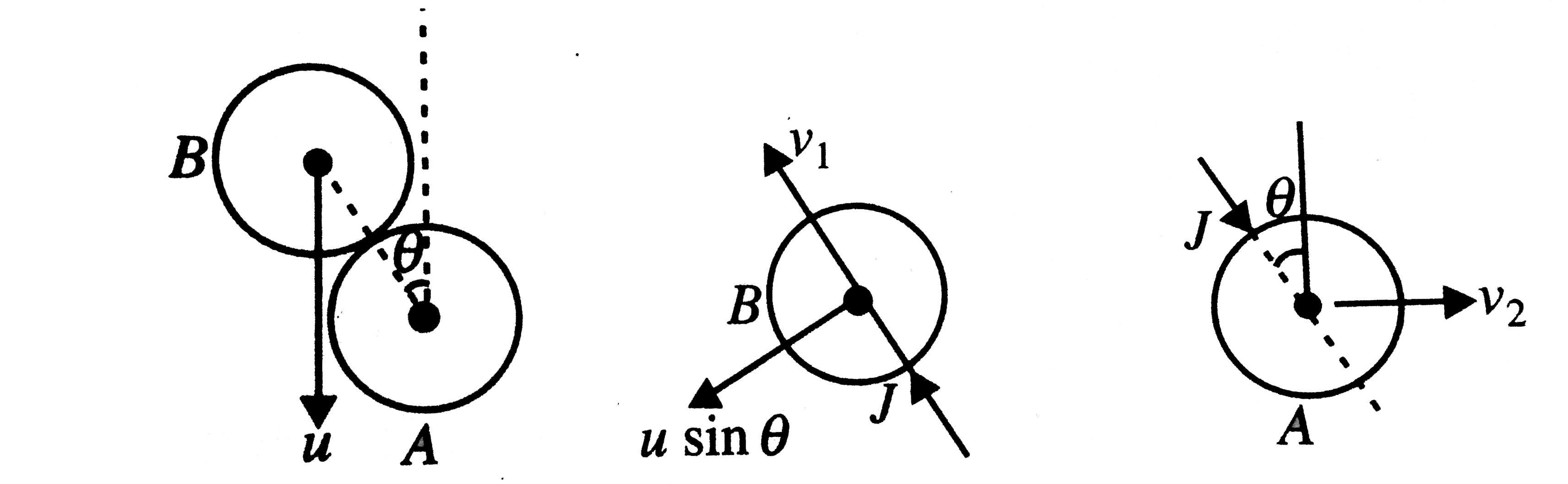 For `B, J=m(v_(1)+ucostheta)` `implies10sqrt(3)m=(v_(1)+(usqrt(3))/2)` `implies20sqrt(3)=2v_(1)+usqrt(3)`……..i By newton's experiment law: `e=1=(v_(2)sintheta+v_(1))/(ucostheta)implies(usqrt3)/2=v_(2)/2+v_(1)` `impliesusqrt(3)=5sqrt(3)+2v_(1)`.........II From i and ii `u=12.5m//s=1250cm//s` |
|
| 5. |
A: A spinning cricket ball moving through air is not deflected from its normal trajectory R: Magnus effect is an application of Bernoulli.s principle |
|
Answer» Both A and R are true and R is the CORRECT explanation of A |
|
| 6. |
A body is projected vertically upward with the velocity v=3hati+4hatjms^(-1). The maximum height attained by the body is (g=10ms^(-2)). |
|
Answer» 7m `H_(max)=(v^(2)sin^(2)theta)/(2G)=(v^(2))/(2g)""[:.thet=90^(@)]` `v=sqrt(9+16)=sqrt25` `:.v^(2)=25""H_(max)=(25)/(20)=(5)/(4)=1.25m` |
|
| 7. |
Increase of pressure |
|
Answer» always INCREASES the boiling point of a liquid |
|
| 8. |
Which of the diagrams correctly shows the change in kinetic energy of an iron sphere falling freely in a lake having sufficient depth to impart it a terminal velocity ? |
|
Answer»
|
|
| 9. |
Find the time period of mass M when displaced from its equilibrium position and then released for the system shown in figure. . |
Answer» Solution :Here, for calculation of time period we have neglected acceleration of gravity. Because, it is constant at all places and doesn.t AFFECT on RESULTANT restoring force.  Let the equilibrium position, the spring has extended by an amount `x_(0)`. Let the mass be PULLED through a distance x and then released. But, string is inextensible, hence the spring alone will contribute the TOTAL extension `x+x= 2x`. So that extension in the spring will be `2x+ x_(0)`. When the extension of spring is `x_(0)`, (M is not suspended) the restoring force in spring. `F= 2kx_(0),"........."(1)""[therefore F= T+T" and "T=kx_(0)]` When mass is suspended, the net extension in spring `2x+x_(0)` and restoring force in spring, `F. = 2k(2x+ x_(0))= 4kx + 2kx_(0)"""........"(2)` Restoring force on system, `f. = -(F. -F)` `=F -F.` `=2kx_(0)-4kx-2kx_(0)""`[From equ. (1) and (2)] `= -4kx` but `F= Ma` `therefore Ma = -4kx` `therefore a= -(4k)/(M)*k"""........."(1)` `therefore a propto -x` where, `(4k)/(M)` is constant. hence, motion of block is SHM The equation compare to `a= -omega^(2)y`, `omega^(2) = (4k)/(M)` `therefore omega = sqrt((4k)/(M))` `therefore (2pi)/(T)= sqrt((4k)/(M))` `therefore T = (2pi)/(2) sqrt((M)/(k))` `therefore T= pi sqrt((M)/(k))" or "T= 2pi sqrt((M)/(4k))`. |
|
| 10. |
Let f be the fundamental frequency of the string . If the string is divided into three segments l_(1) , l_(2) and l_(3) such that the fundamental frequencies of each segments be f_(1) , f_(2) and f_(3) , respectively . Show that(1)/(f) = (1)/(f_(1)) + (1)/(f_(2)) + (1)/(f_(3)) |
|
Answer» Solution :For a fixed TENSION T and mass density `mu`,frequency is inversely proportional to the STRING length i.e. `f prop (1)/(l) implies f = (V)/(2l) implies l = (v)/(2f)` For the first length segment `f_(1) = (v)/(2 l_(1)) implies l_(1) = (v)/(2f_(1))` For the second length segment `f_(2) = (v)/(2l_(2)) implies l_(2) = (v)/(2f_(2))` For the third length segment `f_(3) = (v)/(2l_(3)) implies l_(3) = (v)/(2f_(3))` Therefore , the total length `l = l_(1) + l_(2) + l_(3)` `(v)/(2f) =(v)/(2f_(1)) + (v)/(2f_(2)) + (v)/(2f_(3)) implies (1)/(f) = (1)/(f_(1)) + (1)/(f_(2)) + (1)/(f_(3))` |
|
| 11. |
A car is negotiating a curved road of radius R. The road is banked at an angle. The coefficient of friction between the types of the car and the road is mu_(s). The maximum safe velocity on this road is |
|
Answer» `sqrt(gR(mu_(s)+tan THETA)/(1-mu_(s) tan theta))` |
|
| 12. |
In case of an orbiting satellite, if the radius of orbit is decreased, then (a) its KE decreases (b) its PE decreases (c) its mechanical energy decreases |
|
Answer» only a & B are TRUE |
|
| 13. |
A wire of length 1 m and radius 1 mm is subjected to a load. The extension is x. The wire is melted and then drawn into a wire of square crosssection of side Imm. What is the extension under the same load ? |
|
Answer» |
|
| 14. |
In the diagram shown, no friction at any contact surface. Initially, the spring has no deformation what will be the maximum deformation in the spring? Consider all the strings to be sufficiency large. Consider the spring constant to be K. |
|
Answer» |
|
| 15. |
The initial phase of body executing SHM is (pi)/(4), then what will be its phase at the end of 10 oscillations? |
|
Answer» Solution :`IMPLIES theta = 2 PI eta + phi` `= 2pi xx 10 +(pi)/(4)` `= 20pi +(pi)/(4)` `= (81pi)/(4)RAD`. |
|
| 16. |
A cyclist starts from the centre O of acircular park of radius 1 km, reaches the adge P of the park , then cycles along the circumference , and returns to the centre along QO as shown in Fig . 4.21 . Ifthe round trip takes 10 min , what is the (a)net displacement. (b) average velocity , and (c ) average speed of the cyclist ? |
|
Answer» |
|
| 17. |
A boat moves perpendicular to the bank with a velocity of 7.2km ph . The current carries it 150m downstream. Find the velocity of current and the time required to cross the river. Width of the river is 0.5km. |
|
Answer» |
|
| 18. |
The apparent weight of man inside a lift moving up with certain acceleration is 900N. When the lift is coming down with the same acceleration apparent weight is found to be 300 N. The mass of the man is (g=10 ms^(-2)) |
| Answer» Answer :B | |
| 19. |
A specific gravity bottle weighs 20.5 gm when it is empty. When it is filled with a liquid at 20^(@)C it weighs 45.2 gm. The bottle with the liquid at 100^(@)C weighs 43.2 gm. Calculate the coefficient of apparent expansion of the liquid. |
|
Answer» Solution :wt. of the empty specific gravity BOTTLE `(W _(1)) = 20.5 gm` wt. of the bottle + liquid at `20^(@)C (w _(2)) = 45.2 gm,` wt. of the bottle+ liquid at `100^(@)C (w _(3)) =43.2 gm` `gamma _(a) = (w _(2) - w _(3))/((w _(3) - w _(1)) (t _(2) -t _(1))) = (45.2 - 43.2 )/((43.2 - 20.5 ) ( 100 - 20)) = (2)/( 22.7 xx 80) = (2)/( 1816) = 0.001 1 01 //^(@)C` `THEREFORE` COEFFICIENT of apparent expansion `= 11.01 xx 10 ^(-4) // ^(@)C` |
|
| 20. |
The mouth of a bottle is corked and through it a hollow tube is inserted. The bottle and some part of the tube is filled with mercury. If 1 cm^(3) of mercury is poured into the tube, then what will be the increase in the thrust on the bottom of the bottle? Diameter of the bottom of the bottle is 12 cm and the internal diameter of the tube is 6mm. |
|
Answer» |
|
| 21. |
Three identical spherical balls A, B and C are placed on a table as shown in the figure along a straight line. B and Care at rest initially. The ball A hits B head on with a speed of 10 ms^(-1). Then after all collisions (assumed to be elastic) A and B are brought to rest and C takes off with a velocity of |
|
Answer» `5 MS^(-1)`  Thus, when A and B collide, A comes to rest, and B start moving ahead with `10 ms^(-1)` . Similarly, when B collides with C , B comes to rest and C starts moving ahead with a speed of `10 ms^(-1)`. |
|
| 22. |
Four spheres A, B, C, D, each of mass m and diameter 2 a are placed with their centres at die four corners of a square of side b. What is the moment of inertia of the system about any side of the square ? |
|
Answer» |
|
| 23. |
For a gas molecule with 6 degrees of freedom the law of equipartition of energy gives the following relation between the molar specific heat (C_(V)) and gas constant (R ) |
|
Answer» `C_(V)=(R )/(2)` As `C_(P)-C_(V)=Rand(C_(P))/(C_(V))=gamma` `therefore gammaC_(V)-C_(V)=Ror(4)/(3)C_(V)-C_(V)=RorC_(V)=3R` |
|
| 24. |
Which of the following is incorrect regarding the first law of thermodynamics? |
|
Answer» It introduces the concept of INTERNAL energy |
|
| 25. |
A body is throw up with a velocity 'u'. It reaches maximum height 'h'. If its velocity of projection is doubled the maximum height it reaches is _____ |
|
Answer» 4h |
|
| 26. |
A body is performing simple harmonic motion. Then its: |
|
Answer» AVERAGE TOTAL energy per cycle is equal to its maximum KINETIC energy. |
|
| 27. |
A body falling vertically downwards under gravity breaks in two parts of unequal masses. The centre of mass of the tow parts taken together shifts horizontally towards |
|
Answer» HEAVIER piece |
|
| 28. |
A wire has a mass (0.2 +- 0.002) g, radius (0.7+-0.007) mm and length (3 +- 0.09) cm. The maximum percentage error in the measurement of its density is |
| Answer» SOLUTION :`1%` | |
| 29. |
A wheel of M.I. 0.1" kg m"^(2) is rotating at a speed of 1200 rpm. Now it is slowed down uniformly such that it comes to rest after making 314 complete revolution. The magnitude of the retarding torque is |
|
Answer» `0.4` NM |
|
| 30. |
Mark the incorrect statement |
|
Answer» Internal energy of a GAS must INCREASE when its temperature INCREASES |
|
| 31. |
Which one of the following Cartesian coordinate systems is not follwed in physics? |
|
Answer»
|
|
| 32. |
If the inter - molicule potential energy is minimum at separation R0 what prevents the molecules ofa a substance from collasping to the condensed state ? |
| Answer» Solution :When the DISTANCE between the molecules becomes less then Rthe FORCES between the molecules become STRONG REPULSIVE which prevent them from collapsing to the condensed state . | |
| 33. |
Portion AB of the wedge shown in fig is rough and BC is smooth. A solid cylinder rolls without slipping from A to B. AB = BC, then ratio translational kinetic energy to rotational kinetic energy, when the cylinder reaches point C is |
|
Answer» |
|
| 34. |
A uniform circular disc of mass m is set rolling on a smooth horizontal table with a uniform linear velocity v. Find the total K.E. of the disc. |
|
Answer» Solution :Total K.E. = Translational K.E. + ROTATIONAL K.E. `=1/2 mv^(2) + 1/2 IOMEGA^(2)` For a disc `I = 1/2 mr^(2), v = r OMEGA, omega^(2) = v^(2)/r^(2)` Total K.E. `=1/2 mv^(2) + 1/2 xx 1/2 mr^(2) xx v^(2)/r^(2) =1/2 mv^(2) + 1/4 mv^(2) = 3/4 mv^(2)` |
|
| 35. |
If the terminal speed of a sphere of gold (density =19.5kgm^(-3)) density of liquid =1.5kgm^(-3)) is 0.2ms^(-1) in a viscous liquid . What is the terminal speed of a sphere of silver (density =10.5kgm^(-3)) of the same size in the same liquid ? |
|
Answer» `0.2ms^(-1)` (Here , `(2)/(9)*(r^(2)g)/(n)`is constant) `thereforev_(t)prop(rho-rho_(o))` `THEREFORE((v_(t))g)/((v_(t))_(s))=(rho_(g)-rho_(o))/(rho_(s)-rho_(o))=(19.5-1.5)/(10.5-1.5)=(18)/(9)=2` `therefore(v_(t))_(s)=((v_(t))g)/(2)=(0.2)/(2)=0.1ms^(-1)` |
|
| 36. |
If the gravitational force between two objects were propotional to 1/R (and not as 1//R^(2)) where R is separation between them, then a particle in circular orbit under such a force would have its orbital speed v proportional to |
| Answer» Answer :B | |
| 37. |
Consider a Carnot.s cycle operating between T_(1)=500K and T_(2)=300K producing 1 kJ of mechanical work per cycle. Find the heat transferred to the engine by the reservoirs. |
|
Answer» Solution :`(Q_(2))/(Q_(1))=(T_(2))/(T_(1))=(3)/(5), Q_(1)-Q_(2)=W=10^(3)J` `:.Q_(1)(1-(Q_(2))/(Q_(1)))=10^(3)J` `rArr Q_(1)(1-(3)/(5)) =10^(3)J` `:.Q_(1)=(5)/(2)xx10^(3)=2500J` and `Q_(2)="Q"_(1)(3)/(5)=1500J`. |
|
| 38. |
Particles of masses 10 g and 20 g have position vectors (5,3,0) and (2,0,3) respectively. The position vector of their centre of mass is ………… cm. |
|
Answer» `(1,2,3)` `m_(2)=20g,vec(r_(2))=[2,0,3]cm` `therefore vec(r)_(cm)=(m_(1)vec(r_(1))+m_(2)vec(r_(2)))/(m_(1)+m_(2))=(10(5,3,0)+20(2,0,3))/(10+20)` `therefore vec(r)_(cm)=((50,30,0)+(40,0,60))/(30)=(("90, 30, 60"))/(30)` `therefore vec(r)_(cm)=(3,1,2)cm` |
|
| 39. |
In the arrangement shown in figure pulley is smooh and massless and string is light .Frication coeffcient between A and B is mu friction is absentbetweenA and plane .Selcet the correct alternative(s) . |
|
Answer» ACCELERATION of the SYSTEM is zero if `muge(m_(B)-m_(A))/(2m_(B))tan thetaand m_(B)gtm_(A)` |
|
| 40. |
A horizontal coiled spring is found to stretch 3 cm by a force of 6 xx 10^(-5)N. A bob of 2 xx 10^(-3)kg is attached to the end of the spring and the spring is pulled by 4 cm along a horizontal frictionless table and then released. Find the force constant, period, potential energy and kinetic energy when the displacement is 2 cm. |
|
Answer» |
|
| 41. |
Equation of a plane progressive wave is given by y = 0.6 sin 2pi (t - (x)/(2)).On reflection from a denser medium its amplitude becomes (2)/(3)of the amplitude of the incident wave. The equation of the reflected wave is .......... |
|
Answer» `y =0.6 sin 2pi (t + (x)/(2))` `a _(R) = 2/3 a _(i) = 2/3 xx 0.6 =0.4 ` unit Equation of incident wave, `y _(i) = 0.6 sin 2pi (t - (x)/(2))` (As per the statement) `therefore y _(i) =0.6 sin (2pi t -pi x )` When above wave gets reflected from the surface of DENSER medeium, its phase INCREASES by `pi` rad. Also, x is to be replaced by `(-x).` Hence, equation of reflected wave would be, `y _(r) = 0.4 sin [ (2pi t + pix )+pi ]` `=- 0.4 sin (2pi t +pi x )` `therefore y _(r) =- 0.4 sin {2pi (t + (x)/(2)) }` |
|
| 42. |
Determine the pressure requirred to reduce the given volume of water by 2%. Bulk modulus of water is 2.2xx10^(9)Nm^(-2) |
|
Answer» `4.4xx10^(7)N//m^(2)` |
|
| 43. |
Consider the following statements and choose the correct answer. a) if heat is added to a system, its temperature must always increase. b) if positive work is done by a system in thermodynamics process, its volume must increase. |
|
Answer» both a and B are TRUE |
|
| 44. |
Maximum speed of a particle in simple harmonic motion is v_(max). Then average speed of this particle in one time period is equal to |
|
Answer» `v_(max)/2` |
|
| 45. |
Show that (P^(-5//6)rho^(1//2)E^(1//3)) is of the dimension of time. Here P is the pressure, rho is the density and E is the energy of a bubble). |
|
Answer» Solution :DIMENSION of Pressure = `[ML^(-1)T^(-2)]` Dimension of density = `[ML^(-3)]` Dimension of Energy = `[ML^(2)T^(-2)]` By SUBSTITUTING in the given equation, `=[ML^(-1)T^(-2)]^(-5//6) [ML^(-3)]^(1//2) [ML^(2)T^(-2)]^(1//3)` `= M^(-5//6+1//2+1//3) L^(5//6-3//2+2//3)T^(5//3-2//3)` `= M^(0)L^(0)T^(1) = [T]` |
|
| 46. |
Passage - II In th diagram a block of mass m is connected to a spool of mass 3m, inner radius R and outer radius 2R as shown. If pulley is light and surface is sufficiently rough such that no sliding place. Let moment of inertia of spool is mR^(2), about the axis passing through through centre of mass and perpendicular to plane of rotation. The system is released from rest, answer the following When the block falls down by a distance x the angular speed of spool is |
|
Answer» `sqrt((GX)/(3R^(2)))` |
|
| 47. |
A stone is dropped from a hill of height 180m. Two seconds later another stone is dropped from a point P below the top of the hill . If the two stones reach the ground simultaneously , the height of P from the ground is (g=10ms^(-2)) |
|
Answer» m |
|
| 48. |
Passage - II In th diagram a block of mass m is connected to a spool of mass 3m, inner radius R and outer radius 2R as shown. If pulley is light and surface is sufficiently rough such that no sliding place. Let moment of inertia of spool is mR^(2), about the axis passing through through centre of mass and perpendicular to plane of rotation. The system is released from rest, answer the following The acceleration of the block and angular acceleration of spool is |
|
Answer» `(9g)/(14),(9g)/(10R)` |
|
| 49. |
Is the bulb of a thermometer made of diathermic or adiabatic wall ? |
| Answer» SOLUTION :Diathermic WALL EXCHANGES heat between SYSTEMS and adiabatic wall does not exchange heat. Hence, bulb of a thermometer is MADE of diathermic wall. | |
| 50. |
Displacement time equation of a particle executing SHM is x = a sin (wt+pi//16). Time taken by the particle to go directly from x = -A//2 to x = + A//2 is |
| Answer» Answer :A | |


