

Saved Bookmarks
This section includes 7 InterviewSolutions, each offering curated multiple-choice questions to sharpen your Current Affairs knowledge and support exam preparation. Choose a topic below to get started.
| 1. |
A 40 kg flywheel in from of a circular disc of =1 m radius is making 120revolutions per minute. Calculate its angular momentum. [ I = 1/2m times r^2 ] |
| Answer» SOLUTION :251.3 `kgm^2s^(-1)` | |
| 2. |
A uniform disc of mass 100 g has a diameter of 10 cm. Calculate the total energy of the disc when rolling along a horizontal table with a velocity of 20 cm s^(-1). (take the surface of table as reference). |
|
Answer» Solution :`m=100, g=0.1 KG,` DIA=10cm RADIUS =5cm=0.05m, v`=20cms^(-1)implies0.2ms^(-1)` Total ENERYG `=1/2 I omega^(2)+1/2mv^(2)` Potential K.E`=1/2 I omega^(2)=1/2xx(MR^(2))/2xxomega^(2)` `( :' omega v/r=0.2/0.05=4"rad"s^(-1))` `=1/2xx(0.1xx(0.05)^(2))/2xx4^(2)` `=0.001`............1 K.E `=1/2mv^(2)=1/2xx0.1xx0.2xx0.2` `[ :' h="dia"=10cm]` `=0.5xx0.1xx0.2xx0.2` `=0.0022`.........2 `1+2implies` Total energy `=0.001+0.002` `=0.003J` |
|
| 3. |
For the potential energy curve shown shown in figure. (a) Find directions of force at points A, B, C,D and E. (b) Find positions of stable, unstable and neutral equilibriums. |
|
Answer» Solution :(a) `F = - (dU)/(DR)`or `-(dU)/(dx) = -("SLOPE of U-x graph")` (b) At point `x =2M`, POTENTIAL energy is minimum So. It is stable equilibrium positions. At `x = 2m`, potential energy is maximum. So, it is unstable equilibrium position. Tere is no point, where potential energy is constant. So, we don't have any point of unstable equilibrium position. |
|
| 4. |
The amplitude and time period of a particle of mass 0.1 kg executing simple harmonic motion are 1m and 6.28s, respectively. Find its (i) angular frequency, (ii) acceleration and (iii) velocity at a displacement of 0.5m. |
|
Answer» `1 "rad"//"SEC",-1ms^(-2), SQRT(3)MS^(-1)` |
|
| 5. |
State whether three forces of magnitude 1 dyn, 2 dyn and 3 dyn acting simultaneously on a body can keep it in equilibrium. |
| Answer» Solution :If 1 DYN and 2 dyn forces act on a body in parallel, then the resultant on the body becomes (1+2) dyn or 3 dyn. Now if the given 3 dyn force ACTS on the body ALONG the same line of the resultant force but in opposite direction to it, then the resultant force on the body becomes zero. HENCE the body will be in equilibrium. | |
| 6. |
Two blocks of mass m_(1) and m_(2) (m_(2) gt m_(1)) are placed in contact with each other on an inclined plane as shown in figure . The coefficient offriction between m_(1) and surface is mu_(1) and between m_(2) and surface is mu_(2). |
Answer»  If `m_(1) gt mu_(2)` both BLOCKS will move together as `m_(2) G sin theta gt m_(1) g sin theta ` `therefore ""(a_(2) gt a_(1))`. If `mu_(1) LT mu_(2)` , both blocks will have different acceleration as `a_(2) lt a_(1)` . 
|
|
| 7. |
A bomb of 10 kg at rest explodes into two pieces of mass 4 kg and 6 kg. If the velocity of 4 kg mass is 6 ms^(-1)then the velocity of 6 kg is |
|
Answer» `4ms^(-1)` `m_1v_1+ m_2 v_2 = 0` ` v_2 = (m_1v_1)/(m_2) = - (4 xx 6)/(6 ) = - 4ms^(-1)` |
|
| 8. |
A particle execute in S.H.M whose displacement equation is Y=5 sin(10t - pi//3). The minimum time after which the K.E of the particle will be maximum is |
|
Answer» `pi/30` SEC |
|
| 9. |
The number of significant figures in 0.06900 is .......... |
|
Answer» 1 |
|
| 10. |
Two resisttors of resistacesR=R_(1)+R_(2)and for 1/R=1/(R_(1))+1/(R_(2))"and"(DeltaR)/(R^(2))=(DeltaR)/(R^(2))+(DeltaR_(1))/(R_(1)^(2))+(DeltaR_(2))/(R_(2)^(2)) |
|
Answer» Solution :The equivalent resistance of series combination `R=R_(1)+R_(2)=(100+-3)ohm+(200+-4)ohm=300+-7ohm` then , form `1/R.=1/R_(1)+1/R_(2)` we get , `(DeltaR.)/R.^(2)=(DeltaR_(1))/R_(1)^(2)+(DeltaR_(2))/R_(2)^(2)` `=((66.7)/100)^(2)3+((66.7)/200)^(2)4=1.8` Then ,` R.=66.7+-1.8ohm`(here , `DeltaT` is EXPRESSED as `1.8`instead of2 to keep in conformity with the rules of significant FIGURES). |
|
| 11. |
Wateris beingboiled in a flatbottomedkettleplacedon stove . The area of the bottom is 300 sq .cm. and thethickness is 2mm. If amountof steam produced is1 gmperminute , calulate the differenc of temperaturebetweenthe innerand outer surfaceof the bottom . (k of thematericalof thekettleis 0.5 cal//""^(@)C//sec//cmLatentheatof steam is = 540 cal/gam). |
| Answer» SOLUTION :`0.012^(@)C` | |
| 12. |
The optical density of turpentine is higher than that of water while its mass density is lower. Figure shows a layer of turpentine floating over water in a container. For which one of the four rays incident on turpentine in figure, the path shown is correct? |
|
Answer» 1 |
|
| 13. |
Write the change in magnitude and direction of angular velocity with respect to time of a rotating body about a fixed axis. |
| Answer» Solution :It will be in the direction perpendicular to PLANE FORM by circular path and PARALLEL to the AXIS. | |
| 14. |
A shell of mass (m_(1) + m_(2)) is fired with a given velocity in a given direction. At the highest point of its path, the shell explodes into two fragments of mass m_(1) and m_(2). The explosion produces an additional kinetic energy E and the fragments separate in a horizontal direction. Find the horizontal distance on the ground at which they hit the ground if vertical component of velocity is v_(0). |
|
Answer» `(v_(0))/(g)SQRT(2E((1)/(m_(1)) + (1)/(m_(2))))` |
|
| 15. |
Explain clearly, with examples, the distinction between : (a) magnitude of displacement (sometimes called distance) over an interval of time, and the total length of path covered by a particle over the same interval, (b) magnitude of average velocity over an interval of time, and the average speed over the same interval. (Average speed of a particle over an interval of time is defined as the total path length divided by the time interval]. Show in both (a) and (b) that the second quantity is either greater than or equal to the first. When is the equality sign true ? (For simplicity, consider onedimensional motion only). |
Answer» Solution :(a) Displacement is SHORTEST distance between FINAL POSITION and initial position for moving object. Path length is total distance travelled b y object.  Suppose, object goes to B from A in .t. time, the displacement = AB and path length = AB `therefore` Displacement = Path length Now if object goes grom A to B and then to C, then displacement AC = AB-BC and path length = AB + BC. `therefore` Displacement `lt ` Path length and average velocity `(AC)/(t)lt ` average speed `(AB+BC)/(t)` Thus, average velocity `lt` average speed. |
|
| 16. |
Are inertial mass and gravitational mass different ? |
| Answer» SOLUTION :No, both are same. | |
| 17. |
A body is at a heighyt equal to the radius of the earth from the surface of the earth. With what velocity be it thrown so that it goes out of the gravitational field of the earth? Given M_(e)=6.0xx10^(24)kg, R_(e)=6.4xx10^(6)m and G=6.67xx10^(-11) Nm^(2)kg^(-2). |
|
Answer» |
|
| 18. |
1.56xx10^(5) heat energy is transferred through wall 2 m^(2) and 12 cm thickness in every hour. Temperature difference between two walls is 20^(@)C, the mall conductivity of material of wall is. . . .. ."Wm"^(-1)K^(-1) |
|
Answer» SOLUTION :Here, `A="2 m"^(2)` `L=12cm=0.12m` `H=1.56xx10^(5)J` `t=1" hour "=3600s` `T_(1)-T_(2)=20^(@)C` or 20 K Heat conducted in time .t. in thermal steady state, `H=(kA(T_(1)-T_(2)))/(L)xxt` `:.k=(HL)/(A(T_(1)-T_(2))xxt)` `=(1.56xx10^(5)xx0.12)/(2xx20xx3600)` `=0.0000013xx10^(5)` `:.k=0.13" W m"^(-1)K^(-1)` |
|
| 19. |
Moment of inertia of solid sphere of radiusr_(0) is |
|
Answer» `Mr_(0)^(2)` |
|
| 20. |
If h is the Planck's constant, m = mass of the electron, e = charge of the electron and in_(0) = permittivity of vacuum, then(h^(2)in_(0))/(me^(2)) has the unit |
|
Answer» newton |
|
| 21. |
Equation of progressive wav is given by y = 0.2cospi{(0.4 t +0.02x)-pi/6} The distance is expressed in cm and time in second. What will be the minimum distance between two particles having the phase difference of pi/2 ? |
| Answer» Solution :Req. DISTANCE `= gamma/4` | |
| 22. |
An artificial satellite is revolving round the Earth in a circular orbit, its velocity is half the eacape velocity. Its height from the Earth surface is......... km. |
|
Answer» 6400 |
|
| 23. |
A particle of mass 1 kg is projected with an initial velocity 10" ms"^(-1) at an angle of projection 45^(0) with the horizontal. The average torque acting on the projectile, between the time at which it is projected and the time at which it strikes the ground about the point of projection is |
| Answer» ANSWER :B | |
| 24. |
A mass M is suspended from a spring of negligible mass. The spring is pulled a little and then released so that the mass executes simple harmonic oscillation with a time period T. If the mass is increased by m, the time period becomes ((5)/(4)T). The ratio of (m)/(M) is........... |
|
Answer» `(9)/(16)` `therefore (m_2)/(m_1)= (T_(2)^(2))/(T_(1)^(2))` `implies (M+m)/(M)= (((5)/(4)T)/(T))^(2) implies (m)/(M)= (9)/(16)`. |
|
| 25. |
A rod is hinged at its centre and rotated by applying a constant torque starting from rest. The power developed by the external torque as a function of time is : |
|
Answer»
|
|
| 26. |
Can we change the period of oscillation of a swing by sitting and standing on the plank of swing while swinging? Explain. |
| Answer» Solution :Yes, When a PERSON stands on the PLANK and swings, the centre of MASS of the system moves upwards and the length of the pendulum DECREASES. Hence its time PERIOD decreases. | |
| 27. |
The magnitude of Young's modulus proportonal to the increase in length. |
| Answer» Solution :FALSE. It RECIPROCALLY PROPORTIONA . `Y = (FL)/(A Delta L)` | |
| 28. |
A uniform wire of length L and weight W is rigidly fixed at one end and a load W_1 is applied at its othe end. IF the area of cross section of the wire is S, then stress developed In the wire at a distance (3L)/4 from its lower end will be (assume that increase in length of the wire is very small) |
|
Answer» `W_1/S` |
|
| 29. |
n moles of a monoatomic gas are taken around in a cyclic process consisting of four processes along ABCDA as shown. All the lines representing the processes on the P-V diagram have slope of magnitude P_0 //V_0. The pressure at A and C is P_0and the volumes at A and C ar V_0//2 and 3V_0/2 respectively. Calculate the percentage efficiency of the cycle. |
| Answer» SOLUTION :`18.81%` | |
| 30. |
Determine the pressurerequired to reducethe givenvolumeof water by 1%. Bulk modulusof water2xx10^(9)Nm^(-2) |
|
Answer» SOLUTION :`(DELTAV)/(V) = -(1)/(100) , K=2xx10^(9)Nm^(-2)" " DeltaP=?` `B= -((DeltaP)/(DeltaV))V, DeltaP= -B((DeltaV)/(V))` `=-2xx10^(9) xx (-1)/(100) =2xx10^(7) Nm^(-2) ` |
|
| 31. |
The correct statement of the following is |
|
Answer» LAYER of water with the GROUND is at rest |
|
| 32. |
If F = 2i+ 3j - k and r = i- j + 6k find rx F |
|
Answer» `- 17i +13j + 5K` |
|
| 33. |
A large cylindrical vessel filled with a liquid upto a certain height is empited by a horizontal capillary tube, fitted to its base. Find the ratio of time taken to empty the tank by one half, to the next one fourth. |
|
Answer» `sqrt2:1` |
|
| 34. |
A particle is moving along a horizontal circle with a speed V = at - bt^(3). Then angular displacement of particle at any instant is (consider at t=0 , theta_(0) = 0and 'r' is radius of circle and theta is angular displacement at any instant) |
|
Answer» `theta= (at^(2))/(2r)- (bt^(4))/(4R)` |
|
| 35. |
Two metal spheres of same material and radius ‘r. are in contact with each other. The gravitational force of attraction between the spheres is given by (k in a constant). |
|
Answer» `F = Kr^4` |
|
| 36. |
Which of the following pairs of options are correct ? According to laws of transverse vibtrations in stretched strings, the frequency of vibrating string varies. |
|
Answer» inversely with VIBRATING length. And MASS per UNIT length |
|
| 37. |
A water jet sprinkle water around it. If speed of water is v, then maximum area covered by water jet will b e ....... |
|
Answer» `(PIV^(2))/(g^(4))` Maximumrangeof projectilewill be `R_(max)= (v^(2))/(G ) ` Areacovered= `piR^(2)` `= PI ((v^(2))/(g ))^(2)` `(piv^(2))/( g^(2))` |
|
| 38. |
What do you know artificial joints ? |
|
Answer» SOLUTION :On account of tremendous stress on the bones and JOINTS of arms and legs, desiginig and substituting artificial jonts for the damaged ones have REALLY important. The hip and elow joints are the most stressed ones. The ball and socket JOINT in the hip carries most of the body WEIGHT and is essential for walking. The major consideration in artificial joints is their biocompatibility. Many systems fail because the body rejects the cement used to interface the artificial and real body parts. The most common material used for making artificial joints is titanium. Other light weight plastics and materials similar to done are also being developed. |
|
| 39. |
What happens to the time period of a simple pendulum when it is taken to moon's surface from earth's surface? |
| Answer» Solution :The VALUE of G on Moon is less than that on Earth and ACCORDING to `T propto (1)/(SQRT(g))` hence, time period is more on Moon. | |
| 40. |
A body is projected with velocity u so that the maximum height is thrice the horizontal range.Then find the maximum height. |
|
Answer» |
|
| 41. |
A 70 kg man leaps vertically into the air from a croushing position. To take the leap the man pushes the ground with a constant force F to raise himself. The center of gravity rises by 0.5 m before he leaps. After the leap the c.g. rises by another 1m. the maximum power dilivered by the muscles is (Take g= 10 ms^(-2)) |
|
Answer» `6.26 xx 10^(3)` WATTS at the start |
|
| 42. |
Suppose universal gravitational constant starts to decrease, then a) length of the year will increase b)earth will follow a spiral path of decreasing order c) kinetic energy of earth will decrease |
|
Answer» only a and B are TRUE |
|
| 43. |
What happens to the size of the hole in a metal disc,when the disc is heated? |
| Answer» Solution :The SIZE of the hole INCREASES DUE to linear EXPANSION. | |
| 44. |
Give a plot of Fahrenheit temperature versus Celsius temperature. |
Answer» SOLUTION :
|
|
| 45. |
The system shown in initially in equilibrium Masses of the blocks A, B, C, D and E are respectively 3m, 3m, 2m, 2m and 2m. Match the conditions in column -I with the effects in column -II {:(,"Column -I",,"Column -II"),(,underset("tension in string AB")"(a) After spring 2 is cut",,"(p) Increases"),(,underset("tension in string CD")"(b)After spring 2 is cut",,"(q) Decreases"),(,underset("and pulley is cut tension in string AB")"(c)After spring between C",,"(r)Remains constant"),(,underset("and pulley is cut tension in string CD")"(d) After spring between C",,"(s) Zero"):} |
Answer» 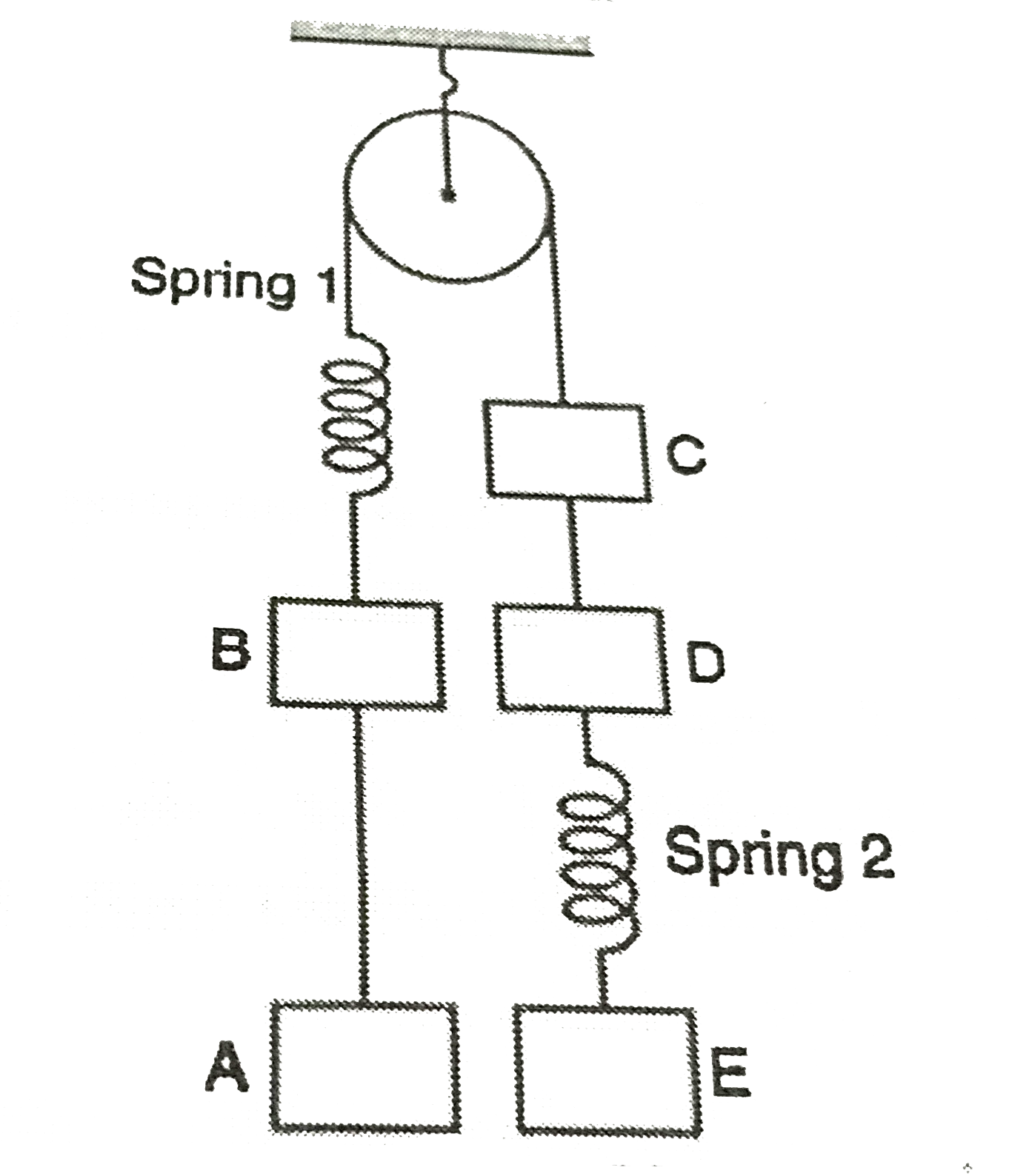
|
|
| 46. |
Hailstones fall from a certain height. If only 1% of the hailstones melt on reaching the ground, find the height from which they fall. (g=10 ms^(-2). L=80" calories/g "and J=4.2"J/calorie") |
| Answer» Answer :A | |
| 47. |
Heat absorbed by the gas undergo a cylic process along closed path in one complete cycle as shown in figure will be _____J. |
|
Answer» `10^7pi` Heat change for a system `DELTAQ=DeltaU+DeltaW` `DeltaQ=DeltaU+Delta(PV)` `therefore DeltaQ` = Area under the graph, `=pir^2kPaxx"lit"` `=pi((30-10)/2)^2` kPa x lit `=pi(20/2)^@ kP_a xx "lit"` `=pixx100xx10^3xx10^(-3)` J `=100piJ=10^2 piJ` |
|
| 48. |
Two identical drops of water are falling throgh air with steady speed of V each. If the drops coalesce to form a single drop, what is the new terminal velocity? |
|
Answer» SOLUTION :From conservation of MASS `4/3piR^(3)xxrho=4/3pir^(3)xxrho+4/3pir^(3)xxrho` or `R=2^(1//3)r`, and `V_(T)propr^(2)` (stokes law) `(V^(1))/V=(R^(2))/(r^(2))=2^(2//3)"" :. V^(1)=2^(2//3)V` |
|
| 49. |
On an incliend plane two particles A and B are projected with same speed at the same angle with the horizontal, particle A down and particle B up the plane. If the ratio of time of flight of A and B is cot theta, is the angle at which B is projected measured from. inclined plane, find the angle at which particles are projected. |
|
Answer» `90^(@)` So `gamma+alpha=theta` 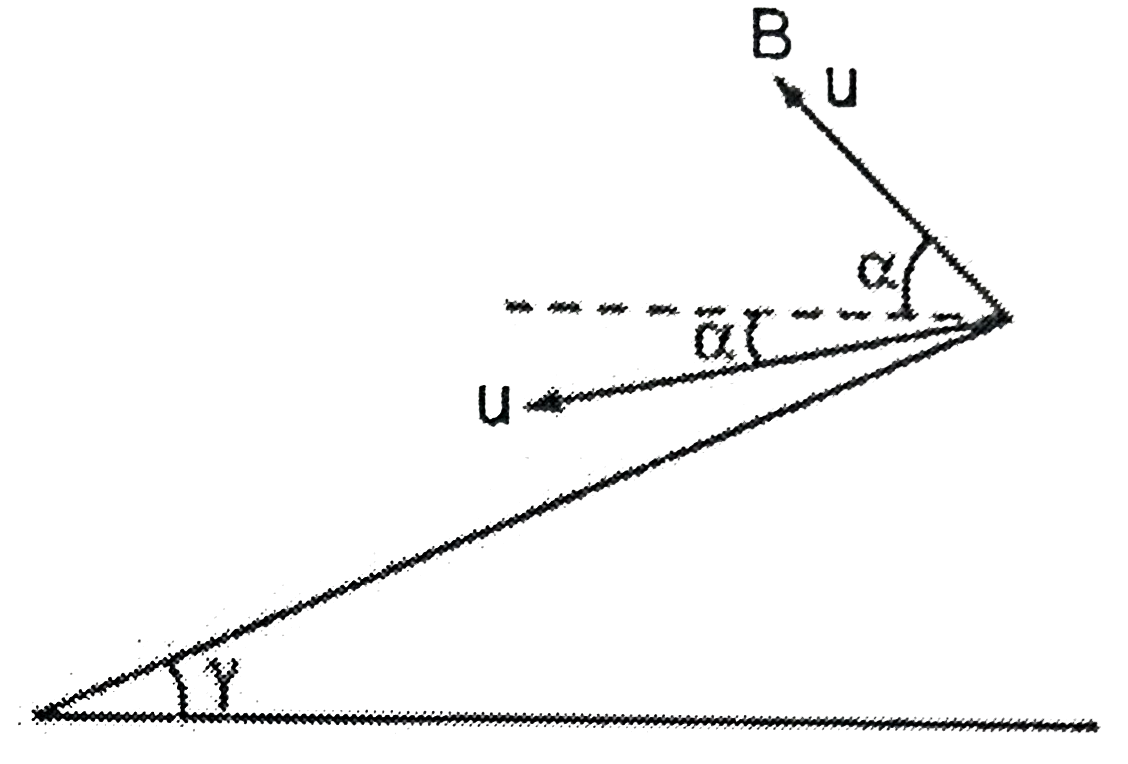
|
|
| 50. |
When two bodies approach each other with the different speeds, the distance between them decreases by 120 m for every one minute. If they are moving in direction, the distance between them increases by 90 m for very one minute. The speeds of the bodies are |
|
Answer» `2MS^(-1) and 0.5 ms^(-1)` |
|


