Saved Bookmarks
This section includes 7 InterviewSolutions, each offering curated multiple-choice questions to sharpen your Current Affairs knowledge and support exam preparation. Choose a topic below to get started.
| 1. |
In a capillary tube experiment, a vertical 30 cm long capillary tube is dipped in water. The water rises upto a height of 10 cm due to capillary action. If this experiment is conducted in freely falling elevator the length of water column becomes |
|
Answer» 10 cm |
|
| 2. |
A man of mass 70 kg ascends a flight of 36 steps each 20 cm high. What is the work he does against gravity ? |
|
Answer» |
|
| 3. |
Given that vecA+vecB=vecC and that vecC is _|_ to vecA. Further if |vecA|=|vecC|, then what is the angle between vecA and vecB |
| Answer» Answer :C | |
| 4. |
"The efficiency of all real engines are less than that of the carnot engine." Why? |
| Answer» SOLUTION :REAL ENGINES are SUBJECTED to the practical difficulties such as friction, heat losses by conduction etc. | |
| 5. |
Two identical springs of spring constant k are attached to a block of mass m and to fixed supports as shown in Fig. 14.14. Show that when the mass is displaced from its equilibrium position on either side, it executes a simple harmonic motion. Find the period of oscillations. |
Answer» Solution :Let the mass be DISPLACED by a small DISTANCE x to the right side of the equilibrium position, as shown in Fig. 14.15. Under this situation the SPRING on the left side gets  elongated by a length equal to x and that on the right side gets compressed by the same length. The forces acting on the mass are then, `F_(1)=-KX` (FORCE exerted by the spring on the left side, trying to pull the mass towards the mean position) `F_(2)=-kx` (force exerted by the spring on the right side, trying to push the mass towards the mean position) The net force, F, acting on the mass is then given by, `F=-2kx` Hence the force acting on the mass is proportional to the displacement and is directed towards the mean position, therefore, the motion executed by the mass is simple harmonic. The time period of oscillations is, `T=2pisqrt(m/(2k))` |
|
| 6. |
The motion of a sphere moving on a rough horizontal surface changes from pure sliding (without rolling) to pure rolling (without slipping). In this process, the force of friction: |
| Answer» SOLUTION :Yes. For rolling, torque is required. The weight and NORMAL reaction cannot produce any torque as they are radial. So if friction is there it will EXERT a torque, because friction acts TANGENTIAL to the moving BODY. | |
| 7. |
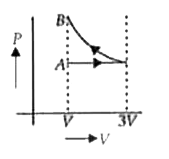
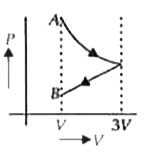
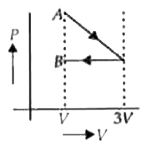
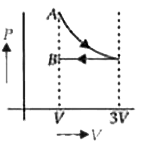
One mole of an ideal gas goes from an initial state A to final state B via two processes : It first undergoes isothermal expansion from volume V to 3V then its volume is reduced from 3V to V at constant pressure. The correct P-V diagram representing the two processes is |
|
Answer»
|
|
| 8. |
A couple is acting on a two particle system. The resultant motion will be: |
|
Answer» PURELY ROTATIONAL motion |
|
| 9. |
In a new system, if units for length mass and time are chosen to be 10 cm 10g and 0.1 s respectively, thennew unit of force in this system will be..... |
|
Answer» 1 Now in new system `F=(10g^(1)) (10 cm)^(1) (0.1 s)^(-2)` `=(10^(-2) kg)^(1) (10^(-1) m)^(1) (10^(2)s^(-2))` `=10^(-1) KGMS^(-1)` `:.F=0.1` NEWTON |
|
| 10. |
The displacement of a particle executing SHM is given by Y = 10 sin(3t + pi/3) m and 't' is in seconds. The initial displacement and maximum velocity of the particle are respectively |
|
Answer» `5sqrt(3)` m and 30m/sec |
|
| 11. |
Inside a uniform sphere of density d there is a spherical cavity whose centre is at a distance r from the centre of sphere. The intensity of gravitational field inside the cavity is … |
|
Answer» zero |
|
| 12. |
An object is weighed at the North Pole bya beam balance and a spring balance, giving readings of W_(B) and W_(S) respectively. It is again weighed in the same manner at the equator, giving reading of W_(B)' and W_(S)' respectively. Assume that the acceleration due to gravity is the same everywhere and that the balances are quite sensitive (a) W_(B) = W_(S)(b) W_(B)' = W_(S)' (c) W_(B) = W_(B)'(d) W_(S)' lt W_(S) |
|
Answer» only a & B are TRUE |
|
| 13. |
A wave travelling along a string is discribed by. y(x,t) = 0.005 sin (80.0 x - 3.0 t). in which the numerical constants are in SI units (0.005 m, 80.0 rad m^(-1), and 3.0 rad s^(-1)). Calculate (a) the amplitude, (b) the wavelength, and (c ) the period and frequency of the wave. Also, calculate the displacement y of the wave at a distance x = 30.0 cm and t = 20 s ? |
|
Answer» Solution :On comparing this displacement equation with Eq. (15.2). `y(x,t) = a SIN (kx - omega t)`. we find (a) the amplitude of the wave is `0.005 m = 5 mm`. (B) the angular wave number k and angular FREQUENCY `omega` are `k = 80.0 m^(-1)` and `omega = 3.0 s^(-1)` We, then relate the wavelength `lamda` to k through Eg. (15.6). `lamda = 2 pi//k` `= (2 pi)/(80.0 m^(-1))` `= 7.85 cm` (c ) Now, we relate T to `omega` by the relation `T = 2 pi//omega` `= (2 pi)/(3.0 s^(-1))` `= 2.09 s` and frequency , `v = 1//T = 0.48 Hz` The displacement y at x = 30.0 cm and time t = 20 s is given by `y = (0.0005 m) sin (80.0 xx 0.3 - 3.0 xx 2.0)` `= (0.005 m) sin (-36 + 12 pi)` `= (0.005 m) sin (1.699)` `= (0.005 m) sin (97^(@)) ~= 5 mm` |
|
| 14. |
If V-velocity. K - kinetic energy and T - time are chosen as the fundamental units, then what is the dimensional formula for surface tension? |
|
Answer» `[K V^(-2)T^(-2)]` |
|
| 15. |
500 g of water is heated from 30^(@)C to 60^(@)C. Ignoring the slight expansion of water, calculate the change in internal energy of the water? ("Specific heat of water "4184 J// kg K) . |
|
Answer» Solution :When the water is heated from `30^(@)C to 60^(@)`C, there is only a slight changes in its volume. So we can treat this proces as isochoric. In an isochoric process the work done by the system is zero. The given heat supplied is used to incrase only the INTERNAL energy. `DeltaU = Q = ms_(v)DELTAT` The mass of water = 500 g = 0.5 kg The change in tenperature = 30K The heat `Q = 0.5 xx 4184 xx 30 = 62.76 kJ` |
|
| 16. |
An object of mass 5 kg is suspended by a copper wire of length 2 m and diameter 5 mm. Calculate the increase in the length of the wire. In order not to exceed the elastic limit, what should be the minimum diameter of the wire ? For copper, elastic limit =1.5 xx 10 ^(9) "dyne" //cm ^(2) , (Y) = 1.1 xx 10 ^(12) "dyne"//cm^(2). |
|
Answer» Solution :`Y = 1.1 xx 10 ^(12) "dyne"//cm^(2)` `L = 2M = 200 cm` `d = 5 mm = 0.5 cm therefore r = 0.25 cm` `F = mg = 5 xx 10 ^(3) xx 980` dyne l = INCREASE n length `Y= (FL)/(pi r ^(2) l )` `therefore l = (FL )/( pi r ^(2) Y) = ( 5.0 xx 10 ^(3) xx 980 xx 200)/( 3.14 xx (0.25) ^(2) xx 1.1 xx 10 ^(12))` `= 4.99 xx 10 ^(-3) cm` (i) For copper, elastic limit `=1.5 xx 10 ^(9) "dyne"/cm^(2)` (given) (ii) If the minimum DIAMETER required is d.. them the maximum stress produced in the wire `= (F)/(pi ((d.)/(2)) ^(2))= ( 4F)/( pi d ^(2)) = 1.5 xx 10 ^(9)` `therefore d .^(2) = (4 xx 5 xx 10 ^(3) xx 980)/( 3.14 xx 1.5 xx 10 ^(9))` `= 41.6 xx 10 ^(-4)` `therefore d.= 6.45 xx 10 ^(-2) cm` |
|
| 17. |
Explain the need for banking of tracks. |
Answer» Solution : In a leveled circular road, skidding mainly DEPENDS on the coefficient of static friction us. The coefficient of static friction depends on the nature of the surface which has a maximum limiting value. To avoid this problem, usually the outer edge of the road is slightly raised compared to inner edge. This is called banking of roads or tracks. This introduces an inclination, and the angle is called banking angle. Let the surface of the road make angle ` theta`with horizontal surface. Then the normal force makes the same angle `theta`with the vertical. When the car takes a turn, there are two forces acting on the car. (a) Gravitational force mg (downwards) (b) Normal force N (perpendicular to surface) We can resolve the normal force into two components N cos `theta`and N sin `theta` . The component balances the DOWNWARD gravitational force ‘mg. and component N sin `theta` will provide the necessary CENTRIPETAL acceleration. By using Newton second law. N cos `theta` = mg `N cos theta= (mv^2)/(r )` By dividing the equations we get ` tan = (v^2)/(rg)` `v = sqrt(rg tan theta)`  The banking angle 8 and radius of curvature of the road or track determines the safe speed of the car at the turning. If the speed of car exceeds this safe speed, then it starts to skid outward but frictional force COMES into effect and provides an additional centripetal force to prevent the outward skidding. At the same time, if the speed of the car is little lesser than safe speed, it starts to skid inward and frictional force comes into effect, which reduces centripetal force to prevent inward skidding. However if the speed of the vehicle is sufficiently greater than the correct speed, then frictional force cannot stop the car from skidding. |
|
| 18. |
Give the law of gravitation of Newton. |
|
Answer» Solution :`implies` One day in 1665, Newton observing an apple falling from a tree, he was inspired to arrive at an universal law of gravitation. `implies`Newton.s reasoning was that the moon revolving in an orbit of radius R Moon was subject to a centripetal acceleration due to EARTH.s gravity of magnitude. `a_m=v^2/R=(4pi^2R_m)/T^2""[:.v=Romega=Rxx(2pi)/T]` `R_m = 3.84 xx 10^(8)m`  `implies`The time period of revolution of moon around earth T = 27.3 days `= 27.3 xx 86,400`S `implies`Speed of moon `v=("circumference orbit of rotation")/("orbital periodic time")` `= (2piR_m)/T` `=(2pixx(3.84xx10^8m))/(27.3 xx 86,400 S )` `= 1.02 xx 10^(3) ` m/s `implies` Centripetal acceleration of moon, `a_m =v^2/R_m=((1.02 xx10^3)^2)/(3.84 xx10^8)` `= 2.70 xx 10^(-3) m//s^2""...(1)` `implies` Acceleration due to gravity on the surface of earth, ` g= 9.8 m//s^(2) ""...(2)` `implies`From equation (1) and (2), `a_m lt ltg` `implies` It is clearly shows that gravitational force of earth decreases with distance. (The distance of moon from earth is LARGE and hence gravitational acceleration due to earth is small). `implies`From the magnitude of `a_m and g`, Newton shows that gravitational force is inversely proportional to the square of distance so `a_m prop 1/(Rm^2) ""..(3)` `implies` and acceleration due to gravity on the surface of earth, `g propR_(E^2)""....(4)` where `R_m` = distance of moon from the earth `R_E`= radius of earth `implies` Taking ratio of equation (3) and (4), `a_m/g=(1/R_m^2)/(1/R_E^2)` `:.a_m/g= ((R_E)/R_m)^(2) "".....(4)` Newton know thaat `R_E/R_m = 1/60` `:. a_m = g((R_E)/R_m)^2` `:. a_m=(9.8)(1/60)^2` `a_m = 2.72 xx 10^(-3)m//s^2 ""...(5)` `implies` Value of `a_m`is obtained from inverse of square of distance. This value is similar to the value obtain in equation (1). From this Newton declared that gravitational force between two bodies is inverse proportional to the square of distance between them. Gravitational force `F prop 1/r^2 ""..(6)` and distance remains constant, the gravitation force directly proportional to the product of masses of two bodies. `F prop m_(1) m_(2) ""...(6)` `implies`From this Newton.s universal law of gravitation is as below. "Every body in the universe attracts every other body with a force which is directly proportional to the product of their masses and inversely proportional to the square of the distance between them". [The direction of this force is along the line joining the two bodies). |
|
| 19. |
Two particles of same mass are projected simultaneously with same speed 20 ms^(-1) from the top of a tower of height 20m. One is projected horizontally. The maximum height attained by centre of mass from the ground will be (g=10 ms^(-2)) |
|
Answer» `10 SQRT(2)m` |
|
| 20. |
A particle moves on the x-axis according to the equation x = A + B sinwt. The motion is harmonic with amplitude |
| Answer» ANSWER :B | |
| 21. |
Areinternalenergyand heatenergythe same ?Exaplain . |
|
Answer» SOLUTION :Internal energy and thermal energy do not mean the same thing, but they are related. Internal energy is the energy stored in a BODY. It increases when the temperature of the body rises, or when the body changes from solid to LIQUID or from liquid to gas. ..HEAT is the energy transferred from one body to another as a result of a temperature DIFFERENCE... |
|
| 22. |
A particle acted upon by constant forces 5hat(i) + hat(j) - 2hat(k) and 2hat(i) + hat(j) - 2hat(k) is displaced from the point2hat(i) + 2hat(j) - 4hat(k)" ""to point" " " 6hat(i) + 4hat(j) - 2hat(k). The total work done by the forces in SI unit is |
|
Answer» `20sqrt2` |
|
| 23. |
A string is wrapped several times on a cylinder of mass M and radius R. The cylinder is pivoted about its axis of symmetry. A block of mass m tied to the string rests on a support positioned so that the string has shown. Now, the block is released Just before the string gets taut, kinetic energy of the system is E_(0). Just after taut kinetic energy of the system, velocity of m and angular velocity of cylinder are E_(1),V_(1) and omega_(1) respectively. Then, |
|
Answer» `E_(0)=" mgh"` |
|
| 24. |
For stationary waves produced in a string of length I wavelength in the n^(th) mode is ...... |
|
Answer» `(n ^(2))/(2L)` At `x =l,` we always have `y=0` (nodal point) `thereofre 0= 2a sin (kl) cos (omega t)` `THEREFORE sin (kl) =0` But `sin (npi) =0` (Where `n = 1,2,3,…)` `therefore kl = n PI` `therefore (2pi)/(LAMDA)l = npi` `therefore lamda = (2l)/(n) ` (Where `n ne 0 (n = 1,2,3,...)}` |
|
| 25. |
Three liquids of densities rho_(1),rho_(2)andrho_(3)(rho_(1)gtrho_(2)gtrho_(3)) having samevalue of surface tension T,rise to the same heitht in three identical capillaries . The following relation is remain true ? |
|
Answer» `(pi)/(2)lttheta_(1)lttheta_(2)lttheta_(3)ltpi` `h=(2Tcostheta)/(lrhog)` here h,2,T, and G are constant `therefore(COSTHETA)/(rho)=` constant `therefore(costheta_(1))/(rho_1)=(costheta_(2))/(rho_(2))=(costheta_(3))/(rho_(3))` but `rho_(1)gtrho_(2)gtrho_(3)` `thereforecostheta_(1)gtcostheta_(2)gtcostheta_(3)` `thereforetheta_(1)lttheta_(2)lttheta_(3)`[cos is decreasing function in first phase] Water rise in all three capillaries , so angle is ACUTE angle , `therefore0letheta_(1)lttheta_(2)lttheta_(3)lt(pi)/(2)` |
|
| 26. |
A particle moves in a circle of radius 4. 0 cm clockwise at constant speed of 2 cms^(-1), Ifhat(x) and hat(y)are unit acceleration vectors along x-axis and y-axis respectively (in cms^(-2)) , find the acceleration of the particle at the instant half way between P and Q . |
|
Answer» Solution :As shown in the figure (ii) , let R be the midpoint of arc PQ . Then`ANGLE PQR = 45^(@)` Magnitude of accelerationat R , The acceleration a ACTS along RO Magnitude of component of along x-axis `a_(x) = a cos 45^(@)` `= 1 xx (1)/(sqrt(2)) = (1)/(sqrt(2)) CMS^(-2)` `:.hat (a) _(x)= - (1)/(sqrt(2)) x^(2)` Magnitude of component of a along y-axis, `a_(y) = 1 xx sin 45^(@)` `= (1)/(sqrt(2)) cms^(-2)` `:. hat(a)_(y) = - (1)/(sqrt(2)) hat(y)` Hence `hat(a) _(x) + hat(a)_(y) = (-1)/(sqrt(2)) (x^(2) + hat(y))` 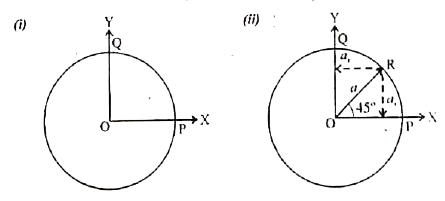
|
|
| 27. |
Let V and E be the gravitational potential and gravitational field at a distance r from the centre of a uniformspherical shell. Consider the following two statements : (A)The plot of V against r is discontinuous (B)The plot of E against r is discontinuous |
|
Answer» Both A and B are CORRECT |
|
| 28. |
fourroundobjects namelya ring, a disc,ahollowsphereand aspherewithsameradiusR start torolldownaninclineat thesametime.findout theorderof objectsreachingthebottomfirst? |
|
Answer» Solidsphere, DISC, HOLLOW , SPHERE, ring |
|
| 29. |
A refrigerator, whose coefficient of performance K is 5, extracts heat from the cooling compartment at the rate of 250 J per cycle. How much heat per cycle is discharged to the room which acts as the high temperature reservoir ? |
| Answer» SOLUTION :As ` Q_H= Q_L +W implies " so"Q_H= 250+ 50= 300 J` | |
| 30. |
A train of 100 m length moves with 40 m/s and overtakes another train of 200 m length moves with 30 ms^(-1). Time taken by 1^(st) train to overtake another train is ...... |
|
Answer» 30 s Distance covered before overtake `= 100 + 200 = 300 m` `therefore ` TIME taken to overtake `= ("distance")/("relative velocity") = (300)/(10)=30s` |
|
| 31. |
According to newton’s low of motion, the force depends on the rate of change of r momentum Using the above law, deduce an expression for force. |
| Answer» SOLUTION :REFER SECTION 5.5 | |
| 32. |
Keeping the volume constant, the pressure of a gas is increased by 10% of its original value by increasing the temperature from 27^(@)C. Find the final temperature. |
|
Answer» <P> SOLUTION :INITIAL pressure of the gas `(P_(1))=P`Final pressure of the gas `(P_(2))=110/100P` , Initial temperature `t_(1)^(@)C=27^(@)C` `T_(1)=27+273=300K` , Final temperature `t_(2)^(@)C=?` At constant VOLUME, according to Charles law `P_(1)/T_(1)=P_(2)/T_(2)` `T_(2)=P_(2)/P_(1)T_(1)=(110P//100)/P times 300=330 rArr t_(2)=330-273=577^(@)C`. |
|
| 33. |
The amplitude of a SHM is halved. How does this affect Maximum acceleration. |
| Answer» Solution :MaximumAcceleration `a_("MAX")= OMEGA^(2)A` Maximum acceleration is ALSO halfed. | |
| 34. |
A rod of mass m and resistance R slides smoothly over two parallel conducting wires kept sloping at an angle theta with respect to the horizontal as shown in figure. The circuit is closed through a perfect conductor at the top. There is a constant magnetic field vecB along the vertical direction. If the rod is initially at rest, find the velocity of the rod as a function of time. |
|
Answer»
The viscous FORCE acting on pebble through viscous oil `F=6pietarv` (where r= radius of pebble , v = velocity of pebble and `eta` = coefficient of viscosity) As the viscous force is variable force ,hence acceleration is also variable so `vtot` graph will not be a straight LINE. Hence , option (C ) is correct. |
|
| 35. |
Choose the correct statement(s) from the given statements(I) The proportionality constant in an equation can be obtained by dimensional analysis.(II) The equation V = u + at can be derived by dimensional method.(III) The equation y = A sin omega t cannot be derived by dimensional method(IV) The equation eta = (A)/(B)e^(-Bt) can be derived with dimensional method |
|
Answer» III is correct |
|
| 36. |
On which fcator does the thermal conductivity depend ? |
| Answer» SOLUTION :TYPE of MATERIAL and TEMPERATURE. | |
| 37. |
On what factors velocity of transverse wave in a string depends ? |
|
Answer» SOLUTION :(i) Directly proportional to the square root of the tension force. (ii) INVERSELY proportional to the square root of LINEAR mass density. (iii) Independent of shape of the WAVES. |
|
| 38. |
At what temperature is the kinetic energy of a gas molecule double that of its value of 27^@C |
| Answer» ANSWER :C | |
| 39. |
A body constrained to move along the z -axis of a coordinate system is subject to a constant force F given by vec(F) =(-hat(i)+2hat(j)+3hat(k))N where hat(i),hat(j),hat(k) are unit vectors along the x, y and z-axis of the system respectively . What is the work done by this force in moving the body a distance of 4 m along the z- axis? |
|
Answer» Solution :`W =VEC(F).vec(d)` `=(hat(i)+2hat(j)+3hat(K)).(4hat(k))` =12 J |
|
| 40. |
The densities of two substances are in the ratio 2: 3 and their specific heats are 0.12 and 0.09 CGS units respectively. The ratio of their thermal capacities per unit volume is |
|
Answer» `8: 9` `:. (S_(1)//V_(1))/(S_(2)//V_(2)) = (s_(1) rho_(1))/(s_(2) rho_(2)) = (0.12)/(0.09) XX (2)/(3) = (8)/(9)` |
|
| 41. |
The coefficient of volume expansion of glycerin is 49xx10^(-5)K^(-1). What is the fractional change in its density for a 30^(@)C rise in temperature ? |
|
Answer» Solution :IF volume glycerine becomes V with increase in TEMPERATURE by `30^(@)C`, then `V=V_(0)(1+gammaDeltaT)` But `V=(M)/(rho)` and `V_(0)=(M)/(rho_(0))`, `:.(M)/(rho)=(M)/(rho_(0))(1+gammaDeltaT)` `:.(rho)/(rho_(0))=1/((1+gammaDeltaT))` `:.(rho-rho_(0))/(rho_(0))=(1-1-gammaDeltaT)/(1+gammaDeltaT)` `:.(rho-rho_(0))/(rho_(0))=(-gammaDeltaT)/(1+gammaDeltaT)` `=(-49xx10^(-5)xx30)/(1+49xx10^(-5)xx30)` `(Delta rho)/(rho_(0))=-0.0145` Negative SIGN REPRESENTS the decrease in density `=0.0145~~1.5xx10^(-2)` |
|
| 42. |
The time period of a body suspended from a spring is T. What will be the new time period, if the spring is cut into two equal parts and (i) the same mass is suspended from one part, (ii) the mass is suspended simultaneously from both the parts in parallel ? |
|
Answer» `T/(2 SQRT(2)), T/2` |
|
| 43. |
In a standing wave formed by two atoms separated by 1.21Å, there are 3 nodes and 2 antinodes. Find its wavelength. |
|
Answer» `1.21 Å`  Here n= no.of CLOSED loops = no. of antinodes =2 Now, `LAMDA _(n) = (2L)/(n) = ( 2 xx 1.21 )/(2) 1.21 Å` |
|
| 44. |
A steam engine delivers 5.4 xx 10^(8) j of work per minute and absorbs 3.6 xx 10^(9) J of heat per minute from its boiler. What is the efficiency of the engine ? |
|
Answer» Solution :Output i.e. USEFUL work done per min `= 5.4 xx 10^(8) J` Input i.e., heat ABSORBED per min `= 3.6 xx 10^(9) J` Efficiency `= ("Output")/("Input") = (5.4 xx 10^(8))/(3.6 xx 10^(9)) = (3)/(20) = (3)/(20) xx 100% = 15%` |
|
| 45. |
(A) : When two bodies of equal masses collide, their velocities are always interchanged.(R ) : Momentum is not conserved in any collision. |
|
Answer» Both (A) and (R ) are true and (R ) is the correct EXPLANATION of (A) |
|
| 46. |
The minimum colatitude which can directly receive a signed from a geostationary satellite is sin^(-1)(1//k). (Take radius of parking orbit as 44, 800 km). Find the value of k |
|
Answer» |
|
| 47. |
A body of mass m= 3.513kg is moving along the x-axis with a speed of 5.00 ms^(-1). The magnitude of its momentum is recorded as |
|
Answer» `17.6kg MS^(-1)` |
|
| 48. |
(a) How many astronomical units (A.U) make 1 parsec ? (b)Consider a sunlike star at a distanceof 1 parsec.When it is seen through a telescope with 100 magnification, what should be the angular size of the star ? Sun appears to be (1//2)^@ from the earth. Due to atmospheric fluctuations, eye can't resolve object smallar then 1 arc minute. (c ) Mars has approximately half of the earth's diameter. When it is closest to the earth it is at about 1//2 A.U. from the erath. Calculate what size it will appear when seen through the same telescope. |
|
Answer» Solution :(a) By definition, 1 par sec= distance at which 1 A.U. long arc subtends an angle of 1 sec. `1 par sec= (1 A.U)/(1 arc sec)` As `1 arc sec =(1)/(60xx60)xx(pi)/(180) RADIAN` `:. 1 par sec= (1 A.U)/(pi//60xx60xx180) = (3600xx180)/(pi) A.U. = 206181 A.U.` ` 1 par sec = 2xx10^5 A.U.` (B) At ` 1 A.U., sun's "DIAMETER" is (1^@)/(2).` `:. At 1 par sec = 2xx10^5 A.U., star's "diameter will be"= (1//2^@)/(2xx10^5) = (60')/(4xx10^5) = 15xx10^(-5)min` With magnification= 100 star look of diameter `=15xx10^(-5)xx 100 = (15xx10^9-3)min.` However, due to atmospheric fultuations, it will still look of diameter about 1 minute. Stars can't be magnified using telescope. (c ) we are given `(D_(mars))/(D_(earth)) =(1)/(2)` , whrer D is for diameter. From QUES. 2.25 (c), we know = `(D_(earth))/(D_(sun)) = (1)/(100) :. (D_(mars))/(D_(sun)) = (1)/(2)xx(1)/(100) = (1)/(200)` At 1 A.U. sun's diameter= `(1^@)/(2)` :. mar's diameter = `(1)/(2)xx(1)/(100) = (1^@)/(400)` At `(1)/(2) A.U`., mar's diameter= `(1)/(400)xx2^@ = (1^@)/(200)`. with magnification = 100, mar's diameter `= (1)/(200)xx100^@ = (1^@)/(2) = 30`' This is larger then resolution limit due to atmopheric fluctuations. Hence, we conclude that planet looks magnified when seen through telescope. |
|
| 49. |
A small glass sphere of radius 2x 10^(-3) m is moving through a liquid of viscosity 0.11 decapaise. Calculate the viscos force acting on it if the speed of the ball is 0.05 ms ^(-1) |
|
Answer» |
|
| 50. |
A cable is cut to half its original length. Can each part support the same maximum load as the original cable? |
| Answer» SOLUTION :YES. Since the breaking STRESS is constant for a given material and the breaking load = breaking stress X area of CROSS section, the maximum load remains the same as the area of cross section does not change. | |