

Saved Bookmarks
This section includes 7 InterviewSolutions, each offering curated multiple-choice questions to sharpen your Current Affairs knowledge and support exam preparation. Choose a topic below to get started.
| 1. |
f:RrarrR: f(x)=x^2 is |
|
Answer» ONE-one and onto |
|
| 2. |
A U^(235) atom undergoes fission by thermal neutrons according to the following reaction U^(235)+nrarr""_(54)^(140)Xe+""_(38)^(94)Sr+2n Then Xenon undergoes four and Strontium undergoes two consecutive B decays and six electrons are detected. What is the atomic number of the two decay products of Xenon and Strontium? |
|
Answer» 50, 36 When `beta` particle is emitted, atomic number of daughter NUCLEI. is increased by 1 and atomic MASS number remains the same. Therefore, when `""_(54)^(140)Xe `undergoes four consecutive `beta` decays, the atomic number of final decay product is increased by 4 i.e., 58 and corresponding decay CHAIN is shown here, `""_(54)^(140)Xerarr""_(55)^(140)CS rarr ""_(56)^(140)Bararr""_(57)^(140)La rarr ""_(58)^(140)Ce` When `""_(38)^(94)Sr` undergoes two consecutive `beta` decays, the atomic number of final decay product is increased by 2. i.e. 40 and corresponding decay chain is shown below `""_(38)^(94)Sr rarr ""_(39)^(94)Y rarr ""_(40)^(94)Zr` |
|
| 3. |
Derivethe expressionfor magneticfieldat apointon theaxisof a circularcurrentloop . |
Answer» Solution :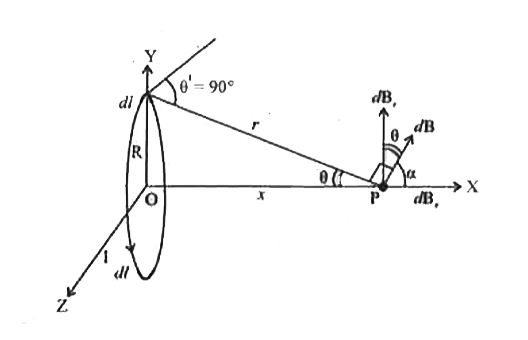 Let RBE theradius of acurrentloop, carryingcurrentI. LetR bea POINTON theaxisof aconductor.LetdBbe MAGNETICFIELD atP , dueto acurrentelement .idl. Fromthefigure ,`theta+ alpha= 90 ^(@) ,`so that` alpha= 90 ^(@)- theta ` and` cod alpha = cos(90 ^(@) - theta)=sin theta= (R^(2))/( (R^(2)+x^(2))^(1/2))` let`dB_(x)`be thehorizontalcomponentof dB . ApplyingBiot- Savart.s law , Wewrite`d vecB= ((mu_(0))/(4pi ))(I(d vecl xxvec r))/(r ^(3))` `i.e.,dB =((mu_(0))/(4pi))(Irdl)/(r^(3)) sintheta . ` where ` theta. = 90 ^(@)` `i.e.,dB =((mu _(0))/(4pi)) (i rdl )/(r^(3))=((mu_0)/(4pi))(idl)/(r^(2))` componentof dBalongthe horizontalis`dB_X =dBcos alpha ` or ` dB _x= dB sintheta= ((mu _(0))/(4pi))(idl)/(r^(2))sin theta `. Byusing(1)wewrite `dB_X =((mu_(0))/(4pi ))(Idl)/(r^(2))(R )/(r)= ((mu_(0))/(4pi )) (idlR )/((R^2+x^2)^(3/2))`.... (3) orintegrating `B_x = intdB_X= int ((mu_0)/(4pi))(IR )/((R^2+x^2)^(3/2))dl` `i.e.,B_(x) =((mu_(0))/(4pi)) (IR)/((R^2 +x^2)^(3/2))(2pi R )` Where` intdl= 2 piR or ` ` B_x =((mu_0)/(4 pi))((2 pi IR ^(2))/((R^(2)+x^2)^(3/2)))` tesl and ` vecb= B_(x)HATI= ((mu_(0))/(4pi )) ((2pi IR ^(2))/((R^(2)+x ^(2))^(3/2)))hati, dB _(y)=0 ` Fora circularloop, andatthecentre, `x = 0 , ` ` vec B _(0 )=((mu_0)/(4 pi))((2pi l)/(R ))hati ` fora circularconductorcontainingn turns, `B_x hati =((mu_0)/(4pi ))(2pi n IR ^2)/((R^2+x^2)^(3/2))hati ` and atthe centre , ` B_0 hati=((mu_0)/(4 pi))((2pi n l)/(R ))hati`. |
|
| 4. |
What is a compound microscope? |
| Answer» SOLUTION :it is COMBINATION of two convex lenses, an objective and ONE EYE PIECE | |
| 5. |
A source emits sound of frequency 600 Hz inside water. The frequency heard in air (velocity of sound in water = 1500 m/s , velocity of sound in air = 300 m/s) will be |
|
Answer» 300 Hz `therefore` Frequency of sound in air = Frequency of sound in water = 600 Hz |
|
| 6. |
In the question number 67, find the potential energy of electron (in joule) in the given state. |
|
Answer» `-4.36xx10^(-14)J` Here, `K.E.=13.6eV=2.18xx18xx10^(-18)J` HENCE, P.E. `=-2xx2.18xx10^(-18)xx10^(-18)J=-4.36xx10^(-18)J`. |
|
| 7. |
Two large plane mirrors PM and PN are arrange as shown. The length of the part of large screen SS' in which two image of the object placed at P can be seen is x (in m). Find the value sqrt3x. |
|
Answer» |
|
| 8. |
There is a thin symmetric bi-convex lens with radius of curvature for its surface to be 40 cm. One surface of the lens is silvered to make it reflecting from inner side. What will be the focal length of equivalent concave mirror? |
Answer» Solution :We can locate equivalent centre of curvature for the equivalent mirror. We know that for concave mirror image is formed on object itself if object is placed at centre of curvature of concave mirror. LET .x. be the distance of object placed in front of un-SILVERED surface of lens. 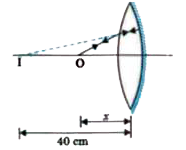 If virtual image from the refraction is formed at a distance 40 cm behind the lens then the LIGHT ray will become perpendicular to the silvered surface and then will be reflected back along the same path and the final image will be formed on the location of object. `(mu_(2))/(v)-(mu_(1))/(u)=(mu_(2)-mu_(1))/(R)` `(1.5)/(-40)-(1)/(-x)=(1.5-1)/(+40)` `rArr""(1)/(x)=(0.5)/(40)+(1.5)/(40)=(2)/(40)` `rArr""x=20cm` Hence, image of object kept at a distance of 20 cm from this equivalent mirror will be formed on object itself hence RADIUS of curvature for the equivalent mirror is 20 cm. We know that focal length is half of the radius of curvature and hence focal length of equivalent concave mirror will be 10 cm. `f=-10cm.` |
|
| 9. |
Two lenses (1) and (2) with R_(1) = R_(2) = 0.20 m each are made from glasses with mu_(1) = 1.2 and mu_(2) = 1.6 respectively. The two lenses with a separation of 0.345 m are submerged in a liquid with mu_(1) = 1.4. The focal lenghts of (1) and (2) are found. An object is placed at a distance of 1.3m from lens 1. The location of the image while system remains inside the liquid is : |
|
Answer» 6.52 m `f_(1) = - 70 cm` = - 70 m `(1)/(v) - (1)/(u) = (1)/(f_(1))` u = - 0.455 m for lens 2 : u = 0.345 - 0.45 = - 0.8 m `(1)/(v) - (1)/(u) = (1)/(f_(2)) v = 5.6` |
|
| 10. |
Two lenses (1) and (2) with R_(1) = R_(2) = 0.20 m each are made from glasses with mu_(1) = 1.2 and mu_(2) = 1.6 respectively. The two lenses with a separation of 0.345 m are submerged in a liquid with mu_(1) = 1.4. The focal lenghts of (1) and (2) are found. An object is placed at a distance of 1.3m from lens 1. Two beams of red and violet colour are made to pass separately through a prism ("angle of the prism is" 60^(@)). In the position of minimum deviation, the angle of regraction will be |
|
Answer» `30^(@)` for both the colours `r = 30^(@)` |
|
| 11. |
Two lenses (1) and (2) with R_(1) = R_(2) = 0.20 m each are made from glasses with mu_(1) = 1.2 and mu_(2) = 1.6 respectively. The two lenses with a separation of 0.345 m are submerged in a liquid with mu_(1) = 1.4. The focal lenghts of (1) and (2) are found. An object is placed at a distance of 1.3m from lens 1. The focal lenght of 2 is : |
|
Answer» `- 700 cm` `mu_(g)= 1.2, mu_(l) = 1.4` `R_(1) = 0.2 m, R_(2) = - 0.2 m` `f_(2) = + 70 cm` |
|
| 12. |
Two lenses (1) and (2) with R_(1) = R_(2) = 0.20 m each are made from glasses with mu_(1) = 1.2 and mu_(2) = 1.6 respectively. The two lenses with a separation of 0.345 m are submerged in a liquid with mu_(1) = 1.4. The focal lenghts of (1) and (2) are found. An object is placed at a distance of 1.3m from lens 1. The focal lenght of 1 is : |
|
Answer» 0.7 cm `R_(1) = R = 0.2, R_(2) = - R = - 0.2 m` `mu_(g) = 1.2, mu_(l) = 1.4` `THEREFORE f_(1) = - 70 cm`. |
|
| 13. |
The distance from the point of projection to again back to the ground is called _____, |
|
Answer» |
|
| 14. |
If the current in the toroidal solenoid increases uniformly from zero to 6.0 A in 3.0 musSelf-inductance of the toroidal solenoid is 40mu H The magnitude of self-induced emf is |
|
Answer» 80 V |
|
| 15. |
A thin circular ring of radius r is charged uniformly so that its linear charge density becomes lambda . Derive an expression for the electric field at a point P at a distance x from it along the axis of the ring. Hence, prove that at large distances (r gtgt r), the ring behaves as a point charge. |
|
Answer» SOLUTION :Let a thin circular ring of radius . is charged unifornmly having a linear charge density `lambda`.. Let Pbe a point on the axis of the ring at a distance .x. from its centre. Consider an element of length Al around a point A of the ring carrying a charge `Deltaq = lambdaDeltaI` Electric field at point P due to this charge element is `|DeltavecE| =(1)/(4piin_(0)).(Deltaq)/((AP)^(2))=(1)/(4piin_(0)) .(lambda DeltaI)/((x^(2)+x^(2))` 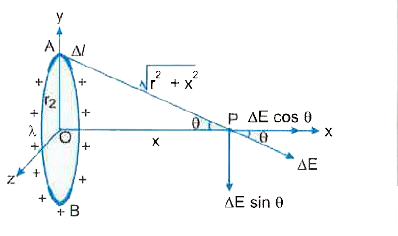 The electric field is directed along AP and thus subtends an angle 0 with the axis of the ring and can be resolved into TWO components (i) `DeltaE` cos `theta`along the axis, and (ii) `DeltaE` sin `theta`normal to the axis of ring. It is clear from symmetry that normal components `DeltaE` sin `theta`. due to mutually OPPOSITE charge elements (say A and B) nullify each other, but their axial components `.DeltaE cos theta` are added up. `:.` Net electric field at point P due to whole charged ring will be `E =sumDeltaE cos theta= sum (1)/(4piin_(0)).(lambdaDeltal)/((r^(2)+x^(2))).(x)/(sqrt(r^(2)+x^(2)))` `=(lambdax)/(4piin_(0)(r^(2)+x^(2))^(3//2))sum DeltaI= (lambda.x)/(4piin_(0)(r^(2)+x^(2))^(3//2)).2pir` `= (lambdarx )/(2in_(0)(r^(2)+x^(2))^(3//2))` The field `vecE` is directed along the axis OP of the charged ring If x `gtgt` r, then the above relation may be written as `E = (lambdarx)/(2in_(0)(x^(2))^(3//2))=(lambdar)/(2in_(0)x^(2))` As total charge on the ring q =` lambda.2pir ` so `lambdar= (q)/(2pi)` and HENCE E = `(q)/(4pi in_(0)x^(2))` The above relation shows that electric field is same as that due to a point charge q situated at the centre of ring IE., the charged ring is now behaving as a point charge. |
|
| 16. |
Why are Ge and Si semiconductors ? |
| Answer» Solution :The energy gaps in Ge and Si are of the order of 1 eV . ELECTRONS can be EASILY excited from valence band to the conduction band to enable them to CONDUCT electricity . So Ge and Si behave as SEMICONDUCTORS. | |
| 17. |
Each of the following particles is confined to an infinite well, and all four wells have the same width : (a) an electron, (b) a proton, (c) a deuteron, and (d) and alpha particle. Rank their zero - point energies, greatest first. The particles are listed in order of increasing mass. |
| Answer» SOLUTION :(a), (B), (C), (d) | |
| 18. |
A magnetic field of ( 4.0 xx 10^(-3)hatk) T exerts a force ( 4.0hati + 3.0hatj ) xx 10^(- 10) N on a particle having a charge 10^(-9) C and moving in the x-y plane. Find the velocity of the particle. |
|
Answer» Solution :Magnetic force `vecF_(m)=(4.0hati+3.0hatj)xx10^(-10)N` Let velocity of the particle in X-y plane be,`vecv=v_(x)hati+v_(y)hatj` Then from the relation `vecF_(m)=1(vecvxxvecB)` We have `(4.0hati+3.0hatj)xx10^(-10)=10^(-9)(v_(x)hati+v_(y)hatj)xx(4xx10^(-3)hatk)]=(4v_(y)xx10^(-12)hati-4v_(x)xx10^(-12)hatj)` . comparing the COEFFICIENT of `hati` and `hatj` we have, `4xx10^(-10)=4v_(y)xx10^(12)` `thereforev_(y)=10^(2)m//s=100m//s` and `3.0xx10^(-10)=-4v_(x)xx10^(-12)` `thereforev_(x)=-75m//sthereforevecv=-75hati+100hatj` |
|
| 19. |
In a sitar wire which one of the following types of vibration is produced? |
|
Answer» PROGRESSIVE LONGITUDINAL |
|
| 20. |
The amplitude of a damped oscillator decreases to 0.9 times its original magnitude is 5 s. In another 10 s it will decrease to alpha times its original magnitude, where alpha equals : |
|
Answer» 0.81 `A=A_(0)e^(-kt)` `IMPLIES""0.9A_(0)=A_(0)e^(-5K)` and `""A_(0)=A_(0)e^(-15k)` solving `impliesalpha=0.739` So, CORRECT choice is (b). |
|
| 21. |
A person with a normal near point (25 cm) using a compound microscope with objective of focal length 8.0 mm and an eyepiece of focal length 2.5cm can bring an object placed at 9.0mm from the objective in sharp focus. What is the separation between the two lenses? Calculate the magnifying power of the microscope, |
|
Answer» Solution :ANGULAR magnification of the eye-piece for image at 25cm `=(25)/(2.5)+1=11, |u_(E)|=(25)/(11)cm=2.27cm, v_(o)=7.2cm` SEPARATION = 9.47 cm, Magnifying POWER = 88 |
|
| 22. |
Two nicol prisms are inclined to each other at an angle 30^(@) .If the intensity of ordinary light incident on the first prism , thenthe intensity of light emerges from the second prism will be |
| Answer» ANSWER :D | |
| 23. |
If the horizontal and vertical components of the earth's magnetic field are equal at a place, find the angle of dip. |
|
Answer» SOLUTION :Here `B_V = B_H` `TANTHETA = B_V/B_H= 1` , so angle of dip = `45^@` |
|
| 24. |
In the question number 79, what would be the angular momentum of H_gamma photon if the angular momentum of the system is conserved |
|
Answer» ħ If the angular momentum of emitted photon `=` CHANGE in angular momentum of ELECTRON corresponding to the tranition from `n=5` to `n=2` `thereforeL=L_5-L_2=5ħ-2ħ=3ħ` |
|
| 25. |
Two batteries of emf E_(1) and E_(2)(E_(2) gt E_(1)) and internal resistances r_(1) and r_(2) respectively are connected in parallel as shown in figure. |
|
Answer» Two batteries of emf E1 and Ei{E2 GT E1) and internal resistances r1 and r2 respectively are connected in parallel as shown in figure. `therefore (R)/(S)=(l_(1))/((100-l_(1)))` `or R=(Sl_(1))/((100-l_(1)))=((100Omega)(2.9cm))/((100-2.9)CM)approx3Omega` The accuracy of MEASURING R can be improved if S and R are of the same ORDER, i.e. S should be changed to `3OMEGA`. |
|
| 26. |
A potential difference of 3000 V is maintained between two large parallel plates 6 cm apart. The force on a proton midway between the plates is x xx 10^(-15)N. What is the value of .x. ? |
|
Answer» |
|
| 27. |
Three point charges +q, -2q and +q are placed at points (x = 0, y = a, z=0), (x = 0, y = 0, z = 0) and (x = a, y = 0, z = 0) respectively. The magnitude and direction of the electric dipole moment vector of this charge assembly are |
|
Answer» `SQRT(2q)`a along the LINE joining points |
|
| 28. |
A string of 0.3 m length is found to resonate in 3 segments (nodes at both ends ) when the driving frequency is 20 Hz. The speed of the wave in the spring is : |
|
Answer» 3 m/s `V = (20 xx 2l)/(3) = (20 xx 2 xx 0.3)/(3) = 4 ms^(-1)` Correct choice is (b) . |
|
| 29. |
State clearly how an unpolarised light gets linearly polarised when passed through a polaroid. Unpolarised light intensity I_(0) is incidentP_(1) which is kept near another polaroid P_(2) whose pass axis is parallel to that of P_(1).How will the intensities of light, I_(1) and I_(2) , transmitted by the polarids P_(1) and P_(2) respectively, change on rotating P_(1)[ without disturbing P_(2) ? |
|
Answer» Solution :The light having vibrations of electric field vector in all possible DIRECTIONS perpendicular to the direction of WAVE progation is called ordinarylight. The light having vibrations field VECTORS in only ONE direaction perpendicular tothe directionof progation of light is called plane polarised light. (i) N/A (II) The value of the sound intensity inversely squared with increasing distance from sound source, i.e with ` 1/r^(2)` ` I alpha 1/(r^(2)) = I_(2)/I_(1) = r_(1)^(2)/r_(1)^(2) Rightarrow I_(2) =I_(1) (r_(1)/r_(2))^(2)` |
|
| 30. |
Find the time required for a 60Hza.c. to reach it's peak value starting from zero ? |
|
Answer» Solution :Time period OD a.c. T=1/f=1/60S The CURRENT will take one FOURTH of the time period to reach the peak value STARTING from zero |
|
| 31. |
A solenoid has a core of a material with relative permeability 400. The windings of the solenoid are insulated from the core and carry a current of 2A. If the number of turns is 1000 per metre, calculate (a) H, (b) M, (c) B and (d) the magnetising current I_(m). |
|
Answer» Solution :(a) Magnetising intensity (independent of material of core) is given by `H= i_f` (Where `i_f=` magnetising current per unit length of solenoid) `H=nI_f` (Where `I_f=` magnetising current, `N=` no. of turns per unit length of solenoid) `THEREFORE H = (1000) (2)` `therefore H= 2 xx 10^(3) Am^(-1)` (b) Total magnetic field in a given magnetic core, `B= mu_(I) mu_(0) H` `= (400) (4pi xx 10^(-7) ) (2 xx 10^(3) )` `therefore B= 1.0048 T` (c) Magnetisation obtained in a given magnetic core, `M= (B)/( mu_0) - H ( because H= (B)/( mu_0) - M)` `= (1.0048)/( 4pi xx 10^(-7) ) -2 xx 10^(3)` `therefore M=7.98 xx 10^(5) Am^(-1)` (NOTE : Here `M=i_b=` INDUCED current (or bound current) per unit length of magnetic core) (d) Additional magnetising current is given by, `I_(m) = (M)/( n)` `= (7.98 xx 10^(5) ) /( 1000)` `therefore I_(m) = 798 A` (Note : Unit of H is actually `("(ampere) (turn)")/( "(metre)")` and unit of `I_m` is actually `("ampere")/("turn")` ) |
|
| 32. |
…… do not always have to be Sunshine. |
| Answer» Answer :B | |
| 33. |
A p-n photodiode is fabricated from a semiconductor with a band gap of 2.5 eV. It can detect a signal of wavelength |
|
Answer» 6000 Å `rArr "" lambda_(0) le (hc)/(e E_(g)) or lambda le(6.63 xx 10^(-34) xx (3 xx 10^(8)))/((1.6 xx 10^(-19)) xx 2.5) or lambda_(0) le 5 xx 10^(-7)` m Thus , light of wavelength 4000 Å `(or 4 xx 10^(-7) m)` only can be detected by the photodiode. |
|
| 34. |
Howcan agiven4 wirespotentiometerbe mademore sensitive ? |
| Answer» SOLUTION :Byconnectingaresistancein serieswithpotentiometerwireintheprimary CIRCUIT, the potentialdropacrossthewireisreduced. | |
| 35. |
A beaker containing an ideal fluid executes plane SHM in a horizontal plane according to the equation x=(sqrt(3)g)/(omega^(2))sinomegat, O being the mean position. A bob is suspended at S through a string of length L as shown in the figure. The line SO is vertical. Assuming L gt gt(sqrt(3)g)/(omega^(2)). The tension in the string is maximum at time t= |
|
Answer» `pi//2omega` |
|
| 36. |
The equation of a sound wave travelling along negative X direction y = 0.04 sin pi(500t +1.5x) meter. The shortest distance between two particles having a phase difference of pi at the same instant is |
|
Answer» 0.33m. |
|
| 37. |
Three particles of masses 2 kg, 4 kg and 6 kg are located at the vertices of an equilateral triangle of side 0.5 m. What is the position of centre of mass if the origin is located at 2 kg mass and 4 kg mass located along x-axis ? |
|
Answer» 0.29 m, 0.22 m `vecx=(2xx0+4xx0.5+6xx0.25)/(12)` = 0.29 m ALSO `y_(1)=y_(2)=0,y_(3)=0.5sin60^(@)=0.433m` `vecy=(2xx0+4xx0+6xx0.433)/(12)=0.22m` 
|
|
| 38. |
The coils have a mutual inductance of 0.001 H. The current in the coil is given by I = I_0 sin (omegat) where I_0 = 5A and omega = 100 pi . What is the value of maximum e.m.f. in the secound coil ? |
|
Answer» 1.57 V |
|
| 39. |
The poet describes the earth's ground as: |
|
Answer» SICKLY brown |
|
| 40. |
For a norma eye, the far point is at infinity and the near point of distinct vision is about 25 cm in front of the eye. The cornea of the eyeprovides a converging power of about 40 diopters, and the least converging power of the eyelens behind the cornea is about 20 diopters. From this rough data estimate the range of accommodation (i.e., the range of converging power of the eyelens) of a normal eye. |
|
Answer» Solution :To observe objects at infinity, the eye USES its least converging power `=40+20=60D` `therefore` Distance between CORNEA eye LENS and retina focal LENGTH of eye lens `=(100)/(P)=(100)/(60)` `=(5)/(3)cm.` To focus and object at the near point `u=-25cm, v=5//3cm` `f=?` `(1)/(f)=-(1)/(u)+(1)/(upsilon) rArr (1)/(f)=(1)/(25)+(3)/(5)=(1+15)/(25)` `=16//25` `f=25//16cm` `"Power "=(100)/(f)=(100)/(25//16)=64D` `"Power of eye lens "=64-40=24D` Hence range of accommodation of eye lens is roughly 20 to 24 dioptre. |
|
| 41. |
A body is projected with a velocity u at an A body is projected with a velocity u at anangle of 60^(@) to the horizontal. The time interval after which it will be moving in a direction of 30^(@) to the horizontal is |
|
Answer» `(U)/(sqrt3g)` |
|
| 42. |
Using Kirchhoff's rules determine the value of unknown resistance R in the circuit so that no current flows through 4 Omegaresistance. Also find the potential difference between A and D. |
|
Answer» SOLUTION :As per question no current flows through 4 `Omega`RESISTANCE. Hence current in branch EB is zero and current flowing through branch EDCB is I. ` THEREFORE ` For mesh AFEBA, we have - 1.I - 1.I - 6 + 9 = 0 ` rarr I = 1.5 A` Now for mesh BEDCB, we have `6 - R XX 1.5 - 3 = 0rArr R = 2Omega` Moreover, potential difference`V_A - V_D =9- 3 -IR = 9 - 3-(1.5) xx (2) = 3 V` |
|
| 43. |
Self inductance coefficient of a system can be increased by a) increasing the current through it b) decreasing the current through it c) inserting an iron core d) increasing the number of turns |
|
Answer» a, C only |
|
| 44. |
What is the shape of equipotential surface around the point charge ? |
Answer» SOLUTION :For an isolated CHARGE the equipotential surfaces are co-centric SPHERICAL shells and the distance between the shells INCREASES with the decrease in electric field.
|
|
| 45. |
Define magnetic 'dip' and 'declination' at a place. |
| Answer» SOLUTION :The ANGLE between the MAGNETIC meridian and the GEOGRAPHIC meridian is known as the magnetic declination. | |
| 46. |
A particle of charge q and mass m moves rectilinearly under the action of an electric field E = alpha - betax . Here, alpha and beta are positive constants and x is the distance from the point where the particle was initially at rest. Then : 1) the motion of the particle is oscillatory withamplitude (alpha)/(beta) 2) the mean position of the particles is at x = (alpha)/(beta). 3) the maximum acceleration of the particle is (q alpha)/(m) 4) All 1, 2 and 3 |
|
Answer» Solution :`a = (F)/(m) = (qE)/(m) = q/m (ALPHA - betax) "" …..(1)` a = 0 at x = `alpha/beta` i.e., force on the particle is zero at, `x = alpha/beta` so , mean position of particle is at `x = alpha/beta` Eq. (1) can be written as `v cdot (dv)/(dx) = q/m (alpha - betax)` `:. v dv = q/m int_0^x (alpha -betax) dx` `:.v = sqrt((2qx)/(m) (alpha - beta/2 x))` `v = 0` at` x = 0` and `x = (2 alpha)/(beta)` So, the particle will oscillate between `x = 0` to `x = (2 alpha)/(beta)` with mean position at `x = (alpha)/(beta)`. Therefore, AMPLITUDE of particle is `(alpha)/(beta)` . Maximum acceleration of particle is at extreme positions (at `x = 0` or `x = 2alpha//beta`) and `a_("max") = qalpha//m ` (from Eq. (1)) |
|
| 47. |
When a plane mirror is rotated through an angle theta then the reflected ray turns through the angle 2 theta then the size of the image |
|
Answer» Is doubled |
|
| 48. |
A magnet of magnetic moment 50 hati A m^2 is placed along the x-axis in a magnetic field vecB = (0.5hati +3.0hatj)T. The torque acting on the magnet is |
|
Answer» `175hatk N-m` |
|
| 49. |
Define ionisation energy. What is its value for a hydrogen atom? |
| Answer» Solution :MINIMUM energy required to free an ELECTRON from the ground state. It.s VALUE for hydrogen ATOM is 13. 6 eV. | |
| 50. |
A conducting ball is charged and another similar point charge is brought closer to the bal : |
|
Answer» the all may attact the point charge |
|