

Saved Bookmarks
This section includes 7 InterviewSolutions, each offering curated multiple-choice questions to sharpen your Current Affairs knowledge and support exam preparation. Choose a topic below to get started.
| 1. |
A converging lens is used to form an image on a screen. When the upper half of the lens is covered by an opaque screen. a) half of the image will disappear b) no part of image will disappear . c) Intensity of the image will increased d. Intensity of the image will decrease |
|
Answer» a,C are true |
|
| 2. |
The threshold wavelength of photo sensitive metal is 5000Å. Find the velocity of the photoelectrons emitted by it when radiation of wavelength 4000 Å is incident on it. Given h = 6.625xx10^(-34)Js, e = 1.6xx10.^(-19)C and mass of electron = 9.1xx10^(-34)kg. |
|
Answer» Solution :Given : `lambda_0 = 5000Å = 5000 xx 10^(-10)m`, V = ? `lambda = 4000 Å= 4000 xx 10^(-19) m` `h= 6.625 xx 10^(-34)` JS `e=1.6 xx 10^(-19)C` `m= 9.1 xx 10^(-31) kg` From Einstein.s photoelectric equation `K_("max") = HV - hv_0` ` =hC[(1)/(lambda)-(lambda)/(lambda_0)]` `= 6.625xx10|^(-34) xx3xx10^8[(1)/(4000xx10^(-10))-(1)/(5000xx10^(-10))]` `=19.875xx10^9-26[(1)/(4xx10^(-7))-(1)/(5xx10^(-7))]` `=(19.875xx10^(-26))/(10^(-7))[1/4-1/5]` `=19.875xx10^(-19)[(5-4)/920)]` `=(19.875xx10^(-19))/(20)` `K_("max")=0.9937xx10^(-19)J` We know that `K_("max")=1/2mv_("max")^2` `v^2=0.2183xx10^(12)` `v=4.672xx10^5 MS^(-1)` |
|
| 3. |
A wire carrying current I has the shape as shown in adjoining figure. Linear parts of the wire are very long and parallel to X-axis while semicircular portion of raduis R is lying in Y - Z plane. Magnetic field at point O is |
|
Answer» `(mu_(0)I)/(4piR)(pii+2k)` |
|
| 4. |
81 व 237 का महत्तम समापवर्तक (HCF) ज्ञात कीजिए । |
|
Answer» 2 |
|
| 5. |
Is pressure a vector ? |
| Answer» Solution :No, because it is always TAKEN to be the NORMAL to the plane of the era.here the DIRECTION is significant. | |
| 6. |
Hydrogen atom is excited from ground state to another state with principal quantum number equal to 4. Then the number of spectral lines in the emission will be |
|
Answer» 2 |
|
| 7. |
In a region, an electric field vec(E )= 5 xx 10^(3) hat(j) NC^(-1) and a magnetic field of vec(B)= 0.1 hat(K)T are applied. A beam of charged particles are projected along X-direction. Find the velocity of charged particles which move an deflected in this crossed fields. |
|
Answer» SOLUTION :`V= (E )/(B)` `V= ((5 xx 10^(3))/(0.1))` `V= 5 xx 10^(4) ms^(-1)` along x-direction |
|
| 8. |
The physical situation in List-I with graphs of the variation of total energy (E), potential energy (U) and kinetic energy ( K) with time in List-II are given. Match the statements from List I with those in List II and select the correct answer using the code given below the lists. |
|
Answer» <P>`{:(P,Q,R,S),(1,4,2,3):}` |
|
| 9. |
Focal lengths of objective and eye-piece of microscope is 1.6 cm and 2.5 cm respectively. Distance between two lenses is 21.7 cm. If final image is formed at infinity, then magnification m = ...... |
|
Answer» 11  For objective`(1)/(v_0)-(1)/(u_0)=(1)/(f_0)` `therefore (-1)/(u_0)=(1)/(f_0)-(1)/(v_0)` `therefore (-1)/(u_0) =(19.2-1.6)/((1.6)(19.2))` `therefore u_0=-1.745`cm When IMAGE is FORMED at INFINITY magnification `m=((v_0)/(u_0))((D)/(f_e))` where D=25 cm `=((19.2)/(1.745))((25)/(2.5))` `therefore m=110` cm |
|
| 10. |
The torque experienced by a rectangular current loop placed perpendicular to a uniform magnetic field is |
|
Answer» MAXIMUM |
|
| 11. |
A double slit apperatus is used to observe an interference pattem projected on a screen from a stationary light source. If the light source is instead moved towards the double slits at constant speed along the axis of symmetry , what will be observed on the screen ? |
|
Answer» The interference patten will REMAIN unchanged |
|
| 12. |
Two events A and B occur at places separated by 10^(6) km, B occuring 5s after A . (a) Find the velocity of a frame in which these events occur at the same place . (b)What is the time interval between the events in this frame ? |
Answer» Solution : (a) Suppose the events A and B occur at POINTS X and Y at times t_A and t_B where t_B = t_A +5 s. Consider a small train which is at the pointX when the event A occurs. Suppose, this same train moves towards Y and reaches the point Y when the events A and B occur at the same place in the train frame . This frame moves `10^(6)` km in 5sas seen from the original frame . Thus, the VELOCITY of the train frame is ` V =10^(6) km / 5 s = 2 xx 10 s m s ^(-1) ` (b) As the events A and B occur at the same place in the train frame, the time interval between the events measured in this frame is the proper interval . Thus , this time interval is , `= (5 5) (SQRT 1 - v^(2)/ c^(2) ) = (5s) (sqrt 1 - (2/ 3 )^(2) ` `= 3.7s` |
|
| 13. |
(A): A small metal ball is suspended in a uniform electric field with an insulated thread. If high energy X-ray beam falls on the ball, the ball will be deflected in the electric field. (R ): X-rays emits photoelectron and metal becomes negatively charged. |
|
Answer» Both .A. and .R. are TRUE and .R. is the correct EXPLANATION of .A. |
|
| 14. |
A wire frame in the form of a part of circle ( sector ) of radius 1 and resistance R is free to rotate about on axis passing through O and perpendicular to plane of paper as shown in the figure. The angle of the sector is (pi)/(4) and it is rotating with constant angular velocity omega as shown. Above line PQ uniform magnetic field of magnitude B exists in the direction perpendicular to plane of paper. In region I field is outward while in region II, field is inward. Based on above information, answer the following questions : Total thermal energy dissipated in one cycle is |
|
Answer» `(B^(2)omegapl^(4))/(16R)` `e_(1)=` induced `emf=(Bomegal^(2))/(2)` Thermal energy DISSIPATED in time `t_(1)` `H_(1)=(e_(1)^(2))/(R)t_(1)=(B^(2)omegapil^(4))/(16R)` SIMILARLY , thermal energy developed when the frame moves fromregion I to region II is , `H_(2)=(B^(2)omegapil^(4))/(4R)` Thermal energy will also develop when the loop comes out from magnetic field and is given by, `H_(3)=(B^(2)omegapil^(4))/(16R)` So, total thermal energy developed in one revolution is, `H=H_(1)+H_(2)+H_(3)=(3B^(2)omegapil^(4))/(8R)` Average power produced, `P_(av)=(H)/(T)=(3B^(2)omega^(2)l^(4))/(16R)` |
|
| 15. |
A wire frame in the form of a part of circle ( sector ) of radius 1 and resistance R is free to rotate about on axis passing through O and perpendicular to plane of paper as shown in the figure. The angle of the sector is (pi)/(4) and it is rotating with constant angular velocity omega as shown. Above line PQ uniform magnetic field of magnitude B exists in the direction perpendicular to plane of paper. In region I field is outward while in region II, field is inward. Based on above information, answer the following questions :The thermal energy dissipated in wire frame when it moves from region I to region II, is |
|
Answer» `(B^(2)omegapipl^(4))/(16R)` `e_(1)=` induced `emf=(Bomegal^(2))/(2)` Thermal energy dissipated in time `t_(1)` `H_(1)=(e_(1)^(2))/(R)t_(1)=(B^(2)omegapil^(4))/(16R)` Similarly , thermal energy developed when the frame moves fromregion I to region II is , `H_(2)=(B^(2)omegapil^(4))/(4R)` Thermal energy will also develop when the loop COMES out from magnetic field and is GIVEN by, `H_(3)=(B^(2)omegapil^(4))/(16R)` So, total thermal energy developed in one revolution is, `H=H_(1)+H_(2)+H_(3)=(3B^(2)omegapil^(4))/(8R)` Average power produced, `P_(av)=(H)/(T)=(3B^(2)omega^(2)l^(4))/(16R)` |
|
| 16. |
A wire frame in the form of a part of circle ( sector ) of radius 1 and resistance R is free to rotate about on axis passing through O and perpendicular to plane of paper as shown in the figure. The angle of the sector is (pi)/(4) and it is rotating with constant angular velocity omega as shown. Above line PQ uniform magnetic field of magnitude B exists in the direction perpendicular to plane of paper. In region I field is outward while in region II, field is inward. Based on above information, answer the following questions : Average power produced in wire framce is |
|
Answer» `(3B^(2)omegapl^(4))/(16R)` `e_(1)=` induced `emf=(Bomegal^(2))/(2)` Thermal energy dissipated in time `t_(1)` `H_(1)=(e_(1)^(2))/(R)t_(1)=(B^(2)omegapil^(4))/(16R)` Similarly , thermal energy developed when the frame moves fromregion I to region II is , `H_(2)=(B^(2)omegapil^(4))/(4R)` Thermal energy will also DEVELOP when the loop COMES out from magnetic field and is given by, `H_(3)=(B^(2)omegapil^(4))/(16R)` So, total thermal energy developed in one revolution is, `H=H_(1)+H_(2)+H_(3)=(3B^(2)omegapil^(4))/(8R)` Average power produced, `P_(av)=(H)/(T)=(3B^(2)omega^(2)l^(4))/(16R)` |
|
| 17. |
Two point charges +8q and -2q are located at x=0 and x=L respectively. The location of a point on the x-axis from +8q at which the net electric field due to these two point charges is zero is |
|
Answer» 2L |
|
| 18. |
A dipole consists of two particles one with charge +1muCand mass 1kg and the other with charge –1muCand mass 2kg separated by a distance of 3m. For small oscillations about its equilibrium position, the angular frequency, when placed in a uniform electric field of 20kV/m is |
|
Answer» 0.1 rad/s |
|
| 19. |
(i) When primary coil P is moved towards secondary coil S (as shown in the Fig.) the galvanometer shows momentary deflection. What can be done to have larger deflection in the galvanometer with the same battery? (ii) State the related law. |
|
Answer» Solution :(i) To have larger DEFLECTION in the galvanometer with the same battery, we should MOVE the primary coil P towards SECONDARY coil S rapidly so that rate of change of MAGNETIC flux is more. (ii) The related law is Faraday.s law which states that induced emf is set up in a circuit when magnetic flux linked with it changes. The magnitude of induced emf is equal to the rate of change of magnetic flux i.e., `|varepsilon = (dphi_(B))(dt)` |
|
| 20. |
Can the nuclear reaction ""_(4)Be^(7)to""_(2)He^(4)+""_(2)He^(3) take place ? Why? |
| Answer» SOLUTION :The sum of the MASSES in the FINAL stage of the possible reaction exceeds the MASS of the original nucleus. The reaction is impossible because it contravenes the LAW of conservation of energy. | |
| 21. |
A free proton cannot decay into (n+e^(+)+v), because such decay is not energetically allowed. Yet we observe in nature beta decay with positron emission. How do we understand the emission of positrons form nuclei? |
|
Answer» Solution :A FREE proton cannot decay into a neutron as the Q value of reaction becomes negative. However, inside the nucleus, both protons and neutrons are BOUND. The bound NUCLEONS behave differently than free nucleons. When we take into account the energetic of parent and DAUGTHER nuclie involved in beta PLUS decay (or positron decay), the decay is always energetically allowed. |
|
| 22. |
From an initial height h, a solid ball rolls smoothly down one side of a U-shaped ramp and then moves up the other side, which is frictionless. What maximum height does the ball reach? |
| Answer» SOLUTION :`H.= (5H)/(7)` | |
| 23. |
Consider a metallic pipe with an inner radius of 1 cm. If a cylindrical bar magnet of radius 0.8cm is dropped through the pipe, it takes more time to come down than it takes for a similar unmagnetised cylindrical iron bar dropped through the metallic pipe. Explain. |
|
Answer» Solution :When a cylindrical BAR magnet is dropped through the pipe the magnetic flux linked with the metal pipe increase and eddy currents are produced and they oppose the MOTION of the magnet and hence acceleration of the falling magnet will be less than .G so the magnet will take more time. If IRON rod which is not magnetised is allowed to fall, no such effect is produced and hence it will fall with the same acceleration .g. and it will take less time for falling. |
|
| 24. |
A racing car moving towards a cliff, sounds its horn. The driver observes that the sound reflected from the cliff has a pitch one octave higher than the actual sound of the horn. If v is the velocity of sound, then the velocity of the car is |
|
Answer» `(v)/(2)` `f.=((v+v_0)/(v-v_0))f = 2F "" thereforev_0 = (v)/(3)` |
|
| 25. |
An object is projected vertically upwards. It explodes at the topmost point of its trajectory into three identical fragments. One of the fragments comes straight down in time t_(1) while the other two lands at a time t_(2) after explosion. Height at which the explosion occurred is equal to |
|
Answer» `(g t_(1)t_(2)(t_(2)+3t_(1)))/(2(t_(1)+t_(2)))` |
|
| 26. |
A point object is placed at a distance of 20 cm from a thin plano-concex lens of focal length 15 cm. The plane surface of the lens is now silvered. The image created by the is at : |
|
Answer» `60 CM` to the left of the system. `(1)/(F)=(1)/(f_(m))-(1)/(f_(L))` `(1)/(F)=(1)/(infty)-(2)/(15)` By mirror formula `(1)/(F)=(1)/(u)+(1)/(v) RARR -(2)/(15)=(1)/(-20)+(1)/(v)` `rArr (1)/(v)=(1)/(20)-(2)/(15)=(3-8)/(60)` `v=-12 cm` negartive means TOWARD left |
|
| 27. |
What is an equipotential surface ? Show that the electric field at a point on the surface of a charged conductor or just outside it is perpendicular to the surface ? |
|
Answer» Solution :n equipotential surface is that, electric POTENTIAL at every point of which is the same. By definition potential difference between two POINTS = work done in carrying unit + ve test charge from one point to another. As for an equipotential surface potential difference is zero hence no work is to be done in moving a test charge from one point to another of an equipotential surface. Thus, `dW = vecE. VEC(dr) = E drcos theta = 0" and it leads to " cos thetaor theta = 90^@` Thus, electric field intensity `vecE` on the surface of a conductor is always PERPENDICULAR to the surface. |
|
| 28. |
Over what distance must there be heat flow by conduction from the blood capillaries beneath the skin to the surface if the temperature difference is 0.50^(@)C ? Assume 200 W must be transferred through the whole body's surface area of 1.5 m^(2) Given that thermal conductivity of blood cells is 0.2W//mK. |
|
Answer» |
|
| 29. |
Open organ pipe has fundamental frequency 400Hz. When it is dipped in water up to one third of its length under water the fundamental frequency will be |
|
Answer» 33Hz |
|
| 30. |
State Kirchhoff's laws of Electrical network. |
| Answer» Solution :KCL: At any junction, the sum of the CURRENTS entering the junction is equal to THESUM of the currents leaving the junction.ie. `sum l=0`. KVL: The algebraic sum of changes in potential around any closed loop involving resistors and cells in the loop is zero. i.e., `sum E= sum IR`. | |
| 31. |
Findout the position of the image formed and draw the appropriate ray diagram. u = –30 cm R = + 10 cm |
Answer» Solution :`n_(2)/v-n_(1)/U=(n_(2)-n_(1))/R` 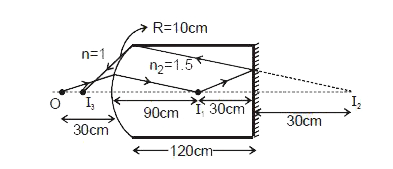 `RARR 1.5/v+1/30=0.5/10` `rArr 1.5/v=0.5/10-1/30` `rArr 1.5/v=0.5/30` `rArr v=+90` Mirror will from the image of `I_(1)` 30 cm behind it as shown in the figure. For the second REFRACTION : `u=-150` cm `R=-10` cm `n_(1)=1.5` `n_(2)=1` `1/v+1.5/150=(-0.5)/(-10)` `rArr 1/v=0.5/10-1/100` `rArr 1/v=4/100` `rArr v=25` cm (Real) |
|
| 32. |
Which of the above Maxwell's equations shows that electric field lines do not form closed loops ? |
| Answer» Answer :A | |
| 33. |
(A): The radius of a nucleus determined byelectron scattering is found to be slightly different from that determined by alpha - particle scattering (R) : The electron scattering senses the charge distribution of the nucleus where as alpha and similar particles sense the nuclear matter |
|
Answer» Both .A. and .R. are TRUE and .R. is the correct EXPLANATION of .A. |
|
| 34. |
(a)a conductor a witha cavitygiven a charge Q show that the entire charge must appear on the outer surface of theconductor (b) another condluctor B with charge q is sensitive instrument is to be shielded from the strong electrosatitic fields in its environmentsuggest a possible way |
| Answer» Solution :THEFORCE is `10^(-2)`in the negativez direction that is in the direction of decreasing electric fieldyoucan check that this is ALSO theenergy of the DIPOLE TORQUE is zero | |
| 35. |
A material is placed in a magnetic field . If it is thrown out of the field then the material is _____ |
| Answer» SOLUTION :DIAMAGNETIC | |
| 36. |
In a resonance tube experiment the first resonance takes place foe an air column of length 13cm and the second resonance for anair column of length 41cm, the diameter of resonance tube is : |
|
Answer» 5cm |
|
| 37. |
A concave lens of refractive index 1.5 is immersed in a medium of refractive index 1.65. What is the nature of the lens ? |
| Answer» Solution :When a CONCAVE LENS of refractive index `1.5 (n_(g) = 1.5)`is immersed in a medium of refractive index `165 (n_(m) = 1.65)`, the lens begins to BEHAVE as a converging (convex) lens. | |
| 38. |
Plane wave of lamda=600 nm incident normally on a slit of width 0.18 mm. Calculate the total angular wideth of the central maximum. |
|
Answer» Solution :Data SUPPLIED `N=1,a=0.18xx10^(-3)m, lamda=600xx10^(-9)m` `a sin theta =nlamda` Since `theta` is a very SMALL `sin theta ~~ theta` `:. theta=(n lamda)/a=(1xx600xx10^(-9))/(0.18xx10^(-3))=3.33xx10^(-3)`radian `:.`Total angular width `=2 theta=6.66xx10^(-3)` radian |
|
| 39. |
A conducting ring of radius 1 m is placed in a uniform magneticfield B of 0.01T oscillating with frequency 100Hz with its plane at right angle to B. What will be the induced electric field? |
|
Answer» `piV//m` that is `e=-(Deltaphi)/(Deltat)` flux induced `=2BA cosphi` where `B` is magnetic field, `A` is area. Given, `theta=0^(@)=Deltat=(1)/(100)s` `Deltaf=2xx0.01xxpixx(1)^(2)xx200xcos 0^(@)` `:. e=(-2x0.01xxpixx(1)^(2)xx200)/(100)=-4pi` volt circumference of a CIRCLE of radius `r` is `2pir`. :. induced electric field `E` is `E=(|e|)/(2pir)=(4pi)/(2pir)=(2)/(1)=2V//m` |
|
| 40. |
A 3.0 cm wire carrying a current of 10 A is placed inside a solenoid perpendicular to its axis. The magnetic field inside the solenoid is given to be 0.27 T. What is the magnetic force on the wire? |
| Answer» SOLUTION :`8.1 xx 10^(-2) N`, DIRECTION of force GIVEN by Fleming’s left-hand rule | |
| 41. |
If the value of Planck.s constant is more than its present value then the De Broglie wavelength associated with a material particle will be |
|
Answer» more |
|
| 42. |
Apply Gauss's theorem to find an expression for the electric field intensity at a point due to a point charge. |
|
Answer» Solution :let us find electric FIELD intensity due to a POINT charge q at a point P at distance r. draw a gaussian sphere of a RADIUS r passing through the point of observation as SHOWN in the fig. From Gauss.s theorem, `ointvec(E).dvec(S)=(q)/(epsi_(0))` or `ointEdScos0^(@)=(q)/(epsi_(0))` 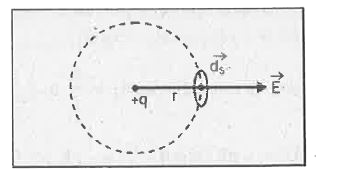 or `EointdS=(q)/(epsi_(0))``[becausecos0^(@)=1]` or `E.4pir^(2)=(q)/(epsi_(0))` or `E=(q)/(4pir^(2)epsi_(0))` or `E=(1)/(4piepsi_(0))(q)/(r^(2))`. |
|
| 43. |
An aircraft with a wingspan of 40 m flies with a speed of 1080 km/hr in the eastward direction at a constant altitude in the northern hemisphere, where the vertical component of the earth's magnetic field 1.75 xx10^(-5) .Then the emf developed between the tips of the wings is |
|
Answer» 2.1V |
|
| 44. |
A wire shaped to a regular hexagon of side x carries a current I ampere. Calculate the strength of the magnetic field at the centre of the hexagon. |
|
Answer» `(sqrt3 mu_(0)I)/(pi X)` `B=(mu_(0))/(4pi). (I)/(a) (sin theta_(1) + sin theta_(2))` where a= OP Here, `theta_(1)= theta_(2)= 30^(@)` (from the geometry of the figure), PB= AB=xand a = OP = PB `cos 30^(@)= x.(sqrt3)/(2)` `:. B= (mu_(0))/(4pi) .(I)/(x.(sqrt3)/(2)) (sin 30^(@) + sin 30^(@)) = (mu_(0))/(4pi) .(2I)/(sqrt3x) ((1)/(2) + (1)/(2)` `=(mu_(0))/(2pi).(I)/(sqrt3x)` tesla. The direction of B at POINT P is perpendicular to the plane of the page directed downward. Similarly, the magnetic fields at P due to the other arms of the hexagon, i.e, BC, CD, DE, EF and FA are same and act in the same direction. Therefore, the total magneitc field at `P= 6B = 6 xx (mu_(0))/(2pi).(I)/(sqrt3x)= (sqrt3 mu_(0)I)/(pi x)` tesla acting in a direction perpendicular to the plane of the page direction downward. 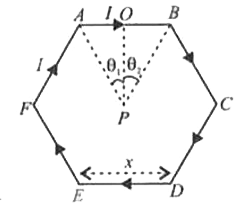
|
|
| 45. |
If the frequency of the carrier wave is increased from 10 MHz to 100 MHz, the length of the half wave dipole antena required for transmission. |
|
Answer» INCREASES |
|
| 46. |
2.0 माइक्रो-कूलॉम के दो बराबर तथा विपरीत आवेशों के बीच की दूरी 3.0 सेमी है। इसका वैद्युत द्विध्रुव-आघूर्ण होगा। |
|
Answer» 6.0 कूलॉम X मीटर |
|
| 47. |
A very small opaque disc is placed in the path oa a monochromatic light. Its geometric shadow has |
|
Answer» bright POINT at the center of SHADOW surrounded by ALTERNATE bright and DARK rings |
|
| 48. |
Give an illustration of determining direction of induced current by using Lenz's law. |
|
Answer» Solution :(i) Consider a uniform MAGNETIC field, with its field LINES perpendicular to the PLANE of the paper and pointing inwards. These field lines are represented by crosses (x) as shown in Figure (a). (ii) A rectangular metallic frame ABCD is placed in this magnetic field, with its plane perpendicular to the field. The arm AB is movable so that it can slide towards right or left, 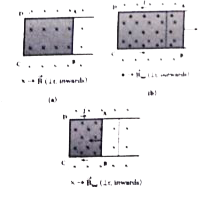 (iii) lf the arm AB slides to our right side, the number of field lines (magnetic flux) passing through the frame ABCD increases and a current is induced. (IV) As suggested by Lenz.s law, the induced current opposes this flux increase and it tries to reduce it by producing another magnetic field pointing outwards ie.. opposite to the existing magnetic field. (v) .The magnetic lines of this induced field are represented by red-colored circles in the Figure (b). From the direction of the magnetic field thus produced, the direction of the induced current is found to be anti clockwise by using right-hand thumb rule. (VI) The leftward motion of arm AB decreases magnetic flux. .The induced current, this time, produces a magnetic field in the inward direction (red-colored crosses) i.e., in the direction of the existing magnetic field (Figure(c)). (vii) Therefore, the flux decrease is opposed by the flow of induced current. From this, it is found that induced current flows in clockwise direction. |
|
| 49. |
Number of ejected photoelectrons increases with increases |
|
Answer» a) in intensity of light |
|
| 50. |
The current through the battery and resistors 1 and 2 in Fig. 26-26a is 1.50 A. Energy is transferred from the current to thermal energy E_(th) in both resistors. Curves 1 and 2 in Fig. 26-26b give that thermal energy Ein for resistors 1 and 2, respectively, as a function of time i. The vertical scale is set by E_(th.s) =40.0mJ and the horizotal scale is set by t_(s)=5.00s. What is the power of the battery? |
|
Answer» |
|