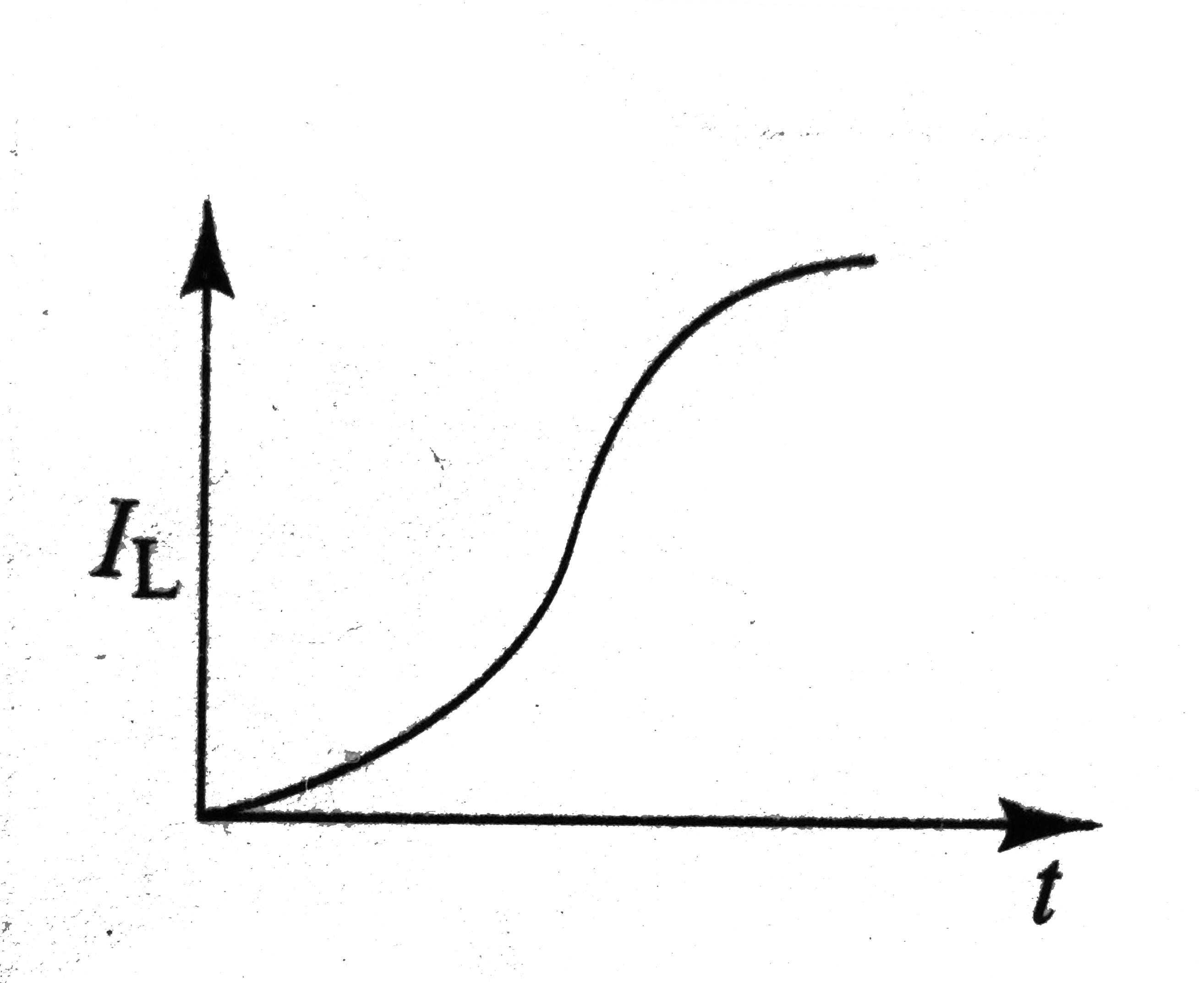
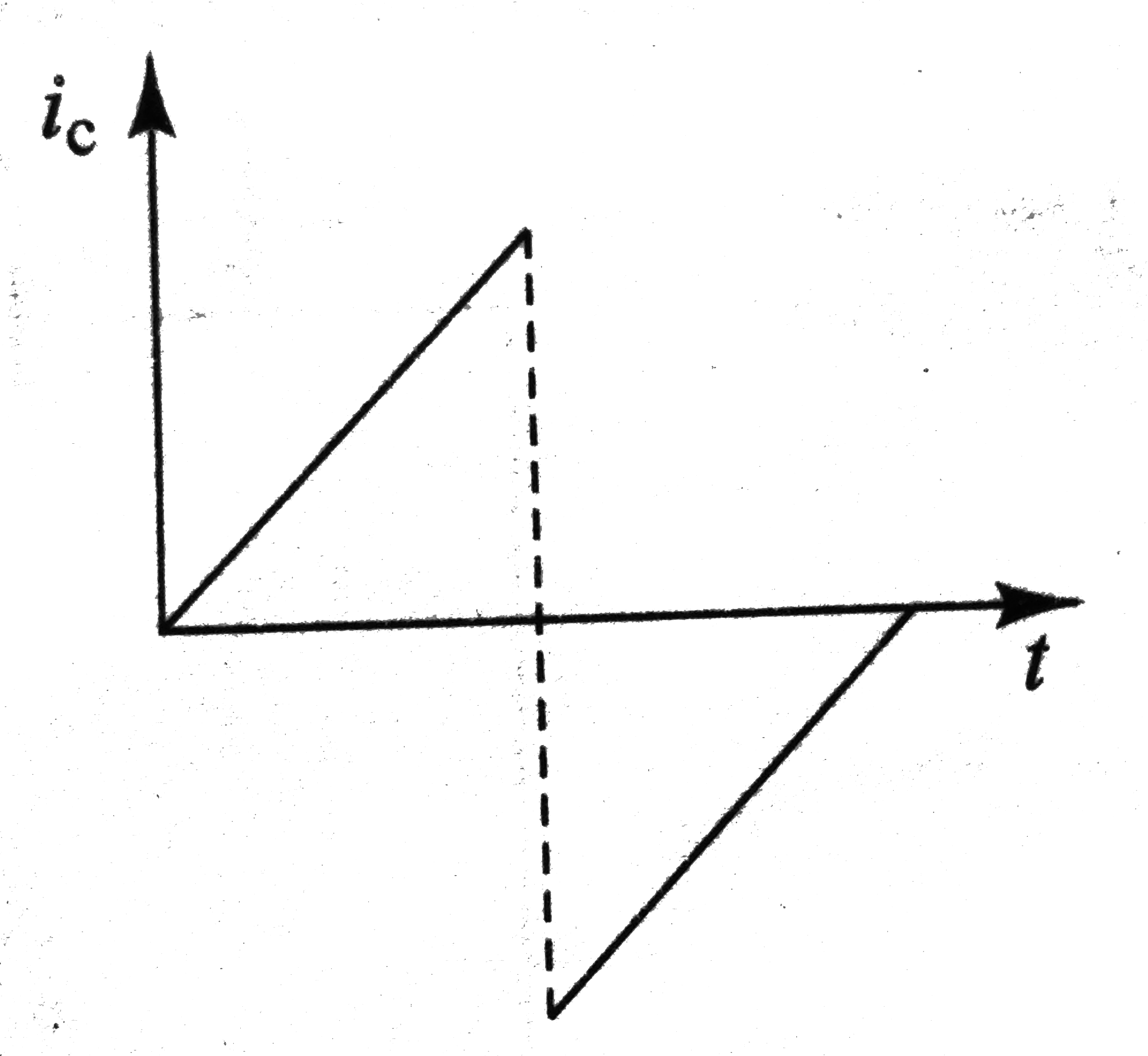
Saved Bookmarks
This section includes 7 InterviewSolutions, each offering curated multiple-choice questions to sharpen your Current Affairs knowledge and support exam preparation. Choose a topic below to get started.
| 1. |
If the linear momentum of a body is increased by 50% then the kinetic energy of that body increases by |
|
Answer» 0.25 `:.` % INCREASE in K.E.=`(n^2-1)XX100` =`[(3/2)^2-1]xx100=125%` |
|
| 2. |
A circular converging lens, with diameter d = 32 mm and focal length f = 24 cm, forms images of distant point objects in the focal plane of the lens. The wavelength is lambda = 550 nm. (a) Considering diffraction by the lens, what angular separation must two distant point objects have to satisfy Rayleigh's criterion? |
|
Answer» Solution :KEY IDEA Two distant point objects `P_(1)` and `P_(2)` the lens, and a viewing screen in the focal plane of the lens. It also shows, on the right, plots of light intensity I VERSUS position on the screen for the central MAXIMA of the images formed by the lens. Note that the angular separation `theta_(o)`, of the objects equals the angular separation `theta_(i)` of the images. Thus, the images are to satisfy Rayleigh.s criterion, these SEPARATIONS must be given by Eq. 35-64 (for small ANGLES). CALCULATIONS: From Eq. 35-62, we obtain `theta_(o)=theta_(i)=theta_(R)=1.22(lambda)/(d)` `((1.22)(550 xx 10^(-9) m))/(32 xx 10^(-3) m)=2.1 xx 10^(-5)` rad. (Answer) Each central maximum in the two intensity curves is centered on the first minimum of the other curve. 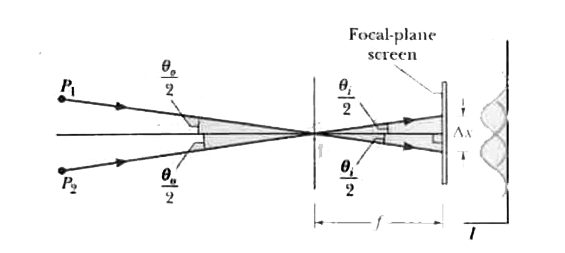
|
|
| 3. |
In Young's double-slit experiment, the screen becomes uniformly bright if one of the slits is covered with a black paper. |
| Answer» Solution :False-On covering one of the slit in Young.s double-slit EXPERIMENT we GET diffraction PATTERN DUE to a single-slit. | |
| 4. |
Draw the ray diagram of image formation in case of compound microscope |
Answer» SOLUTION : TUBE length of a compound microscope is the DISTANCE between the objective LENS and eyepiece lens. |
|
| 5. |
A 44mH inductor is connected to 220V, 50 Hz ac supply . Determine the rms value of the current in the circuit . |
| Answer» Solution :`I_(rms) = (V_(rms) )/(X_L) = (V_(rms) )/(OMEGAL) = (V_(rms) )/(2pi v L) = (220)/(2pi xx 50 xx 4 xx 10^(-3) ) = 15.9 A` | |
| 6. |
If E and B are respectively values of electric and magnetic fields, then which of following is dimensionless ? |
|
Answer» `sqrt(mu_(0)in_(0))(E )/(B)` `THEREFORE sqrt(mu_(0)in_(0)).(E )/(B)=(1)/(c )xx c =1` `therefore` Dimensionless |
|
| 7. |
The loop ABCD is moving with velocity .v. towards right. The magnetic field is 4 T. The loop is connected to a resistance of 8 ohm. If steady current of 2 A flows in the loop then value of u if loop has a resistance of 4 ohm, is : (Given AB=30 cm, AD=30 cm) |
|
Answer» Solution :The induced emf in the loop is e = Blv ` e = B(AD) sin 37^@ v - 4 xx 0.3 sin 37^@ v` Effective RESISTANCE of the circuit is R = (4+8)= 12 ohm Hence i` = e/R = (Blv)/( R)` ` rArr 2 = (4 xx 0.3 xx sin 37^@ mu)/((4+8))` ` therefore v = 100/3 m//s ` |
|
| 8. |
A particle is projected from a tower as shown in figure, then find the distance from the foor of the tower where it will strike the ground (g=10 m//s^(2)) |
|
Answer» Solution :`s=ut+(1)/(2) at^(2)` `1500=(500)/(3)XX(3)/(5)t+5t^(2) RARR 300= 20t+t^(2)` On solving t=10 s `:.` Horizontal distance `= U cos theta. T` `=(500)/(3) xx(4)/(5) xx10=(4000)/(3) m` 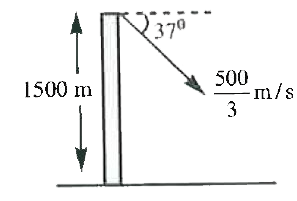
|
|
| 9. |
The current through a wire varies with time asI = I_(0)+ alpha t , where I_(0) = 10 A and alpha = 4 As^(-1) . The charge that flows across a cross-section of the wire in first 10 seconds is ..... |
|
Answer» SOLUTION :Current , I = `(dq)/(dt) = I_(0) + ALPHA t ` `thereforedq= (I_(0) + alpha t ) dt ` INTEGRATING on both sides, ` Q = int dq = int_(t = 0)^(t = 10 ) (I_(0) + alpha t) dt ` `= int_(0)^(10) l_(0)" dt " + int_(0)^(10) alpha` t dt `= I_(0) int_(0)^(10) dt + alphaint_(0)^(10) ` t dt = `I_(0) [ t]_(0)^(10) + alpha [ (t^(2))/(2) ]_(0)^(10)` `= 10I_(0)+ 50 alpha ` Substituting ` I_(0) = 10 and alpha = 4 ` Q = 10 (10 ) + 50(4) = 300 C |
|
| 10. |
(A) : Magnetic field interacts with a moving charge and not with a stationary charge. (R) : Magnetic field will be produced by a moving charge but not by a stationary charge. |
|
Answer» Both 'A' and 'R' are true and 'R' is the CORRECT EXPLANATION of 'A'. |
|
| 11. |
What is upolarised light ? |
| Answer» SOLUTION :UNPOLARISED LIGHT ? | |
| 12. |
The velocity of a particle is u=v_0 + gt + ft^2. If its position is x = 0 at t=0, Then it's displacement after time (t = 1 ) is |
|
Answer» `v_0 + G/2 + F` |
|
| 13. |
A point source of light S is placed in front of two large mirrors as shown. Which of the followingobservers will see only one image of S ? |
| Answer» Answer :B | |
| 14. |
The self-inductance L of a solenoid of length I and area of cross-section A with a fixed number of turns N increases as |
|
Answer» L and A increase. |
|
| 15. |
A.T.G. gives a deflection of 30^(@) for a certain current at one place and a deflection of 45^(@) at another place . The values of the horizontal component of the earth's fields at the two places and in the ratio of |
|
Answer» `1 : SQRT(3)` |
|
| 16. |
The potential difference between the terminals or a battery is 10 V and internal resistance 1 Omega drops to 8 V when connected across an external resistor . Find the resistance of the external resistor. |
|
Answer» 40 `Omega` PuttingI = `(E)/(R + r)` in V = IR `therefore V = (ER)/(R +r)` `therefore 8 = (10xx R)/(R + 1)` `therefore 8R + 8 = 10 ` R `therefore ` 2 R =8 `therefore R = 4 Omega` |
|
| 17. |
(A) : A helical spring tends to contract, when a current passes through it (R) : Two straight parallel metallic wires carrying current in same direction repel each other |
|
Answer» Both 'A' and 'R' are TRUE and 'R' is the CORRECT explanation of 'A'. |
|
| 18. |
Assertion: A charged particle free to move in an electric field always move along an electric line of force. Reason:The electric line of force diverge from a negative charge and converge at a positive charge. |
|
Answer» Both Assertion and REASON are true and Reason is the CORRECT EXPLANATION of Assertion |
|
| 19. |
In the above the angular width of the central maximum is |
|
Answer» `30^(@)` |
|
| 20. |
Employing the uncertainty principle, estimate the minimum kinetic energy of an electron confined within a region whose sizes is l=0.20nm. |
|
Answer» Solution :Clearly `Deltax le L" so" DELTA p_(x),ge(ħ)/(l)` Now `p_(x)geDeltaP_(x)` and so `T=(p_(x)^(2))/(2m) ge (ħ^(2))/(2ML^(2))` Thus `T_(min)=(ħ^(2))/(2m l^(2))~=0.95eV` |
|
| 21. |
An airbubble in sphere having 4 cm diameter appears 1 cm from surface nearest to eye when looked along diameterIf ._(a)mu_(8)=1.5, the distance of bubble from refracting surface is |
|
Answer» `1.2 CM` |
|
| 22. |
Monochromatic light is refracted from air into the glass of refractive index mu. The ratio of the wavelenght of incident and refracted waves is : |
|
Answer» `1 : mu` |
|
| 23. |
In the Young's double slit experiment, the slits are 0.4 cm apart and the screen is 100 cm awayIf the wavelength of light used is 5000 Å then the distance between the fourth dark fringe and central bright will be ...... |
|
Answer» `4.37xx10^(-2) CM` `d sin theta_(n)=(2n-1)(LAMBDA)/(2)` but `sin theta_(n)=(x_(n))/(D)` `:.(dx_(n))/(D)=(2n-1) (lambda)/(2)` `:.x_(n)=((2n-1)lambdaD)/(2d)`, here `n=4, d=0.4 cm` `lambda=5xx10^(-5)cm, D=100 cm and n=4` `:.x_(4)=(7lambdaD)/(2d)` `=(7xx5xx10^(-5)xx100)/(2xx0.4)` `:.x_(4)=4.37xx10^(-2) cm` |
|
| 24. |
Silver nitrate solution is used to study |
|
Answer» ENDOPLASMIC reticulum |
|
| 25. |
A paricle starts from the origin at t = 0s with a velocity of 10.0 hatj m//s and moves in the xy-plane with a constant acceleration of (8.0hati +2.0hatj)ms^(-2). What time is the x-coordinate of the particle 16m? |
|
Answer» `t = 2S` |
|
| 27. |
In Hall effect measurements a plate of width h=10mm and length l= 50mm made of p-type semiconductor was placed in a magnetic field with induction B= 5.0kG. A potential difference V= 10V was applied across the edges of the plate. In this case the hall field is V_(H)= 50mV and resistivity rho= 2.5 Omega, cm. Find the concentration of holes and hole mobility. |
Answer» Solution : We SHALL ignore minority CARRIES. Drifting holes experience a sideways force in the magnetic FIELD and react by setting up a Hall electric field `E_(y)` to conuterbalance it.Thus `v_(x)B=E_(y)=(V_(H))/(h)` If the concentration of carries is `n` then `j_(x)= n e v_(x)` Hence `n=(J_(x))/(ev_(x))=((j_(x))/(eV_(H)))/(hB)=(j_(x)hB)/(eV_(H))` Also using `j_(x)= sigmaE_(x)=E_(x)//rho=(V)/(rho l)` we get `n=(Vh B)/(e rhol V_(H))` Substituting the data (note that in `MKS` unit `B= 5.0kG= 0.5T)` `rho= 2.5xx10^(-2) ohm-m` we get `n=4.99xx10^(21)m^(-3)` `= 4.99xx10^(15)per cm^(3)` Also the mobility is` u_(0)=(v_(x))/(E_(x))=(V_(H))/(nB)xx(l)/(V)=(V_(H)l)/(hBV)` Substitution gives `u_(0)= 0.05m^(2)//V-s` |
|
| 28. |
A circuit has a resistance of 12 Omega. The power factor of the circuit will be : |
|
Answer» 0.4 |
|
| 29. |
The effective length of a magnet is 31.4 cm and its pole strength is 0.8 Am. The magnetic moment, if it is bent in the form of a semicircle is _____ Am^(2). |
|
Answer» 1.6 `thereforer=(31.4)/pi=31.4/3.14=10cm` `thereforer=0.1m` `therefore2r=0.2m` `thereforem=pxx2r` = `0.8xx0.2=0.16Am^(2)` |
|
| 31. |
Referring to the previous illustration, find the time of flight of the balls |
|
Answer» Solution :`(T)^(2)={(2v_(0)sintheta_(0))/(G)}^(2)=(v_(0)^(2)sin^(2)theta)/(2g)(8)/(g)` `rArrT^(2)=(8H)/(g)` `rArrT=sqrt((8H)/(g))=2sqrt((2H)/(g))`: PutH=7.2m |
|
| 32. |
The value of the resistor, R_(s), needed in the de voltage regulator circuit shown here, equals : |
|
Answer» `(V_(i)+V_(1))nI_(L)` |
|
| 33. |
The half life of a substance is 20 minutes The time interval between 33% decay and 67% decay |
|
Answer» Solution :For 33% decay, `N/(N_0)=1/(2^(n_1))implies 1/(100) = 1/(2^(n_1)) .....(1)"" n_(1) = t_(1)/T` For 67% decay , `N/N_(0) = 1/(2^(n_2)) implies 33/100 = 1/(2^(n_2)).....(2)` `n_(2) = t_(2)/T` `((2))/((1))=33/67=1/(2^((n_(2)-n_(1))))implies1//2^(1)=1/(2((t_(2)-t_(1)))/T)implies(t_(2)-t_(1))/T=1` `t_(2)-t_(1) = T = 20 ` minutes. |
|
| 34. |
When you have learned to integrate, try to derive a formula for the instantaneous current from a capacitor discharged through a resistor. |
|
Answer» TAKE the form `triangle Psi=q/C, i=underset(triangle t to 0)lim (-(triangle q)/(triangle t))=-(dq)/(dt)` The minus sign is due to the decrease in the capacitor.s charge in the process of its discharge. Substituting into the expression for Ohm.s law, we OBTAIN. `q/(RC)=-(dq)/(dt), or (dt)/(RC)=- (dq)/q` Integrating, we obtain `t/(RC)=-ln q+ ln A` where A is a constant. Nothing that for t=0m `q=q_(0)`, we obtain `0=-ln q_(0)` + ln A, from which `A=q_0`. Hence `t/(RC)=-ln q+ln q_(0)` Denoting the time constant (the relaxation time) `tau=RC,` we obtain `ln q/q_(0)=- t/tau," GIVING "q=q_(0) E^(-t//tau)` For the current we have `l=- (dq)/(dt)=(q_(0))/(tau) e^(-t//pi)=l_(0) e^(-t//tau)" where "i_(0)=(q_(0))/(tau)=(q_(0))/(RC)=U_(0)/R` |
|
| 35. |
A and B are two points in an electric field produced by q. To bring a unit +ve charge from a to A, 10 J work is needed. To bring the same charge from. A to B, 2J work is needed. What are the potential at A and B? |
| Answer» SOLUTION :POTENTIAL at A, `[V_A = 10V potential at B. V_B = 12V]` | |
| 36. |
The variation of induced emf (e) with time (t) in a coil, if a short bar magnet is moved along its axis with a constant velocity is best represented as : |
|
Answer»
|
|
| 37. |
In mixed grouping current is given by i=______ |
| Answer» SOLUTION :`[(MNE)/(mR+nR).gtgtr/m,Rltltr/m]` | |
| 38. |
The potential difference across a 2-H inductor as a funtion of time is shows in Fig. At t = 0, current is zero. Choose the corrent stetement. |
|
Answer» Current at `t = 2 s` is `5 A` `rArr I = (1)/(L)` [AREA under `nu -t` graph from `t = 0` to `t = t`] At `t = 2 s`, `I = (1)/(2) [(1)/(2) xx 2xx 10] = 5 A` For `t = 0` to `2 s, V = 5t` `I = (1)/(L) underset(0) overset(t) int 5t dt = (1)/(2) [(5t^(2))/(2)]_(0)^(t) = (5t^(2))/(4)` For `t = 2` to `4 s, V = - 5t + 20` `I = (1)/(2) underset(0) overset(t)int (-5t + 20)dt rArr I = (-5t^(2))/(4) + 10t` HENCE the correct graph is (c )`. |
|
| 39. |
A standing wave is maintained in a homogeneous string of cross-sectional area s and density rho. It is formed by the superposition of two waves travelling in opposite directions given by the equation y_(1)=a sin(omegat -kx) and y_(2) = 2a sin(omegat - kx). The total mechanical energy confined between the sections corresponding to the adjacent antinodes is |
|
Answer» `(3pi RHO omega^(2)a^(2))/(2k)` |
|
| 40. |
a. Explain the meaning of the statement 'electric charge of a body is quantised'. b. Why can one ignore quantisation of electric charge when dealing with macroscopic i.e., large scale charges? |
|
Answer» Solution :Charge occurs in nature as discrete entity. One packet of charge (least quantity) is CALLED quantum charge. It is represented by ‘e.. Generally charge of electron is represented by -e. and charge of a proton is represented by .+e.. Therefore, the charge possessed by any charged body will be an integral multiple of `pme,` i.e., ne where n- 1,2,3, `therefore q= pm "ne"` The fact that, electric charge COLLECTIONS are integral multiples of the fundamental electronic charge was proved experimentally by Millikan. b. While decaling with large scale electrical phenomonen we ignore the quantization of charge because the MAGNITUDE of charge of proton and electron is so small. For continuous charge distribution charge can be accounted in terms of charge DENSITY such as linear charge density `lambda` etc. We need not go for individual charge. |
|
| 41. |
Calculate the Hall constant for silver knowing its density and atomic mass. |
|
Answer» |
|
| 42. |
Give the applications of ICT in mining and agriculture sectors. |
|
Answer» Solution :(a) Agriculture : The implentation of information and communication technology (ICT) in agriculture sector enhances the productivity, improves the living standards of farmers and overcomes the challenges and risk factors. (i) Increasing food productivity and farm management. (ii) To optimize the use of water, seeds and fertilizers etc. (iii) Sophisticated technologies that includes robots, temperature and moisture sensors, aerial images, and GPS technology can be used. (iv) Geographic information systems are extensively used in farming to decide the suitable place for the species to be PLANTED. (b) Fisheries : (i) Satellite vessel monitoring system helps to identify fishing zones. (ii) Uses of barcodes helps to identifytime and data of catch, species name, quality of FISH. (c ) (i) ICT in mining improves operational efficiency, REMOTE monitoring and disaster locating system. (ii) Information and communication technology provides audio-visual warming to the trapped underground miners. (iii) It helps to connect remote sites. |
|
| 43. |
A parallel plate capacitor has a capacitance of 6 muF. If the separation between the plates is reduced to one half of its original separation and a dielectric of dielectric constant 3 is introducedbetween the plates of capacitor, its new capacitance will be __________ . |
| Answer» Solution :`36 MUF. C. . (Kepsi_0A)/(d.) = (K epsi_0A)/(d/2) = 2K (epsi_0A)/d =2 KC= 2 XX 3xx 6 muF = 36 muF` | |
| 44. |
Suppose the loop in Exercise 6.4 is stationary but the current feeding the electromagnet that produces the magnetic field is gradually reduced so that the field decreases from its initial value of 0.3 T at the rate of 0.02 T s^(1). If the cut is joined and the loop has a resistance of 1.6Omega, how much power is dissipated by the loop as heat? What is the source of this power ? |
|
Answer» Solution :When loop is stationary, its SURFACE area `A = 1B = 0.08 xx 0.02 = 16 xx 10^(-4) m^(2)` and rate of change of magnetic field `(dB)/dt = - 0.02 Ts^(-1)` (-ve sign means that the field is gradually falling with time) `therefore` Induced EMF `varepsilon =-(dphi_(B))/dt=16xx10^(-4)xx(-0.02)=3.2xx10^(-5)V` and power dissipated as heat `P=varepsilon^(2)/R=(3.2xx10^(-5))^(2)/1.6=6.4xx10^(-10)W.` The SOURCE of power is the external agency due to which magnetic field is being REDUCED with time. |
|
| 45. |
The equation of a yave travellihg on a siring stretched along the x-axis is given by y =Ae^(-(x/a + t/T)^(2)where A. a and T are constants of appropriate dimensions |
|
Answer» The speed of the WAVE is a/T. |
|
| 46. |
Plank'sconstant is represented by: |
|
Answer» `[MLT^(-1)]` |
|
| 47. |
A n-p-n transistor is connected in C - E configuration Collector supply is 8 V . The voltage drop across the load resistor of 800Omega , connected to collector circuit is 0.8 volt . If alpha = 25/26 If input resistance of transistor is 200Omega , then power gain is |
|
Answer» 1000 V Now `alpha=i_c/i_e,i_e=i_c/alpha=10^(-3)/(25//26)=26/25xx10^(-3)` amp. Now `i_b=i_e-i_c=26/25xx10^(-3)-10^(-3)=4XX10^(-5)` amp But `R_i=200Omega` `:.` Input VOLTAGE `V_i-i_bR_i=4xx10^(-5)xx200` `=8XX10^(-3)` volt `:.` Voltage GAIN , `A_v=V_0/V_i=(0.8)/(8xx10^(-3))=100` `:.` Power gain , `beta xx A_v = 25 xx100 = 2500` |
|
| 48. |
A n-p-n transistor is connected in C - E configuration Collector supply is 8 V . The voltage drop across the load resistor of 800Omega , connected to collector circuit is 0.8 volt . If alpha = 25/26 Then collector emitter voltage (V_("ce")) is |
|
Answer» 5.2 V `:. ""beta = alpha/(1- alpha) =(25//26)/(1-25//26)=25` Collector supply voltage E = 8 V Output voltage `V_0 = 0.8 V` `:. V_("CE")=E-V_0= 8 xx 0.8 = 7.2 V` |
|
| 49. |
Consider the arrangement of parallel plates of the previousproblem. If 1.0 nC charge is given to the upper plate instead of the middle, what will be the potentialdifference (in V) between (a) the upper and the middle plates and (b) the middle and the lower plates ? |
|
Answer» |
|
| 50. |
A block of mass 'm' is connected to another block of mass 'M' by a spring (massless) of spring constant 'k'. The blocks are kept on a smooth horizontal plane. Initially the blocks are at rest and the spring is unstretched. Then a constant force 'F' starts acting on the block of mass 'M' to pull it. Find the force on the block of mass 'm'. |
|
Answer» `((M+m)F)/(m)` For the block of mass `M, F-T= Ma….(i)`  Also for the block of mass `m, T = ma…(II)` ADDING (i) and (ii), `F = (M + m) a` Or a`=(F)/(M+m)` Putting in (ii) `T =(mF)/( M + m)` Hence CHOICE is (b). |
|