Saved Bookmarks
This section includes 7 InterviewSolutions, each offering curated multiple-choice questions to sharpen your Current Affairs knowledge and support exam preparation. Choose a topic below to get started.
| 1. |
In the circuitwhat is the change of total electrical energy stored in the capacitors when the key is pressed ? |
|
Answer» `(CV^2)/(12)` `E_i = 1/2 XX 3CV^2 = 3/2 CV^2` When key is CLOSED, two capacitors are in series. `E_f = 1/2 C (V/2)^2 xx 2 = (CV^2)/4` `Delta E = E_i - E_f = 5/4 CV^2` . |
|
| 2. |
How current is formed in conductors ? |
|
Answer» Solution :`rArr` When conductor are subjected to electric field, electric CHARGE experience force. `rArr` If charges are free then they will move and current will be formed. `rArr` In nature free charge exist in UPPER strata of the atmosphere called Ionosphere. `rArr ` In atom and molecules Coulombian force act between electron and nucleus hence electrons are not free. `rArr ` Bulk matter is made up of NWNBER of molecules. `rArr` l gram of water contain about `10^(22)` molecules. These molecules are so closely packed so that individual electron are no longer attached to nucleus. `rArr` In some materials electrons are bound hence even after applying electric field they do not get accelerated. `rArr `In metals some of electrons are practically free to move hence they move randomly in bulk material. `rArr` When external electric field is applied to metals electric current is produced. `rArr` In solid conductors current is formed DUE tomotion of electron. `rArr` In liquid (electrolyte) current is produced due to motion positive and NEGATIVE ion in mutually opposite direction. ` rArr` In gases also current is produced due to motion of ions. |
|
| 3. |
A particle of a mass m is located in a two-diamensional square potential well with absolutely impenetrable walls. Find: (a) the particles permitted energy values if the sides of the well are l_(1) and l_(2) (b) the energy values of the particle at the first four levels if the well has the shape of a square with side l. |
|
Answer» Solution :(a) Here the schrodinger equation is `(ħ^(2))/(2m)((del^(2))/(delx^(2))+(del^(2))/(dely^(2)))Psi=EPsi` We take the origin at one of the corners of the rectangle where the particles can lie. Then the wave function must VANISH for `x=0 or x= l_(1)` or `y=0 or y=l_(2)` We look for a solution in the form `Psi= A sin k_(1) x sin k_(2)y` cosines are not permitted by the boundary conditions. Then `k_(1)=(n_(i)pi)/(l_(1)),k_(2)=n_(2)(pi)/(l_(2))` and `E=(k_(1)^(2)+k_(2)^(2))/(2m)ħ^(2)=(pi^(2)ħ^(2))/(2m)((n_(1)^(2))/(t_(1)^(2))+(n_(2)^(2))/(t_(2)^(2)))` Here, `n_(1),n_(2)` are nonzero integers (b) If `l_(1)=l_(2)=1` then `(E)/(ħ^(2)//ML^(2))=(n_(1)^(2)+n_(2)^(2))/(2)pi^(2)` 1st level: `n_(1)=n_(2)=2= 1rarrpi^(2)=9.87` `2^(nd)` level: `,{:(n_(1),=,n_(2),=,2),(or n_(1),=2,n_(2),=,1):}}rarr(5)/(2)pi^(2)= 24.7` `3^(ST)" level": n_(1)=2,n_(2)=2 rarr 4pi^(2)= 39.5` `4^(nd)" level":{:(n_(1)1,=,n_(2),=,3),(n_(1),=3,n_(2),=,1):}}rarr 5pi^(2)= 49.3` |
|
| 4. |
The objective lens of a compound microscope produces magnification of 10. In order to get an over all magnification of 100 when image is formed at 25 cm from the eye, the focal length of the eye Il'iis should be (in cm) |
|
Answer» 4 |
|
| 5. |
A vessel whose bottom has round holes, dipped vertically in mercury and the surface of contact is measured. What is the maximum height to which water can be filled without leakage? |
|
Answer» SOLUTION :`T = (rhdg)/(2costheta)` for water `theta = 0^@` and `COSTHETA = 1` `therefore h = (2T)/(rdg)T` = 95 dyne/cm, d = 1 gram/cm `therefore h = (2 xx 75)/(5 xx 10^-3 xx 1 xx 10^3)` = 30cm |
|
| 6. |
Do the frequency and wavelength change when light passes from a rarer to a denser medium ? |
| Answer» Solution : When light passes from a RARER to a DENSER MEDIUM, its WAVELENGTH decreases but the frequency REMAINS unchanged | |
| 7. |
A cube is made from six thin insulating square faces, each square having side 'd' and carrying a uniformly distributed charge of Q. The magnitude of electric flux leaving the sixth face, due to the electric field of other five faces, is varphi. The magnitude of electrostatic force on each face of cube is F. Then, |
|
Answer» `varphi = (5Q)/(6E_0)` `varphi + varphi' = Q/E_(0) IMPLIES phi = varphi' = Q/(2E_(0))` `F = sigma INT EdA COS theta = sigma Q/(2E_(0)) = (Q^2)/(2 E_(0)d^(2))`. |
|
| 8. |
(a) Two stable isotopes of lithium ""_(3)^(6)Li and ""_(3)^(7)Li have respective abundances of 7.5% and 92.5%. These isotopes have masses 6.01512 u and 7.01600 u, respectively. Find the atomic mass of lithium. (b) Boron has two stable isotopes, ""_(5)^(10)B and ""_(5)^(11)B. Their respective masses are 10.01294 u and 11.00931 u, and the atomic mass of boron is 10.811 u. Find the abundances of ""_(5)^(10)B and ""_(5)^(11)B. |
| Answer» SOLUTION :(a) 6.941 U (B) 19.9%, 80.1% | |
| 9. |
Given any one source which emits electromagnetic radiations forming a continuous emission spectrum of several wavelengths differing in intensities. |
| Answer» Solution :Condensed MATTER LIKE solids and liquids of SEVERAL and NON- condensed matter like dense gases at all temperatures emit e.m . Radiations of several WAVELENGTHS as a continuous spectrum. | |
| 11. |
During charging of capacitor, I_C. is the conduction current flowing in the wires connecting capacitor to the battery and I_d is theDisplacement current flowing between the plates of the capacitor. |
|
Answer» `I_c gt I_d` Let o be the instantaneous charge ACQUIRED by the PLATES of the capacitor at some instant of time. Electric FIELD between the plates of the capacitor can be written as follows: `E=(q )/(epsi_0 A)` Electric flux associated with a plane PARALLEL to plates of the capacitor having same area as that of plate of capacitor can be written asfollows: `phi = EA =(q )/(epsi_0)` Displacement current can be written as follows:` I_d =epsi_0 ( d phi) /(d t) = ( dq) /( dt)=i_c` Hence displacement current between the plates of the capacitor is same as conduction current FLOWING in the wires. |
|
| 12. |
Two electrons are held at some separation. A third charge q is to be placed at the midpoint between these two electrons. What should q be so that electric potential energy of the system becomes zero? |
Answer» Solution :The GIVEN arrangement of charges is shown below: 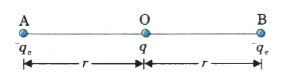 Here `q_(e)=` Magnitude of charge on an ELECTRON The potential energy of the system is zero. `therefore U=(1)/(4pi epsilon_(0))[((-q_(e))q)/(r )+(q(-q_(e)))/(r )+((-q_(e))(-q_(e)))/(2R)]=0` `rArr -q q_(e)-q q_(e)+(q_(e)^(2))/(2)=0` `rArr -2q q_(e)= -(q_(e)^(2))/(2)` `rArr 4q=q_(e )` `rArr q=q_(e)//4` |
|
| 13. |
A MODEMis used |
|
Answer» to superimpose a data signal on a carrier WAVE |
|
| 14. |
Identical spring of steel and copper are equally stretched. On which more work will have to be done ? |
| Answer» Solution :We know that the young's MODULUS of steel is greater than of COPPER. So in order to produce same EXTENSION, a large force will have to be applied on the steel spring than copper string. This shows that more WORK will B edone on spring of steel. | |
| 15. |
A point object is placed at the centre of a glass sphere of radius 6 cm and mu = 1.5. The distance of virtual image from the surface of sphere is : |
|
Answer» 2 CM |
|
| 16. |
An electric field is uniform and in the positive x direction for positive x and uniform with the same magnitude but in the negative x direction for negative x. It is given that E=200 hat(i) N//C for x gt 0 and E=-200 hat(i) N//C for x lt 0. A right circular cylinder of length 20 cm and radius 5 cm has its centre at the origin and its axis along the x-axis so that one face is at x=+10 cm and the other is at x=-10 cm What is the net outward flux through each flat face? |
|
Answer» SOLUTION :(a) we cansee from thethat on the leftfaceE and `triangle S`are parallel therefore the outward fluxis (b) for any pointon the SIDE of the cylinder E is perpwendicular to `triangle S` and hence E `triangleS=0`thereforethe fluxout of the side OFTHE cylinder is zero (c ) net outward flux throughthe cylinder `Phi =1.57 +1.57 +0=3.14 N m^(2) c^(-1)`  (d) the netcharge within the cylinder can be foundby using gauss.slaw which gives `q=epsilon_(0) Phi` `=2.78 xx10^(-11) c` |
|
| 17. |
A wire loop PQRSP is constructed by joining two semi circular coils of radii r_1and r_2 respectively as shown in the fig. current is flowing in the loop. The magnetic induction at point 'O' will be |
|
Answer» `(mu_0i)/(4)[ (1)/(r_1) - (1)/(r_2)]` |
|
| 18. |
Consider one of fission reactions of ^(235)U by thermal neutrons ._(92)^(235)U +n rarr ._(38)^(94)Sr +._(54)^(140)Xe+2n . The fission fragments are however unstable and they undergo successive beta-decay until ._(38)^(94)Sr becomes ._(40)^(94)Zr and ._(54)^(140)Xe becomes ._(58)^(140)Ce. The energy released in this process is Given: m(.^(235)U) =235.439u,m(n)=1.00866 u, m(.^(94)Zr)=93.9064 u, m(.^(140)Ce) =139.9055 u,1u=931 MeV] . |
|
Answer» `156 MEV` `._(92)^(235)U + n rarr ._(40)^(94)Zr +._(58)^(140)Ce + 2n+6e^(-1)` `Q =[m(.^(235)U) - m(.^(94)Zr) - m(.^(140)Ce) -m(n)]c^(2)` `=208 MeV`. |
|
| 19. |
In the circuit shown, L=1 muH, C=1 muF and R=1kOmega. They are connected in series with an source V=V_(0) sin omegat as shown. Which of the following options is/are correct ? |
|
Answer» The frequency at which the current will be in phase with the VOLTAGE is INDEPENDENT of R |
|
| 20. |
Two cells of emf epsi_1 and epsi_2having internal resistances r_1 and r_2respectively are connected inparallel as shown in Fig. Deduce the expressions for the equivalent emf and equivalent internal resistance of a cell which can replace the combination between the points B_1 and B_2 . |
|
Answer» Solution :Consider a parallel combination of two cells. Let `epsi_1` and `epsi_2`be theemfs of two cells and `r_1` and `r_2 ` their respective internal resistances. `I_1` and `I_2`are the currents leaving the positive ELECTRODES of two cells and at junction `B_1`, these currents are added up so that net current `I = I_1 + I_2`.....(i) Let `V(B_1)` and `V(B_2)`be the potentials at `B_1` and `B_2` , RESPECTIVELY, then considering first cell, we have ` V = V(B_1) = V(B_2) = epsi_1 - I_1 r_1 rArr I_1 = (epsi_1 - V)/(r_1)`...(ii) and considering second cell, we have ` V = V(B_1) - V(B_2) = epsi_2 - I_2 r_2 rArr I_2 = (epsi_2 - V)/(r_2)` ` therefore I = I_1+ I_2 = (epsi_1 - V)/(r_1) + (epsi_2- V)/(r_2) = ( epsi_1/r_1 + epsi_2/r_2) - V ((1)/(r_1) - (1)/(r_2))` `rArr V = [ ( espi_1/r_1+ espi_2/r_2) - I ] // ( (1)/(r_1) + (1)/(r_2) ) = ((epsi_1 r_2 + epsi_2 r_1)/(r_1 + r_2))- I ( (r_1 r_2)/(r_1 + r_2))`...(iv) If instead of two cells we join a single cell having equivalent emf `epsi_(eq)`and equivalent internal resistance `r_(eq)` , then we have `V = epsi_(eq) - Ir_(eq)`....(v) Thus, comparing (iv) and (v), we get `epsi_(eq) = (( epsi_1 r_2 + epsi_2 r_1)/(r_1 + r_2)) ` and ` r_(eq) = (r_1 r_2)/(r_1 + r_2)` Alternately , we have can WRITE `(1)/(r_(eq)) = (1)/(r_1) + (1)/(r_2) ` and `( epsi_(eq))/(r_(eq)) = epsi_1/r_1 + epsi_2/r_2` |
|
| 21. |
In the circuit shown the ideal ammeter A reads a current of I_1 , A . Now the source of e.m.f . and the ammeter are physically interchanged , i.e. . the source is out between B and C and the ammeter between A and B . The ammeter now reads a current of I_2 A. Then - |
|
Answer» `I_1 GT I_2` |
|
| 22. |
What is the reason for reddish appearance of sky during sunset and sunrise? |
| Answer» SOLUTION :During sunriseor sunset , the sun is near the horizon . Sunlighthas to travel a graterdistance . So shorterwaves of BLUE region are scatteredaway by the atmosphere . Red WAVES of longer WAVELENGTH are leastscatteredand reach the observer . So the sun appearsred. | |
| 23. |
A monochromatice light beam of wavelength 5896 A^(0) is used in double slit experiment to get interference pattern on a screen 9th bright fringe is seen at a particular position on the screen. At the same point on the screen, if 11th bright fringe is to be seen, teh wavelength of the light that is needed is (nearly) |
|
Answer» `7014 A^(0)` |
|
| 24. |
A cricket ball of mass 0.2 kg moving with a velocity of 20 m/s is brought to rest by the player in 0.1 sec. Find the impulse of the force on the ball and average force applied by the player |
|
Answer» 40 N |
|
| 25. |
What is static characteristic of p-n junction and write its types. |
|
Answer» SOLUTION :The relation of CURRENT and voltage injunction diode (or the change of the voltage current with the change ofvoltage given the JUNCTION) is called static characteristeics of junction diode which are of the following two types. (i) Forward CHARACTERISTICS (II) Reverse characteristics |
|
| 26. |
What made the grandmother unhappy about the author's new English School? |
|
Answer» the FACT that she could no longer HELP him with the lessons |
|
| 27. |
A carbon resister of 47 K Omega is to be marked with rings of different colours for it's identification. Write the sequence of colours. |
| Answer» SOLUTION :Here R = 47 KW = `47xx10^-3Omega`. COLOURS sequence is YELLOW, VOILET, orange. | |
| 28. |
Light shows _____,____ and _____- |
| Answer» SOLUTION :INTERFERENCE, DIFFRACTION and POLARIZATION. | |
| 29. |
Pick the odd one out Figure shows results of an experiment involving photoelectric effect. |
|
Answer» Beam B has the highest frequency |
|
| 30. |
A stone of mass 0.05 kg is thrown vertically upwards. What is the direction and magnitude of net force on the stone during its upward motion? |
|
Answer» 9.8 N VERTICALLY DOWNWARDS |
|
| 31. |
A charged conductor of area ds is placed in electric field of strength E. The force acting on unit area of the conductor is |
|
Answer» `(in_(0)kE^(2))/2` |
|
| 32. |
Magnification of microscope of objective of focal length 5 mm is 400. If its tube length is 20 cm, then focal length of eye-piece is ...... |
|
Answer» SOLUTION :`m=(LD)/(f_0f_e)` `thereforef_e=(LD)/(mf_0)`[`because` D=near point=25 cm] `=(20xx25)/(400xx0.5)=2.5` cm |
|
| 33. |
Kinetic energy of emitted electron depends upon |
|
Answer» frequency |
|
| 34. |
The kinetic energy of a particle, executing S.H.M., is 16 J when it is in its mean position. If the amplitude of oscillation is 25 cm, and the mass of the particle is 5.12 kg, the time period of its oscillations is : |
|
Answer» `pi//5` s `(1)/(2)m omega^(2)=(16)/(A^(2))=(160000)/(25xx25)` `(1)/(2)xx5.12omega^(2)=256` `omega^(2)=(512)/(5.12)=100` `omega=10" or "(2pi)/(T)=10` `T=(pi)/(5)` s. CORRECT choice is (a). |
|
| 35. |
Find the distance between adjacent interference bands if the distance from the source to biprism is 1 m and from biprism to screen is 4 m.The angle of refraction of biprism is 2 xx 10^(-3) rad. How many interference bands can be observed on the screen ? (Given mu = 1.5 & lambda = 6000 Å) |
|
Answer» 5 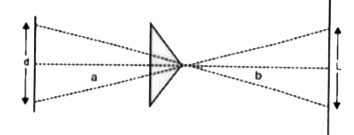 `D = 4 + 1 = 5 m` `beta = (lambda.D)/(d) = 15 xx 10^(-4)` m If N = number of fringes Then `N = (L)/(beta)`, where L is width of interference PATTERN From fig. `(L)/(d) = (b)/(a)` `therefore L = (b)/(a) xx d = 4/1 xx 2 xx 10^(-3) = 8 xx 10^(-3)` `N = (8 xx 10^(-3))/(15 xx 10^(-4)) = 5.3 APPROX 5`. |
|
| 36. |
The electric current is a |
|
Answer» SCALAR quantity |
|
| 37. |
A point P al a certain distance from charge Q has electric potential 600 V and elecuic field intensity 150 N/C, lhen distance of point from charge Q is ...... M. |
|
Answer» 4 `:. D=(V)/(E)= (600)/(150) =4 m` |
|
| 38. |
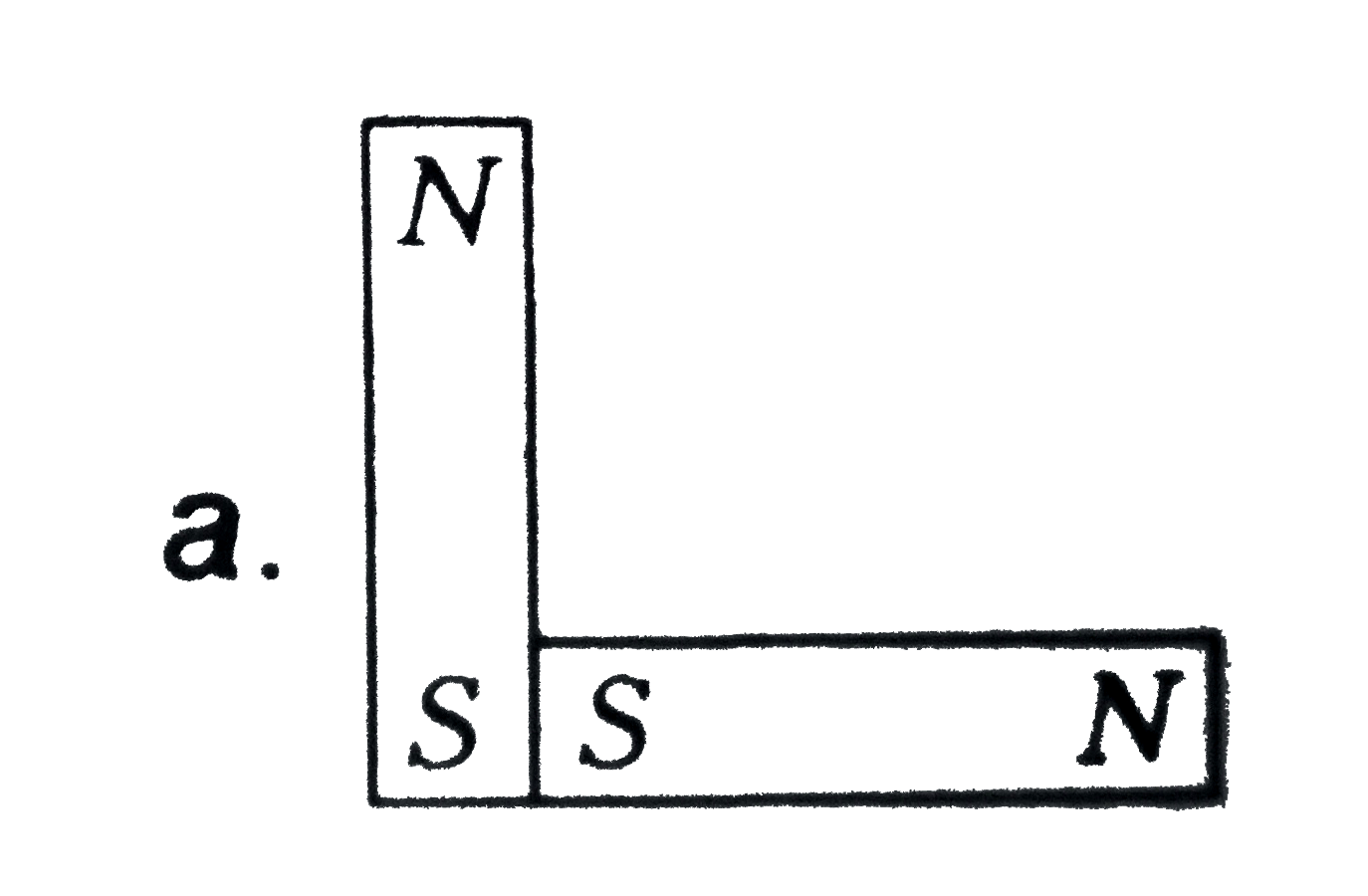
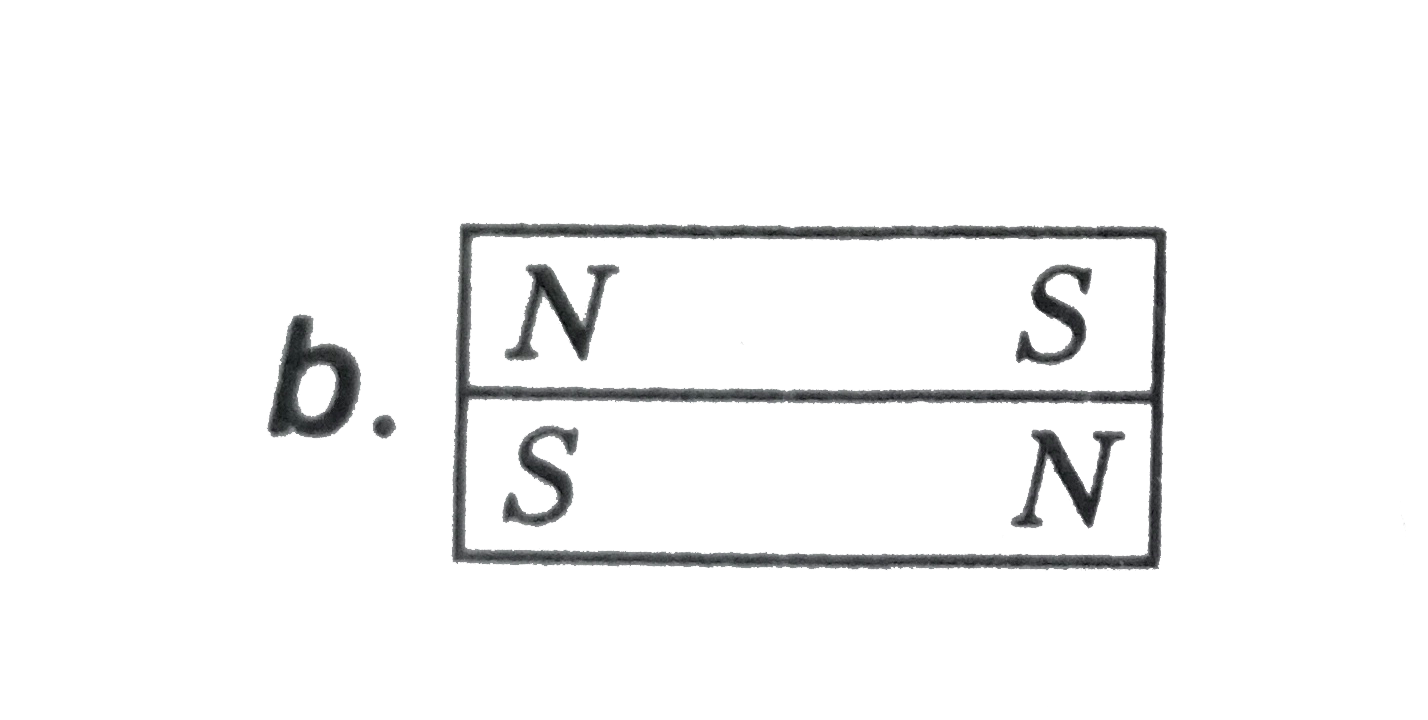
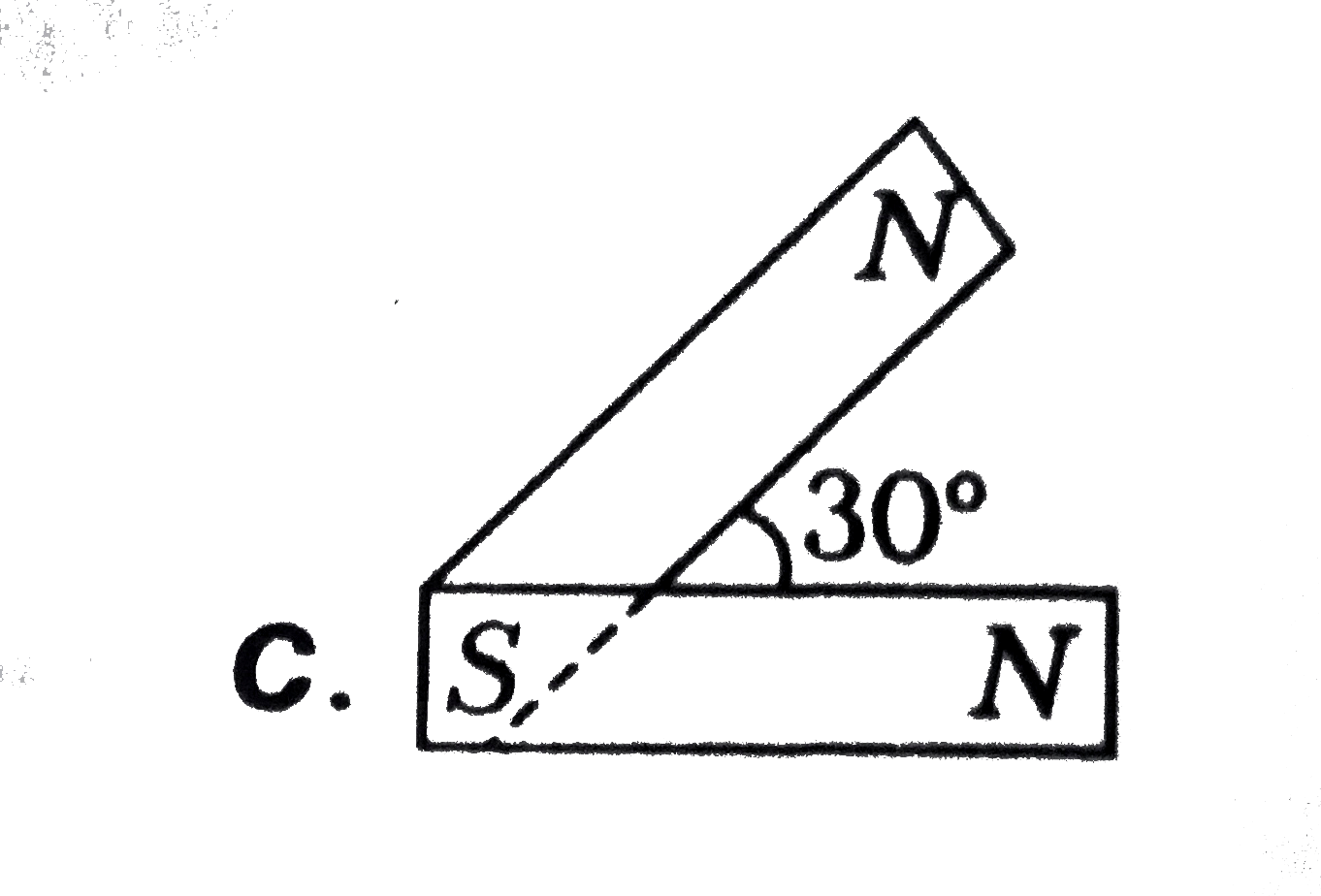
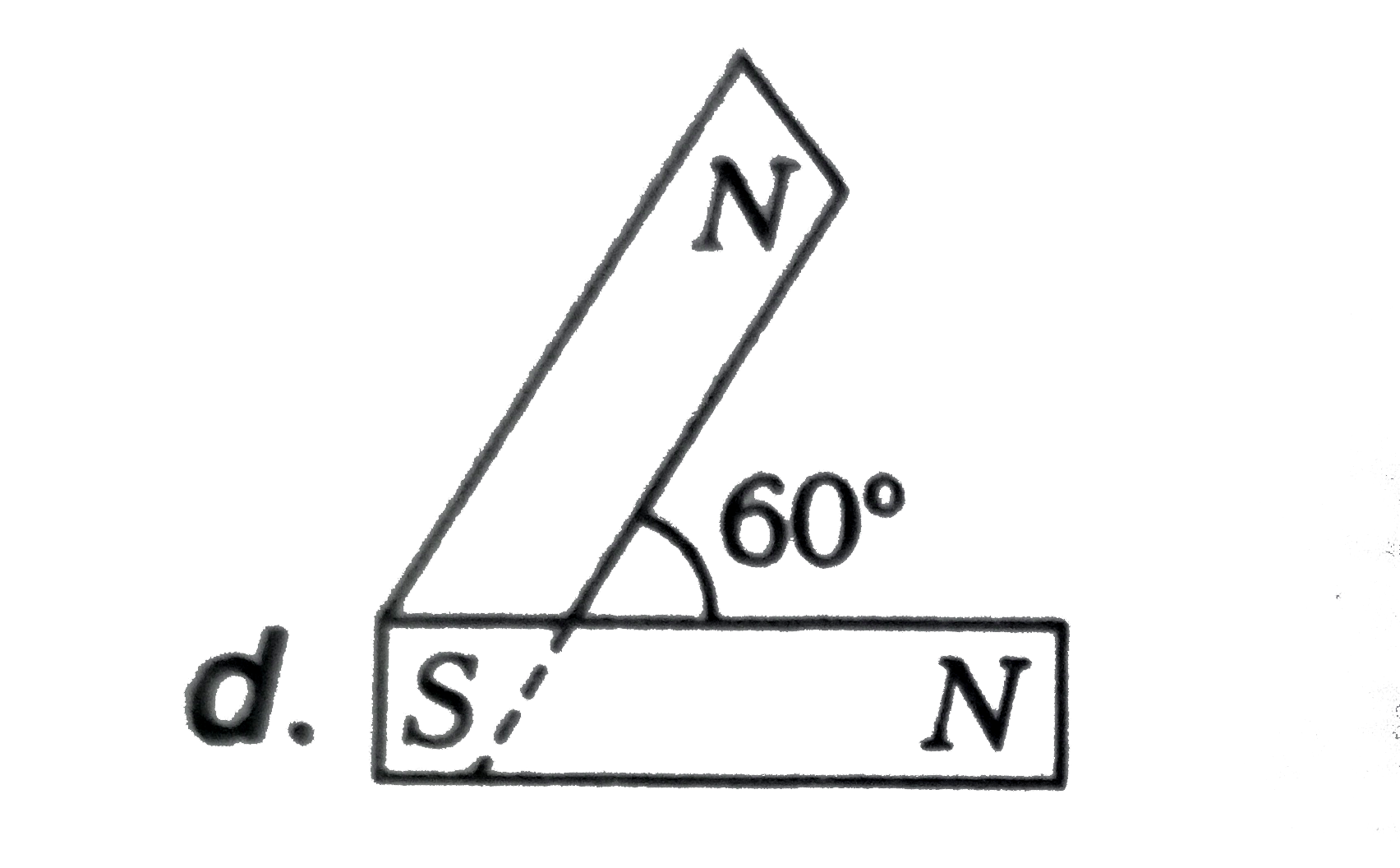
Following figures show the arrangement of bar magnets in different configuration . Each magnet has magnetic dipole moment m. Which configuration has highest net magnetic dipole moment ? |
|
Answer»
b. `underset(m)overset(m)(IFF) implies M_(2)=0` c. `M_(3)=msqrt((1+cos 30^(@))2)` `=msqrt((1+(sqrt(3))/(2))2)=msqrt(2+sqrt(3))` d. `M_(4)= 2m cos 30^(@)=msqrt(3)` |
|
| 39. |
A horizontal overhead power line carries a current of 90 A in east to west direction. What is the magnitude and direction of the magnetic field due to the current 1.5 m below the line ? |
|
Answer» SOLUTION :`I = 90 A, R = 1.5 m` `B= (mu_0I)/(2 pi r) = (4 pi xx 10^(-7) xx 90)/(2 pi xx 1.5) = 1.2 xx 10^(-5)` (south ) |
|
| 40. |
The electric field inside a parallel plate capacitor is E. What would be the work done in moving a charge q along the closed rectangular path ABCDA ? |
| Answer» SOLUTION :WORK done is zero because ELECTRIC field is a CONSERVATIVE field and work done for describing a CLOSED path in the conservative field is always zero. | |
| 41. |
Sensitivity of a potentiometer can be increased by |
|
Answer» increasing the emf of the cell |
|
| 42. |
The momentum of a particle is vec P = 2 cos t hati + 2 sin t hat j. What is the angle between the force vec F acting on the particle and the momentum vec p ? |
| Answer» ANSWER :D | |
| 43. |
If the velocity of a particle is v=At+Bt^(2) Where A and B constatnts ,then the distance travelled by it between 1s and 2s Is. |
|
Answer» `(3)/(2)A+4B` |
|
| 44. |
What is retentivity? |
|
Answer» The MAGNITUDE of B when H is maximum. |
|
| 45. |
When a glass rod is rubbed with a silk cloth, changes appear on both. A similar phenomenon is observed with many other pairs of bodies. Explain how this observation is consistent with the law of conservation of charger. |
| Answer» SOLUTION :Charge is not created or DESTROYED. It is MERELY transferred from one BODY to another. | |
| 46. |
Two blocks of masses 2kg and 5kg are at rest on ground. The masses are connected by a string passing over a frictionless pulley which is under the influence of a constant upward force F = 50 N. Find the accelerations of 5 kg and 2kg masses. |
|
Answer» Solution :The masses will be lifted if the tension in the STRING is greater than the gravitational pull on masses. Weight of 5kg mass `=5xx10=50N` and that of 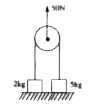 2kg mass `=2xx10=20N`. From free body diagram `50 - 2T = 0` or T = 25 N (`because` pulley is massless) Tension in each string = 25 N. 2kg weight will be lifted.But 5kg weight can not be lifted ACCELERATION of 2kg weight : `rArr 25-20=2a` or `a=(5)/(2)=2.5 ms^(-2)` as the 5kg mass does not lifted, so its acceleration is zero. |
|
| 47. |
A voltmeter having a resistance of 998 ohms is connected to a cell of e.m.f. 2 volt and internal resistance 2 ohm. The error in the measurment of e.m.f. will be |
|
Answer» `4xx10^(-1)V` |
|
| 48. |
A thermocouple has its junctions at 0^(@)C and 100^(@)C. It produces 0.022mV/K. Find the balancing length on a potentiometer wire of 10m length and resistance 10Omega connected in series with a resistance box consisting of a resistance of 1990Omega. Given emf of cell in the primary circuit as 2 volt |
|
Answer» 110cm |
|
| 49. |
Explain the different types of spectral series· in hydrogen atom. |
|
Answer» Solution :The atomic hydrogen emits a line SPECTRUM consisting of five series. 1) LYMAN series : `v=Rc((1)/(1^(2))-(1)/(N^(2)))" wehre "n=2,3,4,….` 2) Balmer series : `v=Rc ((1)/(2^(2))-(1)/(n^(2)))" where "n=3,4,5,….` 3) Paschen series : `v=Rc ((1)/(3^(2))-(1)/(n^(2)))" where "n=4,5,6,...` 4) BRACKETT series : `v=Rc ((1)/(4^(2))-(1)/(n^(2)))" where "n=5,6,7,....` 5) Pfund series : `v=Rc((1)/(5^(2))-(1)/(n^(2)))" where "n=6,7,8,....` |
|
| 50. |
Five identical plates each of area a are joined as shown in the figure. The distance between the plates is d. the plates are connected to a potential difference of V volt. The charge on plates 1 and 4 will be |
|
Answer» `-(epsi_(0)AV)/(d).(2epsi_(0)AV)/(d)` |
|