Saved Bookmarks
This section includes 7 InterviewSolutions, each offering curated multiple-choice questions to sharpen your Current Affairs knowledge and support exam preparation. Choose a topic below to get started.
| 1. |
The neutron separation energy is defined as the energy required to remove a neutron from the nucleus. Obtain the neutron separation energies of the nuclei " "_(20)^(41)Ca and " "_(13)^(27)Al from the following data: m(" "_(20)^(40)Ca) = 39.962591 u, m(" "_(20)^(41)Ca) = 40.962278 u, m(" "_(13)^(26)Al) = 25.986895 u, m(" "_(13)^(27)Al) = 26.981541 u. |
|
Answer» Solution :Neutron separation energy `S_(n)` of a NUCLEUS `" "_(A)^(Z)X` is given by `S_(n) = [ m_(N)(" "_(A-1)^(Z)X) + m_(n) - m_(N) (" "_(A)^(Z)X)].c^(2)` Hence, in terms of atomic masses, the neutron separation energy of `" "_(20)^(41)Ca` is given by `S_(n)(" "_(20)^(41)Ca) = [m(" "_(20)^(40)Ca) + m_(n)-m(" "_(20)^(41)Ca)] xx 931.5 MEV = [39.962591 + 1.008665 - 40.962278] xx 931.5 MeV = 8.36 MeV` and neutron separation energy of `" "_(13)^(27)Al` is given by `S_(n)(" "_(13)^(27)Al) = [m(" "_(13)^(26)Al) + m_(n) -m(" "_(13)^(27)Al)] xx 931.5 MeV= [25.986895 + 1.008665 - 26.981541] xx 931.5 MeV = 13.06 MeV`. |
|
| 2. |
The phase difference between two waves reaching a point 15(pi)/(2). What is the resultant amplitude. If the individual amplitude are 3 mm and 4mm ? |
|
Answer» 1mm |
|
| 3. |
Identify each of the following as either D- or L- glyceraldehyde. |
|
Answer» `(i)-L,""(II)-D,""(III)-D` 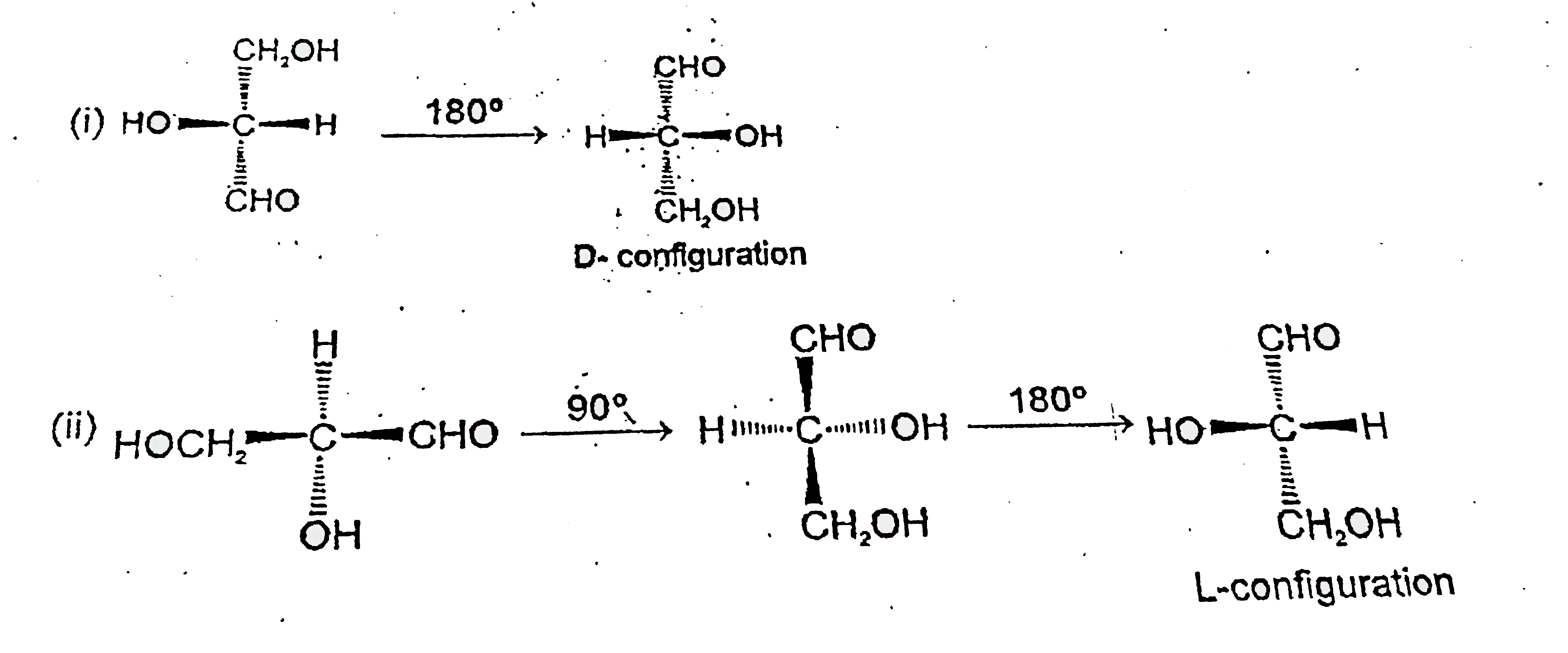
|
|
| 4. |
A vessel contains oil of density 0.8 g /cm^(3) over mercury of density 13.6 g/cm^(3). A homogeneous sphere floats with half of its volume in oil and other half immersed in mercury. The density of the material of the sphere in g /cm^(3) is : |
|
Answer» 3.3 Then Vpg=`(V/2)13.6g+V/2xx0.8xxg` or `p=(13.6+0.8)/2=7.2g//cm^(3)` CORRECT CHOICE is (c). |
|
| 5. |
A test charge q is made to move in the electric field of a point charge +Q along a closed path as shown in figure. What is the work done ? |
| Answer» Solution :SINCE electric field is a conservative field, hence WORK DONE for a CLOSED path is zero. | |
| 6. |
To establish an instantaneous current of 2 A through a 1 mu F capacitor, the potential difference across the capacitor plates should be changed at the rate of |
|
Answer» `2 XX 10^4 V//s` |
|
| 7. |
Two containers A and B are partly filled with water and closed. The volume of A is twice that of B and it contains half the amount of water in B. If both are at the same temperature, the water vapour in the containers will have pressure in the ratio of |
| Answer» ANSWER :B | |
| 8. |
The potential at point A in the circuit is - (N point is grounded. Grounding menas that potential of that point is zero.) |
|
Answer» 10 V 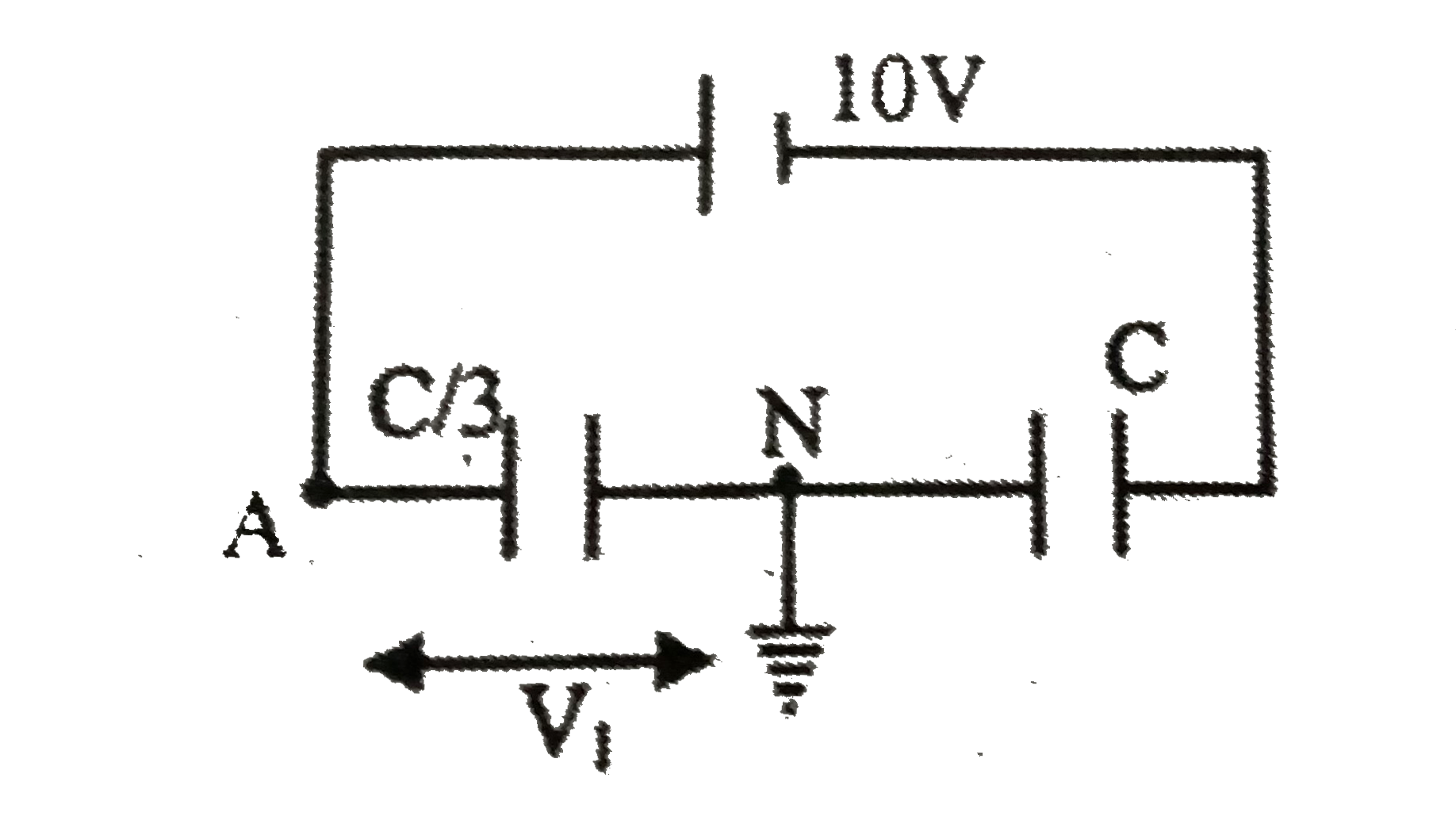 `V_(A)-V_(N)=(10xxC)/(C+(C )/(3))=(30C)/(4C)=7.5` `V_(A)-0=7.5` `V_(A)=7.5V` |
|
| 9. |
Intensity of light incident on a photo sensitive surface is doubled. Then |
|
Answer» the number of EMITTED electrons is trippled |
|
| 10. |
Molecular Formula = (Empirical Formula )n ,where n= |
|
Answer» MOLECULAR MASS X EMPIRICAL Mass |
|
| 11. |
(a) Explain, giving reasons, the basic difference in converting galvanometer into (i) a voltmeter and (ii) an ammeter. (b) Two long straight parallel conductors carrying steady currents I_(1) and I_(2) are separated by a distance 'd'. Explain briefly, with the help of a suitable diagram, how the magnetic field due to one conductor acts on the other. Hence deduce the expression for the force acting between the two conductors. Mention the nature of this force. |
|
Answer» Solution :(a) (i) In converting a GALVANOMETER into a voltmeter, a very high suitable resistance is CONNECTED is series to its coil. So, the galvanometer gives full scale deflection. (i) In converting a galvanometer into an ammeter, a very SMALL suitable resistance is connceted in PARALLEL to its coil. The remaining pair of the current i.e. (I-Ig) flows through the resistance. Here I= Circuit current Ig = Current through galvanometer. |
|
| 12. |
The study of emission line spectra of a material serve as a fingerprint for identification of the gas. Name different series of lines observed in hydro gen spectrum. |
| Answer» SOLUTION :Lyman SERIES, BALMER series, PASCHEN series, Bracket series, Pfund series. | |
| 13. |
The distance between a convex lens and a plane mirror is 10 cm. The parallel rays incident on the convex lens after reflection from the mirror form image at the optical centre of the lens. Focal length of lens will be |
|
Answer» 10cm |
|
| 14. |
कहाँ पर स्थित होने से वस्तु का प्रतिबिंब अवतल दर्पण के फोकस पर बनता है? |
|
Answer» फोकस पर |
|
| 15. |
In the above question, the value of maximum velocity of the particle will be : |
|
Answer» 100 m/sec |
|
| 16. |
Which of the following radiations alpha,beta and gamma are : travel with greatest speed ? |
| Answer» SOLUTION :`GAMMA`-RAYS. | |
| 17. |
A solid uniform sphere resting on a rough horizontal plane is given a horizontal impulse directed through its centre so that it starts sliding with an initial velocity v_(0). When it finally starts rolling without slipping the speed of its centre is |
|
Answer» `2/7v_(0)`  Let M and R be mass and RADIUS of the solid SPHERE respectively. Applying law of conservation of angular momentum about the point of contact, we get `Mv_(0)R=MvR+2/5MR^(2)omega(because` For solid sphere, `I=2/5MR^(2))` `=MvR+2/5MR^(2)(v/R)=7/5MvR(becausev=Romega)` `v_(0)=7/5v` or `v=5/7v_(0)` |
|
| 18. |
Explain lateral shift for the refraction from rectangular glass slab. |
|
Answer» Solution :For a rectangular slab, refraction takes place at two interfaces (air-glass and glass-air). It is easily seen from figure that `r_2 = i_1`. i.e., the emergent ray is PARALLEL to the incident ray there is no deviation but it does SUFFER LATERAL displacement/shift with respect to the incident ray. Here, emergent ray is parallel to incident ray hence`i_1=r_2`. Thus, there is no deviation of incident ray but it experiences the lateral shift as compared to incident ray. For more information : If lateral shift is x, then `x=txxi_2(1-n_1/n_2)` where t = THICKNESS of slab `n_1` = REFRACTIVE index of rarer medium (air) `n_2` = refractive index of denser medium (glass) `i_1` = incidence angle |
|
| 19. |
The thermal resistances of two slabs are 3 and 2 units. When connected in series, the equivalent thermal resistance will be |
|
Answer» 5/6 units |
|
| 20. |
A copper wire ab of length l, resistance r and mass m start sliding at t=0 down a smooth, vertical, thick pair of connected conducting rails as shown in figure. A uniform magnetic field B exists in the space in a direction perpendicular to the plane of the rails which options are correct . |
|
Answer» The magnitude and direction of the induced current in the wire when SPEED of the wire v is `(vBl)/( r)`, a to b |
|
| 21. |
Just outside a sharp point on a conductor we will have a larger __________ than just outside gradually curving places on the conductor . |
|
Answer» ELECTRIC Field Electric field |
|
| 22. |
A point lies on a line making an angle of 30^(@) with the axis (SN direction) of a magnetic dipole. If the |
|
Answer» |
|
| 23. |
Two ladders are hanging from ands of a light rope passing over a light and smooth pulley. A monkey of mass 2m hangs near the bottom of one ladder whose mass is M-2m. Another monkey of mass m hangs near the bottom of the other ladder whose mass is M-m. The monkey of mass 2m moves up a distance l with respect to the ladder. The monkey of mass m moves up a distance l/2 with respect to the ladder. The displacement of centre of mass of the system is (kml)/(4M). Find the value of k. |
|
Answer» |
|
| 24. |
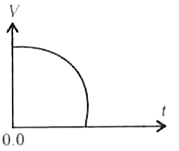
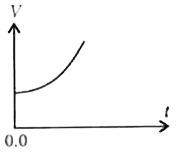
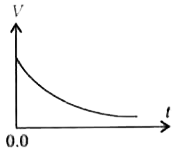
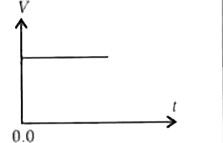
The insulated plates of a charged parallel plate capacitor (with small separation between the plates) are approaching each other due to electrostatic attraction . Assuming no otherforce to be operative and no radiation taking place , which of the following graphs approximately shows the variation with time (t) of the potential difference (V) between the plates ? |
|
Answer»
Also , electric field remains constant between the plates. So , `VpropdandV=E*d` FORCE on each plate `=ma=(q^(2))/(2Aepsilon_(0))` `therefore` Acceleration , `a=(q^(2))/(2Aepsilon_(0)m)` SINCE a = constant `therefore` d-t graph will be so V - t curve (`becauseVpropd)` 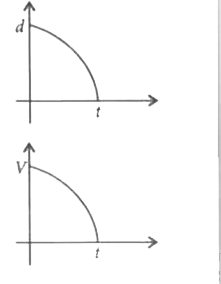
|
|
| 25. |
For what kinetic energy of a neutron, will the associated de-Broglie wavelength be 1.32xx10^(-10)m ? Given that mass of a neutron=1.675xx10^(-27)kg. |
|
Answer» SOLUTION :It is GIVEN that `lamda=1.32xx10^(-10)m and m_(n)=1.675xx10^(-27)kg` `because lamda=(h)/(sqrt(2m_(n)K)) implies K=(h^(2))/(2m_(n)lamda^(2))`. `THEREFORE`Kinetic ENERGY of neutron `K=((6.63xx10^(-34))^(2))/(2xx(1.675xx10^(-27))xx(1.32xx10^(-10))^(2))=7.53xx10^(-21)`. |
|
| 26. |
Four particlesof equalmass are movingrounda circleof radiusr dueto theirmutualgravitationalattraction . Findthe angularvelocityof each particle. |
|
Answer» |
|
| 27. |
How is displacement current produced between the plates of a parallel plate capacitor during charging ? |
| Answer» Solution :During charging process of a parallel plate capacitor ELECTRIC field and HENCE electric FLUX in the REGION between the plates is increasing. As a result, a displacement current `[I_(d)=epsi_(0) (dphi_(E))/(dt)]` is produced. | |
| 28. |
For an object moving with uniform acceleration ,travelling 50 m in 5th sec ,70m in 7th sec. a) Its initial velocity is 5 m/s b)Its acceleration is 20 m//s^(2) c) Its travels 100 m in 9th sec d)Its average velocity during 9th sec is 90 m/s |
| Answer» Answer :B | |
| 29. |
In a diffraction pattern due to a single slit of width a, the first minimum is observed at an angle 30^(@) when light of wavelength 5000 Å is incident on the slit. The first secondary maximum is observed at an angle of ... |
|
Answer» `sin^(-1)((2)/(3))` `a sin THETA= lambda "" [ n=1]` `:. a sin 30^(@) = lambda` `:. a xx(1)/(2)= lambda` For first MAXIMUM, `a sin theta_(1)=(2n+)(lambda)/(2)` `:. a sin theta_(1)=(3lambda)/(2)` `:. sin theta_(1)=(3lambda)/(2)` `:. sin theta_(1)=(3)/(4)` `:. theta_(1)=sin^(-1)((3)/(4))` |
|
| 30. |
When a transparent medium of refractive index 1.5 and thickness of 2.5 xx 10^(-5) m is introduced in front of a slit in Young's experiment, how much shift of interference fringes will occur ? (d=0.4 mm and D=100 cm) |
|
Answer» SOLUTION :Let displacement of interference fringe is `Deltax` Now `(Deltaxd)/(D)=t(mu-1)` path difference) `:. Deltax=(t(mu-1)D)/(d)` `:. Deltax=(2.5xx10^(-5)(1.5-1.0)xx1)/(5xx10^(-4))` `=2.5xx10^(-2)m-2.5` cm |
|
| 31. |
Three plane mirrors are placed such that the angle between the first and second or second and third is the same 'theta'. A light striking the first mirror, after reflection at the three mirrors emerges opposite to the initial direction. The value of 'theta’ can be |
| Answer» ANSWER :C | |
| 32. |
Explain principle, construction and working of optical fibre. |
|
Answer» Solution :Optical fibres too make use of the phenomenon of total internal reflection. Optical fibres are fabricated with high quality composite glass/quartz fibres. Each fibre consists of a core and cladding. The refractive index of the material of the core is higher than that of the cladding. Function: When a signal in the form of light is directed at one end of the fibre at a suitable angle, it undergoes repeated total internal reflections along the length of the fibre and finally comes out at the other end.  Since light undergoes total internal reflection at each stage, there is no appreciable loss in the intensity of the light signal. Optical fibres are fabricated such that light reflected at one side of inner surface STRIKES the other at an angle larger than the critical angle. Even if the fibre is bent, light can easily travel along its length. Thus, an optical fibre can be USED to act as an optical pipe. A bundle of optical fibres can be put to several uses. The device which converts one form of energy in ANOTHER form is called tranducer. Optical fibres are extensively used for transmittin and receiving electrical signals which are converted to light by suitable tranducers. Obviously, optical fibres can also be used fo transmission of optical signals. For example these are used as a .light pipe. to facilitate visua examination of internal organs like esophagus stomach and intestines. Decorative lamp with fine plastic fibres with their free ends forming a fountain like structure. The other end of the fibres is fixed over an electric lamp. When the lamp is switched on, the light travels from the bottom of each fibre and appears at the tip of its free end as a dot of light. The fibres is such decorative lamps are optical fibres. The main requirement in fabricating optical fibres is that there should be very LITTLE absorption of light as it travels for long DISTANCES inside them. This has been achieved by purification and special preparation of materials such as quartz. In silica glass fibres it is possible to transmit more than 95 % of the light over a fibre length of 1 km. |
|
| 33. |
A pendulum made of a uniform wire of cross sectional area A has time period T. When an additional mass M is added to its bob, the time period changes to T_(M) If the Young's modulus of the material of the wire is Y then 1/Y is equal to (g = gravitational acceleration) |
|
Answer» `[((T_(M))/T)^(2)-1](MG)/A` `T_(M)=2pisqrt((l+Deltal)/g)` ..(2) `Y=(Fl)/(ADeltal)rArrDeltal=(Mgl)/(AY)` ..(3) `rArr1/Y=A/(Mg)[((T_(M))/T)^(2)-1]` So correct choice is (d.). |
|
| 34. |
What is n-type semiconductor ? |
| Answer» SOLUTION :A PURE SEMICONDUCTOR doped with DONOR IMPURITY | |
| 35. |
The wavelength of infrared rays is |
|
Answer» GREATER than that of VISIBLE light |
|
| 36. |
In previous problem, if the minimum angular deflection that can be recorded is 0.2^(@), then calculate the minimum current that can be measured by the galvanometer. |
|
Answer» |
|
| 37. |
The terminology of different parts of the electromagnetic spectrum is given in the text. Use the formula E= h upsilon (for energy of a quantum of radiation : photon) and obtain the photon energy in units of eV for different parts of the electromagnetic spectrum. In what way are the different scales of photon energies that you obtain related to the sources of electromagnetic radiation ? |
|
Answer» Solution :Given :FREQUENCY of `gamma `- rays = 3` xx 10^(20)` Hz FROMULA : Energy of gamma rays, E = H`gamma` = `6.63 xx 10^(-34) xx 3 xx 1020` E = `19.8 xx 10^(-14) `J `therefore [ "leV" = 1.6 xx 10-19J , 1 " T" = (1)/(1.6 xx 10^(-19)) eV ] ` Solution: E = `(19.8 xx 10^(-14))/(1.6 xx 10^(-19))` E= `1.24 xx 10^(6)` eV |
|
| 38. |
Consider the circuit shown in figure . With switch S_(1) closed and the other two switches open, the circuit has a time constant 0.05 sec. With switch S_(2) closed and the other two switches open, the circuit has a time constant 2 sec. With switch S_(3) closed and the other two switches open, the circuit oscillates with a period T. Find T ( in sec ) . ( Take pi ^(2)=10) |
|
Answer» `impliesT=2pi sqrt(LC)=2pisqrt((1)/(10))=2sec` |
|
| 39. |
The value of relative permeability of a diamagnetic material is, |
|
Answer» `mu_r GT 1` |
|
| 40. |
The distance between two magnetic pole is double and the pole strength of each is halved. How will the force between them change ? |
|
Answer» Halved |
|
| 41. |
Electric charge q is uniformly distributed over a rod of length 1. The rod is placed parallel to a long wire carrying a current i. The separation between the rod and the wire is a. Find the force needed to move the rod along its length with a uniform velocity v. |
| Answer» SOLUTION :`(mu_0 iqv)/(2 PIA)` | |
| 42. |
What it point P in figure happens to be located to the left of the nagative charge ? Would the answer to part (A) be the same ? |
| Answer» SOLUTION :The MAGNITUDE will be the same . It will BECOME NEGATIVE . | |
| 43. |
(a) Are the equations of nuclear reactions balanced in the sense a chemical reaction? (b) If both the number of protons and the number of neutrons are conserved in each nuclear reaction, in what way is mass converted into energy (or vice-versa) in a nuclear reaction? |
|
Answer» SOLUTION :(a) : A chemical EQUATION is balanced in the sense that the number of ATOMS of each element is the same on both sides of the equation. In nuclear reactions the number of protons and the number of neutrons are the same on the two sides of the equation. (b) : The TOTAL binding energy of NUCLEI on the left side need not be the same as that on the right hand side. The difference in these binding energies appears as energy re leased or absorbed in a nuclear reaction. |
|
| 44. |
Obtain the relative between object distance and image distance in terms of refractive index of medium and radius of curvature for spherically curved surface. |
Answer» Solution :Figure shows the geometry of formation of image I of an object O on the principal axis of a spherical surface with centre of CURVATURE C and RADIUS of curvature R. The rays are INCIDENT from a medium of refractive index n, to another of refractive index `n_2`. NM will be taken to be NEARLY equal to the length of the perpendicular from the point N on the principal axis. We have for small angles, `tan angleNOM=(MN)/(OM) ~~ angle NOM=(MN)/(OM)` `tan angle NCM=(MN)/(MC) ~~ angle NCM =(MN)/(MC)` `tan angle NIM = (MN)/(MI) ~~ angle NIM =(MN)/(MI)` Now, for `triangle`NOC i is the exterior angle. THEREFORE, `i= angle NOM+ angle NCM` `therefore i =(MN)/(OM)+(MN)/(MC)` ... (1) `implies`Similarly, for `triangleNCI,angle NCM=angle NIM+angle INC` `therefore angle NCM=angle NIM+angle INC` `(MN)/(MC)=(MN)/(MI)+r` `therefore r =(MN)/(MC)-(MN)/(MI)` ... (2) Now,by Snell.s law, `n_1sin i=n_2 sin r` Substituting i and r from equation (1) and (2), For small angles sin i `~~` i and sin r `~~` r `therefore n_1i=n_2r` `therefore n_1((MN)/(OM)+(MN)/(MC)) = n_2((MN)/(MC)-(MN)/(MI))` `therefore(n_1)/(OM)+(n_1)/(MC)=(n_2)/(MC)-(n_2)/(MI)` [ `therefore` Dividing by MN] Now taking OM =-u, MC=+R and MI =+v `therefore (n_1)/(-u)+(n_1)/(+R)=(n_2)/(+R)-(n_2)/(+v)` `therefore (n_1)/(-u)+(n_2)/(+v)=(n_2-n_1)/(+R)` or `(n_2)/(v)-(n_1)/(u)=(n_2-n_1)/(R)` If is true for any curved spherical surface. |
|
| 45. |
Radio waves diffract around the building, while light waves eventhough electromagnetic do not. Why ? |
| Answer» Solution :RADIOWAVES have wavelength greater than `10^(-3)m` while that of LIGHT is of the order of `10^(-10)`m. HENCE the reason. | |
| 46. |
If abs(vec v_1+vec v_2)=abs(vec v_1- vec v_2) and vec v_2 is finite thus |
|
Answer» `vec v_1` is PARALLEL to `vec v_2` |
|
| 47. |
A slit 5.0 cm wideis irradiatednormally with microwaves1.0 sm. Then the angular spread of the central maximum on eitherside of the incident light is nearly |
|
Answer» `1/5` RADIAN |
|
| 48. |
If the critical angle for total internal reflection from a medium to vacuum is 30^(@), then velocity of light in the medium is |
|
Answer» `6 xx 10^(8) m//sec` |
|
| 49. |
A parallel beam of light of wavelength 500 nm falls on a narrow slit and the resulting diffraction pattern is obtained on a screen 1 m away. If the first minimum is formed at a distance of 2.5 mm from the centre of the screen, find the (i) width of the slit, and (ii) distance of first secondary maximum from the centre of the screen. |
|
Answer» Solution :Here wavelength of light waves `LAMBDA=500 nm=500xx10^(-9)m`, distance of screen from the slit D = 1m, distance of first minima from the centre of screen `x_(1)=2.5m m=2.5xx10^(-3)m`. (i) `because x_(1)=D theta_(1)= (D lambda)/(a)`, where a = slit width `RARR a=(Dlambda)/(x_(1))=(1xx500xx10^(-9))/(2.5xx10^(-3))=2xx10^(-4)m or 0.2`MM (ii) The distance of first secondary maxima from the centre of the screen `x._(1) =(3)/(2)(Dlambda)/(a)=(3)/(2) x_(1)=(3)/(2) XX 2.5xx10^(-3)=3.75xx10^(-3)m` or 3.75 mm |
|