Saved Bookmarks
This section includes 7 InterviewSolutions, each offering curated multiple-choice questions to sharpen your Current Affairs knowledge and support exam preparation. Choose a topic below to get started.
| 1. |
What is the meaning of "perish"? |
|
Answer» bloom |
|
| 2. |
A solid glass sphere with radius R and an index of refraction 1.5 is silvered over one hemisphere. A small object is located on the axis of the sphere at a distance 2R to the left of the vertex of the unsilvered hemisphere. Find the position of final image after all refractions and reflections have taken place. |
Answer» Solution :The ray of light FIRST gets refracted then reflected and then again rcfracted. For first REFRACTION and then reflection the ray of light travels from left to right while for the last refraction it travels from right to left. Hence, the SIGN convention will change accordingly.  First : refraction Using ` (mu_2)/(v ) (mu_1)/( u) = (mu_2-mu_1)/(R ) ` withpropersign convertions , we have`(1.5 )/(v ) -(1.0 )/( -2R) =(1.5-1.0 )/(+R)thereforev_1 = oo` Second : reflection Using ` (1)/(v ) +(1)/(u )=(1)/(f)=(2)/(R ) ` withpropersign conventions we have ` (1)/( v_2) +(1)/(oo) =- (2)/(R )` ` thereforeV_2=- R/2 ` Third: refraction Again using`(mu_2 )/(v ) -(mu_1)/(u )= (mu_2 - mu_1)/(R ) ` withreversedsignconvention, we have ` (1.0)/(v_3) - (1.5 )/( -1.5R) =(1.0 -1.5)/(-R)` ` or V_3 =- 2 R ` i.e., FINALIMAGE isformedonthe vertexof thesilveredface |
|
| 3. |
The radius of the smallest electron orbit in the hydrogen like atom is (0.51 xx 10^(-10))/(4)m, then it is : |
|
Answer» Hydrogen atom where `r_(0)=0.51 xx 10^(-10)m` Here, `r_(n) =(0.51 xx 10^(-10))/(4)m` In the GROUND state n=1 `(0.51 xx 10^(-10))/(4) =1^(2)/Z xx 0.51 xx 10^(-10)` Z=4 Hence, the atom is triply ionised Beryllium. |
|
| 4. |
For what value of k do the equations kx - 2y 3 and 3x + y = 5 represent two lines intersecting at a unique point? |
| Answer» Answer :D | |
| 5. |
The barrier potential in an ideal P-n junction diode is 0.3 volts. The current required is 6 mA. If a resistance of 200 Omegais connected in series with the junction diode, then the emf of the cell required for use in the circuit is |
|
Answer» 0.3 V |
|
| 6. |
A particle of mass 0.01 kg moving horizontally with velocity 20 m/s strikes a stationary wedge ABC of mass 0.05 kg with a velocity of 20 m/s near the apex of the wedge is free to move. Second collision of the particle with the wedge occurs at B. Find. (a) the length AB of the wedge(b) the normal reaction between the ground and the wedge during the first collision. [Given that angle theta = cot^(-1) (2)] |
|
Answer» |
|
| 7. |
Draw a plot of potential energy of a pair of nucleons as a function of their separations. Mark the regions where the nuclear force is (i) attractive and (ii) repulsive. Write any two characteristic features of nuclear forces. OR Draw a plot of potential energy of a pair of nucleons as a function of their separation. Write two important conclusions which you can draw regarding the nature of nuclear forces. |
Answer» SOLUTION :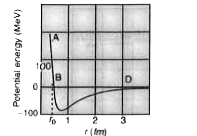 (i) For r `LT` OB, repulsive (ii) For r `gt` OB force is attractive OR NUCLEAR forces are 1. Very strong 2. CHARGE independent 3. Show saturation 4. Spin dependent |
|
| 8. |
Identify the wrong statement in the following. Coulomb's law correctly describes the electric force that |
|
Answer» BINDS the electrons of an atom to its nucleus |
|
| 9. |
Calculate the volume at 273K, 1 atm occupied by 14g Nirtogen gas |
|
Answer» 11.2 L |
|
| 10. |
What happen if a bar magnet is cut into two equal pieces along it's length : |
| Answer» Solution :In both the cases, one will get two magnets. If the magnet has a POLE strength, m, LENGTH 2l and magnetic moment m,then pole strength length and magnetic moment in CASE the CORRESPONDING value will be m/2, 2l, and M/2. | |
| 11. |
A variable capacitor is kept connected to a 10V battery. If the capacitance of the capacitor is changed from 7muF" to " 3muF , the work done is "x" xx 10^(-4)J What is the value of .x. ? |
|
Answer» |
|
| 12. |
The period of oscillation of a simple pendulum is T in a stationary lift. It thelift moves upward with acceleration of 8g the time period will : |
|
Answer» becomes T/2 When lift ASCENDS then apparent ACCELERATION is `g.=g+a=g+8g=9g` `:.""T.=2pi sqrt((l)/(g.))=2pi sqrt((l)/(9g))impliesT.=(T)/(3)` Correct CHOICE is (b). |
|
| 13. |
An astronomical telescope has an angular magnification of magnitude 5 for distant object. The seperation between the objective and the eyepiece is 36 cm. and the final image is formed at infinity. The focal length f_(0) of the objective and the focal length f_(e) of the eyepiece are |
|
Answer» `f_(0)=45cm, f_(e)=-9cm` |
|
| 14. |
The colour sequence in a carbon resistor is red, brown, orange and silver. The resistance of the resistor is |
|
Answer» `21 XX 10^5 OMEGA PM 10%` |
|
| 15. |
A parallel plate air capacitor is connected to a battery. The quantities charge, voltage, electric field and energy associated with this capacitor are given by Q_(0),V_(0),E_(0) and U_(0) respectively. A dielectric slab is now introduced to fill the space between the plates with the battery still in connection. The corresponding quantities now given by Q,V,E |
|
Answer» `QgtQ_(0)` `V=V_0,CgtC_0 ,Q=CV therefore QgtQ_0` `U=1/2CV^(2) therefore ugtU_0,E=v/d` but v and d both are unchanged . Therefore ,`E=E_0`, Therefore correct OPTION are (A) and (D). |
|
| 16. |
Two point like charges having magnitude =16 muCand -9muC are separated by a distance 10 cm in air. The resultant electric field will bt zero at distance......from -9muC charge. |
|
Answer» 30 cm `therefore q_(1)/(x+10)^(2) =q_(2)/x^(2)` `therefore q_(1)/q_(2) =((x+10)/x)^(2)` `therefore 16/9 =((x+10)/x)^(2)` `therefore 4/3 =(x+10)/x` `therefore 4x = 3x + 30, therefore x = 30 cm` |
|
| 17. |
Two crates are stacked on top of each other on a horizontal floor, crate #1 is on the bottom, and crate #2 is on the top. Both crates have the same mass. Compared with the strength of the force F_(1) necessary to push only crate #1 at a constant speed across the floor, the strength of the force F_(2) necessary to push the stack at the same constant speed across the floor is greater because |
|
Answer» the FORCE of the floor on crate #1 is greater because of the additional weight being SUPPLIED by crate #2 |
|
| 18. |
An accelerated charge produces |
|
Answer» a-rays |
|
| 19. |
Light of two different frequencies whose photons have energies 1 eV and 2.5 eV respectively illuminate a metallic surface whose work function is 0.5 eV successively. Find the ratio of maximum speeds of emitted electrons. |
|
Answer» SOLUTION :`K_(max) = (1)/(2) mv_(max)^(2) = h upsilon - W_(0)` `(v_(max)^(2) (1))/(v_(max)^(2) (2)) = ((1-0.5)eV)/((2.5 - 0.5) eV) = (0.5)/(2) = (1)/(4)` `(v_(max) (1))/(v_(max) (2)) = (1)/(2) = 1 : 2` |
|
| 20. |
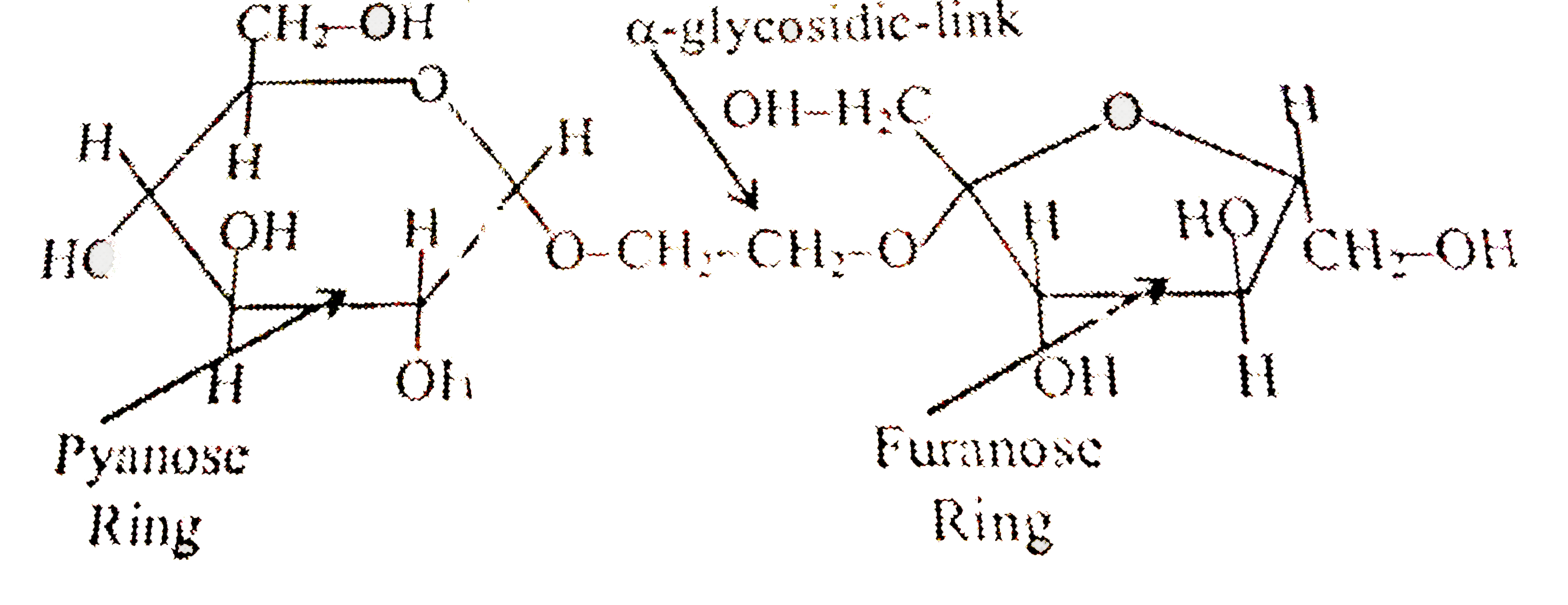
Thecorrectstatementaboutthe followingdisaccharide is : |
|
Answer»
|
|
| 21. |
The logic circuit shown below has the input waveforms 'A' and 'B' as shown. Pick out the current output waveform. |
|
Answer»
|
|
| 22. |
परागण होता है : |
|
Answer» आवृतबीजी तथा शैवाल में |
|
| 23. |
Describethe Davisson and Germerexperiment. What did this experimentconclusively prove ? |
|
Answer» Solution :Davisson and Germer experiment : (1) The experiment arrangement is schematically shown in fig. (2) ELECTRONS from a filament F are rendered into a fine beam by applying a positive potential to the cylinder A. (3) A fine narrow beam of electronsis incident on the nickel crystal. The ELCTRONS are scattered in all directions by the atoms of the crystal ., (4) The intensityof the electron beam scattered in a given direction , is measured by the electron detector (collector) . The detector can be moved on a circularscale and is connectedto a sensitive galvanometer , whichrecords the current . (5) The deflection of the galvanometer is PROPORTIONAL to the intensity of the electron beam entering collector. (6)The apparatus is enclosed in an evacuated chamber . (7) The experiment was performed by varying the accelerating voltage from 44 V to 68 V . It is found that the intensity is maximum at `50^(@)` for a critical energy of 54 V.  (8)For `theta = 50^(@)` , the GLANCING angle , `phi` ( angle between the scatteredbeam of electron withthe plane of atoms of the crystal ) for electron beam will be given by ` phi + theta + phi = 180^(@)` ` phi = 1/2 [ 180^(@)-50^(@)]= 65^(@)` (9)According to Bragg's law for first order diffraction maxima (n =1) , we have 2 d `sin phi = 1 xx lambda rArr lambda= 2 xx 0.91 xx sin 65^(@) = 1.65 Å= 0.165`nm(experimentally ). ` [ :' `for Nickel crystal interatomic separation d = 0.91`Å` ] Accordingto de - Broglie hypothesis , the wavelengthof the waveassociated with electron is given by ` lambda =(12.27Å)/(sqrt(V)) = (12.27)/(sqrt(54))=1.67 Å= 0.167`(Theoritically) (11) The experimentally measured wavelength was found to be in confirmity with proving the existence of de - Brogliewaves. 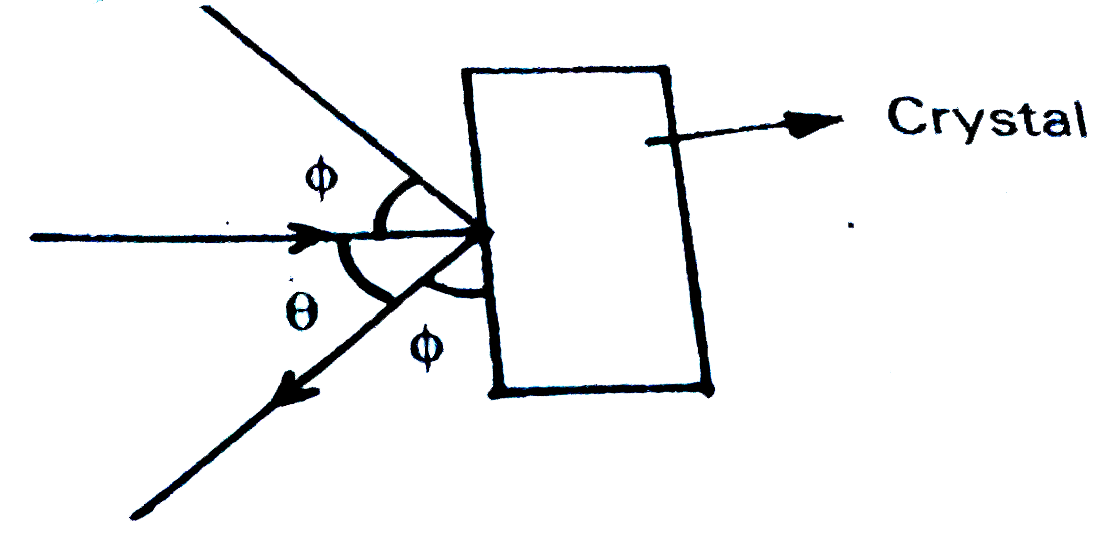
|
|
| 24. |
The insulated wiring in a house can safely carry a maximum current of 18 A. The electrical outlets in the house provide an alternating voltage of 120 V. A space heater when plugged into the ouilet opsates at an average power of 1500 W. How many space heaters can safely. be plugged into a single electrical outlet and turned on for an extended period of time? |
|
Answer» Zero |
|
| 25. |
In the reaction the products (A) and (B) are- |
|
Answer»

|
|
| 26. |
Consider an infinitely long wire carrying acurrent I(t), with (dI)/(dt)=lambda =constant. Find the dt current produced in the rectangular loop of wire ABCD if its resistance is R as in figure. |
|
Answer» Solution :Consider small area ELEMENT having thickness dr and length l on closed rectangular loop ABCD at distance l from very long current carrying wire as shown in FIGURE. Magnetic field at this STRIP, due to very long current carrying wire, `B=(mu_0I)/(2pir)` (Outside the plane) Magnetic flux linked with this strip, `d phi=Bda=Bldr` `d phi=(mu_0 I ldr)/(2pir)` Net flux linked with ABCD loop, `phi=int_(x_0)^x (mu_0Il)/(2pir)dr` `=(mu_0Il)/(2pi)[ln R]_(x_0)^x` `phi=(mu_0Il)/(2pi)ln (x/x_0)` Induced emf, `epsilon=(dphi)/(dt)=d/(dt)[(mu_0Il)/(2pi) ln (x/x_0)]` `=(mu_0l)/(2pi) ln (x/x_0)(dI)/(dt)` `epsilon=(mu_0l lambda)/(2pi) ln (x/x_0) (because (dI)/(dt)=lambda)` Induced current, `I=epsilon/R=(mu_0llambda)/(2piR)ln (x/x_0)` |
|
| 27. |
Kailash Satyarthi won Nobel Prize along with whom? |
|
Answer» MALALA Yousafzai |
|
| 28. |
The simple Bohr model cannot be directly applied to calculate the energy levels of ar atom with many electrons. This is because |
|
Answer» of the electrons not being subject to a central force |
|
| 29. |
A conducting loop in the form of a half circle of r=10cm is placed in a magnetic field as shown. The strength of the magnetic field is given by the relation B=5t^(2)+3t+5 where B is in Tesla and t- the time in seconds. The resistance of the loop is 3Omega. An ideal cell of e.m.f. E = 1.5V is connected to the loop. Calculate the induced e.m.f. and net current in the loop at t = 15 sec. |
|
Answer» Solution :`E=1.5V,t=15sec, R=3Omega,B=5t^(2)+3t+5` Flux, `phi_(B)=BA` By Faraday.s law, induced e.m.f. = `varepsilon=(dphi_(B))/(dt)=A(dB)/(dt)=(pir^(2))/(2)(10t+3)` `3.14xx(100xx10^(-4))/(2)[10xx15+3]=2.4V` The direction of induced e.m.f. and APPLIED e.m.f. are OPPOSITE. Hence the net CURRENT is, `I=(varepsilon-E)/(R)=(2.4-1.5)/(3)=(0.9)/(3)=0.3A` |
|
| 30. |
A block of mass 3 kg slides down an inclined plane of length 6 m and height 4 m. if the force of friction on the block is a constant 16 N as it slides from rest at the top of the incline, what is its speed at the bottom? |
|
Answer» 2m/s `K_(i)+U_(i)+W_("frict")=K_(F)+U_(f)` `0+mgh-F_(f)L=(1)/(2)mv^(2)+0` `v=sqrt((2)/(m)(mgh-F_(f)L))` `=sqrt((2)/(3)(3xx10xx4-16xx6))` `=sqrt(16)` `=4m//s` NOTE: `W_("total")=DeltaK` could also be used. |
|
| 31. |
Explain Doppler effect in sound. Derive the expression for the apparent frequency of sound when the source and listener are i) approaching each other. ii) moving away from each other. |
|
Answer» SOLUTION :The Doppler effect is the change in frequency or wavelength of a WAVE for an observer who is moving relative to the wave source. Let us take the direction from the observer to the source as the positive direction. Let the source and the observer be moving with velocities `v_(S) and v_(0)` respectively as shown in figure Suppose at time t=0, the observer is at `O_(1)` annd the source is at `S_(1),O_(1)` being to the left of `S_(1)`. the source emits a wave of velocity v, of frequency v and period `T_(0)` all measured by ann observer at rest with respect of the medium. Let L be the distance betweenn `O_(1) and S_(1)` at t=0, when the source emits the first crest. Now, since the observer is moving, the velocity of the wave relative to the observer is `v+v_(0)`. THEREFORE, the first crest reaches the observer at time `t_(1)=L//(v+v_(0))`. at time `t=T_(0)`, both the observer and the source have moved to their new position `O_(2) and S_(2) ` respectively the new distance between the observer and the source, `O_(2)S_(2)`, would be `L(V_(S)-V_(0))T_(0)]`. at `S_(2)`. the source emits a second crest. This reaches the observer at time. `t_(2)=T_(0)+[L+(v_(S)-v_(0))T_(0)]//(v+v_(0))` this reaches the observer at time `t_(n+1)=nT_(0)+[L+n(v_(S)-v_(0))T_(0)]//(v+v_(0))` Hence in a time interval `t_(n+1)-t_(n),` i.e., `piT_(0)+(L+n(v_(S)-v_(0))T_(0)]//(v+v_(0))-L//(v+v_(0))`. The observer COUNTS of the wave as equal to T given by `T=T_(0)(1+(v_(S)-v_(0))/((v+v_(0)))=T_(0)((v+v_(0))/(v+V_(0)))` The frequency v observed by the observer is given by `v=v_(0)((v+v_(0))/(v+v_(S)))` (i) When both observer and source are approaching each other, the source is moving in negative direction `therefore v=v_(0)((v+v_(0))/(v-v_(S)))` (ii) When both source and observer are moving away from each other, the observer is moving in negative direction |
|
| 32. |
Four metallic plates are placed as shown in the figure .Plate 2 is given a cgharge Q whereas all other plates are uncharged . Plates 1 and 4 are joined together . The area of each plate is same . . The charge appeartin on the right side of plate 3 is - |
|
Answer» zero `1` Since plate `3` is isolated so net charge on it will be zero .LET it si having charge`Q`, on each face. `2` Since plate `1` and `4` aer connected by a CONDUCTING wire so `V_1 = v_4` Do ` V_2 - K_2 d = V_2 - E_1 xx 2 d - E_1 d` ` E_2 = 3 D_1` ` Q_2 /( in_0 A) = (3 @_1) /( in_0 A) rArr Q_2 = 3 Q_1` ...(1) Since net charge on `2` is `Q` ` Q_1 +Q_2 =Q`...(2) From (1) and (2) ` Q_1 Q/4 , q_2 = (3Q)/4`. |
|
| 33. |
The given block diagram shows general form of a communication system. Identify the blocks X and Y. |
| Answer» SOLUTION :X- TRANSMITTER,Y-Receiver | |
| 34. |
A circular loop of radius R is placed in the uniform magnetic field. The value of magnetic field changes is given by equation B=B_0 e^(-t/tau) . Where B_0 and tau are constants. The emf induced in the coil is ____ |
|
Answer» `pi^2B_0 E^(-t/tau) xx 10^(-2)` V `THEREFORE epsilon=-(dphi)/(DT)` `=-d/(dt)[pir^2B_0 e^(-t/tau)]` `therefore epsilon=-piR^2B_0 d/(dt)(e^(-t/tau))` `=-piR^2B_0 (-1/tau.e^(-t/tau))` `therefore epsilon=(piR^2B_0)/tau e^(-t/tau)` |
|
| 35. |
Name the laws associated with the following equation.ointvecE.vecdt = -(d)/dt ointvecB.vecds |
| Answer» Solution :MODIFIED amper.s law,the TERM on the right HAND side is Maxwell.s displaceent current. | |
| 36. |
Explain how the cells are grouped in parallel. Obtain the condition for maximum current through an external resistor. |
|
Answer» Solution :Cells in parallel. The cells are said to be connected in parallel, if we can proceed from one point to another through different paths. Fig. shows the parallel combination of m cells. Here m cells, each of e.m.f. E and internal resistance R are connected to an external resistance R. In parallel combination, the total e.m.f. of the cells is equal to the e.m.f. of a single cell. `therefore ` Total e.m.f. of the cells=E Since internal resistances of all the cells are connected in parallel. `therefore ` Total internal resistance of the cells is GIVEN by `(1)/(r.)=(1)/(r)+(1)/(r)+ . . . .+m` TIMES or `(1.)/(r.)=(m)/(r)` `therefore r.=(r)/(m)` . So current flowing through the circuit `I=(E)/(R+(r)/(m))` Case 1. if `R GT gt (r)/(m)`, so `R+(r)/(m)=R` `therefore I=(E)/(R)=`current due to single cell. Case 2. if `R lt lt (r)/(m)`, so `R+(r)/(m)=(r)/(m)` `therefore I=(E)/((r)/(m))=(mE)/(r)` `=mxx`current due to single cell. 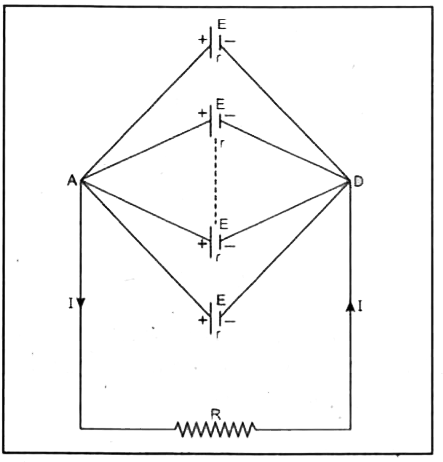 Thus in parallel combination of cells, to have maximum current, the total external resistance of the circuit should be negligible as compared to the total internal resistance of the cells. |
|
| 37. |
two large conducting thin plates are placed parallel to each other. They carry the charges as shown. The variation of magnitude of eclectric field in space due to this system is best given by |
|
Answer»
|
|
| 38. |
The transversal displacement Vs time graph for two waves A and B which travel along the same string are shown in the figure. Their average intensity ratio I_(A)//I_(B)is: |
|
Answer» `9/4` |
|
| 39. |
What kind of charges are produced on each, when a glass rod is rubbed with silk |
| Answer» SOLUTION :on GLASS ROD + ve CHARGE and on SILK - ve charge. | |
| 40. |
A body moves along a curved path of a quarter circle. Calculate the ratio of distance to displacement : |
|
Answer» `11:7` |
|
| 41. |
A metallic rod of length l is moved perpendicular to its length with velocity v in a magnetic field vecB acting perpendicular to the plane in which rod moves. Derive the expression for the induced emf. Or Starting from the expression for the Lorentz force acting on the free charge carriers of a conductor moving in a perpef Zicular magnetic field, obtain the expression for the motional emf induced. |
|
Answer» Solution :Let a conducting ROD PQ of length L is moved in a uniform magnetic field `vecB` with a velocity `vecv` such that `vecB` acts perpendicular to the plane of motion of rod PQ, consider any free charge in the conductor PQ. As the rod moves, the charge q ALSO moves with same velocity and experiences a Lorentz force of magnitude F = q uB and its direction is from Q to P. All free charges experiences the same force IRRESPECTIVE of their positions in the rod PQ. `therefore` Work done in MOVING the charge from Q to P is W = Fl = q v B l Since emf is the work done per unit charge, hence emf induced in the rod will be given by `|varepsilon| = W/q = (q vBl)/q = Blv` 
|
|
| 42. |
A neutron with kinetic energy T= 10MeV activates a nuclear reaction C^(12)(n,alpha)Be^(9) whose threshold is T_(th)= 6.17MeV. Find the kinetic energyof the alpha-particles outgoing at right angles to the incoming neutrons' direction. |
|
Answer» Solution :The momentum of incident neutron is `sqrt(2m_(N)T)hat(i)`, that of `ALPHA` particle is `sqrt(2m_(alpha)T_(alpha))hat(j)` and of `Be^(9)` is `-sqrt(2m_(alpha)T_(alpha))hat(j)+sqrt(2m_(n)T)hat(i)` By conservation of energy `T_(alpha)=[T(1-(m_(n))/(M))-|Q|](M)/(M+m_(alpha))`. Using `T_(th)=(1+(m_(n))/(M))|Q|` we GET `T_(alpha)=(M)/(M+m_(alpha))[(1-(m_(n))/(M))T-(T_(th))/(1+(m_(n))/(M)]]` `M'` is the mass of `C^(12)` nucleus. LTBRGT or `T_(alpha)=(1)/(M+m_(alpha))[(M-m_(n))T-(MM')/(M'+m_(n))T_(th)]=2.21MeV` 
|
|
| 43. |
Pure water can be supercooled down to -10^(@)C. If a small ice crystal is thrown into, it immediately freezes. What fraction of water will freeze? The system is adiabatically isolated. |
|
Answer» Solution :The HEAT of fusion LIBERATED in the process of freezing of water will be spent to heat the remaining water to `0^(@)C`. Let the total MASA of SUPERCOOLED water bem, the mass of ice formed my, the mass of remaining water `m_(2)=m-m_(1)` From the heat balance equation we have `m_(1)lambda=(m-m_(1))c Deltat,` whence `x=(m_(1))/(m)=(c Deltat)/(lambda+c Deltat)` |
|
| 44. |
A 225 kg crate rests on a surface that is inclined above the horizontal at an angle of 20.0^(@).A horizontal force (magnitude = 535 N and parallel to the ground, not the incline) is required to start the crate moving down the incline. What is the coefficient of static friction between the crate and the incline? |
|
Answer» `0.425` |
|
| 45. |
Kirchhoff's two laws for electrical circuits are magnifestations of the conservation of |
|
Answer» CHARGE only |
|
| 46. |
64 small drops of mercury, each of radius r and charge q coalesce to form a big drop the ratio of the surface density of charge of each small drop with that of the big drop is |
|
Answer» 1000 |
|
| 47. |
The internal resistance of two diodes usded in fulllwave rectifier is 20 omega(i) the maximumand mena load current(ii) rmsvalueof load current |
|
Answer» SOLUTION :`V_(max)= 50 V` (i) Maximumloadcurrent `(ii)I_(max)= (I_(C ))/( SQRT(2))= (0.07)/(1.414)` `=0.05A` |
|
| 48. |
Conductor of length l has shape of a semi cylinder of radius R(ltlt l). Cross section of the conductor is shown in the figure. Thickness of the conductor is (ltlt R) and conductivity of its material varies with angle theta according to the law sigma = sigma_(0)cos theta where sigma_(0) is a constant. If a battery of emf epsilon is connected across its end faces (across the semi-circular cross-sections), the magnetic induction at the mid point O of the axis of the semi-cylinder is : |
|
Answer» `(mu_(0)sigma_(0)epsilon t)/(8L)`  `dB=(mu_(0)di)/(2piR)=(mu_(0)xx(epsilon)/(1)(sigma_(0)cos theta)Rd theta XXT)/(2piR)` `B=int_(0)^(pi//2)2dBcostheta=(mu_(0)sigma_(0)epsilon t)/(4l)` |
|
| 49. |
In a parallel palte capacitor with air between the plates, each plate has an area of 6 xx 10^(-3) m^2 and the distacne between the plates is 3 mm. Calculatete capacitance of the capacitor. If this capacitor is connected to a 100 V supply, what is the eachplate of the capacitor ? |
|
Answer» SOLUTION :Here `A = 6 xx 10^(-3) m^2, d = 3 m m = 3 xx 10^(-3) m` and for air K = 1 `:.` Capacitance `C = (K epsi_0A)/d = (1 xx 8.85 xx 10^(-12) xx 6 xx 10^(-3))/(3 xx 10^(-3)) = 17.7xx 10^(-12) F = 17.7 PF= 18 pF` When V = 100 V, the charge on each plate of capacitor `Q = CV = 17.7 xx 10^(-12) xx 100 = 1.77 xx 10^(-9) C or 1.77 nC = 1.8 nC` |
|
| 50. |
The diode used in the circuit shown in figure has a constant voltage drop at 0.5 V at all currents and a maximum power rating of 100 mW. What should be the value of the resistance R, connected in series with diode for obtaining maximum current ? |
|
Answer» `1.5 Omega` `i=P/V=(100xx10^(-3))/(0.5)=0.2A` `:.` VOLTAGE DROP across RESISTANCE ` = 1.5 - 0.5 = 1 V ` `implies R= 1 / (0.2)=5Omega` |
|