

Saved Bookmarks
This section includes 7 InterviewSolutions, each offering curated multiple-choice questions to sharpen your Current Affairs knowledge and support exam preparation. Choose a topic below to get started.
| 1. |
In a sample of radioactive material , what fraction of the initial number of active nucleiwill remain undisintegrated after half of the half life of the sample ? |
|
Answer» `1/4` `N/N_0=(1/2)^(t//T_(1//2))` Here, `t=(T_(1//2))/2 , therefore N/N_0=(1/2)^(1//2) = 1/sqrt2` |
|
| 2. |
Show that the sum of electrostatic energy and magnetic energy in an LC oscillator equals (q_(0)^(2))/(2C). |
|
Answer» Solution :Total energy = `=U_(E)+U_(m)` `=(1)/(2)(q_(0)^(2))/(C)cos^(2)omegat+(1)/(2)Lq_(0)^(2)omega^(2)sin^(2)omegat` `=(1)/(2)(q_(0)^(2))/(C)cos^(2)omegat+(1)/(2)q_(0)^(2)L((1)/(SQRT(LC)))^(2)sin^(2)omegat` `=(1)/(2)(q_(0)^(2))/(C)cos^(2)omegat+(1)/(2)(q_(0)^(2))/(C)sin^(2)omegat` `=(1)/(2)(q_(0)^(2))/(C)[cos^(2)omegat+sin^(2)omegat]` `=(1)/(2)(q_(0)^(2))/(C)` `q_(0)` and C are time independent constants. Note : Maximum energy of a CAPACITOR = maximum energy of an inductor = `(1)/(2)(q_(0)^(2))/(C)=(1)/(2)Li_(m)^(2)` At any given INSTANT, the total energy, in an LC oscillator is the sum of energy in each of them. |
|
| 3. |
A body projected up reaches a point A in its path at the end of 4^(th) second and reaches the ground after 5 seconds from the starts .The height of A above the ground is (g=10 m//s^(2)) |
|
Answer» 19.6 m |
|
| 4. |
(a) Explain with the help of a labelled diagram, the principle and working of a transformer. Deduce the expression for its working principle. (b) Name any four causes of energy loss in an actual transformer. |
|
Answer» Solution :(a) Transformer is a device used to convert low alternating voltage at high current into high alternating voltage at low current and vice-versa. PRINCIPLE: It works on the principle of mutual INDUCTION i.e., if two coils are inductively coupled then on flow of an alternating current in one coil an alternating induced emf is also produced in the other coil. Construction : It consists of two coils, a primary coil P and a secondary coil S, wound on a laminated soft iron core. Alternating current input supply is connected to primary coil and output voltage is obtained across a load joined in secondary coil circuit. Transformer is of the following two types: (i) Step up transformer, in which number of turns in Scoil is more than in P coil so as to obtain a high alternating output voltage. The P coil consists of a few turns of insulated thick copper WIRE and Scoil has larger number of turns of insulated thin copper wire as shown in Fig. 7.47(a). (ii) Step down transformer, in which number of turns in Scoil is less than in P coil [Fig. 7.47(b)] and hence output voltage is less than the input voltage. Here thin wire is used for windings of P coil and thick wire in Scoil. Theory and Working: When an alternating emf/voltage source is applied across the P coil, the input current and, hence, magnetic flux through P coil keeps on changing with time. The changing magnetic flux gets linked up with S coil through the iron core, which in turn produces induced voltage across the secondary coil. If coupling of two coils is good then all flux lines across P coil link up with S coil too. If at any time, the flux linked per unit turn of primary be `phi_(p)` , then  Total magnetic flux of P coil, `phi_(p) = N_(p) -phi_(B)`[where `N_(p)` =Total number of turns in P coil] andinstantaneous value of induced emf in P coil `epsilon_(o) = -(dphi_(p))/(dt) = -N_(p) (dphi_(B))/(dt)` If total number of turns in Scoil be `N_(s)` , then magnetic flux of S coil, `phi_(s) = N_(s).phi_(B)` and instantaneous value of induced emf in Scoil, `epsilon_(s) = -(dphi_(s))/(dt) = -N_(s) (dphi_(B))/(dt)` For an ideal transformer`|epsilon_(p)|` = input voltage `V_(p)`and `epsilon_(s) = V_(s)` = output voltage obtained across secondary coil. Then, `(|epsilon_(s)|)/(|epsilon_(p)|) = V_(s)/V_(p) = N_(s)/N_(p)` Again for an ideal transformer input power = output power `therefore V_(p).I_(p) = V_(s).I_(s)` `RARR V_(s)/V_(p) = I_(p)/I_(s) = N_(s)/N_(p) =k` (the transfoerm or transformation or turn ratio) For a step up transformer `k gt 1` but for a setp down transformer `k lt 1`. From the above relation it is clear that in a transformer `V_(s) = kV_(p)` but `I_(s) = I_(p)/k`, it can be shown that ijnput and output alternative voltages are in mutually opposite phase. However, for a practically transformer. Efficiency, `eta = ("output power")/("input power") = (V_(s).I_(s))/(V_(p).I_(p))` (b) N/A |
|
| 5. |
In CE configuration transistor, the current gain |
|
Answer» Is ALWAYS LESS than 1 |
|
| 6. |
What a reading glass? |
| Answer» Solution :A SINGLE convex LENS, of SHORT focal length, is a simple MICROSCOPE called reading GLASS or magnifying glass | |
| 7. |
A spherically symmetric charge distribution is characterized by a charge density having the following variation : rho (r )=rho_0 for r lt Rrho (r )=0 for rgeR. Where r is the distance from the centre of the charge distribution and pois a constant. The electric field at an internal point (r |
|
Answer» `(rho_0)/(in_0) (r/3 -(r^2)/(4R))` |
|
| 8. |
A certain calorimeter has a water equivalent of 4.9 gm. That is in heat exchanges, the calorimeter behaves like 4.9 gm of water. It contains 40 gm of oil at 50.0^(@)C. When 100 gm of lead at 30.0^(@)C is added, the final temperature is 48.0^(@)C. What is the specific heat capacity of the oil? [Take S_("water")=1cal//gm.^(@)C, S_("lead")=0.305"cal"//gm.^(@)C] |
|
Answer» |
|
| 9. |
Two stable isotopes of lithium ._(3)^(6)Li and ._(3)^(7)Li have respective abundances of 7.5% and 92.5%. These isotopes have masses 6.01512 u and7.01600 u, respectively. Find the atomic mass of lithium. |
| Answer» SOLUTION :(a) 6.941 U (B) 19.9%, 80.1% | |
| 10. |
four nuclei of an element fuse together to form a heavier nucleus. If the process is accompanied by release of energy,which of the two -the parent or the daughter nucleus would have higher binding energy per nucleon? |
| Answer» Solution :As ligther nuclei are LESS STABLE than the intermediate nuclei, therefore, BE/nucleon of daugther nucleus will be higher than the BE/nucleon of PARENT nucleus. The difference in the MASSES of parent nucleus and daughter nuclei is the MASS defect, which is released in the form of energy. | |
| 11. |
If a coil of 40 turns and area 4.0 cm^2is suddenly removed from a magnetic field, it is observed that a charge of 2.0xx10^(-4) Cflows into the coil. If the resistance of the coil is 80 Omegathe magnetic flux density in Wb//m^2is |
|
Answer» 0.5 |
|
| 12. |
In Fig.an open tube of length L = 2.3 m and crosssectional area A = 9.2 cm^(2) is fixed to the top of a cylindrical barrel of diameter D = 1.2 m and height H = 2.3 m. The barrel and tube are filled with water to the top of the tube). Calculate the ratio of the hydrostatic force on the bottom of the barrel to the gravitational force on the water contained in the barrel. Why is that ratio not equal to 1.0? (You need not consider the atmospheric pressure.) |
| Answer» SOLUTION :(a) `2.04 xx 10^(-2) m^(3) , (B) 1.57 xx 10^(3) N` | |
| 13. |
The minimum velocity (in ms^(-1)) with which a car driver must traverse a flat curve of radius 150 m and coefficient of friction 0.6 to avoid skidding is : |
|
Answer» 60 |
|
| 14. |
The ratio of the largest to shortest wavelength in Balmer series of hydrogen spectra is : |
|
Answer» Solution :`1/lambda ALPHA [1/n_(F)^(2)-1/n_(i)^(2)]` `(lambda_("longest"))/(lambda_("shortest"))=((1/4-1/oo))/((1/4-1/9))=9/5` |
|
| 15. |
The wavelength and intensity of light emitted by a LED depend upon |
|
Answer» FORWARD bias and energy gap of the semiconductor. |
|
| 16. |
A loosely wound helix made of stiff metal wire is mounted vertically with the lower end just touching the mercury in a dish. When the current from a battery is started in the metal wire through the mercury. then the spring |
|
Answer» EXECUTES OSCILLATORY motion |
|
| 17. |
निम्नलिखित मे से कौन सी संख्या एक अपरिमेय संख्या है - |
|
Answer» `SQRT 25/49` |
|
| 18. |
(A): With increase in frequency of an A.C supply, the impedance of an L-C-R series circuit, decreases at first, becomes minimum and then increases. (R) : In L-C-R series circuit, impedance z=sqrt(R^(2)+(X_(L)~X_(C))^(2)) |
|
Answer» Both 'A' and 'R' are true and 'R' is the correct EXPLANATION of 'A'. |
|
| 19. |
If the radius of the first Bohr orbit of H atom is 0.53 A, the radius of third orbit will be: |
|
Answer» 47A |
|
| 20. |
1 A current passes through a long solenoid. Number of turns in the solenoid is 3000 per 0.6m. Find the flux density at a point on its axis. DATA: i = 1A, n=(3000)/(0.6)=5000 mu_@=4pixx10^(-7) (Wb)//A To find:B=? |
|
Answer» SOLUTION :MAGNETIC field B on the axis of the SOLENOID: `B=mu_@ni` `(4xxpixx10^(-7)xx5000xx2)/1= 2pixx10^(-3)T`. |
|
| 21. |
When a copper ball is heated, the largest percentage increase will occur on its |
|
Answer» Diameter |
|
| 22. |
Compare the efficiency of a colliding-beam accelerator with that of an accelerator in which the particles strike a target made up of identical stationary particles. |
|
Answer» `varphi=2varphi_c(2+evarphi_c//epsilon_0)` where `varphi`is the accelerating potential in a conventional accelerator, and pc is the accelerating potential in a colliding-beam accelerator. Clearly, for `evarphi_c ltlt epsilon_0` acolliding-beam accelerator is ineffective since the accelerating potential of a conventional accelerator is only four TIMES greater than in the CASE of a colliding-beam accelerator. But in the ultra-relativistic case, when `epsilonvarphi_0 gt gt epsilon_0` the colliding-beam accelerator is very effective. |
|
| 23. |
What is capacitor ? And explain capacitance. Give its SI unit. |
|
Answer» Solution :A capacitor is a system of two conductors separated by an insulator which is shown in figure. DefinitionArrangement in which two good conductors of arbitrary shape and VOLUME are arranged close to one another, but separated from each other is called capacitor." 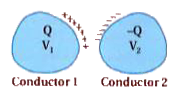 Suppose the conductors have charges `Q_(1)` and `Q_(2)` and potentials `V_(1)` and `V_(2)` . The potential difference is `V=V_(1)-V_(2)` . Single conductor can be used as a capacitor by assuming the other at infinity. The conductors may be charged by connecting them to the two terminals of a battery. Q is called the charge of the capacitor, though this infact is the charge (magnitude) on one of the conductors . The total charge of the capacitor is zero. The electric field `vecE` in the capacitor is from + Q charge to - Q charge it is proportional to the charge Q. `:. E prop Q` The potential difference V is the work done per unit positive charge in taking a small test charge from the conductor 2 to I against the field Hence, V is ALSO proportional to the charge Q. `:. V prop Q ` Hence ratio `(Q)/(V)` is constant . `:. C = (Q)/(V)` C is the capacitance of capacitor . Definition of Capacitance : The ratio of the amount of charge on the plate of parallel capacitor and the potential difference between two PLATES is known as capacitance of capacitor. Hence, capacitance is independent of Q or V. The capacitance of capacitor depends on the following. (1) Geometrical configuration, shape, size,separation of the system of two conductors. (2) Nature of dielectric separating the two conductors. (3) Presence of a capacitor near to other capacitor. The magnitude of capacitance of capacitor does not depend on the following. (1) Types of material of conductor. (2) Amount of electric charge on the conductor. SI unit of capacitance is `("Coulomb")/("Volt")` and in memory of the great scientist Michael Faraday it is known as Farad Its symbol is F. `:. 1 F = (1C)/(V)`and dimensional formula `[:M^(-1)L^(-2)T^(4)A^(2)]` Practically used smaller units : `1 mu F= 10^(-6)F` `mu mu F= 1 pF= 10^(-12)F` `n F= 10^(-9) F` A capacitor with fixed capacitance symbolically shown as while the one with variable capacitance known as 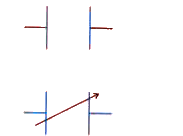
|
|
| 24. |
The time constant of a certain inductive coil was found to be 2.5ms. With a resistance of 80Omega added in series, a new time constant of 0.5ms was obtained. Find the inductance and resistance of the coil. |
|
Answer» |
|
| 25. |
A block B of mass M is suspended from a cord of length l attached to a cart A of mass M as shown in the figure. The horizontal surface on which the cart moves is smooth. Initially both the cart and the block are at rest in the position shown. Now Bis released. Take M=m=2kg, theta=45^(@) and g=10m//s^(2). The tension in the cord immediately after the systemis released from rest is |
|
Answer» 10 N |
|
| 26. |
A particle of mass 10 g is kept on the surface of uniform sphere of mass 100 kg and radius 10 cm. Find the work done against the gravitational force between them to take the particle far away from the sphere. |
|
Answer» `13.34xx10^(-10)J` `W=0-(-(GMM)/(R ))=(GMm)/(R )` `=(6.67xx10^(-11)xx100xx10^(-2))/(10^(-1))=6.67xx10^(-10)J` So the correct CHOICE is (d). |
|
| 27. |
A block B of mass M is suspended from a cord of length l attached to a cart A of mass M as shown in the figure. The horizontal surface on which the cart moves is smooth. Initially both the cart and the block are at rest in the position shown. Now Bis released. Take M=m=2kg, theta=45^(@) and g=10m//s^(2). The acceleration of the cart immediatelyafter the system is released from rest is |
|
Answer» `(1)/(SQRT(2))m//s^(2)` |
|
| 28. |
A cork suspended from the bottom of a container filled with water with a string as shown in figure. If the container accelerate in a horizontal direction towards right. Which one is correct ? |
|
Answer» Inclination of string with vertical is `TAN^(-1)(a//g)` towards left `rArr tantheta=(a)/(g)` `theta=tan^(-1)((a)/(g))` 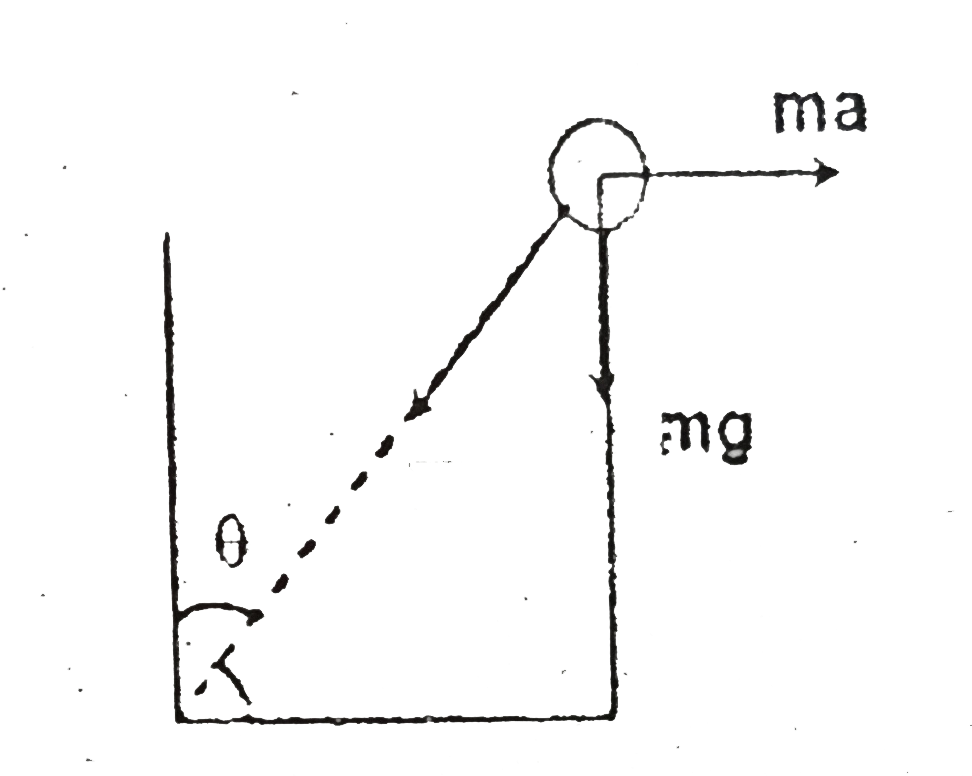
|
|
| 29. |
A block B of mass M is suspended from a cord of length l attached to a cart A of mass M as shown in the figure. The horizontal surface on which the cart moves is smooth. Initially both the cart and the block are at rest in the position shown. Now Bis released. Take M=m=2kg, theta=45^(@) and g=10m//s^(2). The magnitude of acceleration of B (with respect to cart) immediately after the system is released from rest is |
|
Answer» `(10)/(3) [2+SQRT(2)]` |
|
| 30. |
The saturation of photoelectric current depends on |
|
Answer» WORK function |
|
| 31. |
Of the following statements about a p-n-p transistor, which is correct? |
|
Answer» The SEMI CONDUCTOR material used to make the emitter may have been doped with arsenic |
|
| 32. |
Three point charges of +2muC, -3 mu Cand -3 muCare kept at the vertices A,B and C , respectively of an equilateral triangle of side 20 cm as shown in What should be the sign and magnitude of the charge to be placed at the mid-point (M) of side BC so that the charge at A remains in equilibrium?(##U_LIK_SP_PHY_XII_C01_E09_017_Q01.png" width="80%"> |
|
Answer» Solution :Charge q on point M should be such that force on A due to it should just nulify the resultant of forces ` oversetto (F_(AB)) and oversetto (F_(AC)) ` Now` ""F_(AB) =F_(AC) =(1)/(4 pi in _0).(q_1q_2)/(R^(2)) ` ` =(9xx 10^(9) xx 2 xx 10^(-6) xx 3xx 10^(-6))/((0.2)^(2)) =1.35N` Resultant of `oversetto (F_(AB)) and oversetto (F_(AC)) ` inclined at an angle of `60^(@) ` is ` oversetto F= 2 oversetto (F_(AB)) .cos "" (theta)/(2)=2xx 1.35 xx cos 30^(@) ` ` "" = 2xx1.35 xx (sqrt3)/(2)= 1.35 xx sqrt 3N `alongAM For equilibrium force ` oversetto (F_(AM)) ` should be equal and opposite to `oversetto F ` ` therefore "" F= |oversetto (F_(AM)) | =(9xx 10^(9) xx 2 xx 10^(-6) xx q)/((AM)^(2)) =(9XX10^(9) xx 2xx 10 ^(-6) xx q)/([(0.2)^(2) -(0.1) ^(2) ])` ` or "" 1.35 xx sqrt3 =(9xx 10^(9) xx2xx 10^(-6) xxq)/(0.03) ` ` rArr "" q= (1.35 xx sqrt3 xx 0.03)/(9xx10 ^(9) xx 2 xx 10 ^(-6)) =3.93 xx 10^(-6) Cor 3.93 muC ` ` (##U_LIK_SP_PHY_XII_C01_E09_017_S01.png" width="80%"> |
|
| 33. |
Angle of deviation on refraction is given by_____ |
| Answer» SOLUTION :`delta=i_i-r` | |
| 34. |
Bodies which allow the charge to pass through them are called ................ . |
|
Answer» |
|
| 35. |
A magnetic field of 5xx10^(-5) T is produced at a perpendicular distance of 0.2 m from a long straight wire carrying electric current. If the permeability of free space is 4 pi xx 10^(-7)T m//A, the current passing through the wire in A is |
| Answer» Answer :B | |
| 36. |
A small electric dipole having dipole moment vec p is placed along x-axis as shown in the figure . A semi-infinite uniformly charged di-electric thin rod is placed along x axis , with one end coinciding with origin . If linear charge density of rod is + lambda and distance of dipole from rod is a then calculate the electric force acting on dipole . |
|
Answer» `dE = (K lambdadx)/(x^2)` `E = int dE = K LAMBDA int _a^(infty) = (K lambda)/a = 1/(4 pi in_0) (lqambda)/a` ` (##NG_PHY_C01_E01_113_S01.png" width="80%"> POTENTIAL energy of dipole `U =- Pe COS theta` `U = - ( p lambda) /( 4 pi in_0 a)` `F= - (dU)/(da) rArr F= ( lambda )/(4pi in_0 a^2)`. |
|
| 37. |
One henry is equal to: |
|
Answer» `1("VOLT")/(amperexxsec)` |
|
| 38. |
A convex mirror has a focal length f. A real object is placed at a distance f in front of it from the pole produces an image at |
|
Answer» infinity |
|
| 39. |
A parallel stream of hydrogen atoms with velocity v==600 m//s falls normally on a diaphragm with a narrow slit behind which a screen is placed at a distance l= 1.0m. Using the uncertainty principle, evaluate the width of the slit delta at which the width of its image on the screen is minimum. |
|
Answer» Solution :Suppose the width of the slit (its extension along the `y`-axis) is `delta`. Then each electron has an UNCERTAINTY `Delta y~delta`. This translates to an uncertainty `DeltaP_(y)~ħ//delta`. We must therefore have `p_(y)underset(~)gtħ//delta`. For the image, brodering has two sources. We write `Delta(delta)=delta+Delta'(delta)` where `Delta'` is the width caused by the spreading of electrons due to their TRANSVERSE momentum. We have `Delta' = v_(y) (l)/(v_(x)) ~= P_(y)(l)/(p) = (lħ)/(m v delta)` Thus `Delta(delta)=delta+(l ħ)/(MV delta)` For large `delta, Delta(delta)~ delta` and quantum effect is UNIMPORTANT. For small `delta`, quantum effects are large. But `Delta (delta)` is minimum when `delta=sqrt((l ħ)/(mv))` as we see by completing the square. Substitution gives `delta= 1.025xx10^(-5)~~ 0.01mm` |
|
| 40. |
A uniform magnetic field B=B_(0)t (where B_(0) is a positive constant) fills a cylindrical volume of radius R then the potential difference in the conducting rod PQ due to electrostatic field is : |
|
Answer» `B_(0)lsqrt(R^(2)+l^(2))` |
|
| 41. |
An ideal monoatomic gas is enclosed in a fixed horizontal adiabatic cylinder of cross sectional area A. The cylinder is fitted with an adiabatic piston of mass m (attached to one end of a spring as shown) which can move horizontally without friction inside the cylinder. In equilibrium, the spring is in natural length and pressure and volume are P_0 and V_0 respectively. The piston is slightly displaced from equilibrium and released. Then, frequency of small oscillation is |
|
Answer» `1/(2PI)SQRT(k/m+5/3 (P_0A^2)/(mV_0))` |
|
| 42. |
A dog weighing 5 kg is standing on a flat boat so that he is 10 metre from the shore. He walks 4 metre on the boat toward shore and then halts. The boat weighs 20 kg and one can assume that there is no friction between it and the water. How far is the dog from the shore at the end of this time ? |
|
Answer» Solution :Given that initially the system is at REST so initial momentum of the system (Dog + BOAT) is zero. Now as in motion of dog no EXTERNAL force is applied to the system final momentum of the system zero. So, `mvecv_(1) + Mvecv_(2) =0` [as (m+M) = Finite] or `m(Deltavecr_(1))/(dt) + M(Deltavecr_(2))/(dt)=0` [as `vecv =(dvecr)/(dt)`] or `mDeltavecr_(1) + MDeltar_(2)=0` `md_(1) -Md_(2) =0` [as `vecd_(2)` is OPPOSITE to `vecd_(1)`] i.e. `md_(1) = Md_(2)`......(1) 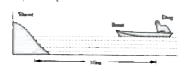 Now when dog moves 4 m towards shoie lelative to boat, the boat will shift a distance `d_2` relative to shore opposite to the displacement of dog so, the displacement of dog relative to shore (towards shore) will be: `d_(2) = 4-d_(1) (therefore d_(1) + d_(2) =d_("ret") =4)`...(2) substituting the value of `d_2` from Eqn. (2) in (1) `md_(1) =M(4-d_(1))` or `d_(1) =(M xx 4)/(m+M) = (20 xx 4)/(5+20) = 3.2 m` As initially the dog was 10 m from the shore , so now he will be 10 - 3.2 = 6.8 m away from the shore. |
|
| 43. |
fillin the black |
|
Answer» Solution :( i)VISIBLEREGION (ii )proton (iii )`n=oo` ` (iv )((4 PI epsi_0 T )/(Ze^2 ))B` |
|
| 44. |
Using A.C. voltmeter, the potential difference in the electrical line in a house is read to be 234 volts. If the line frequency is known to be 50 cycles per second, the equation for the line voltage is |
|
Answer» `V=165 sin (100 pi t)` As, `E=E_(rms)sin (2pi ft)` `therefore` Equation of line voltage is E = 331 sin 100 `pi t` volt |
|
| 45. |
An electron in a hydrogen atom makes a transition n_(l) rarr n_(2), where n_(1) and n_(2) are principal quantum numbers of the states. Assume the Bohr's model to be valid. The time period of the electron in the initial state is eight times to that of final state. What is ratio of n_(2)//n_(2) |
|
Answer» Solution :Since, T `prop N^(3)` `therefore (T_(1))/(T_(2)) = (n_(1)^(3))/(n_(2)^(3)) " As" T_(1) = 8T_(2), ((n_(1))/(n_(2)))^(3) = 8 " (or)" n_(2) = 2n_(2)`. Thus the POSSIBLE values of `n_(1) and n_(2)` are `n_(1) = 2, n_(2) = 1 , n_(1) = 4 , n_(2) = 2 , n_(1) = 6, n_(2) = 3 `, and so on ..... |
|
| 46. |
Which one of the following electromagnetic radiations have the smallest wavelength |
|
Answer» visible |
|
| 47. |
In Young's double slit experiment, the separatation of the slit is 2mm. The screen is at a distance 1m from the slit. How many bands can be seen in a space of 1cm? Given wavelength of light =400nm. |
|
Answer» |
|
| 48. |
What does the scale read if the cab is stationary or moving upward at a constant 0.50 m/s? |
|
Answer» Solution :For any constant velocity (zero or otherwise), the acceleration a of the passenger is zero. Calculation: Substituting this and other known VALUES into EQ. 5-38, we find `F_(N)=(72.2" kg")(9.8" m"//"s"^(2)+0)=708" N"`. This is the weight of the passenger and is equal to the magnitude `F_(g)` of the gravitational force on him. ( c ) What does the scale read if the cab accelerates upward at `3.20" m"//"s"^(2)` and downward at `3.20" m"//"s"^(2)` ? CALCULATIONS: For `a=3.20" m"//"s"^(2)," Eq. "5-38` gives `F_(N)=(72.2" kg")(9.8" m"//"s"^(2)+3.20" m"//"s"^(2))` `=477" N"`. For an upward acceleration (either the cab.s upward speed is increasing or its downward speed is decreasing), the scale reading is greater than the passenger.s weight. That reading is a measurement of an apparent weight, because it is made in a noninertial frame. For a downward acceleration (either decreasing upward speed or increasing downward speed), the scale reading is less than the passenger.s weight. (d) During the upward acceleration in in part (c), what is the magnitude `F_("NET")` of the net force on the passenger, and what is the magnitude `a_("p, cab")` of his acceleration as measured in the frame of the cab? Does `vec(F)_("net")=m vec(a)_("p, cab")` ? Calculation: The magnitude `F_(g)` of the gravitational force on the passenger does not depend on the motion of the passenger or the cab, so, from part (b), `F_(g)` is 708 N. From part (c), the magnitude `F_(N)` of the normal force on the passenger during the upward acceleration is the 939 N reading on the scale. Thus, the net force on the passenger is `F_("net")=F_(N)-F_(g)=939" N"-708" N"=231" N"` during the upward acceleration. However, hsi acceleration `a_("p. cab")` relative to the frame of the cab is zero. Thus, in the noninertial frame of the accelerating cab, `F_("net")` is not equal to `ma_("p, cab")`, and Newton.s second law does not hold. |
|
| 49. |
A square loop of length L is placed with its edges parallel to the XY-axies. The loop is carrying the current I. If the magnetic field in the region varies as B = B_(0) (1+(xy)/(L^(2)))hatk, then the magnitude of the force on the loop willl be |
|
Answer» `lB_(0)L` 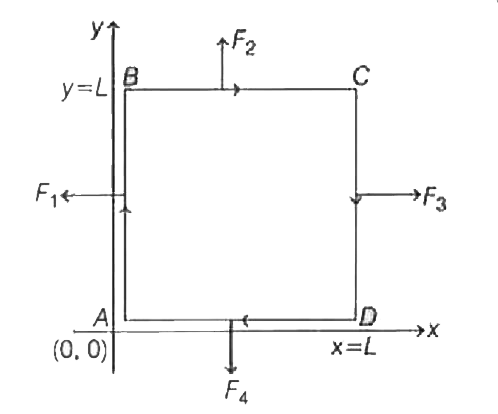 for WIRE AB, magnetic field `AB=B_(0) (1+0) =B_(0),` `therefore N =0` For wire CD, magnetic fiels `= B_(0) (1+ (y)/(L)),` `therefore x=L` For wire BC, magnetic field `=B_(0) (1+ (x)/(L)),` and for wire AD, magnetic field `=B_(0)` `therefore y=0` Now me calculate FORCES `F_(1), F_(2), F_(3) and F_(4),` `F_(1) = int _(0) ^(L) IB_(0) DY = IB_(0)L` `F_(2)=int _(0) ^(I) IB _(0) (1+ (x)/(L)) dx=3/2 IB_(0)L` `F_(3)- int _(0) ^(L) IB_(0) (1+ (y)/(L)) dx` `= 3/2 IB_(0) L` `F_(4) =int_(0) ^(L) IB_(0) dx = IB_(0)L` |
|
| 50. |
A planoconvex lens has a maximum thickness of 6 cm. When placed on a horizontal table with the curved surface in contact with the table surface, the apparent depth of the bottommost point of the lens is found to be 4 cm. It the lens is inverted such that the plane face of the lens is in contact with the surface of the table the apparent depth of the centre of the plane face is found to be ((17)/(4)) cm. The radius of curvature of the lens is : |
|
Answer» 68 CM `n = (6)/(4) = (3)/(2)` `(n_(1))/(u) - (n_(2))/(v) = (n_(1) ~ n _(2))/(R )` `(1.5)/(6) - (4)/(17) = (1.5 - 1)/(R )` R = 34 cm. |
|