

Saved Bookmarks
This section includes 7 InterviewSolutions, each offering curated multiple-choice questions to sharpen your Current Affairs knowledge and support exam preparation. Choose a topic below to get started.
| 1. |
Earth is moving towards a stationary star with a velocity 100 kms^(-1) . If the wavelength of light emitted by the star is 5000 A^0, then, the apparent change in wavelength observed by the observer on earth will be |
|
Answer» 0.67 `A^(0)` |
|
| 2. |
The radius of gyration of a rod rotating about an axis to its length and passing through one of its end is |
|
Answer» `SQRT(10/7)`L |
|
| 3. |
Electrons in a certain energy level n =n_(1), can emit 3 spectral lines. When they are in another energy level, n=n_2. They can emit 6 spectral lines. The orbital speed of the electrons in the two orbits are in the ratio |
|
Answer» `4:3` `3=(n_(1) (n_(1)-1))/(2)," in first case"`. Or `n_(1)^(2)-n_(1)=6 =0 or (n_(1)-3) (n_(1)+2)=0` Take positive root, `n_(1)=3` Again, `6=(n_(2)(n_(2)-1))/(2)`, in second case. Or `n_(2)^(2)-n_(2)-12=0 or (n_(2)-4) (n_(2)+3)=0` Take positive root, or `n_(2)=4` Now velocity of electron `v=(2PI KZ e^(2))/(nh)` `v_(1)/v_(2)=n_(2)/n_(1)=4/3` |
|
| 4. |
If proton and electron have same de-Broglie wavelength then…. |
|
Answer» both will have same kinetic energy Here `lambda` is same (GIVEN) `THEREFORE (h)/(m_(p)v_(p))=(h)/(m_(e)v_(e))` `therefore m_(p)v_(p)=m_(e)v_(e)` `(v_(p))/(v_(e))=(m_(e))/(m_(p))` `therefore (E_(p))/(E_(e))=((1)/(2)m_(p)vp^(2))/((1)/(2)m_(2)v_(e)^(2))` `=(m_(p))/(m_(e))xx((m_(e))/(m_(p)))^(2)=(m_(e))/(m_(p))` but `m_(e)ltm_(p)` thus `(m_(e))/(m_(p))lt1` `therefore (E_(P))/(E_(e))lt1 therefore E_(P)ltE_(e)` |
|
| 5. |
A point object is kept in front of a plane mirror. The plane mirror is doing SHM of amplitude 2 cm. The plane mirror moves along the x-axis and x-axis is normal to the mirror. The amplitude of the mirror is such that the object is always infront of the mirror. The amplitude of SHM of theimage is |
|
Answer» |
|
| 6. |
A train is moving in the north-south direction with a speed of 144 km/hrs. The vertical component of the earth's magnet is 8xx10^-5Wb/m^2. If the length of axle is 2m, the magnitude of e.m.f. generated will be: |
|
Answer» `6.4xx10^3V` |
|
| 7. |
A barmagnet of length 10 cm and having the polestrengthequal to 10^(-3) weber is keptin a magnetic fieldhaving magnetic iduction equal to 4pixx10^(-3)tesla it makes an anlge of 30^(@)with the direction of magnetic induciotnthe valueof hte torque acting on the magnetis |
|
Answer» `2pi xx10^(-7) nxxm` `=0.1 xx10^(-3)xx4pixx10^(-3)xxsin 30^(@) =10^(-7) xx4pi xx1/2` `=2pi xx10^(-7) Nxxm` |
|
| 8. |
In the circuit shown in figure . (a) find the current flowing through the 100Omega resistor connecting points U and S. |
Answer» Solution :Figure (b) shows simplified CIRCUIT . Thebattery is directly attached to resistor `90Omega` HENCE current in it is 2A, SEE figure (c ), The total resistance of SECOND branch is also `90Omega` , hence current divides equally .Nowcurrent through 45 `Omega` , resistor is 2Aand it is a combination of two EQUAL `90Omega` resistors.. Once again current divides equally . `90Omega` resistor is a series combination of `40Omega` and `50Omega` , hence current through them is equal , i.e .,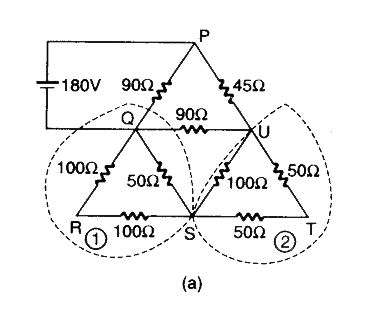 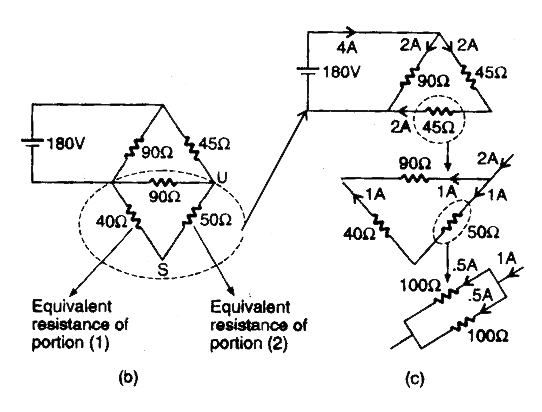 1 A . As `50Omega` resistor is a parallel combination of two equal `100Omega` resistors , they must have the same currenti.e., 0.5 A |
|
| 9. |
A bullet of mass 4.2 xx 10^(-2) kg, moving at a speed of 300 ms^(- 1), gets stuck into a block with a mass 9 times that of the bullet. If the block is free to move without any kind of friction, the heat generated in the process will be |
|
Answer» 45 cal By the law of conservation of momentum, `MV+Mxx0=(M+m)V` or `V=(mv)/(m+M)` …(i) LOSS of KINETIC energy= Heat generated in the process `thereforeDeltaK=1/2mv^(2)-1/2(M+m)V^(2)` [From eqn. (i) ] `=1/2mv^(2)-1/3(M+m)(m^(2)v^(2))/((M+m)^(2))` `=1/2mv^(2)-1/2(m^(2)v^(2))/((M+m))=1/2mv^(2)(1-m/(M+m))` `=1/2mv^(2)((M+m-m)/(M+m))` `=1/2mv^(2)(M/(m+m))=(mMv^(2))/(2(M+m))` ...(ii) `becausem=4.2xx10^(-2)kg,v=300ms^(-1)` `M=9m=9xx4.2xx10^(-2)kg` Substituting the values in eqn. (ii), we get `DeltaK=1701J=1701/(4.2)` cal=405 cal |
|
| 10. |
An ac source is connected to a capacitor. The current in the circuit is I. Now, a dielectric slab is inserted into the capacitor, then the new current is : |
|
Answer» EQUAL to I |
|
| 11. |
Two resistances of 400 Omegaand 800 Omegaare connected in series with 6 V battery of negligible internal resistance. A voltmeter of resistance 10,000Omegais used to measure the p.d. across 4002. The error in the measurement of p.d. in volts approximately |
|
Answer» `0.01` |
|
| 12. |
When light falls on two polaroid sheets, one observes complete brightness then the two polaroids axes are |
|
Answer» MUTUALLY perpendicular |
|
| 13. |
An AND gate can be prepared by repetitive use of |
|
Answer» NOT GATE |
|
| 14. |
इनमें से कौन- सी खाद्यान्न फसल नहीं है? |
|
Answer» चावल |
|
| 15. |
फलन x^3-2x^2+x+6 का उच्चिष्ठ और निम्निष्ठ मान क्रमशः ज्ञात कीजिए ? |
|
Answer» `64/27,6` |
|
| 16. |
A man takes twice as long to row a distance against the stream as to row the same distance in favour of the stream. The ratio of the speed of the boat (in still water) and the stream is : |
|
Answer» `2 : 1` |
|
| 17. |
The coefficient of coupling between two coil is maximum when the two coils are ___ |
|
Answer» PLACED at right angles |
|
| 18. |
What does a toroid consist of ? Show that for an ideal toroid of closely wound turns, the magnetic field (i) inside the toroid is constant, and (ii) in the open space inside and exterior to the toroid is zero. |
|
Answer» Solution :A toroid consists of an anchor ring of mean radius R, over which a large number of turns (say N) of an insulated metallic WIRE is wound. (i) When a current I is passed through the toroid, the magnetic FIELD PRODUCED will be same at all points on the central axis of the right (shown by dotted curve in the figure) and directed along tangent to the ring. Hence, `oint vecB . vecdl = oint B dl = B oint dl = B (2 pi R)` and according to Ampere.s circuital law `oint vecB . vecdl = mu_(0)` (total current enclosed) = `mu_0 (N I)` `:. "" B. 2 pi R = mu_0 N I` `IMPLIES "" B = (mu_0 N I)/(2piR) = mu_0 n I` Where `n = (N)/(2 pi R)` = Number of turns per unit length of toroid. Obviously this magnetic field is constnat at all point INSIDE the toroid. (ii) If we apply Ampere.s law to find magnetic field either in (a) open space inside the toroid , or (b) open space exterior to the toroid, then for any closed loop of radius .r. , we have `oint vecB . vecdl = B(2 pi r) = mu_0 (I) = mu_0 (0)` 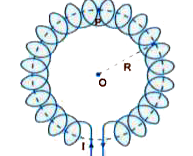
|
|
| 19. |
Passage I An n-p-n transistor is used as a voltage amplifier in a commoin emitter circuit given V_(CC)=8V I_(C )=4mA V_(CE)=4V, (V_(BE)=0.6 V, V_(BB)=8V beta_(Dc)=200 The value of base resistanceis |
|
Answer» 185 K `OMEGA` `I_(B) = (I_(c ))/( beta_(ac)) = (4mA)/( 200) =(4xx 10^(-3))/( 200)= 2XX 10^(-5) A` `rArrR_(B) = (V_(BB) - V_(BE))/( I_(B))= (8-0.6)/( 2 xx 10^(-5))= 3.7 xx 10^(5) Sigma ` |
|
| 20. |
An electric field is given by vec(E)=4hat(i)+3(y^(2)+2)hat(j) pierces gaussian cube of side 1 m placed at origin such that one of its corners is at origin & rest of sides are along positive side of coordinate axis. If the magnitude of net charge enclosed is n varepsilon_(0) then n (in SI units) will be equal to |
|
Answer» Along x axis `vec(E) =const` `:.phi_(x)=0` for y=0 `int vec(E) . Dvec(A)= int 3(0+2)hat(j)DA (-hat(j))=6intdA =-6` y=1 `intvec(E) . Dvec(A) = int3(1+2)hat(j).dA(hat(j))=9intdA=9` `:.phi_(net)=+3in_(0)` |
|
| 21. |
A bar magnet is equivalent to |
|
Answer» toroid carrying current |
|
| 22. |
The value of acceleration due to gravity is 980 cm//s^2. What will be it’s value if lengthen kilometers and that of time in minute. |
|
Answer» `5.5xx10^3kg//m^3` |
|
| 23. |
(A) : Dipole oscillations produce electromagnetic waves.(R) : Accelerated charge produces electromagnetic waves. |
|
Answer» Both 'A' and 'R' are TRUE and 'R' is the CORRECT EXPLANATION of 'A'. |
|
| 24. |
A lift isgoing up with uniform velocity. When brakes are applied, it slows down. A person in that lift, experiences |
|
Answer» more WEIGHT |
|
| 25. |
For sky wave propagation of a 10 MHz signal, what should be the minimum electron density in the ionosphere? |
|
Answer» SOLUTION :CRITICAL FREQUENCY, `f_c=qsqrtN=f_c^2/81` `(10xx10^6)/81 = 1.2xx10^12m^-3` |
|
| 26. |
Two beams of light of intensity I_(1), and I_(2)interfere to give an interference pattern. If the ratio of maximum intensity to that of minimum intensity is (16)/(4) then I_(1):I_(2)= ....... |
|
Answer» `1:9` `(16)/(4)=((a_(1)+a_(2))/(a_(1)-a_(2)))^(2)` `=2(a_(1)+a_(2))/(a_(1)-a_(2))^(2)` `2a_(1)-2a_(2)=a_(1)+a_(2)` `:.a_(1)=3a_(2)` `:.(a_(1))/(a_(2))=(3)/(1)` `:.(a_(1)^(2))/(a_(2)^(2))=(9)/(1)` `:.(I_(1))/(I_(2))=(9)/(1) "" [ a_(1)^(2) PROP I_(1),a_(2)^(2) prop I_(2)`Taking K=1 in both] |
|
| 27. |
If the length of a clock pendulum increases by 0.2% due to atmospheric temperature rise, then the loss in time of clock per day is |
|
Answer» 86.4s |
|
| 28. |
In insulators |
|
Answer» valence band is partially FILLED |
|
| 29. |
Electrons are observed to be ejected in various directions with negligible speed from the negative plate of a parallel plate capacitor when the plate is illuminated by a certain wavelength. The plates are separated by a distance d and a potential difference V is maintained between them. Show that none of these electrons will reach the positive plate if a magnetic field is applied at right angles to the electric field and that the magnetic induction has a value B gt ((2m V)/(ed^(2)))^(1/2) where m and e are the electron mass and charge respectively. |
|
Answer» |
|
| 30. |
In p-n junction, depletion barrier near the junction is due to ……… |
|
Answer» DIFFERENCE in CRYSTAL structure. |
|
| 31. |
The potential difference applied to an X-ray tube is 5kV and the current through it is 3.2 mA. Then the number of electrons striking the target per second is |
|
Answer» ` 2 XX 10^(16)` |
|
| 32. |
Find the number of electrons present in an 8-g gold pin . Given : Molar mass of gold =197 g/mol , electron per atom is gold =79 and Avogadro's number =6.023xx10^23 g^(-1) mol^(-1) |
| Answer» SOLUTION :`193.55xx10^22` ELECTRONS | |
| 33. |
The linear momentum of a particle varies with times as p = a_(0) + at + bt^2. Which of the following represents force and time relation ? |
|
Answer» SOLUTION :`p=a_(0) + at + bt^(2)` `THEREFORE F =(DP)/(DT) = a+ 2bt` At t=0, F=a and F varies linearly with TIME. 
|
|
| 35. |
Find potential difference between points A and B of the network shown in Fig. and distribution of given main current through different resistors. |
|
Answer» Solution :Between points A and B RESISTORS of `4OMEGA, 6OMEGA and 8Omega` RESISTANCE are in series and these in PARALLEL to `9Omega` resistor. Equivalent resistance of series combination is `R_(1)=(4+6+8)" ohm "=18` If equivalent resistance between A and B is `R=9xx18//(9+18)" ohm"=6Omega` Potential difference between A and B is `V=IR=2.7xx6V=16.2V` Current through `9Omega` resistor `=16.2//9=1/8A` Current through `4Omega, 6Omega and 8Omega` resistor `=2.7-1.8=0.9A`. |
|
| 36. |
When a thin transparent plate of Refractive Inex 1.5 is introduced in one of the interfearing becomes, 20 fringes shift. If it is replaced by another thin plate of half the thickness and of R.I. 1.7 the number of fringes that undergo dis place-ment is |
|
Answer» 23 |
|
| 37. |
Who is the author of The Rattrap? |
| Answer» Answer :A | |
| 38. |
In the previous problem, the galvanometer is converted to an ammeter, which can read the current up to 1.5 A, and it is connected to a shunt of resistance R. what is the value of R ? Also calculate the resistance of ammeter. |
| Answer» SOLUTION :`0.1 OMEGA,0.0997 Omega` | |
| 39. |
Which of the following represent relation between momentum and de-broglie wavelength ? |
|
Answer» <P> `therefore p prop (1)/(lambda)` Here as `lambda` increases ,p will DECREASE hence grap (C )is CORRECT. |
|
| 40. |
Read the following passage and then answer question (a) - (e) on the basis of your understanding of the following passage and the related studied concepts. As per Bohr atom model, in an isolated atom the energy of any of its electrons depends on the orbit in which it revolves and it is characterised by a sharp energy level. However, inside a crystalline solid atoms are close to each other and the outer orbits of electrons from neighbouring atoms would come very close or could even overlap. As a result, each electron will have a different energy level. These different energy levels with continuous energy variation form energy bands. The energy band which includes the energy levels of the valence electrons is called the valence band. All the valence electrons reside in the valence band. The energy band above the valence band is called the conduction band. Normally the conduction band is empty. If the lowest level in the conduction band happens to be lower than the highest level of the valence band, electrons from the valence band may easily move into the conduction band and the solid behaves as a conductor. If there is some gap between the conduction band and the valence band, electrons in the valence band remain confined to it and no free electrons are available in the conduction band. It makes the solid an insulator. If some of the electrons from the valence band may gain external energy to cross the gap between the conduction band and valence band, these electrons will move into the conduction band and simultaneously create vacant energy levels in the valence band. Therefore, there is a possibility of conduction due to electrons in conduction band as well as due to vacancies in the valence band. Draw energy band diagram for a metal. |
Answer» SOLUTION :Energy BAND DIAGRAM for a METAL is shown in FIG. 14.01. 
|
|
| 41. |
How a transformer affects the voltage and current ? |
|
Answer» SOLUTION :For an ideal transformer, `(I_(p))/( I_(s)) = (V_(s))/( V_(p)) = ( N_(s))/( N_(p))` (i) If the secondary coil has a greater number of TURNS than the primary `( N_(s) gt N_(p))`. The VOLTAGE is stepped up `( V_(s) gt V_(p))` . Meas voltage increased more in secondary than primary and `I_(p) gt I_(s)` the current in secondary becomes LESS than form primary. (iii) If the secondary coil has a lesser number of turns than the primary `( N_(s) LT N_(p))` the voltage is stepped down `(V_(s) lt V_(p))` , means voltage decrased more in secondary than primary and `I_(p) lt I_(s)`. The current in secondary becomes more than from primary. |
|
| 42. |
Read the following passage and then answer question (a) - (e) on the basis of your understanding of the following passage and the related studied concepts. As per Bohr atom model, in an isolated atom the energy of any of its electrons depends on the orbit in which it revolves and it is characterised by a sharp energy level. However, inside a crystalline solid atoms are close to each other and the outer orbits of electrons from neighbouring atoms would come very close or could even overlap. As a result, each electron will have a different energy level. These different energy levels with continuous energy variation form energy bands. The energy band which includes the energy levels of the valence electrons is called the valence band. All the valence electrons reside in the valence band. The energy band above the valence band is called the conduction band. Normally the conduction band is empty. If the lowest level in the conduction band happens to be lower than the highest level of the valence band, electrons from the valence band may easily move into the conduction band and the solid behaves as a conductor. If there is some gap between the conduction band and the valence band, electrons in the valence band remain confined to it and no free electrons are available in the conduction band. It makes the solid an insulator. If some of the electrons from the valence band may gain external energy to cross the gap between the conduction band and valence band, these electrons will move into the conduction band and simultaneously create vacant energy levels in the valence band. Therefore, there is a possibility of conduction due to electrons in conduction band as well as due to vacancies in the valence band.Name two elements which behave as semiconductors. |
| Answer» SOLUTION :SILICON and GERMANIUM elements behave as SEMICONDUCTORS. | |
| 43. |
A solenoid of length 0.5 m has a radius of 1 cm and is made up of 500 turns. It carries a current of 5 A. What is the magnitude of magnetic fieldinside the solenoid ? |
|
Answer» SOLUTION :The NUMBER of turns per UNIT LENGHT is , `n = (500)/(0.5)` = 1000 tuns / m The leght l =0.5 m and radius r=0.01 m . Thus `l/a`= 50, i,e ` l gt gt a.` Hence , we can use the long solenoid formula `B=mu_(0) n l = 4 pixx 10^(-7) xx 10^(3) xx 5= 6. 28xx 10^(-3) T` |
|
| 44. |
To remove ___________ aberration we prefer to use a refractive type astronomical telescope. |
| Answer» SOLUTION :CHROMATIC | |
| 45. |
Read the following passage and then answer question (a) - (e) on the basis of your understanding of the following passage and the related studied concepts. As per Bohr atom model, in an isolated atom the energy of any of its electrons depends on the orbit in which it revolves and it is characterised by a sharp energy level. However, inside a crystalline solid atoms are close to each other and the outer orbits of electrons from neighbouring atoms would come very close or could even overlap. As a result, each electron will have a different energy level. These different energy levels with continuous energy variation form energy bands. The energy band which includes the energy levels of the valence electrons is called the valence band. All the valence electrons reside in the valence band. The energy band above the valence band is called the conduction band. Normally the conduction band is empty. If the lowest level in the conduction band happens to be lower than the highest level of the valence band, electrons from the valence band may easily move into the conduction band and the solid behaves as a conductor. If there is some gap between the conduction band and the valence band, electrons in the valence band remain confined to it and no free electrons are available in the conduction band. It makes the solid an insulator. If some of the electrons from the valence band may gain external energy to cross the gap between the conduction band and valence band, these electrons will move into the conduction band and simultaneously create vacant energy levels in the valence band. Therefore, there is a possibility of conduction due to electrons in conduction band as well as due to vacancies in the valence band.What are holes ? How are they formed ? |
| Answer» SOLUTION :When an electron, on RECEIVING external energy, passes from valence band to conduction band in a semiconductor material, it creates a vacancy in conduction band with the EFFECTIVE POSITIVE charge of +e. This vacancy with the effective positive ELECTRONIC charge called a hole. | |
| 46. |
(A) : Reactance offered by an inductor increases with the frequency of the ac source. (R): The current leads the voltage in a purely inductive network by pi//2. |
|
Answer» Both 'A' and 'R' are true and 'R' is the correct EXPLANATION of 'A'. |
|
| 47. |
Read the following passage and then answer question (a) - (e) on the basis of your understanding of the following passage and the related studied concepts. As per Bohr atom model, in an isolated atom the energy of any of its electrons depends on the orbit in which it revolves and it is characterised by a sharp energy level. However, inside a crystalline solid atoms are close to each other and the outer orbits of electrons from neighbouring atoms would come very close or could even overlap. As a result, each electron will have a different energy level. These different energy levels with continuous energy variation form energy bands. The energy band which includes the energy levels of the valence electrons is called the valence band. All the valence electrons reside in the valence band. The energy band above the valence band is called the conduction band. Normally the conduction band is empty. If the lowest level in the conduction band happens to be lower than the highest level of the valence band, electrons from the valence band may easily move into the conduction band and the solid behaves as a conductor. If there is some gap between the conduction band and the valence band, electrons in the valence band remain confined to it and no free electrons are available in the conduction band. It makes the solid an insulator. If some of the electrons from the valence band may gain external energy to cross the gap between the conduction band and valence band, these electrons will move into the conduction band and simultaneously create vacant energy levels in the valence band. Therefore, there is a possibility of conduction due to electrons in conduction band as well as due to vacancies in the valence band. What is the difference between energy band diagram of an insulator and a semiconductor? |
| Answer» Solution :The ENERGY gap e.g., between the lower END of conduction band and upper end of valence band for an insulator is greater than 3 EV but it is LESS than 3 eV for a semiconductor. | |
| 48. |
Five capacitors are connected as shown in figure. Find the equivalent capacitance between points A and B. |
|
Answer» |
|
| 49. |
A reactor is developing nuclear energy at a rate of 32,000 kilowatt. How many kg of U^(235) undergo fission per second? How many kg of U^(235)would be used up in 1000 hour of operation ? Assume an average energy of 200 MeV released per fission ? Take Avogadro.s number as6xx10^(23) and MeV = 1.6 xx 10^(-13)joule |
|
Answer» Solution :Power developed by reactor = 32, 000 kilowatt `=3.2XX10^7` watt `:.` Energy RELEASED by reactor per sec `=3.2xx10^7` joule `=(3.2xx10^7)/(1.6xx10^(-13))MeV = 2 xx10^(20)MeV`. Number of fissions occurring in the reactor per second `= (2xx10^(20))/200 =10^(18)`( `:.` Energy released per fission = 200 MeV) The number of atoms of `U^(235)` consumed in 1000 hour Now mass of `U^(235)` consumed in 1000 hour `=10^(18)xx(1000xx3600)=36xx10^(23)` `(36xx10^(23))/(6xx10^(23))xx235 =1410 " GM " = 1.41` kg |
|
| 50. |
The temperature dependence of resistances of Cu and undoped Si in the temperature range 300 - 400 K, is best described by : |
|
Answer» Linear decrease for Cu, linear decrease for SI CU `RARR` TEMPERATURE depedence RESISTANCE increases with temperature Si `rarr` Resistance decrease exponentially with temperature |
|


