

Saved Bookmarks
This section includes 7 InterviewSolutions, each offering curated multiple-choice questions to sharpen your Current Affairs knowledge and support exam preparation. Choose a topic below to get started.
| 1. |
एक घनाकार बर्तन के केन्द्र पर +Q आवेश रखा है | घन से निर्गत कुल विद्युत् फ्लक्स होगा |
|
Answer» `Q/epsilon_0` |
|
| 2. |
State the rule that is used to find out the direction of field acting at a point near a current carrying straight conductor ? |
| Answer» SOLUTION :RIGHT HAND THUMB RULE | |
| 3. |
flux associated with the metal piece of 3hatj m^(2)cross-section placed in electric field of 2hati N//C is………… |
|
Answer» 1.5 |
|
| 4. |
We may define electrostaticpotential at a point in an electrostatic field as the amountof work donein movinga unit positivetest chargefrom infinity to thatpoint againstthe electrostatic forces, along any path. Due to a singlecharge q , potentialat a pointdistantr from the charge isV = (q)/(4pi in_(0)r). The potential can be positiveor negative. However, it isscalar quantity. The total amountof work done in bringingvariouscharges to theirrespective postionsfrom infinelty large mutual separations gives us the electric potential energy of the system of charges. Whereas electric potentail is measured in volt, electricpotential energy is measuredin joule. You aregivena square of each side 1.0 metre with four charges +1xx10^(-8) C, -2xx10^(-8)C, +3xx10^(-8)C and +2xx10^(-8) C placed at the four corners of the square. Withthe helpof the passagegiven above, choose the most appropritealternative for each of the followingquestions : Potential energy fo the system of four system of four charges is |
|
Answer» `12.73xx10^(7) J` `:.` Potential energy of the sytem of charges `= 9xx10^(9)XX` `[((1xx10^(-8))(-2xx10^(-8)))/(1.0) + ((-2xx10^(-8))(3xx10^(-8)))/(1.0)` `+ ((3xx10^(-8))(2xx10^(-8)))/(1.0) + ((2xx10^(-8))(1xx10^(-8)))/(1.0)]` `+ 9xx10^(9)xx` `[((1xx10^(-8))(3xx10^(-8)))/(sqrt(2)) + ((2xx10^(-8))(-2xx10^(-8)))/(sqrt(2))]` `= 0+ (9xx10^(9) (-10^(16)))/(sqrt(2)) = -6.4xx10^(-7) J` |
|
| 5. |
The isotope ._8O^(16) has 8 protons, 8 neutrons and 8 electrons, while ._4Be^8 has 4 protons, 4 neutrons and 4 electrons.Yet the ratio of their atomic masses is not exactly 2. Why? |
| Answer» SOLUTION :The ratio of mass of `._8O^(16)` and mass of `._4Be^8` is not EXACTLY TWO energy of the ATOMIC nuclei of the two elements. | |
| 6. |
We may define electrostaticpotential at a point in an electrostatic field as the amountof work donein movinga unit positivetest chargefrom infinity to thatpoint againstthe electrostatic forces, along any path. Due to a singlecharge q , potentialat a pointdistantr from the charge isV = (q)/(4pi in_(0)r). The potential can be positiveor negative. However, it isscalar quantity. The total amountof work done in bringingvariouscharges to theirrespective postionsfrom infinelty large mutual separations gives us the electric potential energy of the system of charges. Whereas electric potentail is measured in volt, electricpotential energy is measuredin joule. You aregivena square of each side 1.0 metre with four charges +1xx10^(-8) C, -2xx10^(-8)C, +3xx10^(-8)C and +2xx10^(-8) C placed at the four corners of the square. Withthe helpof the passagegiven above, choose the most appropritealternative for each of the followingquestions : Electric potentail and electric potential energy |
|
Answer» both are scalars |
|
| 7. |
A fully charged capacitor has a capacitance C. It is discharged through a small coil of resistance wire embedded in a thermally insulated block of specific heat capacity s and mass m. If the temperature of the block is raised by Delta T, the potential difference Vacross the capacitance is |
|
Answer» `sqrt((2m C DeltaT)/(s ))` |
|
| 8. |
Interference pattern is formed from two coherent sources of same intensity. If intensit of minima is zero, then what will be th intensity of maxima ? |
|
Answer» 4I `0=(sqrt(I_(1))-sqrt(I_(2)))^(2)` `:.sqrt(I_(1))-sqrt(I_(2))` `:.I_(1)=I_(2)=I` suppose Now `I_(max)=(sqrt(I_(1))+sqrt(I_(2)))^(2)` `=(sqrt(I)+sqrt(2))=(2sqrt(I))^(2)= 4I` |
|
| 9. |
The quantity of a charge that will be transferrred bya current flow of 20 A over 1 hour 30 minutes period is |
|
Answer» `10.8xx10^(3)C` |
|
| 10. |
The following pictures depict electric field lines for various charge configurations. (i) In figure (a) identify the signs of two charges and find the ratio |(q_(1))/(q_(2))| (ii) In figure (b) calculate the ratio of two positive charges and identify teh strength of the electric field at three points A, B and C (iii) Figure (c) represents the electric field lines for three charges . If q_(2) =-20nC then calculate the values of q_(1) and q_(3) |
|
Answer» Solution :(i) The electric field lines start at `q_(2)` and end at `q_(1)` . In figure (a) `q_(2)` is positive and `q_(1)` is negative . The number of lines starting from `q_(2)` is 18 and number of the lines ENDING at `q_(1)` is 6. So `q_(2)` has greater magnitud. The ratio of `|(q_(1))/(q_(2))|=(N_(1))/(N_(2))=(6)/(8)=(1)/(3)` . It implies that `|q_(2)|=3|q_(1)|`. (ii) In figure (b) , the number of field lines emanating from both positive charges are equal (N=18). So the charges are equal . At point A the electric field LINE are denser compared to the lines at point B. So the electric at point A is greater in magnitude compared to the field at point B . Further no electric field line passes through C which implies that the resultant electric field at C due to these two charges is zero . (iii) In the figure (c) the electric field lines start at `q_(1)` and `q_(3)` and end at `q_(2)` and end at `q_(2)` , This implies that `q_(1)` and `q_(3)` are positive charges. The ratio of the number of field lines is `|(q_(1))/(q_(2))|=(8)/(16)=|(q_(3))/(q_(2))|=(1)/(2)` IMPLYING that `q_(1)` and `q_(3)` are half of the magnitude of `q_(2)` . So `q_(1)=q_(3)=+10n` C. |
|
| 11. |
Rows of capacitors containing 1, 2, 4, 8, ……., oocapacitors, each of capacitance 2F, are connected in parallel as shown in figure. The potential difference across ABis 10 V, then |
|
Answer» TOTAL capacitance across AB is 4F Capacities in different arms are `2F,1F,(1)/(2)F,(1)/(4)F,`.... `C_(eff)=2+1+(1)/(2)+(1)/(4)+....oo=2(1+(1)/(2)+(1)/(4)+...)=4F`. As `PD` across each row is same, THUS the charge will be MAXIMUM across the cpacitor in first now |
|
| 12. |
A metal conductor of length 1 m rotates vertically about one of its ends at angular velocity 5 radian per second. If the horizontal component of earth's magnetic field is 0.2xx10^(-4)T, then the e.m.f. developed between the two ends of the conductor is |
|
Answer» `5 mu V` `THEREFORE`Induced e.m.f. `=5xx10^(-5)=50 mu V` |
|
| 13. |
A thin prism of 6.0° angle gives a deviation of 3.0°, what is the refractive index of material of prism ? |
|
Answer» SOLUTION :For a THIN PRISM `delta =(n-1)A` `therefore n=1 + delta/A =1+ 3.0/6.0 = 1+ 0.5 = 1.5` |
|
| 14. |
What is a partially polarised light ? |
|
Answer» Solution :In the phenomenon of scattering of LIGHT occurring at `90^(@)` and the angle of polarisation one of two components of the electric field, one component is zero. At angle except the angle of polarisation, both components are PRESENT but one component is stronger than the other. There is no permanent relation between these two components because both of these components are obtained from two perpendicular components of unpolarised light. If light of these two perpendicular components is view from an analyzer, we SEE maximum and minimum intensity but it does not look fully DARK. This kind of light is CALLED partially polarised light. |
|
| 15. |
White coherent light (400 nm - 700 nm) is sent through the slits of a Young's double slit experiment. The separation between the slits is 0.5 mm and the screen is 50 cm away from the slits. There is a hole in the screen at a point away (along the width of the fringes) from the central line. Which wavelengths (s) will be absent in the light coming from the hole ? |
| Answer» Answer :A | |
| 16. |
The current flowing through a wire depends on time as i=3t^(2)+2t+5. The charge flowing through the cross-section of the wire in time from t = 0 and t = 2 sec. is |
|
Answer» 22 C |
|
| 17. |
Derive an expression for field intensity due to a uniformly charged ring at a point on the axis. |
|
Answer» Solution :A ring of radius R is charged uniformly with linear density `lambda=(dq)/(dl)`. Consider a small element of length dl. The FIELD intensity at the axial point P is `dE=(1)/(4pi epsi_(0)) (dq)/(r^(2))`. This can be resolved into `dE sin theta`- the perpendicular component and `dE cos theta-` the parallel component. The perpendicular component gets cancelled by SYMMETRY. The TOTAL field is `E=int dE cos theta=int (dq)/(4pi epsi_(0) r^(.2)) cos theta=int (lambda.dl)/(4pi epsi_(0) r^(.2))cos theta` The quantities r., `cos theta and lambda` are constants, as we look hte coil from P. Hence total field is `E=(lambda cos theta)/(4pi epsi_(0) r^(.2)) int dl=(lambda. cos theta)/(4 pi epsi_(0) r^(.2)) xx 2pi R` But `2pi R lambda="total charge , q"` Hence `E=q/(4pi epsi_(0) r^(.2)) cos theta=(q)/(4pi epsi_(0)) 1/r^(.2) xx r/(r.)=(qr)/(4pi epsi_(0)r^(.3))=(qr)/(4pi epsi_(0) (R^(2)+r^(2))^(2/3))` When `R lt lt r, E=(q)/(4pi epsi_(0) r^(2))` 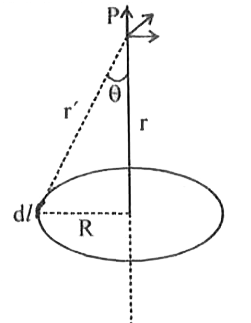
|
|
| 18. |
If the mean free path fer a given molecule is 1.1 xx 10^(6) cm, what is radius of the molecules (Given number of molecules per cm^(3) = 2·69 xx 10^(19)). |
|
Answer» `4·362 XX 10^(-8)` CM `therefored^(2)=1/(sqrt2pinlamda)` `=1/(1·414 xx 3.142 xx 2·69 xx 10^(19) xx 1.1 xx 10^(-6))` `rArrd=8.724xx10^(-8)` cm Thus correct choice is (a). |
|
| 19. |
निम्नलिखित में से कौन-सी लवणीय जलवाली झील है? |
|
Answer» सांभर |
|
| 20. |
V - i characteristics of dilute sulphuric acid with tungsten electrodes and neon gas are shown in fig a and b respectively. What can you say about the nature of these conductors ? |
| Answer» SOLUTION :They are non-ohmic. | |
| 21. |
Light of wavelength lamda falls on a metal having work function hc/ lamda. Photoelectric effect will take place only if |
|
Answer» `lamdagelamda_(0)` |
|
| 22. |
When a car stops suddenly, the passengers are thrown forward from their seats. What causes this motion? |
| Answer» SOLUTION :The outside person will describe this EVENT on the BASIS of inertia while the person inside would describe it on the basis of centrifugal FORCE. | |
| 23. |
In the nuclear reaction : p+^(15)N to_(Z)^(A)X+n (a) Find A, Z and identify the nucleus X. (b) Find the Q- value of the reaction. (c ) If the proton were to collide with the ^(15)N at rest, find the minimum K.E. needed by the proton to initiate the above reaction . (d) If the proton has the twice the energy in (c ) and the outgoing neutron emerges an angle of 90^(@) with the direction of the incident proton, find the momentum of the nucleus X {:(m(p)=1.007825u,, m('^(15)C)=15.0106u,, m('^(16)N)=16.001u),(m('^(15)N)=15.000u,,m('^(16)O)=15.9949u,,),(m(n)=1.008665u,,m('^(15)O)=15.0031u,,and 1u~~931.5MeV):} |
|
Answer» SOLUTION :(`a`) The nucleus is identified by , `Z=8`, `A=15rArrX="_(8)O^(13)` (`B`) `Q=[m(p)+m(N^(15))-m(O^(15))-m(n)]c^(2)` `=[1.007825+15.000-15.0031-1.008665]xx931.5MeV= -3.67MeV` (`c`) `K_(th)=- Q(1)/(4piepsilon_(0))((Q)/(2pi)d theta)q//R^(2)=3.9MeV` (`d`) Now, `E_(k)=2xxK_(th)=2xx3.9MeV=7.8MeV` and `Q= -3.63 MeV` 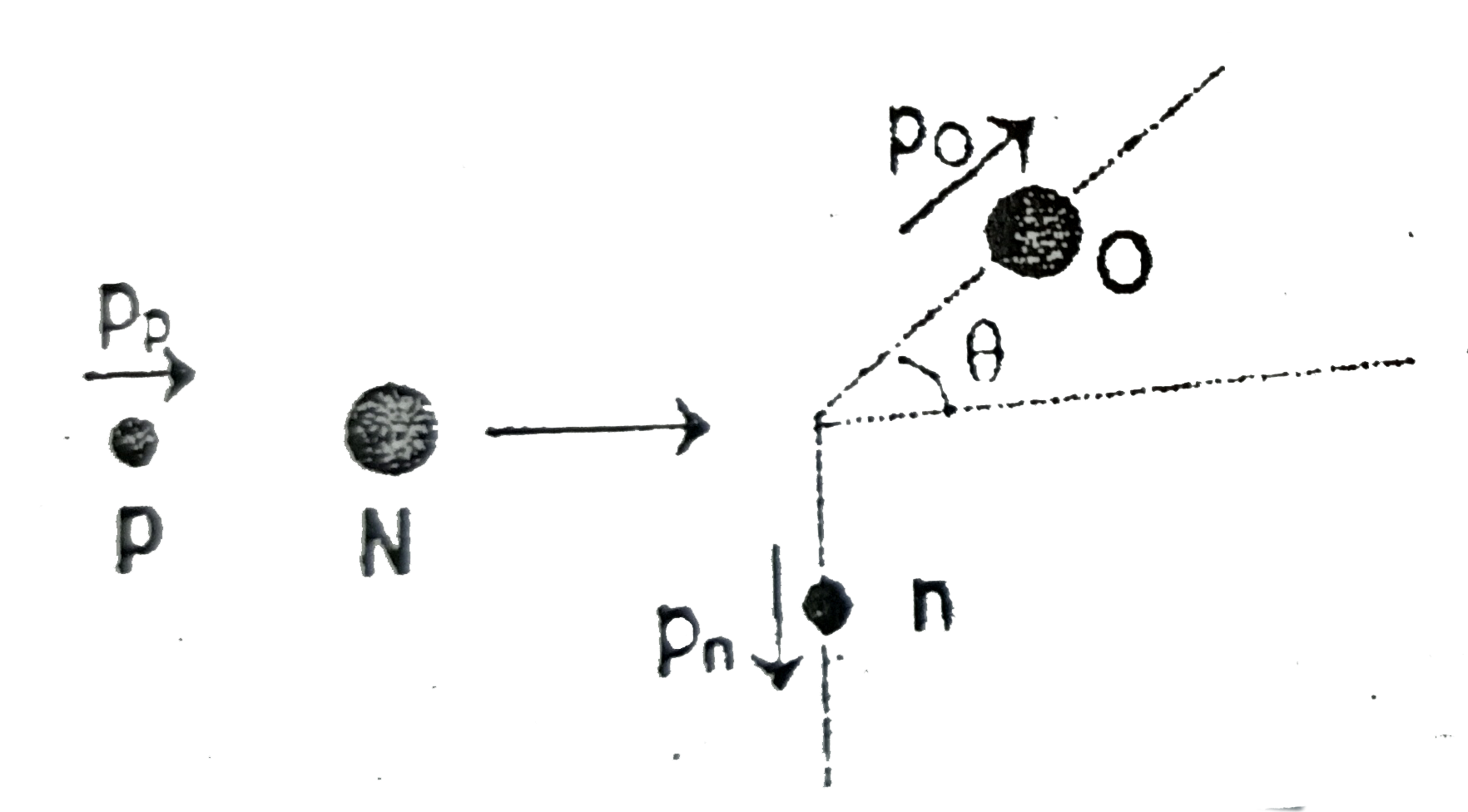 (`i`) CONSERVATION of momentum: `sqrt((T)/(mu))=sqrt((1)/(8pi^(2)epsilon_(0))(Qq)/(R^(2))//(m)/(2piR))=sqrt((Qq)/(4piepsilon_(0)mR))` `p_(0)sintheta=p_(n)` (`ii`) Conservation of energy `(p_(0)^(2))/(2m_(n))+(p_(0)^(2))/(2m_(0))=E_(k)+Q` `p_(n)^(2)=(E_(k)(1-(m_(p))/(m_(0)))+Q)/((1)/(2m_(0))+(1)/(2m_(n)))` Subsituting the values, `p_(n)=79.4MeV//c` `p_(0)costheta=121 MeV//c` `p_(0)sintheta=79.4MeV//c` `p_(0)=145MeV//c` `theta=33^(@)`. |
|
| 24. |
The energy of photon of wavelength lambda is |
|
Answer» `(HC)/(LAMBDA)` |
|
| 25. |
A telephone cable at a place has four long straight horizontal wires carrying a current of 1.0 A in the same direction east to west. The earth's magnetic field at the place is 0.39 G, and the angle of dip is 35^@. The magnetic declination is nearly zero. What are the resultant magnetic fields at points 4.0 cm below the cable ? |
|
Answer» Solution :Here `N= 4 , I= 1.0 A, B_E = 0.39 G = 3.9 xx 10^(-5) T and ` angle of dip `delta=35^@` `therefore B_H= B_E cos delta = 3.9xx10^(-5) xx cos 35^@ = 3.9xx10^(-5) xx 0.8192 = 3.19 xx 10^(-5) T` and `B_V= B_V = B_E sin delta = 3.9xx10^(-5) xx sin 35^@ xx 0.5736 =2.24 xx10^(-5) T` and magnetic field due to current flowing in cables at a point situated at a distance R= 4 cm = 0.04 m is `B= (mu_0 N I)/(2pi r) =(4pi xx 10^(-7) xx 4 xx 1.0)/(2pi xx 0.04) = 2 xx 10^(-5) T` At a point 4 cm below the cable the cable applying right hand rule we find that B is in a direction opposite to that of `B_H` . Hence , horizontal component of resultant magnetic field. `B_(HR) = B_H - B = 3.19 xx 10^(-5) - 2 xx 10^(-5) = 1.19xx 10^(-5) T` and VERTICAL component of resutlant magnetic field `B_(VR) = B_V = 2.24 xx 10^(-5) T` `therefore ` Resultant magnetic field `B_g = sqrt((B_(HR))^2 + (B_(VR))^2) = sqrt((1.19xx10^(-5))^2 + (2.24 xx 10^(-5))^2) = 2.54 xx 10^(-5) T = 0.254 G` `tan beta = (B_(VR))/(B_(HR)) =(2.24 xx 10^(-5))/(1.19 xx 10^(-5)) = 1.8824` `thereforebeta = tan^(-1) (1.8824)=62^@` |
|
| 26. |
A disabled tanker leaks kerosene (n = 1.20) into the Persian Gulf, creating a large slick on top of the water (n = 1.30). (a) If you are looking straight down from an airplane, while the Sun is overhead, at a region of the slick where its thickness is 380 nm, for which wavelength(s) of visible light is the reflection brightest because of constructive interference? (b) If you are scuba diving directly under this same region of the slick, for which wavelength(s) of visible light is the transmitted intensity strongest? |
| Answer» SOLUTION :(a) 456 NM, (B) 608 nm | |
| 27. |
Assertion: Amplification is necessary to compensate for the attenualtion of the signal in communication system. Reason: Amplification is the process of increasing the amplitdue and consequently the strength of a signal using an electronic circuit. |
|
Answer» |
|
| 28. |
A long straight conductor in air carries a current of 5A. Find the magnetic induction produced at a distance of 4 cm from it.[mu_@=4pixx10^(-7) (Wb)//Am] DATA:i=5A, r=4cm =4xx10^(-2)m mu_@=4pixx10^(-7) (Wb)//A To find:B=? |
|
Answer» SOLUTION :Magnetic field B NEAR an infinitely long conductor `B=mu_@/(4PI)xx(2i)/r` B=`10^(-7)xx(2xx5)/(4XX10^(-2))=2.5xx10^(-5)T` |
|
| 29. |
Emissive power of a perfectly black body at 227^@ C is E_b. Emissive power of an ordinary surface of e = 0.4 at 2227^@ C is |
|
Answer» 625 `E_b` |
|
| 30. |
In a trannsistor |
|
Answer» length of EMITTER is GREATER than that of collecor |
|
| 31. |
IfgV_(g), V_(x) and V_(m) are the speeds of gamma rays, X-rays and microwaves respectively in vacuum, then : |
|
Answer» `V_(G) lt V_(x) lt V_(m)` |
|
| 32. |
Referring to figure calculate the downward acceleration of mass m_1. Assume the surfaces are frictionless and pullyes are massless. |
|
Answer» Solution :LET a be the acceleration of mass M and `a_1 and a_2`, the acceleration of `M_1 and M_2` relative to fixed pulley, P. Then from shown in figure. `M_1 g - T_2 = M_1 a_2` ........... (1) `M_2 g -T_2 = M_2a_2` ......... (2) `and T_1 = Ma ` Also `T_1 = 2T_2` ........ (4) Acceleration of `M_1` relative to MOVABLE pulley Q is `(a_1- a)` . Acceleration of `M_2` relative to pulley `Q=(a_2 -a)`. The acceleration of `M_1 and M_2` relative to puelly Q are equal and opposite . ` :. a_1 - a = -(a_2-a)` ` or a =(a_1 + a_2)/( 2)` .......... (5) substracting (2) from (1) `(M_1 - M_2) g = M_1 a_1 - M_2 a_2` ......... (6) Adding (1) and (2) , we get `(M_1 + M_2) g - 2T_2 = M_1 a_1 + M_2a_2` From (3) and (4) , ` 2T_2 = T_1 =Ma ` Using `(5) , 2T_2 =(M(a_1 + a_2))/(2)`............ (7) SUBSTITUTING this value in (7) , we get `(M_1 + M_2) g -(M(a_1+ a_2))/(2) = M_1 a_1 + M_2 a_2` ` or 2(M_1 + M_2) g - Ma_1 - Ma_2 = 2M_1 a_1 + 2M_2a_2` ` or 2(M_1 + M_2)g = (2 M_1 + M)a + (2M_2 + M)a_2` .......... (8) ELIMINATING ` a_2 ` from (6) and (8) , we get ` a_1 = [(4M_1 M_2 + M(M_1 -M_2))/(4M_1M_2+ M(M_1 + M_2))]g` 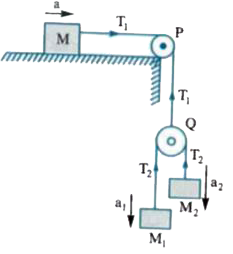
|
|
| 33. |
An infinitely long wire carrying a current i is bent at its mid point 0 to form an angle45^@. P is point a distance Rfrom the pointofbending. Find the magnetic field at P. |
|
Answer» <P> Solution :Since point P lies on the axis of straight part OA, magnetic field at point P is zero due to path OA of wire From `Delta OPN, d= R cos 45^0` Since both the ends O and C are on the same side of normal PN, `phi_1 = -45^0 and phi_2 = + 90^0` So `B = (mu_0 i)/(4pid) (sin phi_1 + sin phi_2)` ` = (mu_0i)/(4PI R cos 45^0)[sin (-45^0) + sin 90^0]` ` = (mu_0 i XX sqrt(2))/(4piR) (-sin45^@ + 1), = (sqrt(mu_0i))/(4piR)(1- (1)/(sqrt(2)))OX` `= ((sqrt(2)-1)mu_0i)/(4piR) ox` (into the page) |
|
| 34. |
What does the term communication signify ? |
| Answer» SOLUTION :Communication is the PROCESS of sending and RECEIVING INFORMATION. | |
| 35. |
The particle which is more effective for bombarding |
|
Answer» Neutron |
|
| 36. |
A conducting liquid is filled in a vessel of area of cross section A upto height'h' then resistance of the liquid is |
|
Answer» `(rhoA)/(H)` |
|
| 37. |
In the wave picture of light, intensity of light is determined by square of the amplitude of wave. What determines the intensity of light in the photon picture of light? |
| Answer» Solution :In photon PICTURE, INTENSITY is DETERMINED by the number of PHOTONS crossing PER unit time. | |
| 38. |
A metallic sphere rotates with angular speed and its surface charge density is o. Find the magnetic field intensity at the centre of sphere. Assume the radius of the sphere to be equal to R. |
Answer» Solution :Consider the CIRCULAR segment selected at an angle with angular width `d theta`as shown in the figure, CHARGE on this circular segment will act as a current loop when rotated about its AXIS. 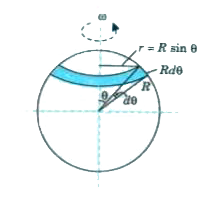 The radius of the circular segment is `r= R sin theta`and width of the circular segment is `Rdtheta`. Charge on the ring segment can be calculated by multiplying its area with surface charge density. So we have: ` dq = sigma (2 pi R sin theta) (Rd theta)` Note that here, the current segment is treated as a rectangular strip for the calculation of its area. Time taken by the sphere to complete one revolution is `2 pi//omega`. Hence, the equivalent current for the ring segment can be written as follows: `dI = (dq)/T = (sigma(2 pi R sin theta)(Rd theta))/(2 pi //omega) = sigmaomegaR^(2) sin theta d theta` Distance of this current loop from the centre is `R COS theta`. We can write magnetic field due to this rotating ring segment of charge as follows: `dB = (mu_(0)(dI)(R sin theta)^(2))/(2(R^(2) sin^(2) theta+ R^(2) cos^(2) theta)^(3//2))` `dB = (mu_(0)(sigmaomegaR^(2)sin thetad theta)(R sin theta)^(2))/(2(R^(2) sin^(2) theta+ R^(2) cos^(2) theta)^(3//2)) = (mu_(0)sigma omegaR sin ^(3) theta d theta)/2` Magnetic field at the centre due to all such circular segments will be in the same direction, which is along the axis. Thus, we can integrate it directly. We can see that to COVER the complete sphere we require limits of integration for `theta` to be from `0 " to " pi` . `B = intdB = (mu_(0)sigmaomegaR)/2 underset(0)overset(pi)intsin^(3) theta d theta` ` rArr "" B = (mu_(0)sigmaomegaR)/2 underset(0)overset(pi)int 1/4 (3 sin theta - sin 3 theta)d theta` `rArr "" B = (mu_(0)sigmaomegaR)/8 [-3 cos theta + 1/3 cos 3 theta]_(0)^(pi) ` `rArr"" B = (mu_(0)sigmaomegaR)/8 [{ -3 cos pi + 1/3 cos 3 pi } - { - 3 cos 0 + 1/3 cos 0}]` ` rArr"" B = (mu_(0)sigmaomegaR)/8 [ { 3 - 1/3 } - {-3 + 1/3}]` ` rArr"" B = (mu_(0)sigma omega R)/8 [16/3]` ` rArr"" B = 2/3 mu_(0) sigma omega R` |
|
| 39. |
The lateral shift produced in a parallel sided glass slab depends on |
|
Answer» angle of INCIDENCE |
|
| 40. |
A block of mass 2kg is lying on a rough inclined plane. The force needed to move the block up the plane with uniform velocity by appling a force parallel to the plane is 100N. The force needed to move the block up with an acceleration of 2 ms^(-2) is |
| Answer» Answer :D | |
| 41. |
In the circuit shown, the resistances are given in ohms and the battery is assumed ideal withh emf equal to 3.0 volts. Q. The resistor that dissipates maximum power |
|
Answer» `R_(1)` `i_(1)=i_(2)+i_(x)` ..(i) `i_(3)=i_(4)-i_(x)` ..(ii) `V=i_(1)R_(1)+i_(1)R_(2)+i_(4)R_(4)` ..(iii) and `i_(1)R_(1)+X i_(x)-i_(3)R_(3)=0` ..(iv) Solving these equation for `i_(x)` we get from (1) & (3) `V-i_(1)(R_(1)+R_(2))-i_(x)R_(2)` ..(v) and from (2) and (3) `V-i_(3)(R_(3)+R_(4))+i_(x)R_(4)` ...(vi) Sustituting for `i_(1)` from (5) and `i_(3)` from (vi) and (iv) `R_(1)[(V+i_(x)R_(2))/(R_(1)+R_(2))]+X i_(2)-R_(3)[(V-i_(x)R_(4))/(R_(3)+R_(4))]=0` Collecting thew terms in `i_(x),i_(x)[x+(R_(1)R_(2))/(R_(1)+R_(2))+(R_(3)R_(4))/(R_(3)+R_(4))]` `=V[(R_(3))/(R_(3)+R_(4))-(R_(1))/(R_(1)R_(2))]` `impliesI_(x)=(V[(R_(3))/(R_(3)+R_(4))-(R_(1))/(R_(1)+R_(2))])/(x+(R_(1)R_(2))/(R_(1)+R_(2))+(R_(3)R_(4))/(R_(3)+R_(4)))` Proceeding to limit `xto0` (`x=` m negligibly small) `i_(x)=(25[(R_(3))/(R_(3)+r_(4))-(R_(1))/(R_(1)+R_(2))])/([(R_(1)R_(2))/(R_(1)+R_(2))+(R_(3)R_(4))/(R_(3)+R_(4))])` substituting values, `i_(x)=(25[(3)/(7)-(1)/(3)])/([(2)/(3)+(12)/(7)])=(25xx2)/(50)=`lamp |
|
| 42. |
Which law of thermodynamics leads us to the concept of temperature ? |
| Answer» Answer :D | |
| 43. |
The R.M.S. value of the voltage is in A.C. circuit is 220 V . Its peak value is |
|
Answer» `220 SQRT2` |
|
| 44. |
Resolving pore of a microscope increase with |
|
Answer» DECREASE in wavelength of incident light |
|
| 45. |
A small square loop of wire of side lis placed inside a large square loop of wire of side L ( > > l). The loops are coplanar and their centres coincide. What is the mutual inductance of the system? |
Answer» Solution :CONSIDERING the large loop to be made up of four rods each of length L, the FIELD at the centre, i.e., at a distance (L/2) from each rod, will be `B= 4 xx (mu_0 )/(4pi) I/d [ sin alpha + sin beta]` i.e., `B = 4 xx (mu_0)/(4pi) (l)/((L//2)) xx 2 sin 45` `i.e., B_1 = (mu_0 )/(4pi) (8sqrt2)/(L) l` So the flux linked with smaller loop `phi_2 =B_1 S_2 = (mu_0)/(4pi) (8 SQRT2I)/(L)l^2` and hence `M = (phi_2)/(I)= 2sqrt2 (mu_0)/(pi) (l^2)/(L) rArr M prop (l^2)/(L)` |
|
| 46. |
State the principles of production of EM waves. An EM wave of wavelength lamda goes from vacuum to a medium of refractive index n. What will be the frequency of wave in the medium? |
| Answer» Solution : An accelerated charge produces OSCILLATING ELECTRIC field in space, which produces an oscillating magnetic field, which in turn, is a source of oscillating electric field and so on. The oscillating electric & magnetic fields produces each other & give RISE to e.m. waves. | |
| 47. |
Calculate the electrostatic potential energy of a system of three point charges q_(1) , q_2 and q_(3) located respectively at vecr_(1) , vecr_(2) and vecr_(3) with respect to a common origin O. |
|
Answer» Solution :Consider a system of three point charges `q_1 , q_2` and `q_3` as shown in Fig. The potential energy of a system of point charges is equal to work done in building up this configuration of charges . To bring `q_1` first from infinity to its present position no work is done because there is no FORCE i.e., `W_(1) = 0` . To bring `q_(2)` frominfinity to its present position work is to be done against the electric FIELD of charge `q_1` . By DEFINITION this work done is `W_(2) = q_(2) . V (vecr_(2)) = q_(2) . (1)/(4pi in_(0)) , (q_(1))/(r_(12)) = (1)/(4 pi in_(0)) * (q_(1) q_(2))/(r_(12))` Now to bring `q_(3)` from infinity to its present position work is to be done against the combined electric fields of `q_1` and `q_2` . Thus , `W_(3) = q_(3) [V_(1) (vecr_(3)) + V_(2) (vecr_(3)) ] = q_(3) [ (1)/(4pi in_(0)) * (q_(1))/(r_(13)) + (1)/(4pi in_(0)) * (q_(2))/(r_(23))] = (1)/(4pi in_(0)) [* (q_(1) q_(3))/(r_(13)) + + (q_(2) q_(3))/(r_(23))]` Thus , total work done in building up the charge configuration `W = W_(1) + W_(2) + W_(3) = (1)/(4 pi in_(0)) [ (q_(1) q_(2))/(r_(12)) + (q_(1) q_(3))/(r_(13)) + (q_(2) q_(3))/(r_(23))]` `therefore` Electrostatic potential energy of the given configuration `U = (1)/(4pi in_0) [ (q_(1) q_(2))/(r_(12)) + (q_(1) q_(3))/(r_(13)) + (q_(2) q_(3))/(r_(23))]`. 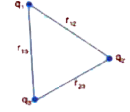
|
|
| 48. |
In the circuit shown, the resistances are given in ohms and the battery is assumed ideal withh emf equal to 3.0 volts. Q. The current passing through 3 V battery is |
|
Answer» 10 mA 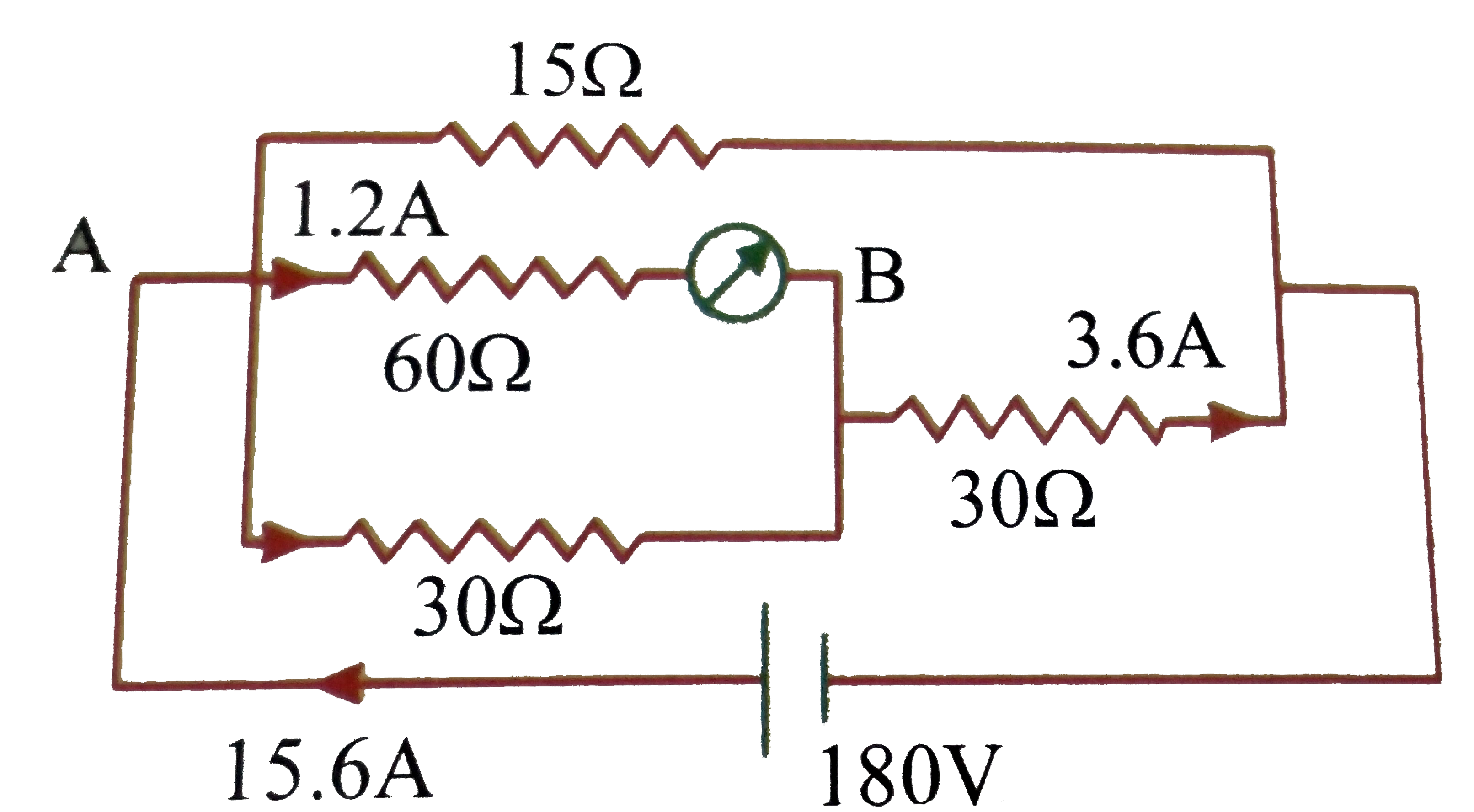 The equivalent circuit can be redrawn as shown in figure 1. From figure 1 it is obivious that power dissipated by `R_(1)` is maximum. Potential difference across `R_(2)` is `=(25)/(25+50)xx3` VOLT `=1` volt Therefore potential difference across `R_(3)` or `R_(4)=(20)/(20+30)xx1` volt `=0.4` volt ltbr. the equivalent RESISTANCE of circuit across the cell is `50+25=75` ohms Therefore current through cell is `(3)/(75)xx1000` mA `=40` mA |
|
| 49. |
Value of adiabatic bulk modulus of elasticity of helium at NTP is |
|
Answer» `1.01xx10^(5)NM^(-2)` |
|