

Saved Bookmarks
This section includes 7 InterviewSolutions, each offering curated multiple-choice questions to sharpen your Current Affairs knowledge and support exam preparation. Choose a topic below to get started.
| 1. |
निम्न में से कौन-सा कथन सत्य है? |
|
Answer» `PI`और 22/7 दोनों परिमेय हैं। |
|
| 2. |
Explain conductor (metal), insulator and semiconductor by drawing diagrams based on band. |
|
Answer» Solution :Atomic number of Si is 14. The electron configuration of silicon atom is `1s^(2)2S^(2)2p^(6)3s^(2)3p^(2)`hence K and L shells are completely filled and M shell is incomplete and there are `3s^(2)3p^(2)` valence electron in it. And atomic number of Ge is 32. The electron configuration of silicon atom is `1s^(2)2s^(2)2p^(6)3s^(2)3p^(6)3d^(10)4s^(2)4p^(2)` hence K, L and M shells are completely filled and N shell is incomplete and there are `4s^(2)4p^(2)` valence electron in it. Hence both Si and Ge semiconductor are tetravalent. There are total 4 ELECTRONS in outermost orbit of Si or Ge crystal. The maximum possible number of electron in the outer orbit is `8(2s+6p` electrons). So, for the 4N valence electrons there are 8N energy states. These 8N discrete energy levels can either form a continuousband or they may be grouped in different bands depending upon the distance between the atoms in the crystal. At the distance between the atoms in the crystal lattices of Si and Ge, the energy band of these 8N states is split apart into two which are separated by an energy gap `E_(g)`, which is shown in the figure below.  The energy band positions in a semiconductor at 0 K. The upper band called the conduction band, consists of infinitely large number of closely spaced energy states. The lower band called the valence band, consists of closely spaced completely filled energy states. The lower band which is completely occupied by the 4N valence electrons at temperature of absolute zero is the valence band and there is an upper conduction ban with 4N energy levels, which is completely empty at absolutezero temperature. The lowest energy level in the conduction band is shown as `E_(c )` and highest energy level in the valence band is shown as `E_(v)`. Above `E_(c )` and below `E_(v )` there are a large number of closely spaced energy levels as shown in figure. The gap between the top of the valence band and bottom of the conduction band is called the energy band gap (Energy gap `E_(g)`). It is known as forbidden gap. Depending on the type of material, forbidden may be small, large or zero, depending on this gap the following three types are available. Case I Metal (conductor) :  According to (i) and (ii) in figure (a) one can have a metal either when the conductionband is partially filled and the valence band is partially empty or when the conduction and valence bands overlap. When there is overlap electrons from valence band can easily move into conduction band. When the valence band is partially empty, electrons from its lower level can move to HIGHER level making conduction possible. Therefore, the resistance of such materials is low or the conductivity is high. Case II Insulator:  According to figure (b), the distance between the valence band and the conduction band is very large means energy gap `E_(g)gt 3eV`, there is no electrons in the conduction band as well as raising the temperature, electrons cannot be send from the valence band to the conduction band therefore, such a material does not carry electricity such material is called insulator. According to figure (c ), such a material has an energy gap `(E_(g) lt 3eV)`. The region between valence band and conduction band is small so at room temperature some electrons from valence band can acquire enough energy to cross the energy gap and enter the conduction band. These electrons (through small in numbers) can move in the conduction band, therefore the conduction of charge flow is reduced. Such materials are called semiconductor. Energy gap in semiconductor `E_(g) lt 3eV`. The value of `E_(g)` for Si is 1. 1 eVand the value of `E_(g)` for Ge is 0.7 eV. |
|
| 4. |
भूगर्भीय प्लेटों में कितने प्रकार की गति होती हैं? |
|
Answer» एक |
|
| 5. |
The political and constitutional changes brought about by the French Revolution were: |
|
Answer» it ENDED the ABSOLUTE monarchy. |
|
| 6. |
In the circuit as shown, it is given that R_1//R_2 = 1//2 and potential at O is V. |
|
Answer» `100//9 V` For AO , `100 -V = i_1R_1` For `BO, 100- V = i_2(2R_2)` For `OD, V-0 = i_3 (20)` For `OC , V - 50 = (i_1 + i_2/2 - i_3)(50)` `VR_1 = 50R_1 = ((3i_1)/2 xx 50 -i_3 xx 50) R_1` From EQS. (i) and (iii), `VR_(1) = 50R_(1) = 75(100-V) -2.5 VR_(1)` `3.5 VR_1 - 50R_1 = 7500 - 75V` ,brgt If `Vlt75V,` then `RHSgt0`. So, `LHS gt0` `3.5 V gt 50 ("since" R_1!=0)` `Vgt50/3.5` From Eq.(v), `V=20 V`. `70 R_1 - 50R_1 = 7500 - 1500 = 6000` `R_1 = 300` Omega `R_2 = 2R_1 = 600`Omega From Eq. (v), `3.5 VR_1 + 75V = 7500 + 50 R_1` For any value of `R_1` Vgt0. 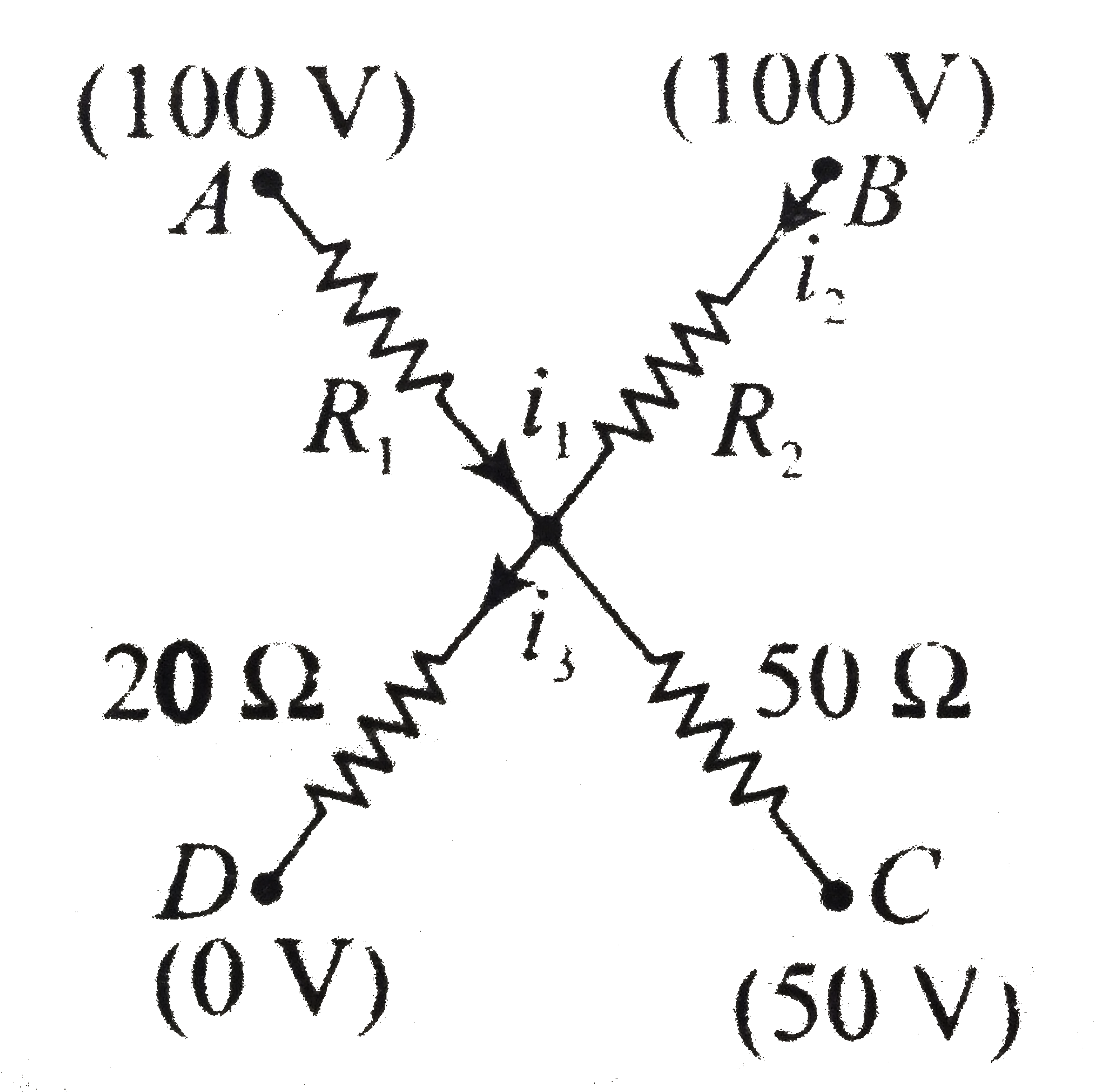
|
|
| 7. |
AB is a potentiometer wire as in figure. If the value of R is increased, in which direction will the balance point J shift ? |
|
Answer» SOLUTION :By increasing value of R current in main circuit will DECREASE hence p.d. across WIRE AB will decrease. Hence potential gradient (K) across two end of wire AB decreases. At certain time for GIVEN cell null point chauges. Hence, potential gradient `(phi)`across AB decreases according to equation, `E = phi I ` `THEREFORE phi = (E)/(I)` , Thus, with increase in I, `phi`decreases. Thus, with increase in current (I) null point wi shift toward B. |
|
| 8. |
The magnetic flux linked with a coil is phi = (4t^(2)-6t-1) milliweber. Find the emf induced in the coil at t = 2 s |
|
Answer» Solution :`PHI= 4t^(2)-6t-1` Induced emf `epsilon= dphi//dt` `epsilon= 8t-6= 8 XX 2- 6= 10 "mV"` |
|
| 9. |
The field at the surface of the earth is approximately equal to .......... . |
| Answer» Answer :10 T | |
| 10. |
Fission of nuclei is possible because the binding energy per nuclei in them |
|
Answer» increases with MASS NUMBER at low mass numbers |
|
| 11. |
In half-wave rectifier, maximum percentage of A.C. power that can be converted into D.C. power is |
|
Answer» 0.25 |
|
| 12. |
Suppose that two tanks, 1 and 2, each with a large opening at the top, contain different liquids. A small hole is made in the side of each tank at the same depth h below the liquid surface, but the hole in tank 1 has half the cross-sectional area of the hole in tank 2. (a) What is the ratio rho_(1) // rho_(2) of the densities of the liquids if the mass flow rate is the same for the two holes? (b) What is the ratio R_(v_(1))//R_(v_(2)) of the volume flow rates from the two tanks? (c) At one instant, the liquid in tank 1 is 16.0 cm above the hole. If the tanks are to have equal volume flow rates, what height above the hole must the liquid in tank 2 be just then? |
| Answer» SOLUTION :(a) 2 , (B) 1/2 , (C) 4.00 CM | |
| 13. |
Light is incident from glass s(mu=1.50) to water (mu=1.33). Find the range of the angle of deviation of which there are two angles of incidence. |
|
Answer» 0 to `COS^(-1)(8//9)` |
|
| 14. |
A parallel plate capacitor is to be designed with a voltage rating 1 kV, using a material of dielectric constant 3 and dielectric strength about 10^7V m^(-1). (Dielectric strength is the maximum electric field a material can tolerate without breakdown, i.e., without starting to conduct electricity through partial ionisation). For safety, we should like the field never to exceed, say 10% of the dielectric strength. What minimum area of the plates is required to have a capacitance of 50 pF ? |
|
Answer» SOLUTION :`:.` Dielectric strength `= 10^7 Vm^(-1)` and field up to 10% of the dielectric strength is to be applied. Hence, electric field employed E = 10% of `10^7 =10^6 V m^(-1)` As voltage rating V = 1 kV = 1000V and for a capacitor`E = V/d` `:. d = V/E = 1000/10^6 =10^(-3)m` As `C = (K epsi_0A)/d` and here`C = 50 pF = 50 xx 10^(-12) F and K = 3` `:.` Area of the plates `A = (C.d)/(K epsi_0) = (50 xx 10^(-12) xx 10^(-3))/(3 xx 8.85 xx 10^(-12)) = 1.9 xx 10^(-3) m^2 = 19 cm^2`. |
|
| 15. |
The wavelength of a microwave is 3.0 mm and it's electric field has an amplitdude of 4Vm^(1). Find the frequency of the wave |
| Answer» SOLUTION :`lambda=3.0mm=3.0xx10^(-3)` m, AMPLITUDE of magnetic field `B_0=(E_0)/C=(4)/(3xx10^8)=1.33xx10^(-7)T`. | |
| 16. |
Mercury of density rho_(m) is poured into cylinderical communicating vessels of cross-sectional area 2A and A respectively. A solid iron cube of volume V_(0) and relative density 2 is dropped into the broad vessel, and as a result the level of the mercury in it rises. Then, water is poured into the broader vessel until the mercury reaches the previous level in it. Find the height of water column if it does not submerge the block. |
| Answer» SOLUTION :`(2v_(0))/(A+v_(0).^(2//3))` PROCESS. | |
| 17. |
In the given circuit values are as follows epsilon_(1)=2V, epsilon_(2)=4V, R_(1)=1Omega and R_(2)=R_(3)=1Omega. Calcualte the Currents through R_(1), R_(2) and R_(3). |
Answer» Solution : LET `i_(1), i_(2)`are CURRENTS across `R_(1) and R_(3)`. `(i_(1)+i_(2))` is current across `R_(2)`. Their DIRECTION are taken as shown From Kirchoff.s second LAW for AGFBA LOOP `-i_(1)R_(1)-(i_(1)+i_(2))R_(2)+E_(1)=0` `i_(1)+i_(1)+i_(2)=2 rArr 2i_(1)+i_(2)=2rarr(1)` From Kirchooff.s second law for BCDEB loop `-i_(2)R_(3)-(i_(1)+i_(2))R_(2)+E_(2)=0` `i_(2)+i_(1)+i_(2)=rArr i_(2)+2i_(2)=4rarr(2)` Solving equation (1) and (2) we get `i_(1)=0A, i_(2)=2A` Thus currents across `R_(1)` is 0, while across `R_(3)` and R_(2)` are 2A each |
|
| 18. |
Use Gauss'law to derive the expression for the electric field(oversetto E)due to a straight uniformaly charged infinite line of charge density lambdaC m ^(-1) (b) Draw a graph to show the variation of E with perpendicular distance r from the line of charge. (c) Find the work done is bringing a charge q from perpendicular distancer_1 to r_2 (r_2 lt r_1) |
|
Answer» Solution :Elementary work done against the electric field for bringing a charge q SITUATED at a normal distance .r. from the line of charge is given by: `dW =- FDR =- q E dr =- q [(lambda)/( 2 pi in _0 r) ] dr ` ` therefore ` Work done in bringing the charge q from perpendicular distance `r_1 "to" r_2 ` is given as : `W= INT dW =- underset (r_1) oversetto (r_2) int (q lambda)/( 2 pi in _0 r)dr = -(qr)/( 2 pi in _0)[1N r ]_(r_1) ^(r_2)=-( q lambda)/( 2 pi in _0) 1n (r_2)/(r_1)=(q lambda )/( 2 pi in _0)1n ((r_1)/( r_2_)) ` |
|
| 19. |
i) Draw a neat labelled ray diagram of a compound microscope. Explain briefly its working. (ii) Why must both the objective and the eyepiece of a compound microscope have short focal lengths ? |
|
Answer» Solution :(i) A compound microscope consists of an objective lens O of small focal length and small aperture and an eyepiece E of small focal length but slightly greater aperture as shown in Fig. 9.84. OBJECT AB is placed at a distance slightly greater than the focal length of objective (`u_(0) gt f_(0)`) so that` A.B.`reaL inverted and magnified IMAGE A.B. is formed at a distance v0 on other side of lens. The image A.B., being situated between principal focus and optical centre of eyepiece, behaves as a real object for eyepiece. As shown in figure the final image A"B" is formed at least distance of distinct vision and is a virtual, inverted and highly magnified one. The MAGNIFYING power of a compound microscope is GIVEN by: `m=-L/f_(0) (1+D/f_(e))`  where L = distance between objective and eyepiece lenses, D = least distance of distinct vision and `f_(0)`and `f_(e)`are the focal lengths of objective and eyepiece lenses respectively. (ii) To have higher magnifying power a compound microscope must have both the objective and the eyepiece having SHORT focal length. This fact is clear from the formula for magnifying power of microscope given above. |
|
| 20. |
Suppose an electron is attracted toward the origin by a force k/r where k is a constant and r is the distance of the electron from the origin. By applying Bohr model to this system, the radius of the nth orbital of the electron is found to be r_(n) and the kinetic energy of the electron to be T_(n). Then which of the following is true? |
|
Answer» `T_(N) ALPHA 1/n, r_(n) alpha n^(2)` `RARR mv^(2)=k` `1//2 mv^(2)=k//2` K.E. is independent of n it also `mvr_(n)=(nh)/(2pi)` `r_(n) alpha n` |
|
| 21. |
A gun fires two bullets at 60° and 30° with the horizontal the bullets strike at same horizontal distance. The maximum heights for the two bullets are in the ratio : |
|
Answer» Solution :`R_(1)=R_(2)IMPLIES (u_(1)^(2)sin2xx60^@)/g=(u_(2)^(2).sin2xx30^@)/g` `implies U_(2)^(2)/u_(1)^(2)=(sqrt(3)/2)/(sqrt(3)/2)=1` `H_(1)/H_(2)=(u_(1)sin^(2)60^@)/(2G)xx(2g)/(u_(2)^(2)sin^(2)30^@)=(sqrt(3)/2)^(2)/(1/2)^(2)` `implies H_(1)/H_(2)=3/4xx4/1=3/1` |
|
| 22. |
Electric field at a point near a uniformaly charged infinite plane sheet having surface density of charge sigmais given as E= ________________ |
|
Answer» |
|
| 23. |
Thimmakka now makes a living ____________. |
|
Answer» from PRIZE money and monthly pension |
|
| 24. |
In this figure the force should be applied on mass m = 5kg so that it just won't slip is (Given that car is moving with constant acceleration a = 5 m/s and mu=0.4 |
| Answer» ANSWER :D | |
| 25. |
In the circuit as shown, it is given that R_1//R_2 = 1//2 and potential at O is V. |
|
Answer» `150 Omega` For `AO , 100 -V = i_1R_1` For `BO, 100- V = i_2(2R_2)` For `OD, V-0 = i_3 (20)` For `OC , V - 50 = (i_1 + i_2/2 - i_3)(50)` `VR_1 = 50R_1 = ((3i_1)/2 xx 50 -i_3 xx 50) R_1` From Eqs. (i) and (III), `VR_(1) = 50R_(1) = 75(100-V) -2.5 VR_(1)` `3.5 VR_1 - 50R_1 = 7500 - 75V` ,BRGT If `Vlt75V,` then `RHSgt0`. So, `LHS gt0` `3.5 V gt 50 ("since" R_1!=0) ` `Vgt50/3.5` From Eq.(v), `V=20 V`. `70 R_1 - 50R_1 = 7500 - 1500 = 6000` `R_1 = 300 Omega` `R_2 = 2R_1 = 600Omega` From Eq. (v), `3.5 VR_1 + 75V = 7500 + 50 R_1` For any VALUE of `R_1 Vgt0`. |
|
| 26. |
In the circuit as shown, it is given that R_1//R_2 = 1//2 and potential at O is V. |
|
Answer» `80 Omega` For `AO , 100 -V = i_1R_1` For `BO, 100- V = i_2(2R_2)` For `OD, V-0 = i_3 (20)` For `OC , V - 50 = (i_1 + i_2/2 - i_3)(50)` `VR_1 = 50R_1 = ((3i_1)/2 xx 50 -i_3 xx 50) R_1` From Eqs. (i) and (iii), `VR_(1) = 50R_(1) = 75(100-V) -2.5 VR_(1)` `3.5 VR_1 - 50R_1` = 7500 - 75V` ,brgt If `Vlt75V,` then `RHSgt0`. So, `LHS gt0` `3.5 V GT 50` ("since" R_1!=0)` `Vgt50/3.5` From Eq.(v), `V=20 V`. `70 R_1 - 50R_1 = 7500 - 1500 = 6000` `R_1 = 300 Omega` `R_2 = 2R_1 = 600Omega` From Eq. (v), `3.5 VR_1 + 75V = 7500 + 50 R_1` For any value of `R_1` Vgt0. |
|
| 27. |
What is Magnetic field ? |
|
Answer» Solution :(i) Magnetic field is the REGION or space around every magnet within which its influence can be FELT by keeping ANOTHER magnet in that region. (ii) The magnetic field `vecB ` (or) magnetic inductor at a point is defined as a force experienced by the bar magnet of UNIT pole strength. (iii) It is also defined as the total number of magnetic lines of force crossing per unit area normally through through a materials . |
|
| 28. |
One mole ideal monatomic gas is taken at temperature of 300 K. If volume is doubled keeping its pressure constant. The change in the internal energy is |
|
Answer» 450 R `therefore (V_(i))/(T_(i))=(V_(F))/(T_(f))` or `T_(f)=(V_(f))/(V_(i))T_(i)=2T_(i)=2xx300=600K` `therefore DeltaU=(f)/(2)nRDeltaT` (f = degrees of freedom) `=(3)/(2)xx1xxRxx(600-300)=450R` |
|
| 29. |
Consider the diffraction pattern for a small pinhole. As the size of the hole is increased |
|
Answer» the size DECREASES. Here power of radiation made incident on the slit is constant. Hence, after passing through slit, if such light is made incident on smaller region then naturally, intensity obtained in that region would be more because `I=(P)/(A)implies` when P = constant, `Iprop(P)/(A)implies` If A decreases then I A must increase `implies`Option (B) is correct. |
|
| 30. |
Inside a conductor electrostatic field is zero'. Explain. |
|
Answer» SOLUTION :In the static situation, when there is no CURRENT inside or on the surface of the conductor, the electric field is zero everywhere inside the conductor. A conductor has free electrons, the free charge carriers would EXPERIENCE force and drift . In the static situation, the free charges have so distributed themselves that the electric field is zero everywhere inside. 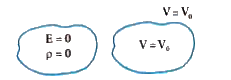
|
|
| 31. |
Figure shows three blocks of mass m each hanging on a string passing over a pulley. Calculate the tension in the string connecting A to B and B to C? |
|
Answer» SOLUTION :Net FORCE = 2mg -mg = mg Total mass = m + m + m = 3m Acceleration , ` a=(mg)/(3m) =(G)/(3)` CONSIDERING block A, `T_1 - mg = ma or T_1 = mg + ma(or)` `T_1 = mg + m((g)/(3)) (or)` `T_1 = (4)/(3) mg ` , Considering block C , `mg-T_2 = ma (or) T_2 = mg-ma(or)` `T_2 = mg - (mg)/(3) = (2)/(3) mg ` . 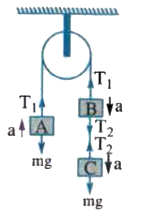
|
|
| 32. |
An imaginary line joining the optical centre of the eye lens and the yellow point is called as |
|
Answer» PRINCIPAL AXIS |
|
| 33. |
An astronaut is floating in space near her shuttle when she realizes that the cord that's supposed to attach her to the ship has become disconnected. Her total mass (body+suit+equipment) is 91kg. She reaches into her pocket, finds a 1 kg metal tool, and throws it out into space with a velocity of 6m/s directly away from the ship. if the ship is 10 m away, how long will it take her to reach it? |
|
Answer» Solution :Here, the ASTRONAUT+tool are the system. Because of conservation of linear momentum ltbgt `m_("astronaut")v_("astronaut")+m_("tool")v_("tool")=0` `m_("astronaut")v_("astronaut")=-m_("tool")v_("tool")` `v_("astronaut")=-(m_("tool"))/(m_("astronaut"))v_("tool")` `=-(1kg)/(90KG)(-6m//s)=(1)/(15)m//s` Using distance=rate`xx`time, we FIND `t=(d)/(v)=(10M)/((1)/(15)m//s)=150s=2(1)/(2)`min |
|
| 34. |
The angle of diffraction of the second order maximum of wavelength 5xx10^(-5) cm is 30^(@) in the case of a plane transmission grating. How many lines are there in 1 cm of the grating surface. |
|
Answer» |
|
| 35. |
Thesetwhichrepresentstheisotope , isobar, isotonerespectivelyis |
|
Answer» a) `(""_(1)H^(2),""_(1)H^(3) ), (""_(79)Au^(197 ), ""_(80)Hg ^(198) ) and (""_(2) He^(3 ) , ""_(1) H^(2))` |
|
| 36. |
A uniform tube of length 60 cm stands vertically with its lower end dipping into water. When the length above water successively taken at 14.8 cm and 48.0 cm, the tube responds to a vibrating tuning fork of frequency 512 Hz. Find the lowest fi-equency to which the tube will respond when it is open at both ends. |
|
Answer» `48 - 14.8 = ((lambda)/(2))` `lambda` = 66.4 cm. THUS for given situaton wavelength is `lambda` is `lambda` = 64.4 cm so speed of sound is `v = nlambda = 512 xx 0.664` = 339.97 m/s Fundamental frequency of tube is `n_(0) = (v)/(2l) = (399.97)/(2 xx 0.6)` = 283.30 Hz. |
|
| 37. |
A current carrying power line carries current from west to east. The direction of magnetic field at a short distance, above it, is |
|
Answer» NORTH to South |
|
| 38. |
The following graph shows current versus voltage values of some unknown conductor. What is the resistance of this conductor? |
| Answer» ANSWER :A | |
| 39. |
A thin conductor rod is placed between two unlike point charges +q_(1), and -q_(2). Then |
|
Answer» Due to charge INDUCED on the rod AB the POINT charge `+q_(1)`, will be acted upon, in addition to the point charge `-q_(2)`, by the induced charges formed at the ends of the rod. |
|
| 40. |
In winter, the temperature inside the wall of a room as compared to the temperature of air is the room is |
|
Answer» LOWER |
|
| 41. |
Two identical spheres of mass m and charge q are suspended from a common point by two threads of the same length l and it is found that threads make an angle theta with the vertical when the spheres are in equilibrium . Calculate the value of q. |
Answer» Solution :The force acting on the charged particles suspended from the strings is shown in the figure. There will be tension in the wire due to the force of repulsion between the two charges. At equilibrium , for charge at A, vertical component of tension in the string will be balanced by the weight of the charge . `T cos theta =MG` …(i) Where, `cos theta =x/l` Also, `T SIN theta =F_E =1/(4piepsilon_0)(q.q)/(2X)^2`, where `F_E` is the force of repulsion between charges at A and B . `rArr T sin theta =F_E = 1/(4piepsilon_0)q^2/(2l cos theta)^2`…(ii) (`because x = l cos theta` ) On dividing equation (i) by (ii) , we get `(sin theta)/(cos theta)=1/(4piepsilon_0)xxq^2/(4l^2 cos^2 theta)xx1/(mg)` `rArr q^2=16 pi epsilon_0 mg l^2 sin^2 theta XX tan theta ` `q=4l sin theta sqrt(piepsilon_0 mg tan theta)` |
|
| 42. |
Differentiate between polarisedandunpolarised light |
Answer» SOLUTION :
|
|
| 43. |
Four particles alpha-particle, deuteron and electron and a CI^(-) ion enter in a transverse magnetic field perpendicular to it with same kinetic energy. Their paths are as shown in figure. Now match the following two columns. |
|
Answer» <P> |
|
| 44. |
Longitudinal waves do not xhibit |
|
Answer» REFRACTION |
|
| 45. |
Assertion: Intensity of magnetic field due to a solenoid near its ends is only half of its magnitude inside the solenoid. Reason: If solenoid is made very long then magnetic field inside the solenoid becomes uniform. |
|
Answer» If both ASSERTION and REASON are correct and reason is correct EXPLANATION of the assertion |
|
| 46. |
In a refracting type telescope, the distance between objective and eyepiece is 25 cm for normal adjustment. Find the focal lengths of the objective and eyepiece if the magnifying power of the telescope is 10. |
| Answer» SOLUTION :22.73 CM, 2.27 cm | |
| 47. |
In figure a point source S is placed at a height h above the plane mirror in a medium of refractive index mu. Find the distance between the images. |
| Answer» Solution :Separation between two IMAGES `(2H)/( MU)` | |
| 48. |
A thin foil of certain stable isotope is irradiated by thermal neutrons falling normally on its surface. Due to the capature of neutrons a radioonuclide with decay constant lambda appears. Find the law describing, accumulation of that radionuclide N(t) per unit area of the foil's surface. The neutron flux density is J, the number of nuclei per unit area of the foil's surface is n, and effective cross-section of formation of active nuclei is sigma. |
|
Answer» SOLUTION :Rate of FORMATION of the radionuclide is `n.J.sigma` PER unit area per.sec. Rate of DECAY is `lambda N`. Thus`(dN)/(dt)=n.J.sigma-lambda N` per unit area per second Then `((dN)/(dt)+lambdaN)E^(lambda t)=n.J.sigma^(lambda t)` or `(d)/(dt)(Ne^(lambda t))=n.J.sigma.e^(lambda t)` Hence `Ne^(lambda t)= Const+(n.J.sigma)/(lambda)e^(lambda t)` The number of radionuclide at `t=0` whenthe process starts is zero. So constant`=-(n.J.sigma)/(lambda)` Then `N=(n.J.sigma)/(lambda)(1-e^(-lambda t))` |
|
| 49. |
Characteristic X-rays are produced due to .... |
|
Answer» transfer of momentum in collision of electron with target ATOMS |
|
| 50. |
A force vector applied on a mass is represented by vec(F)=6hati + 8hatj+10hatk and it accelerates it with 1 ms^(-1) . What will be the mass of the body ? |
|
Answer» `10sqrt(2)` kg `|vec(F)\=[6^(2)+8^(2)+10^(2)]^(1//2)=(200)^(1//2)` `m=|vec(F)|/|a|=(200)^(2)/1=10sqrt(2)kg` |
|