Saved Bookmarks
This section includes 7 InterviewSolutions, each offering curated multiple-choice questions to sharpen your Current Affairs knowledge and support exam preparation. Choose a topic below to get started.
| 1. |
What is wave theory of light? |
|
Answer» Solution :(i) Light' is a disturbance from a source that travels as longitudinal mechanical waves through the ether medium that was presumed to pervade all space as mechanical WAVE REQUIRES medium for itspropagation. (ii) The wave theory COULD successfully EXPLAIN phenomena of reflection, REFRACTION, interference and diffraction of light. |
|
| 2. |
A coil of resistance R and inductance L is joined with a battery of E volt. The current passing through it will be ……….. |
|
Answer» `E/R` `therefore` Impedance of circuit `therefore I=E/"|Z|" "" |Z|=R` `therefore I=E/R` |
|
| 3. |
From quantisation of angular momentum one gets for hydrogen atom, the radius of the n^th orbit as r_n=((n^2)/(m_e))((h)/(2pi))^2((4pi^2epsilon_0)/(e^2)) For a hydrogen like atom of atomic number Z, |
|
Answer» the radius of the first orbit will be the same As the value of ATTRACTION between a proton and electron is proportional to `e^2`, for an ion with a single electron, `(e^2)/(4piepsilon_0)` is REPLACED by `(Ze^2)/(4piepsilon_0)` i.e. `r_(n)prop(n^2)/(Z)`. |
|
| 4. |
The correct curve showing maximum emissive power E_(m) and absolute temperature T is : |
|
Answer»
|
|
| 5. |
Three capacitors of capacity 2muF, 4muF and 6muF are connected first in series and then in parallel. Find the ratio of equivalent capacities in the two combination. |
|
Answer» <P> |
|
| 6. |
A gaivanometer of resistance 100 Omega contains 100 division. It gives a deflection of one division on passing a current of 10^(-4)A. Find the resistance to be connected to it, so that it becomes a coltmeter of range 10V. |
|
Answer» `(500)/(9) alpha ` `10=0.01 (R+ 100) IMPLIES R =900 OMEGA` |
|
| 7. |
A moderator is used in nuclear reactors in order to : |
|
Answer» SLOW down the SPEED of the neutrons |
|
| 8. |
In the following common-emitter circuit, beta = 100 and V_(CE) = 7 . If V_(BE) is negligible, then the base current is |
|
Answer» 0 . 0 1 mA Given , `beta = 100, V _(CE) = 7V, V_(BE) = 0 ` Applying KVL `RARR - 15 + 2Kl_(C) + V_(CE) = 0 ` `rArr - 15 + 2KL_(C) + 7 = 0 rArr I_(C) = 4 mA` `:.`Common-emitter CURRENT gain , `beta = (I_(C))/(I_(B))` or`I_(B) = (I_(C))/(beta) = (4 xx 10^(3))/(100) = 0 . 0 4mA` 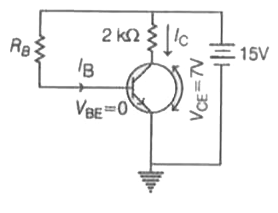
|
|
| 9. |
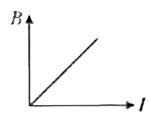
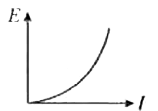
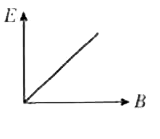
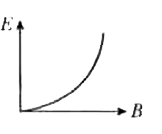
If B and E denote induction of magnetic field and energy density at the midpoint of a long solenoid carrying a current I, then which of the graph/graphs, shown in the following figure, is/are correct? |
|
Answer»
|
|
| 10. |
A body at rest explodes and breaks up into 3 pieces. Two pieces having equal mass, fly off perpendicular to each other with the same speed of 30 in/sec. The 3rd pieces has 3 times the mass of each of the other pieces. Find the magnitude and direction of its velocity immediately after the explosion . |
Answer» Solution :For momentum CONSERVATION in each direction of motion of the smaller pieces, 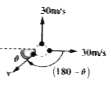 `3mv cos theta = m xx 30` `3m V sin theta = m xx 30` These two relations give, `TAN theta =1` and `v=10sqrt(2)`m/s The 3rd PIECE of mass 3m will go making an angle (180- `theta`) = 135° relative to either piece of equal masses. |
|
| 11. |
In Ques, 126, ratio of the wavelength of incident light to the de-Broglie wavelength of the fastest electron emitted is : |
|
Answer» 100 `E=(hc)/(lambda)` `:. lambda=(hc)/(E)=(6.63xx10^(-34)xx3xx10^(3))/(5.0xx1.6xx10^(-19))` `=2486xx10^(-10)m` If v is velocity of fastest photoelectron, then Using `E=w+(1)/(2) mv^(2)` We find `v= sqrt((3.2xx10^(-19)xx2)/(m))` Then momentum of photoelectron `mv=m sqrt((3.2xx10^(-19)xx2)/(m))` `= sqrt(3.2xx10^(-19)xx2m)=7.63xx10^(-25)kg m//s` de-Brogli wavelength of the tastest electrons `lambda_(D)=(h)/(mv)=(6.63xx10^(-34))/(7.63xx10^(-25))=8.689xx10^(-10)m` `:. "Required ratio"(lambda)/(lambda_(D))=(2468xx10^(-10))/(8.689xx10^(-10))=286` |
|
| 12. |
Polarisation is the distortion of the shape of the shape of an anion by the cation. Which of the following statements is correct ? |
|
Answer» Maximum polarisation is DONE by a CATION of HIGH charge |
|
| 13. |
Draw the magnetic field lines distinguishing diamagnetic and paramagnetic materials . Give a simple explanation to account for the difference in the magnetic behaviour of these materials . |
|
Answer» |
|
| 14. |
A block of mass m is attached to three springs A,B and C having force constants k, k and 2k respectively as shown in figure. If the block is slightly oushed against spring C. If the angular frequency of oscillations is sqrt((Nk)/(m)), then find N. The system is placed on horizontal smooth surface. |
|
Answer» |
|
| 15. |
Questions numbers 149-150 are based on the following paragraph : A nucleus of mass M + Deltam is at rest and decays into two daughter nuclei of equal mass M/2 each. Spped of light is c. 149. The speed of daughter nuclei is : |
|
Answer» `csqrt((DELTAM)/(M + Deltam))` Energy released = `Deltamc^(2)` or `2KE = DeltaMC^(2)` ` 2 xx(1)/(2)((M)/(2))V^(2) = Deltamc^(2)` `THEREFORE V = sqrt((2Deltam)/(M))c^(2) = csqrt((2Deltam)/(M))` |
|
| 16. |
A thermodynamic process ofone mole ideal monatomic gas 2.is shown in figure. The 4 efficiency of cyclic process ABCA will be |
|
Answer» `25%` Heat supplied` = Q_(AB) + Q_(BC) = C_(V) T_(0) + C_(p)2T_(0)` ` = 13/2 RT_(0) = 13/2 P_(0) V_(0) [:. P_(0)V_(0) = RT_(0)]` ` :. ` EFFICIENCY ` = (1/2 P_(0)V_(0))/(13/2 P_(0) V_(0)) xx 100 "" (. :. P_(0) V_(0) = RT_(0))` ` = 1/13 xx 100 = 7.7 %` |
|
| 17. |
The maximum horizontal ragne of a projectile for a given velocity v is |
|
Answer» `v^2/(2G)` |
|
| 18. |
Advantages of cassegrain telescope is/are |
|
Answer» FREE of CHROMATIC aberration |
|
| 19. |
Two polaroids are placed in the path of unpolarised light beam of intensity I_(0) such that no light is emitted from the second polarisation. If a third polaroid whose polarisation axis makes an angle theta with that of the first polaroid is placed between the polaroids, then intensity of light emerging from the last polaroid is |
|
Answer» `((I_(0))/(8))sin^(2) 2theta` `therefore` After first polarister, intensity `I_(0)=I_(0)//2` After second polariser, intensity `I_(2)=(I_(0))/(2) cos^(2) theta` (MALUS law) After third polariser, intensity `I_(3)=(I_(0))/(2) cos^(2) theta cos^(2) (90^(@)-theta)` (because this is at `90^(@)` angle from first polariser) `rArr I_(3) =(I_(0))/(2) cos^(2) theta sin^(2) theta=(I_(0))/(8)(2 sin theta cos theta)^(2)=(I_(0))/(8) sin^(2) 2 theta` |
|
| 20. |
One requires an energy E_n to remove a nucleon from nucleus and an energy E_c to remove an electron from an atom, then |
|
Answer» `E_n = E_c` |
|
| 21. |
If g is the acceleration due to gravity on the surface of the earth, the gain in potential energy of an object of mass m raised from the earth's surface to a height equal to the radius R of the earth is |
|
Answer» Solution :Gravitational potential ENERGY of an object of mass ms at any point at a distance r from the centre of the earth is `U=-(GMm)/(r )` Where M is the mass of the earth. At the surface of the earth, r=R `:. U_(1)=-(GMm)/(R )=-mgR(.: g=(GM)/(R^(2)))""`..(i) At a height R from the surface of the earth, r=2R `:. U_(2)=-(GMm)/(2R )=-(mgR)/(2)""` ....(ii) Gain in potential energy, `DeltaU=U_(2)-U_(1)` `DeltaU=-(mgR)/(2)-(-mgR)`(Using (i)and (ii)) `=(mgR )/(2)`. |
|
| 22. |
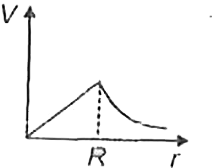
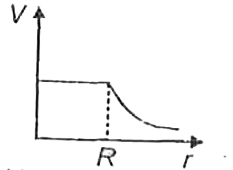
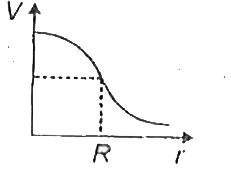
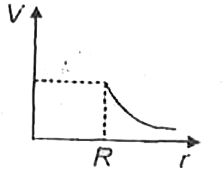
Which graph best represents the variation of electric potential as a function of distance from the centre of a uniformly charged solid sphere of charge of radius R ? |
|
Answer»
|
|
| 23. |
What is de-Broglie wavelength of electron having energy 10 KeV ? |
|
Answer» 0.12 `Å` |
|
| 24. |
The ratio of size of image to the size of object is called ? |
| Answer» SOLUTION :LINEAR MAGNIFICATION | |
| 25. |
The collection of intelligent students in a class is : |
|
Answer» a NULL set |
|
| 26. |
Calculate potential on the axis of a disc of radius R due to a charge Q uniformly distributed on its surface. |
|
Answer» <P> Solution :Let us consider a point P on the axis of the disc at a distance x from the centre of the disc. Let the disc is divided into a numerous CHARGED rings as shown in figure.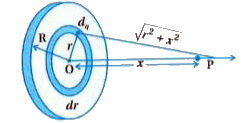 Let radius of ring r width dr and charges DQ `:. Sigma dA = sigma2 pi rdr ` Potential at P `dV = (kdq)/(r)` charge on the ring dq = `+sigma [ pi (r+dr)^(2)-pir^(2)]` `:. dq = +sigma pi [ (r+dr)^(2)-r^(2)]` `= +sigma pi [ r^(2)+2rdr +dr^(2)-r^(2)]` `= +sigma pi [ 2 rdr +dr^(2)]` Neglecting `dr^(2)` as dr is very small dq = `2 pi r sigma dr ` and dV = `(kdq)/(sqrt(r^(2)+x^(2)))` `= (kxx2pir sigmadr)/(sqrt(r^(2)+x^(2)))` [From equation (2)] `:. V = 2 pi k sigma int _(0)^(R) (rdr)/(sqrt(r^(2)+x^(2)))=2piksigmaint_(0)^(R)( r^(2)+x^(2))(-1//2)rdr` `:. V= 2PI ksigma[(r^(2)+x^(2))^(1//2)-x]_(0)^(R)` `:. V = (2pi sigma)/(4 pi in_(0))[(R^(2)+x^(2))^(1//2)-x]` `:. V = (2pixxQ)/(4pi in_(0)xxpi R^(2))[sqrt((R^(2)+x^(2))^(1//2))-x]` `:. V =(2Q)/(4pi inn_(0)R^(2))[sqrt((R^(2)+x^(2))^(1//2))-x]` |
|
| 27. |
(a) In a photoelectric experiment, the collector plate is at 2.0 V with respect to the emitter plate made of copper (phi =4.5 eV) . The emitter is illuminated by a source of monochromatic light of wavelength 200 nm. Find minimum and maximum kinetic energy of the photoelectrons reaching the collector. (b) A small piece of cesium metal (phi =1.9 eV) is kept a distance of 20 cm from a large metal plate having a charge density of 8.85xx10^(-9) C//m^(2) on the surface facing the cesium piece. A monochromatic light of wavelength 400 nm is incident on the cesium piece. Find minimum and the maximum kinetic energy of the photoelectrons reaching the large metal plate. Neglect any change in the electric field due to the presence of small piece of cesium. |
|
Answer» Solution :(a) Energy of INCIDENT photon `E=(1242)/(lambda(nm))eV =(1242)/(200) =6.21 eV` `E =phi + K_(max)` `6.21 =4.5 + K_(max)` `K_(max) =1.71 eV` 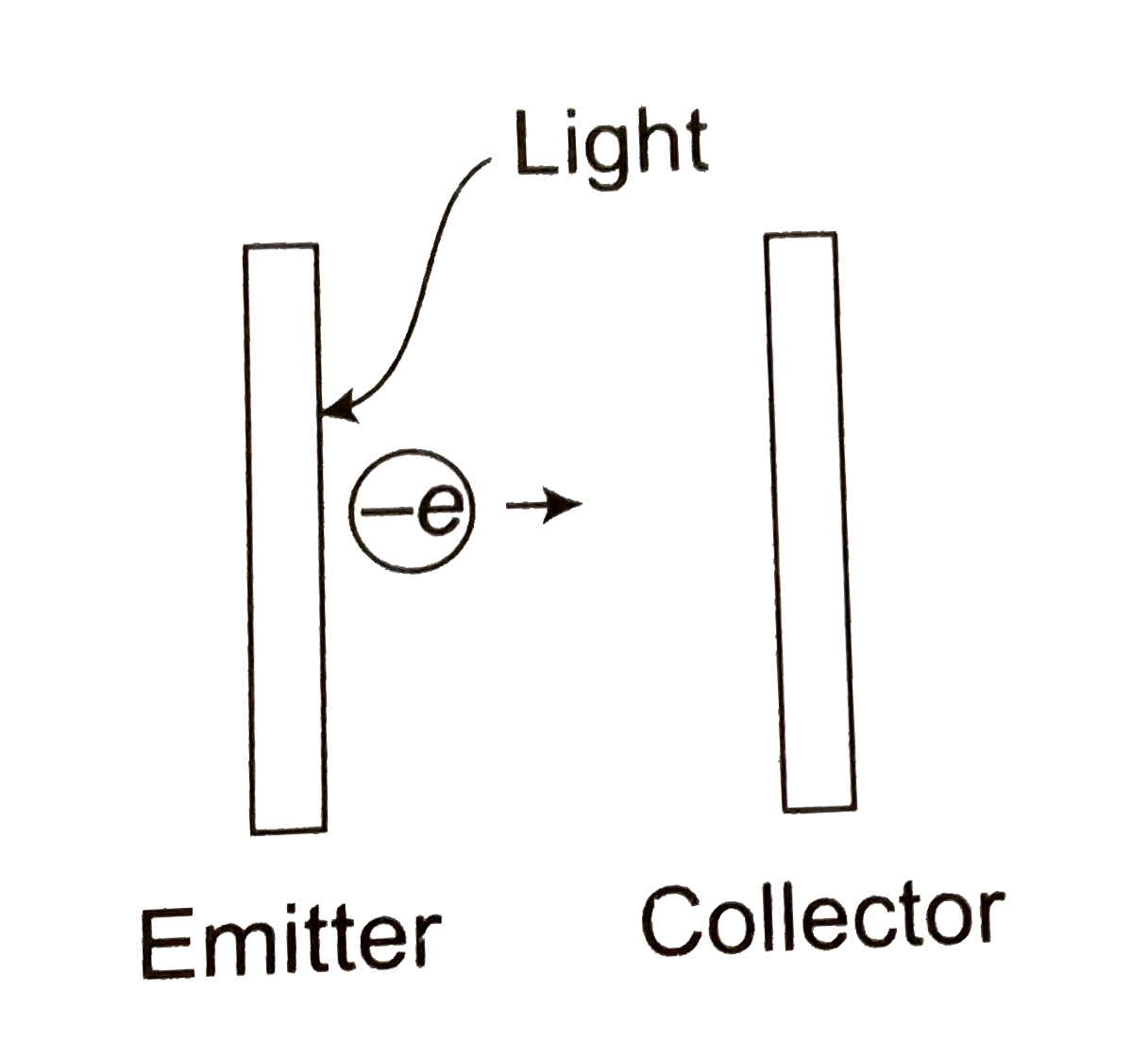 When electron reaches to collector plate, it is accelerated by potential 2 V. Energy of electron emitted by emitter is as FOLLOWS: `K_(min) =0, K_(max) =1.71 eV` When electron reaches to collector its energy. (i) `0+2 =2 eV =K'_(min)` (ii) `1.71 + 2 = 3.71 eV =K'_(max)` (b) 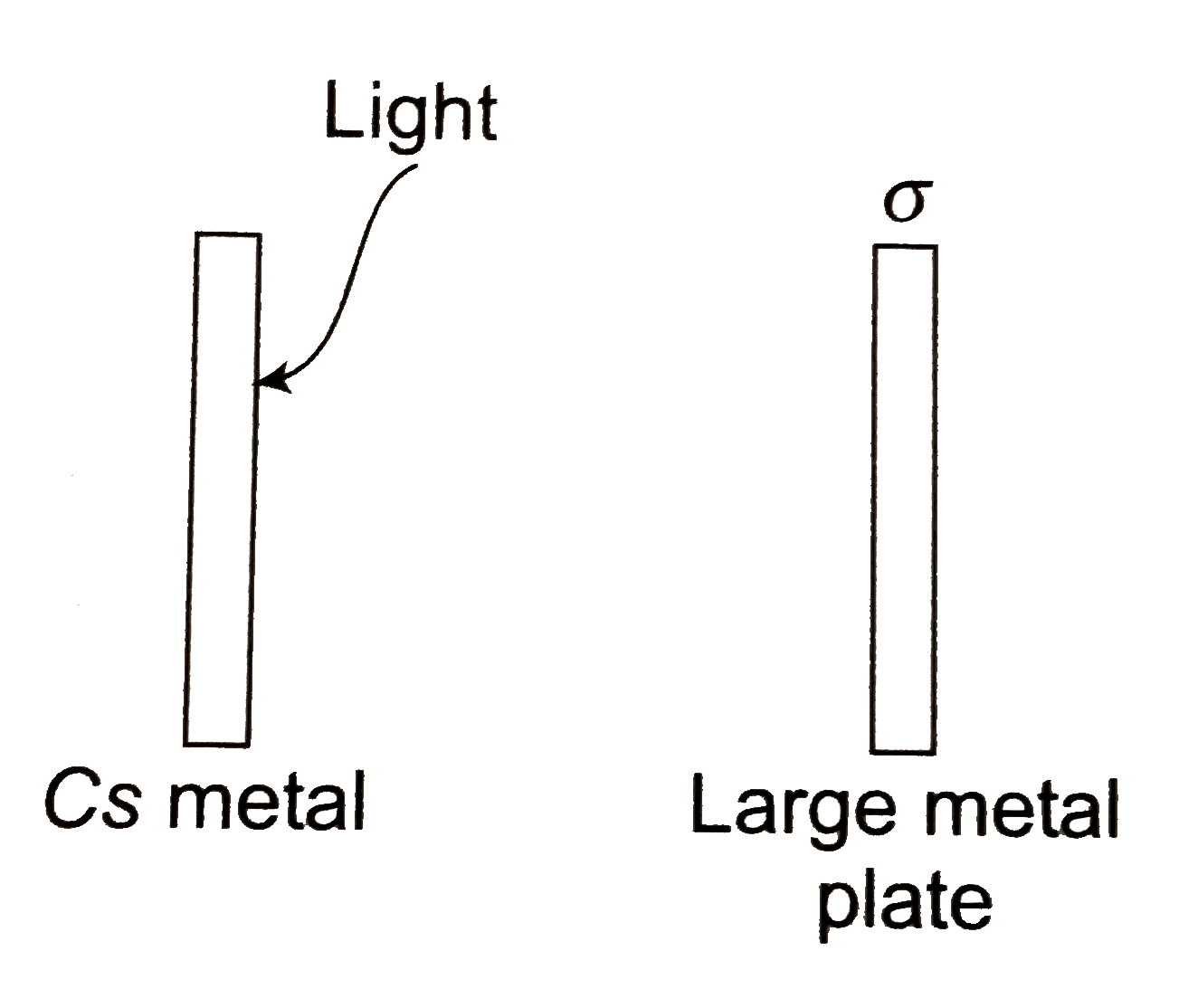 Incident energy of photon `E=(1242)/(lambda(nm))=(1242)/(400) =3.1 eV` `E=phi + K_(max)` `3.1 =1.9 + K_(max) implies K_(max) =1.2 eV` If electrons are emitted with zero VELOCITY, `K_(min) =0` 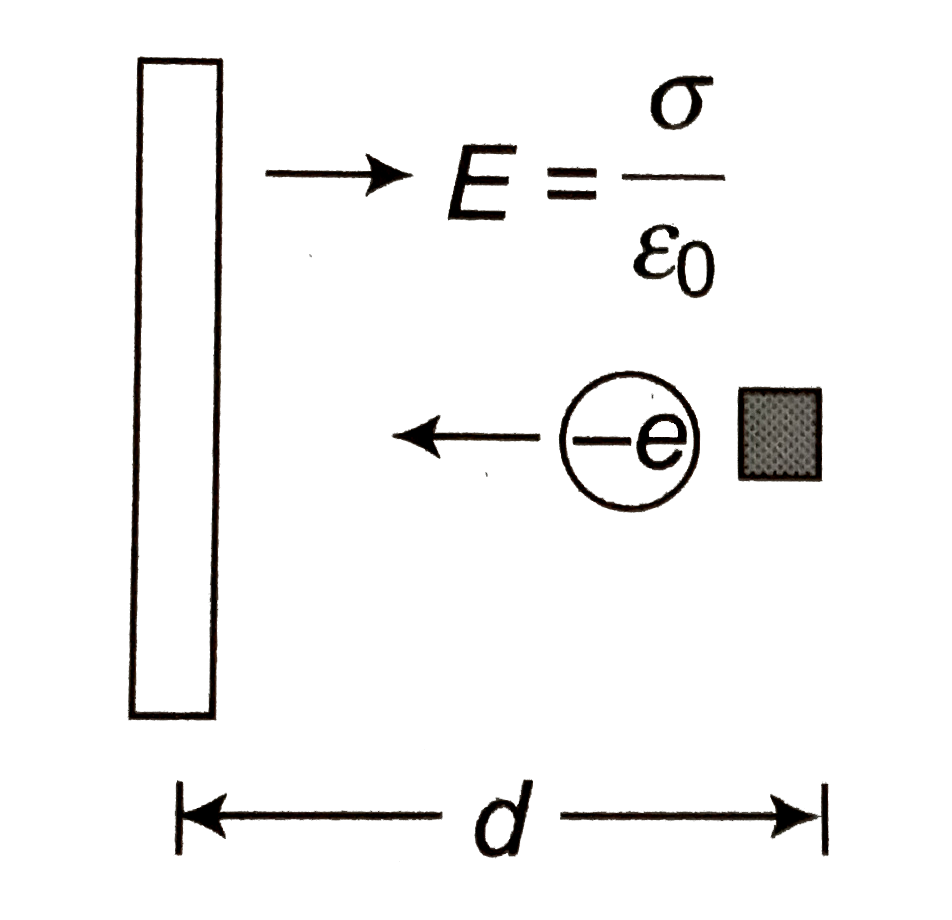 `p.d. V= Ed =(SIGMA)/(in_(0))d` `=(8.85xx10^(-9))/(8.85xx10^(-12))xx0.2=20 V` Due to this potential, electron is accelerated towards large plate, energy GAINED by electron due to this p.d. = 20 eV (i) `0+20 =20 eV =K'_(min)` (ii) `1.2+20 =21.2 eV =K'_(max)` |
|
| 28. |
For circuits used for transporting electric power, a low power factor implies large power loss in transmission. Explain. |
|
Answer» Solution :(a) We know that `P = I V cosphi` where `cosphi` is the power factor. To supply a given power at a given voltage, if `cosphi`is small, we have to increase current accordingly. But this will lead to large power loss `(I^(2)R)` in transmission. (b)Suppose in a circuit, current I lags the voltage by an angle `PHI`. Then power factor `cosphi =R//Z`. We can improve the power factor (tending to 1) by making Z tend to R. LET us understand, with the help of a phasor diagram (Fig.) how this can be achieved. Let us resolve I into two components. `I_(p)` along 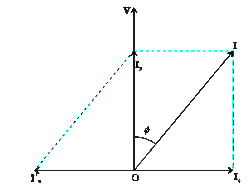 the applied voltage V and `I_(q)`perpendicular to the applied voltage. Iq as you have learnt in Section 7.7, is called the wattless component since corresponding to this component of current, there is no power loss. `I_(p)` is known as the power component because it is in phase with the voltage and corresponds to power loss in the circuit. It’s clear from this analysis that if we want to improve power factor, we MUST completely neutralize the lagging wattless current `I_(q)` by an equal leading wattless current `I._(q)`. This can be done by connecting a capacitor of APPROPRIATE value in parallel so that `I_(q)` and `I._(q)`cancel each other and P is effectively `I_(p) V`. |
|
| 29. |
A charged oil drop is suspended in uniform field of 3 xx 10^(4) V//m so that it neither falls nor rises. The charge on the drop will be (take the mass of the charge = 9.9 xx 10^(-15)kg "&" g= 10 m//s^(2)) |
|
Answer» `3.3 XX 10^(-18)C` |
|
| 30. |
The wavefunction of a particle of mass m in a unidimensional potential field U(x)=kx^(2)//2 has in the ground state the form Psi(x)=Ae^(-alphax^(2)), where A is a normalization factor and alpha is positive constant. Making use of a Schrodinger equation, find the constant alpha and the energy E of the particle in this state. |
|
Answer» Solution :The Schrodinger equation is `(d^(2)Psi)/(dx^(2))+(2m)/( ħ^(2))(E-(1)/(2)kx^(2))Psi=0` we are GIVEN `Psi=Ae^(-alphax^(2)//2)` Then `Psi''= -alphaxAe^(-alphax^(2)//2)` Substituting we find that following equation must hold `[(alpha^(2)x^(2)-prop)+(2m)/( ħ^(2))(E-(1)/(2)kx^(2))]Psi=0` since `Psi!=0`, the bracket must vanish identicall. This means that the cofficient of `x^(2)` as well the term independent of `x` must vanish. we get `prop^(2)=(mk)/( ħ^(2))` and `prop=(2ME)/( ħ^(2))` Putting `k//m= OMEGA^(2)`, this LEADS to `prop=(m omega)/( ħ^(2))`and `E=( ħ^(2)omega)/(2)` |
|
| 31. |
Which of the following is a vector quantity ? |
|
Answer» ELECTRIC charge |
|
| 32. |
स्थिर विद्युतीय क्षेत्र होता है |
|
Answer» संरक्षी |
|
| 33. |
Communication is the process of : |
|
Answer» EXCHANGE of INFORMATION from a CARRIER is KNOWN as |
|
| 34. |
A thin equiconvex lens is made of glass of refractive index 1.5 and its focal length of 0.2m. If it actsas a concave of 0.5 m focal when dipped in a liquid, the refractive index of liquid is |
|
Answer» `17/8` |
|
| 35. |
A particle moving with a velocity equal to 0.4 ms^(-1) is subjected to an acceleration of 0.15 ms^(-2) for 2 seconds in a direction at right angles to the direction of motion. The magnitude of the final velocity is |
|
Answer» `0.3 MS^(-1)` |
|
| 36. |
If the tension and diameter of a sonometer wire of fundamental frequencyvare doubled and density is halved, then its fundamental frequency will become |
|
Answer» v/4 Since TENSION and DIAMETER both are doubled, so frequency remains the same. Correct chocie is b. |
|
| 37. |
A carnot engine operates between 227^@C and 127^@C. It absorbs 80 kilocalories of heat from the source. What is the work done in joule ? |
|
Answer» `4.5xx10^4J` |
|
| 38. |
A magnetic needle is kept in a non-uniform magnetic field. It experiences ...... . |
|
Answer» a FORCE and a torque |
|
| 39. |
Give unit of torsional constant. |
|
Answer» `(Jrad)/m` `thereforek=tau/phi` `therefore` Unit of `k=(Nm)/(rad)` |
|
| 40. |
12 positive charges of magnitude q are placed on a circle of radius R in a manner that they are equally spaced. A charge Q is placed at the centre. If one of the charges q is removed, then the force on Q is - |
|
Answer» ZERO |
|
| 41. |
Give the magnitude and direction of the net force acting on a stone of mass 0.1 kg, [Neglect air resistance throughout]. a) just after it is dropped from the window of a stationary train b) just after it is dropped from the window of a train running at a constant velocity of 36 km/h. c) just after it is dropped from the window of a train accelerating with 1 ms^(-2) d) lying on the floor of a train which is accelerating with 1 ms^(-2) , the stone being at rest relative to the train. |
|
Answer» Solution : Here, `m = 0.1 kg, a = +G = 9.8 m//s^(2)` , Net force, `F = ma = 0.1 xx 9.8 = 0.98 N` This force acts vertically DOWNWARDS, B) When the train is running at a constant velocity its acc. = 0. No force acts on the stone due to this motion. Therefore, force on the stone F = weight of stone = mg = `0.1 xx 9.8 = 0.98N` This force also acts vertically downwards. c) When the train is accelerating with 1 m/s2, an additional force `F. = ma = 0.1 xx 1 = 0.1N` acts on the stone in the horizontal direction. But once the stone is dropped from the train, `F_1` becomes zero and the net force on the stone is `F = mg = 0.1 xx 9.8 = 0.98N`, acting vertically downwards. d) As the stone is lying on the horizontal direction of motion of the train. Note the weight of the stone in this case is being BALANCED by the normal REACTION. |
|
| 42. |
In YDSE arangement shown in figure, fringes are seen on screen using monochromatic source S having wavelength 3000 overset(@)Delta (in air). S_(1) and S_(2) are two slits separate by d = 1mm and D = 1m . Left of slits S_(1) and S_(2) medium of refractive index mu_(1) = 2 is presernt refractive index mu_(2) = (3)/(2) is present. A thin slab of thickness 't' is placed in front of S_(1) . The refractive index of slab mu_(3) varies with distance from its starting face as shown in figure. If the thickness of the slab is selected 1mu m , then the position of the central maxima will be (y - coordinate) |
|
Answer» `(1)/(3)mm`  AREA `(A) = mu_(3) (dx) = ((1+3)t)/(2) = 2T` From the above equation `O = 1XX10^(-6) + (3)/(2) (yd)/(D) -0.5t(3)/(2)xx(yd)/(D) = 0.5t-1xx10^(-6)` `= 0.5xx10^(-6)-1xx10^(-6) = -0.5xx10^(-6)` `y = -(10^(-6))/(2)xx(2)/(3)xx(D)/(d) = (-10^(-6)XX1)/(3xx1xx10^(-3)) = -(1)/(3)xx10^(-3)` `y= -(1)/(3)mm` |
|
| 43. |
A uniform ring of mass m is placed on a rough horizontal fixed surface as shown in the figure. The coefficient of friction between the left part of the ring and left part of the horizontal surface is mu_(1)=0.6pi and between right half and the surface is mu_(2)=0.2pi. At the instant shown, now the ring has been imparted an angular velocity in clockwise sense in the figure shown. At this moment magnitude of acceleration of centre O of the ring (in m//s^(2)) is (take g=10m//s^(2)) |
|
Answer» `:.a=(2(mu_(1)-mu_(2))Rlamdag)/(2piRlamda)=4` 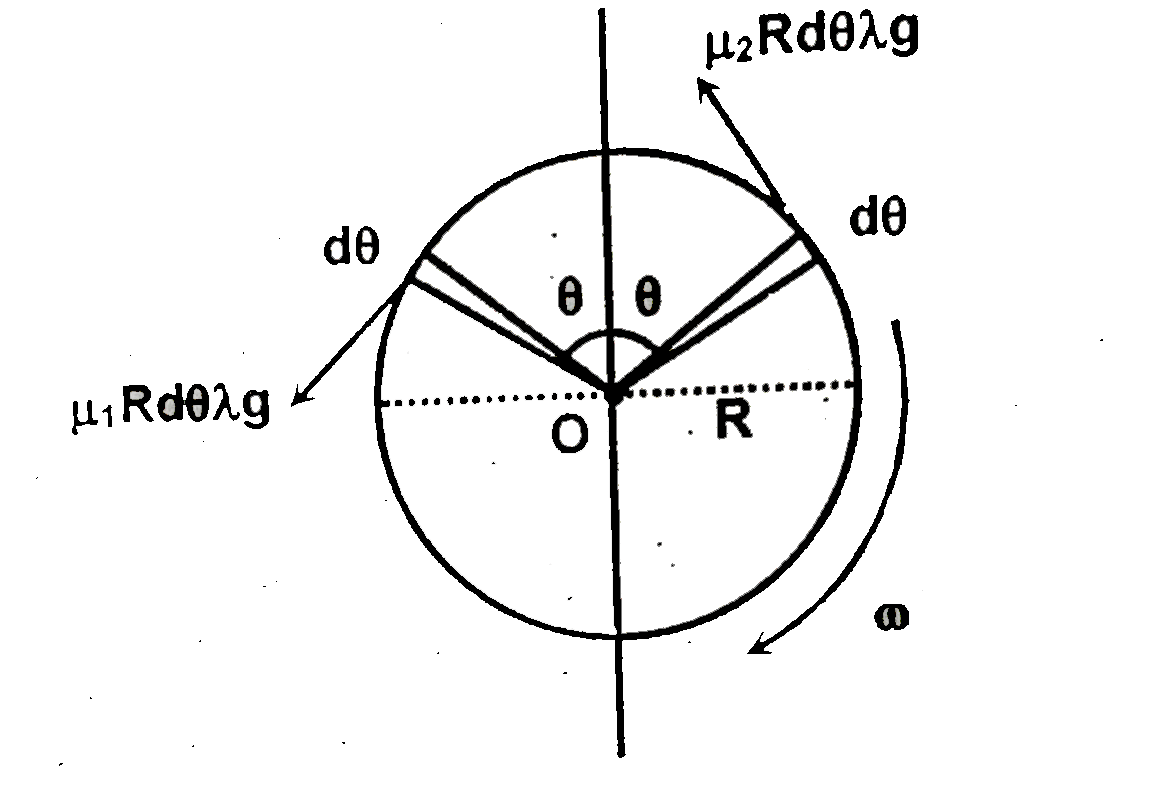
|
|
| 44. |
Assertion: Telephony is an example of point-to-point communication mode. Reason: In point to-point communication modes, communication takes place over a link between a single transmitter and a receiver. |
|
Answer» |
|
| 45. |
The speactral line emitted by a star, has a wavelength of 6800 Å when observed form a Speed of star in the line of light relative to earth for receding or approach is given by |
|
Answer» `2.42 XX 10^5 MS^(-1)` RECEDING |
|
| 46. |
In a Fraunhoffer diffraction experiment at a single slit using light of wavelength 400 nm, the first minimum is formed at an angle of 30^(@). Then the direction theta of the first secondary maximum is |
|
Answer» `sin^(-1)((2)/(3))` |
|
| 47. |
When a pin is moved along the principal axis of a small concave mirror, the image position coincides with the object at a point 0.5 m from the mirror refer figure . If the mirror is placed at a depth of 0.2 m in a transparent liquid, the same phenomenon occurs when the pin is placed 0.4 m from the mirror . The refractive index of the liquid is :- |
|
Answer» `6//5` `0.2 + mu 0.2 = 0.5` , `mu= 3//2` |
|
| 48. |
A runner weighis 580 N (about 130 lb), and 71% of thisweight is water. How many moles of water are in the runner's body? |
|
Answer» `5.3 XX 10^2 ` MOL |
|
| 49. |
Each question has matching list. The codes for the lists have choices (a), (b) , (c ) and (d), out of which only one is correct. |
|
Answer» <P>`{:(P,Q,R,S),(2,1,4,3):}` |
|