

Saved Bookmarks
This section includes 7 InterviewSolutions, each offering curated multiple-choice questions to sharpen your Current Affairs knowledge and support exam preparation. Choose a topic below to get started.
| 1. |
A voltmeter reads 5V at full scale deflection and is graded according to its resistance per volt at full scale deflection as 5000OmegaV^(–1). How will you convert it into a voltmeter that reads 20V at full scale deflection? Will it still be graded as 5000 OmegaV^(–1)? Will you prefer this voltmeter to one that is graded as 2000 Omega V^(–1)? |
| Answer» SOLUTION :`7.5 XX 10^4 OMEGA` | |
| 2. |
(a) A circular current carrying coil has a radius R. Find magnetic field (a) at centre and (b) along the axis of coil distant sqrt(3) R from centre. The coil is having N turns and carriers a current i. (b) Two concentric coil A and B, having current i and 2i and radii 2R and R are placed as shown. Find magnetic field at common centre. (c) In previous problem, if planes of coil are perpendicular to each other, find magnetic field at common centre. (d) A charge q distributed uniformely over a circular ring of radius R. The ring rotates about its axis with an angular velocity omega. find the magnetic field (a) at centre and (b) at distance sqrt(3)R from centre, along the axis. |
|
Answer» Solution :(a) (i) Magnetic FIELD at centre of coil `B_(C)=(mu_(0)NI)/(2R)` (ii) Magnetic field at point `P`, on the axis of coil at distance `x` from centre `B_(P)=(mu_(0)NIR^(2))/(2(R^(2)+x^(2))^(3//2))=(mu_(0)NiR^(2))/(2{R^(2)+(sqrt(3)R)^(2)}^(3//2))` `=(mu_(0)NiR^(2))/(2(4R^(2))^(3//2))=(mu_(0)NiR^(2))/(2xx2sqrt(2)R^(3))=(mu_(0)Ni)/(4sqrt(2)R)` (b) 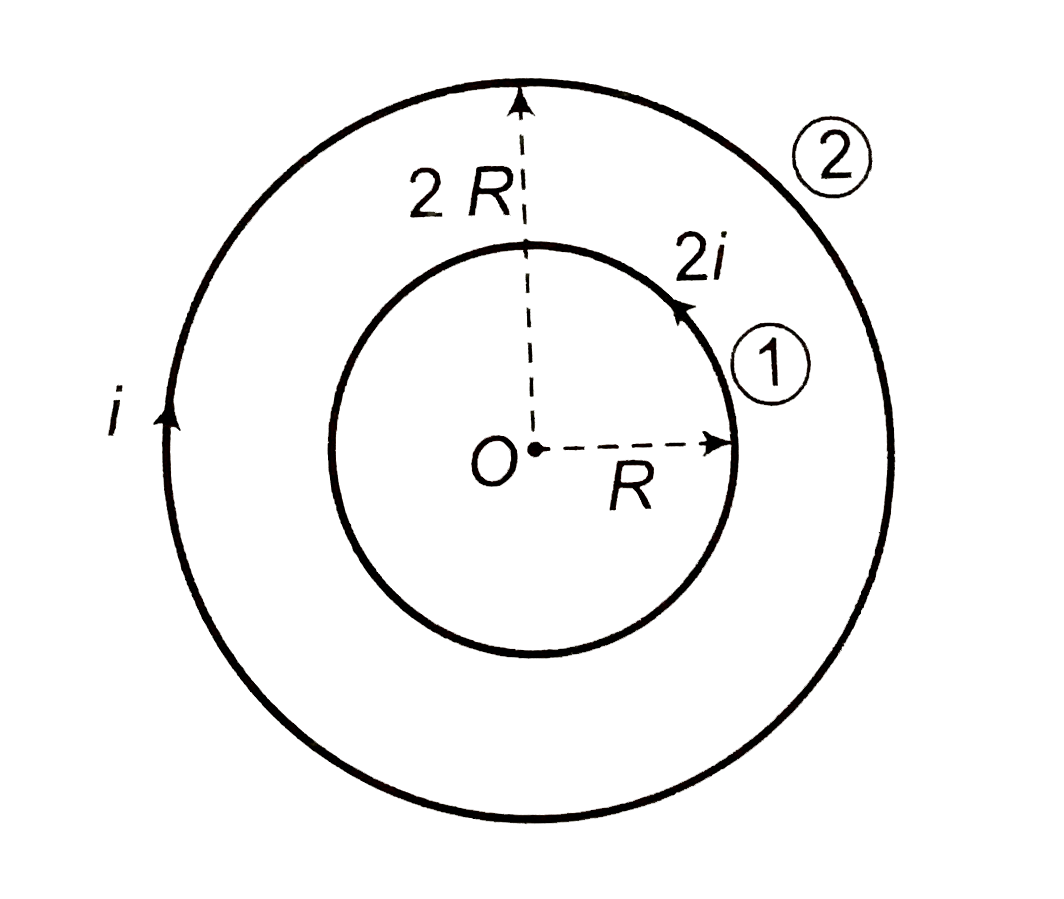 At `O:` `B_(1)=(mu_(0)(2I))/(2R)=(mu_(0)i)/R, o.` `B_(2)=(mu_(0)i)/(2(2R))=(mu_(0)i)/(4R), ox` `B_(O)=B_(1)-B_(2)=(2mu_(0)i)/(4R), o.` (c) If planes of COILS are `bot^(ar)`, `B_(1)` and `B_(2)` will be `bot^(ar)` 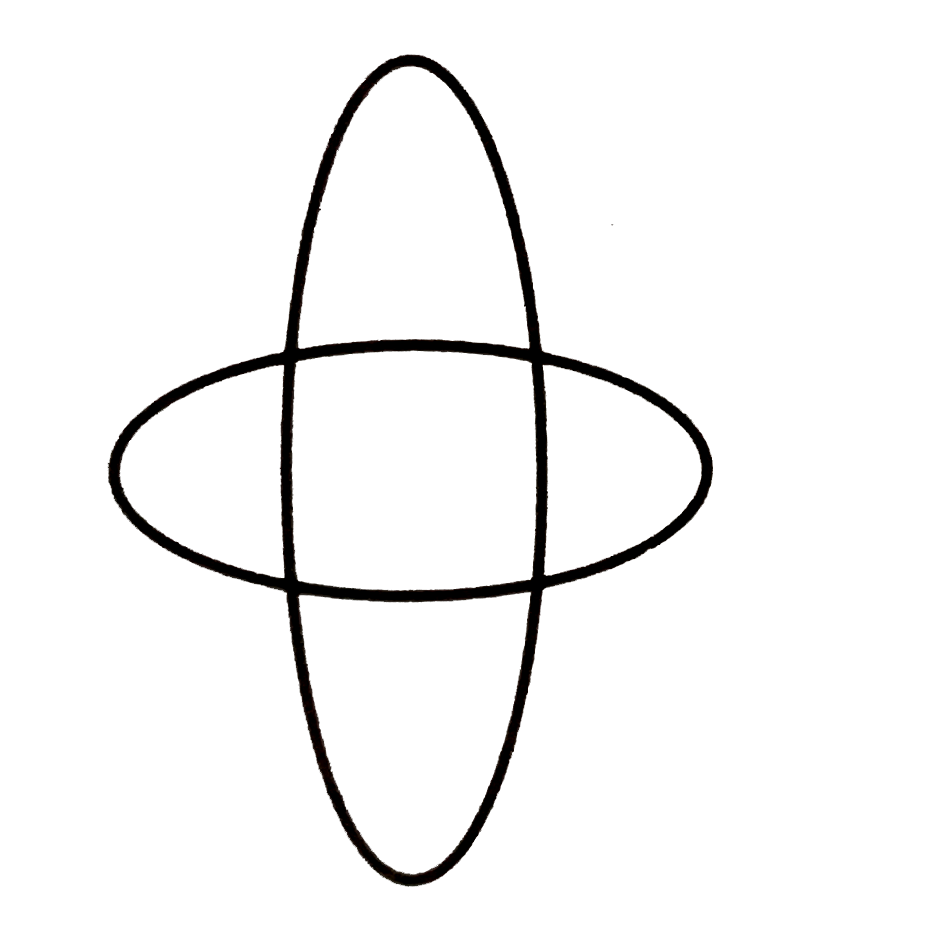 `B_(O)=(mu_(0)i)/R sqrt((1)^(2)+1/((4)^(2)))` `=(sqrt(17)mu_(0)i)/(4R)` (d) Here current `i=q/T=q/(2pi//omega)=(qomega)/(2pi)` (i) `B_(C)=(mu_(0)i)/R=(mu_(0)q omega)/(4piR)` (ii) `B_(P)=(mu_(0)iR^(2))/(2[R^(2)+(sqrt(3)R)^(2)]^(3//2))` `=(mu_(0)iR^(2))/(4sqrt(2)R^(3))=(mu_(0)i)/(4sqrt(2)R)=(mu_(0)q omega)/(8sqrt(2) piR)` |
|
| 3. |
What is frequency of radio waves transmitted by a station , if the wavelength of these waves is 300 m ? |
|
Answer» Solution :Here n= `(C)/(lambda) = (3 xx 10^(8))/(300)` 10 Hz = 1 MHz. correct CHOICE is (a) . |
|
| 4. |
100 millicuries of radon which emits 5.5 MeV alpha- particles are contained in a glass capillary tube 5 cm long with internal and external diameters 2 and 6 m m respectively Neglecting and effects and assuming that the inside of the uniformly irrandicated by the particles which are stopped at the surface calculate the temperature difference between the walls of aa tube when steady thermalconditions have been reached. Thermal conductivity of glass = 0.025 Cal cm^(-2) s^(-1)C^(-1) Curie = 3.7 xx 10^(10) disintergration per second J = 4.18 joule Cal^(-1)s |
|
Answer» Solution :The FLOW of heat in a material placed between the walls of a coaxial cyclinder is given by `(dQ)/(dt)=(2piKL(T_(1)-T_(2)))/(L n((r_(2))/(r_(1))))` Number of decays of radon atoms per SECOND `(dN)/(dt)=100xx10^(-3)xx3.7xx10^(10)=3.7xx10^(9)` disntegration/second Energy deposited by `alpha's=3.7xx10^(9)xx5.5 MeV//s` `=2.035xx10^(10)MeV//s=3.256xx10^(-7)J=0.779xx10^(-3)Cla//s` Using the values . `k=0.025 Cal cm^(-2)s^(-1)C^(-1), L=5 cm, r_(1)=2 MM` and `=r_(2)=6mm` in (1), and solving for `(T_(1)-T_(2))` we find `(T_(1)-T_(2))=1.09^(@)C` |
|
| 5. |
निम्नलिखित में से कौन-सी आपदा बहुउद्देशीय नदीघाटी परियोजनाओं के कारण आसकती है? |
|
Answer» सुखा |
|
| 6. |
SI unit of coefficient of thermal conductivity is |
|
Answer» `WM^(-1) K^(-1)` |
|
| 7. |
The mean power radiation by an elementary dipole is equal to P_(0). Find the mean space density of energy of the electromagnetic field in vacuum in the far field zone at the point removed from the dipole by a distance r along the perpendicular draws to the dipole's axis. |
|
Answer» <P> Solution :From the previous problem.`P_(0) = (8piS_(0)r^(2))/(3)` or `S_(0) = (3P_(0))/(8pi r^(2))` Thus `lt w gt= (S_(0))/(c ) = (3P_(0))/(8pi cr^(2))` (Poynting flux VECTOR is the ENRGY contained is a bx of unit CROSS section and length `c`). |
|
| 8. |
(i) Define mutual inductance. (ii) A pair of adjacent coils has a mutual inductance of 1.5 H. If the current in one coil changes from 0 to 20 A in 0.5 s, what is the change of flux linkage with the other coil ? |
|
Answer» SOLUTION :(i) See Point NUMBERS 21 and 22 under the heading "Chapter At a Glance". (ii) Here M = 1.5 H, `I_(1) = 0 A and I_(2) = 20 A` Magnetic flux linked with coil number `2, phi_(2) = MI_(1)` `THEREFORE Deltaphi_(2) = MDeltaI_(1) = M(I_(2)-I_(1)) = 1.5 xx (20 - 0) = 30 Wb` |
|
| 9. |
If we use n thin rods of length l as described in previous example, as spokes for a wheel to rotate with same angular velocity omega perpendicular to magnetic field B same as in previous example. If r is the electrical resistance of each spoke and then this system is used to drive current in one external resistor R by connecting it between centre and the rim. Find the amount of current flowing through R. |
|
Answer» Solution :All spokes are CONNECTED in parallel to each other and hence, net emf for external resistance R will remain same as that got induced between two ends of the ROD. `E=(1)/(2)Bomegal^(2)` Number of spokes is immaterial as FAR as equivalent emf is concerned, but each spoke has resistance r which will act as internal resistance in a cell. Hence number of spokes will finally AFFECT the amount of current passing through the external resistance R. Equivalent internal resistance of this system to act as battery can be written as `r // n`. Magnitude of electric current passing through the resistor can be written as follows: `i=(E)/(R+(r)/(n))` `implies i=((1)/(2)Bomegal^(2))/(R+(r)/(n))` |
|
| 10. |
An alternating e.m.f. is applied to a circuit containing an inductance and a capacitance in series. It is found that for aparticular frequency 'f' of an A.C. generator, the currrent in the circuit is maximum . If L= 1/2pi Henry and c=1/2pimuF,then the resonant frequency is : |
|
Answer» 100Hz |
|
| 11. |
A jeep passes by you with a speed v. If the speed of sound is c, the ratio of frequencies just before and after jeep passes you is 5/6. Then, the speedv= (Assume c= 330 m/s): |
|
Answer» 20 m/s |
|
| 12. |
A point charge q is located at (2, 3, 3) in xyz coordinate. Find the potential differences between A and B.A = (2, 3, 3)B = (-2, 3, 3) |
|
Answer» `Q/(4PI epsilon_0)` |
|
| 13. |
The diode used in figure requires minimum current of 1 mA to be above the knee voltage 0.7 of current versus voltage characteristics. The maximum value of R so that the voltage is above knee pointis : |
|
Answer» `5 kOmega` `implies R=(V_F-V_B)/i=(5-0.7)/(10^(-3))=4.3xx10^3Omega` `=4.3 kOmega` |
|
| 14. |
Where was the Shehnai played traditionally? |
|
Answer» In temples |
|
| 15. |
Modulation is required to a) distinguish different transmissions b) ensure that the information may be trans mitted over long distances c) allow the information accessible for different people |
|
Answer» a & b are true |
|
| 16. |
Distinguish between n-type and p-type semiconductors on the basis of energy band diagram. |
Answer» SOLUTION :
|
|
| 17. |
Find the maximum distance 'd' from the horizontal centre line of the drawer at which the force F may be applied and still allow the drawer to be opened without binding at the corner. Neglect friction on the bottom of drawer and take the coefficient of static friction between the both sides of the drawer and the tube to be equal to two ( mu = 2). |
|
Answer» 1.5m |
|
| 18. |
In YDSE apparatus shown in figure wavlength of light used is lambda. The screen is moved away form the source with a constant speed v. Initial distance between screen and plane of slits was D. At a point P on the screen the order of fringe will |
|
Answer» `(2D)/(v)` |
|
| 19. |
In a hydrogen atom, a_(0)=0.529A,E_(1)=-13.6eV. Some modified situations are given compare the energy of levels and radius of allowed orbits. |
|
Answer» `{:(p,q,r,s),(1,3,4,5):}` `(mu=(mM)/(m+M))` `r_(n)=a_(0)((n^(2))/(z))((m)/(mu))` |
|
| 20. |
Transitions between three energy levels in a particular atom give rise to three spectral lines of wavelengths, in increasing magnitudes, lambda_(1) , lambda_(2) and lambda_(3), which one of the following equations correctly relates lambda_(1), lambda_(2) and lambda_(3)? |
|
Answer» `lambda_(1) = lambda_(2) - lambda_(3)` |
|
| 21. |
A hydrogen atom in ground state is moving with a kinetic energy of 30 eV. It collides with a deuterium atom in ground state at rest. The hydrogen atom is scattered at right angle to its original line of motion. Assume that energy of n^(th) state in both the atoms is given by E_(n) = -(13.6)/(n^(2)) eV and the mass of deuterium is twice that of hydrogen. Write the maximum and minimum possible kinetic energy of deuterium after collision. |
|
Answer» |
|
| 22. |
the width of the one of the two sites in a Young's double slit experiment is double of the other slit. Assuming that the amplitude of the loight coming from a slit is propotional to the slit width, find the ratio of the maximum to the minimum intensity in the interference pattern. |
|
Answer» |
|
| 23. |
A device which purely allows electric current in one direction but not oposite is called ? |
|
Answer» |
|
| 24. |
A particle is projected vertically upwards with a velocity sqrt(gR), where R denotes the radius of the earth and g the acceleration due to gravity on the surface of the earth. Then the maximum height ascended by the particle is |
|
Answer» `R_(e )` At maximum height the KINETIC energy becomes ZERO. Using conservation of energy, `(mV^(2))/(2)-(GM_(e)m)/(R_(e))=-(GM_(e)m)/(r)` `IMPLIES (mgR_(e))/(2)-(GM_(e)m)/(R_(e))=-(GM_(e)m)/(r)(GM_(e)=gR_(e)^(2))` `implies(mgR_(e))/(2)-mgR_(e)=-(gR_(e)^(2)m)/(r)implies(mgR_(e))/(2)=(gR_(e)^(2)m)/(r)` `implies r=2R_(e)(r=R_(e)+h) therefore` The height attained = `R_(e)` |
|
| 25. |
A pendulum bob of mass 5xx10^(-2) kg is raised to a height of 5xx10^(-2) m and then released. At the bottom of its swing it picks up a mass 10-kg and sticks to it. To what height the combined mass rise |
|
Answer» 0.24 m `=sqrt(2gh)=sqrt(2xx10xx5xx10^(-2))=1 ms^(-1)` Now are conservation of momentum. `(5xx10^(-2)+10^(-3))V.=5xx10^(-2)xx1` `IMPLIES v.=(5xx10^(-2))/(5.1xx10^(-2))=(5)/(5.1)ms^(-1)` `:.` HEIGHT to which the combined mass rises is `h=(v^(2))/(2g)=((5)/(5.1))^(2)xx(1)/(2xx10)=0.48m` |
|
| 26. |
In YDSE apparatus shown in figure wavlength of light used is lambda. The screen is moved away form the source with a constant speed v. Initial distance between screen and plane of slits was D. At a point P on the screen the order of fringe will |
|
Answer» INCREASE |
|
| 27. |
In fission of U-235, the percentage of mass converted into energy is about |
|
Answer» `0.1%` |
|
| 28. |
Explain the meaning of the statement ' electric charge of a body is quantised' Why can one ignore quantisation of electric charge when dealing with macroscopici.e., large scale charges ? |
|
Answer» Solution :The statement . electric charge of a body is quantised, means that the charge on the body must be an integer MULTIPLE of some elementary charge. Experimentallythis elementarycharge is found to be equal to the charge on an electron or a proton and its VALUE is `e= 1.602 XX 10 ^(-19)C .` Thus according to quantisation concept charges on a body ` q= +- NE ,` where n = 0,1,2,3, .... Aselementaryunit of charges e has a value ` 1. 60 xx 10 ^(-19)C,` hence for macroscopic charges of the order of micro coulomb `(1 mu C = 6.25 xx 10 ^(12)` times the value of an ELECTRONIC charge)or more we can ignore the quantisation of charges and may consider charge as a continuous charges. |
|
| 29. |
In a Geiger Marsden experiment, calculate the distance of closest approach to the nucleus of Z 80, when and particle of 8 MeV energy impinges on it before it comes momentarily to rest and reverses its direction.How will the distance of closest approach be affected when the kinetic energy of the O-particle is doubled ? |
|
Answer» Solution :As per question Z = 80, energy of alpha-particle`K = 8MeV = 8 xx 1.6 xx 10^(-13) J`. At distance of CLOSEST approach `(r_(0))` the original KINETIC energy of alpha-particle is completely converted into potential energy i.e., `K= (1)/(4pi in_(0)) = ((Ze)(2e))/(r_(0)) =(2Ze^(2))/(4 pi in_(0) r_(0))` ` rArr ""r_(0) = (2Ze^(2))/(4 pi in_(0) K)= ( 2 xx80 xx (1.6 xx 10^(-19))^(2) xx 9 xx 10^(9))/(8xx1.6 xx 10^(-13)) = 2.9 xx 10^(-14) m` If kinetic energyof thealpha - particles bedoubled ( i.e.,K = 2k) thenas peraboverelationdistanceof closet approch will become one half of its previousvalue(i.e.,`r_(0)= (1)/(2) r_(0)`) provided that `r_(0)`is still greater than the nuclear radius. |
|
| 30. |
Youngs modulus for steel is 2xx10^(11)N//m^(2). What is its value in C.G.S UNITS ? |
|
Answer» `2XX10^(10)` Now `Y=[M^(1)L^(-1)T^(-2)]` `i.e.a=1,b=-1,c=-2` `n_(1)=2xx10^(11)N-m^(-2)` Then `n_(2)=2xx10^(11)[(1kg)/(1g)][(1m)/(1CM)]^(-1)xx[(1SEC)/(1sec)]^(-2)` `2xx10^(11)[(1000)/(1)][(100)/(1)]^(-1)xx[1]^(-2)` `2xx10^(11)[(1000)/(100)]` `2xx10^(12)` dyne `CM^(-2)` `(c )` is correct |
|
| 31. |
A parallel plate capacitor filled with mica having epsilon_(r) = 5 is connected to a 10Vbattery . The area of the parallel plate is 6 m^(2) and separation distance is 6 mm. (a) Find the capacitance and stored charge . (b) After the capacitor is fully charged the battery is disconnected and the dielectric is removed carefully . Calculated the new values of capacitance stored energy and charge. |
|
Answer» Solution :The capacitance of the capacitor in the presence of dielectric is `C =(epsilon_(R)epsilon_(0)A)/(d)=(5xx8.85xx10^(-12)xx6)/(6xx10^(-3))` `=44.25xx10^(-9)F=44.25nF` The stored charge is Q=CV= `44.25xx10^(-9)xx10==44.2nC` The stored energy is `U=(1)/(2)CV^(2)=(1)/(2) xx44.25xx10^(-9)xx100=2.21xx10^(-6)J=2.21muJ` (b) After the removal of the dielectric since the battery is already disconnected the total charge will not change . But the potential difference between the the plates increases . As a result the capacitance is decreased . NEW capacitance is `C_(0)=(C )/(epsilon_(r))=(44.25xx10^(-9))/(5)=8.85xx10^(-9)F=8.85nF` The stored charge remains same and 442.5 nC. Hence newly stored energy is `U_(0)=(Q^(2))/(2C_(0))=(Q^(2)epsilon_(r))/(2C) = epsilon_(r)U` `=5xx2.21 muJ= 11.05 mu J` The increased energy is `DeltaU=11.05 muJ-2.21 muJ=8.84muJ` When the dielectric is removed it experience an inward pulling force due to the plates . To remove the dielectric an external AGENCY has to do work on the dielectric which is stored as additional energy . This is the SOURCE for the extra energy `8.84 mu J` |
|
| 32. |
Read the normal screw gauge main scale has only mm marks. Circular scale has 100 division. In complete rotation, the screw advances by 1mm. |
|
Answer» `11MM` |
|
| 33. |
what is photo diode? Mention its one use. |
|
Answer» Solution : It is a special PURPOSE p-n junction diode WHOSE current strength varies with the intensity of incident light 1. It can be USED as a photo - detector . 2. It is used in light - meters and camera . 3 . It is used a accurate measurement of light intensity . |
|
| 34. |
What is the maximum energy of the anti-neutrino? |
|
Answer» zero |
|
| 35. |
निम्नलिखित मे से कौन सी संक्रियाएसहचार्य नियम का पालन नहीं करती है - |
|
Answer» योगफल |
|
| 36. |
If the speed of a charged particle moving through a magnetic field is increased, then the radius of curvature of its trajectory will _____ . |
|
Answer» decrease |
|
| 37. |
Why are dangerous signals in red when the eye is more sensitive to yellow? |
| Answer» Solution :According to Raleigh.s law of scattering, the intensity of SCATTERED light VARIES INVERSELY as the fourth power of its wavelength. Red light, whose wavelength is more than yellow is scattered less and as such visible from longer DISTANCE. Thus, red color is visible from LONG distance. | |
| 38. |
A body of mass 5 kg is acted upon by a constant forcevecF=(-3overset(wedge)(i)+6overset(wedge)(j))NIts initial velocity at t = 0 isvecu = (6overset(wedge)-2overset(wedge)ms^(-1) what is its velocity after 5s ? What is its magnitude ? |
|
Answer» `(3overset(wedge)(i)+6overset(wedge)(j)),5ms^(-1)` `m=5kg` `:.VECA=(-3hati+6hatj)/(5)` Now `vecupsilon=vecu+vecat` `=(6hati-2hatj)+(-3hati+6hatj)/(5)xx5` `=(6hati-2hatj)-3hati+6hatj` `vecupsilon=(3hati+4hatj)` `|upsilon|=sqrt(9+16)=5ms^(-1)` HENCE (a) is the right choice. |
|
| 39. |
Do all materials behave in the same manner in a magnetic field ? |
| Answer» Solution :Different magnetic MATERIALS like para, FERRO etc. behave differently to EXTERNAL FIELD. | |
| 40. |
Describe the microscopic model of current and obtain general from of Ohm's law. |
Answer» Solution :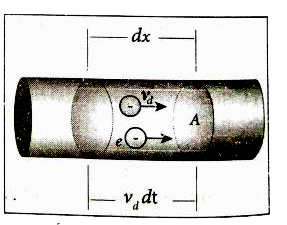 Microscopic model of current: Consider a conductor with area of cross-section A and an electric field `vecE` applied from right to left. Suppose there are n electrons PER unit volume in the conductor and assume that all the electrons move with the same drift velocity `vecv_(d)`. The drift velocity of the electrons `=v_(d)` The electrons move through a DISTANCE dx within a small interval of dt `v_(d)=(dx)/(dt), dx=v_(d)dt ""... (1)` SINCE A is the area of cross section of the conductor, the electrons AVAILABLE in the volume or length dx is = volume `xx` number per unit volume `=adx xx n "" ...(2)` Substituting for dx from equation (1) in (2) `=(A v_(d)dt)n` Total charge in volume element `dQ=` (charge) `xx` (number of electrons in the volume element) `dQ=(e ) (A v_(d)dt)n` Hence the current, `I=(dQ)/(dt)=(n eAv_(d)dt)/(dt)` `I=n eAv_(d)"" ...(3)` Current density (J): The current density (J) is defined as the current per unit area of cross section of the conductor `J=(1)/(A)` The S.I. unit of current density, `(A)/(m^(2))(or) Am^(-2)` `J=(n eAv_(d))/(A)` (from equation 3) `J=n ev_(d)"" ...(4)` the above expression is valid only when the direction of the current is perpendicular to the area A. In general, the current density is a vector quantity and it is given by `vecJ= n e vecv_(d)` Substituting `vecv_(d)` from equation `vecv_(d)=(-e tau)/(m) vecE ` `vecJ= -(n.e^(2)tau)/(m)vecE "" ...(5)` `vecJ= -sigma vecE` But conventionally, we take the direction of (CONVENTIONAL) current density as the direction of electric field. So the above equation becomes `vecJ=sigma vecE` where `sigma (n e^(2)tau)/(m)` is called conductivity. The equation 6 is called microscopic form of ohm.s law. |
|
| 41. |
One body has 2.5 xx 10^13 protons. Now if i carries -2muc charge then how many electron are there on this body ? |
|
Answer» <P>(A) `1.25 XX 10^(13)` `therefore q = n_(e)e^(-) + n_(p)e^(+)` `therefore -2 xx 10^(-6) = n_(e)(-1.6 xx 10^(-19)) + 2.5 xx 10^(13) xx 1.6` `therefore n_(e) = (6 xx 10^(-6))/(1.6 xx 10^(-19)) = 3.75 xx 10^(13)` |
|
| 42. |
A passenger plane flies at an altitude of 8 km at a speed of 900 km/h. The speed is measured with the aid of a Pitot-Prandtl tube. Find the pressure difference in the differential manometer. For data relating to the atmosphere see xi 26.10, Table 26.3. |
|
Answer» |
|
| 43. |
A calorimeter of mass 100 g contains 100 cm^(3) of water at 70^(@)C. It cools down to 30^(@)Cin 12 minutes. When the same volume of glycerine is used in the same calorimeter, it takes 8 minutes to cool down through the same temperature range. Find the specific heat of glycerine of specific heat of the calorimeter is 0.1 calg^(-1)^(@)C^(-1) and specific gravity of glycerine =1.27. |
|
Answer» |
|
| 44. |
The current gain alpha of a transistor is 0.95 . The change in emitter current is 10 mA. The change is base current is : |
|
Answer» `9.5 mA` `implies0.95=(10-I_B)/10""impliesI_B=0.5mA` |
|
| 45. |
Equipotentials at a great distance from a collection of charges, whose total sum is not zero, are approximaltey |
|
Answer» spheres |
|
| 46. |
Though the electron drift velocity is small and electron charge is very small, a conductor can carry an appreciably large current because |
|
Answer» ELECTRON number DENSITY DEPENDS on temperature |
|
| 47. |
What will be the ratio of de Broglie wavelengths of photon and alpha- particle of same energy ? |
|
Answer» `2:1` |
|
| 48. |
Two identical beam A and B of plane coherent waves of the sasme intensity and wavelength lambda fall on a plane screen. The direction of thebeam propagations make angles theta_(1) and theta_(2) with the normal to the screen and lie in the same plane as shown in the figure. Find the distance beta between adject interfrence fringes on the screen. |
|
Answer» `(lambda)/(sin theta-sin theta_(2))`  Path difference between A 'P' and B'P' is `DELTA X =y sin theta_(1) - y sin theta_(2)` `Delta x = y(sin theta_(1) - sin theta_(2))` For bright fringes `Delta x =N lambda` `n lambda = y (sin theta_(1) - sin theta_(2))` `y = (n lambda)/(sin theta_(1) - sin theta_(2))` `:. beta = (lambda)/(sin theta_(1)-sin theta_(2))` |
|
| 49. |
What is linear expansion of light ? Explain ray of light and beam of light. |
|
Answer» Solution :The WAVELENGTH of light is very small compared to the size of ordinary objects. Light can travel from one point to ANOTHER, ALONG a STRAIGHT line joining them. The path is called a ray of light and a BUNDLE of such rays constitutes a beam of light. |
|
| 50. |
where will the new null points be located if the bar magnet in the previous example is rotated through180^(@) ? |
|
Answer» Solution :The new null point will be located on the perpendicular Magnetic field at a distance`r_(ax)`on the axs , `B_(H)=(mu_(0))/(4pi).(2p_(m))/(r_(ax)^(3))` Magnetic field at a distance`r_(EQ)`on the perpendicular bisector of the axis . `B_(H)=(mu_(0))/(4pi).(p_(m))/(r_(eq)^(3))` `therefore(mu_(0))/(4pi).(2p_(m))/(r_(ax)^(3))=(mu_(0))/(4pi).(p_(m))/(r_(eq)^(3))` `[therefore` at null point both the fields are EQUAL ] `therefore "" r_(eq)=(r_(ax))/(root(3)(2))=(14)/(root(3)(2))=11.1 "cm"` |
|