

Saved Bookmarks
This section includes 7 InterviewSolutions, each offering curated multiple-choice questions to sharpen your Current Affairs knowledge and support exam preparation. Choose a topic below to get started.
| 1. |
Solve a problmedifferingfrom theforgoing one by a magneticfield with inductionB = 0.8 Treplacingthe electricfield. |
|
Answer» Solution :CHOICE `vec(B)` in the `Z` direction, andthe velocity `vec(v) = (sin alpha, 0, v cos alpha)` in the`x-z` plane, then in the `K'` FRAME, `{:(vec(E')_(||)=vec(E)_(||)=0),(vec(E')_(bot)=(vec(v)xxvec(B))/(sqrt(1-v^(2)//c^(2)))):}:|{:(VECB'_(||)=vec(B)_(||)),(vec(B')_(bot)=(vec(B)_(bot))/(sqrt(1-v^(2)//c^(2)))):}` We findsimilarly, `E' = (c BETA B sinalpha)/(sqrt(1 - beta^(2)))` `B' = B sqrt((1 - beta^(2) cos^(2) alpha)/(1 - beta^(2))) tan alpha' = (tan alpha)/(sqrt(1 - beta^(2)))` |
|
| 2. |
Let some unpolarised light is travelling along X-axis. Its electric field will be randomly oriented on Y-Z plane. We can represent this unpolarised light in terms of two components of electric field along Y-axis and Z-axis respectively and these two components are assumed to be at a phase difference. Thus E_y = E_1 sin(omega t - kx) E_z = E_2 sin (omega t - k x + delta) If value of delta changes randomly with time, then light is said to be unpolarised. If value of delta is such that tip of the resultant electric field traces a straight line, then light is said to be linearly polarised. Similarly for circular path, light is said to be circularly polarised and for elliptical path, light is said to be elloptically polarised. Light will be linearly polarised if |
|
Answer» `delta = 0` `tan theta = (E_2)/(E_y)` For `delta = 0` and `pi` we can see that `tan theta` remains constant and hence tip of the net electric field TRACES a straight line. So we can SAY that for `delta = 0 and pi` LIGHT will be linearly polarised. |
|
| 3. |
The distance between the poles of a horseshoe magnet is 4 cm . The pole strength of each pole is 40 units. The magnetic potential mid-way between the poles is |
|
Answer» 80 units |
|
| 4. |
For maximum deviation D_("max"). |
|
Answer» emergent ray must graze the SURFACE (FACE) |
|
| 5. |
The alternate discs of iron and carbon, having same area of cross-section are cemented together to make a cylinder whose temperature coefficient of resistivity is zero. The change in temperature in two alternate discs is same. The ratio of their thickness and ratio of heat produced in them is found out. The resistivity of iron and carbon at 20^@C are 1 xx 10^(-7) and 3 xx 10^(-5) Omegam and their temperature coefficient of resistance are 5 xx 10^(-3)""^(@)C and -7.5 xx 10^(-4)""^(@)C, respectively. Thermal expansion is neglected. Here, triangleR_1+ triangleR_2= 0" (where "triangleR_1 and triangleR_2 are the increase in resistances of iron and carbon, respectively, with the rise in temperature) because combined temperature coefficient of resistivity is given as zero. Ratio of heat produced in them is |
|
Answer» 0.51 |
|
| 6. |
The alternate discs of iron and carbon, having same area of cross-section are cemented together to make a cylinder whose temperature coefficient of resistivity is zero. The change in temperature in two alternate discs is same. The ratio of their thickness and ratio of heat produced in them is found out. The resistivity of iron and carbon at 20^@C are 1 xx 10^(-7) and 3 xx 10^(-5) Omegam and their temperature coefficient of resistance are 5 xx 10^(-3)""^(@)C and -7.5 xx 10^(-4)""^(@)C, respectively. Thermal expansion is neglected. Here, triangleR_1+ triangleR_2= 0" (where "triangleR_1 and triangleR_2 are the increase in resistances of iron and carbon, respectively, with the rise in temperature) because combined temperature coefficient of resistivity is given as zero. A copper wire is stretched to make it 1% longer. The percentage change in its resistance is |
|
Answer» 0.002 |
|
| 7. |
The alternate discs of iron and carbon, having same area of cross-section are cemented together to make a cylinder whose temperature coefficient of resistivity is zero. The change in temperature in two alternate discs is same. The ratio of their thickness and ratio of heat produced in them is found out. The resistivity of iron and carbon at 20^@C are 1 xx 10^(-7) and 3 xx 10^(-5) Omegam and their temperature coefficient of resistance are 5 xx 10^(-3)""^(@)C and -7.5 xx 10^(-4)""^(@)C, respectively. Thermal expansion is neglected. Here, triangleR_1+ triangleR_2= 0" (where "triangleR_1 and triangleR_2 are the increase in resistances of iron and carbon, respectively, with the rise in temperature) because combined temperature coefficient of resistivity is given as zero. Ratio of their thickness is |
|
Answer» 54 |
|
| 8. |
Let some unpolarised light is travelling along X-axis. Its electric field will be randomly oriented on Y-Z plane. We can represent this unpolarised light in terms of two components of electric field along Y-axis and Z-axis respectively and these two components are assumed to be at a phase difference. Thus E_y = E_1 sin(omega t - kx) E_z = E_2 sin (omega t - k x + delta) If value of delta changes randomly with time, then light is said to be unpolarised. If value of delta is such that tip of the resultant electric field traces a straight line, then light is said to be linearly polarised. Similarly for circular path, light is said to be circularly polarised and for elliptical path, light is said to be elloptically polarised. Light will be elliptically polarised if |
|
Answer» `delta = 0 and E_1 != E_2` `(E_y^2)/(E_1^2) + (E_z^2)/(E_2^2) = 1` Hence tip of the net electric field TRACES elliptical path and hence light will be ELLIPTICALLY polarised. |
|
| 9. |
Let some unpolarised light is travelling along X-axis. Its electric field will be randomly oriented on Y-Z plane. We can represent this unpolarised light in terms of two components of electric field along Y-axis and Z-axis respectively and these two components are assumed to be at a phase difference. Thus E_y = E_1 sin(omega t - kx) E_z = E_2 sin (omega t - k x + delta) If value of delta changes randomly with time, then light is said to be unpolarised. If value of delta is such that tip of the resultant electric field traces a straight line, then light is said to be linearly polarised. Similarly for circular path, light is said to be circularly polarised and for elliptical path, light is said to be elloptically polarised. Light will be circularly polarised if |
|
Answer» `DELTA = 0 and E_1 != E_2` `E_y^2 + E_z^2 = E^2` Hence in this case tip of the RESULTANT FIELD will trace a circle and hence light will be circularly POLARISED. |
|
| 10. |
The phase of a particle in SHM at time t is pi//6. The following inference is drawn from this: |
|
Answer» The PARTICLE is at X = a/2 and MOVING in + X-direction |
|
| 11. |
A particle of charge q moves with velocity vec(v) along positive y - direction in a magnetic field vec(B). Compute the Lorentz force experienced by the particle (a) when magnetic field is along positive y-direction (b) when magnetic field points in positive z -direction (c ) when magnetic field is in zy - plane and making an angle theta with velocity of the particle. Mark the direction of magnetic force in each case. |
|
Answer» SOLUTION :Velocity of the PARTICLE is `vec(v) = v hat(j)` (a) Magnetic field is along positive y-direction, this implies, `vec(B) = v hat(j)` From Lorentz force, `vec(F_(m)) = q(v hat(j) xx B hat(j) ) ` = 0 So, no force acts on the particle when it moves along the direction of magnetic field. (b) Magnetic field points in positive z - direction, this implies, `vec(B) = B hat(K)` From Lorentz force, ` vec(F_(m)) = q (v hat(j) xx B hat(k)) = "qvB"hat(i)` Therefore, the magnitude,of the Lorentz force is qvB and direction is along positive x - direction . (c ) Magnetic field is in ZY - plane and making an angle `theta` with the velocity of the particle , which implies `vec(B) " B cos" theta aht(j) + ` B sin `theta hat(k)` From Lorentz force, `vec(F_(m)) = q(v hat(j)) xx (B cos theta hat(j) + B sin theta hat(k))` = qvBsin `theta hat(i)`  
|
|
| 12. |
A Body of mass (m) is suspended from two light springs of spring constants k_(1) and k_(2) (lt k_(1)) separately.The periods of vertical oscillations are T_(1) and T_(2) respectively. Now the same body is suspended from same two springs which are first connected in series and then in parallel. The period of vertical oscillationsare T_(S) and T_(P) respectively. |
|
Answer» <P>`T_(P) LT T_(1) lt T_(2)` for `k_(1) gt k_(2)` |
|
| 13. |
A particle of mass m and charge q enters a region of electric field vec(E) as shown in the figure with some velocity at point P. At the moment the particle collides elastically with smooth surface at N, the electric field vec(E) is switched off and a magnetic field vec(B) perpendicular to the plane of paper aoutomatically switched on. If the particle hits the surface at point O, then if B=xsqrt((mE)/(qd)). What is the value of x^(1) |
|
Answer» `(d)/(2)=(1)/(2)((qE)/(m))xxt^(2)impliest=SQRT(((m)/(qE))d)` Ifu is the velocity while entering the field, then  `d=uxxtimplies u=(d)/(t)=sqrt((qEd)/(m))` also if `upsilon_(N_|_)` is the velocity of the particle in the direction of `vec(E)` at N, then `upsilon_(N_|_)=sqrt(2((qE)/(m))xx(d)/(2))=sqrt((qEd)/(m))` So,net velocity at N is `upsilon_(N)=sqrt(upsilon_(N_|_)^(2)+u^(2))=sqrt((2qEd)/(m))` Since `tan theta-(upsilon_(N_|_))/(u)=1impliestheta=45^(@)` HENCE, the collosion is elastic and the particle is reflected back with the same speed `upsilon_(N)`. The charge q now move with a speed `upsilon_(N)` in MAGNETIC field `vec(B)` . Radius of its path. `R=(m upsilon_(N))/(qB)=(sqrt((2mEd)/(q)))xx(1)/(8) ...................(1)` From figure `R=(d)/(2)xx sqrt(2)=(d)/(sqrt(2))` Putting in equation `(1)` , `(d)/(sqrt(2))=(1)/(B)sqrt((2mEd)/(q))` or `B=2sqrt((mE)/(QD))` |
|
| 14. |
The percentage of an element M is 53 inits oxide of molecular formula M_(2)O_(3). Its atomic mass is about - |
|
Answer» `45` `:. E` of element `= (53)/(47) xx 8 ~~ 9` `:.` Atomic MASS `= E xx "valency"` `= 9 xx 3 = 27 gm` |
|
| 15. |
If the energy of a photon of light is given by E=kh^(x)c^(y)lambda^(z), where h= Planck's constant, c = velocity of light and lambda = wavelength then values of x,y,z in order are : |
|
Answer» `1,2,1` Putting the dimensions `ML^(2)T^(-2)=[ML^(2)T^(-1)]^(x)[L^(1)T^(-1)]^(y)[L^(1)]^(z)` `[ML^(2)T^(-2)]=M^(x)L^(2x+y+z)T^(-x-y)` `:.`COMPARING the dimensions `x=1|{:(2x+y+z=1),(2+1+z=2),(z=-1):}||{:(-x-y=-2),(-1-y=-2),(y=1):}|` `:.`Correct choice is `(d)`. |
|
| 16. |
Sodium and copper have work functions of 2.3 eV and 4.6 eV respectively. The ratio of their threshold wavelengths is |
|
Answer» `1:2` |
|
| 17. |
What is meant by admittance of an a.c. circuit ? |
| Answer» SOLUTION :Admittance of an a.c. CIRCUIT is the RECIPROCAL of IMPEDANCE (Z) of the circuit. | |
| 18. |
In a cyclotron, the charged particle cannot be accelerated to energies of the order of billion electron volt because if the speed of the particle is increased |
|
Answer» the FREQUENCY of revolution is INCREASED |
|
| 19. |
A ray of light is incident horizontally on the face AB of the.right angled prism as shown in the figure. If the ray emerges grazing the surface AC, find the value of phi. Refractive index of the material of the prism is given to be n. |
|
Answer» Solution :`Sin theta_(c) = 1//n` from the FIGURE `pi//2 - theta_(c) = phi` `IMPLIES theta_(c) = pi//2 - phi` `implies phi = COS^(-1)(1//n)` 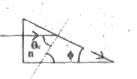
|
|
| 20. |
The energy in MeV released due to transformation of 1 kg mass completely into energy, is (c= 3 xx 10^8 m/s) |
|
Answer» `7.625xx10^9` MEV |
|
| 21. |
Find the damped oscillation frequency of the circuit shown in figure. The capacitance C, inductance L, and active resistance R are supposed to be known. Find how must C,L, and R be interrelated to make oscillations possible. |
|
Answer» Solution :GIVEN `q=q_(1)+q_(2)` `I_(1)=-dot(q_(1)), I_(2)=-dot(q_(2))` `LI_(1)=RI_(2)=(q)/(C)`. Thus `CL ddot(q_(1))+(q_(1)+q_(2))=0` `RC dot(q_(2))+q_(1)+q_(2)=0` Putting `q_(1)=A e^(iomegat)` `q_(2)=Be^(+iomegat)` `(1-omegaLC)A+B=0` `A+(1+iomegaRC)B=0` Asolutiion EXISTS only if `(1- omega^(2)LC)(1+iomegaRC)=1` or `iomegaRC-omega^(2)LC-IOMEGA^(3)LRC^(2)=0` or `LRC^(2) omega^(2)-i omegaLC-RC=0` `omega^(2)-iomega(1)/(RC)-(1)/(LC)=0` `omega=(i)/(2RC)+-sqrt((1)/(LC)-(1)/(4R^(2)C^(2)))~=ibeta+-omega_(0)` Thus `q_(1)=(A_(1)cos omega_(0)t+A_(2) sin omega_(0) t ) e^(-BETAT) `etc `omega_(0)` is the oscillation FREQUENCY. Oscillations are possible only if `omega_(0)^(2)gt0` `i.e.` `(1)/(4R^(2))lt(C)/(L)` 
|
|
| 22. |
Calculate and compare the energy released by (a) fusion of 1.0 kg of hydrogen deep within Sun and (b) the fission of 1.0 kg of " "^(235)U in a fission reactor. |
|
Answer» Solution :(a) Fusion REACTION is `" "_(1)^(1)H +" "_(1)^(1)H+" "_(1)^(1)H+" "_(1)^(1)H to " "_(2)^(4)He + 2+" "_(1)^(0)e + 2nu+ 26 MeV` `therefore` The energy released by 1 kg of hydrogen` = (6.023xx10^(23)xx26)/(4xx10^(-3))MeV =3.9 X 10^(27) MeV` (b) The energy released in one act of fission of `" "^(235)U` is = 200 MeV `therefore` Energy released in fission of 1 kg of `" "_(92)^(235)U= (6.023 xx 10^(23)xx200)/(235xx10^(-3)) MeV =5.1 xx 10^(26) MeV` `therefore ("Energy released in fusion of 1 kg of hydrogen")/("Energy released in fission of 1 kg of" " "^(235)U)=(3.9xx 10^(27))/(5.1xx10^(26)) =7.65 APPROX 8` |
|
| 23. |
An elastic string of unit cross-sectional area and natural length (a+b) where a gt b and modulii of elasticity Y has a particle of mass m attached to it at a distance a from one end, which is fixed to a point A of a smooth horizontal plane. The other end of the string is fixed to a point B. so that string is just unstretched. If particle is diplacement towards right by. distance x_(0) and then released then |
|
Answer» The TIME period of the oscillation will be `PI(sqrt(a)+sqrt(b))sqrt((m)/(Y))`  from `t_(B RARR 0)` `T = y (X)/(a) rArr (d^(2)x)/(dt^(2)) = (-y)/(am) x rArr t_(B rarr 0) = (pi)/(2) sqrt((am)/(y))` simply `t_(B rarr 0)` other ext. `= (pi)/(2) sqrt((bm)/(y))` Time period `= pi = sqrt((m)/(y)) (sqrta + sqrtb)` `(y x_(0)^(2))/(2a) = (yc^(2))/(2b)` `c = x_(0) sqrt((b)/(a))` Distance (ext to ext) `x_(0) + c = x_(0) ((sqrtb + sqrta))/(sqrta)` |
|
| 24. |
In the chapter, Writer discuss about whom? |
|
Answer» grandmother |
|
| 25. |
Find the expression for coverage distance and height of transmitting antenna. |
|
Answer» Solution :Let `AB` be a T.V. tower of height `h` above the EARTH. `T.V.` signal is received within a circle of `CQ=QD` on the SURFACE of earth. Let `R` be the radius of the earth. Let `CQ=QD=d` and `AB=h`. `:. OB=R+h` In rt. `/_d` triangle `OCB,` `OB^(2)=OC^(2)+BC^(2)` `(R+h)^(2)=R^(2)+d^(2)` `d^(2)=(R+h)^(2)-R^(2)` `=R^(2)+h^(2)+2Rh-R^(2)` or `d^(2)=h^(2)+2Rh` Since `h^(2)` can be NEGLECTED as compared to `2hR` `:.d^(2)=2Rh` or `d=sqrt(2hR)` or `h=(d^(2))/(2R).`  AREA covered by T.V. signal `=pid^(2)` `=pi2hR=2pihR` Population covered = Area covered `xx` Population DENSITY Since `dpropsqrt(h,)( :.2R` is constant ) So greater the height of T.V. transmitting antenna, grater is its range. |
|
| 26. |
In insulators and semiconductors, as temperature increases, resistance …………………. . |
| Answer» SOLUTION :DECREASES | |
| 27. |
The de-Broglie wavelength of a particle moving with a speed of 2.25xx10^(8)ms^(-1) is equal to the wavelength of a given photon. The ratio of kinetic energy of the particle to the energy of the given photon is |
|
Answer» `1/8` |
|
| 28. |
Consider a box with three terminals on top of it as shown in Fig. Three components namely, two germanium diode and one resistor are connected across these three terminals in some arrangment. A student performs an experiment in which any two of these three terminals are connected in the circuit shown in Fig. The student obtains graph of current-voltage characteristics for unknown comdination of components between the two terminals connected in the circuit. The graph are Form these graph of current-voltage characteristic shown in Fig. to (h), determine the arrangment of components between A, B and C. |
|
Answer» Solution : In V-I graph of condition (i), a reverse characteristics is shown in Fig. Here A is CONNECTED to n-side of p-n JUNCTION I and B is connected to p-side of p-n junction I with a resistance in series. In V-I graph of condition (II), a forward characteristic is shown in Fig. , where 0.7 V is the knee voltage of p-n junction and `1//"slope"=(1//1000)Omega`. It means A is connected to n-side of p-n junction I and B is connected to p-side of p-n junction I and resistance R is in series of p-n junction I between A and B. In V-I graph of condition (iii), a forward characteristics is shown in Fig., where 0.7 V is the knee voltage. In this case p-side of p-n junction-II is connected to C and n-side of p-n junction II to B. In V-I graph of condition (iv), (v) and (VI) also concludes the above connecttions of p-n junction I and II along with a resistance R. Thus, the ARRANGEMENT of p-n I, p-n II and resistance R between A, B and C will be as shown in Fig . 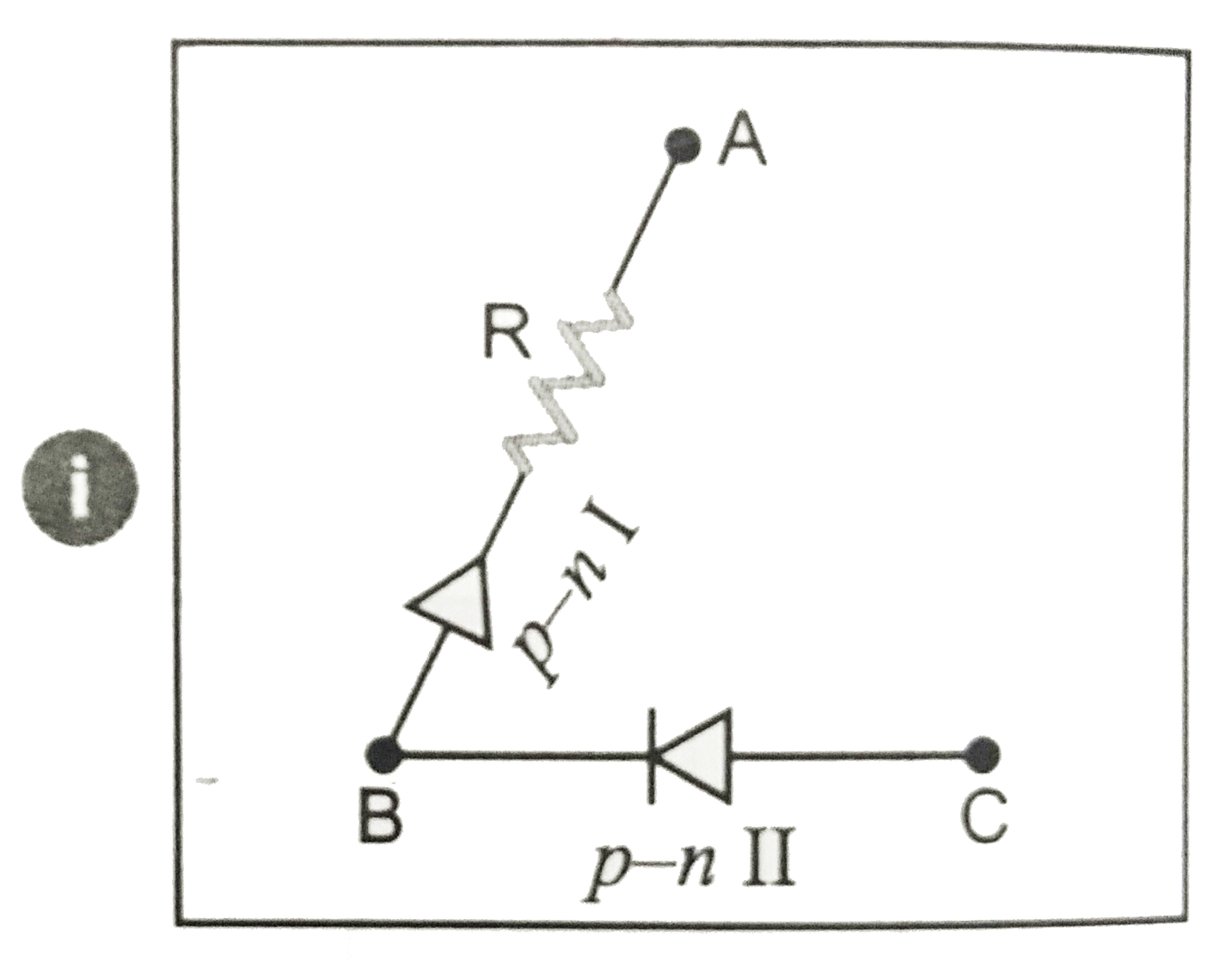
|
|
| 29. |
The angular magnification of an astronomical telescope will be maximum, if the focal lengths of the objective the eyepiece are respectively |
|
Answer» 1m and 5 cm |
|
| 30. |
The torque of a force vecF=-3hati+hatj+5hatk acting at a point is vectau. If the position vector of the point vector of the point is 7hati+3hatj+hatk, then vectau is : |
|
Answer» `14hati-hatj+3hatk` |
|
| 32. |
The angle between frictional force and instantaneous velocity of a body moving over a rough surface is: |
|
Answer» `pi//2` HENCE correct choice is (d) |
|
| 33. |
A wave has S.H.M. whose time period is 4 sec. While other wave which also possess S.H.M. has its period of 3 sec. If both waves are combined, then time period of resultant wave will be equal to |
|
Answer» 12 sec |
|
| 34. |
Explaingiving reasons, the basic difference in converting a galvanometer into (i) a voltmeter and (ii) an ammeter. |
|
Answer» Solution :(i) A galvanometer can be CONVERTED into a voltmeter by connecting a high RESISTANCE in SERIES with its COIL. (ii) A galvanometer can be converted into an ammeter by connecting a low resistancein PARALLEL to its coil. |
|
| 35. |
the unit vector hat(i),hat(j) and hat(k) are as shown below. What will be the magnetic field at O in the following figure ? |
|
Answer» `(mu_(0))/(4PI)(i)/(a)(2-(pi)/(2))hat(J)` |
|
| 36. |
The particle executing simple harmonic motion has kinetic energy K_(0)cos^(2)omegat. The maximum values of the potential energy and the total energy are respectively : |
|
Answer» `(K_(0))/(2)` and `K_(0)` When ` cos^(2)omega t=1` thenkinetic energy `=K_(0)` (MAXIMUM). Thus maximum value of potential energy `=K_(0)` Maximum value of total energy = maximumvalue of potential energy `=K_(0)` Correct choice is ( C ). |
|
| 37. |
The stationary wave y = 2a sin kx cosomegat in a closed organ pipe is the result of the superposition of y = a sin( omegat — kx) and |
|
Answer» y = -ASIN(`OMEGA`t + KX) |
|
| 38. |
The wavelength of light in vacumm is lamda. The wavelength of light in a medium of fefractive index n will be : |
|
Answer» `nlamda` |
|
| 39. |
The electric dipole moment of an HCl atom is 3.4 xx 10^(-30) Cm. The charges on both atoms are unlike and of same magnitude. Magnitude of this charge is ........The distance between the charges is 1 A. |
|
Answer» <P>`1.7 xx 10^(-20)` C `2a = 1.0A = 10^(-10)` m q=? p=(2a)q `THEREFORE q = p/(2a) = (3.4 xx 10^(-30))/10^(-10) = 3.4 xx 10^(-20)` C |
|
| 40. |
The type of communication system needed for a given signal depends on the band of frequencies in the signal. What are the different types of message signals used in a communication systems. |
| Answer» Solution :The DIFFERENT type of message SIGNALS are voice, music, PICTURE and COMPUTER data. | |
| 41. |
A light metal disc on the top of an electromagnet is thrown up as the current is switched on. Why? Give reason. |
|
Answer» Solution :When the CURRENT BEGINS to flow through the ELECTROMAGNET, the magnetic flux through the disc begins to increase. This set up eddy current in the disc in the same direction as that of the electromagnetic current. Thus, if the UPPER surface of electromagnet acquires N-polarity, the lower surface of the disc ALSO acquires N-polarity. As same magnetic poles repel each other, the light metallic disc is thrown up. |
|
| 42. |
A uniformaly charged conducting sphere of 2.4 m diameter has a surface charge density of 80.0muC//m^(2) Find the charge on the sphere. (b) What is the total electric flux leaving the surface of the sphere? |
|
Answer» SOLUTION :Here diameter of SPHERE `D=2.4 m, `hence radius R=`(D)/(2) =1.2 m ` and surface CHARGES density`sigma =80.0 mu C //m^(2)=80 xx 10^(-6)C//m^(2) ` ` therefore`Total charges on the sphere `q = sigma . 4pi R^(2)=80 xx 10^(-6)xx 4 xx 3.14 xx (1.2)^(2)=1.45 xx 10^(-3)C ` Here diameter of sphere `D=2.4 m, `hence radius R=`(D)/(2) =1.2 m ` and surface charges density`sigma =80.0 mu C //m^(2)=80 xx 10^(-6)C//m^(2) ` Total electric flux LEAVING the surface of sphere ` phi_in =(q)/(in_0) =( 1.45xx10^(-3))/(8.85xx10^(-12))=1.6 xx 10^(8)N m^(2)C^(-1)` |
|
| 43. |
An infinite line chargeproduces a fieldof 9xx10^(4) N/Cat a distance of 2 cm calculate the linear charge density |
|
Answer» SOLUTION :Electric field at perpendicular distance r from an INFINITELY extended uniform line of charge is, `E = (2klambda)/r` `therefore lambda = (Er)/(2k)` `=(9 XX 10^(4) xx 0.02)/(2 xx 9 xx 10^(9))` `therefore lambda =10^(-7) C//m` |
|
| 44. |
An object that' s moving with constant speed travels once around a circular path. True statements about this motion include which of the following ? I. The displacement is zero. II. The average speed is zero. III. The acceleartion is zero. |
|
Answer» I only |
|
| 45. |
Find out the phase relationship between voltage and current in a pure inductive circuit. |
|
Answer» Solution :i. Consider a circuit containing a pure inductor of inductance L CONNECTED across analternating voltage source (figure). Thealternating voltage is given by the equation. `v=V_(m)sinomegat""...(1)` ii. The alternating current FLOWING through the inductor induces a self-induced emf or back emf in the circuit. The back emf is given by Back emf,`omega=-(di)/(dt)` By applying Kirchoff's loop to the purely inductive circuit, we get `v+omega=0` `V_(m)sinomegat=L(di)/(dt)` `di=(V_(m))/(L)sinomegadt` Integrating both sides, we get `i=(V_(m))/(L)intsinepsitdt` `i=(V_(m))/(Lomega)(-COSOMEGAT)+"constant"`  III. The integration constant in the above equation is independent of time. Since the voltage in the circuit has only time dependent partk, we can set the time independent part in the current (integration constant) into zero. `cosomegat=sin((pi)/(2)-omegat)` `-sin((pi)/(2)-omegat)=sin(omegat-(pi)/(2))` `i=(V_(m))/(omegaL)sin(omegat-(pi)/(2))` `i=I_(m)sin(omegat-(pi)/(2))""...(2)` iv. where `(V_(m))/(omegaL)=I_(m)` the peak value of the alternating current in the circuit. From equation (1) and (2), itis evident that current lags behind the applied voltage by `(pi)/(2)` in an inductive circuit. This fact is depicted in the phasor diagram. In the wave diagram ALDO, it is seen that current lags the voltage by `90^(@)` (Figure). v. Inductive reactance `X_(L)` The peak value of current `I_(m)` is given by `I_(m)=(V_(m))/(omegaL).` Let us of compare this equation with `I_(m)=(V_(m))/(R)` from resistive circuit The quantity `omegaL` plays the same role as the resistance in resistive circuit. This is the resistance offered by the inductor, called inductive reactance `(X_(L)).` It is measured in ohm. `X_(L)=omegaL` `X_(L)=2piL`  Where f is the frequency of the alternating current. For a steady current, f = 0. Therefore, `X_(L)=0.` Thus an ideal inductor offer no resistance ot steady DC current. |
|
| 46. |
Paragraph for Questions 53 and 54: An isolated system consists of two conducting spheres A and B. Sphere A has five times the radius of sphere B. Initially, the spheres are given equal amounts of positive charge and are isolated from each other. The two spheres are then connected by a conducting wire. Note: The potential of a sphere of radius R that carries a charge Q is V = kQ//R, if the potential at infinity is zero. Determine the ratio of the charge on sphere A to that on sphere B, q_A // q_B, after the spheres are connected by the wire. |
| Answer» ANSWER :C | |
| 47. |
Paragraph for Questions 53 and 54: An isolated system consists of two conducting spheres A and B. Sphere A has five times the radius of sphere B. Initially, the spheres are given equal amounts of positive charge and are isolated from each other. The two spheres are then connected by a conducting wire. Note: The potential of a sphere of radius R that carries a charge Q is V = kQ//R, if the potential at infinity is zero. Which one of the following statements is true after the spheres are connected by the wire? |
|
Answer» The electric POTENTIAL of A is 1/25 as large as that of B. |
|
| 48. |
Two masses A and B each of mass M are connected together by a massless spring. A force F acts on the mass B as shown in fig. At the instant shown the mass A has an acceleration a. What is the acceleration of mass B ? (##MOD_RPA_OBJ_PHY_C04_A_E01_019_Q01.png" width="80%"> |
|
Answer» a `:.F= M a + Ma_(2)` `:. a_(2) =(F)/(M) -a` Hence correct choice is (d) |
|
| 49. |
In a negative feedback amplifier, the gain without feedback is 100, feed back ratio is 1/25 and input voltage is 50 mV. Calculate new input voltage so that output voltage with feedback equals the output voltage without feedback |
| Answer» SOLUTION :NEW increasedinputvoltage`V_i=V_i (1 + betaA) = 50(1 +(1)/(25) xx 100 ) = 250 mV ` | |
| 50. |
In a nuclear fusion reactor, the reaction occurs in two stages (i) Two deuterium (""_(1)^(2)D) nuclei fuse to form a tritium (""_(1)^(3)T) nucleus with a proton as a byproduct. The reaction may be represented as D (D,p) T. (ii) A tritium nucleus fuseswith another deuterium nucleus to form a helium (""_(2)^(4)He) nucleus with a neutron as a byproduct. The reaction is represented as T(D.n)alpha. Given thatm(""_(1)^(2)d)=2.014104u (atom) m(""_(1)^(3)T)=3.01609u (atom) The energy released in the second stage of fusion reaction |
|
Answer» 4.033 MeV |
|