

Saved Bookmarks
This section includes 7 InterviewSolutions, each offering curated multiple-choice questions to sharpen your Current Affairs knowledge and support exam preparation. Choose a topic below to get started.
| 1. |
A radioactive material has half-life time of 10min. The time interval between the 40% decay to 85% decay. |
| Answer» ANSWER :A | |
| 2. |
The diagram shows the energy level of an electron in a certain atom. Which transition shown represents the emission of a photon with max. energy? |
|
Answer» I |
|
| 3. |
वैद्युत क्षेत्र की तीव्रता का मात्रक है: |
|
Answer» न्यूटन-कूलॉम |
|
| 4. |
Regarding the fringewidth choose the correct statement. |
|
Answer» Interference FRINGES are of UNEQUAL width |
|
| 5. |
Define the power for AC circuit. Obtain an equation of average power for L-C-R series AC circuit. |
|
Answer» Solution :Electric power is the rate of ENERGY consumption in an electric CIRCUIT. Instantaneous power cannot be measured in AC circuit, hence true power is measured. True power in AC circuit means the value of average power in full period. Let a voltage `V = V_(m) sin omega t ` applied to a AC circuit drives a current in the circuit by `I = I_(m) sin ( omega t +phi )` where `I_(m) = (V_(m))/( Z) ` and `phi= tan^(-1) ((X_(C ) - X_(L))/( R ))` The intantaneous power supplied by the source, P=VI `= ( V_(m) sin omega t ) [ I_(m) sin ( omega t + phi )]` `= V_(m) I_(m) sin omega t. sin ( omega t + phi )` but `2 sin A sin B = cos ( A-B) - cos ( A+B)` `:. P = ( V_(m) I_(m)) /( 2) [ cos phi - cos ( 2 omega t + phi )]`....(1) The average power over a cycle is given by the average of the two terms in R.H.S. of EQUATION. It is only the second term `cos ( 2 omega t + phi )` which is time - dependent . Its average is zero. `:. P = ( V_(m) I_(m))/( 2) cos phi ` `:. P = ( V_(m))/( sqrt(2)). ( I_(m))/(sqrt(2)) cos phi` `:. P = V_("rms") I_("rms") cos phi` but `V_("rms")` is denoted by V and `I_("rms")` is denoted by I. `:. P = VI cos phi` But taking `V = IZ``[ :. V = IR ]` `P = I^(2) Z cos phi` So, the average power dissipated depends not only on the voltage and current but also on the cosine of the phase angle `phi` between them. The quantity `cos phi` is called the power factor. It is UNITLESS. The ratio of resistance and impedence is called power factor it is denoted by `cos phi`. Power factor ` = cos phi = ( P )/( I^(2) Z ) = ( R )/( Z )` |
|
| 6. |
A meteorite burns in the atmosphere before it reaches earth's surface. What happens to its momentum ? |
| Answer» SOLUTION :The momentum is TRANSFERRED to AIR MOLECULES and the EARTH. | |
| 7. |
A pure inductanceisconnected in parallel to a resistorR and then connected to acellof emf epsilon andof resistanceR through atkey . Find theinstantaneous current throughL after the keyis closed . |
|
Answer» |
|
| 8. |
The device used for detecting optical signal is |
|
Answer» ZENER diode |
|
| 9. |
In an experiment on metre bridge the balancing length on wire is 'l'. What would be its value, if the radius of the metre bridge wire is doubled ? Justify your answer. |
| Answer» Solution :The balancing length REMAINS unchanged because as per RELATION `R/X = (L)/((100 - l)) `,the balancinglength is independent of radius of BRIDGE wire PROVIDED that it is through out uniform. | |
| 10. |
Which of the transistors p-n-p and n-p-n is more useful and why ? |
| Answer» Solution :n-p-n transistor is more useful than p-n-p transistor. In n-p-n transistor, electrons are the main charge carriers while in p-n-p transistor, holes are the main charge carriers. But electrons have-higher mobility than holes, so n-p-n TRANSISTORS are more COMMONLY USED than p-n-p transistors. | |
| 11. |
For a normal eye, the far point is at infinity and the near point of distanct vision is about 25 cm in front of the eye. The cornea of the eye provides a converging power of about 40 dioptres, and the least converging power of the eye-lens behind the cornea is about 20 dioptres. From this rough data estimate the range of accommodation (i.e., the range of converaging power of the eye-lens) of a normal eye. |
|
Answer» <P> SOLUTION :Total power = 40 + 20 = 60 dioptreu = - `infty ,f = (1)/(P) = (1)/(60) m, (1)/(V) - (1)/(u) = (1)/(f) "" therefore (1)/(v) - (1)/((-infty)) = 60 "" therefore v = (1)/(60) m = (100)/(60) ` cm i.e.,v = `(5)/(3) ` cm To focus the object at the near point , u = - 25 cm, v = `(5)/(3) ` cm `therefore (1)/(f) = (1)/(v) - (1)/(u) = (3)/(5) - (1)/((-25)) = (3)/(5) + (1)/(25)= (15 + 1)/(25) = (16)/(25) "" therefore " power" (1)/(f)= (16)/(25)xx 100 = 64 ` dioptres |
|
| 12. |
A planar loop of wire rotates in a uniform magnetic field. Initially at t =0, the plane of the loop is perpendicular to the magnetic field. If it rotates with a period of 10 s about an axis in its plane, then the magnitude of induced emf will be maximum and minimum, respectively at |
|
Answer» 2.5 s, 5 s 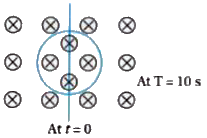 `RARR OMEGA=(2PI)/T =(2pi)/10` `therefore omega=pi/5`….(1) when `omegat=pi/2`, then flux ASSOCIATED with ring is MINIMUM and induced emf is maximum. `therefore t=(pi//2)/omega = (pi//2)/(pi//s)=5/2`=2.5 s (From equ. (1)) and when `omegat=pi` then flux associated with ring is maximum and induced emf is minimum . `therefore t=pi/omega` `=pi/(pi//5)` (`because` From equation (1)) t=5s `therefore` (2.5 s, 5s) |
|
| 13. |
A beam of light of lambda= 600 nm from a distant source falls on a single slit 1 mm wide and the resulting diffraction pattern is observed on a screen 2 m away. The distance between first dark fringes on either side of the central bright fringe is ... |
|
Answer» `1.2` cm `d sin thea_(1)= lambda` `:. sin theta_(1)=(lambda)/(d)` but `sin theta_(1)=(x_(1))/(D)` `:. (x_(1))/(D)=(lambda)/(d)` `:.x_(1)=(lambdaD)/(d)` `:.` The distance between first minimum from central maximum on both the SIDES `=2x_(1)` `:.2x_(1)=(2lambdaD)/(d)` `=(2xx600xx10^(-9)xx2)/(1xx10^(-3))` `=2400xx10^(-6)m=2.4 mm` |
|
| 14. |
Nature of wave front depends on |
|
Answer» SHAPE of source |
|
| 15. |
The turntable of a gramophone is rotated at a constant speed of x revolutions/minute. Which one of the following values of the revolutions per minute is not used? |
|
Answer» 78 r.p.m. |
|
| 16. |
The resistivity of the alloy manganin is nearly independent of temperature. |
| Answer» SOLUTION :NEARLY INDEPENDENT of | |
| 17. |
The moment of inertia of a straight thin rod of mass M and length L about an axis perpendicular to its length and passing through its C.G. is : |
|
Answer» `(1)/(12)ML^(2)` |
|
| 18. |
The molecules of an ideal gas have 6 degrees of freedom. The temperature of the gas is T. The average translational kinetic energy of its molecules is |
|
Answer» `(3)/(2)KT` |
|
| 19. |
Figure shows activities A of three different radioactive material samples (labelled as I, II and III) versus time. Using the given information, correctly match the requisite parameter in the left column with the options given in right column. Consider only their natural decay as the cause of rate of change of number of parent nuclei {:(,"Column-I",,"Column-II",),((P)," Disintegration constant "(lambda)" has maximum value for the material of sample ",,(1),I),((Q),"Half life is maximum for the material of the sample",,(2),II),((R),"Initially if samples of all three materials have same number of atoms then number of parent atoms of which of the sample will be maximum at any later time",,(3),III),((S), "Suppose all the materials decay by emitting "alpha"-particles of same energy and initially all three samples contain same amount (in gm) of the materials. Till the end of time span equal to their respective half lives, maximum energy is radiated by the sample",,(4),"it is not possible to compare with the help of data available"):} |
|
Answer» `{:(,P,Q,R,S),((A),4,2,3,4):}` (Q) Activity of the sample III takes maximum life to become half therefore it has maximum half - life. (R) (S) It can not be compared without INFORMATION about atomic weight as ENERGY radiated will depend UPON no. of atoms, not upon amount of substance. `A_(0)=N_(0)lambda_(1)=N_(0)lambda_(2)` `(A_(0))/2N_(0)lambda_(3)implies lambda_(1)=lambda_(2)=2lambda_(3)` `N=(N_(0))/(2^(n))=(N_(0))/(2^((tlambda)/(mu2)))` `(N_(3))/(N_(1))=2^(t/(mu2)(lambda_(1)-lambda_(3))) gt 1` `N_(3) gt N_(1)` |
|
| 20. |
Produce the truth table of the combination of four NAND gates arranged as shown in Fig.Name the gate so formed. |
|
Answer» Solution :The TRUTH table of COMBINATION of gates is shown below, `|:{:(A,B,y'(=bar(A.B)),y_(1)(=bar(A.y')),y_(2)(=bar(B.y)),y=bar(y_(1).y_(2))),(0,0,1,1,1,0),(1,0,1,0,1,1),(0,1,1,1,0,1),(1,1,0,1,1,0):}:|-= |{:(A,B,y),(0,0,0),(1,0,1),(0,1,1),(1,1,0):}|` It means a EXOR gate is produced. Explaination Using Boolean expression and De morgan's THEOREM[i.e., `bar(C.D)=barC+barD and bar(C+D)=barC.barD]` `y^(')=bar(A.B)=barA+barB` `y_(1)=bar(A.(barA+barB))=barA+bar((barA+barB))=barA+(bar(barA).bar(barB))=barA+(A.B)` `y_(2)=bar(B.(barA+barB))=barB+bar((barA+barB))=barB+(bar(barA).bar(barB))=barB+(A.B)` `y = bar(y_(1).y_(2)) =bar([bar(A)+(A.B)].[bar(B)+(A).B))] =bar([bar(A)+(A+B)]) =barbar(A).bar(A+B)+barbar(B).bar(A+B)` `=A.(barA+barB)+B.(barA+barB)=A.barA+A.barB+B.barA+B.barB=A.barB+B.barA( :'A.barA=B.barB=0)` which is for EXOR gate. Thus, arrangement WORKS as EXOR gate. |
|
| 21. |
State Kirchoff's junction rule. |
| Answer» SOLUTION :The algebraic sum of the currents MEETING at any junction in a CIRCUIT is zero. | |
| 22. |
The magnatic potential due to a short magnetic dipole is 10^-4 (Wb)//m at an axial point 20 cm away from the dipole centre. its magnetic moment is : |
|
Answer» 10 |
|
| 23. |
Anelectron falls throgh a distance of 1.5 cm in a uniform electric field of magnitude2.0 xx10^(4) N c^(-1)the direction of the fieldis reversed keeping its magnitude unchangedandaproton falls throughthe same distance computethe time of falls in each case contrastthe situation with that of free fall under gravity |
|
Answer» Solution :The field is upward so the negatively CHARGED the magnitude of the electricof the electron is`a_(e )=EE//m_(e )` where `m_(e )` is the MAS of the electron distanceh is given by `t_(e )=sqrt(2h)/(a_(e ))=sqrt(2hm_(e ))/(e E)` For e=`1.6 xx10^(-19) C, m_(e )=9.11 xx10^(-31)` kg `t_(e )=2.9n xx10^(-9)` S where `m_(p)` is the MASS of the proton `m_(p)=1.67 xx10^(-27)` kg the time of fall for the proton is `t_(p)=sqrt(2h)/(a_(p))=sqrt(2hm_(p))/(eE)=1.3 xx10^(-7)` S `a_(p)=(eE)/(m_(p))` `=1.9xx10^(12) ms^(-2)` which is enormous compared to the value of g (9.8 `ms^(-2)`)the acceleration DUE to gravity thethus the effect of acceleration due to gravity can be ignored in this example |
|
| 24. |
By bringing the grid nearer to the plate in a triode value, the amplification factor : |
|
Answer» BECOMES zero |
|
| 25. |
In a p-n junction diode, the depletion region is 400 nm wide and an electric field of 5 xx 10^5 V//m exists in it. The minimum kinetic energy of a conduction electron which can diffuse from n side to p side is |
|
Answer» Solution :The p.d across the JUNCTION V = ED But change in K.E. = work done `therefore ` the K.E REQUIRED to conduct electron from n side TOP side = V electron volts ` = 5 xx 10^5 xx 400 xx 10^(-9) = 0.2eV ` |
|
| 26. |
For example 32 consider target body B initially at rest, get the expressin for velocities of bodies after the collision (a)m_(1)=m_(2)(b)m_(2)gt gtm_(1)(c)m_(2)ltltm_(1) |
|
Answer» Solution :Put `m_(1)=m_(2)and u_(2)=0` in equations (x) & (XI) (b) Put `m_(1)=0` in equations (x) &n (xi) (c ) Put `m_(2)=0` in equations (x) & (xi) `u_(2)=0` (GIVEN) From equation (10) `v_(1)=((m_(1)-m_(2))u_(1))/(m_(1)+m_(2))""...(12)` From equation (11) `v_(2)=(2m_(1)u_(1))/(m_(1)+m_(2))""...(13)` (a) Put `m_(1)=m_(2)=m` (SAY) in equations (12) & (13) `v_(1)=((m-m)u_(1))/(m+m)=0` `v_(2)=(2m u_(1))/(m+m)=u_(1)` i.e., body A comes to rest and body B starts mobing with the initial velocity of A `100%` KE of A is transferred to the body B. (b) `m_(2)gt gtm_(1)` `m_(1)` can be ignored Put `m=0` in equations (12) & (13) `v_(1)=(-m_(2))/(0+m_(2))u_(1)=-u_(1)` `v_(2)=(2xx0xxu_(1))/(0+m_(1))=0` When a light body a collides against a heavy body B at rest. A rebounds with its own velocity and B continous to be at rest e.g., a ball rabounds with same speed (direction of velocity is opposite) on striking a floor. (c ) (When target body B at rest has NEGLIGIBLE mass) `m_(2) lt lt m_(1),m_(2)` can be ignored. Put `m_(2)=0` in equations (12) and (13) `v_(1)=-((m_(1)-0))/(m_(1)+0)u_(1)=u_(1)` `v_(2)=(2m_(1)u_(1))/(m_(1)+0)=2u_(1)` When a heavy body AS undergoes an elasticv collision witha light body at rest, A keeps on moving with the same velocity of its own and B starts moving with double the initial VELOSITY of A. |
|
| 27. |
Making use of Planck's formula, derive the expressions determining the number of photons per 1cm^(3) of a cavity at a temperature T in the spectral intervals (omega, omega + d omega) and (lambda, lambda + d lambda). |
|
Answer» Solution :We use the formula `epsilon = cancelh omega` Then the number of photons in the spectral interval `(omega, omega + d omega)` is `n(omega)d omega = (u(omega,T)d omega)/(cancelh omega) = (omega^(2))/(PI^(2)c^(3))(1)/(E^(cancelh omega//kT)-1)d omega` USING `n(omega)d omega =- overset~(n)(LAMBDA) dlambda` we get `d lambda overset~(n)(lambda) = n((2pic)/(lambda)) (2pic)/(lambda^(2))d lambda` `=((2pic)^(3))/(pi^(2)c^(3)lambda^(4))(1)/(e^(2pi cancelh c//klambdaT)-1) dlambda` `= (8pi)/(lambda^(4))(d lambda)/(e^(2picancelh c//lambdakT)-1)` |
|
| 28. |
Telescope has also what ? |
| Answer» SOLUTION :HIGH RESOLVING POWER, BRIGHTNESS | |
| 29. |
60W-220V and 100W-220V bulbs are connected in series to 220V mains. The power consumptionis more in the bulb of : |
|
Answer» 60W |
|
| 30. |
एक ठोस जालक में जब धनायन अपने स्थान को छोड़कर अन्तराकाशी स्थल को ग्रहण कर लेता है तो जालक दोष कहलाता है - |
|
Answer» फ्रेंकिल दोष |
|
| 31. |
The minimum deviation produced by a hollow prism filled with a certain liquid to be 30^@. The light ray is also found to be refracted at angle 30^@. The refractive index of the liquid is |
|
Answer» `SQRT2` |
|
| 32. |
A galvanometer is shunted by [1/n]^th of its resistance Fraction of total current passing through galavanometer is: |
|
Answer» n+1 |
|
| 33. |
Theunit of pole strength ( magnetic charge ) is _________ . |
| Answer» Answer :A | |
| 34. |
If w,x,y and z are mass, length, time and current respectively, then (x^(2)w)/(y^(3)z) are the dimensions of : |
|
Answer» ELECTRIC potential `(WX^(2))/(ZY^(3))=(ML^(2))/(IT^(3))=(ML^(2)T^(-2))/(IT)=("work")/("CHARGE")` Electric potential . Thus `(a)` is the right answer |
|
| 35. |
Define an equipotential surface. Draw equipotential surfaces (i) in the caseof a single point charge. (ii) in a constantelectric field in Z direction. Why the euipotential surfaces about a singlecharge are not equidistant ? (iii) Can electric field exist tangential to an equipotential surface ? Give reson. |
Answer» SOLUTION :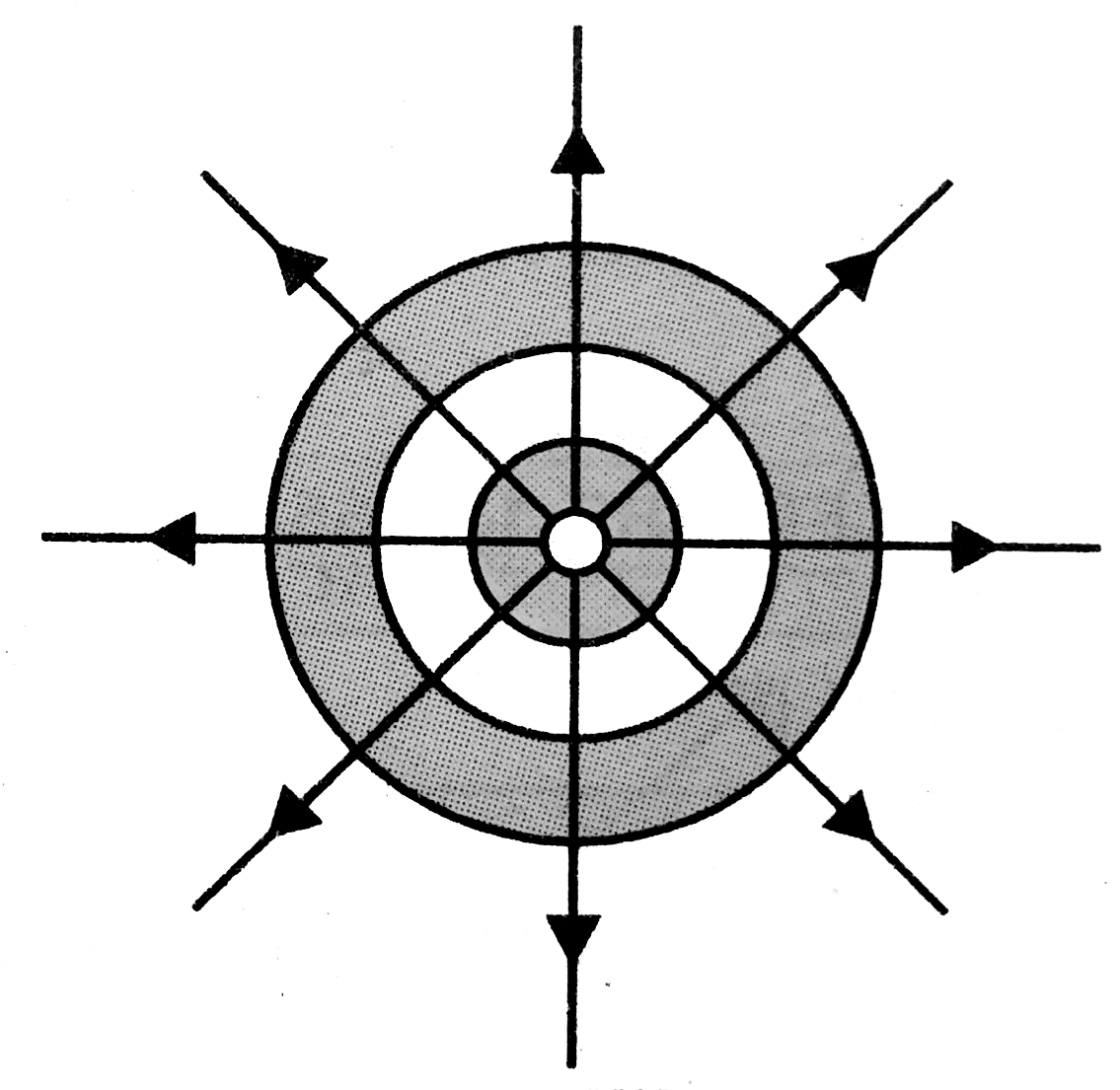 (i) An equipotential SURFACE is that at everypointof which electricpotential is the same. Due to a single POINTCHARGE, equipotnetial surfaces are centredat the charge, As `V prop (1)/(r )`, the equipotential surfaces about a single charge cannot be equidistant. (II) In a constant electricfieldin Z- direction, equipotential surfaceslie in XY plane perpendicular to Z-direction as shown in Fig. 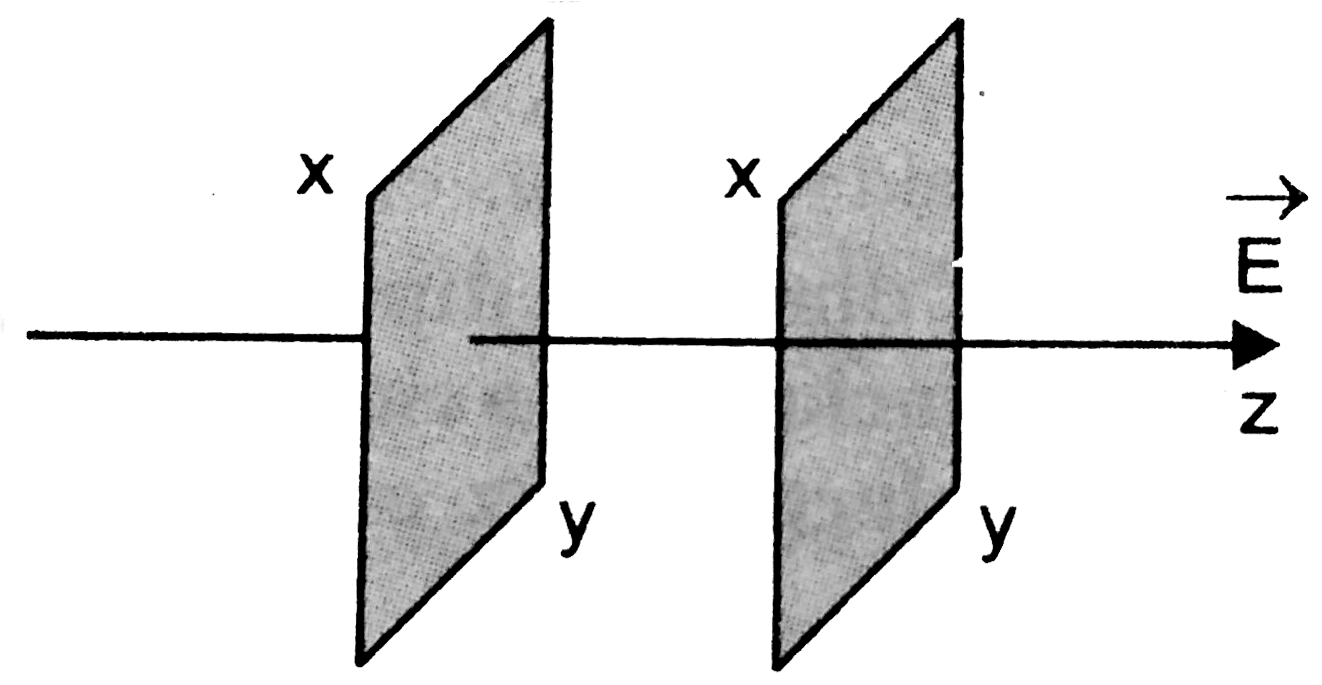 (iii) As electric fiedis perpendicular to the equipotentialsurface, the field cannot existtangenital to the equipotential surface. |
|
| 36. |
The elevation of a cloud is 60° above the horizon. A thunder is heard 8s after the observation of lighting. The speed of sound is 330 ms^(-1). The vertical height of cloud form ground is: |
|
Answer» 2826 m |
|
| 37. |
What we call to thedistance between principal focus and pole of the mirror ? |
| Answer» SOLUTION :FOCAL LENGTH | |
| 38. |
For base station to mobile communication, the required frequency band is |
| Answer» Solution :840 - 935 MHz | |
| 39. |
In a Young's double slit experiment one of the slits is covered (i) with a translucent paper and (ii) with an opaque plate. What changes will be observed in the interference pattern in each case ? |
|
Answer» SOLUTION :(i)Interference pattern will be FORMED and fringe width will remain unchanged. Difference in INTENSITIES of dark and bright fringes will decrease i.e bright fringes will become less bright and dark fringes will become less dark. (II) Interfernce pattern will vanish and a continuous and a continuous illumination will be SEEN on the screen. |
|
| 40. |
A charge Q is distributed over two concentric hollow spheres of radii r and R (R gt r), so that the surface charge densities are equal. The potential at the common centre is (1)/(4pi epsi_(0))" times" |
|
Answer» |
|
| 41. |
Find the charge flown when the switch S is closed. |
|
Answer» ZERO |
|
| 42. |
A particle is placed at the origin and a force F = kx is acting on it (where k is a positive constant). If U (0) = 0, the graph of U (x) versus x will be (where U is the potential energy function) : |
|
Answer»
`thereforedU=-Kxdx` or `U=-Kxdx=-1/2Kx^(2)` This is QUADRATIC equation i.e., equation of a PARABOLA. THUS correct choice is (a). |
|
| 43. |
A positive charge q is placed in front of a conducting solid cube at a distance d from its centre. Find the electric field at the centre of the cube due to the charges appearing on its surface. |
|
Answer» SOLUTION :Charges will induce on the surface of the CUBE due to the charge q. The net electric FIELD at the centre of the cube due to all the charges must be zero. Let `E_1` be the electric field due to the charges appearing on the surface of the cube. If `E_2` is the electric field due to charge q, then `vec(E_1) + vec(E_2) = 0 ` or `vec(E_1) = -vec(E_2)` or `E_1 = E_2` The electric field due to charge q at the centre of the cube `E_1 = ((1)/(4 pi in_0)) q/(d^2) implies E_1 (1/(4 pi in_0))q/(d^2)` 
|
|
| 44. |
An another point charge q, thrown towards the stationary point charge Q at speed v, it returns at a distance r from Q. If 2v speed is given instead of v then distance of closest approach will be ……… |
|
Answer» r `:.r_(0)prop(1)/(K_(0))` where `K_(0)` is initial KINETIC energy Now `K_(0)=(1)/(2)mv_(0)^(2)` `:.K_(0)prop(1)/(v_(0)^(2))` `:.r_(0)prop(1)/(v_(0)^(2))` `:.((r_(0))_(2))/((r_(0))_(1))=((v_(01))/(v_(02)))^(2)=(v^(2))/((2V)^(2))=(1)/(4)` `:.(r_(0))_(2)=(r)/(2)""[:.(r_(0))_(1)=r]` |
|
| 45. |
The story of 'The Last Lesson' is set in the backdrop of |
|
Answer» FRANCE GERMANY WAR |
|
| 46. |
Which of the following, when added as an impurity into the silicon, produces n-type semiconductor? |
|
Answer» <P>B |
|
| 47. |
Two similar balls of mass 'm' are hung by a silk thread of length L and carry similar charges Q as in figure Assuming the separation to be small, the separation between the balls (denoted by x) is equal to |
|
Answer» `[(Q^2. 2L)/(4 PI epsilon_0.mg)]^( 1/3)` |
|
| 48. |
The intensity of a sound wave gets reduced by 20% on passing through a slab. The reduction in intensity on passage through two such consecutive slabs is : |
| Answer» Answer :B | |
| 49. |
A 600pF capacitor is charged a 200V supply. It is then disconnnected from the supply and is connected to another uncharged 600pF capacitor. How much electro static energy is lost in the process. |
|
Answer» Solution :`C_(1)=600pF, V_(1)=200V,""C_(2)=600pF, triangleE=?` `E_(1)=1/2 C_(1)V_(1)^(2)=1/2 xx 600 xx 10^(-12) xx 200 xx 200=12 xx 10^(-6)J` `E_(2)=1/2 (Q^(2))/(C_(1)+C_(2))=1/2 xx ((C_(1)V_(1))^(2))/(C_(1)+C_(2))=1/2 xx ((600 xx 10^(-12) xx 200)^(2))/(1200 xx 10^(-12))` `=1/2 xx ((600)^(2) xx (10^(-2))^(2) xx 200 xx 200)/(1200 xx 10^(-12))=(600 xx 600 xx 10^(-12) xx 100)/(6)=6 xx 10^(-6)J` `triangleE=6 xx 10^(-6)J` |
|
| 50. |
A long wire is stretched by 0.2 cm and energy density is 0.25 J m^(-3), what will be the energy density when stretched by 1 cm ? |
|
Answer» `1/100Jm^(-3)` `Uprop("extension")^(2)` `U_(1)=0.25Jm^(-3)` `l_(1)=0.2cm,l_(2)=1cm` `(U_(2))/(U_(2))=((l_(2)^(2))/(l_(2)^(1)))=1/((0.2)^(2))=100/4=25` `U_(2)=254U_(1)=25xx0.25=25/4` Correct choice is (d). |
|


