

Saved Bookmarks
This section includes 7 InterviewSolutions, each offering curated multiple-choice questions to sharpen your Current Affairs knowledge and support exam preparation. Choose a topic below to get started.
| 1. |
A particle undergoes S.H.M. with a time period of 2 seconds. In how much time will it travel from its mean position to a displacement equal to half of its amplitude ? |
|
Answer» Solution :We know that `T=(2pi)/omega=2(thereforeomega=pi)` When PARTICLE starts from MEAN position, `x=asin omegat` For `x=a/2` ` a/2=a sin omegat` therefore 1/2=sin omegat=sin PIT(there omega=pi)` ` therefore pit=pi/6` `thereforet=1/6sec` |
|
| 2. |
The speed of sound in air at N.T. is 330m/s. If air pressure becomes four times, then what will be the speed of sound ? |
| Answer» SOLUTION :SPEED of sound does not depend upon the CHANGE in pressure. HENCE, velocity = 300m/s. | |
| 3. |
What is coordination number in 2-D hexagonal close packing |
|
Answer» 8 |
|
| 4. |
A ray of light ab passing through air enters a liquid of refractive index mu_(1) at the boundary XY. In the liquid, the ray is shown as bc. The angle between ab and bc ( angle of deviation) is delta. The ray then passes through a rectangular salb ABCD of refractive index mu_(2)(mu_(2)gtmu_(1)) and emerges from the slab as the ray de. The angle between XY and AB is theta. The angle between ab and de is |
|
Answer» `DELTA` |
|
| 5. |
In the above problem, find the speed with which the stone hits the ground. |
|
Answer» |
|
| 6. |
An object of mass m_(1) initially moving at speed v_(0) collides with an stationary abject of mass m_(2)= alpham_(1), where a lt 1.The collision could be completely elastic, completely inelastic, or partially inelastic. After the collision the two objects move at speeds v_(1) " and " v_(2). Assume that the collision is one dimensional , and that object one cannot pass through object two. After the collision, the speed ratio r_(1)=v_(1)//v_(0)of object 1 is bounded by |
|
Answer» `(1-alpha)//(1+alpha)ler_(1)le1` `r_(1)=(V_(1))/(V_(0))=((1-ealpha))/((1+alpha))` `(r_(1))_("min")=((1-alpha))/((1+alpha))` `(r_(1))_("max")=((1)/(1+alpha))` |
|
| 7. |
Obtain the resonant frequency omega_(r ) of a series jLCR circuit with L= 2.0 H, C = 32 muF and R = 10 Omega . What is the Q-value of this circuit ? |
|
Answer» Solution :`omega_(r ) = omega_(0) = (1)/(sqrt(LC))` `:. omega_(r ) = ( 1)/( sqrt(2 XX 32 xx 10^(-6)))` `:. omega_(r ) = 125 (rad)/( s )` Q VALUE( or Q factor ) `= ( omega_(r ) L )/( R )` ` = ( 125 xx 2)/( 10)` ` = ( 1)/( 10) sqrt( ( 2) /( 32 xx 10^(-6)))` ` = (1)/(10) xx (1000)/( 4)` = 25 |
|
| 8. |
Hydrogen (H), deuterium (D), singly ionized helium (He^(+)) and doubly ionized lithium (Li^(++)) , all have one electron around the nucleus Consider n = 2 to n = 1 transition . If the wavelength of emitted radiation are lamda_1,lamda_2,lamda_3 , and lamda_4 , respectively, then approximately. |
|
Answer» `lamda_1=lamda_2=4lamda_3=9lamda_4` |
|
| 9. |
The magnitude of electric field intensity and potential at a point A due to a charge Q placed at point B are 25NC^(-1) and 35JC^(-1), respectively. Calculate the value of Q and distance between A and B. |
| Answer» SOLUTION :`5.44xx10^(-9)C, 1.4m` | |
| 10. |
M is intensity of magnetisation and H is magnetic intensity. Give the formula of magnetic susceptibility (chi_(m) ). |
|
Answer» `(M)/(H)` |
|
| 11. |
A vehicle of mass 20kg is moving with a velocity of 4ms^(-1). Find the magnitude of the force that is to be applied on the vehicle so that the vehicle have a velocity of 1 ms^(-1)after travelling a distance of 20m. |
| Answer» Answer :C | |
| 12. |
In n-p-n transistor 94% of the electrons reach the colectro and10^(12)electrons enter the emitter in what are the values of current transfer ratio and current amplification factor |
|
Answer» SOLUTION :`I_(c ) = (94)/(100) I_(c )` `alpha= (I_(c ))/( I_(c ))= (94 I_(c ))/( 100 I_(c ))= 0.94` `BETA = (alpha)/(1-alpha)= (0.94)/(1-0.94) = 15 .6` |
|
| 13. |
The gravitational waves were theoretically proposed by |
|
Answer» CONRAD Rontgen |
|
| 14. |
Calculate the energyreleased in the nuclear reaction shown below. H_1^2+H_1^2toHe_2^4+"Energy"Mass of H_1^2=2.014102 u mass of He_2^4=4.0026u, 1a.m.u=931 MeV |
| Answer» SOLUTION :ENERGY RELEASED=`Deltamxx931MeV=(2xx2.014102-4.0026)931MeV=23.8336 MEV` | |
| 15. |
In an experiment, the values of refractive indices of glass were found to be 1.54, 1.53, 1.44, 1.54, 1.56 and 1.45 in successive measurements (i) mean value of refractive index of glass i) mean absolute error iii) relative error and iv) percentage error are respectively, |
|
Answer» `1.51,0.04, 0.03 , 3%` |
|
| 16. |
Prove Kirchhoff's law of radiation theoretically. |
|
Answer» Solution :KIRCHHOFF's law of RADIATION : Kirchhoff's law of radioation states that the coefficient of absorption of a body is EQUAL to its coefficient of emission at any given tempereature. It can be proved hy Thought Experiment'. Let us consider an ordinary body O and perfectly blackbody B with same surface area A, are placed in the uniform temperature enclosure. 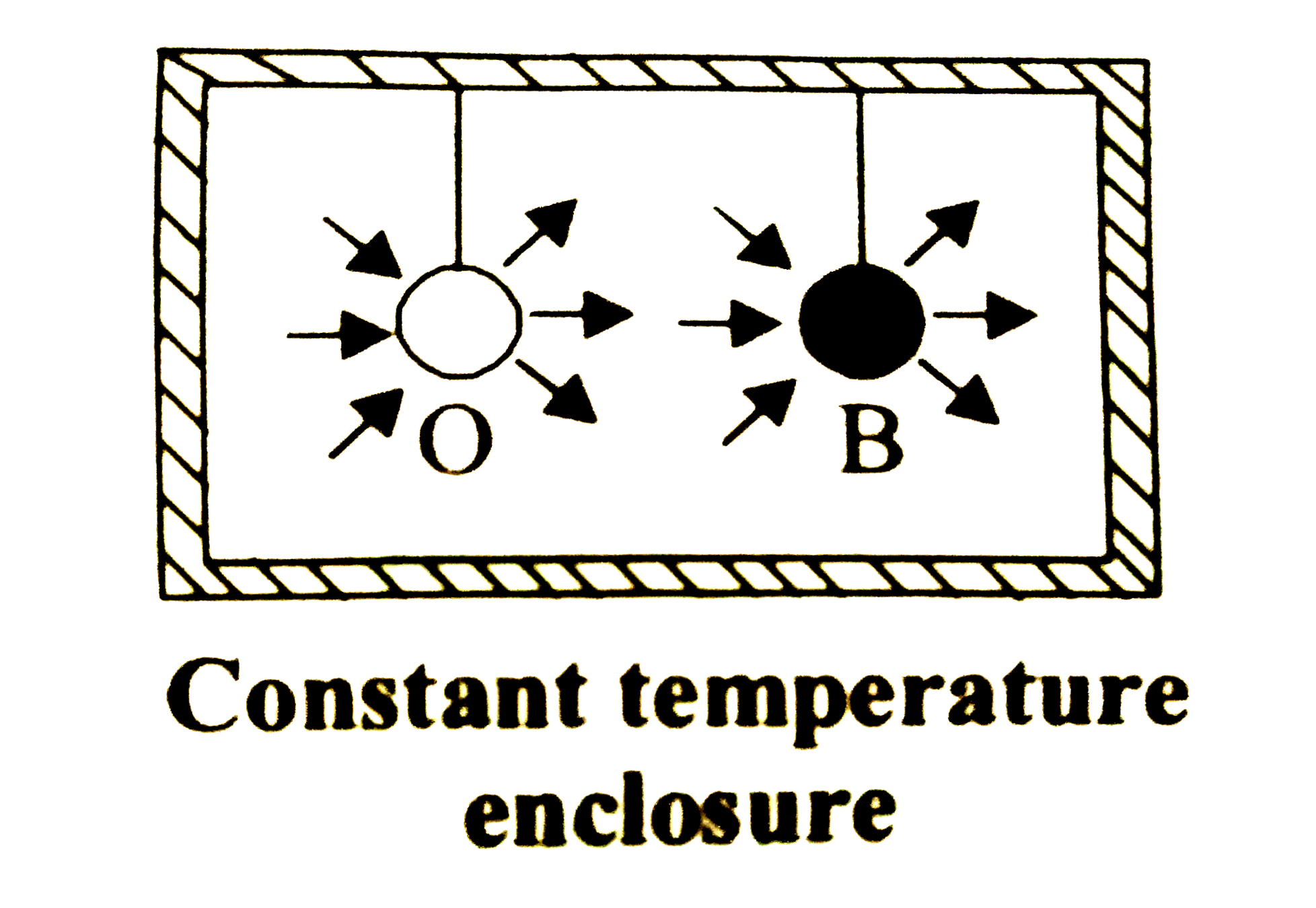 Both the bodies will have same temperature by thermal exchange which is a zeroth law on thermodynamics. Let E be emissive power of ordinary body O, `E_(b)` be emissive power of perfectly BLACK body B, a be the coefficient of absorption, e be the coefficient of emission of O, and Q be the radiant eanrgy incident per unit time per unit area on each body. Now, total radiant energy incident per unit time on B=AQ And quantity of energy emitted per unit time by `B=AE_(b)` Energy emitted per unit time by B= Energy absorbed per unit time by B. `:.AE_(b)=AQ` `E_(b)=Q"".......(i)` The total radiant energy incident per unit time on O=AQ. Quantity of energy emitted per unit time by O=AE And quantity of energy absorbed per unit time by `O=aAQ`. Energy emitted per unit time by O = Energy absorbed per unit time by O `:.AE=aAQ` `:.E=aQ` `:.(E)/(a)=Q"".........(ii)` From EQUATIONS (i) and (ii), we get `(E)/(a)=E_(b)` `:.(E)/(E_(b))=a` But `(E)/(E_(b))=e` (coefficient of emission) `:.a=e` Coefficient of absorption =Coefficient of emissions |
|
| 17. |
The wheel of radius R rolls without slipping on horizontal rough surface, and its centre O has an horizontal acceleration a_(0) in forward direction. A point P on the wheel is a distance r from O and angular position theta from horizontal. For a given values of a_(0), R and r, determine the angle theta for which point P has no acceleration in this position. |
|
Answer» <P> SOLUTION :The ACCELERATION of the point `P` is that due to the axis `(a_(0))` and the to rotation about the axis.`a_(0)costheta=omega^(2)r` `a_(0)sintheta=alphar` `a_(0)=alphaR` 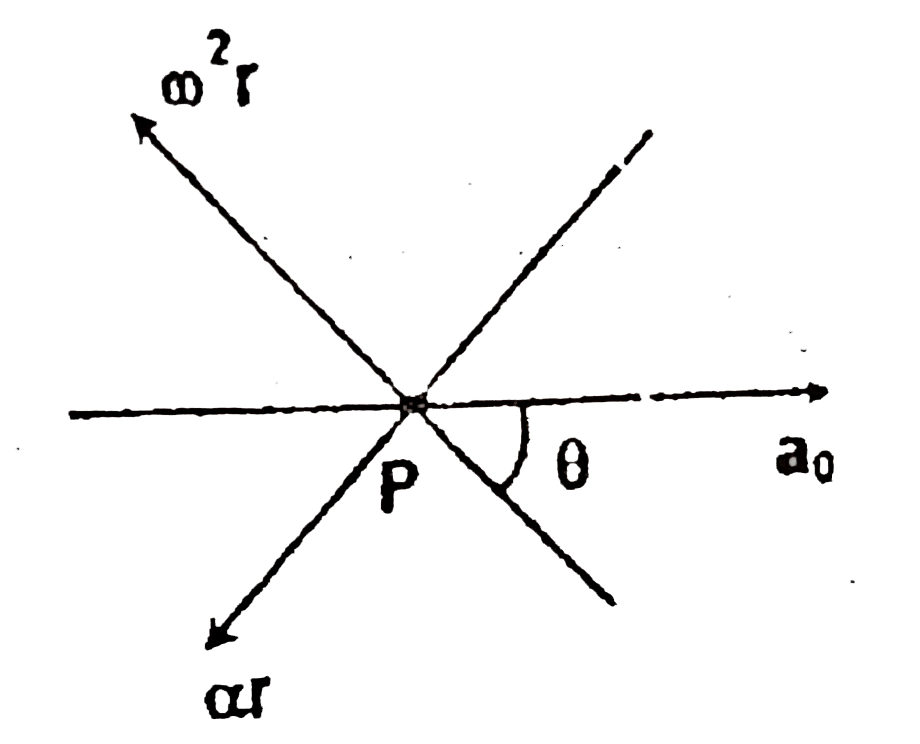
|
|
| 18. |
Moment of inertia of a solid sphere of density rho and radius R is given by : |
|
Answer» <P>`(105)/(176)rhoR^(2)` Since M = volume `XX` density `=(4)/(3)PIR^(3)xxrho` `therefore I=(2)/(5).(4)/(3)piR^(3).rho.R^(2)` `=(8)/(15)piR^(5)rho=(8)/(15)xx(22)/(7)R^(5)P=(176)/(105)rhoR^(5)` |
|
| 19. |
Dimensional formula of mutual inductance is ……. |
|
Answer» `M^(1)L^(2)T^(-2)A^(-2)` |
|
| 20. |
विज्ञान की एक शाखा है जो जीवों को पहचाननेनामकरण और वर्गीकरण से संबंधित है। |
|
Answer» आकारिकी |
|
| 21. |
The equation of a plane progressive is given by y = 0.025 sin (100 t + 0.25 x). The frequency of this wave would be : |
|
Answer» 50 HZ compare it with standard form y = r sin `(omega t + kx)` `omega= 100 sec^(-1)` `2pi v = 100 "" rArr "" v = (100)/(2 pi) =(50)/(pi ) `Hz. Correct choice is (C) . |
|
| 22. |
In a young's double slit experimentthe fringe width is found to be 0.4 mm. if the whole apparatus is immersed in water of refractive index frac{4}{3}, the new fringe width will be |
|
Answer» `450mum` |
|
| 23. |
Statement I: Heavy water is preferred over ordinary water in moderator in nuclear reactor. Statement II: Average number of neutrons per fission reaction is 2.5. |
|
Answer» A Statement I is TRUE, statement II is FALSE. |
|
| 24. |
Ground waves are : |
|
Answer» UNPOLARISED |
|
| 25. |
An ammeter and a voltmeter are connected in series to a battery of emf 6V. When a certain resistance is connected in parallel with the voltmeter, the reading of the latter decreases n = 2 times, whereas the reading of the ammeter increases the same number of times. What is the ratio of the voltmeter resistance to the ammeter resistance? Find the voltmeter reading after the connection. |
|
Answer» |
|
| 26. |
Two balls are projected from the same point in directions inclined at 60° and 30° to the horizontal. If they attain the same maximum height, the ratio of their velocities of projection is : |
|
Answer» `1:1` we get `(u_(1)^(2)sin^(@)60^@)/(2G)=(u_(2)^(2)sin^(2)30^@)/(2g)` `u_(1)^(2)/u_(2)^(2)=1/4xx4/3` `:. U_(1)/u_(2)=1/sqrt(3)` |
|
| 27. |
गंगा नदी का उदगम स्थल कहां है? |
|
Answer» गंगोत्री से |
|
| 28. |
A 0.10-kg cart traveling in the positive x direction at 10.0 m/s collides with a 0.30-kg cart at rest. The collision is elastic. What is the velocity of the 0.10-kg cart after the collision? |
|
Answer» `+2.5` m/s |
|
| 29. |
An X ray tube is operated at 50kV, the maximum wavelength produced is……..A. |
|
Answer» 0.75 `=2.48 times 10^-11` `=0.25 times 10^-10 m=0.25 A` In the present question, it should be minimum INSTEAD of MAXIMUM. Moreover, this TOPIC is out of present syllabus. |
|
| 30. |
Among the following the waves which can penetrate the ionosphere are |
|
Answer» 10 GHz |
|
| 31. |
A body is heated to a temperature 40^(@)C and kept in a chamber maintained at 20^@C. If the temperature of the body decreases to 36^@C in 2 minutues, then the time after which the temperature will further decrease by 4^@C, is |
|
Answer» 2 MINUTES |
|
| 32. |
The imperfect fungi which are decomposers of litter and help in mineral cycling belong to |
|
Answer» Phycomycetes |
|
| 33. |
The central fringe of diffraction pattern obtained by single slit for white light will be |
| Answer» Answer :D | |
| 35. |
Define half life period of a radioactive sample. Arrive at the relation between half life and decay constnat. |
|
Answer» SOLUTION :It is the TIME during which half of the atoms of radioactive substance UNDERGO disintegration Consider the relation, `N=N_(0)e^(-lambda t)…(1)` Where `N_(0)` = initial number of atoms in a radioactive substance. N=Number of atoms at GIVEN instant t. `lambda` = Decay CONSTANT. For half life period `t=T_((1)/(2))` and `N=(N_(0))/(2)` `(1)implies(N_(0))/(2)=N_(0)e^(-lambda T_((1)/(2)))` `(N_(0))/(2)=(N_(0))/(e^(lambda T_((1)/(2)))` `lambda T_((1)/(2))=log_(e)2""[because e^(x)=yimpliesx=log_(e)(y)]`, `lambdaT_((1)/(2))=2.303log_(10)(2)` `lambda T_((1)/(2))=2.303xx0.3010` `T_((1)/(2))=(0.693)/(lambda)` |
|
| 36. |
What is Brewster's law ? What will be the refractive index of a transparent medium with a polarising angle of 60^(@) ? |
|
Answer» Solution :Statement of Brewster.s law It states the tangent of polarising angle is equal to the refractive index of the material i.e. `tan i_(p)=mu` It is found that when LIGHT is INCIDENT in a transparent medium at polarising angle, the reflected and refracted rays are perpendicular to each other. Malus found that an ordinary beam, on refracted from transparent medium, becomes partially polarised. The DEGREE of polarisation increases as the angle of incidence is increased. At a PARTICULAR angle of incidence, called as the polarising angle, the reflected beam becomes completely polarised. 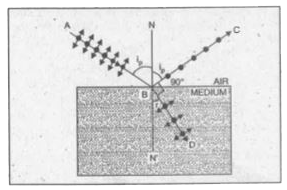 AB is the incident ray and BC is the reflected ray at the polarising angle `i = i_(p)`. The reflected ray BC is plane polarised with its vibrations perpendicular to plane of the paper. A part of the light is refracted along BD. It is found that both the reflected ray and the refracted ray are perpendicular to each other i.e. `/_CBD=90^(@)` `:. i_(p)+r=90^(@)` or `r=90^(@)-i_(p)` According to Snell.s law. `mu=(sin i)/(sin r)=(sin i_(p))/(sin(90^(@)-i_(p))` `=(sin i_(p))/(cos i_(p))=tan i_(p)` Thus, the refractive index pf transparent medium is equal to tangent of polarising angle. Given `i_(p)=60^(@)` `:. mu-tan60^(@)=SQRT3` |
|
| 37. |
If the temperature of a body is reduced to half of in initial temperature, then radiation power decresed by |
|
Answer» 0.84 `(P_(2))/(P_(1))=(1)/(16)` `(P_(2)-P_(1))/(P_(1))=(1-16)/(16)=-(15)/(16)=93.75%=94%`. |
|
| 38. |
For a normal eye, the far point is at infinity and the near point of distanct vision is about 25 cm in front of the eye. The cornea of the eye provides a converging power of about 40 dioptres, and the least converging power of the eye-lens behind the cornnea is about 20 dioptres. from this rough data estimate the range of accommodation (i.e., the range of converging power of the eye-lens ) of a normal eye. |
|
Answer» |
|
| 39. |
Two point charges +4muCand +1muCare separated by a distance of 2 m in air. Find the point on the line joining the two charges at which the net electric field of the system is zero. |
|
Answer» Solution :Let charges ` q_1 =+4 muC and q_2 =+1muC ` be placed at points. A and B respectivelyseparated by a distance AB = 2 m. Let electric field ` oversetto E ` be zero at a point C situated at a distance x from A or a distance (2-x) from B as shown in Thus, `oversetto (E_A) +oversetto (E_B) =0 or |oversetto (E_A)| =|oversetto (E_B)| ` `RARR "" (1)/(4piin _0).(q_1)/(x_2)=(1)/(4 pi in _0) .(q_2)/((2-x)^(2)) rArr (x)/((2-x)) =SQRT((q_1)/(q_2)) = sqrt((4MUC )/(1 muC)) = 2 ` `rArr "" x= (4)/(3) m ` ` (##U_LIK_SP_PHY_XII_C01_E09_009_S01.png" width="80%"> |
|
| 40. |
List-IList-II a) doble refractione) geometrical shadows b) interferencef) colour of thin films c) diffractiong) Fresnel zones d) rectilinearityh) reduction of intensity of light |
|
Answer» `A-H, B-E, C-F, D-G` |
|
| 41. |
How much work is required to separate the two charges infinitely away from each other ? |
|
Answer» SOLUTION :`W=U_2-U_1=0-U=0-(-0.7)` `=0.7J`. |
|
| 42. |
The energy gap of diamond is 6 eV . a . What does it mean ? b. What is the value of energy gap in the case of copper ? c. On the basis of energy gap , explain how substances are classified. |
|
Answer» Solution :a. In ORDER to cross the energy BARRIERS , an energy of 6 eV is required . b. zero c. 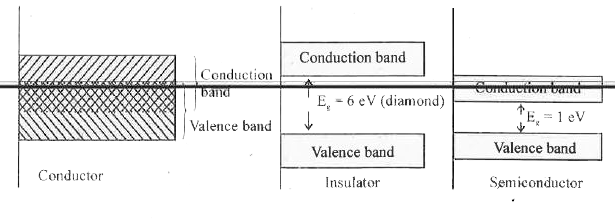
|
|
| 43. |
A positively charged particle is moving with a speed v in the region of uniform magnetic induction field B as shown in figure. Which of the following statements is correct? |
|
Answer» The force is Bqv `sin theta` perpendicular to B and in the plane of PAGE. |
|
| 44. |
You read news paper because of the light it reflects. Then why do you not see even a faint image of yourself in the newspaper ? |
| Answer» SOLUTION :We can see an IMAGE, if it is CALLED a REGULAR reflection. In the case of newspaper, the in homogenetics of the surface cause diffuse reflections. So, the directions. HENCE, no image is seen. | |
| 45. |
How will you distinguish between a' pure semiconductor and a semiconductor made from metals ? |
| Answer» Solution :The resistance of a semiconductor made of Ge and Si decrease in TEMPERATURE. But, the resistance of a semiconductor made from METALS INCREASES with rise in temperature COEFFICIENT. They have positive temperature co.efficient where as Ge etc have NEGATIVE temperature co.efficient. | |
| 46. |
A Cassegrain telescope uses two mirrors. Such a telescope is bult with the mirrors 20mm apart. If the radius of carvature of the large mirror is 220mm and the small mirror is 140 mm, where will the final image of an object at infinity be ? |
|
Answer» SOLUTION :`f_(0) = (220)/(2) = 110` mm Objectat infinity forms an image at 110 cm. This image will act as a yirtual object for the smaller MIRROR . Distance of virtual object from smaller mirror u = 110 - 2090 mm `f_(e) = (140)/(2)= 70` mm Using `(1)/(v) + (1)/(u) = (1)/(f_(s)) rArr (1)/(v) = (1)/(f_(s)) - (1)/(u) = (1)/(70) - (1)/(90) = (1)/(315) mm ` v = 315 mm i.e., Final image is 315 mm from smaller mirror on the righ SIDE |
|
| 47. |
Find the force of interaction between two current carrying coils, the distance between the centres of which is much greater than their linear dimensions (Fig. 28.16). |
|
Answer» `(dB)/(dx)=(6mu_(0) p_(m)x)/(4pi (a^2+x^2)^(5//2))` (see Problem 27.11) and that according to the condition of the problem `x APPROX r ge ge a,` we have `(dB)/(dx)=(6mu_(0)p_(m))/(4pir^4)` The force of interaction is `F=p_(m) (d B)/(dx)=-(6mu_(0)p_(m)^2)/(4pir^4)` It is quite similar to the force of interaction between electric dipoles. |
|
| 48. |
A lab voltmeter has scale as shown in figure. A student uses this nearly ideal voltmeter to record potential difference between points A and B in the circuit shown. He could not see any deflection in the pointer and thinks that the voltmeter must be faulty. He replaces the voltmeter with another similar one. What reading will he record this time? Can you give some suggestion to record the potential difference across A and B ? |
|
Answer» |
|
| 49. |
Two blocks of masses m and M are connected by means of a metal wire passing over a frictionless fixed pulley. The area of cross-section of the wire is 6.5 xx 10^(-9) m^(2) and its breaking stress is 2 xx 10^(9) Nm^(-2). If m = 1kg, then calculate the maximum value of M (g = 10 m//s^(2)) |
|
Answer» Solution :Mg- T = Ma …(i) `T - mg = ma` …(ii) `T = (2Mmg)/((M + m)) RARR (T)/(A) = (2Mmg)/(A(M + m)) = (2MG)/(A (1 + (m)/(M))) = 2 xx 10^(9)` `rArr M = 1.86 kg` 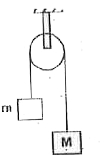
|
|
| 50. |
If a concave mirror is immersed in water will its focal length change? |
|
Answer» |
|