

Saved Bookmarks
This section includes 7 InterviewSolutions, each offering curated multiple-choice questions to sharpen your Current Affairs knowledge and support exam preparation. Choose a topic below to get started.
| 1. |
When the current flowing in a circular coil is doubled and the number of turns of the coil in it is halved, the magnetic field at its centre will become |
|
Answer» FOUR times |
|
| 2. |
The focal length of a plano-convex lens is 20 cm in air. Refractive index of glass is 1.5. Calculate (i) the radius of curvature of lens surface and (ii) its focal length when immersed in liquid of refractive index 1.6 |
|
Answer» |
|
| 3. |
If the distance of 100 W lamp is increased from a photo cell, the saturation current in the photo cell varies with distance d as: |
|
Answer» `ipropd^(2)` |
|
| 4. |
In n-P-n transistor the P-type crystal acts as |
|
Answer» EMITTER only |
|
| 5. |
The velocity of electromagnetic waves in free spaces is 3xx10^8ms^-1. The frequency a radio wavelength 150 m is |
|
Answer» 45MHz |
|
| 6. |
(a) State Lanz's law. Give one example to illustrate this law. "The Lenz's law is a consequence of the principle of conservation of energy." Justify this statement. (b) Deduce a expression for the mutual inductance of two long coaxial solenoids but having different radii and different number of turns. |
|
Answer» Solution :(a) Lenz's law : It states that the direction of induced current or emf in a circuit is always such that it opposes the cause which produces it. It gives the direction of current or emf induced in a circuit. Lenz's law is in accordance with the PRINCIPLES of conservation of energy. In electromagnetic induction, the electrical energy (in the form of induced current or induced e.m.f.) is produced at the expense of MECHANICAL energy. (b) Mutual Inductance : Suppose there are two coils `C_(1)` and `C_(2)`. The current `I_(1)` is flowing in Primary coil `C_(1)`, due to which an effective magnetic flux `phi_(2)` is linked with secondary coil `C_(2)`. By experiments. `phi_(2) prop I_(1) or phi_(2)=MI_(1)` Where, M is a CONSTANT, and is called the coefficient of mutual inductance. From `M=f_(2)/I_(1)`. If `I_(1)=1` ampere, `M=phi_(2)` i.e. the mutual inductance between two coils is numerically equal to the effective flux linkage with secondary coil, when current flowing in primary coil is 1 ampere. Mutual Inductance of Two co-axial Solenoids : CONSIDER two long co-axial solenoid each of length `l` with secondary coil, when current flowing in primary coil is N ampere. Mutual Unductance of two co-axial Solenoids : Consider two long co-axial solenoid each of length `l` with number of turns `N_(1)` and `N_(2)` wound one over the other. Number of turns per unit length in order (primary) solenoid, `n=N_(1)/l`. If `I_(1)` is the current flowing in primary solenoid, the magnetic field produced within this solenoid, `B_(1)=(mu_(0) N_(1) I_(1))/l` The flux linked with each turn of inner solenoid coil is `phi_(2)=B_(1)A_(2)`, where `A_(2)` is the cross-sectional area of inner solenoid. The total flux linkage with innercoil of `N_(2)`-turns. `phi_(2)=N_(2)phi_(2)=N_(2)B_(1)A_(2)` `=N_(2) ((mu_(0) N_(1)I_(1))/l)A_(2)` `=(mu_(0) N_(1)N_(2))/l A_(2)l_(1)` By definition, Mutual Inductance, `M= phi_(i)/I_(1)=(mu_(0)N_(1)N_(2)A_(2))/l` If `n_(1)` is number of turns per unit length of outer solenoid and `r_(2)` is radius of inner solenoid, then `M=mu_(0) n_(1)N_(2) pi r_(2)^(2)` 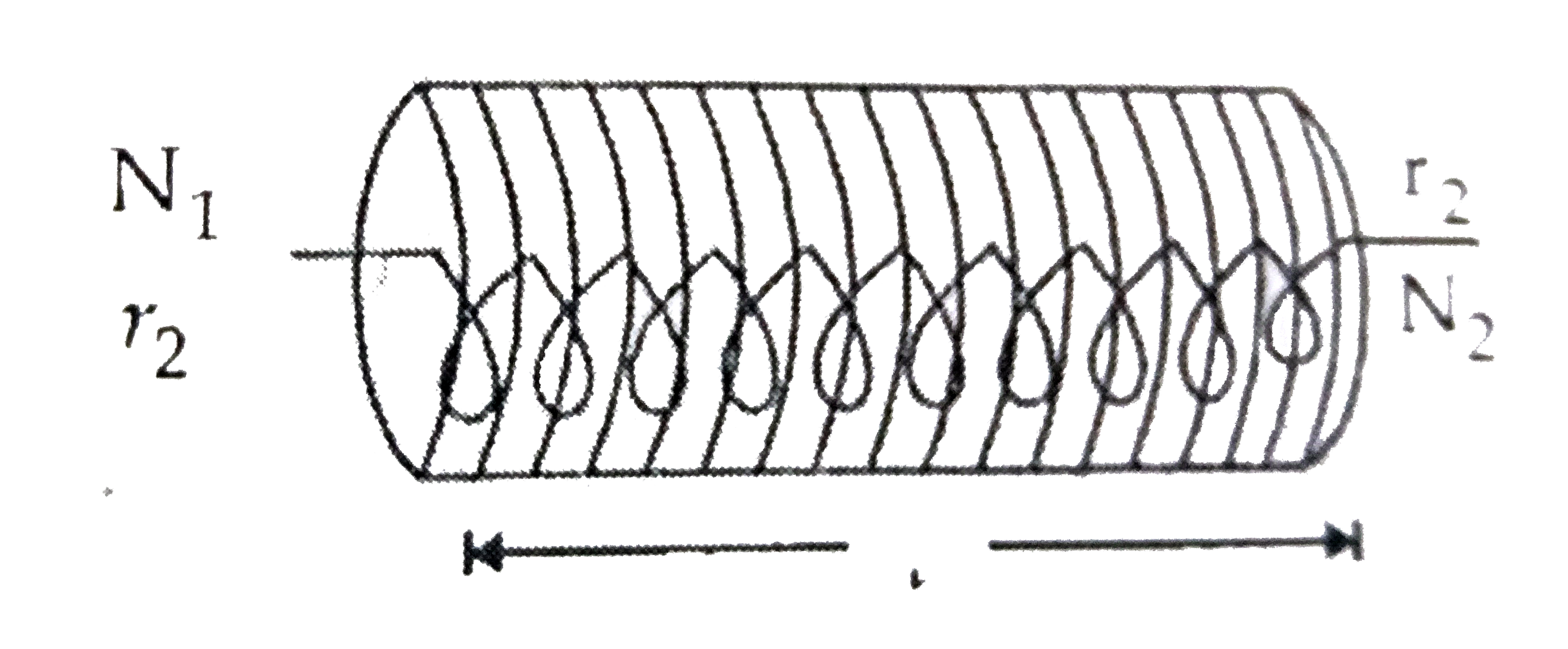
|
|
| 7. |
The characteristic impedance of a co-axial cableis of the order of: |
|
Answer» `50 Omega` |
|
| 8. |
In a plane electromagnetic wave, the electric field of amplitude 1 V m^(-1) varies with time in free space. The average energy density of magnetic field is (in Jm^(-2)) |
|
Answer» a. `8.86xx10^(-12)` |
|
| 9. |
The diagram shows the energy levels for an electron in a certain atom. Which transition shown represents the |
|
Answer» I |
|
| 10. |
Two parallel horizontal conductors are suspended by light vertical threads each of length 75cm. Each conductor has a mass of 0.4 gm per m. When no current flows through them, they are 0.5 cm apart. When same current flows through each conductor the separation is 1.5 cm. The value and direction of current is |
|
Answer» 14 A in same DIRECTION |
|
| 11. |
Dimensional formula of magnetic flux is ....... |
|
Answer» `M^1 L^2 T^(-2) A^(-1)` `therefore [phi]=[A][B]=[A][F/(Il)]` `=[L^2]xx(M^1L^1T^(-2))/(A^1L^1)` `=M^1 L^2 T^(-2) A^(-1)` |
|
| 12. |
If a source of power 4 kW produces 1020 photons per second, the radiation belongs to a part of the spectrum called : |
|
Answer» `gamma`-rays or `(6.6xx10^(-34)xx3xx10^(8))/(4xx10^(3))xx10^(20)=(19.8)/(4)xx10^(-9)` `~=50Å` (X-rays) |
|
| 13. |
If the current through a solenoid changes with time electromagnetic induction takes place in the solenoid. This is known as self-induction. In general, for a current I, the induced emf in the coil is e=-L(dI)/(dt). L is the self-inductance of the solenoid. On the other hand, such change in the current in a solenoid can produce electromagnetic induction in another adjacent solenoid. The induced emf in the other solenoid e=-M(dI)/(dt), M is called the mutual inductance of the solenoids. If L_(1) and L_(2) are the self-inductance of the adjacent coils then their mutual inductance M=ksqrt(L_(1)L_(2)). If the magnetic flux produced by the current in one coil is totally linked with the other coil then k = 1. |
|
Answer» |
|
| 14. |
The figure shows a monochromatic ray of light traveling across parallel interfaces, from an original material a, through layers of materials b and c, and then back into material a. Rank the materials according to the speed of light in them, greatest first. |
| Answer» SOLUTION :B (LEAST N), C, a | |
| 15. |
The radius of the oxygen nucleus (._8^16O)is 2.8xx10^(-15)m. Find the radius of the lead nucleus (._82^205Pb). |
|
Answer» `8.55xx10^(-15)` m |
|
| 16. |
Figure shown plane waves refracted for air to water using Huygen's principle a, b, c, d, e are lengths on the diagram. The ratio of refractive index of water w.r.t. air is |
|
Answer» a/e |
|
| 17. |
If the current through a solenoid changes with time electromagnetic induction takes place in the solenoid. This is known as self-induction. In general, for a current I, the induced emf in the coil is e=-L(dI)/(dt). L is the self-inductance of the solenoid. On the other hand, such change in the current in a solenoid can produce electromagnetic induction in another adjacent solenoid. The induced emf in the other solenoid e=-M(dI)/(dt), M is called the mutual inductance of the solenoids. If L_(1) and L_(2) are the self-inductance of the adjacent coils then their mutual inductance M=ksqrt(L_(1)L_(2)). If the magnetic flux produced by the current in one coil is totally linked with the other coil then k = 1. If the induced emf in a coil totally linked with the coil be 20muV forchange of 1mA/s, the mutual inductance (in H) of the two coils is |
|
Answer» 0.002 |
|
| 18. |
If the current through a solenoid changes with time electromagnetic induction takes place in the solenoid. This is known as self-induction. In general, for a current I, the induced emf in the coil is e=-L(dI)/(dt). L is the self-inductance of the solenoid. On the other hand, such change in the current in a solenoid can produce electromagnetic induction in another adjacent solenoid. The induced emf in the other solenoid e=-M(dI)/(dt), M is called the mutual inductance of the solenoids. If L_(1) and L_(2) are the self-inductance of the adjacent coils then their mutual inductance M=ksqrt(L_(1)L_(2)). If the magnetic flux produced by the current in one coil is totally linked with the other coil then k = 1. The self-inductance (in H) of a coil when the induced emf is 50muV for a change of 1 mA.s^(-1) in current through it, is |
|
Answer» 50 |
|
| 19. |
a. What is meant by magnification 'm' ? b. Give the mathematical relation. c. How is 'm' related to object distance and image distance ? |
|
Answer» Solution :a. Magnification is the RATIO of size of the image to the size of the object. B. m = `(h_(i))/(h_(0)) = ("HEIGHT of image ")/("Height of object")` c.M = `(v)/(u) = ("image distance ")/("Object distance ") ` |
|
| 20. |
A sound source sends a sinusoidal sound wave of angular frequency 3000 rad/s and amplitude 10.0 nm through a tube of air. The internal radius of the tube is 2.00 cm. (a) What is the average rate at which energy (the sum of the kinetic and potential energies) is transported to the opposite end of the tube? (b) If, simultaneously, an identical wave travels along an adjacent, identical tube, what is the total average rate at which energy is transported to the opposite ends of the two tubes by the waves? If, instead, those two waves are sent along the same tube simultaneously, what is the total average rate at which they transport energy when their phase difference is (c) 0, (d) 0.40pi rad, and (e) pi rad? |
| Answer» SOLUTION :`(a) 2.347 XX 10^(-10) W or 0.23 nW, (b) 4.7 xx 10^(-10)W, (C ) 9.4 xx 10^(10) W, (d) 6.1 xx 10^(-10) , (E ) 0 ` | |
| 21. |
किसी वैद्युत द्विध्रुव के वैद्युत क्षेत्र की तीव्रता सुदूर बिन्दुओ पर जिनकी दूरियाँ r है, अनुक्रमानुपाती है - |
|
Answer» `1/r`के |
|
| 22. |
If the current through a solenoid changes with time electromagnetic induction takes place in the solenoid. This is known as self-induction. In general, for a current I, the induced emf in the coil is e=-L(dI)/(dt). L is the self-inductance of the solenoid. On the other hand, such change in the current in a solenoid can produce electromagnetic induction in another adjacent solenoid. The induced emf in the other solenoid e=-M(dI)/(dt), M is called the mutual inductance of the solenoids. If L_(1) and L_(2) are the self-inductance of the adjacent coils then their mutual inductance M=ksqrt(L_(1)L_(2)). If the magnetic flux produced by the current in one coil is totally linked with the other coil then k = 1. Self-inductance (in H) of the coil in question (III) is |
|
Answer» 0.1 |
|
| 23. |
(A) Calculate the value of V_(0) and i if the silicon and germanium diode start conducting at 0.7 V and 0.3 Vrespectively. (B) If the Ge diode connection is now reversed, what will be the new values of V_(0) and i ? |
|
Answer» Solution :Here cut-in voltage (thereshold voltge) for Si diode is 0.7V and cut-in voltage for Ge diode is 0.3V. BATTERY voltage = 12V Load resistance `R_(L)=5kOmega=5xx10^(3)Omega` (A) Current will flow earlier in Ge then Si diode. Forward bias voltage `=12.0-0.3` `=11.7V` `therefore ` Current `I_(F)` in `R_(L)=(11.7)/("Load resistance")` `=(11.7)/(5xx10^(3))` `=2.34xx10^(-3)A` `therefore I=2.34mA` (B) In REVERSE bias CONNECTION current will flowearlier in Si diode. `therefore ` Reverse bias voltage `=12.0-0.7` `=11.3V` `therefore` Current `I_(R )` in `R_(L )=(1.3)/("Load resistance")` `=(11.3)/(5xx10^(3))` `=2.26xx10^(-3)A` `therefore I_(R )=2.26 mA` |
|
| 24. |
A transverse waveis travelling along a string from left to right. Fig. belowrepresentsthe shapeof the string at agiven instant. At lhis instant which points have zero velocity ? |
| Answer» Solution :For zero VELOCITY SLOPE must be zero which is at C and G. | |
| 25. |
If the current through a solenoid changes with time electromagnetic induction takes place in the solenoid. This is known as self-induction. In general, for a current I, the induced emf in the coil is e=-L(dI)/(dt). L is the self-inductance of the solenoid. On the other hand, such change in the current in a solenoid can produce electromagnetic induction in another adjacent solenoid. The induced emf in the other solenoid e=-M(dI)/(dt), M is called the mutual inductance of the solenoids. If L_(1) and L_(2) are the self-inductance of the adjacent coils then their mutual inductance M=ksqrt(L_(1)L_(2)). If the magnetic flux produced by the current in one coil is totally linked with the other coil then k = 1. The negative sign in the expression of induced emf is explained by |
|
Answer» FARADAY's FIRST law |
|
| 26. |
A transverse waveis travelling along a string from left to right. Fig. belowrepresentsthe shapeof the string at agiven instant. At lhis instant which points have an upward velocity? |
|
Answer» SOLUTION :For a wave `v_(pa) = -v xx ("slope")`i.e, particle VELOCITY is proportional to the negative of the slope of y/x curve, so Forupward velocity`v_(pa)`= positive, so slope must be negative which is at POINTS D, E and F. |
|
| 27. |
A transverse wave is travelling along as string from left to right, Fig. below represents the shape of the string at a given instant. Al this instant (a) which points have an upward velocity? (b) which points will have downward velocity ? (c) which points have zero velocity ? (d) which points have maximun magnitude of velocity |
|
Answer» Solution :For a wave `v_(pa) = -V xx ("slope")`i.e, particle velocity is PROPORTIONAL to the negative of the slope of y/x curve, so For DOWNWARD velocity `v_(pa)` =negative, so slope must be POSITIVE which is at A, B and H. 
|
|
| 28. |
In the following circuit (Fig.)the switch is closed at t = 0. Intially, there is no current in inductor. Find out the equation of current in the inductor coil as s function of time. |
|
Answer» SOLUTION :At any time `t, - epsilon + i_(1) R - (i - i_(1)) R = 0` `- epsilon + 2i_(1) R - iR = 0` `i_(1) = (iR + epsilon)/(2R)` 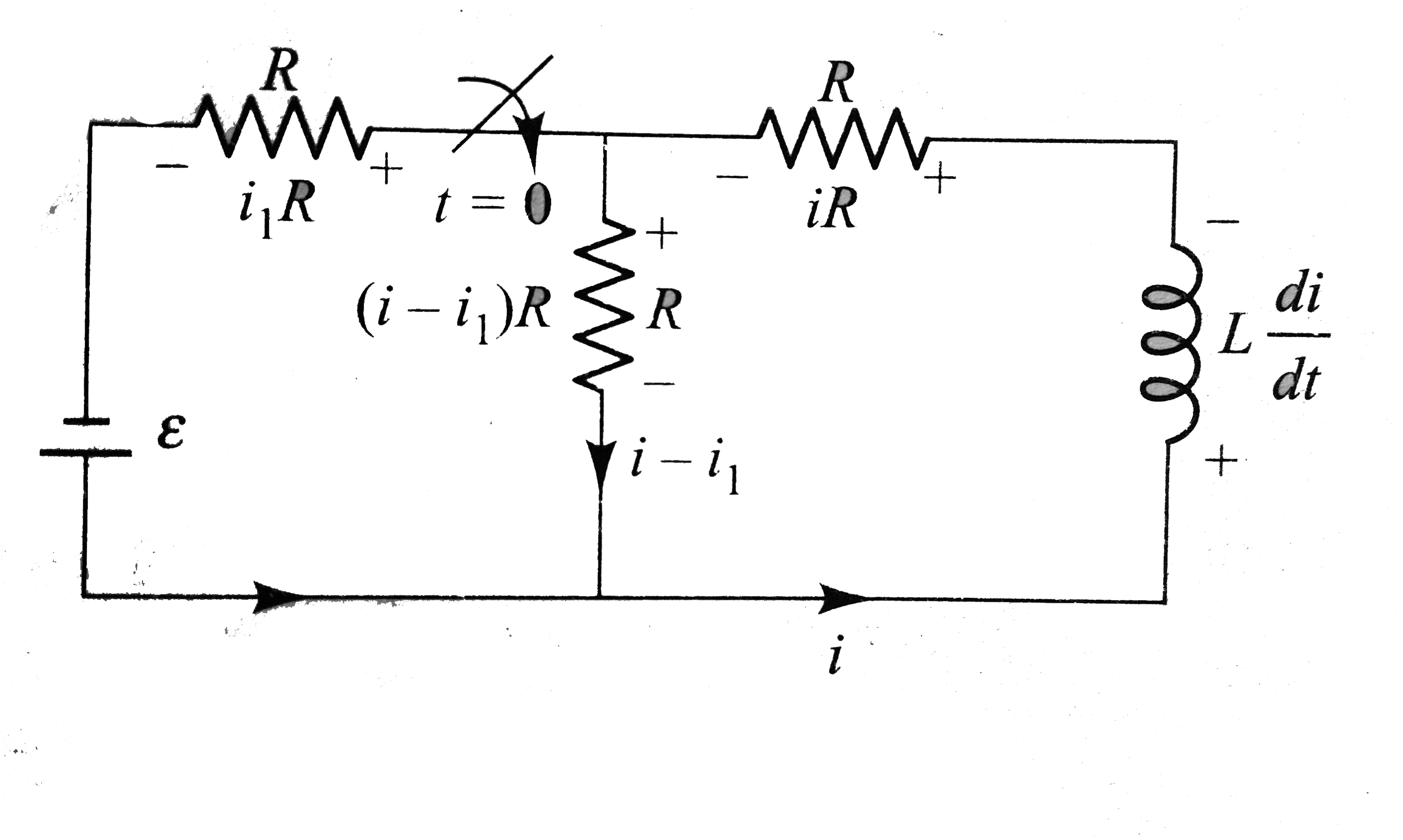 Now `- epsilon + i_(1)R + iR + L(DI)/(dt) = 0` `- epsilon+ ((iR + epsilon)/(2)) + iR + L(di)/(dt) = 0` `(epsilon)/(2) + (3iR)/(2) = - L(di)/(dt)` `((epsilon + 3iR)/(2)) dt = - L di rArr - int_(0)^(t) (dt)/(2L) = int_(0)^(i) (di)/(-epsilon + 3iR)` `(t)/(2L) = (1)/(3R)` In `((- varepsilon + 3iR)/(-varepsilon)) rArr -In ((- varepsilon + 3iR)/(-varepsilon)) = (3Rt)/(2L)` `i = + (varepsilon)/(3R) (1 - e^(-(3Rt)/(2L)))` |
|
| 29. |
The electrical series circuit in digital form is |
|
Answer» AND |
|
| 30. |
In the circuit shown in Fig, the enf of eachbattery is E = 12 votl and the capacitances are C_(1) = 2.0 mu F andC_(2) = 3.0 mu F. Find the charges which flow along the paths 1,2,3 when K is pressed. |
|
Answer» |
|
| 31. |
The balanced position of meter bridge is …… interchangeing the positions of battery and galvanometer |
|
Answer» |
|
| 32. |
A particle of mass m strikes a stationary nucleus of mass M and activated an endoergic reaction. Demonstrate that the threshold (minimal) kinetic energy required to initiate this reaction is defined by Eq.(6.6d). |
|
Answer» SOLUTION :Energy required is minimum when the reaction products all move in the direction of the incident particle with the same velocity (so that the combination is at rest in the centre of mass FRAME.) We then have `sqrt(2mT_(th))= (m+M)v` (Total mass is constant in the nonrelativistic limit). `T_(th)-|Q|=(1)/(2)(m+M)v^(2)=(mT_(th))/(m+M)` or `T_(th)(M)/(m+M)=|Q|` Hence `T_(th)=(1+(m)/(M))|Q|` |
|
| 33. |
A horizontal straight wire 10 m long extending from east to west is falling with a speed of 5.0 m s^(-1), at right angles to the horizontal component of the earth’s magnetic field, 0.30 x× 10^(-4) Wb m^(-2) . (a) What is the instantaneous value of the emf induced in the wire? (b) What is the direction of the emf? (c) Which end of the wire is at the higher electrical potential? |
| Answer» SOLUTION :`1.5 xx 10^(-3)V, (b) ` WEST to EAST , (c) EASTERN end. | |
| 34. |
What is modulation? Write the block diagram of the receiver. |
Answer» Solution :A LOW (audio) FREQUENCY signal varies the high frequency carrier waves, which in turn CARRIES the audio signal into a channel or medium. This process of transmitting an AF signal with the help of a RADIO frequency carrier wave is CALLED modulation.
|
|
| 35. |
The max. No. Of possible interference maxima for slit separation equal to twice the wavelength of YDSE is : |
|
Answer» `INFTY` `d = 2 lambda` `thereforesin theta = n/2` value of sin `theta` VARIES between - 1 and + 1.So equation (i) is true if `n = -1, -2, 0, +1, +2.` `therfore` n has five integer values. |
|
| 36. |
If the number of turns coil be trippled. The value of the magnetic flux linked with it |
|
Answer» BECOMES 1/3 |
|
| 37. |
When a positively charged rod is brought near to electrically neutral good conductor, then that good conductor, |
|
Answer» will BECOME POSITIVELY charged. |
|
| 38. |
The diode used in the circuitshown in the figure has a constant voltage drop at 0.5 V at all currents and a maximumpower rating of 100 milliwatts. What should be the value of the resistor R, connected in series with diode, for obtaining maximum current? |
|
Answer» 6.76 `Omega` So, CURRENT , `I_D=V_D/R_D`=0.2 A TOTAL resistance required in the circuit , `R_(eq)=V/I_D=1.5/0.2=7.5 Omega` `therefore` Resistance of the SERIES resistor , `R=R_(eq)-R_D` = 7.5-2.5 = 5 `Omega` |
|
| 39. |
The dimensional formula of B^2/(2mu_0) is…… |
|
Answer» `M^-1 L^1 T^2` HENCE its DIMENSIONAL formula =`([energy])/([volume])` `=(M^1L^2T^-2)/L^3=M^1L^-1T^-2` |
|
| 40. |
Draw block diagram of Communication System. |
Answer» SOLUTION :BLOCK DIAGRAM of COMMUNICATION SYSTEM. 
|
|
| 41. |
The electronin a givenBohr orbit E_(n) = - 1.54 eV. Calculate (i) its kinetic energy (ii) potential energy and (iii) wavelenghtof light emitted , whenthe electron makes a transition to thegroundstate . Groundstate energyis- 13.6e V |
|
Answer» Solution :(i) As total energy in givenBohr orbit `E_(n) =- 1.5 EV` `THEREFORE ` Kineticenergyof eletron `K_(n) = - E_(n)= + 1.5 eV` (II) The potential energyof electron `U_(n) = 2 E_(n) = - 3.0 eV` (iii) If electron makes a transition from ` - 1.5 eV`state to groundstate having energy ` - 13.6 eV`, theenergy of radiated photon. `E = - 1.5 -(-13.6) eV = 12.1 EC = 12.1 xx 1.60 xx 10^(19)J` As `E =hv = (hv)/(lambda) `, hencewavelenght of lightemitted is equal to `lambda = (HC)/(E) = (6.63xx 10^(-34) xx 3 xx 10^(8))/(12.1 xx 1.60 xx 10^(-19)) = 1.027 xx 10^(-7) m = 102.7` nm. `lambda =(hc)/(E) = (6.63 xx 10^(-34) xx 3 xx 10^(8))/(12.1 xx 1.60xx 10^(-19)) = 1.027 xx 10^(-7) m = 102.7 nm` |
|
| 42. |
Find out equivalent capacitance between A and B |
|
Answer» Solution :` C=(Ain _0)/( d) ` ` (##MOT_CON_JEE_PHY_C25_SLV_030_S01.png" width="80%"> ` (1)/(C_(EQ) ) =(1)/(c) +(2)/(3C) =(5)/( 3C) ` ` rArr "" C_(eq) =(3C)/( 5) =(3Ain _0)/( 5d) ` Alternative method : ` C=(Q)/( V) = (X+y)/(V_(AB) ) ` ` C= (Q)/(V)= (x+y)/( V_( AB) ) ` ` (##MOT_CON_JEE_PHY_C25_SLV_030_S02.png" width="80%"> Potential of 1 and 4 is same ` (y)/( Ain _0) =( 2X)/( A in _0) "" y =2x` ` V= ((2Y +x)/( Ain _0)) d ` `C= ( (x+ 2x )A in _0)/( (5x )d) =( 3A in _0) /( 5d) ` |
|
| 43. |
A point object is placed in front of two plane mirrors as shown in figure Total number of images formed, if OA = b, OB = a, theta = 90^@ |
|
Answer» 3 |
|
| 44. |
When a plasticcomb is passed through dry hair, the chargeacquiredby the comb is |
|
Answer» ALWAYS negative |
|
| 45. |
A sphere of radius R has a volume density of charge rho=kr, were r is the distance from the centre of the sphere and k is constant . The magnitude of the electric field which exists at the surface of the sphere is given by (epsilon_(0)= permittivity of free space) |
|
Answer» `(4pikR^(4))/(3epsilon_(0))` 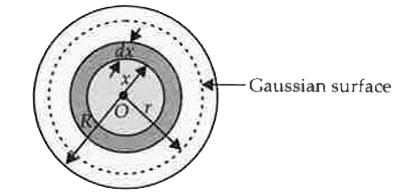 Volume of the shell , `dV=4pix^(2)dx` LET us draw a GAUSSIAN SURFACE od radius `r(rltR)`as shown in the figure above. Total charge enclosed by the Gaussian surface is `Q_("in")=int_(0)^(r)rhodV=int_(0)(r)kx4pix^(2)dx=4pikint_(0)^(r)x^(3)dx` `=4pik[(x^(4))/(4)]_(0)^(r)=pikr^(4)` According to Gaussa.s law `E4pir^(2)=(Q_("in"))/(epsilon_(0))orE4pir^(2)=(pikr^(4))/(epsilon_(0))` At the surface of the sphere , r=R `thereforeE=(kR^(2))/(4piepsilon_(0))` |
|
| 46. |
A convex lens of focal length 40 cm is in contact with a concave lens of focal length 25 cm. The power of the combination is .......... |
|
Answer» `-6.5` D `P_1=(-1)/(f_1)=-(1)/(0.25)=-4D` The power for the concave lens of focal length `f_2` = 40 cm `P_2=(1)/(f_2)=(1)/(0.40)=2.5D` Note : The focal length of concave lens is negative. `therefore` The power of the combination of TWO lens, `P=P_1+P_2=-4.0+2.5=-1.5D` |
|
| 47. |
A plano - convex lens acts like a concave mirror of 28 cm focal length when its plane surface is silvered and like a concave mirror of 10 cm focal length its curved surface is silvered. The refractive index of the material of the lens is : |
|
Answer» 1.55 `(1)/(28)=(2)/(f_(1))+(1)/(f_(m))=(2)/(f_(1))"" ...(1)` `Case II : (1)/(10)=(2)/(f_(1))=(2)/(f_(m)) "" ...(2)` where `f_(m)` = FOCAL length of curved SILVERED hence `f_(m) = (R)/(2)` where R = radius of curvature of curved surface. (By subtracting eqns. (1) from (2) `(1)/(f_(m)) = (1)/(10) - (1)/(28) RARR f_(m) = (140)/(9) cm`. |
|
| 48. |
What are the units of the following physical quantities? i) magnetic moment ii) magnetic permeability |
|
Answer» Solution :i) The unit of MAGNETIC MOMENT is `Am^(2)` ii) The unit of magnetic permeability is `Hm^(-1)` or `NA^(-2)` |
|
| 49. |
An electron experiences a quasi-elastic force kx and a ''friction force'' yx in the field of electromagnetic radiation. The Ecomponent of the field varies as E = E_(0) cos omegat. Neglecting the action of the magnetic component of the field, find, (a) the motion equation of the electron, (b) the mean power absored by the electron, the frequency at which that power is maximum and the expression for the maximum mean power. |
|
Answer» Solution :The equation of the electron can (under the stated conditions) be written as `mddot(x) + gamma dot(x) + KX = eE_(0) cos OMEGA t` To SOLVE this equation we shell find it convenient to use complex displacements. Consider the equation `mddot(z) + gamma dot(z) + kz = eE_(0) e^(-i omegat)` `z = (eE_(0)e^(-i omegat))/(-m omega^(2) - i gamma omega + k)` (we igone transients) Writing `beta = (gamma)/(2m), omega_(0)^(2) = (k)/(m)` we find `z = (eE_(0))/(m)e^(-i omegat)// (omega_(0)^(2) - omega^(2) - 2i beta omega)` Now `x =`1 REAL part of `z` `= (eE_(0))/(m). (cos (omegat + varphi))/(sqrt((omega_(0)^(2) - omega^(2))^(2) + 4beta^(2) omega^(2))) = a cos (omega t + varphi)` where `tan varphi = (2 beta omega)/(omega^(2) - omega_(0)^(2))` `(sin varphi =- (2 beta omega)/(sqrt((omega_(0)^(2) - omega_(0)^(2))^(2) + 4beta^(2) omega^(2))))` (b) We calculate the power absorded as `P = lt Edot(x) gt = lt eE_(0)cos omegat (-omega a sin (omegat + varphi)) gt` `=eE_(0).(eE_(0))/(m)(1)/(2). (2 beta omega)/((omega_(0)^(2) - omega^(2))^(2) + 4beta^(2) omega^(2)).omega = ((eE_(0))/(m))^(2) (beta m omega^(2))/((omega_(0)^(2) - omega^(2))^(2) + 4beta^(2) omega^(2))` This is clearly maximum when `omega_(0) = omega` because `P` can be written as `P = ((eE_(0))/(m))^(2) (beta omega)/((omega_(0)^(2)/ omega^(2)-omega)^(2) + 4beta^(2))` and `P_(max) = (m)/(4 beta) ((eE_(0))/(m))^(2)` for `omega = omega_(0)`. `P` can also be calculated from `P = lt gamma dot(x). dot(x) gt` `= (gamma omega^(2) a^(2)//2) = (beta m omega^(2) (eE_(0)//m)^(2))/((omega_(0)^(2) - omega^(2))^(2) + 4beta^(2)omega^(2))`. |
|
| 50. |
At t = 0 activity of radioactive substance is 1600 Bq and at t = 8 sec activity remains 100 Bq. The activity at t = 2 sec is : |
| Answer» ANSWER :D | |