

Saved Bookmarks
This section includes 7 InterviewSolutions, each offering curated multiple-choice questions to sharpen your Current Affairs knowledge and support exam preparation. Choose a topic below to get started.
| 1. |
An object is kept in front of a concave mirror of focal length 20 cm. The image formed is three times the size of the object. Calculate the possible distance of the object from the mirror for a real imageb. virtual image |
|
Answer» |
|
| 2. |
Three large plates are arranged as shown. How much charge will flow through the key k if it is closed? |
|
Answer» `5Q//6` 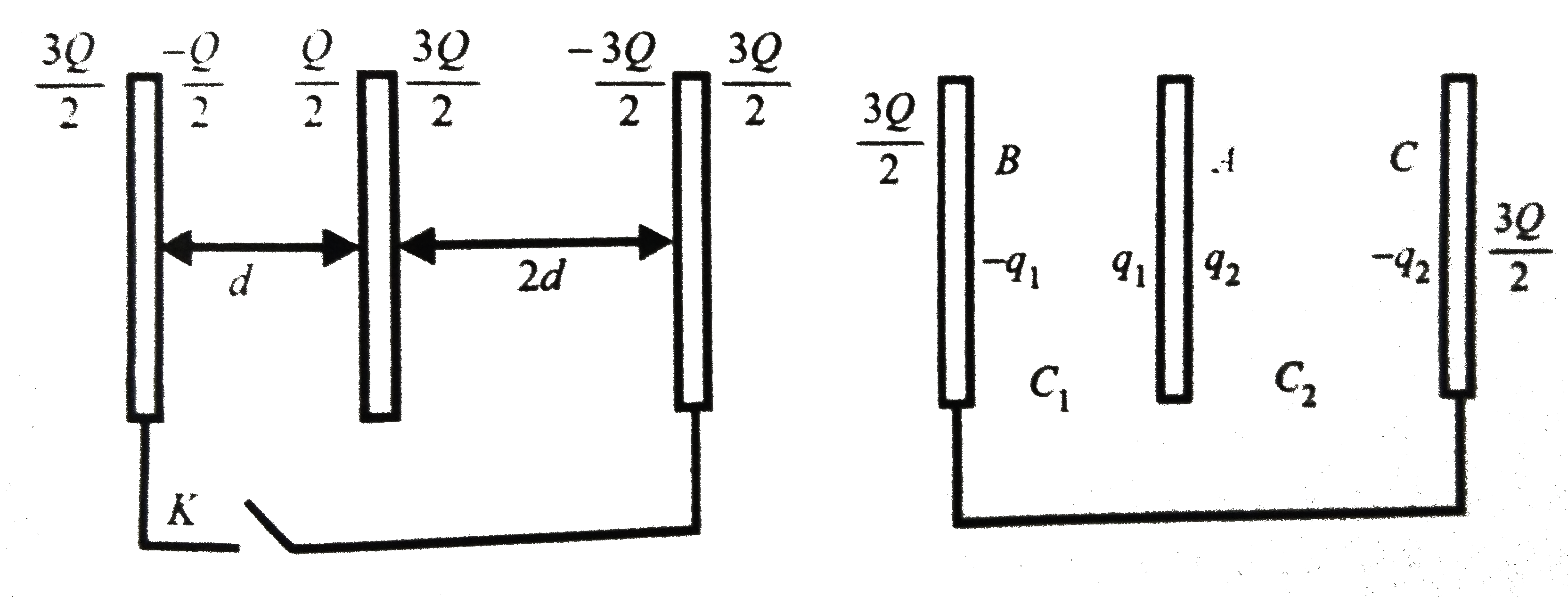 `q_(1)+q_(2)=2Q` `V_(AB)=V_(AC)` or `(Q_(1))/(C_(1))=(q_(2))/(C_(2))` `(q_(1))/(q_(2))=(C_(1))/(C_(2))=2` or `q_(1)=2q_(2)` SOLVING, we get `q_(1)=(4Q)/(3), q_(2)=(2Q)/(3)` Charge flown through `K` is `-(Q)/(2)-(-q_(1))- -(Q)/(2)+(4Q)/(3)=5Q//6` |
|
| 3. |
Yellow light (lambda=6000Å) illuminates a single slit of width 1xx10^(-4)m. Calculate : (i) the distance between the two dark lines on either side of the central maximum, when the diffraction pattern is viewed on a screen kept 1.5m away from the slit, (ii) the angular spread of the first diffraction minimum. |
|
Answer» Solution :(i) Here, `lambad=6000Å=6xx10^(-7)m` `a=1xx10^(-4)m`, `D=1.5m` ANGULAR SEPARATION of two dark bands on each side of CENTRAL bright band, `2theta=(2lambda)/(a)` and ACTUAL distance between them, `2x=(2lambda)/(a)xxD` `=(2xx6xx10^(-7)xx1.5)/(1xx10^(-4))` `=1.8xx10^(-2)m` `(ii)` For first minimum, `(sintheta~~theta)` `theta=(lambda)/(a)=(6xx10^(-7))/(1xx10^(-4))` `=6xx10^(-3)` rad. |
|
| 4. |
Which of the following is/are a valid configuration for an electric field? |
|
Answer»
|
|
| 5. |
For a circular cardboard of uniform thickness and mass M, a square disc of the maximum possible are is cut. If the moment of inertia of the square with the moment of inertial of the square with the axis of rotation at the centre and perpendicular to the plane of the disc is (Ma^2)/6, the radius of the circular cardboard is |
|
Answer» `SQRT(2)a` |
|
| 6. |
Maxwell's equations describe the fundamental laws of |
|
Answer» ELECTRICITY only - |
|
| 7. |
Who was Yayati? |
|
Answer» ANCESTORS of the Pandavas |
|
| 8. |
(A) : Ampere's circuital law is of the BiotSavart law. (R) : Ampere's law is valid for straight conductors |
|
Answer» Both 'A' and 'R' are true and 'R' is the CORRECT EXPLANATION of 'A'. |
|
| 9. |
A concave lens made of a material of refractiven index n_(g) is immersed in a transparent medium of refractiven index n_(w) which is equal to n_(g). The nature of the lens remains unchanged. |
| Answer» SOLUTION :If `n_(g)=n_(w)` then the given concave lens will have as a plane glass plate having no POWER. | |
| 10. |
Which of the following radiations has the least wave- lengths ? |
|
Answer» `GAMMA`-RAYS As `E=(HC)/(lambda) implies E prop (1)/(lambda)` So `gamma`-rays have MIN. WAVELENGTH. |
|
| 11. |
Show that the force on each plate of a parallel plate capacitor has a magnitude equal to 1/2 QE, where Q is the charge on the capacitor, and E is the magnitude of electric field between the plates. Explain the origin of the factor 1/2. |
|
Answer» Solution :Consider a parallel plate capacitor with one plate having + Q charge and the other having - Q charge. Let F be the force between them. If the plates be displaced by a SMALL distance dl, the work done dW = Fdl. This work results in the change in ELECTROSTATIC POTENTIAL energy of the capacitor. `:.` Energy density of capacitor `U = 1/2 epsi_0 E^2` and charge in volume= A.dl `:.` Change in potential energy `du = 1/2 epsi_0 E^2. Adl` Thus, we have `Fdl = 1/2 epsi_0 E^2 Adl` `rArrF = 1/2 epsi_0 E^2 A = 1/2 epsi_0 E.A.E = 1/2 (epsi_0 (sigma)/(epsi_0)A) E = 1/2(sigmaA)E = 1/2 QE` The physical origin of the factor `1/2 ` in the above formula for force lies in the FACT that just between the plates of capacitor electric field is E but just outside E = 0. Hence, average value `E/2` contributes to the force. 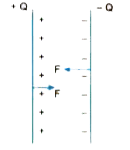
|
|
| 12. |
An air bubble contained inside water. It behaves as |
|
Answer» CONCAVE lens |
|
| 13. |
Ratio of frequencies of the long wavelength limits of the Balmer and Lyman series in hydrogen spectrum is |
|
Answer» `27:5` |
|
| 14. |
A galvanometer F having 50 divisions has a current sensitivity of 1 m A/ division. Its resistance is 30 ohm . How will you convert it in to a. an ammeter of range 10 A b. a voltmeter of range 10 V |
|
Answer» Solution :a. `0.15 omega` in PARALLEL with G. b. `170 omega` in series with G] |
|
| 15. |
(a) How is a toroid different from a solenoid ? (b) Use Ampere's circuital law to obtain the magnetic field inside a toroid. (c) Show that in an ideal toroid. The magnetic field (i) inside the toroid and (ii) outside the toroidat any point in the open space is zero. |
|
Answer» Solution :(a) A toroid can be viewed as a solenoid which has been bent into a circuit shape to close on itself. (b)   For the magnetic FIELD at a point S inside a toroid we have `B( 2 PI r) = mu_(0) N I` `B= mu_(0) (N I)/(2 pi r)= mu_(0)n I` ( `n=` no. of turns per unit length of solenoid ) (c) For the loop I, Ampere.s circuital law gives `B_(1).2pi r_(1) = mu_(0)(0)` i.e., `B_(1)=0` Thus the magnetic field, in the open space inside the toroid is zero. ALSO at point Q, we have `B_(3) ( 2 pi r_(3)) = mu_(0) ( I_("enclosed"))` Butfrom THESECTION cut, we see that the current coming out of the plane of the paper, is cancelled exactly by the current going into it. Hence, `I_("enclosed")=0` `:. B_(3)=0` |
|
| 16. |
A wire carrying a current i is first bent in the form of a square of side e and placed at right angle to a uniform magnetic field of induction B. The work done in changing its shape' into a circle is |
|
Answer» `IA^(2)B(pi+2)` |
|
| 17. |
Assertion : When hot water is poured in a beaker of thick glass, the beaker cracks. Reason : Outer surface of the beaker expands suddenly. |
|
Answer» If both assertion and reason are true and reason is the correct explanation of assertion |
|
| 18. |
A conductingcurrent-carryingplaneis placedin an externalunifrom magneticfield. Asa result, themagneticinduction becomes equal to B_(1) on oneof the plane and too B_(2) on the other. Find the magnetic force actingper unit area ofteh plane in hte cases illiustrated in FIg. Determinethe directionof the current in the plane in each case. |
|
Answer» Solution :(a) The externalfield MUST be`(B_(1) + B_(2))/(2)` , whichwhensuperposedwith the internal FIELD `(B_(1) - B_(2))/(2)` (of opposite sign on the two sides of the plates) must giveactual field. Now `(B_(1) - B_(2))/(2) = (1)/(2) mu_(0) i` or, `i = (B_(1) - B_(2))/(mu_(0))` Thus, `F = (B_(1)^(2) -B_(2)^(2))/(2 mu_(0))`  (b) Here, the EXTERNAL field must be `(B_(1) - B_(2))/(2)` upward with an internal field, `(B_(1) + B_(2))/(2)`, upward on the left and downward on the RIGHT. Thus, `i = (B_(1) + B_(2))/(mu_(0))` and `F = (B_(1)^(2) - B_(2)^(2))/(2 mu_(0))`  (c) Our boundary condition following from Gauss's law is `B_(1) cos theta_(1)= B_(2) cos theta_(2)`. Also , `(B_(1) sin theta_(1) + B_(2) sin theta_(2)) = mu_(0) i` where `i` = current per unit length The externalfied parallelto the platemust be`(B_(1) sin theta_(1) - B_(2) theta_(2))/(2)` (The perpendicularcomponent`B_(1) cos theta_(1)`, does not matter SINCE the correspondingforce is tangetial) Thus, `F = (B_(1)^(2) sin^(2) theta_(1) - B_(2)^(2) sin^(2) theta_(2))/(2mu_(0))` per unit area `(B_(1)^(2) - B_(2)^(2))/(2 mu_(0))` per unit area. The direction of the current in the planeconductoris perpendicular to the paperand beyondthe drawing . 
|
|
| 19. |
If the width of the slit S in Young.s double slit experiment is gradually increased |
|
Answer» Bright fringes becomebrighter and darkfringes become darker |
|
| 20. |
In a Young's experiment, let light of lambda = 5.48 xx 10^(-7) m and 6.85 xx 10^(-8) m be used in turn keeping D and d constant. Compare the fringe widths in the two cases : |
|
Answer» SOLUTION :Fringe Width `beta = (D lambda)/(d)` `therefore (beta_(1))/(beta_(2)) = (lambda_())/(lambda_(2)) = (5.48 xx 10^(-7))/(6.85 xx 10^(-8))` or `(beta_(1))/(beta_(2) = 8/1` i.e.`beta_(1) : beta_(2) = 8 : 1` |
|
| 21. |
A converging lens is kept coaxially in contact with a diverging lens, both the lenses being of equal focal lengths. What is the focal length of the combination? |
|
Answer» SOLUTION :`(1)/( f) = ( 1)/( f_(1)) + ( 1)/( f_(2))` `= ( 1)/( f_(1)) + ( 1)/( -f_(2)) ``( :. f_(1) = - f_(2))` `RARR f = OO` |
|
| 22. |
Match the following: |
|
Answer» II I V III (B) Rli(V) used in INITIATION of anionic POLYMERISATION. ( C) `SnCl_2` (I) used for cationic polymerisation. (D) Bakelite (III) is thermosetting polymer, HENCE option (c ) is correct. |
|
| 23. |
A triangular of rigid wire frame 'AOB' is made, in which length of each wire is l and mass m. The whole system is suspended from point O and free to perform SHM about x-axis or about z-axis. When it performs SHM aboutx-axis its time period of oscillation is T_(1) and when it performs SHM about z-axis, its time-period of osciallation is T_(2), then choose the correct option. |
|
Answer» `T_(1) lt T_(2)` CASE I : System is performing SHM about `x-`AXIS `I_(X)=I_(AB)+I_(AO)+I_(BO)=(3ML^(2))/(4)+[(ml^(2))/(3)sin^(2)60^(@)]xx2=(5ml^(2))/(4)` `T_(1)=2pisqrt((I_(x))/(M_(sys)gd))=2pisqrt(((5ml^(2))/(4)xxsqrt(3))/(3mxxgxxl))=2pisqrt((5sqrt(3)l)/(12g))` Case II : System is performing SHM about `z-` axis `I_(z)=I_(AB)+I_(AO)+I_(BO)=[(ml^(2))/(12)+m((sqrt(3)l)/(2))^(2)]+(ml^(2))/(3)+(ml^(2))/(3)=ml^(2)[(1)/(12)+(3)/(4)+(2)/(3)]` `=ml^(2)[(1+9+8)/(12)]=(3ml^(2))/(2)` `T_(2)=2pisqrt((I_(z))/(M_(sys)gd))=2pisqrt((3ml^(2)xxsqrt(3))/(2xx3mxxgxxl))=2pisqrt((sqrt(3)l)/(2g))` |
|
| 24. |
A bar magnet has a magnetic moment 2.5 JT^(-1)and is placed in a magnetic field of 0.2 T workdone in turningthe magnet from parallel to antiparallel positionrelative to the fielddirection is |
| Answer» ANSWER :B | |
| 25. |
A vector 3hati+4hatj rotates about its tail through an angle 37^(@) in anticlockwise direction then the new vector is |
|
Answer» `-2hati+4hatj` |
|
| 26. |
Explain briefly how the focal length of would remain same. a convex lens changes with increase in wavelength of incident light. |
|
Answer» SOLUTION :The REFRACTIVE INDEX of the material of a lens DECREASES with increase in wavelength of incident LIGHT. Since focal length of a lens is given by. ` 1/f = (mu - 1) ((1)/(R_1)- (1)/(R_2) )` it follows that focal length of the lens will increases with increase in wavelength of incident light. |
|
| 27. |
In a Van de Graaff type generator, a spherical metal shell is to be a 15 xx 10^6V electrode. The dielectric strength of the gas surrounding the electrode is 5 xx 10^7 Vm^(-1). What is the minimum radius of the spherical shell required? (You will learn from this exercise why one cannot build an electrostatic generator using a very small shell which requires a small charge to acquire a high potential.) |
|
Answer» SOLUTION :`V=15 xx 10^(6)V, E=5 xx 10^(7) Vm^(-1) ""R=?, E=V/r` `r=V/E=(15 xx 10^(6))/(5 xx 10^(7))=0.3m` |
|
| 28. |
An electric diple is put in north-south direction in a sphere filled with water. Which statement is correct: |
|
Answer» electric FLUX is coming TOWARDS sphere |
|
| 29. |
Derive a relation for electric field of an electric dipole at a point on its equitorial line. |
|
Answer» <P> Solution :Consider an ELECTRIC dipole having two charges -q and +q lying at A and B at a distance 2l. Let us determine electric field intensity at point P on the equitorial line at a distance r from the centre O of the dipole. Electric field intensity `E_(+)` DUE to charge +q and `E_(-)` due to charge -q at P are given by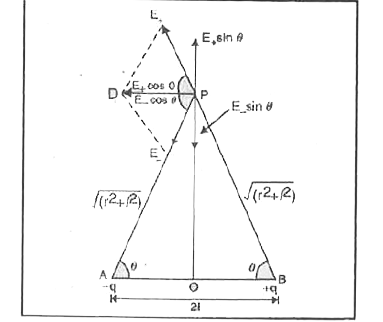 `E_(+)=K(q)/((r^(2)+l^(2)))""[K=(1)/(4piepsi_(0))]` `E_(-)=K(a)/((r^(2)+l^(2)))` Resolving `E_(+) and E_(-)` into rectangular components, we have `E_(+)COSTHETA+E_(-)costheta` along PD. `E_(+) sintheta and E_(-) sin theta` being equal and opposite mutually cancel each other. `therefore`Net electric field at P is given by `E_(eq)=E_(+)costheta+E_(-)costheta` `=2Ecostheta""[becauseE_(+)=E_(-)=E(say)]` `=2(Kq)/(r^(2)+l^(2))*(l)/((r^(2)+l^(2))^(1//2))` `[becauseIn" rt "ltd DeltaAOP,costheta=(l)/(AP)=(1)/((r^(2)+l^(2))^(1//2))]` `=K((q2l))/((r^(2)+l^(2))^(3//2))` or `E_(eq)=K(p)/((r^(2)+l^(2))^(3//2))` `=(1)/(4piepsi_(0))(p)/((r^(2)+l^(2))^(3//2))""[becausep=q2l]` |
|
| 30. |
At a neutral point |
|
Answer» field of magnet is zero `tan theta=(V)/(H)` …..(1) where, V and H are verttical and HORIZONTAL compnents of earth's magnetic field, repectively . Given,`H=(1)/(sqrt3)V Rightarrow (V)/(H)=sqrt3 ..........(II)` |
|
| 31. |
A copper rod of length 2m is rotated with a speed of 10 rps in a uniform magnetic field of 1 tesla about a pivot at one end. The magnetic field is perpendicular to the plane of rotation. Find the emf induced across its ends. |
|
Answer» SOLUTION :`e= (1)/(2) B omega 1^(2) = (1)/(2) B (2PI n) 1^(2)= pi B nl^(2)` `e= 3.14 xx 1 xx 10 xx 2 xx 2 = 125.6` volt |
|
| 32. |
In an oscillating LC circuit with L = 79 mH and C = 4.0 muF, the current is initially a maximum. How long will it take before the capacitor is fully charged for (a) the first time and (b) the second time? |
|
Answer» |
|
| 33. |
A point charge +Q is placed at point B at a distance 2R from the center O of an uncharged thin conducting shell of radius R as shown in figure. If VA be the potential at point A, which is at a radial distance of R//2 from the center of the shell, then |
|
Answer» `V_AgtQ/(8piepsilon_0R)` `V_(0)=V_(A)` and `V_(0)=(Q)/(8piepsilon_(0)R)` `THEREFORE V_(A)=(Q)/(8piepsilon_(0)R)` 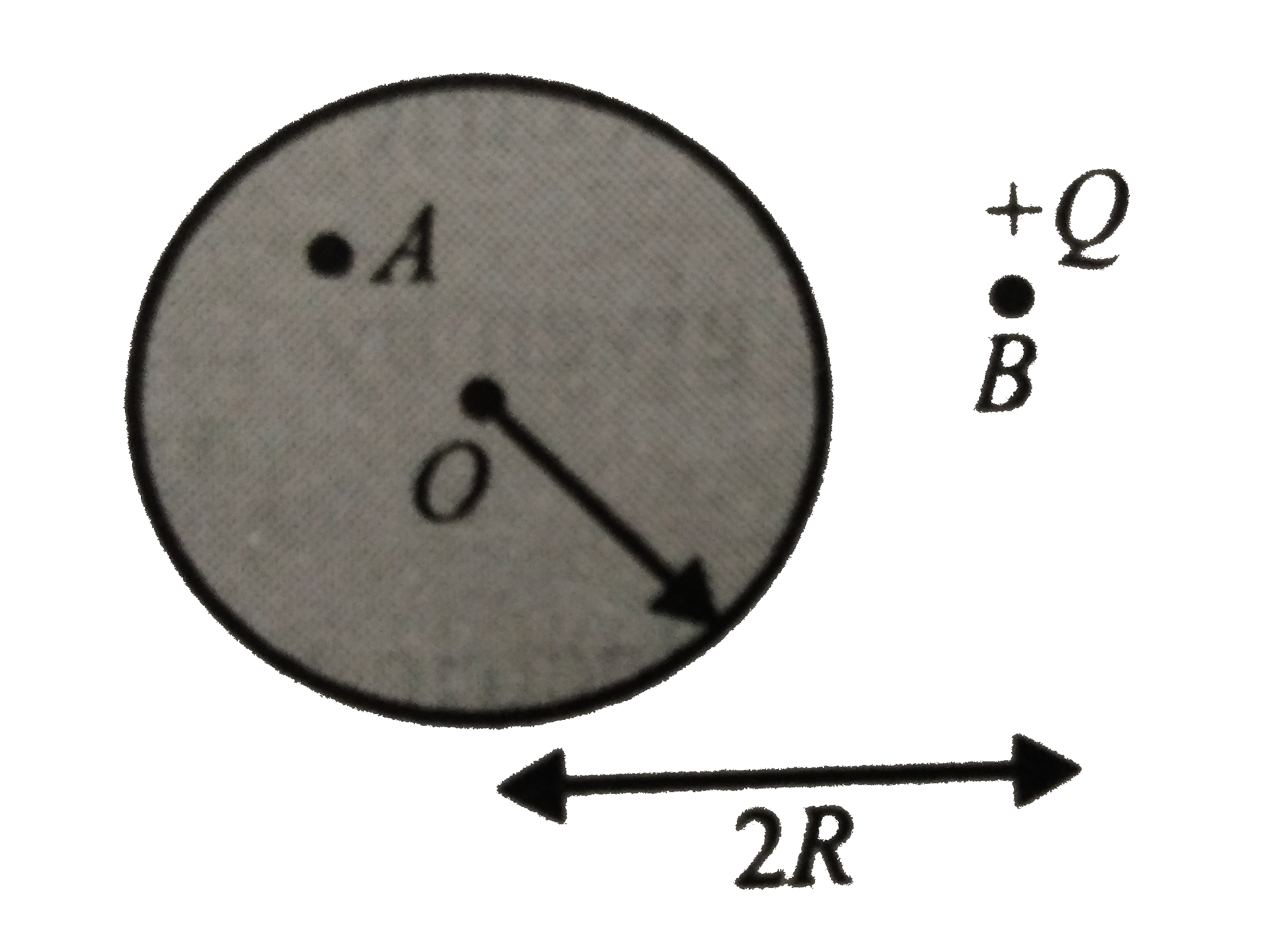
|
|
| 34. |
If E_0 represents the peak value of the voltage in an a.c. circuit, the rms value of the voltage will be ...... |
|
Answer» `E_0/pi` |
|
| 35. |
Is the measurement of an angle dependent upon the unit of length? |
| Answer» Solution :No, SINCE ANGLE=arc/radius which are both lengths. Therefore, angle does not depend upon the UNIT of LENGTH. | |
| 36. |
The wavelength of light observed on the earth , from a moving star is found to decrease by 0.05%.Relative to the earth the star is : |
|
Answer» Moving away with a velocity of `1.5 xx 10^(5) m/s` (Since wavelength is decreasing, so star is coming closer) |
|
| 37. |
Z,A and M represent the atomic number, mass number and rest mass of a nucleus. a. Show that 'M' is always less than the mass of the constituent particles. b. What is this mass difference called ? c. Give the relation. |
|
Answer» Solution :a. Protons and neutrons come TOGETHER WITHIN a very SMALL space of the order of `10^(-14)m` to form a nucleus. The energy required to do so is PROVIDED by nucleus at the expense to their masses. Hence the reason. e.g. For `""_5B^(10)`, the mass , `M = 10.012944` `""_(5)B^(10)` consists of 5 protons and 5 neutrons. Hence total mass = `m_P + m_N` `= 5 xx "Proton mass " + 5 xx "Neutron mass"` `= 5 xx 1.007825 + 5 xx 1.008665` `= 5.039125 + 5.043325 = 10.08245 u`. i.e., `M < (m_P + m_N)`, hence the reason. b. This mass difference is called mass defect (`DELTA m)` c. `Deltam = Zm_P + (A - Z) m_N - M`. |
|
| 38. |
In the figure shown, two identical blocks A and B of mass m=1//2 kg each are placed on the two opposite edges of a table. A light spring of stiffness k=pi^(2) N//m and having natural length equal to the separation between the blocks, is placed between the blocks. Neither block is attached to the spring. The blocks are displaced towards each other by equal distance x=2cm and then released at time t=0. Calculate the magnitude of the net impulse (in SI unit) on the system of the blocks and spring from t=0 to t=1.05 s. Ignore any friction, and take g=10m//s^(2) and assume that the blocks do not reach the ground below the table, before 1.05 second. |
|
Answer» `8 N-S` |
|
| 39. |
If a bar magnet of magnetic moment 'm' is freely suspended in a uniform magnetic field B, the work done in rotating the magnet through an angle thete is |
|
Answer» `mB(1- sin THETA)` As here `theta_1 = 0^@ and theta_2 = theta` , HENCE W = `mB[cos 0^@ - cos theta] = mB(1-cos theta)` |
|
| 40. |
The angle of incidence at which reflected light is totally polarized for a ray travelling from air to glass (refractive index n), is |
|
Answer» `TAN^(-1)""(1/N)` |
|
| 41. |
A beam of light consisting of two wavelengths, 6500 Å and 5200Å , is used, to obtain, interference fringes in a Young’s double slit experiment Q(a) Find the distance of the third bright fringe on the screen from the central maximum for wavelength 6500 Å .) What is the least distance form the central maximum where the bright fringes due to bothwavelengths coincide? The distance between the slits is 2 mm and the distance between the plane of slits and p the screen is 120 cm. |
|
Answer» |
|
| 42. |
A coil has an inductance 0.05 H and 100 turns. Calculate the flux linked with it when 0.02A current is passed through it. |
|
Answer» 10 Wb |
|
| 43. |
Find the de Broglie wavelength associated with an electron accelerated through a p.d of 100 volts. |
|
Answer» SOLUTION :ACCELERATING POTENTIAL V = 100 V The deBroglie wavelength ` lambda = h/p = (1.227)/sqrtV nm` ` lambda= (1.227)/sqrt100 nm = 0.123nm` |
|
| 44. |
Consider 3rd orbit of Het (Helium), using non-relativistic approach, the speed of electron in this orbit will be given k = 9 xx 10^(9) constant, Z = 2 and h(Planck's Constant) = 6.6xx10^(-34)JK) |
|
Answer» `2.92xx10^(6)m//s` `v=(Z)/(N)xx2.188xx10^(6)` `:.v=(2)/(3)xx2.188xx10^(6)` `:.v=1.45866xx10^(6)` `:.v=1.46xx10^(6)m//s` |
|
| 45. |
An audio signal V_(m)=15 sin omega_(1),t is modulated on a CW of V_(c) sin omega_(2)t. The percentage modulation is |
| Answer» ANSWER :C | |
| 46. |
A particle of mass m kg and charge q coulomb is accelerated through V volt then the de-Broglie wavelength associated with it,in meter is lambda=…..m. |
|
Answer» <P>`lambda=(h)/(mv)` `(p^(2))/(2M)=qVimpliesp=sqrt(2Vqm)`……..(2) PUTTING vallue of EQUATION (2) in equation (1), `therefore lambda=(h)/(sqrt(2Vqm))` |
|
| 47. |
Light is incident at an angle i on a glass slab . If the reflected ray is completely polarised, then the angle of refraction is : |
| Answer» Answer :D | |
| 48. |
Two identical small balls each have a mass m and charge q. When placed in a hemispherical bowl of radius R with frictionless, nonconductive walls, the bead move, and at equilibrium the line joining the balls is horizontal and the distance between them is R (see figure). Neglect any induced charge on the hemispherical bowl. Then the charge on each bead is : (here K=(1)/(4piepsilon_(0))) |
|
Answer» `Q=R((mg)/(Ksqrt(3)))^(1//2)` |
|
| 49. |
In AC generator, induced emf is zero at time t = 0. The induced emf at time pi/(2omega) is ____ |
|
Answer» `+V_m` `therefore V=V_m sin (omegaxxpi/(2omega)) [ because t=pi/(2omega)]` `therefore V=V_m sin (pi/2)` `therefore V=+V_m [ because "sin" pi/2=1]` |
|


